• 검색 결과가 없습니다.

Journal of Korean Biological Nursing Science

N/A
N/A
Protected

Academic year: 2021

Share "Journal of Korean Biological Nursing Science"

Copied!
12
0
0

로드 중.... (전체 텍스트 보기)

전체 글

(1)

서  론

1. 연구의 필요성

옥살리플라틴 (oxaliplatin)은 전이성 대장암에서 고식적 치료뿐

만 아니라 수술 후 보조 항암요법으로 사용되고 있어 대장암의 표 준치료로 알려져 있다. 그러나 옥살리플라틴의 사용은 급성 또는 만성으로 나타나는 말초신경병증(oxaliplatin-induced peripheral neuropathy, OXIPN)의 발현으로 제한되기도 한다. 급성 증상의 경

대장암 환자의 옥살리플라틴(oxaliplatin) 유도 말초신경병증에 대한 약물유전학적 접근: 체계적 문헌고찰

안수정 1 ·최소영 1 ·정혜정 2 ·추상희 3

1

연세대학교 대학원,

2

세브란스병원,

3

연세대학교 간호대학·김모임간호학연구소

Current Pharmacogenetic Approach for Oxaliplatin-induced Peripheral Neuropathy among Patients with Colorectal Cancer: A Systematic Review

Ahn, Soojung 1 · Choi, Soyoung 1 · Jung, Hye Jeong 2 · Chu, Sang Hui 3

1

The Graduate School of Yonsei University, Seoul;

2

Severance Hospital,Seoul;

3

College of Nursing·Mo-Im Kim Nursing Research Institute, Yonsei University, Seoul, Korea

Purpose: Peripheral neuropathy is common among colorectal cancer (CRC) patients who undergo oxaliplatin-based (OXL) chemo- therapy. A pharmacogenetic approach can be used to identify patients at high-risk of developing severe neuropathy. This type of ap- proach can also help clinicians determine the best treatment option and prevent severe neurotoxicity. The purpose of this study is to investigate the evidence of pharmacogenetic markers for OXL-induced peripheral neuropathy (OXIPN) in patients with CRC. Meth- ods: A systematic literature search was conducted using the following databases up to December 2017: Pubmed, EMBASE, and CI- NAHL. We reviewed the genetic risk factors for OXIPN in observational studies and randomized controlled clinical trials (RCTs). All pro- cesses were performed independently by two reviewers. Results: Sixteen studies published in English between 2006 and 2017 were included in this review. A genome-wide association approach was used in one study and various candidate genes were tested, based on their functions (e.g., DNA damage or repair, ion channels, anti-oxidants, and nerve growth etc.). The genes associated with inci- dence or severity of OXIPN were ABCG2, GSTP1, XRCC1, TAC1, and ERCC1. Conclusion: This study highlighted the need and the im- portance of conducting pharmacogenetic studies to generate evidence of personalized OXIPN symptoms management. Additional studies are warranted to accelerate the tailored interventions used for OXIPN in patients with CRC (NRF-2014R1A1A3054386).

Key Words: Oxaliplatin; Peripheral neuropathy; Pharmacogenetics; Colorectal cancer 국문주요어: 옥살리플라틴, 말초신경병증, 약물유전학, 대장암

Corresponding author: Chu, Sang Hui

College of Nursing, Yonsei University, 50-1 Yonsei-ro, Seodaemun-gu, Seoul 03722, Korea Tel: +82-2-2228-3257 Fax: +82-2-393-5440 E-mail: [email protected]

* 본 연구는 한국연구재단(National Research Foundation of Korea)에서 지원받아 작성된 연구입니다(NRF-2014R1A1A305386).

* The work of this research was supported by grants from National Research Foundation of Korea, 2015 (NRF-2014R1A1A305386).

Received: February 8, 2018 Revised: May 1, 2018 Accepted: May 8, 2018

This is an Open Access article distributed under the terms of the Creative Commons Attribution Non-Commercial License (http://creativecommons.org/licenses/by-nc/4.0) which permits unrestricted non-commercial use, distribution, and reproduction in any medium, provided the original work is properly cited.

www.bionursingjournal.or.kr

https://doi.org/10.7586/jkbns.2018.20.2.55

Journal of Korean Biological Nursing Science 2018;20(2):55-66

(2)

우 항암제가 투여되는 동안 또는 직후 숨이 참(shortness of breath), 턱 경련(jaw spasm), 근육 경련(muscle cramps), 연하곤란(swallowing difficulties) 등의 증상 등이 나타난다[1]. 심한 급성 옥살리플라틴의 독성은 약 22%의 환자에서 치료 중단 또는 지연을 유발하는데 이는 환자의 예후에도 부정적인 영향을 미친다[2]. 만성 OXIPN은 FOLF- OX (oxaliplatin, leucovorin, fluorouracil), XELOX (oxaliplatin, capecitabine)등 옥살리플라틴을 포함하는 항암화학요법 치료를 받 은 환자의 약 60-75%가 경험하는 것으로 나타났으며, 이 중 약 20%는 grade 3 또는 4의 심한 신경독성을 가지는 것으로 알려져 있다[2,3].

만성 신경 독성은 치료 종료 후에도 저림(paresthesia), 감각저하(hyp- esthesia), 이상감각(dysesthesia) 등이 손, 발 중심으로 지속된다[1]. 만 성 OXIPN의 경우, 보행과 건강한 운동 조정을 방해하여 기능적 장 애를 유도하고, 환자의 일상생활 활동수행능력을 제한하고 삶의 질 에 무기한 부정적인 영향을 주게 된다[4]. OXIPN의 주요 위험요소로 는 옥살리플라틴 누적 용량, 투여시간, 항암치료 이전 말초신경병증 유무 등으로 알려져 있으나[5], 이와 같은 임상적 특성은 특히 만성 OXIPN의 개인별 민감성 차이를 설명하는 것에 한계가 있다.

옥살리플라틴 유도 말초신경병증의 발생기전을 살펴보면, 배근 신경절 (dorsal root ganglia, DRG)의 신경세포 자멸이 주요 현상이다.

옥살리플라틴을 포함하는 백금화합물(platinum compounds)은 de- oxyribonucleic acid (DNA) 가닥 안 부가물(intrastrand adducts)과 DNA 가닥 간 교차결합(interstrand crosslinks)을 형성함으로써 DNA의 구조를 변형시키며, 배근신경절의 세포자멸은 산화 스트레 스 또는 미토콘드리아의 기능부전 등에 의해 발생하는 것으로 알려 져 있다. 특히, 만성 OXIPN은 옥살리플라틴의 국소적 축적에 의한 배근신경절 세포의 구조적·기능적 변화에 의한 것이며, 급성 OXIPN은 신경돌기에서 전압개폐성 Na+ 채널의 기능부전에 의한 것으로 알려져 있다[5].

단일 염기 다형성(single nucleotide polymorphisms, SNPs)은 약 90% 이상의 개인 간 유전적 차이를 설명하기 때문에 이 정보를 활 용하는 약리유전학(pharmacogenetics)은 개인의 치료 반응 또는 독 성을 예측하는 강력한 도구로 주목 받고 있다[6]. 특히, 항암화학요 법 시작 전, 유전자형에 따른 OXIPN의 발현 위험성을 예측하는 것 은 일상생활 수행 능력 저하를 유발하는 OXIPN의 장기적인 효과 를 고려할 때 유용하게 적용될 수 있을 것으로 보인다.

항암제 유도 신경독성의 유전적 요인에 대한 관심이 커지면서 최 근 10여년 간 다양한 유전적 요인과 항암제 유도 말초신경병증 발 현의 관계를 확인하고자 하는 연구가 이루어져 왔다[7]. 대부분의 연구는 약물운반체(drug transporters), 해독작용 효소(detoxification enzymes), DNA 손상 복구 기작(excision repair mechanism)에 관여하

는 후보유전자(candidate genes)의 SNPs를 분석하였다[8]. 최근 발표 된 국제적 협력 연구에서는 신경계 관련 기관에 맞춰 암호화되어 있는 유전자의 SNPs 계열을 조사하였는데, 이 연구결과에 따르면 전압개폐성 Na+ 채널과 연관된 sodium channel alpha subunit (SC- N4A, SCN10A)의 유전자형과 OXIPN의 발생과 증상 정도에 연관성 이 있으며[9], 세포 표면의 신호 매개 및 세포 접착에 관여하는 integ- rin beta3 Leu33Pro 역시 OXIPN의 발생과 연관성을 가진다[2]. 그러 나 , 독립적인 신뢰도 높은 연구의 부족 및 반복 연구의 어려움 등으 로 인해 아직까지 특정 유전자형과 OXIPN의 관계가 일관적으로 보고되고 있지 않다[10,11].

따라서 , 본 연구에서는 옥살리플라틴 포함 항암화학요법을 받은 대장암 환자를 대상으로 OXIPN 발현과 유전자형의 관계를 분석 한 문헌을 체계적 문헌고찰 방법을 이용해 분석하여, 옥살리플라 틴 투여 대장암 환자를 대상으로 맞춤 중재 시 OXIPN의 발생 위험 성을 예측하기 위한 전략의 참고자료를 제시하고자 하였다.

2. 연구 목적

본 연구는 옥살리플라틴을 투여받은 대장암 환자를 대상으로 OXIPN과 유전자형의 관계를 분석한 문헌을 체계적인 방법으로 검 색하고 분석해 향후 대장암 환자를 위한 맞춤 치료 계획수립 시 참 고자료를 제시하기 위해 수행되었다.

연구 방법 

1. 연구 설계

본 연구는 OXIPN의 발생과 관련된 유전학적 요인을 확인하기 위 해 수행된 체계적 문헌고찰 연구이다.

2. 연구 대상

본 연구는 OXIPN의 발생에 연관된 유전자를 확인하여 분석한 국내외 연구논문 가운데 연구자의 선정 기준에 의해 최종 확정된 총 25편의 연구논문을 대상으로 하였다.

3. 자료 수집 1) 문헌 검색

본 연구의 검색대상 데이터베이스는 국외 Pubmed, Embase, Cu-

mulative Index to Nursing and Allied Health Literature (CINAHL)이

며 , 국내는 대한의학학술지편집인협의회(KoreanMed), 학술데이터

베이스 (KISS), 한국교육학술정보원(RISS), 의학논문데이터베이스

(KMbase)였으며, 기간은 2017년 12월까지 발간된 모든 논문을 대상

(3)

으로 하였다. 검색어는 국외문헌은 1차 조사한 검색어를 바탕으로 검색대상 데이터베이스의 관련 주제어(medical subject heading, MeSH) 및 유사어를 찾아 데이터베이스별 특성에 맞게 조합해 관련 문헌이 검색에서 빠지지 않도록 하였다. 검색형태는 주요 검색어인

‘peripheral neuropathy’, ‘polymorphism’, ‘platinum compound’로

‘AND’나 ‘OR’ 등의 연산자를 이용해 병합 적용하였다.

2) 자료 수집과 선별

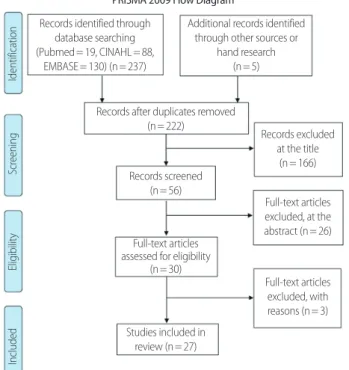
문헌검색 전략을 토대로 검색한 최초의 문헌은 Pubmed 19편, Embase 88편, CINAHL 130편, 기타 5편으로 전체 문헌수는 총 242편 이었다 (Figure 1). 중복문헌을 제외한 문헌수는 222편으로 연구계획 에서 정한 문헌 선정 및 제외기준에 따라 최종 선택문헌을 선정하 였다 . 중복문헌을 제거한 후 독립된 두 연구자가 문헌선택 기준에 따라 각각 검색된 문헌의 제목과 초록을 읽고 문헌을 선택해 결과 가 상이한 경우 교차 확인 및 제 3인의 조언을 구한 후 1차 선택문헌 을 선정했다. 1차 선택된 문헌은 30편이었으며, 이후 전문을 읽고 최 종 선택한 문헌은 27편이었다.

(1) 선정 기준

본 체계적 문헌고찰의 선정기준은 옥살리플라틴을 사용한 성인 대장암 환자를 대상으로 OXIPN 관련 유전자 조사를 시행한 조사

연구로서 한국어나 영어로 출판된 연구이다.

(2) 제외 기준

본 체계적 문헌고찰에서 동물대상 연구, 소아나 청소년 대상 연 구 , 다른 원인으로 인한 말초신경병증에 관한 연구, 원저가 아닌 연 구 , 초록만 발표된 연구, 학술지에 공식적으로 게재되지 않은 연구, 사례분석연구 , 종설, 질적연구는 제외하였다.

4. 자료 분석

본 연구의 자료 분석은 최종 고찰에 포함된 총 27편의 논문의 특 성을 분석하였다. 연구 대상을 Western과 Asian으로 구분한 후 각 각의 문헌에 대해 연구 설계 및 연구 대상, 조사 유전자를 추출하였 다 . 연구 설계 및 연구 대상은 연구 국가, 연구 대상의 구성(성별, 나 이 , 암종 및 항암 요법), 말초신경병증 사정도구를 포함하며, OXIPN 과의 연관성에 대한 결과를 추출하여 분석하였다.

연구 결과

1. 선택문헌의 일반적 특성

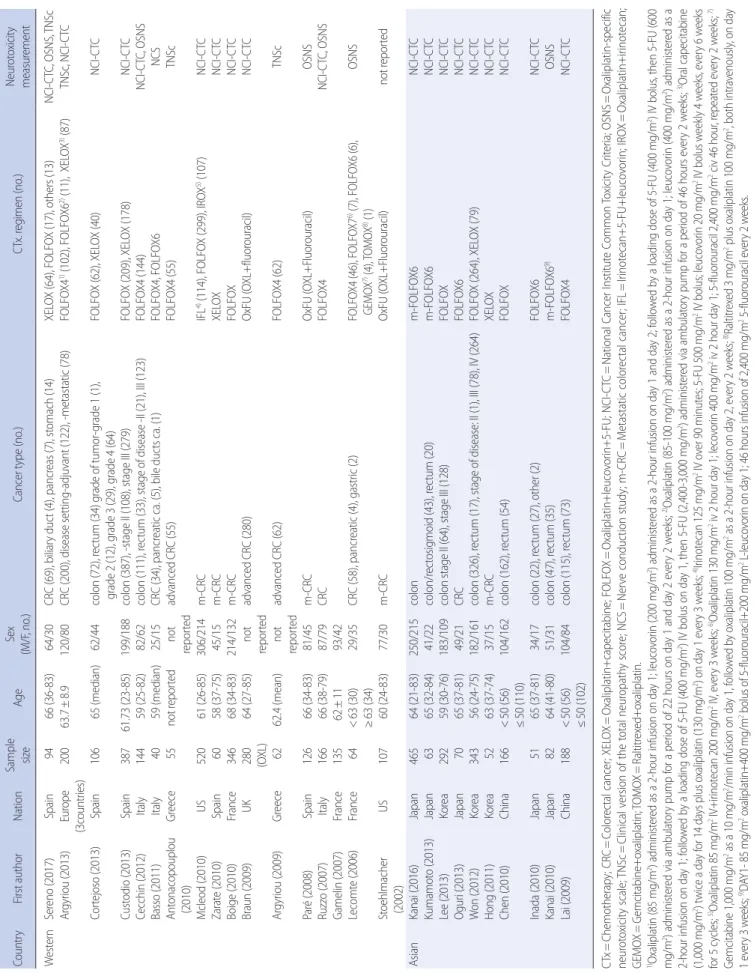
OXIPN과 유전학적 요인의 관계를 분석한 연구는 국외 데이터베 이스에서 총 27편이 선택되었다(Table 1). 발표연도는 2002-2017년도 까지였으며 , 발표국가는 스페인 5편, 이탈리아 3편을 포함하여 유럽 국가 17편, 일본 5편을 포함한 아시아 국가 10편이었다. 연구 대상자 수의 범위는 약 50-500명 내외이었으며, 연구 대상자 수가 가장 작 은 연구는 40명, 가장 많은 연구는 520명이었다. 연구 대상자의 인종 은 자세히 보고되지 않았으나, Hispanic 또는 African-American은 거 의 포함되지 않았다. 연구 대상자 나이의 중간값 또는 평균값 범위 는 56-68세이나, 4편의 문헌에서는 이를 보고하지 않았다. 자료 분 석에 포함된 대부분의 대상자는 대장암 치료를 위한 옥살리플라 틴 치료를 받았으나, 3편의 논문에서는 옥살리플라틴 치료를 받은 각각 5명의 췌장암 환자와 1명의 담관암 환자, 4명의 췌장암 환자와 2명의 위암 환자, 4명의 담관암 환자와 7명의 췌장암 환자, 14명의 위 암 환자가 포함되었다[12-14]. 일반적으로 옥살리플라틴은 5-fluoro- uracil/leucovorin (5-FU/LV)과 함께 투여되었으나, 9편의 논문에서는 capecitabine, gemcitabine, 또는 raltitrexed이 병합요법으로 사용되었 다 [9,11,13-18,25].

항암제 유도 말초신경병증은 주로 National Cancer Institute Com- mon Toxicity Criteria (NCI-CTC), Total Neuropathy Score (TNSc), 또 는 Oxaliplatin-Specific Neurotoxicity Scale (OSNS)를 사용하여 증상 측정하였다 .

Figure 1. Flow of selection.

Records identified through database searching (Pubmed= 19, CINAHL= 88,

EMBASE= 130) (n= 237)

Records after duplicates removed (n= 222)

Full-text articles excluded, at the abstract (n= 26) Full-text articles

assessed for eligibility (n= 30)

Iden tifica tion Scr eening Elig ibilit y Included

Records excluded at the title

(n= 166) Records screened

(n= 56)

Full-text articles excluded, with reasons (n= 3) Additional records identified

through other sources or hand research

(n= 5)

Studies included in

review (n= 27)

PRISMA 2009 Flow Diagram

(4)

Table 1. G ener al Char ac teristics of S tudies Coun try First author Na tion Sample siz e Ag e Sex (M/F , no .) Canc er t ype (no .) CT x. r eg imen (no .) Neur ot oxicit y measur emen t W est er n Ser eno (2017) Spain 94 66 (36-83) 64/30 CR C (69), biliar y duc t (4), pancr eas (7), st omach (14) XEL OX (64), FOLFO X (17), others (13) NCI- CT C, OSNS, TNS c Ar gyr iou (2013) Eur ope (3c oun tries) 200 63.7 ± 8.9 120/80 CR C (200), disease setting-adjuv an t (122), -metasta tic (78) FOLFO X4

1)

(102), FOLFO X6

2)

(11), XEL OX

3)

(87) TNS c, NCI- CT C Cor tejoso (2013) Spain 106 65 (median) 62/44 colon (72), r ec tum (34) g rade of tumor -g rade 1 (1), g rade 2 (12), g rade 3 (29), g rade 4 (64) FOLFO X (62), XEL OX (40) NCI- CT C Cust odio (2013) Spain 387 61.73 (23-85) 199/188 colon (387), -stage II (108), stage III (279) FOLFO X (209), XEL OX (178) NCI- CT C Cec chin (2012) Italy 144 59 (25-82) 82/62 colon (111), r ec tum (33), stage of disease -II (21), III (123) FOLFO X4 (144) NCI- CT C, OSNS Basso (2011) Italy 40 59 (median) 25/15 CR C (34), pancr ea tic ca. (5), bile duc ts ca. (1) FOLFO X4, FOLFO X6 NCS An tonac opouplou (2010) Gr eec e 55 not r epor ted not repor ted adv anc ed CR C (55) FOLFO X4 (55) TNS c M cleod (2010) US 520 61 (26-85) 306/214 m- CR C IFL

4)

(114), FOLFO X (299), IR OX

5)

(107) NCI- CT C Zar at e (2010) Spain 60 58 (37-75) 45/15 m- CR C XEL OX NCI- CT C Boige (2010) Fra nce 346 68 (34-83) 214/132 m- CR C FOLFO X NCI- CT C Br aun (2009) UK 280 (O XL) 64 (27-85) not repor ted adv anc ed CR C (280) OxFU ( OXL+fluor our acil) NCI- CT C Ar gyr iou (2009) Gr eec e 62 62.4 (mean) not repor ted adv anc ed CR C (62) FOLFO X4 (62) TNS c Par é (2008) Spain 126 66 (34-83) 81/45 m- CR C OxFU ( OXL+F luor our acil) OSNS Ruzz o (2007) Italy 166 66 (38-79) 87/79 CR C FOLFO X4 NCI- CT C, OSNS Gamelin (2007) Fra nce 135 62 ± 11 93/42 Lec om te (2006) Fra nce 64 < 63 (30) ≥ 63 (34) 29/35 CR C (58), pancr ea tic (4), gastr ic (2) FOLFO X4 (46), FOLFO X7

6)

(7), FOLFO X6 (6), GEMO X

7)

(4), T OMO X

8)

(1) OSNS St oehlmacher (2002) US 107 60 (24-83) 77/30 m- CR C OxFU ( OXL+F luor our acil) not r epor ted Asian Kanai (2016) Japan 465 64 (21-83) 250/215 colon m-FOLFO X6 NCI- CT C Kumamot o (2013) Japan 63 65 (32-84) 41/22 colon/r ec tosig moid (43), r ec tum (20) m-FOLFO X6 NCI- CT C Lee (2013) Kor ea 292 59 (30-76) 183/109 colon stage II (64), stage III (128) FOLFO X NCI- CT C O gur i (2013) Japan 70 65 (37-81) 49/21 CR C FOLFO X6 NCI- CT C W on (2012) Kor ea 343 56 (24-75) 182/161 colon (326), r ec tum (17), stage of disease: II (1), III (78), IV (264) FOLFO X (264), XEL OX (79) NCI- CT C Hong (2011) Kor ea 52 63 (37-74) 37/15 m- CR C XEL OX NCI- CT C Chen (2010) China 166 < 50 (56) ≤ 50 (110) 104/162 colon (162), r ec tum (54) FOLFO X NCI- CT C Inada (2010) Japan 51 65 (37-81) 34/17 colon (22), r ec tum (27), other (2) FOLFO X6 NCI- CT C Kanai (2010) Japan 82 64 (41-80) 51/31 colon (47), r ec tum (35) m-FOLFO X6

9)

OSNS Lai (2009) China 188 < 50 (56) ≤ 50 (102) 104/84 colon (115), r ec tum (73) FOLFO X4 NCI- CT C CT x= Ch em ot he ra py ; C RC = Co lo re ct al c an ce r; XE LO X = O xa lip la tin + ca pe ci ta bin e; F O LF O X = O xa lip la tin + le uc ov or in + 5- FU ; N CI -C TC = N at io na l C an ce r I ns tit ut e Co m m on To xi ci ty C rit er ia ; O SN S= O xa lip la tin -s pe ci fic neur ot oxicit y scale; TNS c= Clinical v ersion of the t otal neur opa th y sc or e; NCS = Ner ve c onduc tion study ; m- CR C = M etasta tic c olor ec tal canc er ; IFL = Irinot ecan+5-FU+leuc ov or in; IR O X = Oxalipla tin+ir inot ecan; GEMO X = Gemcitabine+o xalipla tin; T OMO X = Raltitr ex ed+o xalipla tin.

1)

Oxalipla tin (85 mg/m

2

) administ er ed as a 2-hour infusion on da y 1; leuc ov or in (200 mg/m

2

) administ er ed as a 2-hour infusion on da y 1 and da y 2; f ollo w ed b y a loading dose of 5-FU (400 mg/m

2

) IV bolus , then 5-FU (600 mg/m

2

) administ er ed via ambula tor y pump for a per iod of 22 hours on da y 1 and da y 2 ev er y 2 w eeks;

2)

Oxalipla tin (85-100 mg/m

2

) administ er ed as a 2-hour infusion on da y 1; leuc ov or in (400 mg/m

2

) administ er ed as a 2-hour infusion on da y 1; f ollo w ed b y a loading dose of 5-FU (400 mg/m

2

) IV bolus on da y 1, then 5-FU (2,400-3,000 mg/m

2

) administ er ed via ambula tor y pump f or a per iod of 46 hours e ver y 2 w eeks;

3)

Or al capecitabine (1,000 mg/m

2

) t wic e a da y f or 14 da ys plus o xalipla tin (130 mg/m

2

) on da y 1 e ver y 3 w eeks;

4)

Irinot ecan 125 mg/m

2

IV o ver 90 minut es; 5-FU 500 mg/m

2

IV bolus; leuc ov or in 20 mg/m

2

IV bolus w eek ly 4 w eeks , e ver y 6 w eeks for 5 c ycles;

5)

Oxalipla tin 85 mg/m

2

IV+ir inot ecan 200 mg/m

2

IV , e ver y 3 w eeks;

6)

Oxalipla tin 130 mg/m

2

iv 2 hour da y 1; lec ov or in 400 mg/m

2

iv 2 hour da y 1; 5-fluor our acil 2,400 mg/m

2

civ 46 hour , r epea ted e ver y 2 w eeks;

7)

Gemcitabine 1,000 mg/m

2

as a 10 mg/m

2

/min infusion on da y 1, f ollo w ed b y o xalipla tin 100 mg/m

2

as a 2-hour infusion on da y 2, e ver y 2 w eeks;

8)

Raltitr ex ed 3 mg/m

2

plus o xalipla tin 100 mg/m

2

, both in tra venously , on da y 1 e ver y 3 w eeks;

9)

DA Y1- 85 mg/m

2

o xalipla tin+400 mg/m

2

bolus of 5-fluor our acil+200 mg/m

2

L-leuc ov or in on da y 1; 46 hours infusion of 2,400 mg/m

2

5-fluor our acil e ver y 2 w eeks .

(5)

Table 2. Results of S tudies First author Incidenc e/ se ver ity of O XIPN Candida te genes f or O XIPN Acut e Chr onic Incidenc e Se ver ity Results Ser eno (2017) M oder at e t o se ver e ( TNS c≥ 15): 48.9% Inexist en t t o mild ( TNS c≤ 6): 51.1% SCN9A-rs41268673, rs6746030, rs74401238 N/A N/A ↓ ↓ S CN9A-rs6746030 w as associa ted with pr ot ec tion f or se ver e neur opa th y ( OR = 0.39, 95% CI = 0.16-0.96, p= .041) Ar gyr iou (2013) A cut e (af ter the disc on tinua tion of Tx.): 84.5% (g rade 1: 36.7%, g rade 2: 27.2%, g rade 3: 36.1%) C hr onic (a t final f/u): 72.5% (g rade 1: 34.5%, gr ade 2: 40.6%, g rade 3: 24.8%)

SCN4A-rs2302237 (+) (+) ↑ ↑ (acut e) OR (95% CI; P) I ncidenc e ( G0 vs . G1-3) 2.39 (1.08-5.30; p= .028) Se ver ity ( G0-1 vs . G2-3) 2.04 (1.16-3.59; p= .013) SCN10A-rs12632942 (+) (-) ↑ (-) OR (95% CI; P) I ncidenc e ( G0 vs . G1-3) 0.45 (0.21-0.98; p= .045) Se ver ity ( G0-1 vs . G2-3) 0.84 (0.47-1.50; p= .560) Cor tejoso (2013) O xalipla tin based tr ea tmen t per ipher al neur opa th y 12.3 % ER CC1-rs11615 N/A N/A (-) (-) D ata associa ted o xalipla tin-induc ed per ipher al neur opa th y w as not repor ted in detail Cust odio (2013) Dur ing tr ea tmen t, se ver e O XIPN (g rade 2-3) 31.0% CCNH-rs2230641 ABC G2-rs3114018 N/A N/A ↑ ↑ OR (95% CI; p) I ncidenc e C CNH-rs2230641 5.03 (1.06-2.41; p= .042) ABC G2-rs3114018 2.67 (0.95-4.41; p= .059) S e ver ity C CNH-rs2230641 and/or ABC G2-rs3114018 2.46 (1.19-5.07; p= .014) Cec chin (2012) I ncidenc e of neur ot oxicit y (within 48 hours bef or e each c ycle): 83.3% (an y g rade), 39% (g rade ≥ 2) ABC C1-rs2074087, rs35587 N/A N/A ↓ N/A G ≥ 2 t oxicit y/G0-1 minor allele fr equenc y OR (95% CI) 0.43 (0.22- 0.86) p= .170 (rs2074087) 0.47 (0.23-0.96) p= .038 (rs35587) ABC C2-rs3740066, rs1885301, rs4148396, rs717620, ABC G2- rs2622604

N/A N/A ↑ N/A G ≥ 2 t oxicit y/G0-1 minor allele fr equenc y OR (95% CI) 3.06 (1.35- 6.92) p= .007 (rs1885301) Basso (2011) A cut e neur ot oxicit y (af ter e ver y subsequen t oxalipla tin administr ations) G 0: 12 pa tien ts (30%); G1: 17 pa tien ts (43%); G2: 11 pa tien ts (27%)

polymor phic CA G r epea t motif within ex on 1 of the SK3 gene (+) N/A ↑ N/A C ompar ing G0-1/G2 Alleles ( ≤ 15/ > 15) OR 95% CI: 0.381 (0.247- 0.590) p= .001 An tonac o -pouplou (2010) C hr onic O XIPN (within a mon th af ter the completion of o xalipla tin based Tx.): 34/55 pa tien ts (61.8%) G1: 38.2%; G2: 61.8%

ITGB3 (genot ype C/C, T/T , C/T ) N/A (+) (-) ↑ I TGB3 a t L33P genot ype TT (incidenc e) No O XIPN: 47.6% O XIPN: 53% OR (95% CI) 2.43 (0.4-18.3) p= .490 I TGB3 a t L33P genot ype TT (se ver ity) G1: 30.8% G2: 66.7% OR (95% CI) 0.2 (0.1-1.2) p= .044 M cL eod (2010) F OLFO X disc on tinua tion r at e 24% vs . 10%; 8/43 vs . 0/54 IR OX pa tien ts (g rade 3-4) GSTP1 I le105V al (+) N/A ↑ N/A P a tien ts with a GSTP1 I105V genot ype of T/T w er e mor e likely t o disc on tinue FOLFO X because of neur ot oxicit y ( p= .010). I n pa tien ts trea ted with IR OX, only pa tien ts with T/T genot ype exper ienc ed gr ade 3 neur ot oxicit y ( p= .003) Zar at e (2010) Neur ot oxicit y g rade 1: 42%; g rade 2: 25%; g rade 3: 2% ER CC1 A sn118A sn GSTP1 Ile105V al GSTM1 deletion N/A N/A (-) N/A No specific r esult of neur ot oxicit y Boige (2010) Gr ade ≥ 2 neur ot oxicit y ar m A: 49%; ar m B: 63% ER CC1, ER CC2, GST T1, GSTM1, GSTP1 N/A N/A (-) N/A N o sta tistically sig nifican t associa tion w as f ound bet w een an y genot ype and FOLFO X-induc ed se ver e neur olog ic t oxicit y. Br aun (2009) Not r epor ted incidenc e of O XIPN seper at ed ER CC2, GSTP1, MLH1 XR CC1 N/A N/A (-) (-) I ncidenc e of NCI- CT C G ≥ 3 t oxicit y within 12 w eeks of star ting of oxalipla tin tr ea tmen t r eg imen, b y genot ype TY MS-ER ( p= .957), TY MS-1494 ( p= .474) M THFR ( p= 0.412) MLH1 ( p= .327) UGT1A1 (p = .455) ABCB1 ( p= .829) XR CC1 ( p= 0.423) GSTP1 ( p= .301) ER CC2 ( p= .915) Ar gyr iou A (2009) C hr onic O XIPN (f ollo wing disc on tinua tion of Tx.): 58.1%; g rade 1: 38.9%; g rade 2: 61.1% SCN2A R19K N/A (-) (-) (-) O f pa tien ts without O XIPN (n = 26), G/G: 80.8% (n = 21) A/G: 19.2% (n = 5) O f pa tien ts with O XIPN (n = 36) G/G: 75% (n = 27) A/G: 19.5% (n = 7) A/A: 5.5% (n = 2) G 2 O XIPN (n = 20) G/G: 72.7% (n = 16) A/G: 11.1% (n = 4) A/A: 9%(n = 2) G1 O XIPN (n = 14) G/G: 78.6% (n = 11) A/G: 21.4% (n = 3) (C on tinued t o the nex t page )

(6)

Table 2. C on tinued First author Incidenc e/ se ver ity of O XIPN Candida te genes f or O XIPN Acut e Chr onic Incidenc e Se ver ity Results Par é (2008) Neur ot oxicit y g rade 1: 32.5%; g rade 2: 52.4%; g rade 3: 4% GSTP1 I le105V al N/A N/A (-) N/A G r ade 2 and 3 c umula tiv e per ipher al n eur opa th y w as mor e common in pa tien ts with the I le/I le genot ype than in pa tien ts with I le/V al or Val/V al genot ype , but the diff er enc e did not r each sta tistical sig nificanc e ( p= 0.08). Ruzz o (2007) (E valua ted af ter f our c ycles of tr ea tmen t and then ev er y 2 mon ths) Gr ade 0: 43%; g rade 1-2: 47%; g rade 3-4: 10%

GSTP1 ex on 5 Val allele (+) (+) N/A ↑ T he fr equencies of GSTP1-105A/A, A/G, and G/G genot ypes: 63%, 34%, 2% (78 pa tien ts with G1-2 neur ot oxicit y) and 23%, 30%, 47% (17 pa tien ts with G3 neur ot oxicit y) ( p< .001). Gamelin (2007) A cut e neur opa th y (n) Gr ade 0: 50; g rade 1: 58; gr ade 2: 20; g rade 3: 7 C hr onic neur opa th y (n) Gr ade 0: 105; g rade 1: 2; g rade 2: 15; g rade 3: 13 AGX T I le340M et AGX T pr o11L eu GSTP1 I le105V al

(+) (+) (+) (+) S ig nifican t associa tion ( p< .001) with CIPN se ver ity f or A GX T Pr o11L eu C/T and T/T vs . C/C, and f or A GX T I le340M et A/G and G/G vs . A/A Lec om te (2006) Cumula tiv e per ipher al neur opa th y Gr ade 1: 42%, g rade 2: 27%, g rade 3: 23% GSTP1 ex on 5 Val allele N/A (+) ↓ N/A P a tien ts with G3 O XIPN (lle/lle; 87%, lle/V al;13%, Val/V al; 0, lle/ Val+V al/V al;13%) P atien ts without G3 O XIPN (lle/lle; 53%, lle/ Val;37%, Val/V al; 10%, lle/V al+V al/V al;47%) → OR 95% CI; 5.75 (1.08- 30.74), p= .020 St oehlmacher (2002) 1 0 pa tien ts ith g rade 3-4 neur olog ical t oxicit y (not indica ted lo w er g rades) G STP1 I le105V al , GSTM1 deletion, GST T1 deletion N/A N/A (-) N/A No specific r esult of neur ot oxicit y Kanai (2016) Not r epor ted the time poin t of assessmen t Gr ade 1: 61.9%, g rade 2: 31.6%, g rade 3: 6.5% A BC G2, A CYP2, B TG4, C CNH, CA MK2N1, DLEU7, F ARS2, FO XC1, GSTP1, IT GA1, TA C1, XR CC1

N/A N/A (-) (-) C ompar ison of g rade 0/1 with g rade 2/3 or g rade 3 sho w ed no sig nifican t associa tion with an y of the 12 SNP mar kers af ter adjustmen t f or t otal dose of o xalipla tin. Kumamot o (2013) Gr ade 2: 66.7%; g rade 3: 3.2% GSTP1-105 A/G, G/G GSTM1-nega tiv e (+) N/A ↑ ↑ A sta tistically sig nifican t c or rela tion bet w een the icidenc e of per ipher al neur opa th y higher than g rade 2 and the GSTP1-105 (p = .030) and GSTM1 ( p= .020) genot ypes w as det er mined . Lee (2013) S ensor y neur opa th y (assessed e ver y 2 w eeks dur ing tr ea tmen t) (257/292 pa tien ts , 88%) G r ade 1: 69.1%; g rade 2: 15.8%; g rade 3: 1.7%; gr ade 4: 0%

XR CC1 (+) N/A ↓ (-) P a tien ts har bor ing the XR CC1 23885GG exper ienc ed less G2-4 (12.9% vs . 21.7%, p= .050, /OR = 0.52 95% CI 0.27-0.99, p= .046). T ime t o the onset of G2-4 neur opa th y w as la ter in pa tien ts habor ing XR CC1 23885GG genot ypes (HR 0.56, 95% CI 0.32-0.99, p= .041) compar ed t o AA/A G O gur i (2013) A cut e neur ot oxicit y (n = 65) (within a w eek af ter infusion of O XL) G r ade 1: 71%, g rade 2: 17%, g rade 3: 4% Chr onic neur ot oxicit y (n = 48) Gr ade 1: 37%, g rade 2: 21%, g rade 3: 10%

TA C1 (rs10486003) FARS2 (rs17140129) ER CC1 (rs11615)

N/A (+) ↑ ↑ F ARS2, r isk of se ver e chr onic neur opa th y c ompar ed t o A/A, A/G & GG genot ype ( p= .034, OR = 6.5 CI 95% 1.2-35.7). T A C1&ER CC1, median number of Tx. C ycles a t onset - C/C: C/T and T/ T= 6:8 ( p= .049) W on (2012) S e ver e O XIPN ( ev alua ted on da y 1 of each chemother ap y c ycle) 39/96 pa tien ts (41%) 8 5/247 pa tien ts (34%): the disc ov er y set and the valida tion set , r espec tiv ely .

T A C1, FO XC1, GMDS, IT GA1, PEL O, A CYP2, TSP YL6, DLEU7 (+) N/A ↑ or ↓ N/A G enes OR (95% CI) TA C1 0.32 (0.19-0.52) FO XC1, GMDS 2.27 (1.58- 3.26) IT GA1, PEL O 0.32 (0.19-0.54) ACYP2, TSP YL6 2.43 (1.61-3.68) DLEU7 0.50 (0.35-0.72) Hong (2011) Sensor y neur opa th y Gr ade 1: 57.7%; g rade 2: 7.7%; g rade 3-4: 7.7% GSTP1-I le105V al (+) N/A ↑ N/A G STP1-I le105V al w as associa ted with neur ot oxicit y. P atien ts with A/ G or G/G genot ypes exper ienc ed mor e fr equen t G2/3 sensor y neur opa th y (35.7% in A/G or G/G vs . 8.1% in A/A, p= .030). Chen (2010) lle/lle vs . lle/V al or Val/V al A f ter 4c ycles: g rade 0-2 99.2%/97.6% g rade 3-4 0.8%/2.4%; A fter 8c ycles: g rade 0-2 92.8%/80.5% gr ade 3-4 7.2%/19.5%; A fter 12 c ycles: g rade 0-2 85.6%/63.4% g rade 3-4 14.4%/36.6%

GSTP1 V al105 (+) N/A ↑ ↑ Ile/I le vs . Ile/V al or Val/V al Af ter 8 c ycles- G3-4 Val105 allele v ar ian ts (7.2% vs . 19.5%, p= .020). Af ter 12 c ycles- (14.4% vs . 36.6%, p< .010). (C on tinued t o the nex t page )

(7)

2. OXIPN의 발생률

선정된 문헌의 OXIPN 발생률을 살펴보면 급성 OXIPN으로 명시 하거나 옥살리플라틴 치료 중 증상을 사정한 문헌에서 54.0-99.2%

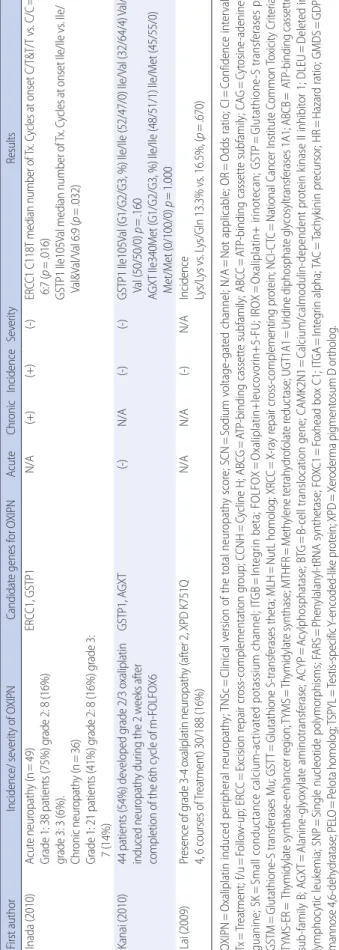
범위로 나타나며, 만성 OXIPN은 19.6-71.0% 범위이다(Table 2). 급성 또는 만성을 명시하거나 OXIPN 증상을 평가한 시점을 보고하지 않 은 논문이 대부분이며, 명시된 급성 또는 만성 OXIPN의 기준 역시 문헌 별로 상이하다. Antonacopouplou 등(2010)의 연구에서는 옥살 리플라틴 치료 종료 후 한 달 이내에 발생한 OXIPN을 만성 OXIPN 으로 정의하였고[19], Won 등(2012)은 옥살리플라틴 치료 다음 날 증상을 평가하고 chronic OXIPN으로 명명하였다[16]. Argyriou 등 (2013), Gamelin 등(2007)의 연구에서는 급성/만성 OXIPN의 발생률 을 각각 보고하였으나, 증상의 평가 시점이 불명확하며[9, 20], Oguri 등 (2013)의 연구에서는 옥살리플라틴 투여 후 일주일 이내 증상이 사라지는 경우 급성 OXIPN으로, 증상이 수개월 지속되며 치료 중 단을 요하는 경우 만성 OXIPN으로 명명하였다[21].

3. OXIPN과의 유전적 연관성

OXIPN과 연관성을 가지는 것으로 분석된 유전자는 다양하게 나타났으며 , 중복연구 된 유전자의연관성에 대한 결과는 일관적이 지 않았다(Table 2). 급성과 만성 OXIPN 관련 유전자를 분석한 논 문은 4편이었으며[9,20-22], OXIPN을 사정한 시점을 정확히 명시하 지 않은 논문은 11편이었다[13,15,17,18,23-29]. 27편의 모든 논문에서 OXIPN의 발생과 관련된 유전자를 분석하였으나, 이 중 유의한 연 관성을 보고한 논문은 17편이었으며, 관련 유전자를 반복 연구된 빈도 순으로 살펴보면 glutathione-S transferases pi 1 (GSTP1), excision repair cross-complementation group 1 (ERCC1), glutathione-S transfer- ases Mu 1 (GSTM1), tachykinin precursor 1 (TAC1), x-ray repair cross- complementing protein 1 (XRCC1), sodium voltage-gated channel alpha subunit 4 (SCN4A), sodium voltage-gated channel alpha subunit 10 (SCN10A) 등으로 나타났다(Table 3).

GSTP1은 14편의 논문에 포함되어 가장 높은 빈도이었으나 이 중 7편의 논문에서는 GSTP1의 OXIPN과의 연관성이 유의하게 보고되 지 않았다. Ruzzo 등(2007)의 연구에서는 GSTP1-105 유전자의 G/G 대립형질을 가진 환자는 GSTP1-105 A/G 또는 A/A 대립형질을 가진 환자와 비해 grade 3 이상의 급성 또는 만성 신경독성에 취약한 것 으로 나타났다[30]. Chen 등(2010)의 연구에서는 GSTP1 의 G 대립형 질을 갖는 경우 grade 3 또는 4의 말초신경병증의 발생이 유의하게 증가함을 밝혔다[31]. 반면 Inada 등(2010)의 연구에서는 GSTP1-105 A/A 대립형질을 갖는 경우 grade 2이상의 말초신경병증 발생이 증 가하지 않지만, grade 1 말초신경병증 발생 시점이 더 이르다는 결과 First author Incidenc e/ se ver ity of O XIPN Candida te genes f or O XIPN Acut e Chr onic Incidenc e Se ver ity Results Inada (2010) Acut e neur opa th y (n = 49) Gr ade 1: 38 pa tien ts (75%) g rade 2: 8 (16%) gr ade 3: 3 (6%). Chr onic neur opa th y (n = 36) G r ade 1: 21 pa tien ts (41%) g rade 2: 8 (16%) g rade 3: 7 (14%)

ER CC1, GSTP1 N/A (+) (+) (-) E R CC1 C118T median number of Tx. C ycles a t onset C/T&T/T vs . C/C = 6:7 ( p= .016) G STP1 I le105V al median number of Tx. C ycles a t onset I le/I le vs . Ile/ Val&V al/V al 6:9 ( p= .032) Kanai (2010) 44 pa tien ts (54%) de veloped g rade 2/3 o xalipla tin induc ed neur opa th y dur ing the 2 w eeks af ter completion of the 6th c ycle of m-FOLFO X6

GSTP1, A GX T (-) N/A (-) (-) G STP1 I le105V al ( G1/G2/G3, %) I le/I le (52/47/0) I le/V al (32/64/4) Val/ Val (50/50/0) p= .160 A GX T I le340M et ( G1/G2/G3, %) I le/I le (48/51/1) I le/M et (45/55/0) M et/M et (0/100/0) p= 1.000 Lai (2009) Pr esenc e of g rade 3-4 o xalipla tin neur opa th y (af ter 2, 4, 6 c ourses of Tr ea tmen t) 30/188 (16%) XPD K751Q N/A N/A (-) N/A Incidenc e Lys/L ys vs . L ys/Gln 13.3% vs . 16.5%, ( p= .670) O XIPN = Oxalipla tin induc ed per ipher al neur opa th y; TNS c= Clinical v ersion of the t otal neur opa th y sc or e; SCN = Sodium v oltage -ga ted channel; N/A = Not applicable; OR = O dds r atio; CI = Confidenc e in ter val; Tx = Tr ea tmen t; f/u = Follo w-up; ER CC = Ex cision r epair cr oss- complemen ta tion g roup; C CNH = Cy cline H; ABC G = ATP -binding cassett e subfamily ; ABC C = ATP -binding cassett e subfamily ; CA G = Cyt osine -adenine - guan ine; SK = Smal l c ondu ctanc e calci um-ac tiv at ed potass ium ch annel; I TGB = In teg rin beta; FOLFO X = Oxal ipla tin +leuc ov or in+5-FU ; IR O X = Oxal ipla tin+ ir inot ecan; G STP = Glu ta thione -S tr ansf er ases pi; GSTM = Gluta thione -S tr ansf er ases Mu; GST T= Gluta thione S-tr ansf er ases theta; MLH = NutL homolog; XR CC = X-r ay r epair cr oss- complemen ting pr ot ein; NCI- CT C = Na tional C anc er I nstitut e C ommon To xicit y C rit er ia; TY MS-ER = Th ymidyla te syn thase -enhanc er r eg ion; TY MS = Th ymidyla te syn thase; M THFR = M eth ylene t etr ah ydr of ola te r educ tase; UGT1A1 = Ur idine diphospha te gly cosyltr ansf er ases 1A1; ABCB = A TP -binding cassett e sub -family B; A GX T= Alanine -gly ox yla te aminotr ansf er ase; A CYP = Ac ylphospha tase; B TG = B- cell tr ansloca tion gene; CA MK2N1 = Calcium/calmodulin- dependen t pr ot ein k inase II inhibit or 1; DLEU = D elet ed in lymphoc ytic leukemia; SNP = Single nucleotide polymor phisms; F ARS = Phen ylalan yl-tRNA syn thetase; FO XC1 = Fo xhead bo x C1; IT GA = In teg rin alpha; TA C = Tach yk inin pr ecursor ; HR = Hazar d r atio; GMDS = GDP - mannose 4,6- deh ydr atase; PEL O = Pelota homolog; TSP YL = Testis-specific Y- enc oded-like pr ot ein; XPD = Xer oder ma pig men tosum D or tholog .

Table 2. C on tinued

(8)

를 보고하였다[22].

GSTP1에 이어 높은 빈도의 반복 연구가 이루어진 유전자인 ERCC1는 6편의 논문에서 분석되었다[15,21,22,25,26,32]. 그러나 이 중 4편의 논문에서는 ERCC1과 OXIPN의 유의한 연관성이 보고되 지 않았으며, 다른 2편 논문[21,22]에서는 C/T 또는 T/T 대립형질을 갖는 경우 C/C 대립형질을 갖는 경우보다 신경독성의 발현 시점이 더 빠른 것으로 나타났다(C/C: C/T, T/T= 8:6; p =.024). GSTP1과 함 께 glutathione의 접합을 통한 약물의 해독작용에 주요한 역할을 하 는 GSTM1의 OXIPN과의 연관성은 4편의 논문에서 보고되었다 [25,28,29,32]. 이 중 Kumamoto 등(2013)의 연구를 제외한 3편의 연구

에서는 유의한 연관성이 나타나지 않았다. Kumamoto 등(2013)의 연 구에 따르면, GSTP1의 G 대립형질을 갖는 경우와 GSTM1-negative 의 경우 grade 2이상의 말초신경병증의 발생이 증가한다[29]. TAC1 의 경우, 분석에 포함된 3편의 논문에서 각각 다른 결과를 보고하였 는데 Oguri 등(2013)의 연구에서는 TAC1 의 C/T 또는 T/T 대립형질 을 가진 경우 C/C의 대립형질을 가진 경우보다 신경독성의 발현 시 점이 이르다고 보고되었으며(C/C: C/T, T/T= 8:6; p =.024) [21], Won 등 (2012)의 연구에서는 T 대립형질을 갖는 경우 심한 말초신경병증 이 덜 발생하는 것으로 나타났으나 (odds ratio 0.32; 95% confidence interval 0.19-0.52) [16] Kanai 등(2016)의 연구에서는 유의한 결과가 Table 3. Genes and Functions

Gene Full name Function

ABCC1 ABCC2

ATP-binding cassette subfamily C member 1, 2

ABC-transport various molecules across extra-and intra-cellular membranes MSH-DNA damage repair

ABCG2 ATP-binding cassette subfamily G member 2 Functions as a xenobiotic transporter which may play a major role in multi-drug resistance and serves as a cellular defense mechanism in response to mitoxantrone and anthracycline exposure

ACYP2 Acylphosphatase 2 Involved in pyruvate metabolism

AGXT Alanine-glyoxylate aminotransferase Localized mostly in the peroxisomes, where it is involved in glyoxylate detoxification. Mutations in this gene, some of which alter subcellular targeting, have been associated with type I primary hyperoxaluria CCNH Cyclin H The protein encoded by this gene belongs to the highly conserved cyclin family, whose members are

characterized by a dramatic periodicity in protein abundance through the cell cycle DLEU7 Deleted in lymphocytic leukemia, 7 Unknown

ERCC1 Excision repair cross-complementation group 1 DNA repair, drug metabolism

FARS2 Phenylalanyl-tRNA synthetase 2 Charges of tRNA with phenylalanine in mitochondrial translation

FOXC1 Forkhead box C1 Binds to cognate sites of FREAC-3 and FREAC-4 which result in bending of the DNA at an angle of 80-90 degrees

GMDS GDP-mannose 4, 6-dehydratase Catalyzes the conversion of GDP-D-mannose to GDP-4-dehydro-6-deoxy-D mannose GSTP1 Glutathione S-transferases pi 1 Functions in xenobiotic metabolism and play a role in susceptibility to cancer, and other diseases GSTT1 Glutathione S-transferases Theta 1 Catalyzes the conjugation of reduced glutathione to a variety of electrophilic and hydrophobic

compounds

GSTM1 Glutathione S-transferases Mu 1 Functions in the detoxification of electrophilic compounds, including carcinogens, therapeutic drugs, environmental toxins and products of oxidative stress, by conjugation with glutathione

ITGA1 Integrin, alpha 1 Catalyzes the conversion of GDP-D-mannose to GDP-4-dehydro-6-deoxy-D mannose

ITGB3 Integrin, beta 3 Enhances activation of ERK 1/2, ERK 1/2-pathway that is essential for successful regeneration and formation of new growth cones

MLH1 MutL homolog 1 DNA repair, drug metabolism

PELO Pelota homolog (drosophila) Normal chromosome segregation during cell division and genomic stability SCN2A

SCN4A SCN10A

Sodium channel, voltage gated, type II alpha subunit

Provide instructions for making sodium channels. Transport positively charged sodium atoms (sodium ions) into cells and play a key role in a cell’s ability to generate and transmit electrical signals SK3 Small conductance calcium-activated

potassium channel 3

Small-conductance calcium-dependent potassium channel after hyperpolization current

TAC1 Tachykinin precursor 1 Excites neurons, evokes behavioral responses, is potent vasodilators and secretagogues, and contracts (directly or indirectly) many smooth muscles

TSPYL6 Testis-specific Y-encoded-like protein 6 Aggregates, arranges and bonds together of a nucleosome, the beadlike structural units of eukaryotic chromatin composed of histones and DNA

XPD Xeroderma pigmentosum D ortholog Participates in DNA unwinding during nucleotide excision repair, which may alter the efficacy of platinum-based chemotherapy

XRCC1 X-ray repair cross-complementing protein 1 Involved in the efficient repair of DNA single-strand breaks formed by exposure to ionizing radiation and alkylating agents

ATP= Adenosine triphosphate; MSH= MutS homologs; DNA= Deoxyribonucleic acid; RNA= Ribonucleic acid; FREAC= Forkhead-related activators; GDP= Glycerophosphoryl

diester phosphodiesterase; ERK= Extracellular signal-regulated kinases.

(9)

나타나지 않았다[23].

반복 연구가 이루어지지 않았지만 OXIPN과의 연관성을 보고한 유전자를 살펴보면, 세포 내·외 막간의 다양한 분자 이동에 관여하 는 단백질이 암호화되어 있는 ATP-binding cassette subfamily C 1 (ABCC1), ATP-binding cassette subfamily C 2 (ABCC2), ATP-binding cassette subfamily G 2 (ABCG2), 세포 접합과 조직 재생 및 염증 반응 등에 과정 인식에 관여하는 세포막 수용체인 integrin alpha 1 (ITGA1), integrin beta 3 (ITGB3), 신경섬유와 근육의 활동 전압의 발 생과 유지에 관여하는 SCN4A, SCN9A, SCN10A와 기타 acylphos- phatase 2 (ACYP2), cycline H (CCNH), deleted in lymphocytic leuke- mia 7 (DLEU7), phenylalanyl-tRNA synthetase 2 (FARS2), forkhead box C1 (FOXC1), GDP-mannose 4, 6-dehydratase (GMDS), pelota homolog (PELO), small conductance calcium-activated potassium channel 3 (SK3), testis-specific Y-encoded-like protein 6 (TSPYL6) 등이다.

논  의 

본 연구는 옥살리플라틴 치료를 받은 대장암 환자를 대상으로 OXIPN과 유전적 요인의 관계를 파악하고 현재 이루어지고 있는 약 리유전학의 동향을 확인함으로써 향후 대장암 환자를 위한 맞춤 치료 계획수립 시 참고자료를 제시하기 위해 시도된 체계적 문헌고 찰 연구이다.

OXIPN은 급성과 만성으로 두 가지 다른 특성을 가진다. 급성 OXIPN은 가역적이며, 차가움과 연관된 감각이상으로 거의 모든 환 자에게서 경련의 형태로 나타난다. 만성 OXIPN은 주로 장기간 지 속되며 약물의 용량의존적(역치용량 500-600 mg/m 2 )이다[36].

OXIPN은 약물 투여에 영향을 주어 용량 감량 뿐만 아니라 치료 중 단을 가져오며 증상의 지속은 삶의 질 저하에 심각한 영향을 미친 다 . 앞서 살펴본 것과 같이, 급성과 만성 OXIPN의 기전은 서로 다르 며 , 옥살리플라틴의 국소적 축적에 의한 배근신경절 세포의 구조 적 ·기능적 변화에 따른 만성 OXIPN의 경우 유전적 요인으로 인한 영향이 더 크기 때문에 만성 OXIPN 발생과 연관된 유전자형의 발 견은 중요하다. 그러나 본 연구에 포함된 대부분의 문헌에서는 급성 과 만성의 기준이 모호하거나, 연구 간 기준이 다르기도 하며, 증상 의 측정 시점 및 기간을 보고하지 않은 연구 또한 있어 급성 또는 만 성 OXIPN에 연관된 유전자형의 일관적 결과를 확인할 수 없었다.

이러한 제한점과 함께 현재까지 항암제 유도 말초신경병증을 평 가하는 표준이 정의되지 않았다. 증상 평가 방법은 임상 평가(clini- cal evaluation)와 기계를 이용하는 객관적 검사, 환자 보고가 있다.

그러나 아직까지 표준화된 방법은 없으며, 신경병성 통증 등 증상

이 상당히 주관적인 현상이기에 다른 약물 독성(피부독성 또는 소 화기계 증상 등)에 비해 객관적인 지표 측정이 어려운 실정이다. 이 에 따라 의료진의 평가와 같은 객관적 평가는 환자가 보고하는 증 상과 상관관계가 낮다는 것은 자주 보고되고 있으며 주목할 만한 부분이다 [37]. 말초신경병증의 증상은 상대적으로 더욱 주관적 평 가 이므로 유전자형과의 관계 파악을 통해 증상 측정의 객관성과 정확성을 확보할 수 있다는 점은 암환자의 증상관리 측면에서 중요 한 부분이다. 이러한 증상의 객관적이고 정확한 사정을 위해서는 OXIPN 측정과 진단의 국제적 기준에 대한 요구가 해결되어야 할 것이라고 보여진다.

본 연구에서 고찰한 OXIPN과 유전자형의 관계를 분석한 연구 에서 후보 유전자로 포함된 빈도가 높은 유전자는 GSTP1 (14편), ERCC1 (6편), GSTM1 (4편) 이며, 각 유전자와 OXIPN의 관계는 연구 가 수행된 지역별로 차이를 보인다. 연구 수행 지역의 차이가 연구 대상자 인종의 차이로 단언할 수는 없지만 GSTP1의 경우, 아시아권 의 연구에서 Kanai 등(2010)을 제외한 4편의 연구에서 G 대립형질이 OXIPN의 발생 위험을 증가와 연관이 있는 것으로 나타났다. 반면, 서양권의 연구에서는 Ruzzo 등(2007)은 아시아권의 연구결과와 일 치하였으나 [30] 다른 6편의 연구에서는 GSTP1과 OXIPN의 유의한 관계가 없는 것으로 나타났으며, 나머지 2편의 연구에서는 상이한 결과가 보고되었다[14,18]. ERCC1의 경우 이러한 차이는 더욱 명확 히 드러나는데, 아시아권의 연구 Oguri 등(2013)과 Inada 등(2010)에 서는 ERCC1 (C118T, rs 11615)이 C/T 또는 T/T 형질을 가진 경우 OXIPN의 발생 위험성이 높아지는 것으로 나타났으나[21,22] 서양 권의 연구에서는 모두 ERCC1과 OXIPN 발생은 관계가 없는 것으 로 나타났다[15,25,26,32].

인종에 따른 차이는 항암제의 반응과 독성에 큰 영향을 주는 것

으로 알려져 있다[31]. 예를 들어, 비소세포암의 경우 아시아인은

epidermal growth factor receptor (EGFR) 돌연변이(mutation)의 발생

률이 높아 gefitinib 치료가 매우 효과적인 것으로 나타난다[38,39]. 또

한 논란의 여지가 있으나 uridine diphosphate glycosyltransferases 1A1

(UGT1A1)의 여러 변이 중 하나인 UGT1A1*28 유전자의 경우 아시아

인에게서 irinotecan 치료에 따른 호중구감소증의 위험성을 예측할

수 있다고 알려져 있다[40]. 옥살리플라틴에 관련된 인종별 유전자

형에 대한 연구결과에서는 ERCC1과 xeroderma pigmentosum com-

plementation group D (XPD) 유전자형의 뚜렷한 차이가 platinum의

항암화학요법의 효과에 영향을 미친다고 보여진다. Chang 등(2009)

의 연구에서는 아시아인에서의 높은 ERCC1의 C/C 대립형질의 발

생률이 , Lai 등(2009)의 연구에서는 아시아인에서의 XPD의 codon

751 Lys/Gln의 낮은 발생률이 옥살리플라틴 포함 치료의 효과적인

(10)

반응의 결정요인으로 보았다[24,41]. 이와 같이 여러 연구에서 인종 별 유전자형의 차이는 약물의 반응 및 독성에 영향을 주는 것으로 알려져 있으나 아직까지 옥살리플라틴의 주요 증상인 말초신경병 증 발생에 대한 인종별 유전자형의 차이에 관한 연구는 다양하게 이루어지지 않고 있다. 본 연구에서 고찰한 문헌들에서도 인종의 차이를 의미 있는 요인으로 보지 않았으며, 다양한 인종을 포함하 는 대규모 연구가 없었기 때문에 인종에 따른 유전자형의 차이가 문헌별 상반되는 결과에 영향을 미치는 요소로 고려될 수 있으므 로 , 옥살리플라틴의 독성 발현에 영향을 주는 인종별 유전적 차이 에 대한 연구가 필요하겠다.

암 치료의 효과를 증진시키기 위해 유전적 다양성과 바이오마커 의 활용은 중요하다. 하지만 옥살리플라틴 치료에 대한 유전자형의 임상적 활용은 임상 현장에서의 유전자 판별 방법을 직접적으로 활용하는 것의 어려움, 약리유전학이 임상 결과를 향상시킨다는 사실에 대한 불완전한 합의, 실험의 비용효과에 대한 지식의 제한 등으로 인해 그 한계를 가진다. 유전자형의 활용은 증상을 예측하 고 이를 예방, 치료 전략에의 변화 등을 가져올 수 있는지에 달려 있 다 [42]. 특히, GSTP1, ERCC1 등은 옥살리플라틴 독성을 최소화하 는 데에 활용될 수 있을 것으로 기대된다. 다만, 유전자형 판별 방법 의 발달에 따라 유전자 전체 접근법(genome-wide association studies, GWAS)이 OXIPN의 유전적 요인을 밝히는 데 중요한 정보를 제공 할 것으로 기대되고 있으나 본 고찰에 포함된 문헌 중 Won 등(2012) 을 제외한 모든 연구에서는 후보 유전자 분석(candidate gene analy- sis) 방법을 사용하였다. GWAS 역시 충분한 표본 크기와 함께 적절 한 질 관리와 연구 설계가 필요함이 지적되고 있다[7,43].

현재까지 OXIPN과 관련성을 가진 것으로 보고되었으며, 상대적 으로 반복 연구 빈도가 높은 유전자를 살펴보면, 신경세포와 신경 교세포에 연관된 유전자이기보다는 암세포 또는 대사기전과 연관 된 유전자의 경우가 대부분이다[43]. 예를 들어, glutathione S-trans- ferases (GST) 유전자 군은 DNA 부가물의 해독(detoxification)에서 주요한 역할을 하며, ERCC1 유전자는 염기 손상-재생 경로의 한 부 분으로 자외선 또는 친전자적인 화합물(electrophilic compounds) 등 으로 인한 DNA 손상 및 재생에 관여한다. 반면, 최근 OXIPN과의 연관성이 밝혀진 sodium volated-gated channels alpha subunit (SC- NAs) 유전자는 OXIPN 발생에 있어서 Na+ 채널의 기능장애 가능성 을 기반으로 선택된 유전자로 신경세포와의 연관성이 보다 더 강하 다고 볼 수 있다.

본 연구에서 고찰한 문헌들을 포함하여 대부분의 OXIPN 관련 약리유전학 연구결과는 적은 수의 연구 대상자 수 포함 및 후향적 조사연구 등의 방법론적 결함과 부적절한 사후 분석 적용 등의 제

한을 가진다. 또한 부적절한 신경학적 문제의 측정 방법과 말초신경 병증에 초점을 맞춘 가설의 부족도 제한점이라 할 수 있다. 이러한 제한을 극복하기 위해 적절한 효과크기를 가지고 명확한 분류 및 스크리닝을 통해 증상이 확인된 환자를 포함하는 등 국제적인 협 력연구를 통해 신경계 관련 유전자형의 분석의 필요성이 제안되고 있다 [2]. 뿐만 아니라, 적절한 약리유전학 연구설계 및 표준화된 질 관리와 함께 신뢰도 있는 임상 증상 측정도구 등을 포함하며, 다양 한 인종 및 다수의 환자를 대상으로 하는 대규모의 국제적 협력 연 구가 요구된다.

앞서 언급한 OXIPN의 유전적 요인을 찾는 약물유전학 연구의 여러 제한점에도 불구하고 암 치료에 있어서 맞춤치료에 대한 요구 가 증가하는 현 시점에 약동학적 또는 약리학적인 측면에 관여하 는 유전자의 규명은 항암화학요법의 반응 뿐만 아니라 발생 가능 한 독성에 대한 예측을 가능하게 하여, 그 필요성이 대두되고 있다.

그러므로 다양한 연구를 통해 밝혀진 옥살리플라틴 누적 용량, 투 여시간 , 항암치료 이전 말초신경병증 유무 등 OXIPN의 위험요소 와 함께 유전자형의 파악은 항암화학요법의 독성을 예측하는 도구 로 활용될 수 있을 것이다.

CONFLICT OF INTEREST The authors have no conflicts of interest to disclose.

REFERENCES

1. Argyriou A. Updates on oxaliplatin-induced peripheral neurotoxicity (OXAIPN). Toxics. 2015;3(2):187-197. http://doi.org/10.3390/toxics3020187 2. Argyriou A, Kyritsis A, Makatsoris T, Kalofonos H. Chemotherapy-induced

peripheral neuropathy in adults: A comprehensive update of the literature.

Cancer Management and Research. 2014;6:135-147. http://doi.org/10.2147/

CMAR.S44261

3. Argyriou AA, Polychronopoulos P, Iconomou G, Koutras A, Makatsoris T, Gerolymos MK, et al. Incidence and characteristics of peripheral neuropathy during oxaliplatin-based chemotherapy for metastatic colon cancer. Acta On- cologica. 2007;46(8):1131-1137. http://doi.org/10.1080/02841860701355055 4. Tofthagen CS, McMillan SC, Kip KE. Development and psychometric evaluation

of the chemotherapy-induced peripheral neuropathy assessment tool. Cancer Nursing. 2011;34(4):E10-20. http://doi.org/10.1097/NCC.0b013e31820251de 5. Argyriou AA, Polychronopoulos P, Iconomou G, Chroni E, Kalofonos HP. A

review on oxaliplatin-induced peripheral nerve damage. Cancer Treatment Re- views. 2008;34(4):368-377. http://doi.org/10.1016/j.ctrv.2008.01.003 6. Chaudhary R, Singh B, Kumar M, Gakhar SK, Saini AK, Parmar VS, et al. Role

of single nucleotide polymorphisms in pharmacogenomics and their associa- tion with human diseases. Drug Metabolism Reviews. 2015;47(3):281-290.

http://doi.org/10.3109/03602532.2015.1047027

(11)

7. Terrazzino S, Argyriou AA, Cargnin S, Antonacopoulou AG, Briani C, Bruna J, et al. Genetic determinants of chronic oxaliplatin-induced peripheral neurotox- icity: A genome-wide study replication and meta-analysis. Journal of the Pe- ripheral Nervous System. 2015;20(1):15-23. http://doi.org/10.1111/jns.12110 8. Cavaletti G, Alberti P, Marmiroli P. Chemotherapy-induced peripheral neurotox-

icity in the era of pharmacogenomics. The Lancet Oncology. 2011;12(12):1151- 1161. http://doi.org/10.1016/s1470-2045(11)70131-0

9. Argyriou AA, Cavaletti G, Antonacopoulou A, Genazzani AA, Briani C, Bruna J, et al. Voltage-gated sodium channel polymorphisms play a pivotal role in the development of oxaliplatin-induced peripheral neurotoxicity: Results from a prospective multicenter study. Cancer. 2013;119(19):3570-3577. http://doi.

org/10.1002/cncr.28234

10. Cecchin E, D’Andrea M, Lonardi S, Zanusso C, Pella N, Errante D, et al. A pro- spective validation pharmacogenomic study in the adjuvant setting of colorec- tal cancer patients treated with the 5-fluorouracil/leucovorin/oxaliplatin (FOLFOX4) regimen. The Pharmacogenomics Journal. 2013;13(5):403-409.

http://doi.org/10.1038/tpj.2012.31

11. Custodio A, Moreno-Rubio J, Aparicio J, Gallego-Plazas J, Yaya R, Maurel J, et al. Pharmacogenetic predictors of severe peripheral neuropathy in colon cancer patients treated with oxaliplatin-based adjuvant chemotherapy: A GEMCAD group study. Annals of Oncology. 2014;25(2):398-403. http://doi.org/10.1093/

annonc/mdt546

12. Basso M, Modoni A, Spada D, Cassano A, Schinzari G, Lo Monaco M, et al.

Polymorphism of CAG motif of SK3 gene is associated with acute oxaliplatin neurotoxicity. Cancer Chemotherapy and Pharmacology. 2011;67(5):1179- 1187. http://doi.org/10.1007/s00280-010-1466-y

13. Sereno M, Gutiérrez-Gutiérrez G, Rubio JM, Apellániz-Ruiz M, Sánchez-Bar- roso L, Casado E, et al. Genetic polymorphisms of SCN9A are associated with oxaliplatin-induced neuropathy. BMC Cancer. 2017;17(1):63. http://doi.

org/10.1186/s12885-016-3031-5

14. Lecomte T, Landi B, Beaune P, Laurent-Puig P, Loriot MA. Glutathione S-trans- ferase P1 polymorphism (Ile105Val) predicts cumulative neuropathy in pa- tients receiving oxaliplatin-based chemotherapy. Clincal Cancer Research.

2006;12(10):3050-3056. http://doi.org/10.1158/1078-0432.ccr-05-2076 15. Cortejoso L, García MI, García-Alfonso P, González-Haba E, Escolar F, Sanjur-

jo M, et al. Differential toxicity biomarkers for irinotecan- and oxaliplatin-con- taining chemotherapy in colorectal cancer. Cancer Chemotherapy and Phar- macology. 2013;71(6):1463-1472. http://doi.org/10.1007/s00280-013-2145-6 16. Won HH, Lee J, Park JO, Park YS, Lim HY, Kang WK, et al. Polymorphic mark-

ers associated with severe oxaliplatin-induced, chronic peripheral neuropathy in colon cancer patients. Cancer. 2012;118(11):2828-2836. http://doi.

org/10.1002/cncr.26614

17. Hong J, Han SW, Ham HS, Kim TY, Choi IS, Kim BS, et al. Phase II study of bi- weekly S-1 and oxaliplatin combination chemotherapy in metastatic colorectal cancer and pharmacogenetic analysis. Cancer Chemotherapy and Pharmacol- ogy. 2011;67(6):1323-1331. http://doi.org/10.1007/s00280-010-1425-7 18. McLeod HL, Sargent DJ, Marsh S, Green EM, King CR, Fuchs CS, et al. Phar-

macogenetic predictors of adverse events and response to chemotherapy in metastatic colorectal cancer: Results from North American Gastrointestinal In- tergroup Trial N9741. Journal of Clinical Oncology. 2010;28(20):3227-3233.

http://doi.org/10.1200/jco.2009.21.7943

19. Antonacopoulou AG, Argyriou AA, Scopa CD, Kottorou A, Kominea A, Per- oukides S, et al. Integrin beta-3 L33P: A new insight into the pathogenesis of

chronic oxaliplatin-induced peripheral neuropathy? European Journal of Neu- rology. 2010;17(7):963-968. http://doi.org/10.1111/j.1468-1331.2010.02966.x 20. Gamelin L, Capitain O, Morel A, Dumont A, Traore S, Anne le B, et al. Predic-

tive factors of oxaliplatin neurotoxicity: The involvement of the oxalate out- come pathway. Clinical Cancer Research. 2007;13(21):6359-6368. http://doi.

org/10.1158/1078-0432.ccr-07-0660

21. Oguri T, Mitsuma A, Inada-Inoue M, Morita S, Shibata T, Shimokata T, et al.

Genetic polymorphisms associated with oxaliplatin-induced peripheral neuro- toxicity in Japanese patients with colorectal cancer. International Journal of Clinical Pharmacology and Therapeutics. 2013;51(6):475-481. http://doi.

org/10.5414/CP201851

22. Inada M, Sato M, Morita S, Kitagawa K, Kawada K, Mitsuma A, et al. Associa- tions between oxaliplatin-induced peripheral neuropathy and polymorphisms of the ERCC1 and GSTP1 genes. International Journal of Clinical Pharmacolo- gy and Therapheutics. 2010;48(11):729-734.

23. Kanai M, Kawaguchi T, Kotaka M, Shinozaki K, Touyama T, Manaka D, et al.

Large-scale prospective pharmacogenomics study of oxaliplatin-induced neu- ropathy in colon cancer patients enrolled in the JFMC41-1001-C2 (JOIN Trial).

Annals of Oncology. 2016;27(6):1143-1148. http://doi.org/10.1093/annonc/

mdw074

24. Lai JI, Tzeng CH, Chen PM, Lin JK, Lin TC, Chen WS, et al. Very low preva- lence of XPD K751Q polymorphism and its association with XPD expression and outcomes of FOLFOX-4 treatment in Asian patients with colorectal carci- noma. Cancer Science. 2009;100(7):1261-1266. http://doi.org/10.1111/j.1349- 7006.2009.01186.x

25. Zarate R, Rodriguez J, Bandres E, Patino-Garcia A, Ponz-Sarvise M, Viudez A, et al. Oxaliplatin, irinotecan and capecitabine as first-line therapy in metastatic colorectal cancer (mCRC): A dose-finding study and pharmacogenomic analy- sis. British Journal of Cancer. 2010;102(6):987-994. http://doi.org/10.1038/

sj.bjc.6605595

26. Braun MS, Richman SD, Thompson L, Daly CL, Meade AM, Adlard JW, et al.

Association of molecular markers with toxicity outcomes in a randomized trial of chemotherapy for advanced colorectal cancer: The FOCUS trial. Journal of Clini- cal Oncology. 2009;27(33):5519-5528. http://doi.org/10.1200/jco.2008.21.6283 27. Paré L, Marcuello E, Altés A, del Río E, Sedano L, Salazar J, et al. Pharmacoge-

netic prediction of clinical outcome in advanced colorectal cancer patients re- ceiving oxaliplatin/5-fluorouracil as first-line chemotherapy. British Journal of Cancer. 2008;99(7):1050-1055. http://doi.org/10.1038/sj.bjc.6604671 28. Stoehlmacher J, Park DJ, Zhang W, Groshen S, Tsao-Wei DD, Yu MC, et al. As-

sociation between glutathione S-transferase P1, T1, and M1 genetic polymor- phism and survival of patients with metastatic colorectal cancer. Journal of the National Cancer Institute. 2002;94(12):936-942.

29. Kumamoto K, Ishibashi K, Okada N, Tajima Y, Kuwabara K, Kumagai Y, et al.

Polymorphisms of GSTP1, ERCC2 and TS-3’UTR are associated with the clini- cal outcome of mFOLFOX6 in colorectal cancer patients. Oncology Letters.

2013;6(3):648-654. http://doi.org/10.3892/ol.2013.1467

30. Ruzzo A, Graziano F, Loupakis F, Rulli E, Canestrari E, Santini D, et al. Pharma- cogenetic profiling in patients with advanced colorectal cancer treated with first-line FOLFOX-4 chemotherapy. Journal of Clinical Oncology. 2007;

25(10):1247-1254. http://doi.org/10.1200/jco.2006.08.1844

31. Chen YC, Tzeng CH, Chen PM, Lin JK, Lin TC, Chen WS, et al. Influence of

GSTP1 I105V polymorphism on cumulative neuropathy and outcome of

FOLFOX-4 treatment in Asian patients with colorectal carcinoma. Cancer Sci-

(12)

ence. 2010;101(2):530-535. http://doi.org/10.1111/j.1349-7006.2009.01418.x 32. Boige V, Mendiboure J, Pignon JP, Loriot MA, Castaing M, Barrois M, et al. Phar-

macogenetic assessment of toxicity and outcome in patients with metastatic colorectal cancer treated with LV5FU2, FOLFOX, and FOLFIRI: FFCD 2000-05.

Journal of Clinical Oncology. 2010;28(15):2556-2564. http://doi.org/10.1200/

jco.2009.25.2106

33. Argyriou AA, Antonacopoulou AG, Scopa CD, Kottorou A, Kominea A, Per- oukides S, et al. Liability of the voltage-gated sodium channel gene SCN2A R19K polymorphism to oxaliplatin-induced peripheral neuropathy. Oncology.

2009;77(3-4):254-256. http://doi.org/ 10.1159/000236049

34. Lee KH, Chang HJ, Han SW, Oh DY, Im SA, Bang YJ, et al. Pharmacogenetic analysis of adjuvant FOLFOX for Korean patients with colon cancer. Cancer chemotherapy and pharmacology. 2013;71(4):843-851. http://doi.org/10.1007/

s00280-013-2075-3

35. Kanai M, Yoshioka A, Tanaka S, Nagayama S, Matsumoto S, Nishimura T, et al.

Associations between glutathione S-transferase π Ile105Val and glyoxylate ami- notransferase Pro11Leu and Ile340Met polymorphisms and early-onset oxali- platin-induced neuropathy. Cancer epidemiology. 2010;34(2):189-193. http://

doi.org/10.1016/j.canep.2010.02.008

36. Grisold W, Cavaletti G, Windebank AJ. Peripheral neuropathies from chemo- therapeutics and targeted agents: Diagnosis, treatment, and prevention. Neuro- Oncology. 2012;14(Suppl 4):iv45-54. http://doi.org/10.1093/neuonc/nos203 37. Stubblefield MD, Burstein HJ, Burton AW, Custodio CM, Deng GE, Ho M, et

al. NCCN task force report: Management of neuropathy in cancer. Journal of National Comprehensive Cancer Network. 2009;7(Suppl 5):S1-S26.

38. Calvo E, Baselga J. Ethnic differences in response to epidermal growth factor re- ceptor tyrosine kinase inhibitors. Journal of Clinical Oncology. 2006;24(14):

2158-2163. http://doi.org/10.1200/jco.2006.06.5961

39. Taron M, Ichinose Y, Rosell R, Mok T, Massuti B, Zamora L, et al. Activating mutations in the tyrosine kinase domain of the epidermal growth factor recep- tor are associated with improved survival in gefitinib-treated chemorefractory lung adenocarcinomas. Clinical Cancer Research. 2005;11(16):5878-5885.

http://doi.org/10.1158/1078-0432.CCR-04-2618

40. Han FF, Guo CL, Yu D, Zhu J, Gong LL, Li GR, et al. Associations between UG- T1A1*6 or UGT1A1*6/*28 polymorphisms and irinotecan-induced neutrope- nia in Asian cancer patients. Cancer Chemotherapy and Pharmacology. 2014;

73(4):779-788. http://doi.org/10.1007/s00280-014-2405-0

41. Chang MH, Kim KH, Jun HJ, Kim HS, Yi SY, Uhm JE, et al. Irinotecan and ox- aliplatin combination as the first-line treatment for patients with advanced non- small cell lung cancer. Cancer Chemotherapy and Pharmacology. 2009;64(5):

917-924. http://doi.org/10.1007/s00280-009-0943-7

42. Di Francia R, Siesto RS, Valente D, Del Buono A, Pugliese S, Cecere S, et al. Cur- rent strategies to minimize toxicity of oxaliplatin: selection of pharmacogenomic panel tests. Anti-Cancer Drugs. 2013;24(10):1069-1078. http://doi.org/10.1097/

CAD.0000000000000002

43. Alberti P, Cavaletti G. Management of side effects in the personalized medicine era: Chemotherapy-induced peripheral neuropathy. Methods in Molecular Bi- ololgy Pharmacogenomics in Drug Discovery and Development. 2014;1175:

301-322. http://doi.org/10.1007/978-1-4939-0956-8_12

수치

Figure 1. Flow of selection.
Table 1. General Characteristics of Studies CountryFirst authorNationSample  sizeAgeSex (M/F, no.)Cancer type (no.)CTx
Table 2. Results of Studies  First authorIncidence/ severity of OXIPNCandidate genes for OXIPNAcuteChronicIncidenceSeverityResults Sereno (2017)Moderate to severe (TNSc≥15): 48.9% Inexistent to mild (TNSc≤6): 51.1%SCN9A-rs41268673, rs6746030, rs74401238N/A
Table 2. Continued First authorIncidence/ severity of OXIPNCandidate genes for OXIPNAcuteChronicIncidenceSeverityResults Paré (2008)Neurotoxicity grade 1: 32.5%; grade 2: 52.4%;   grade 3: 4%GSTP1 Ile105ValN/AN/A(-)N/AG rade 2 and 3 cumulative peripheral n
+2

참조

관련 문서

Factors affecting post-traumatic stress of general hospital nurses after the epidemic of Middle East respiratory syndrome infection: Journal of Korean Clinical

After first field tests, we expect electric passenger drones or eVTOL aircraft (short for electric vertical take-off and landing) to start providing commercial mobility

In this group of high-risk patients with severe COVID-19 pneumonia, treatment with lenzilumab was associated with a significantly shorter time to clinical improvement compared

“Characteristics of Meteorological Variables in the Leeward Side associated with the Downslope Windstorm over the Yeongdong Region.” Journal of the Korean

1 John Owen, Justification by Faith Alone, in The Works of John Owen, ed. John Bolt, trans. Scott Clark, &#34;Do This and Live: Christ's Active Obedience as the

Preoperative evaluation of pelvic lateral lymph node of patients with lower rectal cancer: comparison study of MR imaging and CT in 53 patients?.

This study verified that after correcting variables, affecting dementia of prostate cancer patients, the ADT treatment group had a higher risk of dementia as

According to the result of this study, to do effective nursing that improve health promoting behaviors of early-stage lung cancer patients, nurses should