INTRODUCTION
Hepatic encephalopathy may be defined as a disturbance in central nervous system function because of a hepatic insuf- ficiency. This broad definition reflects the existence of a spec- trum of neuropsychiatric manifestations related to a range of pathophysiological mechanisms. Present in both acute and chronic liver failure, these neuropsychiatric manifestations are potentially reversible (1). However, patients who are irri- table or confused are more difficult to care for and require greater medical supervision, and patients in deeper stages of coma are more likely to develop severe complications, such as aspiration pneumonia (2).
Acute intestinal pseudo-obstruction is one of the most fatal conditions in cirrhotic patients (3). Especially, acute hepatic encephalopathy with acute intestinal pseudo-obstruction may be a catastrophic condition in cirrhotic patients. Gut-derived toxins of nitrogenous origin are thought to play a role in the genesis of acute hepatic encephalopathy. Thus, treatment is aimed at reducing the production and absorption of these compounds. Lactulose (orally or as an enema) is one of the cor- nerstones of the treatment of hepatic encephalopathy (4). And, bowel cleansing is a mainstay of therapy (1). However, bowel cleansing and lactulose enemas may be useless in patients with functional or mechanical bowel obstruction. Furthermore, oral therapy can be harmful because of a risk of aspiration.
We treated a 49-yr-old man with neostigmine, who had
liver cirrhosis, acute hepatic encephalopathy, and acute intesti- nal pseudo-obstruction. Initially, we treated him with lactu- lose enemas. But, there was no improvement in his mental state. Therefore, with the consent of his family, we gave him 0.5 mg of neostigmine to improve his peristaltic movement.
CASE REPORT
A 49-yr-old man presented to the emergency room with mental confusion and vomiting in December 2003. Two days earlier he had abrupt onset of abdominal pain, vomiting, and constipation. Since then, he had exhibited slurred speech. A search of his home found no prescription medication. He had liver cirrhosis with hepatitis B. He had two episodes of hep- atic encephalopathy since 2002, and had been on oral lactu- lose therapy.
His blood pressure was 130/90 mmHg, and pulse rate was 64 beats/min. On physical examination, he was neurologically in a disoriented and drowsy mental state. His abdomen was distended, and bowel sound was absent. Ascites were noted.
Laboratory investigations revealed a white blood cell count of 3,000/ L; hemoglobin 8.1 g/dL; platelet count 22,000/ L;
serum aspartate transaminase 65 U/L; alanine transaminase 32 U/L; albumin 1.9 g/dL; total bilirubin 3.5 mg/dL; ammo- nia 185 g/dL; blood urea nitrogen 22.3 mg/dL; creatinine 1.2 mg/dL; sodium 143 mEq/L; potassium 4.5 mEq/L; glu-
Chang-Hwan Park, Young-Eun Joo, Hyun-Soo Kim, Sung-Kyu Choi, Jong-Sun Rew, Sei-Jong Kim
Department of Internal Medicine, Chonnam National University Medical School, Gwangju, Korea
Address for correspondence Sei-Jong Kim, M.D.
Department of Internal Medicine, Chonnam National University Medical School, 8 Hak-dong, Dong-gu, Gwangju 501-757, Korea
Tel : +82.62-220-6296, Fax : +82.62-228-1330 E-mail : [email protected]
150 J Korean Med Sci 2005; 20: 150-2
ISSN 1011-8934
Copyright � The Korean Academy of Medical Sciences
Neostigmine for the Treatment of Acute Hepatic Encephalopathy with Acute Intestinal Pseudo-obstruction in a Cirrhotic Patient
We treated a 49-yr-old man with neostigmine, who had liver cirrhosis, acute hepatic encephalopathy, and acute intestinal pseudo-obstruction. He was admitted in a state of hepatic confusion. On physical examination, the abdomen was distended; and bowel sound was absent. Plain abdomen film revealed multiple air-fluid levels and distention of bowel loops. Initially, we gave him lactulose enemas every 6 hr for one day without improvement in his mental state. Furthermore, he became to a state of coma. Therefore, we gave him 0.5 mg of neostigmine subcutaneously to improve his peristaltic movement, and 2 L of polyethylene glycol electrolyte solution through a nasogastric tube for 4 hr to reduce the production and absorption of gut-derived toxins of nitrogenous compounds. After these treatments, the venous ammonia level decreased to the normal range within 12 hr, and the coma disappeared after 2 days.
We suggest that neostigmine may be one of the most effective treatments to initiate peristaltic movement and bowel cleansing in cirrhotic patients with acute hepatic encephalopathy and acute intestinal pseudo-obstruction.
Key Words : Hepatic Encephalopathy; Liver Cirrhosis; Intestinal Pseudo-Obstruction; Neostigmine
Received : 6 January 2004 Accepted : 26 February 2004
Neostigmine for Hepatic Encephalopathy and Intestinal Pseudo-obstruction 151
cose 110 mg/dL; prothrombin time 25.1 sec (2.2 in interna- tional normalized ratio); partial thromboplastin time 73.2 sec (vs. a control of 35 sec); alpha-fetoprotein 3.14 ng/mL.
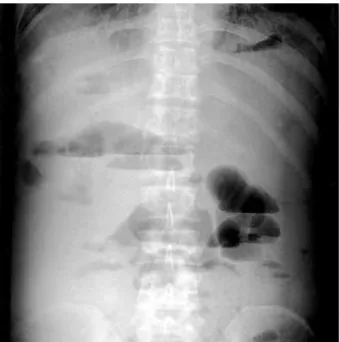
Plain abdomen (upright film) revealed multiple air-fluid levels, distention of bowel loops, and presence of bowel gas in the left lower quadrant of the abdomen (Fig. 1). Initially, we gave him lactulose enemas every 6 hr for one day. Oral lactulose was not used because of frequent vomiting and ileus.
However, there was no improvement in his mental state. Fur- thermore, he became to a state of coma, and there was an ele- vation of his venous ammonia level (298 g/dL). Computed tomography of the head revealed no evidence of intracranial hemorrhage or cerebrovascular injury. Therefore, with the consent of his family, we gave him 0.5 mg of neostigmine subcutaneously to improve his peristaltic movement. Three minutes after this treatment, there was a prompt evacuation of stool with a reduction in abdominal distention and an in- crease in bowel sound on physical examination. Then we gave him 2 L of polyethylene glycol electrolyte solution through a nasogastric tube for 4 hr. After these treatments, his venous ammonia level decreased to the normal range (19.0-60.0 g/
dL) within 12 hr, and the coma disappeared after 2 days. Plain abdomen (upright film) also revealed no air-fluid level (Fig. 2).
Then, oral lactulose therapy was restarted, and his condition remained stable. After 5 days, he was discharged from the hospital.
DISCUSSION
We present the first case of acute hepatic encephalopathy
with acute intestinal pseudo-obstruction in a cirrhotic patient who was successfully treated with neostigmine. Kiba et al. (2) reported the first successful treatment with neostigmine and polyethylene glycol electrolyte solution in a cirrhotic patient with acute hepatic encephalopathy. But, the patient did not demonstrate the signs of acute intestinal pseudo-obstruction.
Nitrogenous substances derived from the gut are thought to play a role in the pathogenesis of hepatic encephalopathy.
These compounds gain access to the systemic circulation as a result of decreased hepatic function or portal systemic shunts.
Once in brain tissue, they produce alterations of neurotrans- mission that affect consciousness and behavior (1). Most mani- festations of hepatic encephalopathy are reversible with med- ical treatment. However, some patients have progressive debil- itating syndromes, such as dementia, spastic paraparesis, cere- bellar degeneration, and extrapyramidal movement disorders, associated with structural abnormalities of the central nervous system (2). In addition, it is well known that mortality is higher with an acute encephalopathy that is classified as Child’s C and grade III or IV hepatic encephalopathy (5). Therefore, a treatment regimen that produces a more rapid response is likely to be of greater benefit to cirrhotic patients, especially in Child’s C (4).
Ileus refers to the partial or complete blockage of the small and/or large intestine either because the regular rhythmic squeezing motion is impaired or because of mechanical obst- ruction. Both types, functional or mechanical bowel obstruc- tion, are associated with increased luminal pressure that might cause gut wall ischemia and may lead to increase in intra-ab- dominal pressure. Intra-abdominal hypertension has been found in up to 20% of critically ill patients and may lead to
Fig. 1.Plain abdomen (upright film) reveals multiple air-fluid levels, distention of bowel loops, and presence of bowel gas in the left lower quadrant of the abdomen.
Fig. 2.Two days after the use of neostigmine and polyethylene gly- col electrolyte solution, plain abdomen (upright film) shows only colonic gas without an air-fluid level.
152 C.-H. Park, Y.-E. Joo, H.-S. Kim, et al.
a broad pattern of systemic consequences with multiple organ dysfunctions, including cardiovascular, hepatic, pulmonary, renal and neurological function (6). The most serious compli- cation is the abdominal compartment syndrome, a life-threat- ening condition presenting as an indication for decompressive laparotomy. Cirrhosis patients with ascites often have intestinal pseudo-obstruction (3). Consistent with this, it was reported that acute intestinal pseudo-obstruction developed after surgery or severe illness (7-9). However, there was no reported case of acute intestinal pseudo-obstruction with acute hepatic ence- phalopathy in cirrhotic patients according to review of English literature. We suspect that there was little possibility of sur- vival in cirrhotic patients with acute hepatic encephalopathy and acute intestinal pseudo-obstruction, because this combined illness may be a catastrophic condition in cirrhotic patients.
Although the pathophysiology of acute intestinal pseudo- obstruction is not fully understood, it is thought to result from an imbalance in the regulation of colonic motor activity by the autonomic nervous system. Multiple pharmacologic and metabolic factors can alter the autonomic regulation of colonic function, leading to excessive parasympathetic suppression, sympathetic stimulation, or both. This imbalance results in colonic atony or pseudo-obstruction. Therefore, neostigmine has been used as a simple, safe, and effective therapy for treat- ment of intestinal pseudo-obstruction (7-9), because this drug enhances excitatory parasympathetic activity by competing with acetylcholine for attachment to acetylcholinesterase at sites of cholinergic transmission (10). In the present case, there was no bowel sound before the administration of neostigmine.
However, after the administration of neostigmine, there was a prompt evacuation of stool with an increase in bowel sound.
Therefore, we thought that neostigmine was a salvage treat- ment to initiate the peristaltic movement and bowel cleans- ing so that dietary and endogenous nitrogenous substances could be evacuated from the intestine.
The elimination half-life of neostigmine after intravenous infusion averages 80 min. Neostigmine is hydrolyzed by plas- ma cholinesterase and is metabolized by microsomal liver enzymes. Renal excretion accounts for the clearance of 50 per- cent of the drug, and the serum half-life is prolonged in pati- ents with renal dysfunction. Therefore, patients with renal impairment may have an increased or prolonged vagomimetic response after the administration of neostigmine (8). Con- traindications for neostigmine are serum creatinine concen- tration >3 mg/dL, heart rate <60 beats/min, systolic blood pressure <90 mmHg, active bronchospasm, and signs of bowel perforation (11). In the present case, we used 0.5 mg of neo- stigmine because we thought that patients with hepatic dys- function might have an increased or prolonged vagomimetic response after the administration of neostigmine. Actually, there was a prompt bowel response after the administration of 0.5 mg of neostigmine. Therefore, a second administration
of neostigmine was not used.
In the present case, we used the polyethylene glycol elec- trolyte solution as a whole gut irrigation solution because of several reasons. First, we initially used the lactulose enema, but there was no improvement in his mental state. Therefore, we could not use it again. Second, there was a necessity of rapid bowel cleansing, because one day was already passed over without any improvement of his mental state. Third, colonic cleansing was reported to be better with polyethylene glycol electrolyte lavage (12).
In conclusion, we suggest that neostigmine may be one of the most effective treatments to initiate peristaltic movement and bowel cleansing in cirrhotic patients with acute hepatic encephalopathy and acute intestinal pseudo-obstruction.
REFERENCES
1. Blei AT, Cordoba J; Practice Parameters Committee of the American College of Gastroenterology. Hepatic encephalopathy. Am J Gastroen- terol 2001; 96: 1968-76.
2. Kiba T, Numata K, Saito S. Neostigmine and polyethylene glycol electrolyte solution for the therapy of acute hepatic encephalopathy with liver cirrhosis and ascites. Hepatogastroenterology 2003; 50:
823-6.
3. Runyon BA. Fatal bacterial peritonitis secondary to nonobstructive colonic dilatation (Ogilvie’s syndrome) in cirrhotic ascites. J Clin Gas- troenterol 1986; 8: 687-9.
4. Morgan MY, Hawley KE. Lactitol vs. lactulose in the treatment of acute hepatic encephalopathy in cirrhotic patients: a double-blind, randomized trial. Hepatology 1987; 7: 1278-84.
5. Strauss E, da Costa MF. The importance of bacterial infections as pre- cipiting factors of chronic hepatic encephalopathy in cirrhosis. Hep- atogastroenterology 1998; 45: 900-4.
6. Malbrain ML. Abdominal pressure in the critically ill: measurement and clinical relevance. Intensive Care Med 1999; 25: 1453-8.
7. Paran H, Silverberg D, Mayo A, Shwartz I, Neufeld D, Freund U.
Treatment of acute colonic pseudo-obstruction with neostigmine. J Am Coll Surg 2000; 190: 315-8.
8. Amaro R, Rogers AI. Neostigmine infusion: New standard of care for acute colonic pseudo-obstruction? Am J Gastroenterol 2000; 95:
304-5.
9. Ponec RJ, Saunders MD, Kimmey MB. Neostigmine for the treatment of acute colonic pseudo-obstruction. N Engl J Med 1999; 341: 137-41.
10. Trevisani GT, Hyman NH, Church JM. Neostigmine: safe and effec- tive treatment for acute colonic pseudo-obstruction. Dis Colon Rec- tum 2000; 43: 599-603.
11. Delgado-Aros S, Camilleri M. Pseudo-obstruction in the critically ill.
Best Pract Res Clin Gastroenterol 2003; 17: 427-44.
12. Beck DE, Fazio VW, Jagelman DG. Comparison of oral lavage meth- ods for preoperative colonic cleansing. Dis Colon Rectum 1986; 29:
699-703.