INTRODUCTION
Sepsis occurs most frequently during the neonatal period, and is associated with a poor prognosis despite continuous improvements in intensive care medicine and antibiotic ther- apy (1, 2). The causes of poor prognosis during sepsis might be attributable to multiple organ dysfunction syndrome, in- cluding septic shock, disseminated intravascular coagulation (DIC), and acute respiratory distress syndrome, caused by acti- vation of acute inflammatory responses in response to systemic infection (3).
Although nitric oxide (NO) has been implicated to play a key role in mediating the acute pathophysiological processes during sepsis (4), the use of NO synthase (NOS) inhibitors in sepsis has yielded both beneficial and detrimental effects.
Treatment with NOS inhibitor increased blood pressure and systemic vascular response (5-9), protected against DIC (10), and improved survival rate (9) in both animal and clinical stud- ies of sepsis. However, detrimental hemodynamic effects (11- 14), increased mortality (15-18), and aggravation of DIC (19) have also been reported with NOS inhibition in both neonatal and adult models of experimental sepsis. Therefore, the avail- able data on the role of NO and the efficacy of NOS inhibitors as a novel adjuvant therapy in sepsis are still controversial, and further study will be necessary to clarify this.
This study was done to evaluate the role of NO and the effi-
cacy of NOS inhibitors as a novel adjuvant therapy in neonatal sepsis. We tested the hypothesis that nonselective inhibition of NOS with Nw-nitro-L-arginine methyl ester (L-NAME) is detrimental during the early phase of experimental sepsis in the newborn piglet. In the present study, we used the newborn piglet as an animal model of neonatal sepsis because the piglet is comparable in growth spurt, energy metabolism, and vas- cular anatomy to human newborns at birth (20, 21). It is also suitable in size for continuous hemodynamic monitoring dur- ing the experiment. Escherichia coli was used to induce sepsis because it is the most common Gram-negative pathogen of neonatal sepsis (1, 2).
MATERIALS AND METHOES Animal Preparation
The experimental protocols described herein were reviewed and approved by the Institutional Animal Care and Use Com- mittee of the Samsung Biomedical Research Center, Seoul, Korea. This study also followed the institutional and National Institutes of Health guidelines for laboratory animal care.
Newborn piglets less than 3 days old were anesthetized with sodium thiopental (5 mg/kg intravenously), paralyzed with pancuronium (1 mg/kg intravenously), tracheotoimzed,
Sung Shin Kim*, Jong Hee Hwang, Chang Won Choi, Jae Won Shim, Yun Sil Chang, Won Soon Park, Chang Kyu Oh�
Department of Pediatrics, Bucheon Hospital*, Soonchunhyang University, College of Medicine, Bucheon; Samsung Medical Center, Sungkyunkwan University School of Medicine, Seoul; St. Paul’s Hospital�, Catholic University of Korea, College of Medicine, Seoul, Korea
Address for correspondence Won Soon Park, M.D.
Department of Pediatrics, Samsung Medical Center, 50 Ilwon-dong, Kangnam-gu, Seoul 135-710, Korea Tel : + 82-2-3410-3523, Fax : +82-2-3410-0043 E-mail : [email protected]
637 J Korean Med Sci 2003; 18: 637-40
ISSN 1011-8934
Copyright � The Korean Academy of Medical Sciences
Detrimental Effects of N
w-nitro-L-arginine Methyl Ester (L-NAME) in Experimental Escherichia coli Sepsis in the Newborn Piglet
The role of nitric oxide during neonatal sepsis is complex. We tested the hypothesis that nonselective inhibition of nitric oxide synthase with Nw-nitro-L-arginine methyl ester (L-NAME) is detrimental during the early phase of experimental sepsis in the newborn piglet. Newborn piglets were divided into four groups: 6 in the control group, 6 in the L-NAME control group, 12 in the sepsis group (SG), and 11 in the sepsis with L-NAME group (NS). Sepsis was induced by intravenous injection of 108colony forming units of Escherichia coli. L-NAME 10 mg/kg was given intra- venously 60 min before the induction of sepsis. The survival rate of piglets after 4 hr was 27% in NS, while it was 100% in other groups. Systemic hypotension, observed in both SG and NS, were more profound in NS. Leukopenia was observed in both SG and NS. Thrombocytopenia, prolongation of prothrombin time and acti- vated partial thromboplastin time, and increase in thrombin-antithrombin complexes were observed only in NS. Decreased PaO2/FiO2ratio, arterial pH and base excess, and increased blood lactate levels observed in both SG and NS, but were more pro- found in NS. These findings suggest that nonselective inhibition of nitric oxide syn- thase with L-NAME is detrimental during the early phase of experimental neonatal sepsis.
Key Words : Sepsis; Nitric Oxide; Animals, Newborn; Escherichia coli; NG-Nitroarginine Methyl Ester
Received : 25 April 2003 Accepted : 9 June 2003
and artificially ventilated with mechanical ventilator (Sechrist Infant Ventilator, IV-100B, Sechrist Industries Co., Anaheim, CA, U.S.A.). Femoral arteries and veins were cannulated for blood pressure monitoring and blood sampling, and for med- ication and fluid infusion, respectively. Electrocardiogram (ECG), oxygen saturation, and blood pressure were continu- ously monitored using Hewlett Packard neonatal monitoring system (Hewlett Packard Model M1276A, Hewlett Packard Co., MA, U.S.A.). Throughout the experiment, the piglet was placed under the servo-controlled warmer (Airshields Inc., Hatboro, PA, U.S.A.) and rectal temperature was maintained at between 38.0 and 39.0℃.
Experimental Protocol
After surgery and the period of stabilization, 35 newborn piglets were divided randomly into four groups: 6 in the con- trol group (CG), 6 in the L-NAME control group (NG), 12 in the sepsis group (SG), and 11 in the sepsis with L-NAME group (NS). Sepsis was induced by intravenous injection of 108 colony forming units of E. coli in 100 L of saline. L-NAME 10 mg/kg was given intravenously 60 min prior to the induc- tion of sepsis. Continuous monitoring of ECG, systemic blood pressure, and oxygen saturation was done during the experi- ment. Arterial blood gas analyses, concentrations of glucose, and lactate in the blood were measured at baseline, and at every 1 hr for 4 hr after bacterial inoculation. Complete blood count (CBC), prothrombin time (PT), activated partial throm- boplastin time (aPTT) and thrombin-antithrombin complexes were measured at baseline and at the end of the experiment.
Arterial blood gases were measured using a blood gas analyzer (Ciba-Corning Diagnostics Corp., Medfield, MA, U.S.A.) and the concentrations of glucose and lactate were measured using an YSI model 2300 dual analyzer (Yellow Springs
Instrument Co., Yellow Springs, OH, U.S.A.).
Statistical Analysis
Data were analyzed by unpaired t test for inter-group com- parisons. To detect significant changes over time within each group, data were compared using repeated measures analysis of variance with Bonferroni correction. Statistical analysis described above was done using SAS software program ver.
6.04. A p-value of <0.05 was considered significant. Data were given as mean±standard deviation.
RESULTS Survival
All piglets in the SG (n=12), CG (n=6), and NG (n=6) were found alive at 4 hr after induction of sepsis. In the NS (n=11), only 3 piglets (27%) were found alive until the end of the experiment.
Hemodynamic Changes
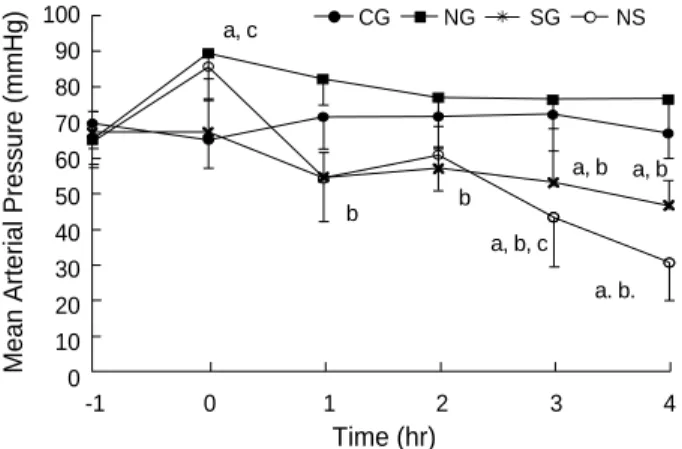
The CG showed no significant changes in mean arterial pres- sure (MAP) during the experiment (Fig. 1). In both NG and NS, MAP increased transiently but significantly, compared to CG and SG at 1 hr, and returned to baseline values in NG at 2 hr after L-NAME injection. MAP decreased progressively in both SG and NS, and became significantly different from corresponding values in CG and NG after 3 hr. This systemic hypotension was found more profound in NS.
Physiologic Variables
No significant differences in physiologic values such as heart rate, arterial pH, PaO2, PaCO2, base excess, and blood lactate
638 S.S. Kim, J.H. Hwang, C.W. Choi, et al.
Mean Arterial Pressure (mmHg)
-1 0 1 2 3 4
CG NG SG NS
Time (hr) 100
90 80 70 60 50 40 30 20 10 0
Fig. 1. Time course of changes in mean arterial pressure in new- born piglets in each experimental group. ‘CG’ means control group.
‘NG’ means L-NAME control group. ‘SG’ means sepsis group. ‘NS’
means sepsis with L-NAME group. Data are expressed as mean
±standard deviation. a: p<0.05 compared to CG, b: p<0.05 com- pared to NG, c: p<0.05 compared to SG.
�
a. b.
a, b a, b
a, b, c b b
a, c
Heart rate (/min) 201±32 199±47 186±41 235±49 Arterial base excess 0.2±2.0 0.4±2.9 -5.5±3.5a-22.4±7.5a,b,c
(mEq/L)
Arterial pH 7.41±0.11 7.35±0.08 7.28±0.14a6.82±0.26a,b,c PaCO2(mmHg) 41±17 47±12 45±11 66±23a,b,c PaO2/FiO2ratio 260±33 238±37 210±74 139±62a,b,c Blood lactate 1.4±0.6 1.0±0.4 2.9±5.2 9.5±6.1a,b,c
(mmol/L)
CG (n=6)
NG (n=6)
SG (n=12)
NS (n=11) Table 1.Physiological data at 4 hr of experiment in each group of newborn piglets
CG: Control group, NG: L-NAME control group, SG: Sepsis group, NS:
Sepsis with L-NAME group.Values given present mean±standard devia- tion.a:p<0.05 compared to CG, b:p<0.05 compared to NG, c:p<0.05 compared to SG.
L-NAME in Neonatal Sepsis 639
levels were observed in CG and NG throughout the experi- ment (Table 1). Arterial pH and base excess were significantly reduced in both SG and NS, and these abnormalities were more profound in NS. Increased PaCO2and blood lactate lev- els, and decreased PaO2/FiO2ratio were observed only in NS.
Hematologic Data
In both CG and NG, no significant abnormalities in hema- tologic values were observed during the experiment (Table 2).
Leukopenia was observed in both SG and NS until the end of experiment. Thrombocytopenia, prolongation of PT and aPTT, and increase in thrombin-antithrombin complexes were observed only in NS.
DISCUSSION
The role of NO during sepsis is generally assessed by the effect of NOS inhibitors (5-19). In the present study, pretreat- ment with L-NAME increased mortality, aggravated systemic hypotension, leukopenia, and induced disseminated intravas- cular coagulation during the early phase of experimental E. coli sepsis in the newborn piglet. These findings suggest that NO plays a protective role by attenuating the sepsis-induced mul- tiple organ dysfunction syndrome, caused by acute inflamma- tory responses, and that inhibition of NOS might therefore be detrimental at least during the early phase of neonatal sepsis.
The beneficial effects of NOS inhibitors such as improved survival rate (9), protection against DIC (10) and increase in blood pressure (5-9), and brain injury observed in other ani- mal and clinical studies of sepsis have not been observed in the present study. However, we have also observed the bene- ficial effects of NOS inhibition in our previous study of experi- mental neonatal bacterial meningitis (21). Significant atten- uation of the acute inflammatory responses and prevention of brain damage were observed with L-NAME pretreatment during the early phase of experimental E. coli meningitis in the newborn piglet. These findings implicate that the friend or foe simple dichotomy could not account for the complex role of NO in bacterial sepsis and meningitis.
As the animal model, type and dosage of NOS inhibitors,
etiologic pathogen, and stages of the disease were same in our present study of sepsis and in our previous study of meningitis (21); the reasons for this discrepancy between these two differ- ent compartments of infection remain to be explained. NO can exert both beneficial and deleterious effects in different tissues and under different conditions. Three isoforms of NOS have been described: endothelial NOS (eNOS), neuronal NOS, and inducible or immunological NOS. Among the three iso- forms of NOS, NO produced by vascular endothelial cells (eNOS) has been known to have anti-inflammatory effects such as limiting platelet aggregation (22), leukocyte adherence to endothelial cells (23), and microvascular permeability (24).
Therefore, blockade of these beneficial effects of NO with NOS inhibitors would be responsible for the detrimental effects observed in the present study of experimental neonatal sepsis.
It is also noteworthy in this regard that a number of studies have demonstrated that the nonselective inhibition of NOS activity aggravates organ function (11-14, 19) and survival rate (15-18) in various animal models of sepsis or endotoxemia.
In our previous study of meningitis (21), secondary bacterial invasion from central nervous system to the bloodstream, which would result in secondary septicemia, has not been observed in the meningitis with L-NAME group, and the blood brain barrier might also be relatively intact during the early phase of meningitis. Thus, the activation of vascular eNOS might have been minimal, and the detrimental effects with NOS inhibition have not been observed during our previous study of meningitis. Further studies using selective inhibitors of NOS will be necessary to substantiate this hypothesis.
Our data of transient but significant increase in blood pres- sure in both NG and NS immediately after L-NAME pretreat- ment supports the assumption that NO is a potent endoge- nous vasodilator (4). In this study, however, L-NAME aggra- vated septic shock and increased mortality. These detrimen- tal effects might be attributable to pulmonary hypertension and reduced cardiac output due to severe vasoconstriction with NOS inhibition (11-14). More profound decrease in arterial pH and base excess, and the increase in blood lactate level observed in NS compared to SG suggests compromised micro- circulatory blood flow and oxygen delivery to the tissues due to active vasoconstriction with NOS inhibition during neona- tal sepsis. Taken together, these findings suggest that NO may
White blood cell (/ L) 9,040±1,017 9,980±3,300 2,500±1,570a,b 1,900±2,820a,b
Platelet (×1,000/ L) 242±83 302±77 223±91 108±30a,b,c
PT (sec) 11.5±1.6 11.7±2.1 12.6±2.1 23.4±9.9a,b,c
aPTT (sec) 10.6±2.1 11.7±2.2 11.5±3.1 39.3±10.5a,b,c
TAT (ng/mL) 5.7±3.5 2.8±1.2 13.4±10.6 49.5±12.9a,b,c
Group CG (n=6) NG (n=6) NG (n=6) NS (n=11)
Table 2.Hematologic data of the newborn piglets in each experimental group
CG: Control group, NG: L-NAME control group, SG: Sepsis group, NS: Sepsis with L-NAME group, PT: Prothrombin time, aPTT: activated partial thromboplastin time, TAT: Thrombin-antithrombin complexes. Values given present mean±standard deviation. a: p<0.05 compared to CG, b: p<0.05 compared to NG, c: p<0.05 compared to SG.
640 S.S. Kim, J.H. Hwang, C.W. Choi, et al.
play an important role in maintaining organ blood flow and tissue oxygenation during the early phase of neonatal sepsis.
Our data of leukopenia, thrombocytopenia, and induction of DIC in NS suggest that nonspecific inhibition of NOS might be detrimental by blocking the anti-inflammatory effects of eNOS (19, 22-24). Besides aggravating pulmonary hyperten- sion and physiologic shunting (11-14), increased leukocyte and platelet infiltration into the lung tissue with NOS inhibi- tion might also contribute to decreased PaO2/FiO2ratio ob- served in NS during this study (19).
In summary, inhibition of NOS with L-NAME is detrimen- tal as evidenced by increasing mortality, aggravating systemic hypotension, leukopenia, and inducing disseminated intravas- cular coagulation during the early phase of experimental E. coli sepsis in the newborn piglet. These findings suggest that some of the NO produced during neonatal sepsis is beneficial, and inhibition of NOS as adjuvant therapy must be approached with great caution.
ACKNOWLWDGMENTS
This study was supported by Good Health Project, Min- istry of Health and Welfare, Republic of Korea (HMP-00- B-20200-0015).
REFERENCES
1. Klein JO. Bacterial sepsis and meningitis. In: Remington JS, Klein JO, editors, Infectious diseases of the fetus and newborn infant. Philadel- phia: WB Saunders, 2001; 943-98.
2. Polin RA, St Geme JW III. Neonatal sepsis. Adv Pediatr Infect Dis 1992; 7: 25-61.
3. Powell KR. Sepsis and shock. In: Behrman RE, Kliegman RM, Arvin AM, editors, Nelson textbook of pediatrics. Philadelphia: WB Saunders, 2000; 747-51.
4. Feihl F, Waeber B, Liaudet L. Is nitric oxide overproduction the target of choice for the management of septic shock? Pharmacol Ther 2001;
91: 179-213.
5. Avontuur JAM, Nolthenius RPT, Buijk SLC, Kanhai KJK, Bruining HA. Effect of L-NAME, an inhibitor of nitric oxide synthesis, on cardio- pulmonary function in human septic shock. Chest 1998; 113: 1640-6.
6. Petros A, Bennett D, Vallance P. Effect of nitric oxide synthase inhi- bitors on hypotension in patients with septic shock. Lancet 1991; 338:
1557-8.
7. Broccard A, Hurni JM, Eckert P, Liaudet L, Schaller MD, Lazor R, Perret C, Feihl F. Tissue oxygenation and hemodynamic response to NO synthase inhibition in septic shock. Shock 2000; 14: 35-40.
8. Kiehl MG, Ostermann H, Meyer J, Kienast J. Nitric oxide synthase inhibition by L-NAME in leukocytopenic patients with severe septic shock. Intensive Care Med 1997; 23: 561-6.
9. Strand OA, Leone AM, Giercksky KE, Skovlund E, Kirkeboen KA.
NG-monomethyl-L-arginine improves survival in a pig model of ab-
dominal sepsis. Crit Care Med 1998; 26: 1490-9.
10. Korbut R, Warner TD, Gryglewski RJ, Vane JR. The effect of nitric oxide synthase inhibition on the plasma fibrinolytic system in septic shock in rats. Br J Pharmacol 1994; 112: 289-91.
11. Robertson FM, Offner PJ, Ciceri DP, Becker WK, Pruitt BA. Detri- mental hemodynamic effects of nitric oxide synthase inhibition in septic shock. Arch Surg 1994; 129: 149-55.
12.Meadow W, Rudinsky B, Bell A, Hipps R. Effects of inhibition of endothelium-derived relaxation factor on hemodynamics and oxygen utilization during group B streptococcal sepsis in piglets. Crit Care Med 1995; 23: 705-14.
13. Gibson RL, Berger JI, Redding GJ, Standaert TA, Maycock DE, Truog WE. Effect of nitric oxide synthase inhibition during group B strepto- coccal sepsis in neonatal piglets. Pediatr Res 1994; 36: 776-83.
14. Barrington KJ, Etches PC, Schulz R, Talbot JA, Graham AJ, Pearson J, Cheung PY. The hemodynamic effects of inhaled nitric oxide and endogenous nitric oxide synthesis blockade in newborn piglets during infusion of heat-killed group B streptococci. Crit Care Med 2000; 28:
800-8.
15. Cobb JP, Natanson C, Quezado ZMN, Hoffman WD, Koev CA, Banks S, Correa R, Levi R, Elin RJ, Hosseini JM, Danner RL. Differ- ential hemodynamic effects of L-NMMA in endotoxemic and normal dogs. Am J Physiol 1995; 268: H1634-42.
16. Minnard EA, Shou J, Naama H, Cech A, Gallagher H, Daly JM. Inhi- bition of nitric oxide synthesis is detrimental during endotoxemia. Arch Surg 1994; 129: 142-7.
17. Avontuur JAM, Nolthenius RPT, van Bodegom JW, Bruining HA.
Prolonged inhibition of nitric oxide synthesis in severe septic shock:
A clinical study. Crit Care Med 1998; 26: 660-7.
18. Fukatsu K, Saito H, Fukushima R, Inoue T, Lin MT, Inaba T, Muto T. Detrimental effects of a nitric oxide synthase inhibitor (N-w-nitro- L-arginine-methyl-ester) in a murine sepsis model. Arch Surg 1995;
130: 410-4.
19. Jourdain M, Tournoys A, Leroy X, Mangalaboyi J, Fourrier F, Goude- mand J, Gosselin B, Vallet B, Chopin C. Effects of Nw-nitro-L-arginine methyl ester on the endotoxin-induced disseminated intravascular coagulation in porcine septic shock. Crit Care Med 1997; 25: 452-9.
20. Raju TNK. Some animal models for the study of perinatal asphyxia.
Biol Neonate 1992; 62: 202-14.
21. Park WS, Chang YS, Lee M. Nw-nitro-L-arginine methyl ester (L- NAME) attenuates the acute inflammatory responses and brain injury during the early phase of experimental Escherichia coli meningitis in the newborn piglet. Neurol Res 2001; 23: 862-8.
22. Yao SK, Ober JC, Krishnaswami A, Ferguson JJ, Anderson V, Golino P, Buja LM, Willerson JT. Endogenous nitric oxide protects against platelet aggregation and cyclic flow variations in stenosed and endo- thelium-injured arteries. Circulation 1991; 86: 1302-9.
23. Kubes P, Suzuki M, Granger D. Nitric oxide: An endogenous mod- ulator of leukocyte adhesion. Proc Natl Acad Sci USA 1991; 88:
4651-5.
24. Kurose I, Kubes P, Wolf R, Anderson DC, Paulson J, Miyasaka M, Granger DN. Inhibition of nitric oxide production. mechanisms of vas- cular albumin leakage. Circ Res 1993; 73: 164-71.