INTRODUCTION
Non-myeloablative allogeneic peripheral stem cell transplan- tation (NST) is an emerging treatment modality for malignant and nonmalignant hematologic disorders. Because of their low toxicity, nonmyeloablative preparative regimens are being explored in patients who are not eligible for conventional hematopoietic stem cell transplantation owing to age or med- ical contraindications (1-4). However, several problems need to be resolved in this procedure.
Although antiviral prophylaxis has led to a significant reduc- tion in early cytomegalovirus (CMV) disease after hematopoi- etic stem cell transplantation (HSCT), CMV infection con- tinues to be a major cause of morbidity and mortality in pa- tients undergoing this procedure (5). Several studies have found a high rate of CMV infection after non-myeloablative stem cell transplantation (NST) (6-8). However, it is still con- troversial whether non-myeloablative procedure increases the risk of CMV infection after HSCT, since there have been few studies comparing NST and conventional HSCT. Therefore, we examined whether NST affected the outcomes of CMV
infection in patients undergoing allogeneic HSCT. The pri- mary end point of this study was to compare the incidence of CMV infection and disease between NST group and CBT group. Secondly, we compared the time to first detection of CMV antigenemia, initial and maximal CMV antigen values and serial change of CMV antigen values after pre-emptive therapy using ganciclovir between these two groups.
MATERIALS AND METHODS Patients
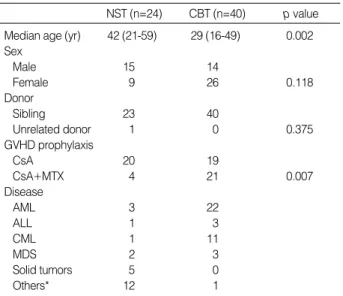
We retrospectively analyzed the medical records of 64 con- secutively registered CMV-seropositive patients who had undergone allogeneic HSCT from HLA-identical or one-locus mismatched sibling at the Asan Medical Center between July 1999 and July 2001. Forty patients underwent conven- tional bone marrow transplantation (CBT group), whereas 24 patients underwent non-myeloablative peripheral stem cell transplantation (NST group). Patient characteristics are
Suk Joong Oh*, Kyoo Hyung Lee, Je Hwan Lee, Seong Jun Choi, Woo Kun Kim, Jung Shin Lee, Mi Na Kim�
Department of Internal Medicine, Kangbuk Samsung Hospital* Division of Oncology-Hematology, Seoul;
Department of Medicine and Laboratory Medicine�, Asan Medical Center, University of Ulsan, College of Medicine, Seoul, Korea
Address for correspondence Kyoo Hyung Lee, M.D.
Department of Medicine, Asan Medical Center, Ulsan University, College of Medicine, 388-1 Poongnap-dong, Songpa-gu, Seoul 138-040, Korea
Tel : +82.2-2224-3213, Fax : +82.2-3010-6961 E-mail : [email protected]
172
The Risk of Cytomegalovirus Infection in Non-myeloablative Peripheral Stem Cell Transplantation Compared with Conventional Bone Marrow Transplantation
Non-myeloablative allogeneic peripheral stem cell transplantation (NST) is a novel therapeutic strategy for patients with hematologic malignancies. Whether non-mye- loablative transplants are associated with increased risk of cytomegalovirus (CMV) infections is unknown. To clarify this issue, we compared the outcome of CMV infec- tion following 24 allogeneic non-myeloablative peripheral blood stem cell transplants and 40 conventional bone marrow transplants (CBT). The NST regimen consisted of busulfan (4 mg/kg/day), fludarabine (30 mg/m2) and anti-thymocyte globulin (10 mg/kg). Twelve patients (50%) in the NST group and 17 (43%) in the CBT group developed positive antigenemia before day 100 (p=0.60). The time to the first appear- ance of positive antigenemia was not different between these two groups (p=0.40), and two groups showed similar initial and maximal antigenemia values (p=0.56 and p=0.68, respectively). Only one case of CMV colitis developed in the CBT group whereas CMV disease did not develop in the NST group. Although statistically in- significant, the treatment response against CMV antigenemia using ganciclovir was in favor of NST group. In conclusion, there was no difference in the risk of CMV in- fection between NST group and CBT group. Further prospective and controlled study is needed to clarify the impact of non-myeloablative procedure on the outcome of CMV infection.
Key Words : Cytomegalovirus; Hematopoietic Stem Cell Transplantation; Bone Marrow Transplantation;
Ganciclovir
Received : 17 October 2003 Accepted : 23 December 2003
shown in Table 1.
Transplantation procedures
The NST regimen consisted of busulfan (4 mg/kg/day p.o.
on days -7 to -6), fludarabine (30 mg/m2/day i.v. on days -7 to -2), and anti-thymocyte globulin (ATG: 10 mg/kg/day for on days -5 to -2). Granulocyte colony-stimulating factor (G-CSF)-mobilized peripheral stem cells from donors were infused on day 0 and 1. In the CBT group, all patients received Bu-Cy regimen (busulfan 4 mg/kg/day p.o. on days -7 to -4 and cyclophosphamide i.v. 60 mg/kg/day on days -3 to -2) and received bone marrow stem cell from donors.
GVHD prophylaxis and treatment
All patients received prophylactic therapy with cyclosporine alone or cyclosporine and methotrexate for graft-versus-host disease (GVHD) prophylaxis. Cyclosporine 1.5 mg/kg was given intravenously every 12 hr starting on day -1, then switched to an oral dose of two times the intravenous dose when oral intake became feasible. If there was no evidence of GVHD, the cyclosporine dose was tapered by 10% each month starting on day 60. Intravenous methotrexate was given at a dose of 15 mg/m2on day 1 and 10 mg/m2on days 3, 6 and 11. Patients who developed grade II-IV acute GVHD were treated with methylpredinisolone at 1-2 mg/kg/day.
Supportive care
All patients were treated as inpatients in private rooms.
Patients received antibacterial and antifungal prophylaxis with oral ciprofloxacin at 1,000 mg/day and fluconazole 100 mg/day until the absolute neutrophil count (ANC) was over 3,000/ L.
Prophylaxis against herpes simplex was performed with acy- clovir 750 mg/m2i.v. from days -7 to 14 and then switched to an oral dose at 600 mg/day until the end of immunosup- pressive therapy. Intravenous globulin 500 mg/kg was given once every 2 weeks from day -7 until day 120, then monthly until day 180.
CMV antigenemia assay
All patients were monitored for CMV infection using a CMV pp 65 antigenemia assay once a week from day -7 until day 100 after BMT. Patients with a positive antigenemia test were monitored twice weekly. The CMV antigenemia assay was performed according to the method described previously (9). In brief, 2×10⁵peripheral blood leukocytes were attached to slides using a cytocentrifuge and fixed with formaldehyde.
The cells were sequentially incubated with Clonab CMV monoclonal antibodies C10/11 (Biotest AG, Dreieich, Ger- many). After incubation, the slides were washed with pho- sphate buffered saline (PBS) and then stained using alkaline phosphatase anti-alkaline phosphatase (APAAP) technique.
If the target antigen (CMV matrix protein pp 65) is present, a red reaction product forms at leukocyte. Reading was done under a microscope to search for red reaction-positive cells.
Records were reported as the number of pp 65-positive cells per 2×10⁵cells examined.
Preemptive therapy
Ganciclovir treatment was started on the day of the first positive antigenemia findings for all patients with positive CMV antigenemia at an induction dose of 5 mg/kg intrave- nously twice daily for 1 week. Maintenance gancicovir ther- apy was continued until day 100 after transplantation with doses of 5 mg/kg/day 5 to 6 days per week.
A neutropenic episode was defined as a decrease of the ANC to 1,000/ L for 2 consecutive days. If the ANC dropped below 1,000/ L for 3 consecutive days, G-CSF was administered.
If the ANC dropped below 500/ L for >2 consecutive days in spite of therapy, treatment with ganciclovir was temporarily
NST (n=24) CBT (n=40) p value Median age (yr) 42 (21-59) 29 (16-49) 0.002 Sex
Male 15 14
Female 9 26 0.118
Donor
Sibling 23 40
Unrelated donor 1 0 0.375
GVHD prophylaxis
CsA 20 19
CsA+MTX 4 21 0.007
Disease
AML 3 22
ALL 1 3
CML 1 11
MDS 2 3
Solid tumors 5 0
Others* 12 1
Table 1.Patient characteristics
GVHD, graft-versus-host disease; CsA, cyclosporin; mTX, methotrexate.
*Others included Non-Hodgkin’s lymphoma (n=6), Hodgkin’s disease (n=3), multiple myeloma (n=3), paroxysmal nocturnal hemoglobinuria (n=2) in NST group, and one case of non-Hodgkin’s lymphoma in CBT group.
Ag, Antigen.
NST group CBT group p value
CMV Ag (+) 12/24 (50%) 17/40 (43%) 0.600 Day of 1st Ag
detection (range) 41 (12-97) 47 (20-75) 0.407 Initial Ag value 4 (1-110) 4 (1-190) 0.563 Maximal Ag value 4 (1-110) 7 (1-190) 0.680
CMV disease 0 1
Table 2.The comparison of CMV infection between NST and CBT group
discontinued until the ANC returned to a level 1,000/ L on 2 successive days.
Definition of CMV disease
CMV pneumonia was diagnosed on the basis of signs and symptoms compatible with a diagnosis of pneumonia (dys- pnea, interstitial infiltrates on chest radiography) and a bron- choalveolar lavage fluid or lung biopsy specimen positive for CMV by culture or immunohistology. Diagnosis of CMV colitis was based on gastrointestinal signs or symptoms and histologic demonstration of CMV.
Statistical Analysis
Time to the documentation of first positive CMV antigen- emia was estimated by the Kaplan-Meier method and the differences between 2 groups were compared using the log- rank test. We accepted a level of p<0.05 as statistically signif- icant. To compare the mean levels of CMV antigenemia, we used a Mann-Whitney U test. The differences of treatment response for positive CMV antigenemia were compared using repeated ANOVA. We performed the analysis using the SPSS statistical program for Windows version 10.0.
RESULTS Transplant outcome
All patients achieved engraftment except 1 patient in the NST group. The NST group (median 11days) showed faster neutrophil engraftment than CBT group (median 14 days).
Seven (29%) in the NST group and 5 (12%) in the CBT group developed acute GVHD III-IV. After a median follow-up of 575 days (range 44-1146) for surviving patients, 30 CBT patients are alive with an actuarial survival of 75%. In NST,
8 patients are alive with a median follow up of 234 days (range 49-1106) with an actuarial survival of 33%. Of 10 deaths in CBT and 16 deaths in NST, 6 were due to relapse or disease progression. Of the remaining 20 patients, 5 died of acute GVHD, 8 patients died of infection, one patient died of graft failure.
Incidence and levels of CMV Antigenemia
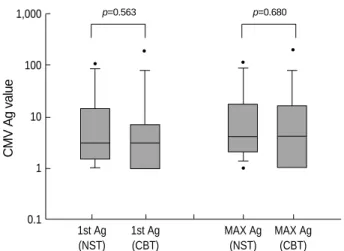
In the NST group, 12 patients (50%) developed antigen- emia at a median onset of 44 days (range 12-97). Seventeen patients (43%) developed CMV antigenemia at a median onset of 47 days (range 20-75) in the CBT group. The time to the first appearance of positive antigenemia was not different be- tween these two groups (p=0.40, Fig. 1). The median num- ber of initial CMV antigen value of NST group was 4 (range 1-110) and that of CBT group was 4 (range 1-190). The medi- an number of maximal CMV antigen of NST group was 8 (range 1-110) and that of CBT group was 7 (range 1-190).
There was no significant difference in the degree of initial and maximal CMV antigen value between NST group and CBT group (Fig. 2).
Serial CMV antigenemia values after pre-emptive therapy using ganciclovir
Of the 12 NST group patients who had CMV antigenemia, 9 patients received pre-emptive therapy using ganciclovir and one patient developed neutropenia. In the CBT group, 14 patients received pre-emptive therapy and 3 patients developed neutropenia. The serial antigen value declined to baseline with- in 7 weeks in all of the patients undergoing pre-emptive thera- py. The serial change of antigenemia values during pre-emptive therapy using ganciclovir is shown in Fig. 3. Although statis- tically insignificant, there was a trend for the treatment res- ponse using ganciclovir in favor of NST group (p=0.168).
Probability of CMVantigenemia
Days from HSCT 0.6
0.5 0.4 0.3 0.2 0.1
0.0
20 40 60 80 100
p=0.04
CBT group NST group
Fig. 1.Probability of developing positive CMV antigenemia after non-myeloablative and conventional transplantation shown by Kaplan-Meier curves.
Fig. 2.The initial (1st Ag) and maximum (Max Ag) antigenemia values, compared between non-myeloablative and conventional transplantation procedures.
CMV Ag value
1,000
100
10
1
0.1
1st Ag 1st Ag MAX Ag MAX Ag
(NST) (CBT) (NST) (CBT)
p=0.563 p=0.680
CMV disease
Among the patients who received pre-emptive therapy, no patient developed CMV disease in the NST group whereas one patient developed CMV colitis in the CBT group. The patient who had CMV colitis suffered from acute GVHD before the onset of disease and she was treated with combi- nation of ganciclovir and intravenous immunoglobulin. She recovered from CMV colitis after 1 month of therapy.
DISCUSSION
Following conventional allogeneic hematopoietic stem cell transplantation, all patients experience a period of profound neutropenia and immunodeficiency that are responsible for serious infection. Over the past years several groups have devel- oped non-myeloablative regimens, allowing engraftment of donor hematopoietic stem cells with lesser toxicity compared with conventional HSCT. This reduced extrahematologic toxi- city may lead to a reduction in infectious complication post transplant. However, in earlier studies, it was reported that the risk of CMV infection had been increased in patients un- dergoing NST. One potential assumption is the possible delay of immune reconstitution after NST. Since the NST regimen is primarily based on the concept of intensifying immunosup- pression to enhance engraftment of donor cells rather than cytoreduction, it is likely that CMV infection will increase during this procedure.
Mohty et al. reported a high frequency of CMV infections after NST using a regimen consisting of fludarabine, busul- fan and ATG (6). A higher incidence of early and late CMV infection was also observed after a conditioning regimen with fludarabine, melphalan, and Campath 1H, a mono- clonal anti-CD52 antibody (7). In all of these NST protocol, anti-thymocyte globulin or CAMPATH 1H was used in the
conditioning regimens for promoting engraftment, which may lead to delayed reconstitution of CMV-specific T cell responses post transplant. On the other hand, Junghanss et al. observed a trend toward less CMV infection and disease after NST using low-dose TBI with fludarabine (10). Naka- mura et al. also showed a reduced incidence of CMV reacti- vation after conditioning with fludarabine and cyclophos- phamide (11). Therefore, the risk of CMV infection appears to be influenced by the agents used in the NST regimen.
In a recent study of Fred Hutchison Cancer Center, com- paring 56 recipients of an NST with 112 matched recipients of a myeloablative transplant found a lower probability of CMV antigenemia, viremia in the former group (12). They reported a similar incidence of CMV disease between the two groups and delayed onset of the disease in the NST group.
They assumed that host hematopoietic cells, especially T lym- phocytes, are not immediately eradicated by NST regimen if anti-lymphocyte antibody was not used; host T cells were present in the peripheral blood for up to 6 months. In con- trast, conventional myeloablative conditioning regimens lead to early and complete disappearance of host hematopoiesis.
On the basis of these findings, it is conceivable that the pro- longed presence of host immunity after NST may provide some protection against early CMV infection as compared with conventional myeloablative transplantation.
We used anti-thymocyte globulin in NST group as a con- ditioning regimen. However, there was no significant differ- ence in the outcome of CMV infection between NST and CBT group in our study. The frequency of CMV antigenemia, time to the first appearance of positive antigenemia after HSCT, initial and maximal CMV antigen values did not differ bet- ween these two groups. Although statistically insignificant, the treatment response against CMV infection was in favor of NST group rather than CBT group. These results may be explained in the following.
Our study had some limitations. The patient number was small and this study was a retrospective analysis. The main shortcoming of our study is the differences in baseline patient characteristics between the two transplant groups. Since NST allografts are currently offered to patients who are poor can- didates for conventional myeloablative therapies due to older age or medical co-morbidity, we were unable to perform a well- matched cohort study. Some variables that may influence the outcomes of CMV infection favor the NST group; others favor the CBT group. Age has been described as a risk factor for CMV disease (13). Median age of NST group was much higher than CBT group which may have influenced the rate of CMV infection. In addition, in our study, acute GVHD was much more frequent in the NST group. Acute GVHD is a well known risk factor of CMV infection and CMV disease. So this result may negatively impact the outcome of CMV infection in NST group. In a recent study from Germany, the incidence of CMV antigenemia and CMV-related interstitial pneumonia was lower in alloPBSCT compared to BMT recipients; sug-
Fig. 3.Serial changes in antigenemia values in patients receiving ganciclovir were compared between non-myeloablative and con- ventional transplantation.
CMV Ag values
Weeks after ganciclovir treatment 40
30
20
10
0
0 1 2 3 4 5 6 7
p=0.168
NST group
CBT group
gesting more rapid immune reconstitution following PBSCT compared to BMT(14). All of the CBT group patients in our study received bone marrow stem cells from donors whereas NST group patients received peripheral blood stem cells, a fact favoring the NST group. Some variables favor NST group and others favor CBT group. Overall they may have resulted in no difference for the risk of CMV infection between the two group.
In conclusion, our study showed that a new approach NST did not increase the risk of CMV infection and disease com- pared with CBT. Besides, the treatment response against CMV infection using ganciclovir seemed to be in favor of NST. However, our study had limitation mentioned above.
Large, prospective and well controlled studies are needed to clarify the impact of NST procedure on the outcome of CMV infection.
REFERENCES
1. Slavin S, Nagler A, Naparstek E, Kapelushnik Y, Aker M, Cividalli G, Varadi G, Kirschbaum M, Ackerstein A, Samuel S, Amar A, Brautbar C, Ben-Tal O, Eldor A, Or R. Nonmyeloablative stem cell transplantation and cell therapy as an alternative to conventional bone marrow transplantation with lethal cytoreduction for the treat- ment of malignant and nonmalignant hematologic disease. Blood 1998; 91: 756-63.
2. McSweeney PA, Niederwieser D, Shizuru JA, Sandmaier BM, Molina AJ, Maloney DG, Chauncey TR, Gooley TA, Hegenbart U, Nash RA, Radich J, Wagner JL, Minor S, Appelbaum FR, Bensinger WI, Bryant E, Flowers ME, Georges GE, Grumet FC, Kiem HP, Torok- Storb B, Yu C, Blume KG, Storb RF. Hematopoietic cell transplan- tation in older patients with hematologic malignancies: replacing high-dose cytotoxic therapy with graft-versus-tumor effects. Blood 2001; 97: 3390-400.
3. Khouri IF, Keating M, Korbling M, Przepiorka D, Anderlini P, O’Brien S, Giralt S, Ippoliti C, von Wolff B, Gajewski J, Donato M, Claxton D, Ueno N, Andersson B, Gee A, Champlin R. Transplant lite: Induc- tion of graft-versus-malignancy using fludarabine-based nonabla- tive chemotherapy and allogeneic blood progenitor cell transplan- tation as treatment for lymphoid malignancy. J Clin Oncol 1998; 16:
2817-24.
4. Giralt S, Estey E, Albitar M, van Besien K, Rondon G, Anderlini P, O’Brien S, Khouri I, Gajewski J, Mehra R, Claxton D, Andersson B, Beran M, Przepiorka D, Koller C, Kornblau S, Korbling M, Keating M, Kantarjian H, Champlin R. Engraftment of allogeneic hematopoi- etic progenitor cells with purine analog-containing chemotherapy:
harnessing graft-versus-leukemia without myeloablative therapy.
Blood 1997; 89: 4531-6.
5. Park SH, Lee HG, Choi SC, Lee HR, Kim KH, Nam EM, Kim WS,
Yoon SS, Kang WK, Kim SW, Park KC. Cytomegalovirus infection and disease after allogeneic hematopoietic stem cell transplantation;
analysis of risk factors. Korean J Hematop Stem cell Transplant 2001;
5: 23-31.
6. Mohty M, Faucher C, Vey N, Stoppa AM, Viret F, Chabbert I, Cha- bannon C, Bouabdallah R, Ladaique P, Collet L, Zandotti C, Maran- inchi D, Blaise D. High rate of secondary viral and bacterial infec- tions in patients undergoing allogeneic bone marrow mini-transplan- tation. Bone Marrow Transplant 2000; 26: 251-5.
7. Chakrabarti S, Mackinnon S, Chopra R, Kottaridis PD, Peggs K, O’Gorman P, Chakraverty R, Marshall T, Osman H, Mahendra P, Craddock C, Waldmann H, Hale G, Fegan CD, Yong K, Goldstone AH, Linch DC, Milligan DW. High incidence of cytomegalovirus infection after nonmyeloablative stem cell transplantation: potential role of Campath-1H in delaying immune reconstitution. Blood 2002;
99: 4357-63.
8. Nakai K, Kanda Y, Mineishi S, Saito T, Ohnishi M, Niiya H, Chizuka A, Takeuchi T, Matsubara H, Kami M, Makimoto A, Tanosaki R, Kunitoh H, Tobinai K, Takaue Y. Suspected delayed immune recov- ery against cytomegalovirus after reduced-intensity stem cell trans- plantation using anti-thymocyte globulin. Bone Marrow Transplant 2002; 29: 237-41.
9. Boeckh M, Bowden RA, Goodrich JM, Pettinger M, Meyers JD.
Cytomegalovirus antigen detection in peripheral blood leukocytes after allogeneic marrow transplantation. Blood 1992; 80: 1358-64.
10. Junghanss C, Boeckh M, Carter R. Incidence of herpesvirus infections following nonmyeloablative allogeneic stem cell transplantation.
Blood 2000; 96 (Suppl 1): 188a (Abstr. 805).
11. Nakamura R, Cortez K, Solomon S, Battiwalla M, Gill VJ, Hensel N, Childs R, Barrett AJ. High-does acyclovir and pre-emptive gan- ciclovir to prevent cytomegalovirus disease in myeloablative and non-myeloablative allogeneic stem cell transplantation. Bone Mar- row Transplant 2002; 30: 235-42.
12. Junghanss C, Boeckh M, Carter RA, Sandmaier BM, Maris MB, Maloney DG, Chauncey T, McSweeney PA, Little MT, Corey L, Storb R. Incidence and outcome of cytomegalovirus infections fol- lowing nonmyeloablative compared with myeloablative allogeneic stem cell transplantation, a matched control study. Blood 2002; 99:
1978-85.
13. Einsele H, Hebart H, Kaufmann-Schneider C, Sinzger C, Jahn G, Bader P, Klingebiel T, Dietz K, Loffler J, Bokemeyer C, Muller CA, Kanz L. Risk factors for treatment failures in patients receiving PCR- based preemptive therapy for CMV infection. Bone Marrow Trans- plant 2000; 25: 757-63.
14. Trenschel R, Ross S, Husing J, Ottinger H, Elmaagacli A, Roggen- dorf M, Schaefer UW, Runde V. Reduced risk of persisting cytome- galovirus pp65 antigenemia and cytomegalovirus interstitial pneu- monia following allogeneic PBSCT. Bone Marrow Transplant 2000;
25: 665-72.