약 학 회 지 제
36
권 제2
호120-125(1992) Yakhak Hoeji Vol. 36, No. 2
생체시료로 부터 미량 디페닐허단토인의 고상추출에 Af용될 흡착제의 특성
김경례* • 이경원• 심원희
성균관대학교 약학대학 (Received January 31, 1992)
Characterization of Adsorbents for the Solid-Phase Extraction of Trace Diphenylhydantoin from Biological Samples
Kyoung Rae K im *, Kyoung Won Lee and Weon Hee Shim College of Parmacy, Sung Kyun Kwan University, Suwon 440-746, Korea
Abstract—Ths sorption and desorption properties of four different solid adsorbents were evalua
ted for the trace enrichment of diphenylhydantoin from biological samples. Graphitized carbon black(GCB) gave the highest adsorption coefficient. And among the organic solvents examined, methanol gave the highest desorption coefficient. Using the GCB column, the optimum elution volume of the eluting solvent was evaluated from the breakthrough curve of diphenylhydantoin.
The usefulness of GCB as the solid adsorbent was examined for the solid-phase extraction of diphenylhydantoin from serum in the concentration range of 20-50
Keywords □ Solid-phase extraction, diphenylhydantoin, graphitized carbon black, adsortion coeffi
cient.
Diphenylhydantoin(5,5-diphenyl-2,4-imidazolidi- nedione, Dilantin, Phenytoin, DPH) 은 여러 가지 발작증세 중 대발작 및 정신운동성 발작에 유효한 전간치료제로 가장 널리 처방되 며 종종 phenobarbi- tal과 같은 bartital 계 약물 및 다른 항전간제를 병용 투여한다
D PH 외 치료혈중 농도는 10~20ng/m/이며 LDso은 mice에 정맥주사시 92m g/kg*^l다. 부작용으로는 임 신 중 최기형 발생작용이 있다고 보고되었으며« 혈중 농도 20~40|ig/m/에서 처육증식, 안구진탕증, 탈모 등이 유발되므로 장기간에 걸친 효과적인 전간치료 흑은 급성중독 진단을 신속히 하기 위해서는 DPH 혈중 농도의 신속정확한 측정은 매우 중요하다.5•«
생체액 중의 DPH 미량분석에 대한 많은 연구가
»본 논문에 관한 문의는 이 저자에게로.
보고되었으나^® DPH와 병용투여되는 barbital 계, 여 러 항전 간제들 및 대사산물들의 동시 분석 온 gas ch- romatography( GC) ® ~ h i g h performance liquid chroinatography(HPLC)법 에 * ® 의 해 서 대부분 이 루어지고 있다. HPLC범보다 감도, 분리능, 정밀성 등에 우수성을 갖는 GC법을 적용하여 좀 더 정밀하게 DPH를 분석하기 위헤서는 DPH외 amide와 imide 기를 적당한 휘발성 기능기로 먼저 전환한다. 본 실 험에서는 수분에 매우 안정하여 GC 및 gas chroma
tography-mass spectrometry 분석 성질이 우수한 tert-butyldimethylsilyl (TBDMS) 유도체화 반응조건 을 최적화하여 보고한 바 있다?3>
생체시료 중 미량의 약물을 정확히 분석할 때는 여러 유기성. 무기성 방해물질을 제거하여 목적성분을 선택적으로 분리하고 사용할 분석기기외 검출한계 이상으로 오염없이 농측하는 과정이 선행된다. 이제
120
까지 보고된 대부분의 DPH 분석농측방범으로서는 용매 추출법이 이 용 되 었 다 . ® 일 반 적 으 로 용매 추 출법은 여러 단계에 걸친 조작이 요구되고 사용되는 용매 자체외 불순물에 외한 오염 및 시료의 손실 등의 문제점이 있으므로 복합시료 중 미량의 유기성분들을 신속히 분리농측하기 위해서 조작이 간단한 고상 추 출범(solid-phase extraction : SPE) 이 ^ 최 근 에 개 발되어 용매 추출법을 대체하고 있다.
고상 추출범의 고형흡착제로서는 극성이 적은 유 기성 흡착제인 RP-Ci
8, XAD-2, XAD-7이 주로 사용 되며 무기성인 비극성 흡착제 graphitized carbon black(GCB) 파 Thermosorb(TS) 도 사용되고 있 다_26,27) rp_Ci
8를 사용한 DPH외 고상추출범이 보고 되었으나^« 최적의 흡착제와 용출유기용매를 결정하 기 위해서는 이용가능한 흡착제들의 흡착계수 및 탈 착계수와 같은 기초적인 물리적성질 조사가 선행되 어야 한다.
본 연구에서는
2개의 benzene ring 때문에 편국 성이 큰 DPH에 대한 최적의 흡착제를 선정하기 위 하여 수용액 중에서 DPH에 대한 GCB, XAD-2, XAD- 7과 TS의 동적흡착계수를 측정하였다. 또한 흡착된 DPH에 대한 최적외 용출용매를 선정하기 위헤서 DPH를 용해하는 유기용매의 탈착성질을 조사하였다.
실험방법
재료 및 시약~60/80mesh 크기의 GCB로 사용된 Carbopack B, 16/50 mesh의 XAD-2, XAD-7(Supelco, U.SA) 파 80/100 mesh의 TS(Union Carbide, U.S.A.) 4종류의 고형흡착제를 본 실험에서 조사하였다. 각 흡착제들은 methanol, acetone, methylene chloride 순으로 세정한 후 (Soxhlet 장치 사용) 진공하에서 가열하여 활성화시켰다. Diphenylhydantoin(DPH) 과 medazepam(MZ)은 각각 부광약품과 종근당으로 부 터 제공되었다. Petroleum ether, methanol, methy
lene chloride, dimethylformamide(Junsei, Japan) 특급시약이고 acetone, ethyl acetate(Hyasi, Japan)은 HPLC급 시약이 었다. TBDMS 유도체화 시약은 N- Methyl-N-(tert-butyldimethylsilyl)trifluoroaceta- mide(MTBSTFA)는 Pierce(Rockford, IL, U.S.A.) 것을 사용하였다. 사용된 물은 2차 정제한(Milli Q water system, U .SA) 탈 이온수였다.
약물용액과 혈청시료一DPH를 methanol에 10 mg /m/외 농도가 되도록 용해하여 DPH 원액을 조제하 였다. MZ을
1 0mg/m/의 농도가 되도록 methan이에 용해하여 내부표준 원액으로 사용하였다. DPH 원액을 첨가하여 20 ppm MZ을 함유한 5에서 50 ppm까지의 농도범위외 DPH 표준 methanol 용액을 조제하였다.
탈 이 온수를 pH 4로 조정 한 후 DPH 표준원액을 첨 가하여 50 ppm의 DPH 표준수용액을 조제하였다. 혈 청에 DPH가 10에서 50ppm 농도가 되도록 DPH 원액을 첨가한 후 p H 4 물을 가헤서 10배 S1 석한 혈청시료를 조제하였다.
Tert-butyldimethylsilyKTBDMS) 유도체화 반등-- TBDMS 유도체화 최적 반응 조건에 따라서^ > dime
thylformamide (DMF) 40 |o/, MTBSTFA 10|j/를 첨 가한 후 상온에서 흔화하여 유도체화하였다.
GC 분석조건一 G o t flame ionization detector가 부착된 Pye Unicam GCV를 사용하였다. Cross-linked methylsilicone HP-1 fused silica capillary column (13X0.2 mm I.D. d/ : 0.2 (im) 을 고정 상으로 nitrogen gas룔 이동상으로 사용하였다. Column 온도는 200°C (4 min) 에 서 분당
6t 로 280°C까지 상승시 켜 10분간 유지하였고 주입시료량은 0.6 m/(30 : 1 split mode), 검출기와 주입부 온도는 각각 320°C, 280°C이었다.
MZ에 대한 DPH외 peak height ratio롭 검량선의 값과 비교하여 모든 정량 계산을 하였다.
동적흡착계수 측정 (Dynamic Adsorption Coeffi
cient, K_
4)-GCB, XAD-2, XAD-7, TS의 그램 당 DPH에 대 한 흡착력 을 50 ppm, pH 4 표준수용액 을 사용하여 조사하였다. 각 흡착제
( 2 0 0mg) 가 기밀하게 충전되 어 있는 내 경 4 mm의 polypropylene column (Supelco, U.S.A.) 에 50 ppm 표준수용액 (5 m/) 을 통 과시켜 얻은 여액 중 3m/룔 취해 내부표준물질인 MZ을 최종농도가 20 ppm되게 가한 후 ethyl ace
tates. 2회 추출한 추출액 2 m/를 질소 gas로 60°C 에 서 휘발시킨 후 앞에서 기술한 방범에 따라서 TBDMS 유도체로 전환시킨 다옴 0.6 m/룔 GC에 주입하였다.
흡착계수 Ka는 다용 식에 외해 산출하였다.
K
a- Cs _ |ig of DPH per g of solid phase C
lfig of DPH per ml of water phase
유기용매의 동적탈착계수 측정(Dynamic Desorp
tion Coefficient, Kd) —50 ppm 표준수용액 5 m/를
Vol. 36. No. 2. 1992
122 김 경 례 • 이 경 원 • 심원희
200 mg의 column 에 통과시켜 DPH를 GCB 에 동적 으로 흡착시킨 후 methanol, acetone, acetonitrile, 흑은 ethyl acetate 5 m/를 통과시 켜 DPH 를 탈착시 켰다 탈착액 3m/를 취해 내부표준물질인 MZ을 최 증농도가
2 0ppm 이 되 게 가하고 60 t 로 질소 gas 하에 휘발시킨 후 앞에서 기술한데로 유도체화한 뒤 GC로 분석하였다. 탈착계수 Kd는 다용식에 외해서 산출하 였다.
Ko-~ C
l_ jig of DPH per ml of organic liquid Cs |ig of DPH per g of GCB Breakthrough Curve 및 Elution Curve 촉정一사 용한 HPLC 기기는 U
6K injector 6000A solvent deli
very system과 440 absorbance detector가 부착된 Waters Assoc. Model ALC 200이었다. HPLC용 stai- nless steel column(5 cm X 2 mm i.d.) 에 75 mg외 GCB를 기밀하여 충전한 후 injector와 UV detector 사이에 직접 연걸하고 methanol 흑은 물을 이동상 으로 사용하여 UV 검 출 파장 240 nm에 서 DPH를 on- line monitroing하였다. 탈착계수가 가장 큰 metha- n이을 낮은 유속(0.5 m//min)으로 GCB column내로 통과시키면서 50 ppm 표준수용액을 각각 50, 100, 250 m/썩 주업하여 UV response(0.4 AUFS)를 측정하여 검량선을 측정하였다. GCB column을 p H 4 물로 평 형시킨 후 50 ppm 표준수용액(100 mO을 주입하고 pH 4의 물을 20분간 통과시키 면서 (3m//min) respo- nse(0.01 AUFS)를 측정하여 DPH breakthrough cu- rve룔 측정하였다. 이동상을 methan이로 바꾼 후 (0.5 m//min) 흡착된 DPH가 GCB column으로부터 용 출되는 elution curve(0.4 AUFS)를 측정하였다.
혈청 중의 DPH 정 랑一 유리 column(2 mm i.d.) 에 GCB(50mg)를 기밀하게 충전하여 GCB 고상추출 column을 만들었다. 이것을 methanol, acetone, me
thylene chloride 순서로 세정하고 감압하에서 가열 하여(IR lamp) 활성화시켰다. pH 4 물(2 m/)로 평형 시킨 GCB 고상추출 column에 20에서 50 ppm 혈청 시료 1 m/를 loading시킨 후 p H 4 물(3 m/)을 통과 시키고 탈수한 후 petroleum ether(3 m/)를 통과하고, 감압하에서 건조시켰다. Methanol(2 m/)를 통과시켜 얻은 용출액을 휘발 건조시키고 탈착계수 측정에서 기슬한 절차에 따라 DPH를 정량하였다.
결과 및 고찰
본 실험의 TBDMS 유도체화 조건 및 GC 분석조 건을 사용하여
1 0분 이내에 내부표준물질인 MZ과 DPH를 높은 분리능으로 분리할 수 있었으며 5에서 50 ppm 농도 범위에서 일직선외 검량선을 얻을 수 있었다.^^^
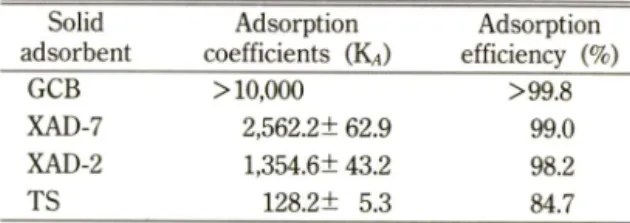
널리 고상주줄용 고형제로 사용되는 흡착제 중에서 pH 의 영향을 받지 않는 XAD-2, XAD-7, GCB, TS를 선정하여 DPH에 대한 흡착력을 조사하였다. 약산성 DPH(pK^ = 8.3) 외 이온화를 억제하기 위하여 표준수 용액의 pH를 4로 조정하였다. 약물들의 일반적인 득 성 혈중 농도보다 높은 50 ppm 농도에서 각 흡착제 들의 동적흡착 계수 K
4값을 구하였다(Table I). 보 편적으로 사용되고 있는 비극성 XAD-2와 중간극성의 XAD-7보다 GCB외 흡착력이 월동히 강함을 보여주고 있다. 그러나, 흑연 유사구조를 가진 비극성 TS의 흡착력은 예상외로 가장 낮았다. GCB는 흑연 유사 구조외 다환성 비극성 흡착제로서 편국성이 큰 기능 단을 가진 분자들에 대해서 선택적으로 친화성이 크
다 27,28)
Benzene ring을 2개 가진 편극성 이 큰 DPH 에 대 한 GCB의 흡착계수가 예상한대로 10,000 이상의 가장 높은 값으로 이것은 99.8% 이상외 흡착효율에 해당 한다. GCB는 완전한 무기물질이므로 용매에 전혀 용해되지 않고 국성용매나, 열, pH에 안정한 장점을 지니고 있다.
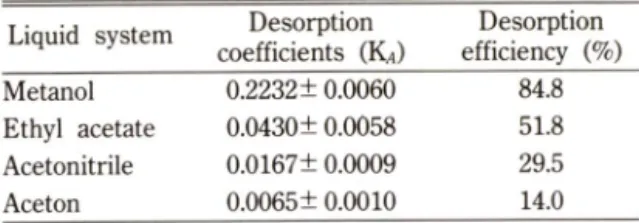
최적외 흡착제인 GCB로부터 DPH를 높은 회수율 로 탈착시킬 수 있는 용출 용매를 선정하기 위하여 DPH를 용해하는 4가지 유기용매의 탈착계수를 동적
Table I —Dynamic adsorption coefficients in solid ad- sorbent-water systems
Solid adsorbent
Adsorption coefficients (K^)
Adsorption efficiency (%)
GCB >
1 0 , 0 0 0>99.8
XAD-7 2,562.2+62.9 99.0
XAD-2 1,354.6+ 43.2 98.2
TS 128.2± 5.3 84.7
Conditions: Solid adsorbents, 200 mg packed into colu- mns(4 mm i.d.); DPH 250 |ig in pH 4.0 water(5 m/);
gravity flow; n=4.
J. Pharm. Soc. Korea
v o lu m e (m l)
0.5 I.O vo lu m e (m l)
Fig. 1 — Breakthrough curve(A) and methanol elution curve(B) for DPH.
Table III —Results of breakthrough studies on GCB column
Passage of water Without After Column efficiency (n) 89 139
Recovery (%) NA 99.5 ± 1.5
Elution volume (m/) 0.9 0.7 NA = not aplicable
Conditions: GCB, 75 mg (5 cmX2 mm i.d.): 50 ppm DPH, 100 |i/: methanol elution (0.5 m//min); pH 4.0 wa
ter passage (3 m//min); n = 3.
ling을 보여주면서 용출되고 있음을 보여주고 있다.
GCB에 흡착된 DPH를 직접 methanol로 용출시킨 경우와 물을 통과시킨 후 용출시켰을 경우를 정량적 으로 비교헤 보았다(Table III). 후자의 경우에 오히려 GCB column efficiency가 1.6배 증가하고 99% 이 상외 회수율을 내면서 methanol elution 용량이 감소함을 보여주고 있다. 이러한 결과는 DPH가 GCB column외 상단부분에 좁은 band 형으로 강하게 흡착되어 상 당한 앙의 물이 통과되는 동안에도 확산이 적게 일 어나 band broading이 적었다고 설명할 수 있다.
혈청 중의 수용성 단백성분들 염기성 유기물 기타 수용성 방헤물질들을 제거시키기 위하여 pH 4 물로 세정한 후에는 지용성 유기방해물질을 제거하기 위 해서 petroleum ether로 세정하였다 DPH가 첨가된 혈청 시료를(100 |j/) pH 4 물로 10배 희석한 후 GCB (50 mg) 고상추출 column에 loading시 키 고, pH 4 물 Table I I —Dynamic desorption coefficients in GCB-Li-
quid systems Liquid system Desorption
coefficients (K^)
Desorption efficiency {%) Metanol 0.2232± 0.0060 84.8 Ethyl acetate 0.0430± 0.0058 51.8 Acetonitrile 0.0167± 0.0009 29.5 Aceton 0.0065± 0.0010 14.0 Conditions: GCB, 200 mg packed into columns(4 mm i.d.); DPH 250 |ig in pH 4.0 water(5 m/); liquid solvent 5 m/: gravity flow; n=4.
탈착 조건하에서 조사하였다. Methanol, ethyl ace
tate, methylene chloride, acetone 순서로 Ko값이 감소하는 경향을 보여주고 있다(Table II), 탈착계수 가 클수록 용출 용매의 GCB로부터 약물의 회수율이 중가한다. 84.8%외 탈착효율에 해당되는 가장 높은 탈착계수를 가진 methanol을 최적의 용출 용매로 선정하였다. 용매의 용출용량을 5 m/ 이 상 증가시 키 면 탈착효율이 더 증가했을 것으로 사료된다.
선정된 GCB/methan이의 고상추출 흡착제/용매쌍 을 혈액과 같은 복합생체시료에 적용할 때에는 DPH를 용출하기 전에 GCB 표면으로부터 시료외 대부분을 차지하는 수용성, 그리고 지용성 방해물질 들을 제거해야 한다.2 6 흡착된 매난가 GCB
C 0 -lumn에서 breakthrough되기 전까지 수용성 방해물 질을 제거시키는 목적으로 통과 가능한 p H 4 물외 최대용량을 측정하기 위하여 DPH 표준수용액 (100
|i)을 주입한 후 통과되는 물을
2 0분간 on-line moni- toring하여 breakthrough curve(Fig. lA )를 구하였다.
60 m/외 물이 통과해도 GCB로부터 DPH가 breakth- rough되지 않옴을 보여주고 있다. 이것은 수용성 방 헤물질들을 제거하기 위해 pH 4의 물로 세정하는 동 안 GCB에 DPH가 정량적으로 흡착되고 있옴을 증 명 해 준다. 70 mg외 GCB column에 서 5 |ig의 DPH의 breakthrough 용량이 60 m/ 이상일 것으로 주산할 수 있다.
물이 통과되는 동안 GCB에 흡착되어 있는 DPH를 정량적으로 용줄하는데 필요한 용줄용매의 최소용량 을 측정하여 GCB column의 흡착 및 탈착효율을 조 사하기 위해서 methan이을 낮은 유속으로(0.5 m//
min) 통과시켰다. 얻어진 elution curve(Fig. IB )는 methanol 1 ml 이내에 흡착된 DPH가 약간의 tai-
Vol. 36. No. 2, 1992
A B
0
I
0 0 0 5•e I
< >
r>
124
김 경 례 • 이 경 원 • 심원희Time (min)
Fig. 2—Typical chromatogram of serum spiked with DPH.
Cross-linked methylsilicon HP-1 fused silica capillary column (13X0.2 mm i.d.); tempera
ture programmed from 200t
:(4 min) to 280°C at 6°C/min; 0.6 \d injected at split mode (30:1).
Table IV—Recoveries of known amounts of dipheny- Ihydantoin added to human serum Amount added
(|ig//m/)
Amount found Oig/m/
Recovery {%)
20.0 15.0 75.0
30.0 24.0 80.0
40.0 32.2 80.4
50.0 40.3 80.6
Conditions: Serum, 100 |j/ diluted with pH 4.0 water(0.9 ml); GCB, 50 mg packed into glass columns(2 mm i.d.):
methanol eluate, 1 m/; n = 2.
(3 m /) 과 petroleum ether(3 ml) 순서로 GCB룔 세 정한 후에 DPH를 methanol로 용출하였다. 용출시료 를 분석하여 얻은 전형적인 chromatogram(Fig. 2 )에 서 GCB를 사용한 고상추출 전처러 방범이 혈청 중의 방해물질을 대부분 제거하며 선택적으로 DPH 를 흡
착, 탈착하는데 효과적임을 보여주고 있다.
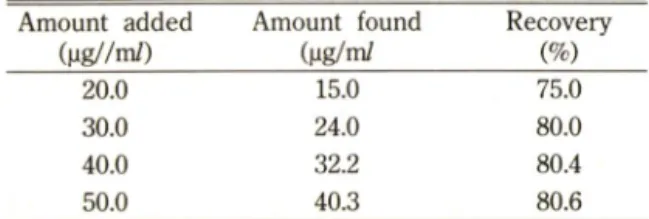
DPH를 20에서 50 ppm의 농도로 첨가한 혈청시료 에 GCB/methanol 고상추출범을 적용하여 분석한 결과 75% 이상의 회수율을 얻었다(Table IV). DPH 표준수용액에 적용했을 때보다 회수율이 떨어지는 것은 혈청 자체의 matrix effect 때문일 것으로 사료 된다.
본 고상추출법은 20분 이내에 5단계에 걸쳐 적은 앙외 생체시료를 전처리하여 DPH 분리 농측을 가 농케하므로 기존의 용매추출법보다 훨씬 신속하며 간편하다.
결론적으로 본 연구에서 선정한 최적의 GCB/me- thanol 고상추출범이 미량의 생체시료로부터 신속히 DPH 를 분리 농축하는데 효과적으로 사용될 수 있 으며 또한 HPLC의 on-line 시료 전처리 precolumn 으로서 확장되어 사용될 수 있으리라 기대된다.
감사의 말씀
한국과학재 단외 1988년도 기 초연구비 ( 파제 번호 881-0204-005-2) 지원에 의해서 본 연구가 이루어졌 으므로 감사드립니다.
문 헌
1)
2
)
3)
4)
Richens, A. and Robin, A.(ed): Drug Treatment of Epilepsy, Henry Kimpton, London, pp. 61-76(1976).
Swinyard, E.A., Woodbury, D.M., Penry, J.K. Sch
midt and Pippenger, C.E.(eds): Antiepileptic Drugs, Raven Press, New York, pp. 1-7(1982).
Richens, A. and Marks, V.(eds): Therapeutic Drug Monitoring, Churchill Livingstone, Edinburgh, 19 81.
Wells, P.G., Harbison, R.D., Hassell, T.M., Johns
ton, M.C. and Dudley, K.H.(eds): Phenytoin-Indu- ced Teratology and Gingival Pathology, Raven Press, New York, pp. 83(1980).
5) Porter, R.J., Woodbury, D.M., Penry, J.K. Schmidt and Pippenger, C.E.(eds): Antiepileptic Drugs, Ra
ven Press, New York, p. 167-175(1982).
Gerson, B. and Anhalt, J.P.: HPLC and Therapeutic Drug Monitoring, Am. Soc. Clin. Pathol., Chicago, IL, (1980).
6)
/
Pharm. Soc. Korea7) Horning, M.G. and Tsuji, K.(ed): GLC and HPLC Determination of Therapeutic, Agents, M. Dekker, New York. pp. 477-518 (1978).
8) Kapetanovic, I.M.: Analysis of antiepileptic drugs.
J. Chromatogr., 531, 421-457(1990).
9) Kumps, A. and Mardens, Y.: Improved gas-liquid chromatographic method for the simultaneous de
termination of phenobarbital, phenytoin, carbama- zepine and pyrimidine in biological fluids. J. Chro- matogr., 182, 116-120(1980).
10) Sarhan, F., Ziegler, J.M., Nicolas, A. and Siest, G.:
Rapid method for simultaneous determination of phenobarbital, diphenylhydantoin and their main hydroxylated metabolites by nitrogen selective gas chromatography. J. Chromatogr., 185, 505-510(19 80).
11) Bailey, Farmer, RE., Hoskins, J.A., Lamb, J.H. and Peal, J.A.: Determination of plasma phenytoin by capillary gas chromatography with nitrogen-phos- phorus detection and with selective ion monito
ring. J. Chromatogr., 310, 199-203(1984).
12) Shimada, K., Wakabayashi, H. and Sato, A
.:Gas chromatographic determination of m- and p- hyd- roxyphenytoin in the urine of epileptic patients.
/. Chromatogr., 339, 331-337(1985).
13) Rudenko, B A , Lenchik, N.V. and Djabarov, D.N.:
Gas chromatographic determination of nitrogen containing anticonvulsant drugs and opium alka
loids using a thermoaerosol detector. J. Chroma- togr., 364, 369-376(1986).
14) Inotsume, N., Higashi, A., Kinoshita, E., Matsnoka, T. and Nakano, M.: Rapid and sensitive determi
nation of ethotoin as well as carbamazapine, phe- nobarbital, phenytoin and primidone in human se
rum. J. Chromatogr., 383, 166(1986).
15) Maurer, H.H.: Detection of anticonvulsants and their metabolites in urine within a general unk
nown analysis procedure using computerized gas chromatography-mass spectrometry. Arch. Toxicol., 64(7), 554-561(1990).
16) Dolan, J.W., Van der Wal, Sj. Bannister, SJ. and Snyder, L.R.: On-line liquid chromatographic anal
ysis for drugs in serum with the technicon **Fast- LC" system: Performance data for theophylline and four commonly used anticonvulsants and their
metabolites. Clin. Chem., 126(7), 871-880(1980).
17) Stout, S.A. and DeVane, C.L.: Tissue assay of phe- nobarbital, phenytoin and p-hydroxyphenytoin by high performance liquid chromatography. J. Chro- matogr., 285, 500-508(1984).
18) Benjamin Gerson, Frances Bell and Sum Chan.:
Antiepileptic agents-primidone, phenobarbital, phenytoin and carbamazepine by reversed-phase liquid chromatography. Clin. Chem., 30(1), 105-108 (1984).
19) Wed, N.: Simultaneous determination of eleven antiepileptic compounds in serum by high perfor
mance liquid chromatography. / Chromatogr., 305, 127-133(1985).
20) Kushida, K. and Ishizaki, T.: Concurrent determi
nation of valproic acid with other antiepileptic drugs by high-performance liquid chromatography.
J. Chromatogr., 338, 131-139(1985).
21) Lum, J.T., Vassanji, N A and Wells, P.G.: Analysis of the toxicollogically relevant metabolites of phe
nytoin in biological samples by high performance liquid chromatography. /. Chromatogr., 338, 242- 248(1985).
22) Juergens, U.: High performance liquid chromatog
raphic determination of antiepileptic drugs by an advanced automated sample processor. J. Chroma- togr., 371, 307-312(1986).
23) Kim, K.R,, Lee, K.W. and Hong, J.K.; Simultaneous gas chromatography of barbiturates and dipheny
lhydantoin as tert-butyldimethylsilyl derivatives.
Manuscript in preparation to be submitted to the / Chromatogr., 1992.
24) Yago, L.: Automated sample preparation using sor
bent extraction. Int. Lab., Nov/Dec, 40(1985).
25) Dimson, P., Brocato, S. and Majors, R.E.: Automa
ting solid phase extraction for HPLC sample pre
paration. Amer. Lab., O ct 82(1986).
26) Kim, K.R., Lee, YJ. and Lee, H.S.; Solid-phase ex
traction of chloramphenicol with graphitized car
bon black. J. Chromatogr., 400, 285(1987).
27) Kim, K.R. and Myoung, N.H.: Characterization of adsorbents as the solid matrices for the trace en
richment of drugs from biological samples: 1. So- lid-phase extraction of flurazepam. 성균약학논문 점, 1, 66-73(1989).
Vol. 36, No. 2, 1992