48
Vol. 21, No. 1, March 2016
www.jcpjournal.org
Anti-inflammatory and Anti-tumorigenic Effects of Açai Berry in Helicobacter felis-infected mice
Original Article
Ju Yup Lee
1,3, Nayoung Kim
1, Yoon Jeong Choi
1, Ryoung Hee Nam
1, Seonmin Lee
1, Min Hee Ham
1, Ji Hyung Suh
1, Yoon Jin Choi
1, Hye Seung Lee
2, Dong Ho Lee
1Departments of
1Internal Medicine and
2Pathology, Seoul National University Bundang Hospital, Seongnam,
3Department of Internal Medicine, Keimyung University School of Medicine, Daegu, Korea
Background: The aim of this study was to evaluate the anti-inflammatory and anti-tumorigenic effect of açai berry after chronic Helicobacter felis colonization in the stomachs of C57BL/6 mice.
Methods: A total of 57 four-week-old female C57BL/6 mice (18 control mice and 39 experimental mice) were used. The mice were administered orogastrically with vehicle only or vehicle containing H. felis, 5 times every other day. After inoculation of H. felis, mice were fed either a standard or an açai-containing diet and then sacrificed at 4, 24, and 52 weeks. The infection status and degree of inflammation were determined by culture and histopathology. The level of gastric mucosal myeloperoxidase (MPO), TNF- , and interleukin-1 (IL-1) were measured by ELISA.
Results: At 24 weeks after inoculation, mucosal atrophy and mucous metaplasia appeared in all infected mice. At 52 weeks after inoculation, dysplastic change was noted in 10%, 25%, and 50% of mice in the H. felis-control, H. felis-açai 5%, and H. felis-açai 10%
groups, respectively. The neutrophil, monocyte, atrophy, and metaplasia grades of infected mice showed no significant difference among the H. felis-infected groups. H. felis-infected mice fed with açai berry showed no significant difference compared with H. felis-infected control mice in gastric mucosal MPO, TNF-, and IL-1 levels.
Conclusions: H. felis that colonized the stomachs of C57BL/6 mice provoked inflammation, and induced mucosal atrophy, metaplasia, and dysplasia. However, açai berry did not effectively prohibit the gastric carcinogenesis which was induced by chronic H. felis infection.
(J Cancer Prev 2016;21:48-54)
Key Words: Açai (Euterpe oleracea), Stomach, Helicobacter felis, Inflammation
Received February 29, 2016, Revised March 5, 2016, Accepted March 7, 2016 Correspondence to: Nayoung Kim
Department of Internal Medicine, Seoul National University Bundang Hospital, 82 Gumi-ro 173beon-gil, Bundang-gu, Seongnam 13620, Korea Tel: +82-31-787-7008, Fax: +82-31-787-4051, E-mail: [email protected], ORCID: Nayoung Kim, http://orcid.org/0000-0002-9397-0406 Copyright © 2016 Korean Society of Cancer Prevention
cc This is an Open Access article distributed under the terms of the Creative Commons Attribution Non-Commercial License (http://creativecommons.org/licenses/by-nc/4.0) which permits unrestricted non-commercial use, distribution, and reproduction in any medium, provided the original work is properly cited.
INTRODUCTION
The prevalence of gastric cancer is high in Korea
1and Helicobacter pylori infection is a major etiologic factor associated with gastric cancer,
2which shows a high prevalence of 54.4%
among asymptomatic Korean adults.
3H. felis , which is analogous to H. pylori in humans, is one of the most common organisms colonizing the mouse stomach
4and causes natural infections in mice.
5Chronic H. felis infection induces severe inflammation, atrophy, metaplasia, dysplasia, and gastric cancer in C57BL/6 mice.
6We previously demonstrated that H. felis colonized the stomachs of C57BL/6 mice and provoked severe inflammation,
eventually inducing mucosal atrophy, metaplasia, dysplasia, and cancer.
7Numerous studies have focused on gastric cancer chemoprevention; among these approaches, blocking the H.
pylori -associated gastric cancer pathway has been shown to be important for gastric cancer prevention.
Fruits and vegetables that contain various compounds,
including antioxidant and anti-inflammatory compounds, are
considered promising sources for preventive agents of various
cancers. Among them, açai berry has received considerable
attention in recent years as a ‘super fruit’ because of its high
antioxidant capacity and potential anti-inflammatory activities.
8Açai ( Euterpe oleracea Mart.) belongs to the family Arecaceae
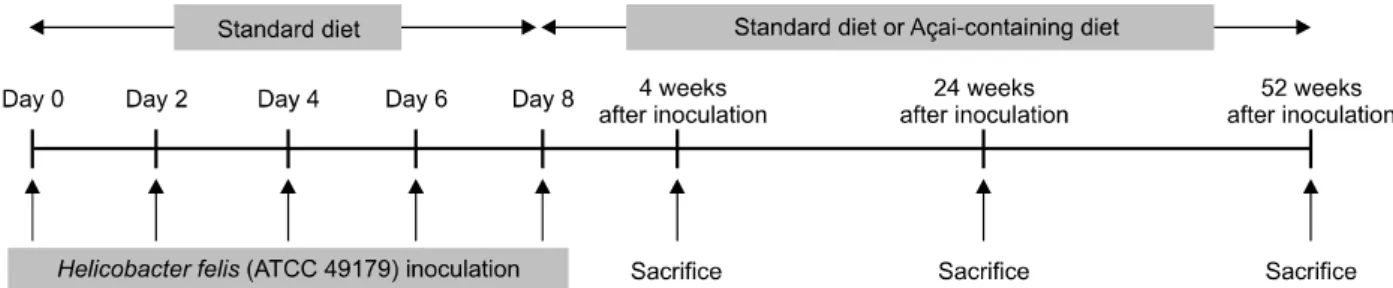
Figure 1.
Schematic representation of the experimental design.(palm tree) and is widely cultivated in the Amazon region of Brazil. It contains various essential nutrients, including fatty acids, amino acids, minerals, and antioxidant such as anthocyanins, proanthocyanidins, and other flavonoids.
9Açai was found to attenuate cell proliferation and tumor growth in an esophageal cancer rodent model,
10and açai feeding attenuated dimethylhydrazine-induced rat colon carcinogenesis.
11The açai flavonoid velutin is a potent anti-inflammatory agent that blocks lipopolysaccharide-mediated TNF- and interleukin (IL)-6 production by inhibiting NF- B activation and the mitogen- activated protein kinase pathway.
12Although consumption of açai has increased, few studies have examined its protective effect in gastric carcinogenesis. Thus, the aim of this study was to evaluate the anti-inflammatory and anti-tumorigenic effect of açai berry after chronic H. felis colonization in the stomachs of C57BL/6 mice.
MATERIALS AND METHODS
1. Animals and Helicobacter felis infection
A total of 57 (18 control mice and 39 experimental mice) four-week-old female C57BL/6 mice (Orient Co. Ltd., Seoul, Korea) weighing 10 to 15 g were used for the experiment.
The mice were administered orogastrically with vehicle only (0.25 mL, for controls) or vehicle containing more than 1 × 10
7colony- forming units/mL of H. felis (ATCC 49179), 5 times every other day. After inoculation of H. felis , mice were fed with a standard or an açai-containing diet for 4, 24, and 52 weeks, respectively (Fig. 1). Both the control and H. felis -infected groups were divided into 3 groups, respectively, according to the diet and housed in a cage maintained at 23
oC with a 12/12-hour light/dark cycle under specific pathogen-free conditions. Group 1 (con) included control mice fed with the standard diet; group 2 (açai 5%) included control mice fed with 5% açai powder (AP); group 3 (açai 10%) included control mice fed with 10% AP; group 4 ( H. felis [HF]-con) included H. felis -infected mice fed with the standard
diet; group 5 (HF-açai 5%) included H. felis -infected mice fed with 5% AP; and group 6 (HF-açai 10%) included H. felis -infected mice fed with 10% AP. The mice were sacrificed by CO
2asphyxiation at 4, 24, and 52 weeks after H. felis inoculation.
Açai berries were collected in Belem, Brazil and spray-dried using an industrial spray-dryer system with maltodextrin DE10 as a carrier agent.
13AP was produced by Centroflora Group Brazil (Botucatu, Brazil) with the following characteristics: 6% moisture, 350 to 650 g/L volumetric density, and 0.5% total polyphenol content.
13Freeze-dried açai pulp powder was purchased from Boto Superfood Co. (Seoul, Korea), which imported the end product. Freeze-dried AP was stored at −20
oC until analysis. A cereal-based commercial diet containing 5% and 10% AP for mice was specially formulated by the Orient Bio (Seongnam, Korea) according to the National Research Council’s recommendation to meet rodent nutritional needs.
13The standard diet group was fed with LabDiet for rodent (Orient Bio) which contained 18%
protein, 5.2% fat, and other crude fiber and minerals.
2. Histopathology
At necropsy, stomach tissue was taken from the greater curvature beginning at the squamocolumnar junction and ending at the gastroduodenal junction. Linear gastric strips were fixed in 10% formalin solution, processed using standard methods, embedded in paraffin, sectioned at 5 m, and stained with hematoxylin and eosin. The stomach mucosa was histologically examined for inflammatory and epithelial changes and for the presence of H. felis . The degree of neutrophil infiltration, mononuclear cell infiltration, atrophy, and metaplasia were assessed according to the updated Sydney classification as follows: 0, absent; 1, minimal; 2, mild; 3, moderate; 4, marked.
3. Measurement of mucosal myeloperoxidase, TNF-, and interleukin-1
Ten milligrams of scraped mucosa were homogenized for 30
seconds with a Polytron homogenizer in 200 L of ice-cold lysis
Table 1.
Histologic findings in mice infected withHelicobacter felis
during 52 weeksHistologic finding Control 4 weeks 24 weeks 52 weeks
Standard Açai 5% Açai 10% Standard Açai 5% Açai 10% Standard Açai 5% Açai 10%
H. felis
(+) 0/18 6/6 4/4 4/4 5/5 3/3 4/4 5/5 4/4 3/4Neutrophil 2/18 3/6 1/4 2/4 3/5 3/3 4/4 4/5 4/4 3/4
Monocyte 2/18 1/6 1/4 0/4 5/5 3/3 4/4 5/5 4/4 4/4
Atrophy 0/18 0/6 0/4 0/4 3/5 3/3 4/4 3/5 3/4 3/4
Metaplasia 0/18 0/6 0/4 0/4 3/5 3/3 4/4 3/5 3/4 3/4
Lymphoid aggregate 0/18 0/6 0/4 0/4 3/5 3/3 2/4 4/5 1/4 3/4
Dysplasia 0/18 0/6 0/4 0/4 0/5 0/3 0/4 1/5 1/4 2/4
Gastric cancer 0/18 0/6 0/4 0/4 0/5 0/3 0/4 0/5 0/4 0/4
Values are presented as the number of mice with histological findings/total number of mice. Açai, açai berry.
buffer (200 mM NaCl, 5 mM EDTA, 10 mM Tris [pH 7.4], 10%
glycerin, 1 mM phenylmethylsulfonyl fluoride, 1 g/mL leupeptin, and 28 g/mL aprotinin). The cell suspensions were centrifuged at 13,000 rpm for 15 minutes, and the resulting supernatant was assayed using a myeloperoxidase (MPO) ELISA kit (HyCult Biotechnology, Uden, The Netherlands). For TNF- and IL-1, the appropriate kits from R&D Systems (Minneapolis, MN, USA) were used following the manufacturer’s instructions. Protein concen- tration was measured using a Bio-Rad Protein Assay Kit (Bio-Rad Laboratories, Hercules, CA, USA). The concentration of each cytokine was measured as pg/mg of protein. All assays were performed in triplicate.
4. Statistical analysis
Data are expressed as the mean ± SEM. Comparison between 2 groups (control and experimental) was performed using the Mann-Whitney U-test. P -values less than 0.05 were considered statistically significant. All statistical analyses were performed using IBM SPSS software ver. 20.0 (IBM Co., Armonk, NY, USA).
RESULTS
1. Histopathology
At 4 weeks after inoculation, neutrophil and monocyte infiltration occurred in all infected mice. At 24 weeks after inoculation, mucosal atrophy and mucous metaplasia appeared in most of infected mice. At 52 weeks after inoculation, dysplastic change was noted in 20%, 25%, and 50% of mice in the H.
felis -control, H. felis -açai 5%, and H. felis -açai 10% groups, respectively. Gastric cancer was not observed in any infected mice (Table 1).
The neutrophil and monocyte grades of infected mice peaked at week 24 and were significantly higher compared with the
control mice; however, there was no significant difference among the H. felis -control, H. felis -açai 5%, and H. felis -açai 10% groups (Fig. 2A and 2B). No atrophy and metaplasia occurred up to week 4; however, all infected mice showed higher atrophic and metaplasia scores than control mice after 24 weeks. There was no significant difference among the H. felis -control, H. felis -açai 5%, and H. felis -açai 10% groups (Fig. 2C and 2D).
2. Expression of pro-inflammatory cytokines
The gastric mucosal MPO level (ng/mL) in H. felis -infected mice was significantly higher than in control mice at 24 and 52 weeks; however H. felis -infected mice fed with açai berry showed no significant difference compared with H. felis -infected control mice (Fig. 3A). Gastric mucosal TNF- expression (pg/mL) in H.
felis -infected mice showed no significant difference compared with control mice at 4, 24, and 52 weeks (Fig. 3B). Gastric mucosal IL-1 expression (pg/mL) in H. felis -infected mice was significantly higher than in control mice at 24 and 52 weeks; however H.
felis -infected mice fed with açai berry showed no significant difference compared with H. felis -infected control mice (Fig. 3C).
DISCUSSION
In this study, we observed inflammation, atrophy, metaplasia, and dysplasia in mouse stomachs after H. felis inoculation;
however, Açai berry did not effectively reduce inflammation and dysplasia.
It has been reported that in various inflammation models, açai
berry extract has anti-inflammatory and antioxidant effects by
regulating protein enzymes expressed by pro-inflammatory
cytokines and induced by oxidative stress. Xie et al.
12showed that
compounds in açai effectively inhibited the expression of TNF-
and IL-6 by inhibiting NF- B activation and p38 and JNK
Figure 2.
Gastric histopathology scores of (A) neutrophil, (B) monocyte, (C) atrophy, and (D) metaplasia at 4, 24, and 52 weeks afterHelicobacter felis
(HF) inoculation and standard diet or diets with açai powder. Data are presented as means ± SEMs. *P
< 0.05 compared with controls of the same diet. Con, control.phosphorylation. They also found lower serum levels of TNF-
and IL-6 in apoE-deficient mice fed with 5% freeze-dried açai juice powder for 20 weeks. In a mouse experiment, açai extract also reduced inflammatory and oxidant markers such as MPO, superoxide dismutase, catalase, gluthathione peroxidase, TNF-, and nitrites that increase by cigarette smoking.
14Açai berry also has anticancer activities. Açai berry effectively inhibited N-nitrosomethylbenzylamine-induced esophageal cancer and reduced serum levels of IL-5 and IL-8, which may have an
inhibitory role in F344 rats.
15Açai berry upregulated serum levels of IFN- and activated macrophage-released IFN- induced apoptosis through the Fas/FasL pathway in glioma cells.
16In addition, many berry types may function through a tumor inhibition mechanism in nitrosomethylbenzylamine-treated rat esophagus.
15Açai also reduced the development of dimethylhydrazine-induced rat colon carcinogenesis.
11It has been shown that berry compounds, including cranberry,
raspberry, and strawberry extracts, are capable of preventing the
Figure 3.
Expression of gastric mucosal (A) myeloperoxidase (MPO), (B) TNF-, and (C) interleukin (IL)-1 by ELISA at 4, 24, and 52 weeks afterHelicobacter felis
(HF) inoculation and stand- ard diet or diets with açai powder. Data are presented as means± SEMs. *
P
< 0.05 compared with controls of the same diet.Con, control.