https://doi.org/10.22889/KJP.2020.51.4.238
238
자소엽에서 분리된 트리테르페노이드의 베타-아밀로이드 응집 억제 효과
여지윤·이충현·박소영*
단국대학교 약학대학 약학과
Anti-Amyloidogenic Effects of Triterpenoids Isolated from Perilla Leaves
Ji-Yun Yeo, Chung-Hyun Lee, and So-Young Park*
College of Pharmacy, Dankook University, Cheonan 31116, Korea
Abstract Perilla frutescens Britton var. acuta Kudo, an annual plant primarily cultivated in China, Japan, and Korea, has been used as a traditional medicine to treat inflammatory diseases, depression, and many anxiety-related disorders. Previously, we reported the inhibitory effects of n-hexane layer of P. frutescens var. acuta extract against beta-amyloid (Aβ) aggregation, and the isolation of asarone derivatives as active constituents from n-hexane layer. In this study, dichloromethane layer of P. frute- scens var. acuta was applied to bioassay-guided isolation methods accompanied with Thioflavin T (Th T) fluorescence assay to investigate the inhibitory effect on Aβ aggregation and disaggregation. As the results, three triterpenoids including ursolic acid (1), tormentic acid (2) and corosolic acid (3) were isolated. All compounds reduced Aβ aggregation and increased dis- aggregation of preformed Aβ aggregates in a dose-dependent manner. However, the inhibitory effect of three compounds on Aβ aggregation was not correlated with antioxidant activity, which was measured by DPPH assay. Taken together, these results suggest that the triterpenoid derivatives from P. frutescens have the potential to be developed as good therapeutics or pre- ventatives for AD.
Keywords Perilla frutescens var. acuta, Beta-amyloid, Aggregation, Disaggregation, Triterpenoids
현대 의학 기술의 발달과 더불어 노인 인구가 급속히 증 가하고 있으며 이에 따른 노인성 질환도 가파르게 증가하 고 있다. 특히 퇴행성 질환인 치매 환자수가 급격히 증가하 고 있는데 현재 국내 65세 이상 노인 인구 10명 중 1명은 치매 환자인 것으로 보도되고 있다. 치매는 기억력 감퇴, 인 지 기능 저하가 언어 및 행동 장애로 이어지는 퇴행성 뇌질
환으로 알츠하이머성 치매가 가장 많은 부분을 차지한다.1)
알츠하이머성 치매의 주요 원인으로는 베타-아밀로이드 단 백질(Aβ)을 꼽을 수 있다. 인체 내에서 과생산된 베타-아밀 로이드는 서로 응집하여 응집체를 형성하게 되고, 베타-아 밀로이드 응집체들이 신경독성을 유발하는 것으로 알려져 있다.2,3)
꿀풀과 (Labiatae)에 속하는 1년생 초본식물인 차즈기 (Perilla frutescens Britton var. acuta Kudo) 또는 주름소엽 (P. frutescens Britton var. crispa Decaisne)의 잎 및 끝 가지 를 쓰는 자소엽은 중국이 원산지이며, 현재는 한국, 일본,
베트남, 중국 및 아시아 지역에 널리 분포하고 있다. 자소 엽은 예로부터 기침, 구토, 만성 기관지염 등을 개선하는 용 도로 사용되어 왔으며, 항염증 및 항알레르기 작용과 항균 및 항산화 효과 등의 약리작용도 보고되고 있다.4,5) 자소엽 의 주성분으로는 rosmarinic acid, caffeic acid와 같은 페놀 성 화합물과 함께 플라보노이드, 테르페노이드 등이 분리되 었다.4,6) 자소엽의 지표성분으로는 rosmarinic acid, elemicin, perilladehyde 등이 제시되고 있는데, elemicin, perilladehyde 의 경우 자소엽이 재배되는 곳에 따라 개체 간의 성분 함유 량의 편차가 커서 지표성분으로의 활용이 제한적이며, 이 중 편차가 가장 적은 rosmarinic acid가 지표성분으로 가장 적합하다고 제시되고 있다.7,8)
본 연구진은 자소엽의 메탄올 추출물이 베타-아밀로이드 의 응집을 억제하는 효과가 뛰어남을 보고한 바 있다.9) 또 한, 자소엽의 메탄올 추출물을 용매 분획한 분획층 중 가장 활성이 뛰어난 헥산층으로부터 bioassay-guided isolation 방 법을 통해 유효성분을 분리하였으며 그의 구조를 아사론 유 도체로 동정하였다.10) 본 연구는 그 후속 연구로서, 자소엽 추출물의 분획층 중 두 번째로 베타-아밀로이드 응집 억제
*교신저자(E-mail):[email protected] (Tel): +82-41-550-1434
효과가 뛰어난 디클로로멘탄층으로부터 아사론 유도체 이 외의 새로운 유효성분을 분리하여 그 활성을 확인하였다.
재료 및 방법
실험재료 실험에 사용한 자소엽(P. frutescens var. acuta) 은 삼흥건재(Samhong medicinal herb market; Seoul, Korea) 에서 2019년에 구입하였으며, 약학대학 박소영 교수가 감정 한 후 실험에 사용하였고, 그 표본(2019-012-PF-DKU)은 단 국대학교 약학대학 생약학 연구실에 보관하였다.
기기 및 시약 1H 및 13C-NMR은 AscendTM500(500 MHz, Bruker, Karlsruhe, Germany)를 이용하여 측정하였다 (Center for Biomedical Engineering Core Facility, 단국대 학교, 한국). 질량분석기는 AB Sciex사의 4000QTrap (Framingham, MA, USA)을 사용하였다. Column chromato- graphy용 충진제는 Watchers사의 Silica gel Si 60, 40-63 µm를 사용하였고 TLC plate의 발색은 20% ethanol성 H2SO4 용액을 사용하였다. 분리용 유기 용매는 옵티젠(충주, 한국)에서 구입하였다. Beta-amyloid(1-42)는 GL Biochem (상하이, 중국)에서, Thioflavin T(Th T)는 Sigma Aldrich(Saint Louis, MO, USA)에서 구입하였다. Dimethyl sulfoxide (DMSO)는 Wako pure chemical(Japan)에서 구입하였다.
추출 및 분리 구매한 자소엽(6 kg)을 분쇄한 후 100%
에탄올로 3회 추출(10 L씩 3회)한 후 여과한 여액을 감압 농축하여 650 g의 에탄올 추출물을 확보하였다. 확보한 에 탄올 추출물에 소량의 메탄올을 가해 녹인 후 물에 현탁하 고 n-hexane, dichloromethane, ethylacetate로 연속적으로 분 획하여 n-hexane(116.1 g), dichloromethane(30 g), ethylace- tate(263.3 g), 그리고 물층(226.7 g)을 확보하였다. 이 중 dichloromethane 층을 실리카겔을 고정상으로 사용한 오픈 컬럼크로마토그래피(chloroform : methanol = 100 : 1~5 : 5~0 : 1)에 적용하여 7개의 소분획물을 확보하였다. 이 중 PFD 2를 실리카겔을 고정상으로 사용한 오픈 컬럼크로마토그래 피(n-hexane : acetone = 8 : 2)로 분획하고 정제(chloroform : methanol = 100 : 1~50 : 1)하여 화합물 1(120 mg)를 얻었다.
소분획물 PFD 4를 실리카겔을 고정상으로 사용한 오픈 컬 럼크로마토그래피(chloroform : methanol = 100 : 1~20 : 1~0 : 1)에 적용하여 얻은 소분획물중 2개를 정제((chloroform : methanol = 20 : 1) 또는 (chloroform : acetone = 4.5 : 1~1 : 1)) 하여 화합물 2(41 mg)와 화합물 3(11.7 mg)를 얻었다.
화합물 1 White powder; C30H48O3 MS m/z 457 [M+H]+; 1H NMR (500 MHz, Pyridine-d5): δ 5.47 (1H, brs, H-12), 3,44 (1H, dd, J=10.0, 5.5 Hz, H-3), 2.62 (1H, d, J=11.0 Hz, H-18), 2.31 (1H, td, J=13.0, 3.5 Hz, H-15), 2.10 (1H, td, J=13.5, 4.0 Hz, H-16), 1.23 (3H, s, Me-23), 1.21 (3H, s, Me-27), 1.03 (3H, s, Me-26), 1.01 (3H, s,
Me-24), 0.98 (3H, d, J=6.0 Hz, Me-29), 0.95 (3H, d, J=6.0 Hz, Me-30), 0.87 (3H, s, Me-25); 13C NMR (125 MHz, Pyridine-d5): δ 181.2 (C-28), 140.5 (C-13), 126.9 (C-12), 79.4 (C-3), 57.1 (C-5), 54.8 (C-18), 49.3 (C-9, C- 17), 43.7 (C-14), 41.2 (C-8), 40.7 (C-19), 40.6 (C-4, C- 20), 40.3 (C-1), 38.7 (C-22), 38.5 (C-10), 34.8 (C-7), 32.3 (C-21), 30.1 (C-23), 29.9 (C-15), 29.4 (C-2), 26.2 (C-16), 25.2 (C-27), 24.9 (C-11), 22.3 (C-30), 19.9 (C-6), 18.6 (C-29), 18.5 (C-26), 17.5 (C-24), 16.4 (C-25).
화합물 2 White powder; C30H48O5 MS m/z 489 [M+H]+; 1H NMR (500 MHz, Pyridine-d5): δ 5.52 (1H, brs, H-12), 4.04 (1H, ddd, J=10.5, 9.5, 4.5 Hz, H-2), 3.32 (1H, d, J=9.5 Hz, H-3), 3.06 (1H, ddd, J=13.5, 12.5, 4.5 Hz, H-16), 2.98 (1H, s, H-18), 1.65 (3H, s, Me-27), 1.37 (3H, s, Me-29), 1.20 (3H, s, Me-23), 1.05 (3H, d, J=6.0 Hz, Me-30), 1.04 (3H, s, Me-26), 1.01 (3H, s, Me-24), 0.93 (3H, s, Me-25); 13C NMR (125 MHz, Pyridine-d5):
δ 180.4 (C-28), 144.6 (C-13), 127.7 (C-12), 83.6 (C-3), 72.4 (C-19), 68.3 (C-2), 55.7 (C-5), 54.3 (C-18), 48.5 (C- 17), 48.1 (C-9), 48.0 (C-1), 42.6 (C-20), 42.1 (C-14), 40.1 (C-8), 39.8 (C-4), 38.5 (C-10, C-22), 33.2 (C-7), 29.2 (C- 23), 29.1 (C-15), 26.8 (C-29), 26.7 (C-21), 26.1 (C-16), 24.6 (C-27), 24.5 (C-11), 18.9 (C-6), 17.5 (C-24), 17.1 (C-26), 16.7 (C-25), 16.4 (C-30).
화합물 3 White powder; C30H48O5 MS m/z 489 [M+H]+; 1H NMR (500 MHz, Pyridine-d5): δ 5.38 (1H, brs, H-12), 4.18 (1H, d, J=11.0, 9.0, 4.5 Hz, H-2), 3.48 (1H, d, J=6.0 Hz, H-19), 3.18 (1H, d, J=9.0 Hz, H-18), 3.19 (1H, d, J=9.0 Hz, H-3), 1.62 (3H, s, Me-27), 1.25 (3H, s, Me-23), 1.17 (3H, s, Me-29), 1.09 (3H, s, Me-30), 1.06 (3H, s, Me-24), 1.05 (3H, s, Me-25), 1.00 (3H, s, Me-26); 13C NMR (125 MHz, Pyridine-d5): δ 179.1 (C- 28), 139.0 (C-13), 125.3 (C-12), 83.5 (C-3), 68.3 (C-2), 55.6 (C-5), 53.2 (C-18), 47.8 (C-9, C-17), 47.7 (C-1), 42.3 (C-14), 39.7 (C-8), 39.6 (C-4), 39.2 (C-20), 39.1 (C- 19), 38.2 (C-10), 37.2 (C-22), 33.2 (C-7), 30.8 (C-21), 29.1 (C-23), 28.4 (C-15), 24.6 (C-16), 23.6 (C-27), 23.4 (C-11), 21.1 (C-29), 18.6 (C-6), 17.4 (C-24), 17.2 (C-26, C-30), 16.7 (C-25).
Th T 시험법 베타-아밀로이드(1-42) (GL Biochem, Shanghai, China)은 DMSO에 1 mg/mL의 농도로 녹여 보관 하고, 시료도 DMSO에 녹여서 사용한다. 시료의 베타-아밀 로이드 응집 억제 효과를 측정하기 위해 베타-아밀로이드(최 종농도 20 µM)와 다양한 농도의 시료들을 함께 섞어 37°C 인큐베이더에 24 시간 방치한다. Th T(3 µM)을 추가하고 30분 방치한 후 형광을 Emax precision microplate reader
(Molecular Devices, CA, USA)을 이용하여 excitation은 442 nm, emission은 485 nm에서 측정한다. DMSO만 처리 한 베타-아밀로이드 그룹을 콘트롤 그룹으로 사용하였으며 모든 실험은 3회 반복하였다. 다음으로, 이미 생성된 베타- 아밀로이드를 해체하는 효과를 확인하기 위해서 베타-아밀 로이드(최종농도 20 µM)만 37°C에서 24 시간 방치하여 베 타-아밀로이드가 응집하도록 한다. 그 후 시험하고자 하는 시료를 추가하고 37°C에서 24 시간 더 방치한 후 Th T를 추가한 후 형광의 변화를 측정한다. 이 경우에도 DMSO만 처리한 베타-아밀로이드 군을 컨트롤로 사용했으며 모든 실 험은 3회 반복하였다.
항산화활성 측정 항산화 활성은 2,2-diphenyl-1-picryl- hydrazyl(DPPH)를 이용하여 측정하였다. 먼저 0.2 mM의 DPPH 시약(190 μL)과 시험하고자 하는 시료(10 μL)를 잘 섞어 37oC에서 30분간 방치한 후 흡광의 변화를 E-max precision microplate reader(Molecular Devices, San Jose, CA, USA)를 이용하여 540 nm에서 측정한다. 알파-토코페 롤을 양성대조군으로 사용하였으며 모든 실험은 3회 반복 되었다.
통계처리 모든 실험 결과는 3번의 다른 실험 결과의 평 균 ± 오차로 표시하다. 통계의 유의성은 One-Way Analysis of Variance followed by Tukey post hoc text(SPSS version 17.0, Armonk, NY, USA)으로 확인하였으며 p < 0.05인 경 우 통계적으로 유의미하다고 판정하였다.
결론 및 고찰
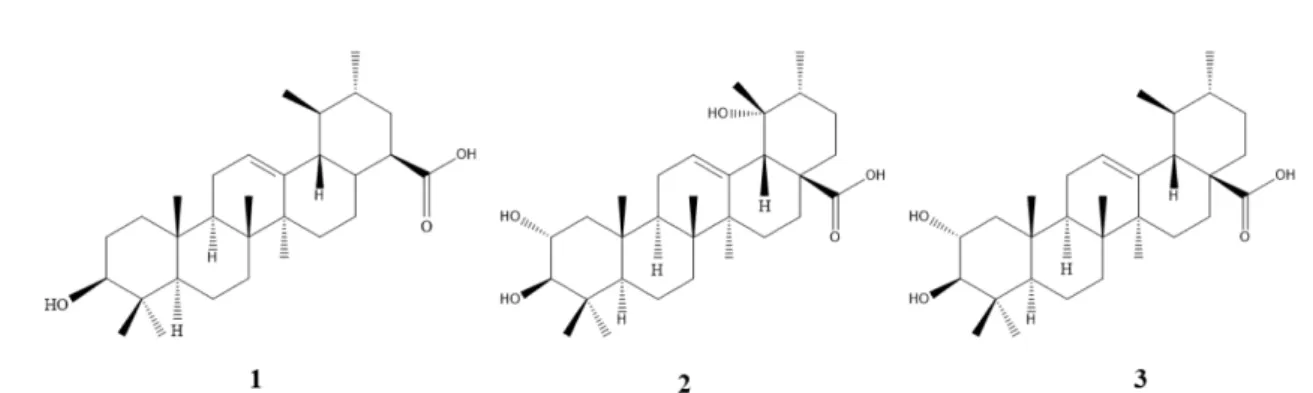
선행 연구 결과 자소엽 메탄올 추출물의 용매 분획층 중 헥산층이 뛰어난 베타-아밀로이드 응집 억제 효과를 나타내 었으며 그 유효성분으로 5개의 아사론 유도체들을 분리하 였다.10) 헥산층 이외의 분획층 중에서 베타-아밀로이드 응 집을 억제하는 유효성분을 분리하고자 분획층들의 베타-아 밀로이드 응집 억제 효과를 Th T assay로 시험하였다. 그 결과 디클로로메탄층이 우수한 효과를 나타내어(Fig. 1) bioassay-guided isolation을 실시하였고 3 개의 트리테르페 노이드를 분리하였으며, 분리된 화합물 1, 2 및 3은 NMR, MS 결과를 문헌과 비교하여 ursolic acid,11,12) tormentic acid,11,13) 및 corosolic acid11,14)로 그 구조를 각각 동정하였 다 (Fig. 2).
분리된 화합물 1-3의 베타-아밀로이드 응집 억제 효과는 Th T assay를 이용하여 시험하였다(Fig. 3). 그 결과, 화합 물 1-3은 유사한 베타-아밀로이드 응집 효과를 나타냈으며, 농도 의존적으로 응집을 억제하였다. 특히, 8 µg/mL의 농도 에서 화합물 1-3은 베타-아밀로이드의 응집을 50% 이상 억 제하였다.
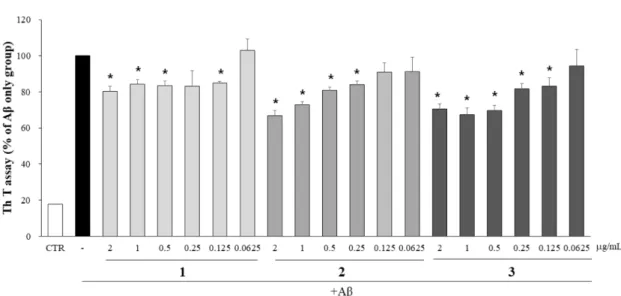
또한, 화합물 1-3이 기 응집된 베타-아밀로이드 응집체를 분해하는 효과가 있는지 Th T assay를 이용하여 확인하였 다(Fig. 4). 그 결과, 화합물 1-3은 효과적으로 베타-아밀로 이드 응집체를 분해하는 효과를 나타냈으며, 그 효과는 농
Fig. 1. Inhibitory effects of ethanol extract of P. frutescens var. acuta and its solvent-partitioned fractions on Aβ aggregation. The effect of extract and solvent-partitioned fractions of P. frutescens var. acuta at 4, 20, and 100 μg/mL on the aggregation of Aβ was determined by Th T assay. EtOH:ethanol, Hx:hexane, DCM:dichloromethane, EA:ethylacetate, DW:distilled water). The Aβ treated with DMSO was used as a control and each experiment was repeated three times. *p < 0.05 compared to Aβ only-treated group.
도 의존적이었다.
항산화활성이 높을수록 베타-아밀로이드 응집 억제 효과 가 뛰어난 것으로 보고되고 있다.15) 따라서 분리된 3개의 화 합물의 항산화활성을 DPPH 법을 이용한 측정 하였다. 그 러나 3개 화합물 모두 64 µg/mL 농도까지 대조군에 비해 5% 이하의 아주 낮은 DPPH scavenging 활성을 보였다(결 과 나타내지 않음).
베타-아밀로이드는 처음에는 단량체로 생성이 되나 체내 에서 응집하여 신경독성을 유발하는 응집체가 형성되는 것 으로 알려져 있다.2,3) 베타-아밀로이드가 응집체를 형성하는 동안 발생하는 산화스트레스는 신경세포의 시냅스 기능을 방해하고 교란시킨다.16,17) 따라서 항산화 물질은 산화 스트 레스에서 의해 유발되는 신경 독성을 줄여줌으로 알츠하이
머성 치매를 치료 및 예방하는 효과를 기대할 수 있다. 즉, quercetin와 kaempferol 같은 플라보노이드류,18,19) rosmarinic acid와 curcumin 같은 페놀성 화합물20,21)은 높은 항산화 활 성과 함께 베타-아밀로이드의 응집을 억제하는 효과를 가지 고 있다. 그러나 본 연구 결과 자소엽의 디클로로메탄 층에 서 분리된 3개의 트리테르페노이드의 항산화활성은 아주 미 미하였고, 따라서 베타-아밀로이드의 응집 억제 효과의 기 전이 뛰어난 항산화활성에서 기인한 것이 아니라는 것을 시 사한다.
반면, 최근 보고된 논문에 의하면 트리테르페노이드에 존 재하는 카르복실산 그룹이 베타-아밀로이드에 있는 염기성 잔기인 Lys16, Lys28과 salt bridge를 형성하여 베타-아밀로 이드 응집 과정 중 nucleation phase를 억제함으로 응집을 Fig. 2. Chemical structures of triterpenoids isolated from dichloromethane layer of P. frutescens var. acuta. (1) Ursolic acid, (2) tor- mentic acid, and (3) corosolic acid.
Fig. 3. Effect of triterpenoids isolated from P. frutescens var. acuta on Aβ aggregation. The effect of triterpenoids at 0.5, 1, 2, 4 and 8 μg/mL on the aggregation of Aβ was determined by Th T assay. The Aβ treated with DMSO was used as a control and each experiment was repeated three times. *p < 0.05 compared to Aβ-treated group.
억제한다고 한다.22) 그 예로, 같은 트리테르페노이드이지만 카복실산을 포함하고 있는 asiatic acid는 베타-아밀로이드의 응집을 효과적으로 억제하는 반면 카복실산이 없는 -amyrin 은 응집 억제 효과가 나타나지 않았다.23) 이 논문에 비춰볼 때, 본 연구에서 분리된 ursolic acid, tormentic acid, corosolic acid가 효과적으로 베타-아밀로이드의 응집을 억제한 것은 카르복실산 그룹을 가지고 있기 때문인 것으로 사료된다.
ursolic acid는 항산화 및 항염 효과를 가지고 있는 트리 테르페노이드의 하나로 생쥐모델에서 베타-아밀로이드에 의 해 유도된 기억력 감소를 개선하는 효과를 보였다.24) 항염 증 효과가 알려진 tormentic acid는 amyloid precursor protein/presenilin 1 형질전환 생쥐에 복강 투여시 신경교세 포의 과활성화를 억제하여 염증인자들의 발현을 억제하여 기억력 개선 및 신경세포 보호 효과를 나타냈다.25) 그러나, corosolic acid 의 베타-아밀로이드 응집 억제효과 및 치매 개선 가능성은 본 논문이 첫 보고이다.
결 론
베타-아밀로이드의 응집 효과가 뛰어난 자소엽 추출물의 디클로로메탄층으로 부터 3개의 트리테르페노이드를 분리 하였으며 ursolic acid, tormentic acid, corosolic acid로 구조 동정하였다. 이 3개의 화합물은 농도 의존적으로 베타-아밀 로이드의 응집을 억제하였으며, 기 응집된 베타-아밀로이드 를 해체하는 효과도 보였다. 따라서 자소엽에서 분리한 트 리테르페노이드도 치매의 예방 또는 치료제로서의 가능성 을 가지고 있다.
사 사
본 연구는 농림축산식품부의 재원으로 농림식품기술기획 평가원의 맞춤형혁신식품 및 천연안심소재기술개발사업의 지원을 받아 연구되었다(119012-3). 또한 본 연구는 단국대 학교 약학과 소속저자의 결과물로서 해당학과는 2020년 단 국대학교 대학혁신지원사업 연구중심학과 육성사업의 지원 으로 연구되었다. 단국대학교 Center for Bio-Medical Engineering Core Facility의 NMR 지원에 감사드린다.
인용문헌
1. Hardy, J. A. and Higgins, G. A. (1992) Alzheimer's disease:
the amyloid cascade hypothesis. Science 256: 184-185.
2. Lambert, M. P., Barlow, A. K., Chromy, B. A., Edwards, C., Freed, R., Iosatos, M., Morgan, T. E., Rozovsky, I., Trommer, B., Viola, K. L., Wals, P., Zhang, C., Finch, C. E., Krafft, G.
A. and Klein, W. L. (1998) Diffusible, nonfribrillar ligands derived from Aβ1–42 are potent central nervous system neu- rotoxins. Proc. Natl. Acad. Sci. USA 95: 6448-6453.
3. Ward, R. V., Jennings, K. H., Jepras, R., Neville, W., Owen, D. E., Hawkins, J. and Howlett, D. R. (2000) Fractionation and characterization of oligomeric, protofibrillar and fibrillar forms of beta-amyloid peptide. Biochemical. J. 348: 137-144.
4. 배기환 (2019) 천연약물도감 I·II, pp 141-142 (II). 교학사, 5. Zheng, J., Dong, Z. and Se, J. (1997) Modern study of Tra-서울.
ditional Chinese Medicines, pp. 4354-4363. Xue Yuan Press, China.
Fig. 4. Effect of triterpenoids isolated from P. frutescens var. acuta on Aβ disaggregation. The Aβ preaggregated for 24 h was incu- bated with triterpenoids (0.0625, 0.125, 0.25, 0.5, 1 and 2 μg/mL) for additional 24 h. Then, Th T assay was performed to measure the levels of Aβ aggregation. The Aβ treated with DMSO was used as a control and each experiment was repeated three times. *p
< 0.05 compared to Aβ only-treated group.
6. Peng, Y., Ye, J. and Kong, J. (2005) Determination of phe- nolic compounds in Perilla frutescens L. by capillary elec- trophoresis with electrochemical detection. J. Agric. Food Chem. 53: 8141-8147.
7. Seo, W. H. and Baek, H. H. (2009) Characteristic aroma- active compounds of Korean perilla (Perilla frutescens Brit- ton) leaf. J. Agric. Food Chem. 57: 11537-11542.
8. Kil, H. W., Rho, T. and Yoo, K. D. (2020) Phytochemical study of hot-water extract of Perillae Folium. Kor. J. Phar- macogn. 51: 55-64.
9. Kim, D.-J., Kim, M.-S., Kim, S., Hwang, K.-W. and Park, S.- Y. (2017) Anti‐amyloidogenic effects of Perilla frutescens var. acuta on beta‐amyloid aggregation and disaggregation. J.
Food Biochem. 41: e12393.
10. Lee, J.E., Kim, N., Yeo, J.Y., Seo, D.-G., Kim, S., Lee, J.-S., Hwang, K. W. and Park, S.-Y. (2019) Anti-Amyloidogenic effects of asarone derivatives from Perilla frutescens leaves against beta-amyloid agregation and nitric oxide production.
Molecules 24: 4297.
11. Woo, K. W., Han, J. Y., Choi, S. U., Kim, K. H. and Lee, K.
R. (2014) Triterpenes from Perilla frutescens var. acuta and their cytotoxic activity. Nat. Prod. Sci. 20: 71-75.
12. Seebacher, W., Simic, N., Weis, R., Saf, R. and Kunert, O.
(2003) Spectral assignments and reference data. Magn.
Reson. Chem. 41: 636-638.
13. Taniguchi, S., Imayoshi, Y., Kobayashi, E., Takamatsu, Y., Ito, H., Hatano, T., Sakagami, H., Tokuda, H., Nishino, H., Sugita, D., Shimura, S. and Yoshida, T. (2002) Production of bioactive triterpenes by Eriobotrya japonica Calli. Phyto- chemistry 59: 315-323.
14. Wen, X., Sun, H., Liu, J., Wu, G., Zhang, L., Wu, X. and Ni, P. (2005) Pentacyclic triterpenes. Part 1: the first examples of naturally occurring pentacyclic triterpenes as a new class of inhibitors of glycogen phosphorylases. Bioorg. Med. Chem.
Lett. 15: 4944-4948.
15. Lee, J.-E., Kim, M.-S. and Park, S.-Y. (2017) Effect of natural antioxidants on the aggregation and disaggregation of beta- amyloid. Trop. J. Pharmaceut. Res. 11: 2629-2635.
16. Mattson, M. P. (2004) Pathways towards and away from Alz- heimer's disease. Nature 430: 631-639.
17. Butterfield, D. A., Drake, J., Pocernich, C. and Castegna, A.
(2001) Evidence of oxidative damage in Alzheimer's disease brain: central role for amyloid beta-peptide. Trends Mol. Med.
7: 548-554.
18. Jimenez-Aliaga, K., Bermejo-Bescos, P., Benedi, J. and Mar- tin-Aragon, S. (2011) Quercetin and rutin exhibit antiam- yloidogenic and fibril-disaggregating effects in vitro and potent antioxidant activity in APPswe cells. Life Sci. 89: 939- 945.
19. Sharoar, MG., Thapa, A., Shahnawaz, M., Ramasamy, VS., Woo, ER., Shin, SY. and Park, I-S. (2012) Kaempferol-3-O- rhamnoside abrogates amyloid beta toxicity by modulating monomers and remodeling oligomers and fibrils to non-toxic aggregates. J. Biomed. Sci. 19: 104.
20. Ono, K., Hasegawa, K., Naiki, H. and Yamada, M. (2004) Curcumin has potent anti-amyloidogenic effects for Alzhei- mer’s beta-amyloid fibrils in vitro. J. Neurosci. Res. 75: 742- 750.
21. Yamada, M., Ono, K., Hamaguchi, T. and Noguchi-Shino- hara, M. (2015) Natural phenolic compounds as therapeutic and preventive agents for cerebral amyloidosis. Adv. Exp.
Med. Biol. 863: 79-94.
22. Murakami, K., Yoshioka, T., Horii, S., Hanaki, M., Midorikawa, S., Taniwaki, S., Gunji, H., Akagi, K.-I., Kawase, T., Hirosed, K. and Irie, K. (2018) Role of the car- boxy groups of triterpenoids in their inhibition of the nucle- ation of amyloid β42 required for forming toxic oligomers.
Chem. Commmun. 54: 6272-6275.
23. Murakami, K. and Irie, K. (2019) Three structural features of functional food components and herbal medicine with amy- loid β42 anti-aggregation properties. Molecules 24: 2125.
24. Liang, W., Zhao, X., Feng, J., Song, F. and Pan, Y. (2016) Ursolic acid attenuates beta-amyloid-induced memory impairment in mice. Arq. Neuropsiquiatr. 74: 482-488.
25. Cui, W., Sun, C., Ma, Y., Wang, S., Wang, X. and Zhang, Y.
(2020) Neuroprotective effect of tormentic acid against mem- ory impairment and neuro-inflammation in an Alzheimer's disease mouse model. Mol. Med. Rep. 22: 739-750.
(2020. 11. 6 접수; 2020. 11. 18 심사;
2020. 12. 3 게재확정)