Copyright ⓒ 2014, The Microbiological Society of Korea
생물계면활성제 생성 세균 Pseudomonas sp. HN37의 특성
정다희1․장동호1․김영은1․정미랑1․한규웅1․김형배2․박경량1*
1한남대학교 생명시스템과학과,
2고려대학교 생명정보공학과
Characteristics of Biosurfactant Producing Pseudomonas sp. HN37
Da Hee Jung1, Dong Ho Chang1, Yeong Eun Kim1, Mi Rang Jeong1, Kyu Woong Hahn1, Hyong Bai Kim2, and Kyeong Ryang Park1*
1Department of Biological Science and Biotechnology, Hannam University, Daejeon 305-811, Republic of Korea
2Department of Biotechnology and Bioinformatics, Korea University, Sejong 339-800, Republic of Korea (Received November 19, 2012 / Accepted March 20, 2014)
One hundred forty four bacterial colonies which were able to degrade crude oil were isolated from soil samples that were contaminated with oil in Daejeon area. Among them, one bacterial strain was selected for this study based on its emulsification activity, growth rate and surface tension activity, and this selected bacterial strain was identified as Pseudomonas sp. HN37 through physiological- biochemical tests and analysis of its 16S rRNA sequence. Pseudomonas sp. HN37 utilize the several aliphatic hydrocarbons, 3,5-dinitrosalicylic acid and 2,4-dichlorophooxyacetic acid as a sole carbon source. And this bacterial strain showed a high resistance to antibiotics such as ampicillin and chloramphenicol, as well as heavy metals such as Ba, Cr, Li and Mn. Also, it was found that the optimal pH and temperature for the cell growth, surface tension, and emulsification activity of Pseudomonas sp. HN37 were pH 6.0‒9.0 and 30℃, respectively. The emulsification and surface tension activity was reached the maximum to 1%
(V/V) crude oil and 1% (W/V) NaCl concentration. The surface tension of the culture broth was decreased from 62 to 27 dyne/cm after fifteen hours of inoculation in LB media.
Keywords: Pseudomonas sp. HN37, biosurfactant, colony count, emulsification, surface tension
*For correspondence. E-mail: [email protected]; Tel.: +82-42-629-8770;
Fax: +82-42-629-8769
산업체와 가정에서 많이 사용되고 있는 화학합성 계면활성제 는 난분해성 물질로 생분해도가 낮고 거품을 형성하여 빛과 산 소를 차단하므로 여러 환경적 문제를 야기시킨다. 반면 생물 계 면활성제(biosurfactant)는 친환경적 물질로 화학합성 계면활성 제 보다 상대적으로 독성이 적고 생분해능도 높아 환경오염에 큰 영향을 미치지 않고, 극한의 온도, pH, 염도 등 물리 화학적인 면에서도 그 안정성이 화학합성 계면활성제에 뒤지지 않는다 (Yakimov et al., 1995).
생물 계면활성제는 친수성기(hydrophilic)와 소수성기 (hydrophobic)를 한 분자 내에 갖고 있는 양친매성 분자로, 친수 성기는 monosaccharide, oligosaccharide, polysaccharide, peptides 또는 protein으로 구성되어 있고, 소수성기는 포화지방산, 불포 화 지방산 및 수산화 지방산(hydroxylated fatty acid) 또는 지방 알코올(fatty alcohols)로 이루어져 있다(Lang, 2002). 이런 분자 구조의 특성으로 인해 생물 계면활성제는 불용성 물질인 소수성 기의 표면적을 증가시키므로 물과 친화력이 높아져 표면이나 계
면의 성질이 변화되어 표면 장력이 감소하게 된다. 따라서 생물 계면활성제의 이런 특징을 이용하여 효율적인 유화제와 발포제, 또는 분산제를 만들 수 있으므로 농업, 식품업, 화학 분야, 화장품, 약학, 생물정화 등 다양한 분야에서 이용된다(Muthusamy et al., 2008; Banat et al., 2010; Soberón-Chávez and Maier, 2011).
살아있는 생명체가 생성하는 생물 계면활성제는 구조에 따라 glycolipids, fatty acids, phospholipids, neutral lipids, lipopeptides, polymeric biosurfactant, particulated surfactant 등 그 종류가 매 우 다양하다(Pacwa-Płociniczak et al., 2011). 이중 glycolipid는 rhamnolipid, trehalolipid, cellobiolipid, sophorolipid로 구분되며, rhamnolipid는 Burkholderia kururiensis, Pseudomonas sp., Arthrobacter sp.에서(Singh and Cameotra, 2013; Tavares et al., 2013), trehalolipid는 Rhodococcus sp., Mycobacterium paraffinicum, Micrococcus luteus, Nocardia sp., Gordonia amarae, Corynebacterium sp., Brevibacteria sp.에서, Sophorolipid는 Mycobacterium sp., Torulopsis sp., Candida bombicola에서 생 산된다(Van Bogaert et al., 2013). 이들은 탄화수소와 식물성 오 일을 유화시키며, 토양에 존재하는 중금속을 제거하고, 탄화수 소를 분해하거나 생체 이용 향상 및 오일 정화에 사용된다. 그 외
에 Lysinibacillus fusiformis S9, Ochrobactrum anthropic, Halomonas sp. BS4도 glycolipids 계열의 생물계면활성제를 생 산하며 이들은 병원성 균의 biofilm의 형성을 억제하거나 오일 을 유화 및 방향족 탄화수소의 용해도를 향상시키며 약리학적으 로도 사용된다(Donio et al., 2013; Noparat et al., 2013; Pradhan et al., 2014). 그리고 Corynebacterium lepus, Penicillium spiculisporum, Acinetobacter sp., Rhodococcus erythropolis, Micrococcus sp., Nocardia erythropolis 등에 의해 생성되는 fatty acids, phospholipids, neutral lipids로는 corynomycolic acid, spiculisporic acid, phosphatidylethanolamine 등이 있으며 이들은 역청 복구를 향상시키거나, 중금속이온의 제거 등에 사 용되고 있다(Appanna et al., 1995; Hong et al., 1998; Ishigami et al., 2000). 또 Bacillus subtilis, B. licheniformis 등에 의해서 생성되는 lipopeptides와 lipoprotein에는 viscosin, surfactin, serrawettin, subtilisin, peptide-lipid 등이 있고, 이 중 surfactin 는 7개의 아미노산으로 이루어진 ring 구조로 항생물질 활성도 가지고 있다(Al-Wahaibi et al., 2014). 그리고 이들 역시 중금속 또는 유류로 오염된 토양을 정화시키거나, 탄화수소 및 살충제 의 생분해도를 향상시키고, 화장품 및 제약 산업에 사용된다 (Jennema et al., 1983; Awashti et al., 1999). Pseudomonas aeruginosa, Acinetobacter calcoaceticus RAG-1, A. radioresistens KA-53, A. calcoaceticus A2, Candida lipolytica, Saccharomyces cerevisiae에 의해 생성되는 polymeric biosurfactants는 고분자 물질로 emulsan, alasan, biodispersan, liposan, mannoprotein이 있으며, 이들 역시 탄화수소를 유화시키는데 사용된다(Cirigliano and Carman, 1984; Cameron et al., 1988; Rosenberg et al., 1988; Toren et al., 2001; Rahman and Gakpe, 2008).
본 연구는 이처럼 여러 분야에서 사용되는 생물 계면활성제 생성이 우수한 균주를 유류로 오염된 토양에서 분리하여 이 균 주의 생리 ․ 생화학적 특성과 최적의 생장 조건을 조사하고, 이 균주가 생산하는 생물 계면활성제의 특성을 파악하여 추후 이 균주가 생산하는 생물 계면활성제를 산업적으로 활용하고자 하 였다.
재료 및 방법
균주 분리 및 사용 배지
대전 지역의 자동차 정비소, 주유소, 폐차장, 송유관 주변 등 유류로 오염된 지역에서 토양을 채취하였다. 이들 토양 5 g을 멸 균 생리식염수 5 ml이 들어있는 50 ml 삼각 플라스크에 넣고 30℃, 200 rpm으로 90분 진탕한 후, 단일 탄소원으로 2% (v/v) 쿠웨이트산 원유가 첨가된 bushnell-hass (magnesium sulfate 0.2 g/L, calcium chloride 0.02 g/L, monopotassium phosphate 1.0 g/L, ammonium phosphate dibasic 1.0 g/L, potassium nitrate 1.0 g/L, ferric chloride 0.05 g/L, pH 7.0) 최소 평판배지 에 현탁액을 접종하고 2‒3일 배양하여 총 144균주의 단일 집락 을 분리하였다. 분리된 단일 집락들은 1% (V/V) tributyrin이 첨 가된 고체배지(peptone 5 g/L, yeast extract 3 g/L, pH 7.0)에 접 종하여 30℃에서 2‒3일간 배양한 후, 세균 집락 주위에 투명 환
을 가장 넓게 생성하는 5균주를 선별하였고, 이 균주 중 Luria- Bertani (LB)배지(tryptone 10 g/L, yeast extract 5 g/L, sodium chloride 5 g/L, pH 7.0)에서 표면장력 활성과 성장능이 가장 우수 하고, 단일 탄소원으로 1% (v/v) 쿠웨이트산 원유가 첨가된 bushnell-hass 최소 평판배지에서 유화능이 가장 우수한 한 균주 를 최종 선별하였다.
생리, 생화학적 특성 조사
최종 선별된 균주는 Bergey's mannual of systematic bacteriology (Krieg and Holt, 1984)와 Biochemical tests for identification of medical bacteria (MacFaddin, 1984)에 의거하 여 형태, 생리 및 생화학적 특성을 조사하였다. 또 이 균주의 mannitol, arabinose, cellobiose, fructose, glucose, maltose, ribose, sucrose, xylose, lactose 등의 당과 pentane, hextane, cyclohexane, tetradecane, hexadecane, octadecane, benzene, benzoic acid, 3,5-dinitrosalicylic acid, 2,4-dichlorophenoxyacetic acid, 2,4,5-trichlorophenoxyacetic acid, phenanthrene 등의 지 방족과 방향족 탄화수소 이용능은 bushnell-hass 배지에 최종농 도가 1% (w/v)가 되도록 각각의 당과 탄화수소를 단일 탄소원으 로 첨가하고 30℃에서 2‒3일 배양 후 집락 생성유무로 이용 여부 를 결정하였다. 당 발효능은 Oxidative-Fermentative 최소배지 (sodium chloride 5 g/L, pancreatic digest of casein 2 g/L, potassium phosphate dibasic 0.3 g/L, bromothymol blue 0.08 g/L, pH 7.0)에 각 당의 최종 농도가 1% (w/v)되게 첨가하여 30℃에서 2‒3일 배양한 후 배지의 색 변화 여부로 조사하였다.
그리고 중금속 Ba, Cd, Co, Cr, Cu, Hg, Li, Mn, Ni2와 항생제 ampicillin, chloramphenicol, kanamycin, spectinomycin, tetracycline, streptomycin를 LB 배지에 다양한 농도로 첨가한 후 선별 균주의 성장유무로 중금속 내성과 항생제 내성을 조사 하였다.
16S rRNA 염기 서열 조사
최종 선별 균주의 정확한 동정을 위해 최종 선별 균주의 genomic DNA를 CTAB 방법(Wagner et al., 1987)으로 추출하고, 이 DNA를 주형으로 중합효소연쇄반응(Polymerase Chain Reaction, PCR)을 수행하여 16S rRNA 유전자 염기 서열을 조사하였다.
이때 선별 균주의 16S rRNA를 증폭하기 위해 forward primer 5′
-AGA GTT TGA TCM TGG CTC AG-3′ (27F)와 reverse primer 5′-GGT TAC CTT TGT TAC GAC TT-3′ (1492R)를 사 용하고(BIONEX), 염기서열은 ABI model 310 (Applied Biosystem, USA)을 사용하여 분석하였다. 이렇게 분석된 rRNA 염기서열은 BLAST search (www.ncbi.nih.gov/ BLAST/)를 사 용하여 비교 ․ 분석 하였다.
생육조건 조사
유화능과 집락수는 bushnell-hass 최소배지를, 표면장력 활성 과 성장률은 LB 영양배지에 선별 균주를 접종하여 조사하였다.
선별 균주의 온도에 따른 영향은 각각 20℃, 30℃, 37℃, 42℃로 조정된 배양기에서 진탕 배양하며 각각의 유화능과, 집락수, 그
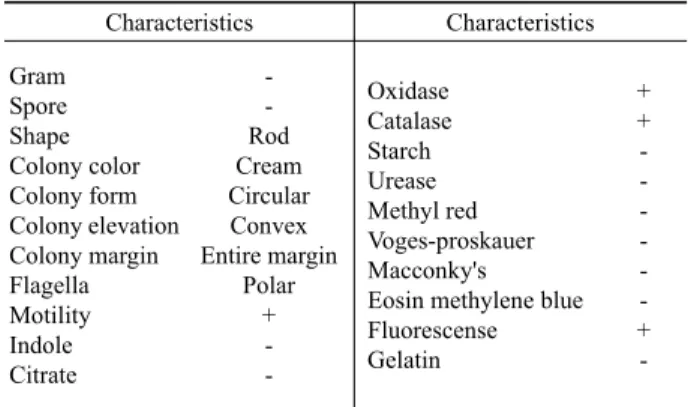
Characteristics Characteristics Gram
Spore Shape Colony color Colony form Colony elevation Colony margin Flagella Motility Indole Citrate
- - Rod Cream Circular Convex Entire margin
Polar + - -
Oxidase Catalase Starch Urease Methyl red Voges-proskauer Macconky's Eosin methylene blue Fluorescense Gelatin
+ + - - - - - - + -
+, positive; -, negative
Table 1. Morphological, physiological and biochemical characteristics of Pseudomonas sp. HN37
Carbon source Utilization* Fermentation**
Mannitol + +
Arabinose - +
Cellobiose - -
Fructose - +
Glucose + +
Maltose - -
Ribose - +
Sucrose - -
Xylose - -
Lactose - -
* +, growth; -, no growth
** +, positive; -, negative
Table 2. Utilization and fermentation of various carbon sources in Pseudomonas sp. HN37
리고 표면장력 활성과 성장률을 측정하였다. 성장률 측정은 LB 영양배지에서 24시간 배양후 일정량을 분취하여 600 nm의 UV-Spectrophotometer (SmartSpec3000, Bio-Rad, USA)에서 측정하였다. 집락수 측정은 최소배지에서 2일 배양한 배양액을 10-2에서 10-8까지의 농도로 멸균생리식염수에서 희석한 후, 희 석된 배양액 0.1 ml를 LB 평판배지에 도말하고 30℃에서 24시 간 배양한 후 계수하였다. 그리고 pH에 따른 균주의 유화능, 집 락수, 표면장력 활성, 성장률 조사는 bushnell-hass 최소배지와 LB 영양배지에 1 N HCl과 1 N NaOH를 각각 첨가하여 pH 4–
10으로 조정한 후, 전 배양한 균액 1% (V/V)를 접종하고 진탕 배양하며 측정하였다. NaCl의 농도에 따른 최종 선별 균주의 성 장 특성은 NaCl의 농도가 각각 0.5%, 1%, 2%, 3%, 4%, 5%
(w/v)가 되도록 첨가 한 bushnell-hass 최소배지와 LB 영양배지 에 전 배양한 배양액 1% (v/v) 접종하고 30℃에서 진탕 배양하 며 유화능, 집락수, 표면장력 활성, 성장률을 측정하였다. 이때 bushnell-hass 최소배지의 경우 48시간, LB 영양배지에서는 24 시간 배양하였다.
유화능 측정
유화능은 Rosenberg (1993)의 방법으로 측정하였다. Bushnell- hass 최소배지에서 2일 배양한 배양액을 원심분리기(supra22K, Hanil Science, Korea)로 원심분리(10,000 × g, 10분, 4℃)하여 얻은 상등액 0.5 ml에 2.5 ml의 20 mM Tris-Cl (pH 7.8)을 가하 고, 기질로 쿠웨이트산 원유 1% (v/v)를 첨가한 후, 1분간 강하 게 교반하여 유화시킨 다음 10분간 실온에서 정치시킨 후 UV-Spectrophotometer (SmartSpec3000, Bio-Rad, USA)를 이 용하여 OD 610 nm에서의 흡광도를 측정하였다. 이때 배양액을 첨가하지 않는 시료를 대조구로 사용하였고, 모든 실험은 3회 반 복하여 측정하였다.
표면장력 측정
LB 영양배지에서 OD600=1.0까지 전 배양한 균주 5 ml을 500 ml LB 배지에 접종 후 30℃에서 200 rpm으로 진탕배양하며 배 양시간에 따라 시료를 3 ml씩 채취하였다. 채취한 시료는 원심 분리기(supra22K, Hanil Science)로 원심분리(13,000 × g, 10분)
하여 균체를 제거한 후, Surface Tensiometer (CBVP-A3, FACE, Japan)를 사용하여 plate 방법(Barathi and Vasudevan, 2001)으 로 25℃에서 3회 반복하여 표면장력을 측정하였다.
결과 및 고찰
선별 균주의 특성 및 동정
생물 계면활성제 생성능력이 우수한 미생물 균주를 확보하기 위해 대전 지역의 주유소, 자동차 정비소, 세차장, 폐차장 등 유 류로 오염된 토양에서 유류를 단일 탄소원으로 이용하는 총 144 균주의 단일 집락을 분리한 후, 1% tributyrin이 첨가된 고체배지 에 접종하여 세균집락 주위에 투명 환을 넓게 생성하는 5균주를 일차 선별하고, 선별된 균주 중 유화능과 집락수, 표면장력활성 과 성장률 등이 우수한 한 균주를 최종선별 하였다. 최종 선별된 균주는 형태학적 특성 조사 결과 이 균주는 포자를 생성하지 않 고 편모를 갖고 이동하는 호기성 그람 음성 간균으로, oxidase와 catalase에 양성반응을 보이고, 형광성을 갖는 것으로 확인되었다 (Table 1). 그리고 당 이용능 실험결과 최종 선별균주는 glucose 와 mannitol을 단일 탄소원으로 이용하고 arabinose, cellobiose, fructose, maltose, ribose, sucrose, xylose, lactose는 이용하지 못하였다. 그러나 mannitol, arabinose, glucose, fructose, ribose 를 발효하는 것으로 보아(Table 2), 선별 균주의 당 이용 경로는 Chang 등(2011)이 보고한 균주와 동일한 발효과정을 가지는 것으 로 판단된다. 최종 선별균주의 정확한 동정을 위해 16S rRNA 염기서열 분석을 통해 조사한 결과, 이 균주는 Pseudomonas sp.
CT07과 100%의 상동성을 보여(Accession No. DQ777633), 이 균을 Pseudomonas sp. HN37이라 명명하였다.
최종 선별된 Pseudomonas sp. HN37의 지방족과 방향족 탄화 수소 이용능을 조사한 결과 pentane, hextane, cyclohexane, tetradecane, hexadecane, octadecane 등의 지방족 탄화수소를 이 용하였고, 3,5-dinitrosalicylic acid, 2,4-dichlorophenoxyacetic acid 등 일부 방향족 탄화수소도 이용할 수 있음이 확인되었다 (Table 3). 그리고 선별 균주의 항생제 내성 조사 결과 Pseudomonas sp. HN37는 ampicillin과 chloramphenicol에 비교적 강한 내성 을 나타내(Table 4), 비슷한 환경에서 분리된 Chang 등(2011)의
Carbon source Utilization
Pentane +
Hexane +
Cyclohexane +
Tetradecane +
Hexadecane +
Octadecane +
Benzene -
Benzoic acid -
3,5-Dinitrosalicylic acid +
2,4-Dichlorophenoxyacetic acid + 2,4,5-Trichlorophenoxyacetic acid -
Phenanthrene -
+, growth; -, no growth
Table 3. Utilization of various aliphatic and aromatic hydrocarbons as a sole carbon source in Pseudomonas sp. HN37
Antibiotics MIC (µg/ml)
Spectinomycin Streptomycin Chloramphenicol
Kanamycin Ampicillin Tetracycline
200 100 1,600
5 2,400
5
Table 4. Susceptibility of Pseudomonas sp. HN37 to various antibiotics
(A)
(B)
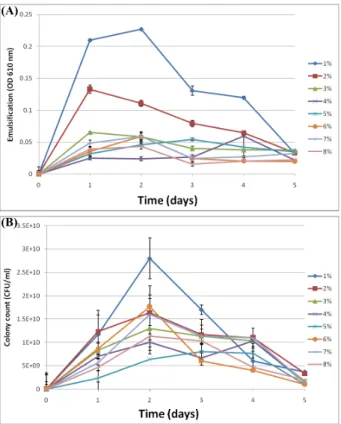
Fig. 1. Effect of the emulsification (A) and colony count (B) by Pseudomonas sp. HN37 dependent on the concentration of Kuwait crude oil as a sole carbon source. The cell was cultured for 48 h in bushnell-hass minimal media at 30℃.
Heavy metals MIC (µg/ml)
BaCl2
CdCl2
CoCl2
CrCl2
CuSO4
LiCl2
MnSO4․7H2O NiCl2
HgCl2
1,600 100 400 1,600
800 6,400 1,600 800 200
Table 5. Susceptibility of Pseudomonas sp. HN37 to various heavy metals
Pseudomonas sp. Z1보다는 항생제 내성이 약하지만, Acinetobacter lwoffii I6C-1 (Kim et al., 1999)와 유사한 항생제 내성을 갖고 있음을 확인하였다. 또 일반적으로 유류에 오염된 토양은 Pb, Cd, Cr, Ni, Cu, Hg, Zn, Fe 등 다양한 중금속이 함유 되어 있다는 Mulligan 등(1993)의 보고처럼, 유류로 오염된 다 른 지역의 토양에서 분리된 균(Kim et al., 1999; Chang et al., 2011)들과 유사하게 본 실험에서 선별된 Pseudomonas sp.
HN37도 Ba, Cr, Li과 Mn 등의 중금속에 비교적 높은 내성을 갖 고 있음을 확인 하였다(Table 5).
원유 농도, 배양 온도와 pH의 영향
본 실험에서 최종 선별된 Pseudomonas sp. HN37의 원유 농도 에 따른 유화능과 집락수의 영향을 알아보기 위해 bushnell-hass 최소배지에 쿠웨이트산 원유를 1‒8% (V/V)까지 첨가한 후 30℃
에서 5일 동안 유화능(Fig. 1A)과 집락수(Fig. 1B)의 변화를 조 사하였다. 그 결과 1%의 원유농도에서 2일 배양했을 때 유화능 과 집락수가 가장 우수한 것으로 확인되었고, 원유농도가 증가 할 수록 유화능과 집락수가 감소함을 확인하였다.
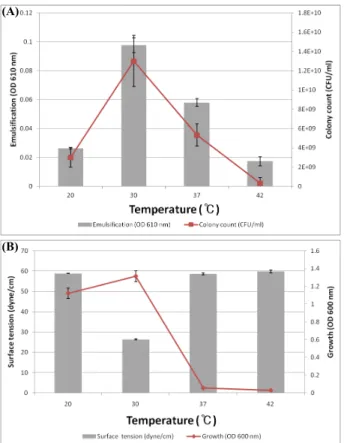
일반적으로 미생물의 생육조건에 가장 큰 환경적 요인은 온도 와 pH로 알려져 있다(Atlas and Bartha, 1972; Mulkins-philips and Stewart, 1974; Dibble and Bartha, 1979). 따라서 Pseudomonas sp. HN37의 온도에 따른 배양 특성을 조사한 결과, 30℃에서 유 화능과 집락수(Fig. 2A), 표면장력활성과 성장률(Fig. 2B)이 가 장 우수하고 42℃ 이상에서는 거의 성장하지 못하는 중온성 균으 로 확인되었다. 또 배지의 초기 pH에 따른 유화능과 집락수, 그 리고 표면장력 활성과 성장률을 조사한 결과, bushnell-hass 최 소배지에 단일 탄소원으로 1% (v/v) 원유를 첨가했을 경우에는 pH 8에서 유화능이 가장 우수하고, pH 9에서 가장 많은 집락을 형성하는 것으로 나타났으나(Fig. 3A), 영양배지인 LB에서는 pH 4와 pH 10을 제외하고 pH 5부터 pH 9까지 성장률도 비슷하 고, 표면장력 활성도 27–29 dyne/cm 정도를 유지해(Fig. 3B), 본 실험에 선별된 Pseudomonas sp. HN37는 비교적 넓은 pH 범위 에서도 성장할 수 있음을 확인하였다. 또 본 실험에서 최종 선별 된 Pseudomonas sp. HN37의 표면장력 활성은 Zhang 등(2012) 에서 분리된 유류 분해 세균이 생성하는 40 dyne/cm 보다 우수 하고, Cappello 등(2012)이 분리한 유류분해세균이 배양 8일째 에 생성하는 27 dyne/cm의 표면장력활성과 동일한 활성을 Pseudomonas sp. HN37는 배양 1일 만에 생성하므로, 본 실험에
(A)
(B)
Fig. 3. Effect of pH on the emulsification (A) and surface tension (B) by Pseudomonas sp. HN37. The pH values of media were adjusted by addition of 1 N HCl or 1 N NaOH. The emulsification and surface tension were determined after reciprocal shaking (200 rpm) at 30℃ for 24 h.
The cell was cultured 48 h in bushnell-hass minimal media in 2% Kuwait crude oil as a sole carbon source (A) and 24 h in LB (B).
(A)
(B)
Fig. 2. Effect of temperature on the emulsification (A) and surface tension (B) by Pseudomonas sp. HN37. The cell was cultured for 48 h in bushnell-hass minimal media in 2% Kuwait crude oil as a sole carbon source (A) and 24 h in LB (B) at 20℃, 30℃, 37℃ and 42℃, respectively.
사용된 균주가 성장률과 표면장력 활성에 있어 우수한 균주 임 을 확인할 수 있었다.
염 농도 영향과 생장곡선
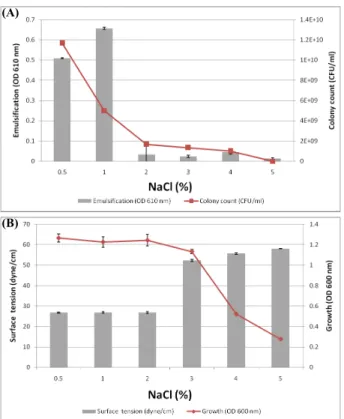
Pseudomonas sp. HN37의 표면활성 감소 능력이 해양에 오 염된 유류 분산에 이용 가능한지를 확인하기 위해 bushnell-hass 최소영양배지와 LB 배지에 NaCl 농도를 0.5%, 1%, 2%, 3%, 4%, 5%로 각각 조정하여 배양하며 유화능과, 집락수, 표면장력 활성과 성장률을 조사한 결과, 단일 탄소원으로 원유를 이용하 는 최소 배지에서는 1% NaCl 농도에서 유화능이 가장 높게 유 지되고, 집락수는 0.5% NaCl에서 가장 많이 형성되었다(Fig.
4A). 그러나 영양배지에서는 2% NaCl까지 성장률이 우수하고, 표면장력 활성도 27 dyne/cm를 유지하였으나(Fig. 4B), 3% 이 상의 NaCl에서는 성장률과 표면장력 활성이 좋지 않은 것으로 나타났다. 따라서 본 실험에서 분리한 Pseudomonas sp. HN37 은 평균 NaCl 농도가 3.5‒3.7%인 해수(Walker와 Cowell, 1975) 의 유류오염 정화에는 적합하지 않는 것으로 생각된다.
또 영양배지에서의 Pseudomonas sp. HN37의 성장률과 표면 장력 활성과의 상관관계를 알아보기 위해 배양시간에 따른 표면 장력 활성을 측정한 결과, 균주의 생육이 대수 증식기 후기에 이 르는 배양 9시간 이후부터 표면장력 활성이 급격히 감소하여 배
양 15시간 후에는 배지의 표면장력 활성이 거의 30 dyne/cm 이 하까지 저하되었고, 그 이후 정지기에도 계속 표면장력 활성이 높게 유지되어(Fig. 5), Pseudomonas sp. HN37의 표면장력 활 성은 비교적 오랜 시간 유지됨을 확인하였다.
따라서 본 연구에서 분리 선별된 Pseudomonas sp. HN37는 단일 탄소원으로 다양한 지방족 탄화수소와 일부 방향족 탄화수 소를 이용할 수 있고, 넓은 pH 범위와 다양한 종류의 중금속에 내성을 갖고, 비교적 빠른 성장을 보일 뿐 아니라, 정지기 이후에 도 표면장력 활성을 낮게 유지하는 등 다양한 특성을 갖고 있어, 생물 계면활성제가 이용되는 여러 분야와 토양의 유류 오염 정 화에 일부 활용될 수 있을 것으로 생각된다. 그러나 Pseudomonas sp. HN37를 생물 계면활성제 이용 분야와 오염토양의 유류제거 등에 적용하기 위해서는 이 균주가 생성하는 생물 계면활성제의 구조를 파악하고, 또 토양 내 다른 원소에 대한 영향 등의 추가적 인 연구가 진행되어야 할 것으로 생각된다.
적 요
대전일원의 유류오염 지역의 토양으로부터 원유를 단일 탄소 원으로 이용하는 총 144균주를 순수분리 하였고, 이중 유화능과 성장률 그리고 표면장력활성이 가장 우수한 한 균주를 최종 선
(A)
(B)
Fig. 4. Effect of NaCl concentration on the emulsification (A) and surface tension (B) by Pseudomonas sp. HN37. The emulsification and surface tension were determined after reciprocal shaking (200 rpm) at 30℃ for 24 h. The cell was cultured 48 h in bushnell-hass minimal media in 2% Kuwait crude oil as a sole carbon source (A) and 24 h in LB (B)
Fig. 5. Time course on the growth and the surface tension by Pseudomonas sp. HN37. The cell was cultured in LB medium at 30℃.
별하여 형태 및 생리·생화학적 특성을 조사하고 16S rRNA 염기 서열을 분석을 통해 Pseudomonas sp. HN37이라 명명하였다.
최종 선별된 Pseudomonas sp. HN37는 여러 종류의 지방족 탄 화수소와 3,5-dinitrosalicylic acid와 2,4-dichlorophooxyacetic acid를 단일 탄소원으로 이용하여 성장하였다. 그리고 이 균주는 암피실린과 클로람페니콜 항생제와 Ba, Cr, Li, Mn 중금속에 대 해 강한 내성을 갖고 있었고, pH 6.0‒9.0과 30℃에서 성장능과 표면장력활성, 그리고 유화능이 가장 우수한 것으로 확인되었
다. 또 Pseudomonas sp. HN37는 1% (v/v) 원유 농도와 1%
(w/v) NaCl에서 최대 유화능과 표면장력활성을 나타내었고, LB 배지에서 배양 15시간 후에 표면장력활성이 62 dyne/cm에서 27 dyne/cm까지 감소하였다.
감사의 말
본 논문은 2012년도 한남대학교 학술 연구 조성비 지원에 의 해 연구되었으며 이에 감사드립니다.
참고문헌
Al-Wahaibi, Y., Joshi, S., Al-Bahry, S., Elshafie, A., Al-Bemani, A., and Shibulal, B. 2014. Biosurfactant production by Bacillus subtilis B30 and its application in enhancing oil recovery. Colloids Surf. B. 114, 324–333.
Appanna, V.D., Finn, H., and Pierre, M.S. 1995. Exocellular phosphatidylethanolamine production and multiple-metal tolerance in Pseudomonas fluorescens. FEMS Microbiol. Lett. 131, 53–56.
Atlas, R.M. and Bartha, R. 1972. Biodegradation of petroleum in seawater at low temperature. Can. J. Microbiol. 18, 1851-1855.
Awashti, N., Kumar, A., Makkar, R., and Cameotra, S. 1999. Enhanced biodegradation of endosulfan, a chlorinated pesticide in presence of a biosurfactant. J. Environ. Sci. Heal. B. 34, 793–803.
Banat, I.M., Franzetti, A., Gandolfi, I., Bestetti, G., Martinotti, M.G., Fracchia, L., Smyth, T.J., and Marchant, R. 2010. Microbial biosurfactants production, applications and future potential. Appl.
Microbiol. Biotechnol. 87, 427–444.
Barathi, S. and Vasudevan, N. 2001. Utilization of petroleum hydrocarbons by Pseudomonas fluorescens isolated from a contaminated soil. Environ. Int. 26, 413–416.
Cameron, D.R., Cooper, D.G., and Neufeld, R.J. 1988. The mannoprotein of Saccharomyces cerevisiae is an effective bioemulsifier. Appl. Environ. Microbiol. 54, 1420–1425.
Cappello, S., Santisi, S., Calogero, R., Hassanshahian, M., and Yakimov, M.M. 2012. Characterisation of oil-degrading bacteria isolated from Bilge Water. Water Air Soil Pollut. 223, 3219–3226.
Chang, D.H., Ko, E.J., and Park, K.R. 2011. Charcateristics of biosurfactant producing Pseudomonas sp. Z1. J. Life Science 21, 134–140.
Cirigliano, M.C. and Carman, G.M. 1984. Purification and characterization of liposan, a bioemulsifier from Candida lipolytica. Appl. Environ.
Microbiol. 50, 846–850.
Dibble, J.T. and Bartha, R. 1979. Effects of environmental parameters on the biodegradation of oil sludge. Appl. Environ. Microbiol. 37, 729–739.
Donio, M.B.S., Ronica, F.A., Viji, V.T., Velmurugan, S., Jenifer, J.S.C.A., Michaelbabu, M., and Citarasu, T. 2013. Halomonas sp.
BS4, A biosurfactant producing halophilic bacterium isolated from solar salt works in India and their biomedical importance.
SpringerPlus 2, 149.
Hong, J.J., Yang, S.M., Lee, C.H., Choi, Y.K., and Kajiuchi, T. 1998 Ultrafiltration of divalent metal cations from aqueous solution using polycarboxylic acid type biosurfactants. J. Colloid Interf. Sci. 202, 63–73.
Ishigami, Y., Zhang, Y., and Ji, F. 2000. Spiculisporic acid. Functional development of biosurfactants. Chim. Oggi. 18, 32–34.
Jennema, G.E., McInerney, M.J., Knapp, R.M., Clark, J.B., Feero, J.M.,
Revus, D.E., and Menzie, D.E. 1983. A halotolerant, biosurfactants- producing Bacillus species potentially useful for enhanced oil recovery. Dev. Ind. Microbiol. 24, 485–492.
Kim, G.J., Lee, I.S., and Park, K.R. 1999. Characteristics of waste lubricant degradation by Acinetobacter lwoffii I6C-1. J. Life Science 9, 76–81.
Krieg, N.R. and Holt, J.G. 1984. Bergey's Manual of Systematic Bacteriology. Williams, Wikins and Baltimore.
Lang, S. 2002. Biological amphiphiles (microbial biosurfactants). Curr.
Opin. Colloid Inter. Sci. 7, 12–20.
MacFaddin, J.F. 1984. Biochemical tests for identification for medical bacteria. 2nd ed., Williams and Wilkins Co., Baltimore, USA.
Mulkins-philips, G.J. and Stewart, T.E. 1974. Effect of environmental parameters on bacterial degradation of bunker C oil, crude oil, and hydrocarbons. Appl. Microbiol. 28, 915–922.
Mulligan, C.N., Gibbs, B.F., and Kosaric, N. 1993. Biosurfactants- production, properties, application, pp. 329–372. In Dekker, M.
(ed.), New York, USA.
Muthusamy, K., Gopalakrishnan, S., Ravi, T.K., and Sivachidambaram, P. 2008. Biosurfactants: properties, commercial production and application. Curr. Sci. 94, 736–747.
Noparat, P., Maneerat, S., and Saimmai, A. 2013. Utilization of palm oil decanter cake as a novel substrate for biosurfactant production from a new and promising strain of Ochrobactrum anthropi. World J.
Microbiol. Biotechnol. 30, 865–877.
Pacwa-Płociniczak, M., Płaza, G.A., Piotrowska-Seget, Z., and Cameotra, S.S. 2011. Environmental applications of biosurfactants:
recent advances. Int. J. Mol. Sci. 12, 633–654
Pradhan, A.K., Pradhan, N., Sukla, L.B., Panda, P.K., and Mishra, B.K.
2014. Inhibition of pathogenic bacterial biofilm by biosurfactant produced by Lysinibacillus fusiformis S9. Bioprocess Biosyst. Eng.
37, 139–149.
Rahman, P.K. and Gakpe, E. 2008. Production, characterisation and applications of biosurfactants-review. Biotechnology 7, 360–370.
Rosenberg, E. 1993. Exploiting microbial growth on hydrocarbons - New markets. Trends Biotechnol. 11, 419–424.
Rosenberg, E., Rubinovitz, C., Legmann, R., and Ron, E.Z. 1988.
Purification and chemical properties of Acinetobacter calcoaceticus A2 biodispersan. Appl. Environ. Microbiol. 54, 323–326.
Singh, A.K. and Cameotra, S.S. 2013. Rhamnolipids production by multi-metal-resistant and plant-growth-promoting Rhizobacteria.
Appl. Biochem. Biotechnol. 170, 1038–1056.
Soberón-Chávez, G. and Maier, R.M. 2011 Biosurfactants: A general overview. Biosurfactants, pp. 1–11. In Soberón-Chávez, G. (ed.), Springer-Verlag, Berlin, Germany.
Tavares, L.F., Silva, P.M., Junqueira, M., Mariano, D.C., Nogueira, F.C., Domont, G.B., Freire, M.G., and Neves, B.C. 2013. Characterization of rhamnolipids produced by wild-type and engineered Burkholderia kururiensis. Appl. Microbiol. Biotechnol. 97, 1909–1921.
Toren, A., Navon-Venezia, S., Ron, E.Z., and Rosenberg, E. 2001.
Emulsifying activity of purified alasan proteins from Acinetobacter radioresistens. Appl. Environ. Microbiol. 67, 1102–1106.
Van Bogaert, I.N., Holvoet, K., Roelants, S.L., Li, B., Lin, Y.C., Van de Peer, Y., and Soetaert, W. 2013. The biosynthetic gene cluster for sophorolipids: a biotechnological interesting biosurfactant produced by Starmerella bombicola. Mol. Microbiol. 88, 501–509.
Wagner, D.B., Furnier, G.R., Saghai-Maroof, M.A., Williams, S.M., Dancik, B.P., and Allard, R.W. 1987. Chloroplast DNA polymorphisms in lodgepole and jack pines and their hybrids. Proc.
Natl. Acad Sci. USA 84, 2097–2100.
Walker, J.D. and Cowell, R.R. 1975. Some effects of petroleum on estuarine and marine microorganisms. Can. J. Microbiol. 21, 305–313.
Yakimov, M.M., Timmis, K.N., Wray, V., and Fredrickson, H.L. 1995.
Characterization of a new lipopeptide surfactant produced by thermotolerant and halotolerant subsurface Bacillus licheniformis BAS50. Appl. Environ. Microbiol. 61, 1706–1713.
Zhang, X., Xu, D., Zhu, C., Lundaa, T., and Scherr, K.E. 2012. Isolation and identification of biosurfactant producing and crude oil degrading Pseudomonas aeruginosa strains. Chem. Engineering J.
209, 138–146.