CagL 재조합 단백질 접종후에 Mongolian gerbil에서 나타나는 Helicobacter pylori 감염에 대한 반응
박은정1․장성일2,3,4․최윤희2,3․김진문2,3,4․김애련2,3,4․김지혜2,3,4․우계형5
유윤정2,3,4․이성행6*․차정헌1,2,3,4*
1연세대학교 치과대학 구강종양연구소, 2연세대학교 치과대학 악안면 경조직 재생 연구센터
3연세대학교 치과대학 구강생물학교실, 4연세대학교 대학원 응용생명과학과
5세명대학교 임상병리학과, 6조선대학교 의과대학 세포분자의과학교실
Effect of Recombinant CagL Immunization on the Gastric Diseases Induced by Helicobacter pylori in Mongolian gerbils
Eun-Jung Bak1, Sungil Jang2,3,4, Yun-Hui Choi2,3, Jin Moon Kim2,3,4, Aeryun Kim2,3,4, Ji-Hye Kim2,3,4, Gye-Hyeong Woo5, Yun-Jung Yoo2,3,4, Sung Haeng Lee6*, and Jeong-Heon Cha1,2,3,4*
1Oral Cancer Research Institute, Yonsei University College of Dentistry, Seoul 120-752, Republic of Korea
2Research Center for Orofacial Hard Tissue Regeneration, College of Dentistry, Yonsei University, Seoul 120-752, Republic of Korea
3Department of Oral Biology, Oral Science Research Center, Yonsei University College of Dentistry, Seoul 120-752, Republic of Korea
4Department of Applied Life Science, The Graduate School, Yonsei University, Seoul 120-752, Republic of Korea
5Department of Clinical Laboratory Science, Semyung University, Jecheon 390-711, Republic of Korea
6Department of Cellular and Molecular Medicine, Chosun University, Gwangju 501-759, Republic of Korea (Received May 3, 2012 / Accepted May 11, 2012)
Helicobacter pylori is an important factor of chronic gastritis, digestive ulcer, and stomach cancer. CagL, a virulence factor of H. pylori, is well-known as a pilus protein which acts as adhesion to host cell and a component of Type 4 secretion system. In this study, we evaluated the protective response of recombinant CagL protein (rCagL) using Mongolian gerbil animal model for H. pylori infection. The cagL gene was cloned from 26695 H. pylori followed by over-expression and purification of the protein in E. coli. Mongolian gerbils were immunized with rCagL protein mixed with aluminum adjuvant via intramuscular injections once a week during 4 weeks. At a week after the last immunization, the Mongolian gerbils were administrated with H. pylori 7.13 strain into the stomach and sacrificed to measure antibody titer on rCagL by ELISA and bacterial colonization in the stomach, and to examine the histopathological changes and cytokine expression at 6 week after challenge. Antibody titers on recombinant protein were significantly increased from a week after the first immunization. There was no significant change of the number of bacterial colony between control group and immunized group. The relative stomach weight was significantly decreased in immunized group, but the significant change of histopathological assessment was not observed in the stomach. Cytokine expression such as IL-1β and KC also was not significantly different between control and immunized groups. These results indicate that rCagL could effectively induce the formation of the specific IgG antibodies. However, bacterial colonization and histopathological lesions could not be inhibited by the immunization in the stomach, indicating not enough protection against H. pylori infection. We consider that along with CagL other adequate antigens could be needed stimulating immune response and inducing protective effects against gastric disease, and also a better adjuvant could be considered.
Keywords: Helicobacter pylori, CagL, IgG antibodies, immunization, Mongolian gerbils
*For correspondence. (S.H. Lee) E-mail: [email protected]; Tel.:
+82-62-230-6381; Fax: +82-62-233-6337 / (J.H. Cha) E-mail: jcha@
yuhs.ac; Tel.: +82-2-2228-3061; Fax: +82-2-2227-7903
사람의 위점막 표면 근처에 기생하는 그램 음성 세균인 Helicobacter pylori는 감염된 사람의 20% 이상이 만성 위축성
위염, 위궤양, 위암 등을 포함하는 여러가지 위장질환으로 발전하 는 것으로 보고되어 있다(Marshall and Warren, 1984; Parsonnet et al., 1991). H. pylori는 제4형 분비기관(Type IV secretion system)이라 알려진 복합체 수송기관(multisubunit transport apparatus)을 통해 숙주세포 내로 독성 인자들을 이주시킨다 (Cascales and Christie, 2003; Backert and Meyer, 2006). H.
al., 2011), CagL은 제4형 분비기관 표면에 존재하는 부착인자 이며 숙주세포 내로 CagA를 이주시키는데 필요한 섬모 단백질 이다. CagL을 제거한 H. pylori를 감염시켰을 때 숙주세포에서 IL-8의 분비능력이 유의적으로 저하된다는 연구결과가 보고되 어 있으며(Covacci and Rappuoli, 2000), 이는 CagL이 H. pylori 의 발병에 있어 중요한 역할을 수행한다는 것을 제시한다.
H. pylori 감염에 대한 치료전략으로는 proton pump inhibitor 와 항생제가 일반화되어 있으나 항생제 내성에 대한 위험도와 H. pylori 재병율이 증가하는 것으로 나타나고 있다(Graham, 1998). 최근에는 재조합 단백질 등을 이용한 vaccination이 새로 운 H. pylori 감염 치료법으로 제시되고 있다(Rossi et al., 2004;
Wu et al., 2008). Vaccination의 효과검증을 위해 동물 모델들 이 사용되고 있는데, H. pylori 감염을 유도한 마우스 동물 모델 은 접종후 H. pylori의 집락화가 현저하게 저하되며, 지속적으로 면역이 유지되지 않는다는 단점이 있다(Del Giudice et al., 2001; Ruggiero et al., 2003). 또한 위병변 유발에 있어서도 gastric antrum보다는 gastric corpus에서 호발하여 나타난다 (Sakagami et al., 1996). 비교적 최근에 H. pylori 감염에 이용하 게 된 저빌 동물모델은 많은 종류의 H. pylori 균주에 감염될 수 있으며(Wang et al., 2003), 초기에 gastric antrum에서 병변이 나타나 위전반으로 진행되는 사람의 위장질환과 유사한 증상을 나타낸다(Israel et al., 2001; Crabtree et al., 2004). 이번 연구에 서는 최근에 알려진 CagL 단백질을 면역화시켰을 때, H. pylori 감염이 유도된 저빌에서 나타나는 방어작용에 대해서 평가하고 자 하였다.
재료 및 방법
CagL 재조합 단백질 준비 및 확인
CagL의 유전자는 서양 H. pylori 26695 균주로 부터 연쇄중 합반응으로 얻어낸 후 pET28a plasmid vector에 제한 효소 NdeI 과 BamHI을 이용해서 삽입하였다. 삽입 결과로 얻은 pET28a- 26695 CagL은 BL21(DE3)에 형질전환하였다. BL21 형질전환 체는 Kanamycine (50 μg/ml)이 들어간 Luria-Bertany (LB) Broth에 OD600nm이 0.5가 될 때까지 37℃에서 배양한 후, 1 mM IPTG를 넣고, 18시간 동안 30℃를 유지하여 단백질 발현을 유 도하였다. 세균은 10분 동안 원심분리(2,000×g)하여 수확하였 다. 재조합 CagL 단백질은 His Tag이 N-끝단 쪽에 포함되어 있 어서 이를 이용하여 분리하였다. 분리된 세균 용출액은 30분 동 안 원심분리(20,000×g)하고, 상층액에 존재하는 재조합 CagL
순화과정을 거쳤다. 실험군은 H. pylori 감염 대조군과 H. pylori 감염 CagL 재조합 단백질(rCagL) 접종군으로 나누어 사육하였 다. rCagL 접종군은 rCagL 100 μg을 일주일 간격으로 4번 근육 내 접종하였다. rCagL 접종시 알루미늄 애쥬번트를 사용하였고, H. pylori 감염 대조군에는 알루미늄 애쥬번트만을 근육내 접종 하였다. 4번째 rCagL 접종이 끝나고 일주일 후, 모든 저빌에 H.
pylori 7.13 균주를 1×10⁹ bacteria/500 μl 농도로 위내 접종하였 고, H. pylori 감염 6주째 모든 저빌을 희생하였다. 실험기간동안 매주 저빌의 체중과 사료소비량을 측정하였다.
CagL 항체가 측정
rCagL 접종 0, 1, 2, 3, 4, 7주(H. pylori 7.13 균주 감염 3주째) 째에 저빌의 안와정맥총에서 채혈하여 혈청을 분리하였고, 10주 (H. pylori 7.13 균주 감염 6주째)째에는 심장에서 채혈하고 희생 하였다. 접종기간 동안 형성된 특이 CagL 항체가를 비교하기 위 해 면역효소측정법(ELISA)을 실시하였다. rCagL을 100 mM 중 탄산염/탄산염 흡착완충용액(pH 9.6)에 1 mg/ml의 농도로 희석 하여 96 well 마이크로 플레이트에 100 ng씩 처리하여 4℃에서 18시간 동안 흡착시켰다.
rCagL을 흡착시킨 마이크로 플레이트를 0.05% Tween 20가 함유된 TBST (0.05% Tween 20 in Tris-beffered saline)로 5회 세척하였다. 비특이반응을 막기 위해 5% BSA(w/v)가 함유된 TBST 용액을 300 μl씩 넣어 2시간 동안 실온에서 진탕하며 반 응시키고 TBST로 5회 세척하였다.
저빌에서 채취한 혈청을 PBS에 1:800으로 희석하여 마이크 로 플레이트에 100 μl씩 처리하여 실온에서 2시간 동안 반응시 켰다. 세척용액으로 5회 세척 후 100 μl의 anti-gerbil IgG-HRP (1:10,000, GeneTex Inc., USA, GTX77588)를 1시간 동안 실온 에서 반응시켰다.
세척 후 TMB substrate 용액을 100 μl씩 분주하고 2 N 황산 수용액 100 μl으로 반응을 정지시킨 후 450 nm 파장에서 흡광도 를 측정하였다. ELISA 결과, 모든 개체 혈청의 rCagL 접종 시작 시점의 흡광도 값의 평균을 기준값으로 하여 실험기간 동안 각 개체의 흡광도 값의 증가정도를 계산하였다.
위조직내 세균 수 측정
저빌을 희생시킨 후 위를 적출하여 소만곡을 따라 절개하고 위내 내용물을 제거하였다. 전위 부위를 제거한 위의 무게를 측 정하고 펼쳐진 위점막면의 정중앙선을 따라 이등분하였다. 이등 분한 위조직 중 하나는 정중앙선에서 약 3 mm의 조직을 잘라내
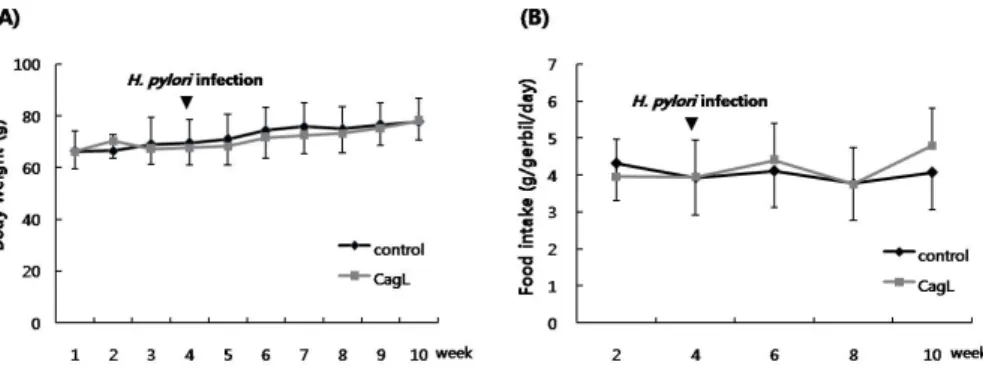
Fig. 2. Changes of body weight and food intake in Mongolian gerbil immunized with recombinant CagL protein during experimental period (8-9 animals per each group). (A) Body weight change (B) Food intakes change. Data are presented as the mean±SD.
Fig. 1. Expression and purification of recombinant CagL protein. (A) SDS-PAGE analysis for pET281-26695 CagL purification processes.
Lanes: M, Protein size marker; 1, The crude extract of IPTG-induced E. coli BL21(DE3) containing pET28a-26695 CagL; 2, the pellet after sonication; 3, the supernatant after sonication; 4, Flow–through solution; 5, wash-out; 6 and 7, elution with 100 mM Imidazole. (B) Purified rCagL using Ni+ Column. Black arrow indicates the expected rCagL band.
어 병리조직학적 평가에 사용하였고 3 mm 잘라낸 나머지 조직 의 무게를 측정한 후 1 ml brucella broth에 넣어 조직분쇄기로 균질화하였다. 균질화된 위 조직을 혈액배지에 도말하여 37℃
미호기성 환경에서 72시간 동안 배양한 후 집락화된 세균수를 세어 위 조직 내 세균의 수를 계산하였다.
병리조직학적 평가
잘라낸 3 mm 조직은 10% 중성 포르말린에 고정한 후, 파라 핀에 포매, 4 μm 두께의 조직 절편을 제작하였다. Hematoxylin- Eosin 염색을 실시하고 광학현미경으로 관찰하였다. H. pylori에 의해 유도된 위점막에서의 병변은 호중구 침윤, 림프구 및 단핵구 의 침윤 및 lymphoid follicle 형성, 장화생(intestinal metaplasia), 위선의 증생(hyperplasia) 및 이소성 증식성 위선(heterotopic proliferative gland) 형성 정도에 따라 grade를 0 (normal), 1 (mild), 2 (moderate), 3 (severe)으로 나누어 평가하였다(Cao et al., 2008).
위조직에서의 RNA 추출 및 real-time PCR
위에서 이등분한 위조직의 나머지 하나는 RNA를 추출하기 위해 위점막면을 sclipper로 긁어내고 Trizol (Invitrogen Corp., USA)을 이용하여 총 RNA를 추출하였다. 2 μg의 총 RNA를 RT Premix Kit (Bioneer, Korea)를 이용하여 cDNA로 합성하였고,
SYBR_GREEN PCR MASTER Mix (Applied Biosystems, UK) 와 MyiQ2 Two-Color Real-Time PCR을 이용하여 Quantitative real-time PCR을 실시하였다. 사용한 forward (F)와 reverse (R) primer는 IL-1β-F, TGA CTT CAC CTT GGA ATC CGT CTC T; IL-1β-R, GGC AAC AAG GGA GCT CCA TCA C; KC-F, CAC CCG CTC GCT TCT TC; KC-R, ATG CTC TTG GGG TGA ATC C; GAPDH-F, AAC GGC ACA GTC, AAG, GCT, GAG, AAC, G; GAPDH-R, CAA CAT ACT CGG CAC CGG CAT CG 였다. 유전자 발현의 상대적인 평가는 2-△△Ct analysis method (Livak and Schmittgen, 2001)를 적용하였다. 모든 real- time PCR procedures는 melting curve analysis를 이용하였다.
통계학적 평가
SPSS 12.0 statistical package program (SPSS Inc., USA)을 모든 통계평가에 사용하였고, unpaired t-test로 군간의 통계학적 차이를 평가하였다. P값이 0.05 이하일 때 통계학적 유의차가 나 는 것으로 간주하였다.
결과 및 고찰
His tag을 포함하고 있는 재조합 CagL 단백질은 pET28a–
26695 CagL을 가지고 있는 E. coli BL21(DE3)에서 1 mM
Fig. 3. Antigen-specific serum IgG response in immunized Mongolian gerbil challenged with H. pylori strain 7.13. Recombinant CagL protein-treated gerbils were intramuscularly immunized on weeks 0, 1, 2, and 3. All Mongolian gerbils were infected by oral gavage with H.
pylori 7.13 strain at 1 week after the last immunization. The specific IgG levels were measured using ELISA coated with recombinant CagL protein at different time-points during immunization and infection. Data are presented as the mean±SD. The symbol * indicates a significant difference at P<0.05.
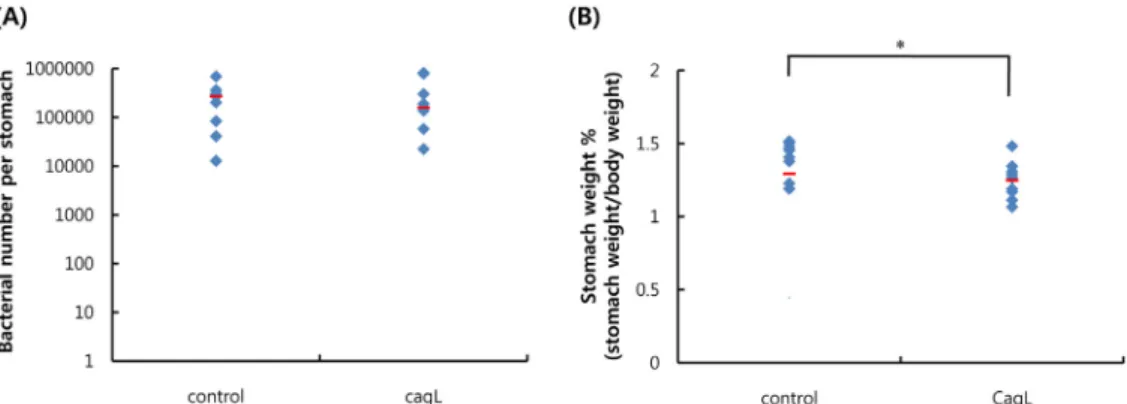
Fig. 4. The colonization of H. pylori infect in the gastric mucosa of Mongolian gerbils and relative stomach weight per body weight. (A) The colonization of H. pylori infection in the gastric mucosa. The number of H. pylori in the gastric mucosa was evaluated using a whole stomach culture system. (B) Relative stomach weight. The symbol * indicates a significant difference at P<0.05.
IPTG로 발현되었고, 발현의 유무는 10% SDS-PAGE gel로 전 기영동하여 확인하였다(Fig. 1A). 10% SDS-PAGE gel에서 BL21/pET28a-26695 CagL 단백질의 발현이 뚜렷하게 나타나 는 것이 확인되었고(Fig. 1A), 그 후 crude extract에서 Nickel- Chelate chromatography를 통해 재조합 CagL 단백질을 분리하 였고, 정제된 단백질은 27 kDa 정도의 예상된 크기를 가지고 있 었다(Fig. 1B).
rCag의 접종이 실험동물에 있어 육안적 변화를 나타내는지 확인하기 위하여 실험기간동안 매주 저빌의 체중과 사료소비량 을 측정하였다(Fig. 2). 10주 동안의 실험기간 동안 체중은 H.
pylori 감염 대조군과 H. pylori 감염 rCagL 접종군 모두 유사한 증가양상을 나타내었고, 저빌 희생시 두군의 체중 차이는 거의 없었다. 사료소비량 또한 rCagL 접종한 저빌과 접종하지 않은 저빌사이에 유의적인 변화(하루 평균소비량 4.5 g 정도)는 관찰 되지 않았다. 체중증가 정도와 사료소비율의 변화는 실험동물의 생리적인 건강상태를 육안적으로 판단할 수 있는 근거가 된다.
이러한 결과는 4회의 rCagL 근육내 접종이 저빌에 있어 식욕저 하 및 체중감소 등의 스트레스 요인으로 작용하지 않았다는 것
을 제시하는 것이다.
rCagL 근육내 접종에 의해 형성된 특이 IgG 항체 수준을 평 가하기 위해 4회의 rCagL 근육내 접종 및 H. pylori 감염 3주째 와 희생시(H. pylori 감염 6주째)마다 혈청을 분리하여 ELISA 방법으로 특이 IgG 항체 수준을 측정하였다(Fig. 3). 그 결과, rCagL 근육내 접종에 의해 특이 IgG 항체가 유의적으로 높게 형 성되는 것을 확인하였다. 특이 IgG 항체 수준은 rCagL 근육내 접종시작 일주일 후부터 뚜렷하게 증가하여 마지막 근육내 접종 시에 수거한 저빌 혈청에서의 특이 IgG 항체 수준은 rCagL을 접 종하지 않은 저빌에 비해 약 80배 정도 증가하였다. 저빌 희생시 의 rCag 접종군의 저빌의 IgG 항체 수준은 rCagL을 접종하지 않은 군에 비해 약 60배 정도 높게 나타나, 형성된 IgG 항체가가 지속되는 양상을 관찰할 수 있었다.
rCagL의 면역화가 저빌의 위점막에서 H. pylori 집락화에 영 향을 미치는지 평가하기 위해 위점막을 균질화하여 미호기성 환 경에서 배양한 후 집락화된 세균수를 세어 위 조직 내 세균의 수 를 계산하였다(Fig. 4A). rCagL 접종군와 rCagL 비접종군사이 의 조직내 세균 수는 유의적인 통계학적 차이를 나타내지 않았
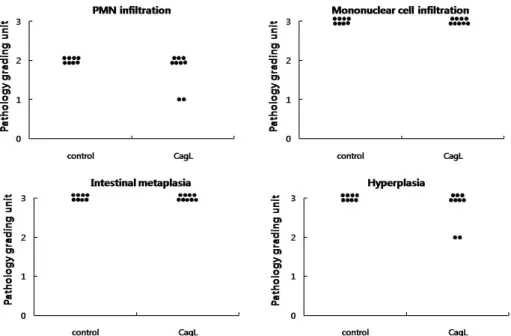
Fig. 5. Grading of histopathological changes in stomach of H. pylori-infected Mongolian gerbils after rCagL immunization.
Fig. 6. mRNA expression levels of IL-1β and KC in gastric mucosal tissues of H. pylori-infected Mongolian gerbils after rCagL immunization.
Quantitative RT-PCR was performed with RNA isolated from gastric mucosa. The levels of IL-1β and KC were normalized to those of GAPDH.
The data are presented as the mean±SD.
다. 이것은 rCagL 의 면역화에 의해 특이 IgG 항체가 높은 수준 으로 형성되었지만 형성된 IgG 항체가 H. pylori의 집락화에는 영향을 미치지 못하였다는 것을 제시한다.
H. pylori에 감염된 개체의 위점막은 호중구, 림프구 등의 염 증세포 침윤 및 lymphoid follicle의 형성, 수종, 위선조직의 이형 성 등의 병변 형성으로 인해 위점막이 비후되고 그로 인해 H.
pylori에 감염되지 않은 개체에 비해 위무게가 증가하기 때문에 다음으로 위무게 비율을 측정하고, 위조직에 대한 병리조직학적 평가를 실시하였다. 흥미롭게도 CagL 접종군의 위조직 무게비 율이 rCagL 비접종군에 비해 유의적으로 감소하는 것을 확인하 였으나(Fig. 4B, P<0.05) 위조직에서의 병리조직학적 평가에서 는 두군 사이의 유의적인 차이를 관찰할 수 없었다(Fig. 5). 저빌 에 H. pylori 7.13 균주 감염 6주째의 위조직에서는 중증의 만성 염증을 거쳐 전암병변에서 나타나는 장화생, 위선의 형태적인 변화들이 동반되어 나타나게 되는데, 두 군 모두 중증의
lymphoid follicle의 형성 및 림프구를 포함한 단핵구의 침윤과 전암병변에서 관찰되는 장화생을 나타내었다. 반면 호중구의 침 윤 및 위선의 증생과 이소성 증식성 위선 형성의 병변은 rCagL 접종군에서 그 정도가 감소하는 개체들도 관찰되었지만 통계학 적 유의차는 없었다. 이같은 결과를 미루어 보아, rCagL의 면역 화에 의해 저빌 위점막에서의 병변형성까지는 감소시키지 못한 것으로 생각된다.
rCagL의 면역화에 의해 위점막에서 싸이토카인의 발현정도 가 변화하는지 평가하기 위해 IL-1β와 KC의 mRNA 발현정도 를 real-time PCR을 이용하여 정량하여 측정하였다(Fig. 6). H.
pylori 감염 6주째의 IL-1β와 KC의 발현정도는 rCagL 접종군과 비접종군사이의 유의적인 차이를 나타내지 않았다. 이러한 결과 는 두군 사이에 차이가 없었던 병리조직학적 소견과 일치하는 것으로 생각된다.
사람과 동물 모델에서의 백신 연구에서 애쥬번트와 투여경로
pylori 감염에 대한 방어정도를 비교한 연구에서는 혈청내 IgG 항체 형성정도는 알루미늄 애쥬번트가 높았지만 질병발생에 대 한 방어율은 toxin 애쥬번트보다 낮게 나타나 방어 효과가 제한 적이라는 것이 보고된 바 있다(Wu et al., 2008). 이번 연구에서 도 알루미늄 애쥬번트로 근육내 주사하여 전신 면역을 유도하였 을 때 혈청내에서 특이 IgG 항체가 유의적으로 높게 형성되었지 만 위점막에서의 세균 집락화, 병리조직학적 소견 및 싸이토카 인의 mRNA 발현에서는 유의적인 차이는 확인 할 수 없어 재조 합 항원에 대한 알루미늄 애쥬번트 사용은 제한점을 가지는 것 으로 사료된다. 최근에는 cholera toxin (Durrani and Rijpkema, 2003; Jeremy et al., 2006; Nystrom et al., 2006)이나 E. coli heat-liable toxin (Lee, 2001; Sougioultzis et al., 2002) 점막면역 을 자극하는 애쥬번트를 여러 동물 모델에서 H. pylori vaccine으 로 사용하는 연구논문들이 보고되고 있다. 하지만 cholera toxin 이나 E. coli heat-liable toxin이 점막 면역을 유도하는 애쥬번트 로써 효과가 뛰어나지만 독성이 강해 사람에게는 사용할 수 없 는 단점이 있다. 또한 H. pylori 감염에 있어 한가지나 두가지 항 원을 사용할 때보다 세가지 이상의 항원을 사용할 때, 보다 질병 에 대한 방어효과가 뛰어나다는 보고가 있어(Wu et al., 2008), 향후에는 H. pylori의 T4SS에서 높은 발현을 나타내는 CagA 또 는 CagC (Ta et al., 2012) 등과의 혼합 접종 및 점막 면역을 유도 하는 애쥬번트의 사용 등을 제고하여 연구를 진행할 필요가 있 을 것으로 생각한다.
이번 실험의 결과를 미루어 보아 H. pylori 감염에 대해 유효 한 면역 반응 및 질병 방어 효과를 나타내기 위해서 CagL을 포 함한 다른 종류의 재조합 항원 사용 및 보조적으로 전신 면역 및 점막 면역을 효과적으로 유도하기 위해 안정성 있는 애쥬번트의 사용을 고려해야 할 것으로 사료된다.
적 요
Helicobacter pylori는 만성 위염, 소화성 궤양, 위암의 중요한 역학적 인자중 하나이다. H. pylori의 독성인자중 CagL은 숙주 세포와 H. pylori의 제 4형 분비기관(Type 4 secretion system)을 연결하는 adhesin으로 작용하는 섬모 단백질로 H. pylori가 발병 하는데 중요한 역할을 하는 것으로 알려져 있다. 이번 연구는 저 빌에 H. pylori를 감염시킨 동물 모델을 이용하여 CagL 재조합 단백질을 면역화시켰을 때 나타나는 효과를 평가하였다. 재조합 CagL은 클론되었고, 과발현시켜 정제하여 준비하였다 저빌은 H. pylori 감염 대조군과 H. pylori 감염 CagL 재조합 단백질 접
는 두군의 차이가 없었다. 저빌 체중에 대한 위무게 비율는 H.
pylori 감염 CagL 재조합 단백질 접종군이 유의적으로 감소하였 으나 병리조직학적 평가에서는 유의적인 차이는 확인하지 못하였 다. 위에서의 IL-1β와 KC (IL-8 homologues)의 유전자발현 정도도 두 군사이에 유의적인 차이는 없었다. 이번 결과는 CagL 재조합 단백질의 접종은 IgG 항체형성은 효과적으로 자극하였지만 면 역화된 숙주에서 세균 집락화의 감소 및 병변형성의 방어까지는 유도하지 못한 것으로 나타났으며, 앞으로 H. pylori 감염에 대 해 유효한 면역 반응 및 질병 방어 효과를 나타내기 위해서 CagL을 포함한 다른 종류의 재조합 항원 사용 및 보조적으로 전 신 면역 및 점막 면역을 효과적으로 유도하기 위해 안정성있는 애쥬번트의 사용을 고려해야 할 것으로 사료된다.
감사의 말
본 연구는 연세대학교 치과대학 2011년도 교수연구비에 의하 여 이루어졌음(6-2011-0032).
참고문헌
Amieva, M.R., Vogelmann, R., Covacci, A., Tompkins, L.S., Nelson, W.J., and Falkow, S. 2003. Disruption of the epithelial apical-junctional complex by Helicobacter pylori CagA. Science 300, 1430–1434.
Backert, S. and Meyer, T.F. 2006. Type IV secretion systems and their effectors in bacterial pathogenesis. Curr. Opin. Microbiol. 9, 207–
217.
Cao, X., Tsukamoto, T., Seki, T., Tanaka, H., Morimura, S., Cao, L., Mizoshita, T., Ban, H., Toyoda, T., Maeda, H., and et al. 2008.
4-Vinyl-2,6-dimethoxyphenol (canolol) suppresses oxidative stress and gastric carcinogenesis in Helicobacter pylori-infected carcinogen-treated Mongolian gerbils. Int. J. Cancer 122, 1445–
1454.
Cascales, E. and Christie, P.J. 2003. The versatile bacterial type IV secretion systems. Nat. Rev. Microbiol. 1, 137–149.
Covacci, A. and Rappuoli, R. 2000. Tyrosine-phosphorylated bacterial proteins: Trojan horses for the host cell. J. Exp. Med. 191, 587–592.
Crabtree, J.E., Court, M., Aboshkiwa, M.A., Jeremy, A.H., Dixon, M.F., and Robinson, P.A. 2004. Gastric mucosal cytokine and epithelial cell responses to Helicobacter pylori infection in Mongolian gerbils.
J. Pathol. 202, 197–207.
Del Giudice, G., Covacci, A., Telford, J.L., Montecucco, C., and Rappuoli, R. 2001. The design of vaccines against Helicobacter pylori and their development. Annu. Rev. Immunol. 19, 523–563.
Durrani, Z. and Rijpkema, S. 2003. Orogastric vaccination of guinea pigs with Helicobacter pylori sonicate and a high dose of cholera toxin lowers the burden of infection. FEMS Immunol. Med. Microbiol. 36, 169–173.
Gottwein, J.M., Blanchard, T.G., Targoni, O.S., Eisenberg, J.C., Zagorski, B.M., Redline, R.W., Nedrud, J.G., Tary-Lehmann, M., Lehmann, P.V., and Czinn, S.J. 2001. Protective anti-Helicobacter immunity is induced with aluminum hydroxide or complete Freund's adjuvant by systemic immunization. J. Infect. Dis. 184, 308–314.
Graham, D.Y. 1998. Antibiotic resistance in Helicobacter pylori:
implications for therapy. Gastroenterology 115, 1272–1277.
Israel, D.A., Salama, N., Arnold, C.N., Moss, S.F., Ando, T., Wirth, H.P., Tham, K.T., Camorlinga, M., Blaser, M.J., Falkow, S., and et al.
2001. Helicobacter pylori strain-specific differences in genetic content, identified by microarray, influence host inflammatory responses. J. Clin. Invest. 107, 611–620.
Jeremy, A.H., Du, Y., Dixon, M.F., Robinson, P.A., and Crabtree, J.E.
2006. Protection against Helicobacter pylori infection in the Mongolian gerbil after prophylactic vaccination. Microbes Infect.
8, 340–346.
Kwok, T., Zabler, D., Urman, S., Rohde, M., Hartig, R., Wessler, S., Misselwitz, R., Berger, J., Sewald, N., Konig, W., and et al. 2007.
Helicobacter exploits integrin for type IV secretion and kinase activation. Nature 449, 862–866.
Lee, C.K. 2001. Vaccination against Helicobacter pylori in non-human primate models and humans. Scand. J. Immunol. 53, 437–442.
Lee, C.K., Soike, K., Giannasca, P., Hill, J., Weltzin, R., Kleanthous, H., Blanchard, J., and Monath, T.P. 1999. Immunization of rhesus monkeys with a mucosal prime, parenteral boost strategy protects against infection with Helicobacter pylori. Vaccine 17, 3072–3082.
Maeda, K., Yamashiro, T., Minoura, T., Fujioka, T., Nasu, M., and Nishizono, A. 2002. Evaluation of therapeutic efficacy of adjuvant Helicobacter pylori whole cell sonicate in mice with chronic H.
pylori infection. Microbiol. Immunol. 46, 613–620.
Marchetti, M., Rossi, M., Giannelli, V., Giuliani, M.M., Pizza, M., Censini, S., Covacci, A., Massari, P., Pagliaccia, C., Manetti, R., and et al. 1998. Protection against Helicobacter pylori infection in mice by intragastric vaccination with H. pylori antigens is achieved using a non-toxic mutant of E. coli heat-labile enterotoxin (LT) as adjuvant.
Vaccine 16, 33–37.
Marshall, B.J. and Warren, J.R. 1984. Unidentified curved bacilli in the stomach of patients with gastritis and peptic ulceration. Lancet 1, 1311–1315.
Nystrom, J., Raghavan, S., and Svennerholm, A.M. 2006. Mucosal immune responses are related to reduction of bacterial colonization in the stomach after therapeutic Helicobacter pylori immunization in mice. Microbes Infect. 8, 442–449.
Parsonnet, J., Friedman, G.D., Vandersteen, D.P., Chang, Y., Vogelman,
J.H., Orentreich, N., and Sibley, R.K. 1991. Helicobacter pylori infection and the risk of gastric carcinoma. N. Engl. J. Med. 325, 1127 –1131.
Rossi, G., Ruggiero, P., Peppoloni, S., Pancotto, L., Fortuna, D., Lauretti, L., Volpini, G., Mancianti, S., Corazza, M., Taccini, E., and et al.
2004. Therapeutic vaccination against Helicobacter pylori in the beagle dog experimental model: safety, immunogenicity, and efficacy. Infect. Immun. 72, 3252–3259.
Ruggiero, P., Peppoloni, S., Rappuoli, R., and Del Giudice, G. 2003. The quest for a vaccine against Helicobacter pylori: how to move from mouse to man? Microbes Infect. 5, 749–756.
Sakagami, T., Dixon, M., O'Rourke, J., Howlett, R., Alderuccio, F., Vella, J., Shimoyama, T., and Lee, A. 1996. Atrophic gastric changes in both Helicobacter felis and Helicobacter pylori infected mice are host dependent and separate from antral gastritis. Gut 39, 639–648.
Segal, E.D., Cha, J., Lo, J., Falkow, S., and Tompkins, L.S. 1999. Altered states: involvement of phosphorylated CagA in the induction of host cellular growth changes by Helicobacter pylori. Proc. Natl. Acad.
Sci. USA 96, 14559–14564.
Shaffer, C.L., Gaddy, J.A., Loh, J.T., Johnson, E.M., Hill, S., Hennig, E.E., McClain, M.S., McDonald, W.H., and Cover, T.L. 2011.
Helicobacter pylori exploits a unique repertoire of type IV secretion system components for pilus assembly at the bacteria-host cell interface. PLoS Pathog. 7, e1002237.
Sougioultzis, S., Lee, C.K., Alsahli, M., Banerjee, S., Cadoz, M., Schrader, R., Guy, B., Bedford, P., Monath, T.P., Kelly, C.P., and et al. 2002. Safety and efficacy of E. coli enterotoxin adjuvant for urease-based rectal immunization against Helicobacter pylori.
Vaccine 21, 194–201.
Ta, L.H., Hansen, L.M., Sause, W.E., Shiva, O., Millstein, A., Ottemann, K.M., Castillo, A.R., and Solnick, J.V. 2012. Conserved transcriptional unit organization of the cag pathogenicity island among Helicobacter pylori strains. Front. Cell. Infect. Microbiol.
2, 1–14.
Tegtmeyer, N., Hartig, R., Delahay, R.M., Rohde, M., Brandt, S., Conradi, J., Takahashi, S., Smolka, A.J., Sewald, N., and Backert, S. 2010. A small fibronectin-mimicking protein from bacteria induces cell spreading and focal adhesion formation. J. Biol. Chem.
285, 23515–23526.
Wang, J., Court, M., Jeremy, A.H., Aboshkiwa, M.A., Robinson, P.A., and Crabtree, J.E. 2003. Infection of Mongolian gerbils with Chinese Helicobacter pylori strains. FEMS Immunol. Med. Microbiol. 36, 207–213.
Wu, C., Shi, Y., Guo, H., Zou, W.Y., Guo, G., Xie, Q.H., Mao, X.H., Tong, W.D., and Zou, Q.M. 2008. Protection against Helicobacter pylori infection in mongolian gerbil by intragastric or intramuscular administration of H. pylori multicomponent vaccine. Helicobacter 13, 191–199.