Introduction
Rice-barley double cropping system is common in the east Asia monsoon area. This is characterized by growing barley in winter followed by rice cultivation in summer.
These days, however, there have been growing concerns on how to manage the barley straw produced from the rice-barley cropping system because of the increasing shift in management practices from the traditional off- field use of barley straw for feeding livestock to burning in open field. The shift is caused by the increasing shortage of labor and the intensive labor requirement of the traditional practice.
The result of a study on barley straw management practices conducted by Ko et al.(2003) in 203 sites at the Yeongnam region revealed that burning in open field is
the most common, practiced by 62% of the investigated sites. Only 26% of the sites incorporated barley straw in the soil while 12% utilized them off-field for livestock feeds. What was more alarming was that open-field burning practice was mostly done in piedmont areas where plow layers are normally shallow.
Open burning is a very easy and economical practice to remove barley straw from paddy fields. But it causes not only the loss of barley straw, one of valuable sources of organic matter, to the atmosphere but also increasing GHGs emission, especially CO
2, and large amounts of particulate matters, NOx and SOx (Levin, 1991; Torigoe, et al., 2000; Takashi, et al., 2001; Boopathy, et al., 2002, Ko, et al., 2004) resulting in air pollution. For example, to improve air quality and reduce smoke impacts, the California Air Resources Boards (ARB) began to regulate agricultural, rangeland, and forest land burning issuing a Smoke Management Guideline in 1971. The California
Received : January 18. 2008 Accepted : February 13. 2008*Corresponding author: Phone : +82553501267, E-mail : [email protected]
Effects of Barley Straw Management Practices on
Greenhouse Gases(GHGs) Emission During Rice Cultivation in Rice-barley Double Cropping System
Jee-Yeon Ko,
*Jae-Saeng Lee, Ki-yul Jung, Young-Dae Choi, Edwin P Ramos, Eul-Soo Yun, Hwang-Won Kang, and Seong-Tae Park
1National Institute of Crop Science, Yeongnam Agricultural Research Institute, Milyang, Gyeongnam, South Korea
1
National Institute of Crop Science, Environment and Biotechnology Division, Suwon, Gyeonggi-do, South Korea
Because main barley straw management is changing these days from off-fields to burning that may relate to air quality concerning the global warming, this study was conducted to investigate the effects of barley- straw management practices on greenhouse gas emissions during rice cultivation in rice-barley double cropping system. The treatments were barley straw burning, off-field usage of barley straw and incorporation of barley straw in paddy fields. Laboratory experiment showed that burning of barley straw at the rate of 4.5 Mg ha
-1emitted GHGs in the amounts of 4,607, 19.5, and 0.9 kg ha
-1of CO
2, CH
4, and N
2O, respectively. During the rice cultivation of the rice-barley double cropping system, the highest GHG emission by evaluated close-static chamber method was observed from the soil incorporation of barley straw with 387 and 1.0 kg ha
-1of CH
4and N
2O, respectively. The GHGs emissions from the barley straw burning and off-field usage treatments were 233 and 160 kg ha
-1for CH
4and 0.80 and 0.79 kg ha
-1for N
2O, respectively. The barley straw burning treatment showed the greatest GHGs emission among barley straw management practices in rice-barley double cropping system when considering GHGs emissions both during burning and from paddy fields during the cropping seasons. As a result, the GHGs emissions recorded in the barley straw incorporation to soil and off-field usage treatments were 22.4 and 66.8%, respectively, less than sum of GHGs emissions from the burning of barley straw and from paddy fields during rice cultivation.
Key words: Greenhouse gases, Biomass burning, Barley straw, Rice-barley double cropping system
ARB has been strictly controlling agricultural biomass burning since 1992 by the phase down of rice straw burning in Sacramento Valley Air Basin (Najita, 2001).
The incorporation of barley straw into soil, which is an alternative management practice recommended to replace off-usage of barley straw, is not an attractive method to farmers. They noted that the incorporation of barley straw into the soil could result in unsuitable soil conditions during rice transplanting and impede rooting during early rice growth as a result of significant increase in anaerobic gases and acetic acids produced by a rapidly decaying barley straw. Another problem arising from incorporation of barley straw into soil is that it can increase emission of CH
4, the second important GHG, from paddy field which is a major source of CH
4emission in the global budget.
Previous researches reported that the incorporation of rice straw at a rate of 6~9 Mg ha
-1in paddy fields can increase GHGs emission by 2~3 times during rice cropping because the incorporated organic matter into soil functioned as substrate of methanogen (Neue and Wassaman, 1995; Yagi and Minami, 1990).
The aim of this study was to evaluate the effects of different barley straw management practices on the emission of GHGs in paddy fields under rice cultivation in rice-barley double cropping system and to identify the best practice in consonance with reduced impact on global warming.
Material and Methods
Barley straw burning experiment An open chamber technique was used to investigate the amount of emission of GHGs (CO
2, CH
4and N
2O) and CO when burning barley straw at a rate of 4.5 Mg ha
-1. The open chamber was made of acrylic material with a diameter of 30 cm and a height of 100 cm, mounted on an open platform with four legs 15 cm in height to facilitate the entry of sufficient air supply during burning, and had on open top for effective air circulation(Miura and Kanno, 1997).
The barley straw burning experiment consisted of six levels of straw moisture contents (0, 10, 20, 30, 40 and 50%) and four harvesting time schedules (30, 35, 40 and
45 days after heading, DAH). In preparing a sample for moisture content determination, the barley straw was oven dried at 70 for 24 hr. After cooling down in a desiccator, the oven-dried samples were placed in vinyl bags with different quantity of water until water was completely absorbed. The samples that were used in different harvesting time schedules were collected in same field and variety in order to ensure uniformity of sample materials.
Burning experiment was conducted in a laboratory to minimize disturbance of on results by wind. The conditions during burning were closely monitored and the ambient air temperature was maintained at 22~25℃, relative humidity at 45~65%, and stack gas temperature at 30~42℃.
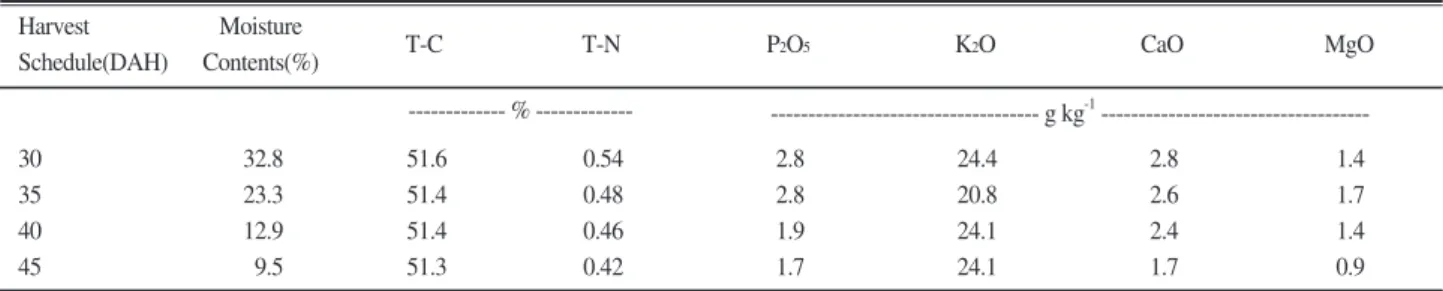
Tables 1 and 2 show the chemical properties of barley straw used in the burning experiment. Total carbon(T-C) of barley straw was determined using Carbon/Hydrogen determinator(LECO, TruSpec CHN) after oven-drying at 70℃ for 72hr and grounding. Total nitrogen(T-N) of barley straw was determined by distillation method after oven-drying at 70℃ for 72hr and digested in micro- Kjeldahl block heater using H
2SO
4. A subsample of oven-dried material was digested using a ternary solution(HNO
3:H
2SO
4:HClO
4, 10:1:4) for determination of P, Mg, Ca and K. As to barley type, T-C content of the hull-type barley straw was slightly higher than that of malt-type. T-N content however, was higher in the malt- type than in the hull-type barley straw. As regards harvest time, the barley straw harvested at earlier dates (lesser number of days after heading) had higher T-N and moisture contents.
The analyses of GHGs (CO
2, CH
4and N
2O) were performed by means of Gas Chromatograph (Varian 3800, FID: CH
4, CO
2, ECD: N
2O). The Porapack Q and Porapack N stainless steel column(80/100 mesh, 0.3 cm,
´2 m) at 40℃ were used for detection. Nitrogen was used as the carrier gas at a flow rate of 30 ml min
-1. The standard gases for analysis used for N
2O were 0.1 ppmV and 0.5 ppmV and CH
4standards was 9.3 ppmV. The technique which combines back-flashing and sample
Barley straw T-C T-N P2O5 K2O CaO MgO
--- % --- --- g kg-1---
Hull- type 51.6 0.49 1.8 25.4 3.1 1.6
Malt- type 50.8 0.58 3.0 24.2 3.5 2.1
Table 1. Chemical properties of barley straw used in the burning experiment.
injection with 10-port valve and signal switching with 4- port valve ware adopted in the analyzing system for minimizing effects of oxygen and moisture to ECD. CO was analyzed by Electro-chemical sensor (Drager Multi- warn Ⅱ) with dust trap.
GHGs emission during rice cropping season The close-static chamber (Shin, et al., 1995) was used to evaluate the impact of the different barley straw management treatments on GHGs emission from paddy fields. The determination was made during the rice culture period of the rice-barley double cropping system.
Barley straw managements (burning, incorporation and straw removal for off-field use) were treated on field before the field monitoring of GHGs emission.
The amount of barley straw used in the experiment was 4.5 Mg ha
-1. The rice variety used for this study was japonica Sangmee-byeo which requires about 120 days of growing period and suits for rice-barley double cropping system. The 30-day old rice seedlings were transplanted on the 8th day of June after harvesting the hull-type barely on the 20th day of May. Each plot was applied with chemical fertilizers at a rates of 90-45-57 kg ha
-1N-P
2O
5-K
2O.
Samples were collected once a week between 10:00 and 11:00 AM during the cropping season because that time showed the average value of GHGs emission(shin et al., 1995). The analyses employed in the determination of the GHGs in the collected gas samples were the same as the methods used in the burning experiment.
Soil properties and rice yield by barley straw management Soil samples were collected at surface layer after rice cultivation and dried for chemical analysis. The chemical properties of sieved soils(<2 mm)were as followed : pH(1:5 water extraction), organic matter(Tyurin method), exchangeable cation(1N- NH
4OAc extraction, ICP), and available phosphate (Lancaster method).
Grain yields and growth status were determined at each treatment plot following RDA standard investigation method for agricultural experiment(RDA, 1995).
Results and Discussion
GHGs emission by barley straw burning The amounts of GHGs emitted by burning barley straw are shown in Table 3. The amounts emitted were 4,607.0, 19.5 and 0.9 kg ha
-1of CO
2, CH
4, and N
2O, respectively.
The emitted CO amount, which is normally produced by incomplete incineration of organic matters, was 288.3 kg ha
-1.
Considering C containing gases, emitted C as CO
2-C ranged from 49 to 53 %, followed by CO-C (5.9~6.4%) and CH
4-C (0.5~0.7%). From burning rice straw using the same open chamber method, Miura (1997) reported trace gases emission in the amount of 57.0~81.0% of CO
2-C, followed by CO-C (5.0~9.0%) and CH
4-C (0.4~0.9%). The rest C of barley straw may be remain as
Harvest Schedule(DAH)
30 35 40 45
32.8 23.3 12.9 9.5
51.6 51.4 51.4 51.3
0.54 0.48 0.46 0.42
2.8 2.8 1.9 1.7
24.4 20.8 24.1 24.1
2.8 2.6 2.4 1.7
1.4 1.7 1.4 0.9 MgO CaO
K2O P2O5
T-N Moisture T-C
Contents(%)
--- % ---
DAH: Days after heading
--- g kg-1--- Table 2. Chemical properties of barley straw used in the burning experiment as affected by differet harvest schedules.
GHGs
CO2
CH4
N2O CO
4895.0±139.8"
2222.2±0.84 2220.7±0.03 2299.8±2.25
4340.5±159.6"
2216.8±0.28 2221.0±0.02 2276.9±11.55
4607.0±288.8"
2219.5±1.68 2220.9±0.08 2288.3±10.62
Average Malting barley
Hulled barley
--- kg ha-1---
"
Mean±SE
Table 3. GHGs emission from barley straw burning.
forms of particle matters and residue.
Table 4 shows amounts of GHGs emitted by burning barley straw with different moisture contents. The CO
2emission amount was the greatest among treatments regardless of moisture contents and other GHGs emission such as CH
4, N
2O and CO increased as the moisture content of barley straw increases.
The increasing of CH
4, N
2O and CO amounts by moisture contents increasement of barley straw were consistent with findings of Takashi et al.(2001) that the amount of mutagenic and carcinogenic polyacrylic aromatic hydrocarbon emissions from burning rice straw increased with higher moisture contents of the rice straw.
Theses results imply that burning of wetter barely straw is more harmful to air quality and human than that of dry one because of more emission of GHGs and mutagenic and carcinogenic hydrocarbon emissions.
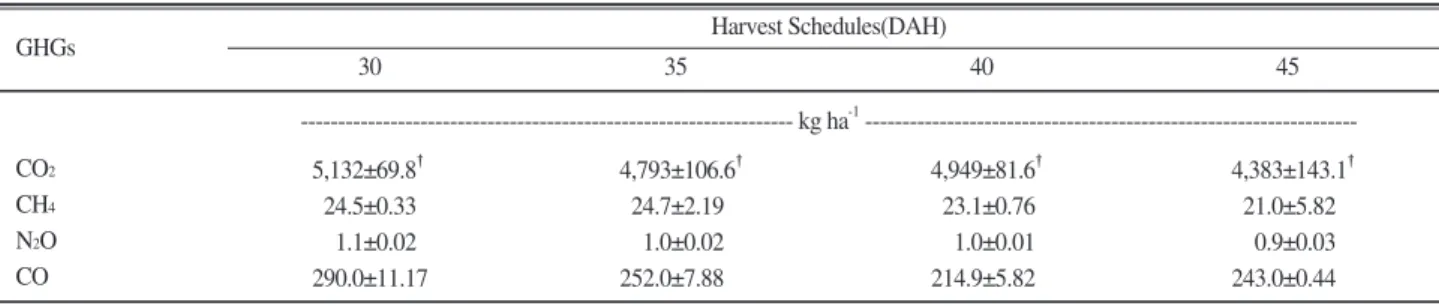
The amount of GHGs emission was found to decrease with delayed harvesting time, expressed in days after heading (Table 5). This decrease can be attributed with the decrease in the moisture, nitrogen and carbon contents of the barley straw with delay in harvesting. As shown earlier in Table 2, the biomass moisture, carborn and nitrogen contents of the barley straw decreased with increase in the number of days after heading(DAH).
GHGs emission from paddy fields during rice cropping season The amount of CH
4and N
2O emitted was monitored from paddy fields under rice cultivation of
rice-barley cropping system after implementation of three barley straw management practices: straw burning, straw removal for off-field use, and soil incorporation of straw (Fig. 1). Results showed that the highest amounts of CH
4and N
2O were recorded in the plots incorporated with barley straw. The increase in CH
4was significantly noticeable as compared to N
2O. This result can be attributed to the fact that CH
4is the final product of the anaerobic decomposition of organic matters such as barley straw in the soil. There is many studies which reported that CH
4emission increased with an increase in the amount of C source, such as rice straw, incorporated into paddy fields (Yagi and Minami, et al., 1990; Neue and Wassman, at al, 1995; Ko, et al., 1996; Deborah, et al., 1999).
The increased amount of CH
4induced by higher amount of organic matters implies a significant progress of anaerobic decomposition because the critical initial soil redox potential(Eh) for CH
4production was -150 (Wang et al.. 1993) and optimum soil (Eh) to produce CH
4was reported a range of -200~-300 mv(Yu and Patrick, 2004). Oftentimes, this severe anaerobic condition caused by high amount of organic matter may hinder rice growth due to high production of anaerobic gases and acetic acid. This is a recognized problem in rice-barley double cropping system brought by the quick transition from aerobic condition during barley cultivation to the next anaerobic term during rice
GHGs
CO2 CH4 N2O CO
5,132±69.8"
224.5±0.33 221.1±0.02 290.0±11.17
4,793±106.6"
224.7±2.19 221.0±0.02 252.0±7.88
4,949±81.6"
223.1±0.76 221.0±0.01 214.9±5.82
4,383±143.1"
221.0±5.82 220.9±0.03 243.0±0.44
45 40
35 30
--- kg ha-1---
"
Mean±SE
Harvest Schedules(DAH)
Table 5. Emission GHGs emission from burning of barley straw as affected by different harvest schedules.
GHGs
CO2 CH4 N2O CO
5143±31.2"
220.5±0.55 220.9±0.02 262.1±3.59
5120±38.8"
220.5±0.30 220.9±0.004 244.2±5.19
5099±79.0"
221.1±0.22 221.0±0.04 227.9±4.61
5083±75.8"
222.2±0.30 221.0±0.03 2284.9±9.01
5100±86.1"
24.0±0.35 1.0±0.01 320.9±14.22
5104±88.3"
227.6±1.45 221.1±0.01 324.2±2.39
50%
40%
30%
20%
10%
0%
--- kg ha-1---
"
Mean±SE
Table 4. GHGs emission pollutant from barley straw burning as affected by different straw moisture content.
transplanting (Gotoh and Onikura, 1971; Katyal, 1977).
The increased emission of CH
4in the barley straw incorporation treatment became apparent and distinguishable within the first month of the rice growing season. According to Watanabe et al. (1998), 98% of the evolved CH
4in the early growth stage was derived from rice straw. Watanabe et al. (1999) also investigated the contribution of C source by using 13C-labeled rice straw and soil to CH
4evolution in flooded pot with rice plants.
They concluded that the contributions were 42% from rice straw, 37~40% from rhizo-deposition and 18~21%
from soil organic matter.
The emission of N
2O showed a similar pattern to that of CH
4but early emission peaks as that appearing in CH
4was not observed.
Table 6 shows the amount of GHGs emitted in rice paddy fields under rice-barley double culture system depending on barley straw management practices. The emission of CH
4in the barley straw-incorporation treatment was 2.4 folds of the CH
4emission observed in the off-field usage treatment, and 1.7 folds for the burning treatment. Neue and Wassaman(1995) obtained similar results thate CH
4emission amounts by rice straw
application of 5 Mg ha
-1was 2.5 times higher than without rice straw incorporation. Yagi and Minami (1990), reported that the application of rice straw at rates of 6~9 Mg ha
-1in paddy fields increased CH
4emission by 1.8 to 3.5 folds. The difference among these studies as to the magnitude of CH
4emission by application of organic matters may be due to differences in other factors that effect CH
4emission, including soil characteristics, agricultural practices and rice variety. The higher amount of CH
4emitted from barley straw burning as compared to off-field usage of barley straw can be attributed to the fact that the burned residue of barley straw which contains lots of mineral and some C sources because the residue was not completely burned, can stimulate the activity of soil microorganisms including methanogenic bacteria when mixed with the soil.
Although the differences in the amounts of N
2O emission among management practices were very small, the pattern was very similar to that for CH
4with the soil incorporation of barley straw exhibiting the highest, followed by burning and off-field usage treatments.
Milkha et al. (2001) investigated the N
2O emission from paddy fields applied with wheat straw at a rate of 6 Mg
Emission
GHGs CH4
N2O GWP*1
160.3±23.59"
30.79±0.108 3,614±501.7
232.8±32.05"
30.80±0.133 5,136±667.4
386.9±50.05"
31.01±0.160 8,439±1063.9 Incorporation Burning
Off-field usage
--- kg ha-1---
"
Mean±SE
Barley straw application : 4.5 Mg ha-1
GWP (Global Warming Potential) = (CH4× 21) + (N2O × 310)
Table 6. GWP and GHGs emission from paddy fields as affected by barley straw management practices.
Fig. 1. Changes in (a) CH4and (b) N2O emissions from paddy fields during rice cultivation.
ha-1 and observed an emission of N
2O in the amount of 1.35 kg ha
-1, while the wheat straw-free field emitted 1.24 kg ha
-1. McKenney et al. (1993) and Ragab et al. (1994) also confirmed that the application of organic matter increased N
2O emissions. The incorporation of organic material create a pool of readily available N and therefore often stimulates N
2O emission (Lemke, et al., 1999). On the other hand, observed increase in N
2O emission was not as pronounced as CH
4emission. Moreover, some researches contend that N
2O emission from rice fields could even be reduced by higher straw amendments, which may be explained by N immobilization (Abao, et al., 2000; Hwang and Hanaki, 2000).
Because each GHG has different global warming effects on a basis of 1 mole, the effects of CH
4and N
2O emission from paddy fields were recalculated to CO
2Global Warming Potential (GWP) value. The calculated GWP were 3,614, 5,136, and 8,439 kg ha
-1for the off- field usage, burning, and soil incorporation of barley straw, respectively. The pattern of GWP resembled that of CH
4because this gas was the most abundant among the GHGs.
The total GHGs emission calculated as GWP depending on barley straw management practices from rice-barley double cropping system under rice culture is shown in Fig. 2. The data used in the calculation of total emission value for the burning treatment was from the emitted value for the 40 DAH in the barley straw burning experiment.
The barley straw burning treatment showed highest GHGs emission amounts of 10,880 kg ha
-1among three management practices when GHGs emissions were considered to be from both of straw burning (5,744 kg ha
-1) and paddy fields during rice culture of the rice-barley double cropping system (5,136 kg ha
-1). The less emission in the barley straw soil incorporation management practice as compared to that of the barley straw burning treatment can be attributed from the possible scenario that not all the incorporated barley straw into the soil were decomposed in one rice cropping
season resulting in less CH
4emission in the season. If the emitted portion from incorporated barley straw in GWP of the barley straw incorporation is calculated by adopting the results of Watanabe et al. (1999) that 42% of emitted CH
4amount can be derived from incorporated rice straw, then 2,520 kg ha
-1could be emitted when barley straw of 6 kg ha
-1was incorporated. The other C from barley straw mixed into soil ecosystem could become soil organic matter and microbial biomass and some may remain as residue (Kimura, et al., 2004).
Results revealed that GHGs emissions from barley straw incorporation and off-field usage treatments decreased by 22.4 and 66.8%, respectively, compared to the burning of barley straw treatment.
Soil properties and rice yield by barley straw management Table 7 shows chemical properties of paddy soils depending on barley straw management after harvest. As shown in table 7, pH, organic matter and exchangeable K increased in barley straw incorporation treatment than other treatments. These results could imply that application of barley straw improved the soil fertility .
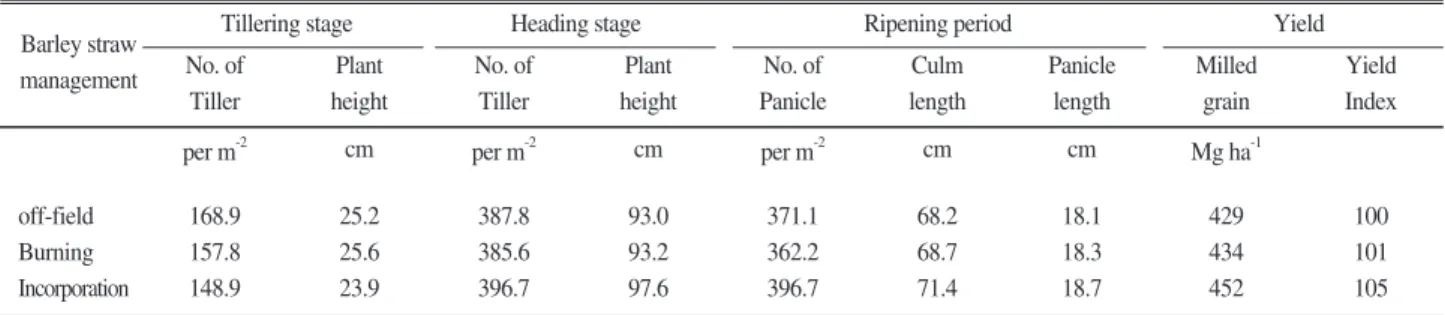
Table 8 showed the rice growth status and yield depending on barley straw management practices. Tiller number and plant height of rice in barley straw
Fig. 2. GWP from barley straw burning and/or paddy fields during the cropping season as affected by barley straw management practices.Barley straw management
off-field Burning Incorporation
6.01 5.65 6.23
28.1 30.3 31.5
45.4 50.6 51.1
0.70 0.57 0.88
5.31 5.49 5.46
1.08 1.06 1.07 Mg Ca
K mg kg-1
g kg-1
1:5 --- cmolckg-1---
Ex. Cation Av. P2O5
OM pH
Table 7. Chemical properties of the paddy soils as affected by barley straw management after harvest.
incorporation treatment decreased a little among treatments at tillering stage. From heading stage, the rice growth status of barley straw incorporation increased and milled rice grain yield showed highest as 5% increased compared to off-usage. Shin et al.(2001) reported a similar results in the changes of rice yield in long-term rice-barley double cropping that rice yield was increased due to barley straw application starting from the second year, recording 2 to 19% increase (average of 9% for 10 years) due to higher spikelet number.
Conclusion
The open burning of barley straw is now prevailing barley straw management practice among farmers in South Korea due to convenience and economic consideration. But this practice posed a great threat to the environment due to GHGs emitted by the process in the amount of 4,607, 19.5, 0.9, and 288 kg ha
-1of CO
2, CH
4, N
2O, and CO, respectively. This can be exacerbated when the barley crop is harvested early while the moisture content of the straw is still high.
From the standpoint of GHGs emission and their potential contribution to global warming, burning barley straw can have the highest emission of CO
2amounting to 10,880 kg ha
-1, sum of GHG emitted while burning and emitted during the rice cultivation of the rice-barley double cropping system. The incorporation of barley straw into the soil and the off-field usage of barley straw emitted 8,439 and 3,614 kg CO
2ha
-1, respectively.
As the results, the minimizing management of barley straw to global warming was off-field usage and the best management could be incorporation of barley straw when we consider the rice production, soil fertility and farmer's convenience even though the emission amount was greater than off-field usage. Burning barley straw was found to have a more negative impact on air quality not only in terms of air pollutants emission such as SOx,
NOx and particle matters(Takashi, et al., 2001; Boopathy, et al., 2002, Ko, et al., 2004) but also on the amount of greenhouse gases emissions.
References
Abao, E.B., K.F. Bronson, R. Wassmann and U. Singh. 2000.
Simultaneous records of methane and nitrous oxide emissions in rice-based cropping systems under rainfed conditions. Nutr. Cycl.
Agroecosyst. 58 : 131-140.
Boopathy, R., B.R. Asrabadi and T.G. Ferguson. 2002. Sugar Cane (Saccharum officinarum L) Burning and asthma in southeast Louisiana, USA. Bull. Environ. Toxicol. 68: 173-179.
Deborah, A. B., R.H. William, G.M. Randall and K. van Chris.
1999. Methane pool and flux dynamics in a rice field following straw incorporation. Soil Bio. Bioch. 31: 1313-1322.
Gotoh, S. and Y. Onikura. 1971. Organic acids in a flooded soil receiving added rice straw and their effect on the growth of rice.
Soil Sci. Plant Nutri. 17: 1-8.
Hwang, S. and K. Hanaki. 2000. Effects of oxygen concentration and moisture content of refuse on nitrification, denitrification and nitrous oxide production. Bioresource Technology 71(2) : 159- 165.
Katyal J. C. 1977. Influence of organic matter on the chemical and electro chemical properties of some flooded soil. Soil Biol.
Biochem. 9: 259-266.
Kimura, M. J. Murase, and Y. Lu. 2004. Carbon cycling in rice field ecosystems in the context of input, decomposition of organic materials and the fates of their end products(CO2and CH4). Soil Biol. Biochem. 36: 1399-1416.
Ko, J.Y., H.W. Kang and K.B. Park. 1996. Effects of water management rice straw and compost on methane emission in dry seeded rice. J. Korean Soc. Soil Sci. Fer. 29(3): 212-217.
Ko, J. Y. H. W. Kang, J.S. Lee, C.S. Kim, S.T. Park, B.J. Kim.
2004. The impacts of barley straw burning having different moisture contents and harvesting timing on air pollutant emission.
Koe. J. Env. Agri. 23(2): 99-103.
Ko, J.Y., H.W. Kang, J.S. Lee, C.S. Kim. 2003. Atmospheric environmental impact assessment by barley straw management practices on rice-barley double cropping system in Yeongnam.
Research Report for 2003. Yeongnam Agricultural Research Institute(YARI), National Institute of Crop Science. R.D.A.
Barley straw management
off-field Burning Incorporation
168.9 157.8 148.9
25.2 25.6 23.9
387.8 385.6 396.7
93.0 93.2 97.6
371.1 362.2 396.7
68.2 68.7 71.4
18.1 18.3 18.7
429 434 452
100 101 105 Yield Index Milled
grain Panicle
length Culm
length No. of
Panicle Plant
height No. of
Tiller Plant
height No. of
Tiller
Tillering stage
per m-2 cm per m-2 cm per m-2 cm cm Mg ha-1
Heading stage Ripening period Yield
Table 8. Changes of tiller numbers and plant heights at tillering and heading stage and rice yield as affected by barley straw management
Milyang, Korea.
Lemke, R.L., R.C. Izaurralde, M. Nyborg and E.D. Solberg. 1999.
Tillage and N source influence soil emitted nitrous oxide in the Alberta parkland regime. Canadian J. of Soil Sci. 79: 15-24 Levin, J. S. 1991. Global biomass burning. MIT Press, Cambridge,
MA.
McKenny, D.J., S.W. Wang, C.F. Drury and W.I. Findlay. 1993.
Denitrification and mineralization in soil amended with legume, grass and corn residues. Soil Sci. Soc. Amer. J. 57: 1013-1020.
Milkha S. A, S. K. Tejinder, W.D. John and F.B. Kevin. 2001.
Denitrification N2O and CO2fluxes in rice wheat cropping system as affected by crop residues, fertilizer N and legume green manure.
Bio Fertil Soils 34: 375-389.
Miura, Y. and T. Kanno. 1997. Emission of trace gases (CO2, CO, CH4, and N2O) resulting from rice straw burning. Soil Sci. Plant Nutri. 43: 849-854.
Najita T, P. Gaffney, R. Hackney, M. Johnson, E. Linse, R.
Mahdavi, B. Oulrey, H. Tran. 2001. Progress report on the phase down and the 1988-2000 Pause in the phase down of rice straw burning in the Sacramento valley air basin. California Air resource board(California ARB). Report to the legislature. California, USA.
Neue, H. U. and R. Wassaman. 1995. Mitigation options for methane emissions from rice fields. pp. 374. Climate change and rice field Springer publisher. Germany.
Ragab, M., R.S. Aldag and T. Mehana. 1994. Denitrification and nitrogen immobilization as affected by organic matter and different forms of nitrogen added to an anaerobic water sediment system. Biol. Fert. Soils 17: 219-224.
RDA. 1995. Standard investigation method for agricultural experiment. Rural Development Administration, Suwon, Korea Shin, S.O., S.T. Park, C.D. Hwang, D.Y. Hwang, S.Y. Kim and
H.P. Moon. 2001 Changes of Rice Yield and Soil
Physicochemical Properties in Long-term Dry Seeded Rice-Barley Double Cropping. Korean Journal of Crop Science. 46(6): 459- 463.
Shin, Y.K., Y.S. Lee, S.H. Yun and M.E. Park. 1995. A simplified closed static chamber method for measuring methane flux in paddy soils. J. Korean Soc. Soil Sci. Fer. 28: 183-190.
Takashi, K., L. Xiaoxing, and H. Zuyun. 2001. The influence of moisture content on poly aromatic hydrocarbons emission during rice straw burning. Chemocphere Global Change Science 3: 117- 122.
Torigoe, K., S. Hasegawa, O. Numata, S. Yazaki, M. Matsunga, N.
Boku, M. Hiura and H. Ino. 2000. Influence of emission from rice straw burning on bronchial asthma in children. Pediatrics International : Official Journal of the Japan Pediatric Society 42:
114-150.
Yagi, K., and K. Minami. 1990. Effect of organic matter application on methane emission from some Japanese paddy fields. Soil Sci.
Plant Nutr., 36: 599-610.
Yu, K.W., and W.H. Patrick. 2003. Redox range with minimum nitrous oxide and methane production in a rice soil under different pH. Soil Sci. Soc. Am. J. 67 : 1952-1958
Wang, Z. P., R. D. DeLaune, P. H. Masscheleyn, and W. H. Patrick Jr. 1993. Soil redox and pH effects on methane production in a flooded rice soil. Soil SCI. Soc. Am. J. 57: 382 -385.
Watanabe, A., M. Yoshida, M. Kimura, 1998. Contribution of rice straw carbon to CH4 emission from rice paddied using 13C- enriched rice straw. Journal of Geophysical research 104D, 8237- 8242.
Watanabe, A., T. Takeda, M. Miura. 1999. Evaluation of carbon origins of CH4emitted from rice paddies. Journal of Geophysical research 104D, 13623-23630.
벼-보리 이모작 재배시 발생하는 보릿짚은 예전에는 포장에서 수거되어 땔감이나 우사의 깔집 등으로 주로 이 용되었으나 농촌 노동력 부족으로 인하여 소각이나 토양혼입 등으로 처리방법이 바뀜에 따라 농업생태계에 미 치는 영향이 커지고 있다. 따라서 벼-보리 이모작 재배시 주요 보릿짚 처리방법인 소각, 논으로부터 제거, 토양 내 혼입 처리에 따른 온실가스 발생량을 구명하여 보릿짚 처리방법이 온실가스 배출에 미치는 영향을 밝히고자 시험을 수행하였다. 보릿짚의 소각(4.5Mg ha-1)시 발생하는 온실가스 발생량은 CO2 4,607 kg ha-1, CH4 19.5 kg ha-1, N2O 0.9 kg ha-1 로 CO2의 발생량이 가장 많았으며 이는 보릿짚내 총 탄소함량의 45∼55%에 해당하였다.
각각의 보릿짚 처리 후 논에서 배출되는 온실가스량은 CH4 387 kg ha-1, N2O 1.0 kg ha-1로 보릿짚이 토양에 혼 입된 논토양에서 발생량이 가장 많았으며, 다음으로 소각처리한 논토양과 포장 밖으로 제거 처리한 논의 순이 었다. 보릿짚 처리방법이 온난화가스 배출에 미치는 영향을 소각시 발생한 양 및 논토양에서 배출되는 양을 합 하여 지구온난화지수(GWP)로 계산한 결과, 소각시 10,880 CO2 kg ha-1, 토양혼입시 8,439 CO2 kg ha-1, 포장 밖 제거시 3,614 CO2 kg ha-1의 온실가스가 발생하여 소각처리에 비해 토양혼입과 포장 밖 제거시 각각 22.4%와 66.8%의 온실가스 배출량이 감소하였다.
벼보리 이모작 재배에서 보리짚 처리 방법이 벼재배시 온실가스 배출에 미치는 영향
고지연*·이재생·정기열·최영대·Edwin P Ramos·윤을수·강항원·박성태1