
IEG 환경지질연구정보센터
5
0
0
전체 글
(2) Proceedings of KSEG 2012 Spring Conference / April 5 - 6, 2012. Previous studies have shown that dikes can intrude by reactivating pre-existing discontinuities during emplacement or by making their own fractures. Dykes that intrude into pre-existing fractures can open with a sense of shear that may be recorded in the field. In other cases, due to local changes in stress and/or lithology, dykes can also deflect into sills (Gudmundsson, 2011). In our study we looked at the angular relationships between dykes and fractures, to gain a better understanding of the tectonic history of the Korean peninsula and to better understand the way fluids use pre-existing discontinuities.. 2. Geological setting To the West of Goseung, in the Southeast of South Korea, an approximately 20 km long stretch of coastal platform outcrops shows extensive fracturing; regional joint sets and local fault related fractures (Fig. 1). Shallow dipping Cretaceous volcanic rocks and sedimentary rocks from the Jindong formation are dissected by more than 50 dikes that were examined at outcrop scale to establish the relationships between dike orientation, tectonic stresses and pre-existing fractures. In this area various Tertiary dikes have been intruded into the rocks. Some of them were sub-vertically emplaced along pre-existing fractures or created their own fractures, as well as sometimes being deflected along bedding to form sills.. Fig. 2. a) Lineament analysis using DEM and aerial photographs. b) Rose plot of lineament orientations weighted by length. c) Study area – coastal outcrops.. 3. Analysis Method 3.1 Lineament Analysis Lineament analysis was carried out in the study area and the surrounding area, using DEM image, aerial photographs and satellite imagery along coastal outcrops (Fig. 2). The main lineaments were plotted in rose diagram and weighted using their length. N60°W, NS, NE and EW lineaments, showed the highest concentrations in the study area, respectively.. - 114 -.
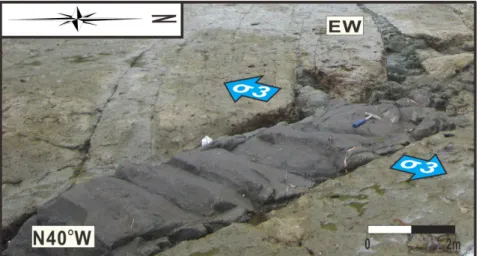
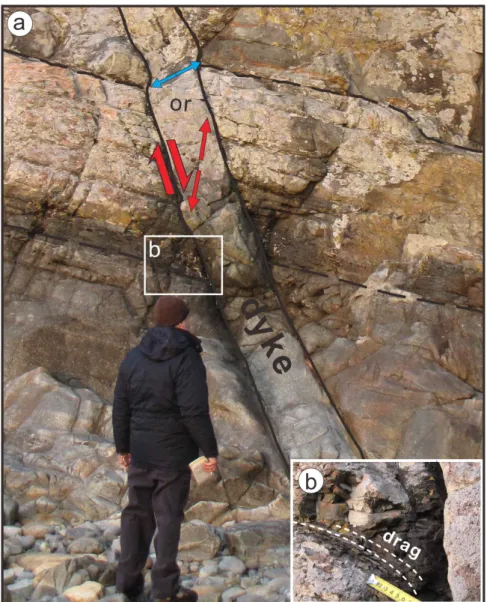
(3) Proceedings of KSEG 2012 Spring Conference / April 5 - 6, 2012. 3.2 Outcrop Analysis Along the 20 km of outcropping coastal platform, near Goseung, 50 outcropping dykes were measured. If piercing points were found, opening could be calculated through field analysis (Yang et al., 2008). Perpendicular opening was very rare and opening tended to be oblique with some shear component. Often due to the three-dimensional nature of dykes, opening was impossible to calculate by looking at a two-dimensional surface. Age dating was attempted, but due to the composition and weathering related poor preservation of dyke material, it was impossible to date the absolute ages of the dyke rocks.. 4. Results and Discussion By simply comparing the trends of lineaments with the orientation of dikes, we can clearly see that, with around forty percent of the dikes being orientated N60°W, fifty percent orientated EW, NE or NS, there is a strong relationship between local fractures and the orientation of dykes. Field relationships show that it is rare for a dyke to open perpendicular to its length and often complex three-dimensional opening exists depending on local conditions. Joints, faults and bedding surfaces are preferred discontinuities to be reactivated to create dykes and sills. In Figure 3 we see a single intrusion event opening a N40°W fracture with a left lateral shear component. EW fractures are also locally opened accommodating the intrusion, which might be related with left lateral shearing. This site shows, at outcrop scale, how regionally pre-existing discontinuities are used by intrusions.. Fig. 3. Small scale example of intrusion into pre-existing fractures with oblique opening. Single intrusion event opens two fracture systems, both oblique to least compressive stress at the time of intrusion. The intrusions are generally observed in map view, due to the nature of the outcrop. Because of this, it is often difficult to calculate the exact opening angle. Figure. 4 shows a non-vertical dyke with almost East-West opening, with an oblique vertical component. Closer examination shows pre-intrusion normal slip, indicated by the drag fold in the footwall, which is followed by opening. If this interpretation is correct, the amount of vertical opening is under exaggerated. To measure slip exactly, we would need to know the exact position of the key bed before opening occurred.. - 115 -.
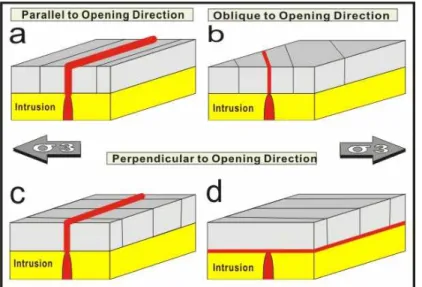
(4) Proceedings of KSEG 2012 Spring Conference / April 5 - 6, 2012. Fig. 4. a) Four dimensional problem? Dyke opens pre-existing normal fault with lateral and vertical (reverse) shearing. b: Pre-intrusion normal sense drag from normal faulting. In Goseung we found that there is not only one single important factor in determining the orientation of dykes, at the time of emplacement. Pre-existing discontinuities must play a pivotal role during emplacement. Figure 5 shows four possible scenarios during emplacement. In a and b, the orientation of pre-existing fractures is favourable for their reactivation and opening. In scenarios c and d, either pre-existing fractures are unfavourable to opening, or they are non-existent. In this case one of three things can happen: i) the intrusion will create its own fracture, therefore in this scenario the opening will occur in the directional of least compressive stress. ii) Dike will deflect into a sill. Local stress conditions must also be favourable for dyke deflection. iii) Dike will terminate.. - 116 -.
(5) Proceedings of KSEG 2012 Spring Conference / April 5 - 6, 2012. Fig. 5. Simplified end member model of intrusion interaction with pre-existing fractures. a) Pre-existing fractures are parallel to least compressive stress at the time of intrusion. b) Oblique to least compressive stress. c) Perpendicular to least compressive stress or absent.. 5. Conclusion Our results show the role of pre-existing fractures is a very important factor in the emplacement process. Therefore, dikes rarely form perpendicular to the least compressive stress if favourable pre-existing fractures are present. These pre-existing discontinuities, along with local changes in stress conditions, play a pivotal role in the development of dikes. Often we try to think three-dimensionally when interpreting dyke intrusions, we show here that sometimes four dimensions sometimes need to be looked at and often interpretation is extremely difficult and complex. It is hoped that this study can help in the understanding of fracture networks and their role in the movement of fluids within the crust. References. M. Anderson, E. ., 1951. The Dynamics of. Faulting. Oliver & Boyd, Edinburgh.. Y – b k : w w w Gudmundsson, A., 2011. Deflection of dykes into sills at discontinuities and magma-chamber formation. Tectonophysics, 500, 50-64. Glazner, A.F., Bartley, J.M., Carl, B.S., 1999. Oblique opening and noncoaxial emplacement of the Jurassic Independence dike swarm, California. Journal of Structural Geology, 21, 1275-1283. Son, M., Kim, J.S., Hwang, B.H., Lee, I.H., Kim, J., Song, C.W., Kim, I.S., 2007. Paleogene dyke swarms in the eastern Geoje Island, Korea: their absolute ages and tectonic implications. Journal of the Petroleum Society of Korea, 16, No 2, 82-99 Yang, S. J., Jin, G. M., Kim, Y. S.., 2008. Paleostress conditions based in dyke intrusion patterns and deformation histories in Geo-je island, SE Korea, Journal of the Geological Society of Korea, Vol. 44, No 6, 747-764 Chough, S.K., Sohn, .K., 2010. Tectonic and sedimentary evolution of a Cretaceous continental arc ac arc system in the Korean peninsula Ne vie . Earth Science Revie s, 101, 225 249.. - 117 -.
(6)
수치


+2
관련 문서
ABSTRACT: In this study, we describe the taxonomy of the Cretaceous non-marine ostracods from the Hampyeong Basin, southwestern Korean Peninsula as well as its biostratigraphical
Occurrence and distribution: This species is known in the Duho Formation of the Yeonil Group and also commonly known in the Miocene floras of the Korean Peninsula
The average trace element compositions of the Chunyang granite, the Daebo granitic rocks in the southern Korea and granites in the world ppm #.. High Field
Seo, D.W., 2004, An analysis of observations and hypotheses of elementary school students on sedimentary rocks and geological structures in field courses.
Woo-Hun Ryang, 2013, Characteristics of strike-slip basin formation and sedimentary fills and the Cretaceous small basins of the Korean Peninsula.. Journal of the Geological Society
(1993) Evolution trends of biotite and hornblende in granitic rocks from Yonghae-Yongdok area, northeastern Gyeongsang basin, Korea. Journal of Korean Institute of
The second mission is the oceanographic image and data gathering for marine environment monitoring around Korean Peninsula by using an eight channel Geostationary Ocean
Moho, Korean Peninsula, gravity anomalies, wavenumber correlation analysis, power spectrum analysis, Moho integration by least-squares method... *Corresponding
