주향이동 분지 형성, 퇴적층 충전의 특징과 한반도 백악기 소분지
양우헌
전북대학교 과학교육학부 및 과학교육연구소
요 약
한반도 중부와 남부 지역에는 주향이동 단층계에 의해 형성된 백악기 소분지(<50×50 ㎢)가 존재한다. 1980 년대 후반 이래로 해남분지, 영동분지, 음성분지, 공주분지, 격포분지, 천수만분지, 부여분지, 무주분지, 풍암분 지, 진안분지, 함평분지, 남양분지, 탄도분지, 계화분지 등의 14개 육성 백악기 소분지에 대한 연구가 주로 구조 지질과 퇴적학적 관점에서 수행되었다. 경상분지를 포함한 백악기 퇴적분지에 대한 종합 연구는 중생대 시기 한반도를 포함하는 동북아 지역의 지구조 운동에 초점을 맞추어 왔다. 이제 백악기 퇴적 소분지의 분지 형성과 퇴적층 충전 특징을 정리하고, 그 내용을 일반적인 주향이동 분지 특징과 비교해 볼 필요가 있다. 본 논문은 주 향이동 분지 형성과 퇴적층 충전에 대한 최근까지 연구결과를 다루면서, 그 내용을 한반도 중부와 남부 지역에 분포하는 백악기 소분지의 연구결과와 비교하며 종합하였다.
주요어: 백악기 소분지, 주향이동 분지, 분지 형성, 퇴적층 충전
Woo-Hun Ryang, 2013, Characteristics of strike-slip basin formation and sedimentary fills and the Cretaceous small basins of the Korean Peninsula. Journal of the Geological Society of Korea. v. 49, no. 1, p. 31-45 ABSTRACT: There are Cretaceous small basins (<50×50 ㎢) in the middle and southern part of the Korean
Peninsula, formed by strike-slip fault systems. Since late 1980s, 14 nonmarine small basins of the Cretaceous have been studied mainly in terms of structural geology and sedimentology, such as the Haenam, Yongdong, Eumsung, Kongju, Kyokpo, Chonsu Bay, Puyeo, Muju, Pungam, Jinan, Hampyeong, Namyang, Tando, and Gyehwa basins.Integrated studies of the Cretaceous basins including the Kyongsang Basin have focused on tectonics of the northeastern Asian region during the Mesozoic. Now it is necessary to review characteristics of basin formation and sedimentary fills in the Cretaceous small basins. This paper have reviewed recent study results of the basinal characteristics in general strike-slip basins, comparing with those of the Cretaceous small basins in the middle and southern part of the Korean Peninsula.
Key words: Cretaceous small basin, strike-slip basin, basin formation, sedimentary fills
(Woo-Hun Ryang, Chonbuk National University, Division of Science Education and Institute of Science Education, Baekje-daero 567, Deokjin-gu, Jeonju 561-756, Republic of Korea)
‡Corresponding author: +82-63-270-2790, E-mail: [email protected] 1. 서 언
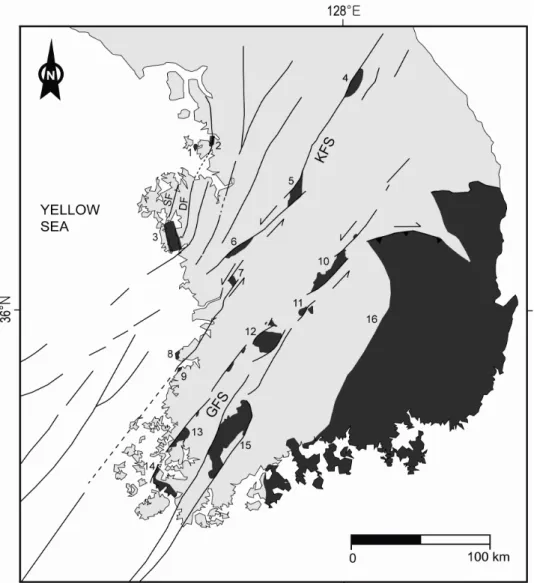
한반도 중부와 남부 지역에는 중생대 주향이동 단층계에 의해 형성된 백악기 소분지(<50×50 ㎢)가 분포한다(그림 1). 1980년대 후반 이래로 지난 20여 년간, 해남분지, 영동분지, 음성분지, 공주분지, 격포 분지, 천수만분지, 부여분지, 무주분지, 풍암분지, 진
안분지, 함평분지, 남양분지(시화분지), 탄도분지, 계화분지 등의 14개 육성 백악기 소분지에 대한 학 문분야별 연구가 수행되었다(Chough and Chun, 1987; Lee and Paik, 1989, 1990; Song et al., 1990, 1991; Chun and Lee, 1991; Lee et al., 1992; Song and Woo, 1992; Kim et al., 1994; Chun and Chough, 1995; Choi, 1996; Kim et al., 1997; Park
Fig. 1. Distribution of Cretaceous faults and basins in the Korean Peninsula (modified after Chun and Chough, 1992;
Baag and Baag, 1994; Korea Institute of Geology, Mining, and Materials, 1995; Ryang, 2003; Chough and Sohn, 2010; Shinn et al., 2010; Kwon et al., 2013). Numbers indicate Cretaceous nonmarine basins (black area): 1. Tando, 2. Namyang, 3. Chonsu Bay, 4. Pungam, 5. Eumsung, 6. Kongju, 7. Puyeo, 8. Kyokpo, 9. Gyehwa, 10. Yongdong, 11. Muju, 12. Jinan, 13. Hampyeong, 14. Haenam, 15. Neungju, and 16. Kyongsang (Gyeongsang). KFS: Kongju Fault System; GFS: Gwangju Fault System.
and Lee, 1997; Ryang and Chough, 1997, 1999;
Lee, 1998; Kim and Cheong, 1999; Lee, D.W., 1999; Lee, Y.U., 1999; Lee and Chough, 1999;
Park et al., 2000; You et al., 2000; Cheong, 2002;
Kim et al., 2003; Lee and Kim, 2003; Kee et al., 2006; Kim et al., 2009; Noh et al., 2009; Kwon et al., 2013). 이러한 퇴적분지 연구는 크게 분지 형성 의 구조지질 분야와 분지 충전의 퇴적 분야로 나눌
수 있다. 또한 한반도 백악기 퇴적분지의 전체적인 형성과 진화를 설명하려는 지구조, 고지자기, 화성암 특성 등에 대한 종합적인 연구 결과가 지속적으로 발 표되고 있다(Chun and Chough, 1992; Lee, D.W., 1999; Chough et al., 2000; Park et al., 2005; Hwang et al., 2008; Chough and Sohn, 2010; Lee et al., 2011; Kim et al., 2012).
한반도 백악기 소분지에 대한 개별 분지 연구와
종합 연구는 이들 퇴적분지가 주향이동 단층계에 의 해 형성되고 규제되었다는 해석에서 모두 일치하고 있다. 또한 경상분지를 포함한 한반도 백악기 퇴적 분지 전체를 다루는 논문은 중생대 시기 한반도를 포함하는 동북아 지역의 지구조 운동에 초점을 맞추 어 왔다. 이제 한반도 중남부에 분포하는 백악기 퇴 적 소분지의 각 특징을 정리하고, 그 내용을 국제적 으로 발표된 일반적인 주향이동 분지 특징과 비교해 볼 필요가 있다. 본 논문은 주향이동 분지 형성과 퇴 적층 충전에 대한 최근까지 연구결과를 다루면서, 그 내용을 한반도 백악기 소분지의 연구결과와 비교 하며 종합할 것이다. 이는 한반도 백악기 소분지의 분지형성모델과 지층모델을 구축하는 분지해석 연 구와 퇴적분지 내 CO2 지중저장의 가능성을 연구하 는 응용 연구에 도움을 줄 것이다.
2. 지구조 논의
중생대 쥬라기 후기와 백악기 동안 활동한 좌수 향 공주, 광주 주향이동 단층계는 비교적 작은 크기 (<50×50 ㎢)의 주향이동 소분지들을 형성시켰다(그 림 1). 이러한 백악기 소분지가 형성된 주요 시기가 백악기 초기이었다는 해석이 최근 강조되고 있다 (Kee et al., 2011; Kim et al., 2012). 또한 한반도 백 악기 소분지가 주향이동 단층계에 의해 형성되었다 는 해석에는 모든 연구가 일치하는 반면, 경상분지 를 포함한 백악기 퇴적분지를 형성시킨 주향이동 단 층계가 어떤 지구조 역학에 의해서 활성되었는지에 대해서는 논란이 있다. 최근까지 가장 우세한 해석 은 이자나기판이 유라시아판 하부로 섭입하면서 한 반도에 전반적인 지구조적 영향을 미치며, 북동-남 서 방향의 옥천대 주변의 좌수향 주향이동 단층계가 활성되면서 주향이동 분지가 형성되었다는 것이다 (Chun and Chough, 1992; Lee, D.W., 1999; Chough et al., 2000; Chough and Sohn, 2010). 한편으로 Lee et al. (2011)는 고지자기 연구결과에 근거하여, 한반도가 백악기 동안 남쪽으로 이동하면서 2번 이 상의 시계방향 회전운동을 겪었고, 이 회전운동이 백악기 주향이동 단층계의 활성에 주요한 역할을 하 였다는 해석을 하였다. 한반도 화성활동에 대한 최근 연구는 쥬라기 초기 이후 백악기까지 지속된 섭입작 용과 백악기 초기 북중국 블록(North China Block)
과 고 유라시아 대륙(paleo-Eurasia continent) 사 이의 융합(amalgamation)의 영향으로 백악기 초기 인 약 130~110 Ma 시기 동안 활발한 화성활동과 분 지형성이 수반되었을 것이라는 해석을 하였다(Kim et al., 2012). 이러한 지구조 논의는 향후 각 분야의 연구결과를 축적하면서 지속될 것으로 보인다.
3. 주향이동 단층과 분지
3.1 용어
주향이동 단층과 분지 형성은 실제 야외에서 매 우 복잡하게 나타나는 현상인 만큼, 그러한 단층과 분지를 표현하는 용어가 한글 표기 뿐만 아니라 영 어 표기에서도 매우 다양하게 제시되고 있다. 본 논 문에서는 다음과 같은 용어로 표기하고자 한다.
3.1.1 주향이동 단층과 주향이동 단층계
주향이동 단층(strike-slip fault)은 단층 이동이 단층면의 주향에 대체로 평행한 단층으로 정의된다 (Sylvester, 1988; Mann, 2007). 국내 학계에서 영문
‘strike-slip fault'의 한글 표기는 ’주향이동 단층‘으 로 대부분 사용하고 있다. 주향이동 단층계(strike-slip fault system)는 판경계 또는 상대적으로 넓은 폭으 로 형성된 주향이동 단층과 관련 단층을 모두 포함 하는 용어로 정의할 수 있다(참조, Mann, 2007). 주 향이동 단층을 유사하게 표현하는 wrench fault, transcurrent fault 등은 용어에 포함된 역사적인 모 호함을 피하기 위해 본 논문에서는 사용하지 않는다 (참조, Sylvester, 1988).
3.1.2 횡인장과 횡압축
주향이동 단층대에는 단층의 영향을 상대적으로 크게 받는 변형 지역이 나타난다. 이는 인장력이 우세 하여 기반암이 침강하는 횡인장(transtension) 지역과 압축력이 우세하여 융기하는 횡압축(transpression) 지역으로 나눌 수 있다(그림 2, 3). 현재 국내 학계에 서 ‘transtension’과 ‘transpression’을 가리키는 우 세한 한글 표기는 없다. 본 논문에서는 ‘횡인장’과
‘횡압축’으로 각각 표기한다.
3.1.3 주향이동 분지
주향이동 분지(strike-slip basin)는 주향이동 단
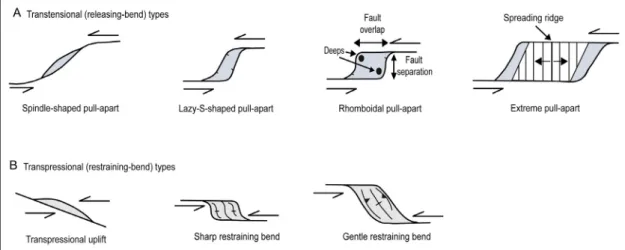
Fig. 2. Development models of strike-slip basins (Mann, 2007). (a) Trastensional types incuding releasing-bend
and pull-apart. (b) Transpressional types incuding restraining-bend.층 또는 단층계에 의해 형성된 모든 분지를 가리키는 가장 일반적인 용어이다(Mann et al., 1983; Christie- Blick and Biddle, 1985; Nilsen and Sylvester, 1995). 한편 주향이동 단층에 의해 형성된 분지 중 특 정한 종류를 지칭하는 용어로 pull-apart, releasing bend, fault-wedge 등이 있다(Burchfiel and Stewart, 1966; Crowell, 1974; Mann et al., 1983). 특히 ‘pull-apart basin’은 인리형 분지 또는 당겨-열림형 분지로 한글 표기되며, 국내 분지에 비교적 많이 적용되고 있다.
본 논문에서는 가능한 ‘주향이동 분지’ 용어를 사용 할 것이며, 필요에 따라 ‘횡인장 주향이동 분지’, ‘횡 압축 주향이동 분지’, ‘인리형 분지’ 용어를 사용할 것이다.
3.2 주향이동 분지의 특징
주향이동 분지는 주향이동 단층이 현재 활성인 경우 인지가 비교적 쉽게 가능하지만, 이동을 멈춘 고 환경에서는 인지가 어렵다(Reading, 1980). 따라서 고기(ancient) 주향이동 분지 연구는 현생(active) 주향이동 분지의 연구 과정에서 발견된 여러 특징들 을 종합하고 비교하여 수행된다. 또한 육상 탄성파, 자기지전류 등의 지구물리 탐사를 수행하여 분지 심 부 구조와 퇴적층 충전에 대한 특징을 파악한다 (May et al., 1993; Ryang et al., 1999; Gruber et al., 2012). 주향이동 분지의 특징은 (1) 지구조적 배경에 따른 주향이동 단층계의 존재, (2) 주향이동 분지 발
달모델에 의한 분지 형태, (3) 분지 형성과 관련된 화 산활동, (4) 단층 이동에 따른 충전 퇴적상의 횡적, 수직적 변화, (5) 퇴적 양상의 특이성과 층서 특징 등이 있다(Reading, 1980; Mann et al., 1983; Hempton and Dunne, 1984; Christie-Blick and Biddle, 1985;
Mann, 2007).
4. 주향이동 분지 형성
4.1 분지 형태
주향이동 분지의 형태는 주향이동 경계 단층의 특성에 따라 달라지는데, 주향이동 단층의 활동이 멈춘 고기의 주향이동 분지에서는 퇴적상 분포에 의해 유추되고 있다(Aydin and Nur, 1982; Mann et al., 1983; Hempton and Dunne, 1984; Christie-Blick and Biddle, 1985). 분지 형태는 분지발달 초기 이래 의 평행한 두 단층 사이의 거리(fault separation), 단층이 겹치는 부분의 길이(fault overlap)와 이동량 (fault displacement)에 의해 결정되는데(Rodgers, 1980; Segall and Pollard, 1980), 실제 주향이동 분 지에서 이들 수치에 대한 통계처리를 바탕으로 형성 과정에 따른 연속적인 발달 모델이 제시되었다(그림 2; Aydin and Nur, 1982, 1985; Mann et al., 1983;
Mann, 2007).
주향이동 분지의 형성과정에 대한 연구는 크게 두 방향에서 이루어졌는데, 첫째는 이론 모델링과
실험모형으로서 지각의 열전달과 역학적 특성에 대 한 모델링(Rodgers, 1980; Segall and Pollard, 1980) 과 모래 모형 실험(McClay and Dooley, 1995; Dooley and McClay, 1997; McClay and Bonora, 2001)이 다. 둘째는 실제적인 접근으로서, 현재 전 세계에 분포 하는 주향이동 분지의 지질학적, 지구물리학적 자료 로부터 일반 모델을 이끌어 내는 방법이다(Crowell, 1974; Aydin and Nur, 1982; Bahat, 1983; Mann et al., 1983; Mann, 2007). 이들 연구에 따르면, 분지의 주향이동 단층대가 뚜렷하지 않다고 할지라도, 분지 의 모양이 마름모꼴 또는 방추형이라면 주향이동 분 지일 가능성을 제기할 수 있고, 또한 주향이동 분지 의 중요한 특징으로 판단할 수 있다. 이 경우 고기 분 지는 분지 형성 이후 변형과 분지 역전(basin in- version) 등을 겪었는지 파악하여야 한다(Reading, 1980; Christie-Blick and Biddle, 1985).
한반도 백악기 소분지에서 분지 형태가 온전히 파악되는 경우는 공주분지, 부여분지, 음성분지 등 이다(Kim et al., 1994; Lee and Kim, 2003; Ryang, 2003). 공주분지는 주향이동 단층에서 횡인장이 진 행되는 초기 형태인 ‘spindle-shaped‘로 해석된다 (그림 2; 표 1). 부여분지는 비록 그 크기(4 × 11 ㎢) 가 다른 소분지에 비해 작은 편이지만, 좌스텝 좌수 향으로 분리된 주향이동 경계 단층 사이에 형성된 뚜렷한 마름모 형태를 보인다(Kim et al., 1994). 부 여분지의 폭과 길이 비가 약 2.8이며, 연속 모델 중 'rhomboidal'로 해석된다(그림 2; 표 1). 음성분지도 좌스텝 좌수향으로 분리된 주향이동 경계 단층 사이 에 형성된 마름모 형태를 보인다(Ryang, 2003). 음 성분지의 폭과 길이 비가 약 4.7이며, 연속 모델 중 'rhomboidal'에 가깝게 해석된다(그림 2; 표 1). 영 동분지는 형태가 비교적 잘 보존되어 있지만, 북서 쪽 분지 경계 단층의 존재 여부에 대한 논란이 있어, 현재로선 분지의 형태적 특징을 확정하여 분류하기 어렵다(참조, Lee and Paik, 1990; Kim et al., 1997).
진안분지, 함평분지, 무주분지, 풍암분지 등은 화산 활동에 의해 분지 형태가 변형되었거나 화산암에 의 해 분지 표층이 덮혀 있어 온전한 분지의 형태 파악 이 어렵다. 해남분지, 계화분지, 격포분지, 천수만분 지, 남양분지, 탄도분지 등은 우리나라 서해안을 따 라 분포하는데, 육지 쪽으로 화산암에 의해 덮혀 있 고, 바닷쪽으로는 조간대 퇴적층에 의해 덮혀 있어,
분지의 전체 형태를 파악하기 어렵다.
4.2 급속한 침강
주향이동 분지와 열개분지(rift basin)는 모두 분 지 형성 초기에 빠른 침강을 한다(Reading, 1980).
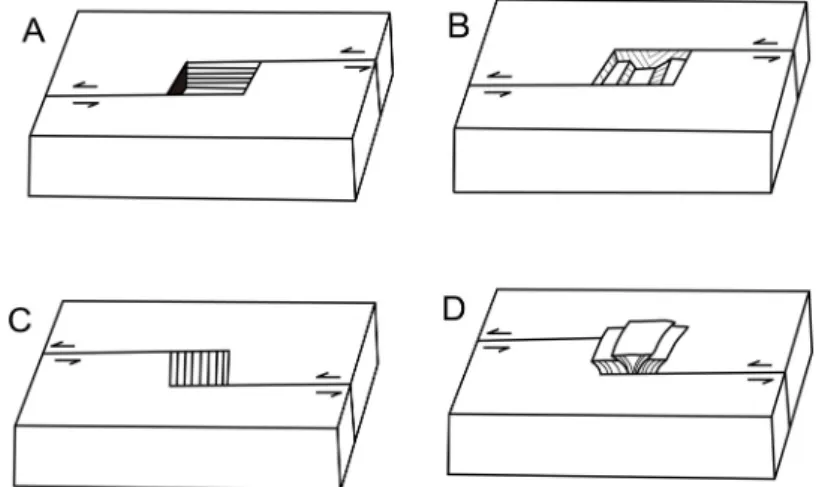
이러한 침강에는 지각이 얇아져 연결된 지각을 따라 수평으로 이동하는 열손실(syn-rifting cooling sub- sidence)에 의한 것과 지구조 운동에 따른 구조적인 침강(syntectonic subsidence)이 있다(Pitman and Andrews, 1985; Allen and Allen, 2005). 열개분지는 분지 형성과정에서 지열역학적인 영향(geothermal effect)이 더 크게 작용하는 경우가 많다(Kearey et al., 2009). 반면 작은 크기(<폭 50 km)의 주향이동 분지는 대부분 빠른 침강의 원인이 주로 지구조 운동 에 의한 구조적인 침강인 경우가 많다(그림 3; Christie- Blick and Biddle, 1985; Pitman and Andrews, 1985; Allen and Allen, 2005).
한반도 소분지의 분지 침강의 특성을 기반암의 분지 형성 관점에서 파악하기는 어렵다. 소분지의 지하구조를 볼 수 있는 지구물리 자료와 시추 자료 가 거의 없기 때문이다. 심부 분지의 단면을 파악할 수 있는 지구물리 자료로는 음성분지의 자기지전류 자료가 유일하며(Ryang et al., 1999), 음성분지에서 도 시추 자료를 통한 시료 검증 연구는 아직 없다. 구 조지질과 퇴적 연구는 거의 모두 표층 지질에 한정 하여 수행되었다. 백악기 소분지 침강의 특성을 파 악하기 위해서, 기존 연구는 표층 퇴적층의 퇴적상 분석과 수 백 m 층서 두께 단위의 조립질과 세립질 퇴적층의 매적 특징에 근거해 상대적인 분지 침강률 을 유추하고 있을 뿐이다(5.2 참조).
4.3 화산 활동
화성, 화산활동에 의한 화성암과 화산암의 분포 는 인장력이 우세한 횡인장대를 따라 많이 나타나 며, 퇴적상 구성에 주요한 영향을 끼친다(Reading, 1980; Hempton and Dunne, 1984). 화산활동은 주 향이동 분지를 열전달과 침강과정의 관점에서 분류 할 경우, 맨틀활동이 분지형성과 관련되는 ‘hot ba- sin’과 상대적으로 지각의 얕은 부분에서 형성되는
‘cold basin’으로 분류하는 기준이 된다(Allen and Allen, 2005). 주향이동 분지 내 화산 활동에 대한 체 계적인 인과 관계는 아직 밝혀지지 않았지만, calc-
Fig. 3. Three-dimensional views of deformation at transtensional (a and b) and transpressional (c and d) settings
in a strike-slip fault (modified after Aydin and Nur, 1985). (a and b) Left-stepping and left-lateral faults produce a pull-apat basin with basinal subsidence in overlap area. (c and d) Right-stepping and left-lateral faults experience uplift in overlap area, producing transpressional basins in the adjacent area.alkaline 화산활동은 섭입대와 관련되어 형성된 분 지에 영향을 미칠 수 있으며, 또한 주향이동 소분지 내 화산활동은 두꺼운 퇴적층에 의한 절연 효과로 상대적으로 차가운 분지의 양 측면으로 열을 이동시 킬 수 있다(Mann, 2007).
한반도 중부와 남부에 분포하는 백악기 소분지는 분지 형성 과정에서 거의 모두 화산 활동의 영향을 받은 것으로 보인다. 분지에 영향을 미친 화산 활동의 특성은 대륙호-섭입작용(continental arc-subduction) 의 결과로 제안되고 있으며(Chough and Sohn, 2010;
Kim et al., 2012), 대체로 남부 지역에 분포하는 분 지가 중부 지역에 분포하는 분지 보다 더 큰 영향을 받은 것으로 해석된다(표 1). 또한 거의 모든 분지에 서 화산암 역이 분지 내 조립질 퇴적층에 포함되어 있는 점, 격포분지와 계화분지에서 페퍼라이트가 산 출된 점, 많은 분지에서 화산응회암이 분지 퇴적층 을 덮고 있는 점에 근거해, 화산 활동은 소분지 분지 형성 이전부터 이후까지 지속적으로 진행된 것으로 해석된다(표 1).
5. 주향이동 분지 충전
5.1 퇴적환경
전 세계에서 연구되는 주향이동 분지 내 퇴적환 경은 매우 다양하여, 호소 퇴적환경 뿐만 아니라 해 침의 영향을 받는 해성 퇴적환경까지 나타난다. 일
반적으로 우세한 퇴적환경은 주향이동 분지가 주향 이동 단층을 따라 고립된 소분지 형태로 나타나기 쉬우므로 충적-호소(alluvial-to-lacustirne) 퇴적환 경이 우세하다. 분지 경계 단층에 가까운 지역에 충 적층이 우세하며, 분지의 퇴적중심(depocenter)에 호소 환경이 발달한다. 결과적으로 분지 경계부에는 조립질 충적 퇴적층이 우세하며, 하류 방향으로 가 면서 조립질과 세립질 퇴적층이 교호하는 하천계 퇴 적층이 발달하며, 분지의 퇴적중심에는 세립질 호소 퇴적층이 매적된다. 주향이동 분지는 역동적인 분지 구조 형성에 따라 퇴적중심이 분지 평면 상에서 비 대칭하게 발달한다(그림 2). 결과적으로 세립질 퇴 적층이 우세한 호소 퇴적은 분지의 특정한 방향에서 비대칭으로 집적되는 경향이 크다.
한반도 백악기 소분지는 주향이동 단층계를 따라 고립된 분지로 형성되었다. 퇴적 분지는 대부분 선 상지-하천-호소 퇴적환경에서 쌓인 역암, 역질 사암, 사암, 자색이암, 녹색이암, 암회색 이암 등의 퇴적층 으로 채워져 있다(표 1). 각 분지 형성과정에 따라 조 립질 퇴적체와 세립질 퇴적체 분포 양상은 다양하게 나타난다. 대체로 조립질 퇴적체가 분지 경계부에, 세립질 퇴적체가 분지 중앙부에 분포한다. 한편으론 많은 소분지에서 역동적으로 구조 침강하는 분지 기 반암의 특성을 반영하여, 조립질 퇴적체가 우세한 충적 선상지(alluvial fan), 하천, 삼각주, 호소 퇴적환 경과 세립질 퇴적체가 우세한 선상지-삼각주(fan-del
Basin in Region Width
(km) Length (km)
Cumulative Stratigraphic
Fill (km)
Sedimentation Rate
(m/1000 yr) Time Loreto
in Baja California Sur > 10 > 25 > 1.2 max. ~8.1 2.0-2.6 Ma;
Four interbedded tuff Little Sulphur Creek
in northern California 1.5-2 12 ~5 ~2.5 Pliocene Ridge
in southern California 6-15 30-40 ~7-11 ~3.0 Late Miocene-Pliocene Hornelen
in western Norway 15-25 60-70 ~25 ~2.5 Early-Middle Devonian
Table 2. Sedimentation rates in several strike-slip basins (Nilsen and McLaughlin, 1985; Dorsey et al., 1995).
ta)와 호소 퇴적환경이 비대칭하게 전개되어 나타난 다(표 1).
5.2 퇴적충전
고기 주향이동 분지의 경우, 주향이동 단층계의 구조적인 관계를 실제 야외조사에서 정확히 발견하 기 어려우므로, 분지 진화의 복원을 위해 주로 분지 내 퇴적층의 발달을 연구한다(Reading, 1980; Nilsen and McLaughlin, 1985). 일반적인 주향이동 분지의 퇴적양상 특징은 다음과 같다: (1) 분지 크기에 비해 매우 두꺼운 퇴적층, (2) 퇴적작용의 빠른 진행, (3) 분지 횡축과 종축의 퇴적두께와 그 상의 비대칭적인 분포, (4) 단층대 주변부의 역암상의 우세와 분지 중 심부의 호소환경과 범람원의 전개, (5) 주로 종축방 향으로 발달한 분지 충전, (6) 지구조 운동을 반영하는 두꺼운 퇴적상의 반복 등이 있다(Crowell, 1974; Link and Osborne, 1978; Heward and Reading, 1980;
Steel and Gloppen, 1980; Hempton and Dunne, 1984;
Christie-Blick and Biddle, 1985; Frostick and Steel, 1993). 이러한 퇴적충전 양상을 파악하기 위해서는 고기 분지의 형태와 분지 경계부의 단층과 퇴적체가 비교적 잘 보존되어 있어야 한다.
한반도 백악기 소분지에서 주향이동 단층을 반영 하는 퇴적체의 전개를 비교적 잘 제시한 경우는 영 동분지, 음성분지, 진안분지 등이다(Lee and Paik, 1990; Kim et al., 1997; Ryang and Chough, 1997;
Lee and Chough, 1999). 모두 좌수향 주향이동 단 층을 반영한 경계부 퇴적체의 순차적인 전개 양상을 보고하였다. 자세한 퇴적체 맵핑, 고수류, 역성분, 퇴 적체 전개 방향 등이 파악되면, 퇴적체 형성에 영향 을 준 경계 단층의 특성을 파악할 수 있고, 이는 분지
형성이 진행 중인 단층의 정보를 주기 때문에 중요 한다. 음성분지에서는 1 km, 1.2 km 층서두께로 서 로 다른 교호 양상을 보이며 순차적으로 전개된 퇴 적체 양상에 근거해, 퇴적층의 매적에 영향을 미치 는 기반암의 수평 이동과 수직 이동의 특성을 해석 하였다(Ryang and Chough, 1997). 또한 인리형 분 지의 경우, 주향이동이 우세한 주향이동 경계부와 정단층이 우세한 인리형 경계부의 특성 차이에 따라 퇴적체의 전개 양상이 서로 다를 수 있다고 보고하 였다(Ryang and Chough, 1999; Ryang, 2003).
5.3 퇴적률
주향이동 분지 내 퇴적은 분지 크기에 비해 상대 적으로 두꺼운 퇴적층이 충전되는 경우가 많다. 특 히 작은 크기의 주향이동 분지는 지구조 운동에 의 한 구조적인 침강이 급속이 일어나므로 퇴적률이 높 다. 퇴적률이 잘 연구된 주향이동 분지의 예는 표 2 와 같고, 2.5~8.0 m/1000 yr 범위로 매우 높은 퇴적 률을 보인다.
한반도 백악기 소분지에서는 퇴적률이 보고된 분 지가 없다. 퇴적률을 계산하려면 분지 형성과 퇴적 층의 연대측정이 반드시 필요하다. 최근 U-Pb 저어콘 (SHRIMP) 연대측정 방법을 통해 한반도 백악기 분지 의 형성 연대가 재해석되고 있다. 기존의 분지 형성 과 관련된 화산암의 K-Ar 전암 연대는, 120 Ma으로 측정된 남양분지(Kim et al., 2009)를 제외하고, 70~93 Ma의 백악기 후기로 측정된 바 있다(표 1). 이와 달리 최근 U-Pb 저어콘(SHRIMP) 연대는 103~112 Ma 의 백악기 후기 Albian으로 측정되고 있다(Kee et al., 2011; Kim et al., 2012; Kwon et al., 2013). 이는 1995년에 음성분지 표층 이암층에 보존된 고생물 윤
조화석을 분석하여 Hauterivian-Aptian (~130-113 Ma)을 제시하였던 Choi et al. (1995)의 연구와 근접 한 결과이다.
Ryang et al. (1999)은 음성분지에서 자기지전류 자료로 해석한 분지구조에 근거해 3 km 이상의 심 부 퇴적층의 존재를 보고하였지만, 심부 시추를 수 행하지 못해 분지 형성 초기 퇴적층의 시료를 분석 할 수 없었다. 소분지에서 퇴적분지 형성과 관련된 연대측정 시료는 황해의 군산분지(Kim et al., 2012) 를 제외하고, 지표에 노출된 표층 지층에서 채취된 화산암, 응회암, 화산암 역 등의 시료였다. 육상 소분 지에서 심부 시료를 채취하고 분석하여 분지형성 초 기의 연대를 측정한다면, 세밀한 분지형성 시기와 퇴적률을 파악할 수 있을 것이다. 또한 페퍼라이트 가 퇴적 당시의 시기를 가장 정확히 지시한다는 점 을 고려할 때, 격포분지와 계화분지에서 K-Ar 전암 연대 83 Ma, 85-93 Ma로 각각 측정된 페퍼라이트를 U-Pb 저어콘(SHRIMP) 연대측정 방법으로 재분석 할 필요가 있다(표 1; Lambiase and Bosworth, 1995;
Kim et al., 2003; Noh et al., 2009).
6. 토의 및 제안
주향이동 단층계에 의해 형성된 주향이동 분지는 전 세계에서 가장 많이 연구된 분지 종류 중 하나이 다. 주향이동 분지에 대한 연구는 지구조, 구조지질, 퇴적 분야가 중심인 개별 분지 연구와 실내 실험 및 모델링 연구로 나눌 수 있다. 주향이동 분지의 형성 과 퇴적 충전에 대한 국제적인 연구 결과는 Ballance and Reading (1980) 이래로, Sylvester (1984, 1988), Biddle and Christie-Blick (1985), Woodcock (1986), Harding (1990), Woodcock and Schubert (1994), Nilsen and Sylvester (1995), Holdsworth et al. (1998), Storti et al. (2003), Cunningham and Mann (2007) 등과 같이 주기적으로 논문집과 리뷰 논문으로 발표 되고 있다. 이러한 연구는 크게 퇴적분지 형성과 퇴 적층 충전이라는 주제로 나누어 이해할 수 있다.
분지 해석은 분지 형성, 퇴적 충전과 진화 등을 포함 한다(Allen and Allen, 2005). 고기의 분지는 분지 에 충전된 퇴적층이 분지의 형성과 진화과정을 반영 하고 있다고 판단되기 때문에 중요하다. 특히 주향 이동 분지는 분지 경계 단층을 따라 편향되어 주기
적으로 중첩된 충적 퇴적층과 역 구성 성분의 변화 등의 특징이 강조되어 왔다(Steel, 1976, 1988; Crowell, 1982). 그러나 주향이동 단층 기원의 대부분의 분지들은 복잡한 분지 형성과정을 경험한다(Crowell, 1987;
Nilsen and Sylvester, 1995). 예를 들어, 주향이동 분 지로 잘 알려졌던 Hornelen 분지(Devonian)은 북해 (North Sea) 열개와 관련된 확장분지(extensional ba- sin)로 재해석되어 논란이 되었다(Hossack, 1984;
Seranne and Seguret, 1987). 또한 북미 San Andreas 단층계의 대표적인 주향이동 분지로 연구되었던 Ridge 분지(late Cenozoic)는 초창기 표층 지질과 퇴적학적 연구에 근거하여 횡압축 분지로 해석되었 다(Crowell and Link, 1982). 그러나 이후 탄성파 자료로 해석된 지하 분지구조에 근거해 횡인장 분지 로 재해석되었다(May et al., 1993). 과연 Ridge 분 지가 횡압축 분지인지 횡인장 분지인지는 여전히 불 분명하다(Ingersoll and Busby, 1995). 어쩌면 이러 한 문제는 주향이동 분지가 모두 분지 종류 중 가장 복잡한 분지 형성 과정을 겪기 때문일 것이다(Nilsen and Sylvester, 1985). Dickinson (1993)은 모든 퇴 적분지는 복합적이며 복잡한 작용에 의해 형성되므 로, 역동적이고 유연한 분지 분류와 이해가 필요하 다고 주장하였다.
최근까지 전 세계에서 연구된 193개의 현생과 고기 주향이동 분지 중 최소 49개가 횡압축 분지로, 144개 가 횡인장 분지로 분류되었다(Mann, 2007). 우리나 라 14개의 고기 주향이동 분지 중, 풍암분지 1개가 횡압축 분지로, 나머지 13개 분지 중 최소 8개 이상 이 횡인장 분지로 분류되었다(표 1). 이러한 결과는 전 세계에서 연구된 횡압축 분지와 횡인장 분지의 통계적인 해석 비율인 약 1 : 3에 비해, 한반도 백악 기 소분지의 경우 횡인장 분지의 해석 비율이 현저 히 높다. 기존에 횡인장 분지로 해석된 일부 분지를 포함하여 분류 해석이 보류된 분지에 대해 횡압축 분지의 해석 가능성에 대해 연구할 필요가 있다. 분 지해석의 관점에서 한반도 백악기 소분지의 역동적 인 분지 형성과 충전 과정을 이해하기 위해서는 지 하 분지구조와 심부 퇴적층의 특성을 파악할 수 있 는 연구방법론이 적용될 필요가 있다. 또한 아직 본 격적인 연구가 시작되지 못한 철원분지, 김포분지, 능주분지 등의 백악기 소분지는 구조지질과 퇴적학 등의 연구가 필요하다(Kee et al., 2011).
한편 한반도 백악기 소분지는 형성 이전, 과정, 이후까지 광범위한 화산 활동의 영향을 받았다(표 1). 이러한 화산 활동의 특성과 주향이동 분지 형성 의 관계는 한반도 백악기 소분지의 형성과정이 다른 국제적으로 발표된 주향이동 분지 형성과 비교하여 특이한 점이다. 이는 향후 연구 과제로 의미있다.
사 사
논문 심사와 함께 논문의 부족한 부분을 세심하 게 수정해 주신 김복철 박사님과 이철우 교수님께 감사드립니다. 논문 작성의 계기를 마련해 주신 김 정찬 박사님과 손영관, 권이균 교수님께 감사드립니 다. 논문의 그래픽 작업을 수행한 강솔잎 연구원에 게 감사합니다. 이 논문은 2012년도 정부(지식경제 부)의 재원으로 에너지기술개발사업 지원을 받아 수 행되었습니다(전담기관 한국에너지기술평가원, 주 관기관 한국지질자원연구원 - 과제명 : 이산화탄소 지중저장 실증을 위한 저장지층 특성화 및 기본설계 기술개발).
참고문헌
Allen, P.A. and Allen, J.R., 2005, Basin Analysis.
Blackwell, Malden, USA, 549 p.
Aydin, A. and Nur, A., 1982, Evolution of pull-apart basins and their scale independence. Tectonics, 1, 91-105.
Aydin, A. and Nur, A., 1985, The type and role of stepovers in strike-slip faults. In: Biddle, K.T. and Christie-Blick, N. (eds.), Strike-slip Deformation, Basin Formation, and Sedimentation. SEPM, Special Publication 37, 35-44.
Baag, C. and Baag, C.E., 1994, Aeromagnetic inter- pretation of the southern and western offshore Korea.
Korean Journal of Petroleum Geology, 2, 51-57 (in Korean with English abstract).
Bahat, D., 1983, New aspects of rhomb structures. Journal of Structural Geology, 5, 591-601.
Ballance, P.F. and Reading, H.G., 1980, Sedimentation in Oblique-Slip Mobile Zones. International Association of Sedimentologists, Special Publication 4, 265 p.
Biddle, K.T. and Christie-Blick, N., 1985, Strike-slip Deformation, Basin Formation, and Sedimentation.
SEPM, Special Publication 37, 386 p.
Burchfiel, D.C. and Stewart, J.H., 1966, 'Pull-apart' origin of the central segment of Death Valley, California.
Geological Society of America Bulletin, 77, 439-442.
Cheong, D.K., 2002, Sedimentary facies and volcanic ac- tivities of the Cretaceous Gongju Basin. Journal of the Geological Society of Korea, 38, 1-19 (in Korean with English abstract).
Cheong, D.K. and Kim, K.H., 1999, Basin evolution and provenance of sediments of the Cretaceous Poongam sedimentary basin. Korean Journal of Petroleum Geology, 7, 28-34 (in Korean with English abstract).
Choi, S.J., Kim, B.C., Chun, H.Y. and Kim, Y.B., 1995, Charophytes from the Chopyeong Formation (Cretaceous) of the Eumsung basin, Korea. Journal of the Geological Society of Korea, 31, 523-528 (in Korean with English abstract).
Choi, Y.S., 1996, Structural evolution of the Cretaceous Eumseong Basin, Korea. Ph.D. thesis, Seoul National University, Seoul, Korea, 159 p (in Korean with English abstract).
Chough, S.K. and Chun, S.S., 1987, The Uhangri Formation: volcaniclastic and chemical sedimentary facies in a Cretaceous foreland basin. 16th Pacific Science Congress, Seoul, Korea, Field Trip B-9, 113 p.
Chough, S.K. and Sohn, Y.K., 2010, Tectonic and sedi- mentary evolution of a Cretaceous continental arc-back- arc system in the Korean Peninsula: New view.
Earth-Science Reviews, 101, 225-249.
Chough, S.K., Kwon, S.T., Ree, J.H. and Choi, D.K., 2000, Tectonic and sedimentary evolution of the Korean Peninsula: a review and new view. Earth-Science Reviews, 52, 175-235.
Christie-Blick, N. and Biddle, K.T., 1985, Deformation and basin formation along strike-slip faults, In: Biddle, K.T. and Christie-Blick, N. (eds.), Strike-Slip Deformation, Basin Formation, and Sedimentation. SEPM, Special Publication 37, 1-34.
Chun, S.S. and Chough, S.K., 1992, Tectonic history of Cretaceous sedimentary basins in the southwestern Korean Peninsula and Yellow Sea. In: Chough, S.K.
(ed.), Sedimentary Basins in the Korean Peninsula and Adjacent Seas. Korean Sedimentology Research Group, Special Publication 1, 60-76.
Chun, S.S. and Chough, S.K., 1995, The Cretaceous Uhangri Formation, SW Korea: lacustrine margin facies. Sedimentology, 42, 293-322.
Chun, S.S. and Lee, H.J., 1991, Basin analysis of the Cretaceous sedimentary basins: depositional environ- ments and depositional mechanisms of the Kyokpo Basin. Korea Ocean Research and Development Institute, BSPE 00233-348-5, 131 p.
Chung, G.S. and Song, M.Y., 1994, Structure and physical property of the midwest crust of Korea: evolution of
sedimentary sequences in the Chonsu Bay of the West Coast. Journal of the Korean Earth Science Society, 15, 470-484 (in Korean with English abstract).
Crowell, J.C., 1974, Origin of late Cenozoic basins in southern California. In: Dickinson, W.R. (ed.), Tectonics and Sedimentation. SEPM, Special Publication 22, 190-204.
Crowell, J.C., 1982, The tectonics of Ridge Basin, south- ern California. In: Crowell, J.C. and Link, M.H. (eds.), Geologic History of Ridge Basin, Southern California.
Pacific Section, SEPM, Los Angels, USA, 25-41.
Crowell, J.C., 1987, Late Cenozoic basins of onshore southern California: complexity is the hallmark of their tectonic history. In: Ingersoll, R.V. and Ernst, W.G.
(eds.), Cenozoic Development of Coastal California.
Prentice-Hall Inc., New Jersey, USA, 207-241.
Crowell, J.C. and Link, M.H., 1982, Geologic History of Ridge Basin, Southern California. Pacific Section, SEPM, Los Angels, USA, 304 p.
Cunningham, W.D. and Mann, P., 2007, Tectonics of Strike-slip Restraining and Releasing Bends. The Geological Society of London, Special Publication 290, 482 p.
Dickinson, W.R., 1993, Basin geodynamics, Basin Research, 5, 195-196.
Dooley, T. and McClay, K., 1997, Analog modeling of pull-apart basins. American Association of Petroleum Geologists Bulletin, 81, 1804-1826.
Dorsey, R.J., Umhoefer, P.J., Renne, P.R., 1995, Rapid sub- sidence and stacked Gilbert-type fan deltas, Pliocene Loreto Basin, Baja California Sur, Mexico. Sedimentary Geology, 98, 181-204.
Frostick, L.E. and Steel, R.J., 1993, Tectonic signatures in sedimentary basin fills: an overview. In: Frostick, L.E.
and Steel, R.J. (eds.), Tectonic Controls and Signatures in Sedimentary Successions. International Association of Sedimentologists, Special Publication, 20, 1-9.
Gruber, W., Sachsenhofer, R.f. and Wagreich, M., 2012, Neogene pull-apart basins in the Eastern Alps (Austria).
Journal of Alpine Geology, 54, 293-307.
Harding, T., 1990, Identification of wrench faults using subsurface structural data: criteria and pitfalls.
American Association of Petroleum Geologists Bulletin, 74, 1590-1609.
Hempton, M.R. and Dunne, A, 1984, Sedimentation in pull-apart basins: active examples in eastern Turkey.
Journal of Geology, 92, 513-530.
Heward, A.P. and Reading, H.G., 1980, Deposits asso- ciated with a Hercynian to late Hercyian continental strike-slip system, Cantabrian Mountains, Northern Spain. In: Ballance, P.F. and Reading, H.G. (eds.),
Sedimentation in Oblique-Slip Mobile Zones. International Association of Sedimentologists, Special Publication 4, 105-125.
Holdsworth, R.E., Strachan, R.A. and Dewey, J.F., 1998, Continental Transpressional and Transtensional Tectonics. The Geological Society of London, Special Publication 135, 360 p.
Hossack, J.R., 1984, The geometry of listric growth faults in the Devonian basins of Sunnfjord, w. Norway.
Journal of the Geological Society of London, 141, 629-638.
Hwang, B.H., Son, M., Yang, K., Yoon, J. and Ernst, W.G., 2008, Tectonic evolution of the Gyeongsang Basin, southeastern Korea from 140 Ma to the present, based on a strike-slip and block rotation tectonic model.
International Geology Review, 50, 343-363.
Ingersoll, R.V. and Busby, C.J., 1995, Tectonics of Sedimentary Basins. In: Busby, C.J. and Ingersoll, R.V.
(eds.), Tectonics of Sedimentary Basins. Blackwell Science, Cambridge, USA, p. 1-51.
Kearey, P., Klepeis, K.A. and Vine, F.J., 2009, Global Tectonics. Wiley-Blackwell, Chichester, UK, 496 p.
Kee, W.S., Kim, B.C. and Lee, Y.N., 2006, Sedimentary environments and structural evolution of the Cretaceous Namyang Basin, Korea. Journal of the Geological Society of Korea, 42, 329-351 (in Korean with English abstract).
Kee, W.S., Koh, H.J., Kim, S.W., Kim, Y.B., Kim, Y.H., Kim, H.C., Park, S.I., Song, K.Y., Lee, S.R., Lee, Y.S., Lee, H.J., Cho, D.R., Choi, B.Y., Choi, S.J. and Hwang, J.H., 2011, Tectonic evolution of the upper crustal units in the mid-western part of the Korean Peninsula. Korea Institute of Geoscience and Mineral Resources, Daejeon, Korea, GP2009-012-01-2011 (3), 255 p (in Korean with English abstract).
Kim, B.C., Yu, K.M., Chun, H.Y., Choi, S.J. and Kim, Y.B., 1997, The southeastern margin of the Cretaceous Yongdong Basin, Korea: a lacustrine fan-delta system.
Geoscience Journal, 1, 61-74.
Kim, J.H., Lee, J.Y. and Kee, W.S., 1994, Structural evolu- tion of the Cretaceous Puyeo Basin, Korea. Journal of the Geological Society of Korea, 30, 182-192 (in Korean with English abstract).
Kim, K.H. and Cheong, D.K., 1999, Sedimentary facies of the Cretaceous Poongam Sedimentary basin in Hongcheon area. Journal of the Geological Society of Korea, 35, 279-296 (in Korean with English abstract).
Kim, S.B., Chough, S.K. and Chun, S.S., 2003, Tectonic controls on spatio-temporal development of deposi- tional systems and generation of fining-upward basin fills in a strike-slip setting: Kyokpori Formation
(Cretaceous), south-west Korea. Sedimentology, 50, 639-665.
Kim, S.B., Kim, Y.G., Jo, H.R., Jeong, K.S. and Chough, S.K., 2009, Depositional facies, architecture and envi- ronments of the Sihwa Formation (Lower Cretaceous), mid-west Korea with special reference to dinosaur eggs. Cretaceous Research, 30, 100-126.
Kim, S.W., Kwon, S., Ryu, I.C., Jeong, Y.J., Choi, S.J., Kee, W.S., Yi, K., Lee, Y.S., Kim, B.C. and Park, D.W., 2012, Characteristics of the Early Cretaceous igneous activity in the Korean Peninsula and tectonic implications.
Journal of Geology, 120, 625-646.
Korea Institute of Geology, Mining, and Materials, 1995, Geologic Map of Korea (1:1,000,000). Taejon, Korea.
Kwon, C.W., Choi, S.J., Lee, Y.N., Chwae, U.C., Kee, W.S.
and Kim, B.C., 2013, Basin geometry, depositional en- vironment, dinosaur bone and basin evolution in the Cretaceous Tando Basin, mid-west Korea. Journal of the Geological Society of Korea, 49(1), in press (in Korean with English abstract).
Lambiase, J.J. and Bosworth, W.P., 1995, Structural devel- opment and stratigraphy of the Kyokpo pull-apart ba- sin, South Korea and tectonic implications for inverted extensional basins. In: Buchanan, J.G. and Buchanan, P.G. (eds.), Basin Inversion. The Geological Society of London, Special Publication, 88, 457-471.
Lee, B.J. and Kim, B.C., 2003, Geology and structural de- velopment of the Cretaceous Gongju Basin, Korea.
Journal of the Geological Society of Korea, 39, 161-170 (in Korean with English abstract).
Lee, D.W., 1999, Strike-slip fault tectonics and basin for- mation during the Cretaceous in the Korean Peninsula.
The Island Arc, 8, 218-231.
Lee, D.W. and Paik, K.H., 1989, Sedimentological charac- teristics along Yongdong fault zone in Cretaceous Yongdong Basin, Korea. Journal of the Geological Society of Korea, 25, 259-272.
Lee, D.W. and Paik, K.H., 1990, Evolution of strike-slip fault-controlled Cretaceous Yongdong Basin, South Korea: signs of strike-slip tectonics during infilling.
Journal of the Geological Society of Korea, 26, 257-276.
Lee, H.K., 1998, Structural analysis of the Cretaceous Pungam Basin, Journal of the Geological Society of Korea, 34, 122-136 (in Korean with English abstract).
Lee, M.W., Won, C.K. and Kim, K.H., 1992, The Cretaceous volcanic activities and petrology in Kyonggi Massif - On the Kapcheon, Eumsung and Kongju Basin.
Journal of the Geological Society of Korea, 28, 314-333 (in Korean with English abstract).
Lee, S.H. and Chough, S.K., 1999, Progressive changes in sedimentary facies and stratal patterns along the
strike-slip margin, northeastern Jinan Basin (Cretaceous), southwest Korea: implications for differential subsidence.
Sedimentary Geology, 123, 81-102.
Lee, Y.S., Han, H.C., Hwang, J.H., Kee, W.S. and Kim, B.C., 2011, Evidence for significant clockwise rota- tions of the Korean Peninsula during Cretaceous.
Gondwana Research, 20, 904-918.
Lee, Y.U., 1999, An analysis of the energy for the elevation of the Cretaceous Jinan Basin. Journal of the Korean Earth Science Society, 20, 437-443 (in Korean with English abstract).
Link, M.H. and Osborne, R.H., 1978, Lacustine facies in the Pliocene Ridge Group: Ridge Basin, California.
In: Matter, A. and Tucker, M.E. (eds.), Modern and Ancient Lake Sediments. International Association of Sedimentologists, Special Publication, 2, 169-187.
Mann, P., 2007, Global catalogue, classification and tec- tonic origins of restraining- and releasing bends on ac- tive and ancient strike-slip fault systems. In:
Cunningham, W.D. and Mann, P. (eds.), Tectonics of Strike-slip Restraining and Releasing Bends. The Geological Society of London, Special Publication 290, 13-142.
Mann, P., Hempton, M.R., Bradley, D.C. and Burke, K., 1983, Development of pull-apart basins. Journal of Geology, 91, 529-554.
May, S.R., Ehman, K.D., Gray, G.G. and Crowell, J.C., 1993, A new angle on the tectonic evolution of the Ridge basin, a “strike-slip” basin in southern California.
Geological Society of America Bulletin, 105, 1357-1372.
McClay, K. and Bonora, M., 2001, Analog models of re- straining stepovers in strike-slip fault systems. American Association of Petroleum Geology Bulletin, 85, 233-260.
McClay, K. and Dooley, T., 1995, Analogue models of pull-apart basins. Geology, 23, 711-714.
Nilsen, T.H. and McLaughlin, R.J., 1985, Comparison of tectonic framework and depositional patterns of the Hornelen strike-slip basin of Norway and the Ridge and Little Sulpher Creek strike-slip basin of California. In:
Biddle, K.T. and Christie-Blick, N. (eds.), Strike-slip Deformation, Basin Formation, and Sedimentation.
SEPM, Special Publication 37, 79-103.
Nilsen, T.H. and Sylvester, A.G., 1995, Strike-slip basins.
In: Busby, C.J. and Ingersoll, R.V. (eds.), Tectonics of Sedimentary Basins. Blackwell Science, Cambridge, USA, 425-457.
Noh, B.S., Park, J.M., Kim, S.B. and Ryang, W.H., 2009, Basaltic andesite-siltstone peperite in the Gyehwari Formation (Cretaceous). Journal of the Korean Earth Science Society, 30, 33-39 (in Korean with English ab-
stract).
Park, J.W. and Lee, Y.I., 1997, Lithostratigraphic revision of the Cretaceous Muju Basin, Korea. Journal of the Geological Society of Korea, 33, 65-77 (in Korean with English abstract).
Park, J.W. and Lee, Y.I., 2000, Provenance of Cretaceous conglomerates (the Gilwangri Formation) of the Muju Basin in Mt. Jeogsang area, Korea. Journal of the Geological Society of Korea, 36, 355-370 (in Korean with English abstract).
Park, S.D., Chung, G.S., Jeong, J.G., Kim, W.S., Lee, D.W.
and Song, M.Y., 2000, Structure and physical property of the crust of mid-west Korea: Analysis of sedimentary basins in the Namyang and Tando areas, Kyeonggi Province, Korea. Journal of the Korean Earth Science Society, 21, 563-582 (in Korean with English abstract).
Park, Y.H., Doh, S.J., Ryu, I.C. and Suk, D., 2005, A syn- thesis of Cretaceous palaeomagnetic data from South Korea: tectonic implications in East Asia. Geophysical Journal International, 162, 709-724.
Pitman, W.C., III and Andrews, J.A., 1985, Subsidence and thermal history of small pull-apart basins. In: Biddle, K.T. and Christie-Blick, N. (eds.), Strike-slip Deformation, Basin Formation, and Sedimentation. SEPM, Special Publication 37, 45-49.
Reading, H.G., 1980, Characteristics and recognition of strike-slip fault systems. In: Ballance, P.F. and Reading, H.G. (eds.), Sedimentation in Oblique-Slip Mobile Zones. International Association of Sedimentologists, Special Publication 4, 7-26.
Rodgers, D.A., 1980, Analysis of pull-apart basin devel- opment produced by en echelon strike-slip faults. In:
Ballance, P.F. and Reading, H.G. (eds.), Sedimentation in Oblique-Slip Mobile Zones. International Association of Sedimentologists, Special Publication 4, 27-41.
Ryang, W.H., 2003, Contrasting basin fills in a strike-slip setting, Eumsung Basin (Cretaceous), Korea. Geosciences Journal, 7, 263-275.
Ryang, W.H. and Chough, S.K., 1997, Sequential develop- ment of alluvial/lacustrine system: southeastern Eumsung Basin (Cretaceous), Korea. Journal of Sedimentary Research, 67, 274-285.
Ryang, W.H. and Chough, S.K., 1999, Alluvial-to-lacus- trine systems in a pull-apart margin: southwestern Eumsung Basin (Cretaceous), Korea. Sedimentary Geology, 127, 31-46.
Ryang, W.H., Chough, S.K., Kim, J.S. and Shon, H., 1999, Three-dimensional configuration of a pull-apart basin from high-resolution magnetotelluric profiling: Eumsung Basin (Cretaceous), Korea. Sedimentary Geology, 129, 101-109.
Segall, P. and Pollard, D.D., 1980, Mechanics of dis- continuous faults, Journal of Geophysical Research, 85, 4337-4350.
Seranne, M. and Seguret, M., 1987, The Devonian basins of western Norway: tectonics and kinematics of an ex- tending crust. In: Coward, M.P., Dewey, J.F. and Hancock, P.L. (eds.), Continental Extensional Tectonics.
The Geological Society of London, Special Publication 28, p. 537-548.
Shinn, Y.J., Chough, S.K. and Hwang, I.G., 2010, Structural development and tectonic evolution of Gunsan Basin (Cretacesou-Tertiary) in the central Yellow Sea. Marine and Petroleum Geology, 27, 500-514.
Sohn, Y.K., Rhee, C.W. and Kim, B.C., 1999, Debris flow and hyperconcentrated flood-flow deposits in an allu- vial fan, northwestern part of the Cretaceous Yongdong basin, central Korea. Journal of Geology, 107, 111-132.
Song, M.Y., Lee, C.Z. and Lee, J.R., 1990, Integrated geo- tectonic study on the Mesozoic sedimentary basins in Umsong-Jeungpyeong and Kongju area (I. Umsong- Jeungpyeong). Journal of the Korean Earth Science Society, 11, 1-12 (in Korean with English abstract).
Song, M.Y., Lee, J.Y., Lee, C.Z. and Lee, D.I., 1991, Integrated geotectonic study on the Mesozoic sedi- mentary basins in Eumseong-Jeungpyeong and Kongju area (II. Kongju Basin). Journal of the Korean Earth Science Society, 12, 1-13 (in Korean with English ab- stract).
Song, M.Y. and Woo, Y.K., 1992, Structure and physical properties of Earth crust material in the middle of Korea Peninsula (1): Geology in the vicinity of Chonsu Bay.
Journal of the Korean Earth Science Society, 13, 53-65 (in Korean with English abstract).
Steel, R.J., 1976, Devonian basins of western Norway - sedimentary response to tectonism and to varying tec- tonic context. Tectonophysics, 36, 207-224.
Steel, R.J., 1988, Coarsening-upward and skewed fan bod- ies: symptoms of strike-slip and transfer fault move- ment in sedimentary basins. In: Nemec, W. and Steel, R.J. (eds.), Fan Deltas: Sedimentology and Tectonic Settings. Blackie, Glasgow, U.K., 75-83.
Steel, R. and Gloppen, T.G., 1980, Late Caledonian (Devonian) basin formation, western Norway: signs of strike-slip tectonics during infilling. In: Ballance, P.F.
and Reading, H.G. (eds.), Sedimentation in Oblique-Slip Mobile Zones. International Association of Sedimentologists, Special Publication 4, 79-103.
Storti, F., Holdsworth, R. and Salvini, F., 2003, Intraplate strike-slip deformation belts. In: Storti, F., Holdsworth, R. and Salvini, F. (eds.), Intraplate Strike-slip Deformation Belts. The Geological Society of London, Special
Publication 210, 1-14.
Sylvester, A.G., 1984, Wrench Fault Tectonics. American Association of Petroleum Geology Reprint Series, 28, 374 p.
Sylvester, A.G., 1988, Strike-slip faults. Geological Society of America Bulletin, 100, 1666-1703.
Woodcock, N.H., 1986, The role of strike-slip fault sys- tems at plate boundaries. Philosophical Transactions of the Royal Society of London, A317, 13-29.
Woodcock, N.H. and Schubert, C., 1994, Continental strike-slip tectonics. In: Hancock, P.L. (ed.), Continental
Deformation. Pergamon Press, Oxford, UK, 251-263.
You, H.S., Kenrick, P., Koh, Y.K., Kim, J.Y., Yun, S.T., Kim, H.G., Chung, C.H. and Ryu, S.O., 2000, Palaeodepositional environment of the Cretaceous Hampyeong Basin, southwestern Korea. Journal of the Korean Earth Science Society, 21, 683-694.
━━━━━━━━━━━━━━━━━━━━━━━━
투 고 일 : 2013년 1월 15일 심 사 일 : 2013년 1월 16일 심사완료일 : 2013년 2월 1일