DOI : http://dx.doi.org/10.5394/KINPR.2017.41.2.55
Nearshore Current Pattern and Rip Current Occurrence at Jungmun Beach, Jeju by Numerical Computation
Seung-Hyun An*․†Nam-Hyeong Kim
*Coastal, Harbor and Disaster Prevention Research Institute, Sekwang Engineering Consultants Co., LTD.
†Department of Civil Engineering, Jeju National University, Jeju 63243, Korea
Abstract : A nearshore current or a wave-induced current is an important phenomenon in a nearshore zone, which is composed of
longshore, cross-shore, and rip currents. The nearshore current is closely related to the occurrence of coastal accidents by beachgoers.
A considerable number of coastal accidents by beachgoers involving the rip current have been reported at Jungmun Beach. However,
in studies and observations of the nearshore current of Jungmun Beach, understanding of the rip current pattern remains unclear. In this
study, a scientific approach is taken to understand the nearshore current and the rip current patterns at Jungmun Beach by numerical
computation for year of 2015. From results of numerical computation, the occurrence and spatial characteristics of the rip current, and
the similarities between the rip current and incident wave conditions are analyzed. The primary results of this study reveal that the rip
currents are frequently generated at Jungmun Beach, especially in the western parts of the beach, and that the rip currents often occur
with a wave breaking height of around 0.5 ~ 0.7 m, a wave period of around 6 ~ 8 seconds, and a breaking angle of around 0 ~ 15 degrees.
Key words: Nearshore Current, Incident Wave, Occurrence of Rip Current, Numerical Computation
†Corresponding author, [email protected] 064)754-3452
* [email protected] 02)330-6149
Note) This paper was presented on the subject of "A study on the nearshore current pattern at Jungmun beach" in 2016 Joint Conference
KINPR proceedings(BEXCO, Busan, 19th-20th May, 2016, pp.61-64).
1. Introduction
A nearshore current or a wave-induced current consisted of longshore, cross-shore, and rip currents is generated by incident waves at a nearshore area, and it has been known as important factor with respect to sediment transport and diffusion of pollutant within an onshore region. Since a development for the nearshore current including a concept of a radiation stress by Longuet-Higgins and Stewart (1964), a considerable number of researches have been carried out in South Korea as well as around the world (Kim and Lee, 1998; Kim and An, 2011).
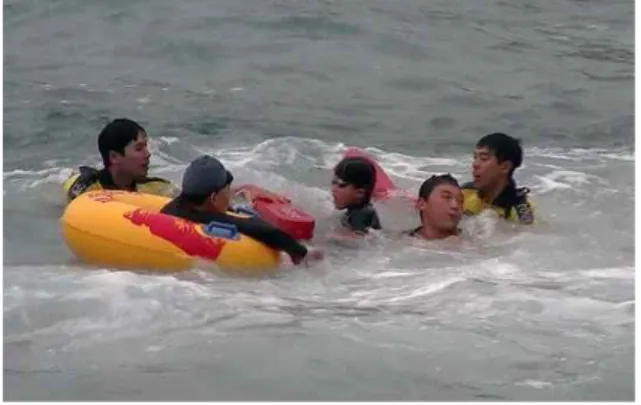
Since importance of the rip current involved with coastal accident to beachgoers perceived, researches on the rip current have been widely implemented from the end of 2000s. According to Ministry of Oceans and Fisheries (MOF) of South Korea, it has been turned out that there were a significant number of safety accidents for beachgoers related to the rip current every year, and are shown in Table 1.
Typical examples of accidents due to the rip current in South Korea is Haeundae beach (Choi et al., 2012; Yoon et
al., 2012). Choi et al. (2014) developed warning system based on real time observations for Haeundae beach, which is helpful to prevent safety accident for beachgoers due to the rip current at Haeundae beach.
Jungmun Beach is one of the famous attractions located in Jungmun Tourism Complex, Seogwipo, Jeju (Fig. 1).
Many people have been visiting Jungmun Beach every year, and safety accidents for them due to the rip current repeatedly occur here every year, implying that the nearshore current at Jungmun Beach should be understood to scientifically approach above matters, but researches on nearshore current at Jungmun Beach are not entirely conducted.
In this aspect, this study tries to identify annual
generation pattern of the nearshore current and the rip
current in year of 2015 using a numerical computation. The
rip current is detected by checking direction of cross-shore
velocity component at breaker lines. If cross-shore currents
are flowing to the offshore, it is considered as the rip
current. In this study, Outbreak patterns of the rip current
are computed and compared with incident wave conditions
to infer mutuality between the rip current and wave states.