• 검색 결과가 없습니다.

Spatio-temporal change detection of land-use and urbanization in rural areas using GIS and RS - Case studies of Yongin and Anseong regions -

N/A
N/A
Protected

Academic year: 2021

Share "Spatio-temporal change detection of land-use and urbanization in rural areas using GIS and RS - Case studies of Yongin and Anseong regions -"

Copied!
10
0
0

로드 중.... (전체 텍스트 보기)

전체 글

(1)

Spatio-temporal change detection of land-use and urbanization in rural areas using GIS and RS

Case studies of Yongin and Anseong regions

Yujie Gao

1

, Dae-Sik Kim

2

*

1

Dept. of Agricultural Engineering, Chungnam National University Graduate School, Daejeon 305-764, Korea

2

Dept. of Agricultural and Rural Engineering, Chungnam National University, Daejeon 305-764, Korea

GIS와 RS를 이용한 농촌지역 토지이용 및 도시화 변화현상의 시공간 탐색 - 용인 및 안성지역을 중심으로 -

고옥결

1

ㆍ김대식

2

*

1충남대학교 대학원 농공학과, 2충남대학교 지역환경토목학과

Received on 14 February 2011, revised on 3 March 2011, accepted on 9 March 2011

Abstract : This study analyzed the spatio-temporal change detection of land-use and urbanization in Yongin and Anseong regions, Kyunggi Province, using three Landsat-5 TM images for 1990, 1996, and 2000. Remote sensing (RS) and geographic information system (GIS) techniques were used for image classification and result analysis. Six land-use types were classified using supervised maximum likelihood classification. In the two study areas, the land-use changed significantly, especially the decrease of arable land and forest and increase of built-up area. Spatially, the urban expansion of Yongin region showed a spreading trend mainly along the national road and expressways. But in Anseong region the expansion showed ‘urban sprawl phenomenon’ with irregular shape like starfish. Temporally, the urban expansion showed disparity ─ the growth rates of urbanized area rose from the period 1990-1996 to 1996-2000 in both study areas.

The increased built-up areas were converted mainly from paddy, dry vegetation, and forest.

Key words : Change detection, Urban expansion, Land-use, Expressway

*Corresponding author: Tel: +82-42-821-5795 E-mail address: [email protected]

I. Introduction

Land-use of the Earth is changing rapidly, mainly because of human activities. Urbanization, as an im- portant type of land-use change, which links human and environment has attracted many researchers (Kim et al., 2003; Kim, 2004; Fan et al., 2008; Xiao et al., 2006; Mundia and Aniya, 2005; Long et al., 2008).

More job opportunity and better economic interest prompt more and more people to pour into cities and towns, which can provide the city with a rich resource

of labor but a lot of problems can be generated

simultaneously, like urban heat island phenomenon,

high land prices, traffic jam, urban sewage, social

welfare, and so on. Subsequently, the process of

population migration from within towns and cities to

the suburbs and surrounding areas of cities is

generated, namely suburbanization which is one of the

many causes of the increase in urban sprawl and can

urbanize the surrounding areas of cities. On the one

hand, it can relieve some social problems of centre

cities mentioned above. But on the other hand, in the

urbanized regions, it may result to blind urban

expansion, farm land loss, and environmental damage.

(2)

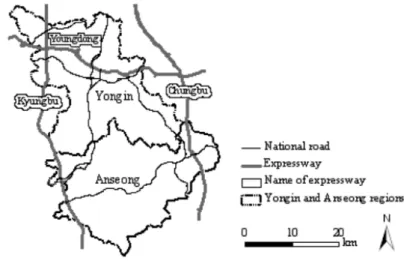
Fig. 1. Location of the two study areas.

Seoul Metropolitan Area has experienced urbaniza- tion since the early 1970s. And the percentage of population living in Seoul among Korea's entire population increased gradually till 1990. Most of the increased population was resulted from immigrants who came from other cities and rural areas. Such a rapid increase in population led to a lot of changes in Seoul’s socio-economic system as well as citizens’

well-being. So the government has implemented various policies in order to disperse the population of Seoul, which developed the surrounding regions. New towns near Seoul were constructed and tax deduction policies were implemented for businesses and people who moved from Seoul to the new towns or other areas in Kyunggi province (Rii and Ahn, 2001). As a result, several types of expansion of existing satellite and local cities, such as road construction for improvement of accessibility and new urban development on arable land in rural areas, have rapidly urbanized the south of Seoul (Kim et al., 2003). Urbanization has not only promoted the increase of new residential areas but also led to the loss of arable land and forest.

Therefore, understanding the state and trend of land-use change and urban expansion are indis- pensable for the sustainable regional development (Fan et al., 2008).

This study aims to analyze the spatio-temporal

change detection of land-use, focusing especially on the change of built-up areas which are linked to urban sprawl and population growth in Anseong and Yongin regions located in the south of Seoul, Kyunggi Province, using three Landsat-5 TM images over a 10-year interval. Satellite remote sensing techniques were used in order to detect and monitor land-use change because it can provide spatially consistent data sets that cover large areas with both high spatial detail and high temporal frequency (Xiao et al., 2006).

Change-related images are generated from change detection techniques including Tasseled Cap trans- formation, Principal Component Analysis and indices for water, clay, iron, and ferrous iron. This study also used GIS techniques in combination with RS for analysis of land-use change more effectively.

II. Study area and data

1. Study area

Two study areas, Yongin and Anseong regions, are located in the south of Seoul, Kyunggi Province (Fig. 1).

As mentioned above, the government policy has

promoted urbanization of these two study areas,

especially during the period 1990-2000. Smooth

transportation, with Kyungbu expressway and Youngdong

(3)

expressway crossing the Yongin region, Chungbu and Kyungbu expressways running through the Anseong region, makes the two study areas urbanize more rapidly.

Census data derived from the Yongin and Anseong statistical year books show that the increase percentage of the population and built-up area were 110.1% and 55.9% in Yongin from 1990 to 2000, and 7.1% and 34.2% in Anseong during the same period.

2. Data set

This study used three Landsat-5 TM images acquired on April 26, 1990, April 10, 1996, and May 7, 2000, respectively. A digitized map covering the two study areas was used for geometric correction. And two 1:50 000 geographic maps produced from aerial photographs were also used as reference maps for classification, 1996 map for Yongin City and 1998 map for Anseong City. This study used census data from Yongin and Anseong statistical year books to analyze population growth, land-use change, and urbanization.

III. Research methods

1. Image processing

Three Landsat-5 TM images were geometrically registered to a digitized map of the corresponding area using second-order polynomial transformation. Up to 50 ground control points (GCP) were selected with the Root Mean Square Error (RMSE) of 0.5 for image of 1990, 0.42 for 1996, and 0.44 for 2000, respectively.

Afterwards the cubic convolution resampling was implemented. This paper adopted three transformation methods, PCA for reducing data redundancy, TCT for brightness, greenness, and wetness, indices for water, clay, iron, and ferrous iron. The generated color image from only the first three PCA bands is usually used for interpretation and classification because it can agglomerate almost total information of original

images. This study combined the first three PCA bands with the three TCT bands and four indices bands. So three ten new composite bands images were con- structed (Kim et al., 2003) for 1990, 1996 and 2000, respectively.

2. Classification

This study applied supervised maximum likelihood classification. Two 1:50,000 geographic maps produced from aerial photographs were used as reference maps for defining signatures, 1996 map for Yongin City and 1998 map for Anseong City. The satellite map on the Internet (congnamul.com) was used for ground truth.

Signature selection is the most important procedure for accurate supervised classification. In the two study areas, more than 80% of the total area is covered with paddy, forest, and dry vegetation. It is very difficult to identify these three types of land-use/

cover on the satellite images. Therefore this study modified the signature files again and again to ensure the high accuracy of the classification.

Finally, six types of the land-use were identified, such as built-up area, paddy, dry vegetation, forest, vacant land, and water. This study concentrated on the land-use change detection and especially focused on the change detection of the built-up area in order to analyze the urbanization.

3. Classification accuracy assessment

The present study applied two kinds of classification accuracy assessment. First, the classification error matrix was used. Several measures of accuracy were adopted, including overall accuracy, producer’s accuracy, user’s accuracy, and the Kappa coefficient of agree- ment (Kim et al., 2003; Morisette and Khorram, 2000;

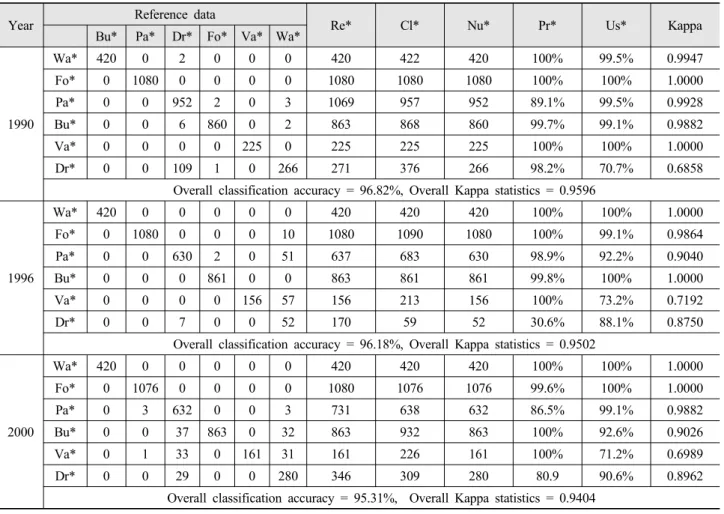
Lo and Yeung, 2007). Table 1 shows the results of

accuracy assessment for the three land-use maps

using samples, indicating overall classification accuracy

(4)

Table 1. Error matrix and classification accuracy.

Year Reference data

Re* Cl* Nu* Pr* Us* Kappa

Bu* Pa* Dr* Fo* Va* Wa*

1990

Wa* 420 0 2 0 0 0 420 422 420 100% 99.5% 0.9947

Fo* 0 1080 0 0 0 0 1080 1080 1080 100% 100% 1.0000

Pa* 0 0 952 2 0 3 1069 957 952 89.1% 99.5% 0.9928

Bu* 0 0 6 860 0 2 863 868 860 99.7% 99.1% 0.9882

Va* 0 0 0 0 225 0 225 225 225 100% 100% 1.0000

Dr* 0 0 109 1 0 266 271 376 266 98.2% 70.7% 0.6858

Overall classification accuracy = 96.82%, Overall Kappa statistics = 0.9596

1996

Wa* 420 0 0 0 0 0 420 420 420 100% 100% 1.0000

Fo* 0 1080 0 0 0 10 1080 1090 1080 100% 99.1% 0.9864

Pa* 0 0 630 2 0 51 637 683 630 98.9% 92.2% 0.9040

Bu* 0 0 0 861 0 0 863 861 861 99.8% 100% 1.0000

Va* 0 0 0 0 156 57 156 213 156 100% 73.2% 0.7192

Dr* 0 0 7 0 0 52 170 59 52 30.6% 88.1% 0.8750

Overall classification accuracy = 96.18%, Overall Kappa statistics = 0.9502

2000

Wa* 420 0 0 0 0 0 420 420 420 100% 100% 1.0000

Fo* 0 1076 0 0 0 0 1080 1076 1076 99.6% 100% 1.0000

Pa* 0 3 632 0 0 3 731 638 632 86.5% 99.1% 0.9882

Bu* 0 0 37 863 0 32 863 932 863 100% 92.6% 0.9026

Va* 0 1 33 0 161 31 161 226 161 100% 71.2% 0.6989

Dr* 0 0 29 0 0 280 346 309 280 80.9 90.6% 0.8962

Overall classification accuracy = 95.31%, Overall Kappa statistics = 0.9404

*Wa water; Fo forest; Pa paddy; Bu built-up area; Va Vacant land; Dr dry vegetation; Re reference totals; Cl classified totals; Nu number of correct items; Pr producer’s accuracy Us User’s accuracy.

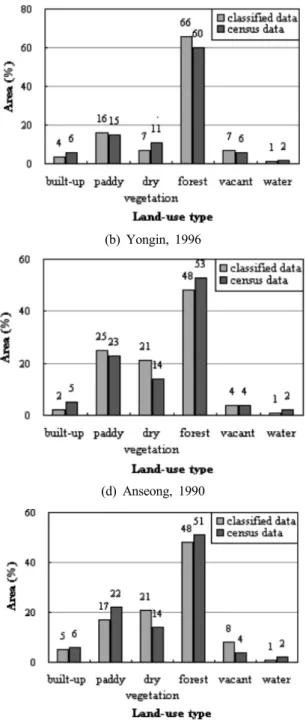
of 96.82% and a Kappa coefficient of 0.96 for 1990, 96.18% and 0.95 for 1996, and 95.31% and 0.94 for 2000. Second, this study tested the classification accuracy by comparing the classified data with the census data. The verification results (Fig. 2) shows that the built-up area was underestimated because the satellite image can only identify the concrete area.

Dry vegetation and forest areas which should decrease increased sometimes because of some confusion between dry vegetation and forest. And if the image was acquired in no cultivated season, paddy and dry vegetation field could be identified as vacant land.

That is why sometimes the vacant lands were over- estimated. However, the classification results are relatively high and can meet the demand of change detection analysis.

So the land-use maps of Yongin and Anseong regions were extracted by administrative boundary maps of the two study areas, as shown in Fig. 3.

IV. Results and discussion

1. Spatial dynamic pattern

In order to analyze spatial dynamic pattern of urban expansion, the urban areas of Yongin and Anseong regions in 1990, 1996, and 2000 were extracted, as shown in Fig. 4.

In Yongin region, the mean value of annual urban

growth rate was 6.0% during 1990-1996. The expansion

areas were mainly distributed along the national roads

and expressways. However, in 1996-2000, the annual

(5)

(a) Yongin, 1990 (b) Yongin, 1996

(c) Yongin, 2000 (d) Anseong, 1990

(e) Anseong, 1996 (f) Anseong, 2000

Fig. 2. Verification results for classification using census data.

urban growth rate was up to 18.5%. The high-speed urban expansion areas were distributed not only along the national road and two expressways but also in the southeast and southwest regions.

In Anseong region, the urban area increased at an average annual rate of 4.6% from 1990 to 1996. The increased built-up areas were located in the west middle region. During 1996-2000, the mean value of

annual urban growth rate reached up to 22.0%. The expansion showed an ‘urban sprawl phenomena’ and most of the high-speed growth areas lay on the northeast, middle west, and center regions.

2. Temporal disparity

Through change detection analysis of the six maps

(6)

(a) Yongin, 1990 (b) Yongin, 1996 (c) Yongin, 2000

(d) Anseong, 1990 (e) Anseong, 1996 (f) Anseong, 2000 Fig. 3. Land-use maps of Yongin and Anseong regions.

(a) Yongin, 1990 (b) Yongin, 1996 (c) Yongin, 2000

(d) Anseong, 1990 (e) Anseong, 1996 (f) Anseong, 2000

Fig. 4. Urban land-use maps of Yongin and Anseong regions.

(7)

Table 2. Conversion matrix of land use/cover change in Yongin region from 1990 to 1996 (unit: km

2

).

LULC type in 1990

LULC type in 1996

Total in 1990 Built-up Paddy Dry

vegetation Forest Vacant land Water

Built-up 5.5 3.9 1.7 1.6 2.1 0.0 14.8

Paddy 7.1 45.1 16.5 49.5 14.3 0.7 133.2

Dry vegetation 4.6 24.4 11.1 21.4 10.9 0.1 72.6

Forest 3.0 17.1 8.9 313.4 12.3 0.5 355.1

Vacant land 0.7 2.6 1.0 3.6 1.3 0.0 9.2

Water 0.1 0.9 0.2 0.8 0.5 5.8 8.4

Total in 1996 21.0 93.9 39.4 390.2 41.6 7.1 593.3

Change rate (%) 42.2 -29.5 -45.6 9.9 351.6 -14.9 -

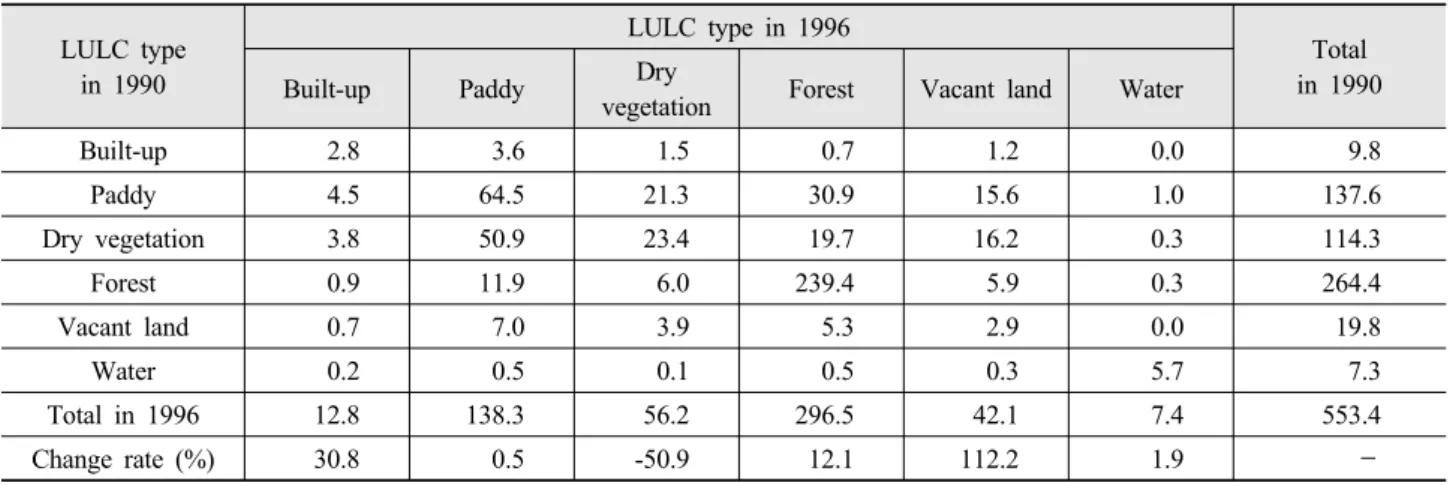
Table 3. Conversion matrix of land use/land cover change in Anseong region from 1990 to 1996 (unit: km

2

).

LULC type in 1990

LULC type in 1996

Total in 1990 Built-up Paddy Dry

vegetation Forest Vacant land Water

Built-up 2.8 3.6 1.5 0.7 1.2 0.0 9.8

Paddy 4.5 64.5 21.3 30.9 15.6 1.0 137.6

Dry vegetation 3.8 50.9 23.4 19.7 16.2 0.3 114.3

Forest 0.9 11.9 6.0 239.4 5.9 0.3 264.4

Vacant land 0.7 7.0 3.9 5.3 2.9 0.0 19.8

Water 0.2 0.5 0.1 0.5 0.3 5.7 7.3

Total in 1996 12.8 138.3 56.2 296.5 42.1 7.4 553.4

Change rate (%) 30.8 0.5 -50.9 12.1 112.2 1.9 -

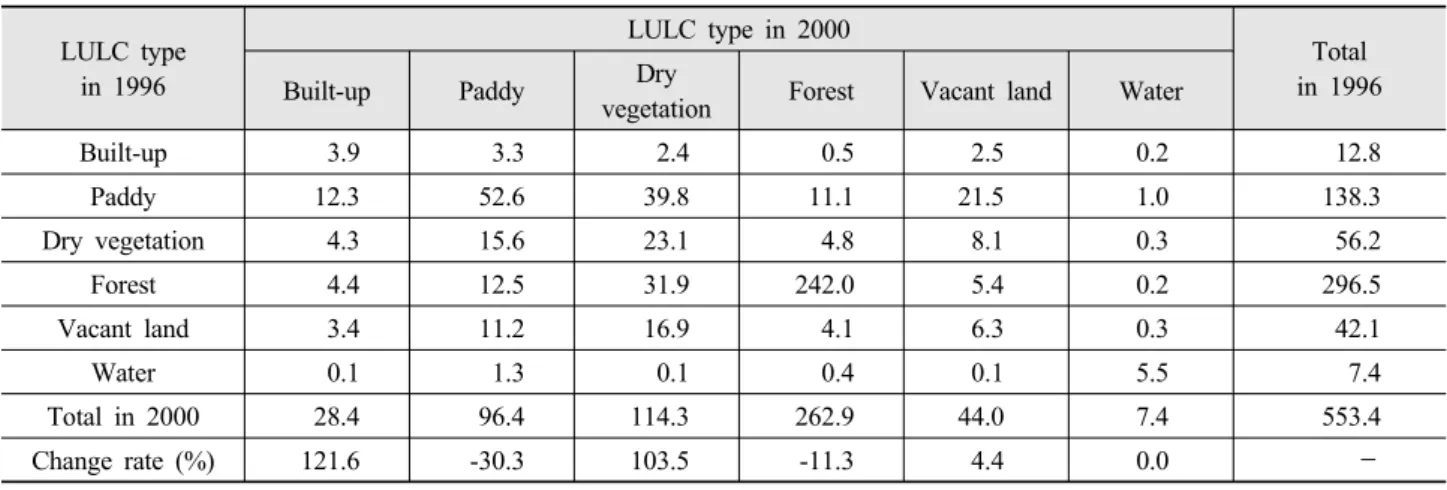
of the two study areas (Fig. 3), four land use/cover conversion matrices between 1990 and 2000 were produced, as shown in Tables 2-5. The conversion matrices show that land-use changed significantly during 1990-2000 in both Yongin and Anseong regions.

According to analysis of conversion matrices, the built-up area increased continually from 1990 to 2000. Paddy, dry vegetation, and forest which should have decreased increased sometimes instead because of some confusion between paddy, dry vegetation, and forest. But the total area of these three land-use types was decreased, -6.7% and -4.9% during 1990-1996, and -3.7% and -3.6% during 1996-2000 in Yongin and Anseong, respectively. Also, if the crops haven't been planted when the images were acquired, the paddy and dry vegetation field could be identified as vacant land. So vacant land also increased or

decreased from time to time. Although the built-up area increased continually, there is a great disparity in the two periods, which happened in both study areas.

In 1990-1996, the built-up area increased from 14.8 km 2 to 21.0 km 2 with a growth rate of 42.2% in Yongin region (Table 2). Meanwhile, the expansion of urban area also happened in Anseong region, from 9.8 km 2 to 12.8 km 2 with a change rate of 30.8% (Table 3). Fig.

5 presents the area ratios of five land-use types

changed to built-up area during the periods

1990-1996 and 1996-2000 in the two study areas. It

indicates that, in both study areas from 1990 to 1996,

the increased built-up area mainly converted from

paddy, dry vegetation, and forest, with area ratios of

46%, 30%, and 19%, respectively, in Yongin region,

and 44%, 38%, and 9% in Anseong region. The period

(8)

Table 4. Conversion matrix of land use/land cover change in Yongin region from 1996 to 2000 (unit: km

2

).

LULC type in 1996

LULC type in 2000

Total in 1996 Built-up Paddy Dry

vegetation Forest Vacant land Water

Built-up 10.4 3.0 2.4 0.8 4.2 0.1 21.0

Paddy 12.1 32.2 23.2 11.1 14.9 0.4 93.9

Dry vegetation 4.7 9.7 13.0 5.4 6.5 0.1 39.4

Forest 7.8 18.3 29.9 325.3 8.6 0.2 390.2

Vacant land 6.2 8.3 14.4 5.7 6.9 0.2 41.6

Water 0.1 0.8 0.1 0.3 0.1 5.8 7.1

Total in 2000 41.4 72.4 83.0 348.5 41.2 6.7 593.3

Change rate (%) 97.0 -22.9 110.5 -10.7 -1.0 -5.2 -

Table 5. Conversion matrix of land use/land cover change in Anseong region from 1996 to 2000 (unit: km

2

).

LULC type in 1996

LULC type in 2000

Total in 1996 Built-up Paddy Dry

vegetation Forest Vacant land Water

Built-up 3.9 3.3 2.4 0.5 2.5 0.2 12.8

Paddy 12.3 52.6 39.8 11.1 21.5 1.0 138.3

Dry vegetation 4.3 15.6 23.1 4.8 8.1 0.3 56.2

Forest 4.4 12.5 31.9 242.0 5.4 0.2 296.5

Vacant land 3.4 11.2 16.9 4.1 6.3 0.3 42.1

Water 0.1 1.3 0.1 0.4 0.1 5.5 7.4

Total in 2000 28.4 96.4 114.3 262.9 44.0 7.4 553.4 Change rate (%) 121.6 -30.3 103.5 -11.3 4.4 0.0 -

Fig. 5. Area ratio of land-use changed to built-up area during 1990-1996 and 1996-2000.

1996-2000 is referred to as ‘fast expansion stage’ of urban area for both study areas. In Yongin region, built-up area increased by 20.4 km 2 with a change rate of 97.0% (Table 4) and the increased urban area primarily converted from paddy, forest, and vacant land which accounted for 39%, 25%, and 20%, respectively. At the same time, in Anseong region, the

urban area increased by 15.6 km 2 with an increase rate of 121.6% (Table 5) and the increased built-up area mostly came from paddy, dry vegetation, and forest as well with the ratios of 50%, 18%, and 18%, respectively.

3. Discussion

As two local cities near Seoul, Yongin and Anseong had undergone a great change in land-use, especially a big decrease in arable land and increase in built-up area known as urbanization which is accelerated by a policy of new residential development promotion for dispersing the population of Seoul (Kim et al., 2003).

According to the census data, during the period 1990

to 2000, the percentage increase of the population and

built-up area were 110.1% and 55.9% in Yongin, and

(9)

7.1% and 34.2% in Anseong, respectively.

This study used three Landsat-5 TM images acquired in 1990, 1996, and 2000, respectively, to analyze the land-use change and urbanization.

Supervised maximum likelihood classification was applied. Two kinds of accuracy assessment methods were used. First, the error matrix was applied. And it shows that the overall classification accuracy and Kappa coefficient of the classified land-use maps were 96.82% and 0.96 for 1990, 96.18% and 0.95 for 1996, and 95.31% and 0.94 for 2000. Second, this study tested the classification accuracy by comparing the classified data with the census data, indicating that the classification results also have high accuracy.

From the conversion matrix, the built-up area increased from 1990 to 2000 with growth rate of 180.2% and 189.9% in Yongin and Anseong, re- spectively. And it also indicates how the land changed from the conversion matrix. For example, the increased built-up area mainly converted from paddy, dry vegetation and forest. But we can not know it from census data. So the use of satellite imagery for monitoring urban encroachment can provide both land use planners and conservation bodies with visually striking material and can contribute to a quantitative assessment of the rate of land transformation (Quarmby and Cushnie, 1989).

V. Summary and conclusion

This study analyzed the spatio-temporal change detection of land-use and urbanization during the period 1990 to 2000 in Yongin and Anseong regions which are located in the south of Seoul, using RS and GIS. Supervised maximum likelihood classification was used to classify the land-use types into six classes with classification accuracies of 97%, 96%, and 95% for 1990, 1996, and 2000 Landsat-5 images, respectively.

This study demonstrated the temporal disparity

during the two periods. In 1990-1996, the built-up area increased by 6.2 km 2 with a growth rate of 42.2%

in Yongin region while the results were 3.0 km 2 and 30.8% in Anseong region. But during the period 1996-2000, as ‘fast expansion stage’ of urban area for both study areas, the results were 20.4 km 2 and 97.0%

in Yongin region, and 15.6 km 2 and 121.6% in Anseong region. The increased built-up area was converted mainly from paddy, dry vegetation, and forest, which happened in both periods and in both study areas. The urban expansion of Yongin region showed a spreading trend mainly along the national road and two expressways, Kyungbu and Chungbu, which is a very common phenomenon in the urban development of many cities. One explanation is that accessibility by road construction leads this kind of urbanization phenomenon. But in Anseong region, the expansion showed an ‘urban sprawl phenomena’ with irregular shape like starfish. And this phenomenon seems to have expanded to further rural areas.

The built-up area of Yongin region is larger than

Anseong in the whole 1990s because Yongin is closer

to Seoul than Anseong. And from 1990 to 1996, the

change rate of built-up area in Yongin is higher than

in Anseong region. However, from 1996 to 2000, the

growth rate of built-up area in Anseong is much

higher than in Yongin. This result demonstrates that

the effect of the residential development policy

continued and had reached further areas away from

Seoul. As mentioned above, the increased built-up

area mainly converted from paddy, dry vegetation, and

forest, which will certainly result in farmland loss,

food shortage, and ecological damage. It is important

to realize that today’s urbanization should not be at

the expense of tomorrow’s food production and natural

environment, and therefore reasonable land-use

policy should be adopted for sustainable development

which is defined by the World Commission on En-

vironment and Development as "forms of progress that

meet the needs of the present without compromising

(10)

the ability of future generations to meet their needs".

Acknowledgments

This study was financially supported by research fund of Chungnam National University in 2009.

References

1. Al-Quraishi AMF, Hu GD, Chen JG. 2004. Land degradation detection, mapping, and monitoring in the northwestern part of Hebei Province, China, using RS and GIS technologies.

Map Asia Conference.

2. ERDAS Field Guide. 2005. Leica Geosystems Geospatial Imaging. LLC.

3. ER Mapper. 1995. ER Mapper Tutorial. Earth Resources Mapping Pty Ltd.

4. Fan F, Wang Y, Wang Z. 2008. Temporal and spatial change detecting (1998-2003) and predicting of land use and land cover in Core corridor of Pearl River Delta (China) by using TM and ETM+ images. Environmental Monitoring and Assessment 137: 127-147.

5. Kim DS. 2004. Simulation of urban expansion causing farmland loss and sprawl phenomena with cellular automata technology. Journal or the Korean Society of Agricultural Engineers 46: 23-32.

6. Kim DS, Chung HW. 2005. Spatial diffusion modeling of new residential area for land-use planning of rural villages.

Journal of Urban Planning and Development 131: 181-194.

7. Kim DS, Mizuno K, Kobayashi S. 2003. Analysis of urbanization characteristics causing farmland loss in a rapid growth area using GIS and RS. Paddy and Water Envir- onment 1: 189-199.

8. Lo CP, Yeung AKW. 2007. Concepts and Techniques of Geographic Information Systems. 2nd ed. Prentice Hall Series in Geographic Information Science.

9. Long H, Wu X, Wang W, Dong G. 2008. Analysis of urban- rural land-use change during 1995-2006 and its policy dimensional driving forces in Chongqing. China. Sensors 8:

681-699.

10. Morisette JT, Khorram S. 2000. Accuracy assessment curves for satellite-based change detection. Photogrammetric Engineering & Remote Sensing 66(7): 875-880.

11. Mundia CN, Aniya M. 2005. Analysis of land use/cover changes and urban expansion of Nairobi city using remote sensing and GIS. International Journal of Remote Sensing 26: 2831-2849.

12. Quarmby NA, Cushnie JL. 1989. Monitoring urban land cover changes at the urban fringe from SPOT HRV imagery in south-east England. Int. J. Remote Sensing 10(6): 93-963.

13. Rii HU, Ahn JS. 2001. Urbanization and its impact on Seoul, Korea. Conference Proceedings of Urbanizing World and UN Human Habitat II, Theme 4: Globalization, Urban Transition, and Governance in Asia: 83-99.

14. Tao R, Xu Z. 2007. Urbanization, rural land system and social security for migrants in China. Journal of Development Studies 43: 1301-1320.

15. Tian G, Yang Z, Zhang Y. 2007. The spatio-temporal dynamic pattern of rural residential land in China in the 1990s using Landsat TM images and GIS. Environmental Management 40: 803-813.

16. Xiao J, Shen Y, Ge J, Tateishi R, Tang C, Liang Y, Huang Z. 2006. Evaluating urban expansion and land use change in Shijiazhuang, China, by using GIS and remote sensing.

Landscape and Urban Planning 75: 69-80.

17. Zhao GX, Lin G, Warner T. 2004. Using thematic mapper

data for change detection and sustainable use of cultivated

land: a case study in the Yellow River delta, China. In-

ternational Journal of Remote Sensing 25: 2509-2522.

수치

Fig. 1. Location of the two study areas.
Table 1. Error matrix and classification accuracy.
Fig. 2. Verification results for classification using census data.
Table 3. Conversion matrix of land use/land cover change in Anseong region from 1990 to 1996 (unit: km 2 ).
+2

참조

관련 문서

• 이명의 치료에 대한 매커니즘과 디지털 음향 기술에 대한 상업적으로의 급속한 발전으로 인해 치료 옵션은 증가했 지만, 선택 가이드 라인은 거의 없음.. •

(i.e., how conceptual records and fields are represented at the internal level) – Structure of the stored database : change. (i.e., change in the

 Students needing additional information about grading policies and procedures should meet with their faculty advisor, Executive Director/Chairperson or a

For this study—our third on global workforce trends, follow- ing studies in 2014 and 2018—Boston Consulting Group and The Network surveyed some 209,000 people in 190 countries

Basic aspects of AUTOSAR architecture and methodology Safety mechanisms supported by AUTOSAR.. Technical safety concepts supported by AUTOSAR Relationship to ISO

For example, when NBRLU changes one unit, the odds are increased by a factor of 2.156, as is shown in the Exp(B)column in <Figure 5-2>. This implies that the more urban

Second, as a direct impact, the abolishing of licensing gives both incumbent and entrants higher option value directly because the new facility based

Income security for people in slum areas can be fragile as the majority of income earners earn income on a daily basis and about 50% of slum dwellers are