• 검색 결과가 없습니다.

Synthesis of p-Type ZnO Thin Film Prepared by As Diffusion Method and Fabrication of ZnO p-n Homojunction

N/A
N/A
Protected

Academic year: 2021

Share "Synthesis of p-Type ZnO Thin Film Prepared by As Diffusion Method and Fabrication of ZnO p-n Homojunction"

Copied!
4
0
0

로드 중.... (전체 텍스트 보기)

전체 글

(1)

1. INTRODUCTION


ZnO is a very promising II-VI semiconductor for optoelectronic applications in the short wavelength region [1]. At room temperature, ZnO has a direct wide band gap (3.37 eV) and higher exciton binding energy (60 meV) than that of GaN (28 meV) [2]. In general, ZnO films with hexagonal wurtzite structure exhibits n-type conduction due to nonstoichiometry, presenting high electrical resistivity due to a low carrier concentration. The fabrication of p-type ZnO thin films has been known as a very difficulty due to low doping solubility of acceptor ion, complex formation of crystal defects and doped acceptor, and electrical inactivity from the interstitial location of dopant [3]. Many research groups have suggested the elements of N, P, or As as a p-type dopant but the selection of p-type

a. Corresponding author; [email protected] Copyright ©2017 KIEEME. All rights reserved.

This is an Open-Access article distributed under the terms of the Creative Commons Attribution Non-Commercial License (http://creativecommons.org/licenses/by-nc/3.0) which permits unrestricted non-commercial use, distribution, and reproduction in any medium, provided the original work is properly cited.

dopant and fabrication technique remain controversial. Kim et al [4] reported that a P doped ZnO film grown by RF sputtering using P 2 O 5 as a P source can be converted into p-type ZnO by post-thermal annealing. Lim et al [5]

reported on the fabrication and properties of a ZnO LED by growing a P doped p-type ZnO on the n-type GaN layer or on n-type ZnO. However, the properties of p-type ZnO thin films prepared by As diffusion method and the fabrication of the ZnO p-n homojunction have not been reported yet.

In this study, ZnO thin films were deposited by RF magnetron sputtering and diffused using As source in the ampoule-tube at 650℃. The properties of As doped ZnO thin film were investigated. In addition, a ZnO p-n homojunction was fabricated and its properties were analyzed.

2. EXPERIMENTAL PROCEDURE

Undoped ZnO thin films were deposited on GaAs

Synthesis of p-Type ZnO Thin Film Prepared by As Diffusion Method and Fabrication of ZnO p-n Homojunction

Deok Kyu Kim a

Advanced LED Technology Development Project, Samsung Electronics Co. Ltd., Yongin 17113, Korea (Received March 6, 2017; Revised April 5, 2017; Accepted April 9, 2017)

Abstract: ZnO thin films were deposited by RF magnetron sputtering and then diffused by using an As source in the ampouletube. Also, the ZnO p-n homojunction was made by using As-doped ZnO thin films, and its properties were analyzed. After the As doping, the surface roughness increased, the crystal quality deteriorated, and the full width at half maximum was increased. The As-doped ZnO thin films showed typical p-type properties, and their resistivity was as low as 2.19×10 -3 Ωcm, probably because of the in-diffusion from an external As source and out-diffusion from the GaAs substrate. Also, the ZnO p-n junction displayed the typical rectification properties of a p-n junction. Therefore, the As diffusion method is effective for obtaining ZnO films with p-type properties.

Keywords: ZnO:Al, RF magnetron sputtering, In situ heat treatment, Surface roughness

Regular Paper 372

J. Korean Inst. Electr. Electron. Mater. Eng.

Vol. 30, No. 6, pp. 372-375 June 2017

DOI: https://doi.org/10.4313/JKEM.2017.30.6.372

ISSN 1226-7945(Print), 2288-3258(Online)

(2)

전기전자재료학회논문지 , 제30권 제6호 pp. 372-375, 2017년 6월: 김덕규 373

substrate by RF magnetron sputtering. A 2-inch ZnO target (99.999%) was used and a thickness of thin film was about 850 nm. The GaAs substrate was loaded into the chamber after general organic cleaning. The sputtering chamber was evacuated to 8.0×10 -6 Torr before sputtering.

Ar gas of 50 sccm and oxygen of 10 sccm were used as a reaction gas for thin film deposition and the working pressure was maintained at 15 mTorr. The RF sputtering power was 210 W and the substrate temperature was 650℃.

Prior to deposition, the target was pre-sputtered for 10 min in order to remove any contamination. The detailed deposition conditions are shown in Table 1. Undoped ZnO thin film deposited by RF sputtering was loaded into the ampoule-tube with 3 g of As for the vapor diffusion. The ampoule-tube was sealed by welding using extra pure oxygen and hydrogen gases while maintaining the vacuum below 5×10 -7 Torr. The p-type ZnO thin film was synthesized by As diffusion for 3h at 650℃.

To fabricate the ZnO p-n homojunction, n-type ZnO thin film was deposited on As doped ZnO by RF magnetron sputtering using a ZnO (99.999%) target doped with 2 wt% Al. The n-electrode and p-electrode was Ti/Au and Ni/Au, respectively. The sample structure and band diagram of ZnO p-n homojunction are shown in Fig. 1.

The surface morphology was analyzed by atomic force microscopy (AFM, PUCOTECH). The structural properties were investigated with an X-ray diffraction (XRD, D/MAX III A). The electrical properties were measured at room temperature using a standard Hall measurement system (ECOPIA HMS-3000) in van der Pauw method.

The optical properties were examined using a photoluminescence (Spectra Pro).

3. RESULTS AND DISCUSSIONS

Fig. 2. AFM 3D images of the undoped and As doped ZnO thin films.

Figure 2 shows 3D surface images of the undoped and As doped ZnO thin films with a scan area of 1×1 μm 2 obtained by AFM measurements. The surface morphology of the undoped ZnO thin film was very smooth with small and dense grains. On the other hand, the surface

Parameter Value

Substrate n-GaAs (100)

RF power (W) 210

Ar flow (sccm) 50

O2 flow (sccm) 10

Base pressure (Torr) 8×10 -6

Working pressure (Torr) 15×10 -3 Deposition temperature (℃) 650

Table 1. Condition of the undoped ZnO thin film deposited by RF magnetron sputtering.

Fig. 1. (a) The sample structure and (b) band diagram of ZnO

p-n homojunction.

(3)

374 J. Korean Inst. Electr. Electron. Mater. Eng., Vol. 30, No. 6, pp. 372-375, June 2017: D.-K. Kim

morphology of the As doped ZnO thin film is found to be surface textures with converging grains. It can also be seen that the surface roughness of the ZnO thin films be came lager after As doping process: 10.6 nm in the undoped ZnO thin film, and 18.9 nm in the As doped ZnO thin film. An increment in the surface roughness after As doping process is ascribed to recrystallization of the crystalline structure.

Figure 3 displays XRD patterns of the undoped and As doped ZnO thin films, measured with conventional θ–2θ scan. All films displayed a strong (002) peak, indicating a polycrystalline hexagonal structure, and had a preferred orientation with the c-axis perpendicular to the substrate.

The peak position of the ZnO thin film shifted to a lower angle after the As doping process: 34.85° in the undoped ZnO thin film, and 34.75° in the As doped ZnO thin film.

Lower angle shift in the peak position after As doping process is attributed to be a relaxation of the stress generated by the sputtering process. Also, it can be seen that the intensity of the As doped ZnO thin film is 0.4 times smaller than that of the undoped ZnO thin film. The full width at half maximum (FWHM) of the ZnO thin film increased after the As doping process: 0.2° in the undoped ZnO thin film, 0.25° in the As doped ZnO thin film. This result indicated the deterioration of the crystal quality of the ZnO film after the As doping process, which was caused by the diffusion of As into the ZnO thin film.

Figure 4 shows the result of the PL analysis of the

undoped ZnO thin film and the As doped ZnO thin film measured at room temperature. The peak intensity of the As doped ZnO thin film was reduced to half comparing with the undoped ZnO thin film, and the FWHM dropped a little from 113 meV to 108 meV. In general, the FWHM of the p-type ZnO thin film increases over that of the undoped ZnO thin film. However, the FWHM of the As doped ZnO thin film decreased a little instead. This result means that the quality of the p-type ZnO thin film diffused by As source in the ampoule-tube is excellent. In addition, it was confirmed that the peak photon energy of the ZnO thin film had a clear shift towards the high photon energy range after the As doping process: 3.27 eV in the undoped ZnO thin film, and 3.29 eV in the As doped ZnO thin film.

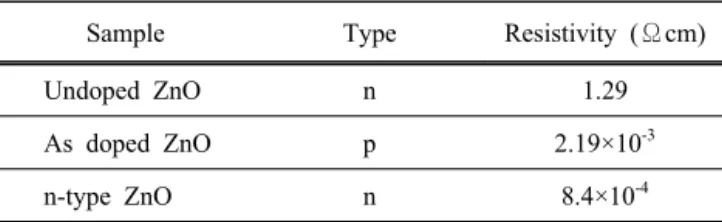
In order to confirm the electrical properties, the Hall effects analysis was carried out and the results are shown in Table 2. The type and resistivity of the undoped ZnO Fig. 3. XRD patterns of the undoped and As doped ZnO thin

films.

Fig. 4. PL sprectra of the undoped and As doped ZnO thin films.

Sample Type Resistivity (Ωcm)

Undoped ZnO n 1.29

As doped ZnO p 2.19×10 -3

n-type ZnO n 8.4×10 -4

Table 2. Hall effect results of the undoped ZnO thin film, As

doped ZnO thin film, and Al doped n-type ZnO thin films for

fabricating the ZnO p-n junction.

(4)

전기전자재료학회논문지 , 제30권 제6호 pp. 372-375, 2017년 6월: 김덕규 375

thin film were typical n-type and 1.29 Ωcm, respectively.

While, the type and resistivity of the As doped ZnO thin film were p-type and 2.19×10 -3 Ωcm, respectively. The resistivity of the As doped ZnO thin film was lower than previously reported values [6,7]. This result is contributed to the co-diffusion of the As dopant, which is not only in-diffusion from an external source toward the ZnO thin film but also out-diffusion from the substrate toward the ZnO thin film. Liang et al have been reported that the thermal annealing induces the diffusion of the As and Ga atoms from the GaAs substrate into the ZnO film to form acceptor defects for p-ZnO [8]. Therefore, the As diffusion method is a useful method for fabricating p-type ZnO thin films with outstanding properties. In addition, the electrical properties of the n-type ZnO thin film doped Al for fabricating the ZnO p-n homojunction were shown in table 2.

The resistivity of the n-type ZnO thin film was 8.4× 10 -4 Ωcm.

Figure 5 displays the current-voltage properties of the fabricated ZnO p-n homojunction, showing the rectification characteristics of a typical p-n junction at forward voltage.

The voltage at 20 mA in forward bias was about 5.5 V and the breakdown voltage in reverse bias was about –11 V. These results are superior to results of previous report for the ZnO p-n junction [9,10]. Based on the current- voltage results, we conclude that the As doped ZnO thin film using the As diffusion method leads to the remarkable properties for the ZnO p-n junction.

4. CONCLUSION

The As doped ZnO thin film was obtained using As source in the ampoule-tube and the ZnO p-n homojunction was fabricated by these p-type ZnO thin film. The properties of As doped ZnO thin film and ZnO p-n homojunction were investigated. The electrical properties of As doped ZnO thin film and ZnO p-n homojunction are superior to those of previously reported p-type ZnO thin films and ZnO p-n junction. Thus, the As diffusion method provide a very useful technology for fabricating ZnO homojunction LEDs.

REFERENCES

[1] D. C. Look and B. Claflin, Phys. Status Solidi B, 241, 624 (2004). [DOI: http://doi.org/10.1002/pssb.200304271]

[2] Y. R. Ryu, W. J. Kim, and H. W. White, J. Cryst.

Growth, 219, 419 (2000). [DOI: http://doi.org/10.1016/

S0022-0248(00)00731-4]

[3] A. V. Singh, R. M. Mechra, A. Wakahara, and A. Yoshida, J. Appl. Phys., 93, 396 (2003). [DOI: http://dx.doi.org/10.

1063/1.1527210]

[4] K. K. Kim, H. S. Kim, D. K. Hwang, J. H. Lim, and S.

J. Park, Appl. Phys. Lett., 83, 63 (2003). [DOI: http://

dx.doi.org/10.1063/1.1591064]

[5] J. H. Lim, C. K. Kang, K. K. Kim, I. K. Park, D. K.

Hwang, and S. J. Park, Adv. Mater., 18, 2720 (2006).

[DOI: http://dx.doi.org/10.1002/adma.200502633]

[6] Z. Z. Ye, F. Z. Ge, J. G. Lu, Z. H. Zhang, L. P. Zhu, B. H. Zhao, and J. Y. Huang, J. Cryst. Growth, 265, 127 (2004). [DOI: http://doi.org/10.1016/j.jcrysgro.2003.12.059]

[7] J. Lu, Y. Zhang, Z. Ye, L. I Wang, B. Zhao, and J.

Huang, Mater. Lett., 57, 3311 (2003). [DOI: http://doi.

org/10.1016/S0167-577X(03)00054-5]

[8] J. H. Liang, Y. J. Chen, and Y. C. Wang, Surf. Coat.

Tech., 231, 243 (2013). [DOI: http://doi.org/10.1016/j.

surfcoat.2012.04.079]

[9] S. K. Hazra and S. Basu, Solid State Elect., 49, 1158 (2005). [DOI: http://doi.org/10.1016/j.sse.2005.04.015]

[10] C. Zhang, X. Li, J. Bian, W. Yu, and X. Gao, Sur. &

Coat. Tech., 198, 253 (2005). [DOI: http://doi.org/10.1016/

j.surfcoat.2004.10.088]

Fig. 5. The current-voltage curve of the fabricated ZnO p-n

homojunction.

수치

Fig. 2. AFM 3D images of the undoped and As doped ZnO  thin films.
Fig. 4. PL sprectra of the undoped and As doped ZnO thin  films.
Figure 5 displays the current-voltage properties of the  fabricated ZnO p-n homojunction, showing the rectification  characteristics of a typical p-n junction at forward voltage

참조

관련 문서

It was confirmed that the silicon thin films fabricated on the p-Si (100) substrates by using DIPAS (DiIsoPropylAminoSilane) and TDMA-Sb (Tris-DiMethylAminoAntimony) sources by

The photocatalytic oxidation efficiencies of benzene, toluene, ethylbenzene, and o-xylene with Cu 2 O-TiO 2 were higher than those of P25 TiO 2 and undoped TiO 2..

Abstract >> In this work, thin film type Cu/ZnO nanostructure catalysts were fabricated by several synthetic routes in order to maximize the performance of the micro