• 검색 결과가 없습니다.

Fabrication and characterization of n-IZO / p-Si and p-ZnO:(In, N) / n-Si thin film hetero-junctions by dc magnetron sputtering

N/A
N/A
Protected

Academic year: 2021

Share "Fabrication and characterization of n-IZO / p-Si and p-ZnO:(In, N) / n-Si thin film hetero-junctions by dc magnetron sputtering"

Copied!
7
0
0

로드 중.... (전체 텍스트 보기)

전체 글

(1)

Fabrication and characterization of n-IZO / p-Si and p-ZnO:(In, N) / n-Si thin film

hetero-junctions by dc magnetron sputtering

Dao Anh Tuan * , Phan Thi Kieu Loan * , Nguyen Van Hieu ** , Le Vu Tuan Hung *

Abstract

Using a ceramic target ZnO:In with In doping concentration of 2%, hetero-junctions of n- ZnO:In/p-Si and p- ZnO:(In, N)/n-Si were fabricated by depositing Indium doped n - type ZnO (ZnO:In or IZO) and Indium-nitrogen co-doped p - type ZnO (ZnO:(In, N)) films on wafers of p-Si (100) and n-Si (100) by DC magnetron sputtering, respectively. These films with the best electrical and optical properties were then obtained. The micro-structural, optical and electrical properties of the n-type and p-type semiconductor thinfilms were characterized by X-ray diffraction (XRD), RBS, UV–vis; four-point probe resistance and room-temperature Hall effect measurements, respectively. Typical rectifying behaviors of p-n junction were observed by the current–voltage (I–V) measurement. It shows fairly good rectifying behavior with the fact that the ideality factor and the saturation current of diode are n=11.5, Is=1.5108.10-7 (A) for n-ZnO:In/p-Si hetero-jucntion; n=10.14, Is=3.2689.10-5 (A) for p-ZnO:(In, N)/n-Si, respectively. These results demonstrated the formation of a diode between n-type thin film and p-Si, as well as between p-type thin film and n-Si..

Keywords:n-ZnO:In/p-Si; p-ZnO:(In,N); hetero-junctions; rectifying; Current–voltage.

* Department of Applied Physics, Faculty of Physics and Engineering Physics, University of Science,Ho Chi Minh city, Vietnam. ( [email protected] ).

** Department of Physics and electronics, Faculty of Physics and Engineering Physics, University of Science, Ho Chi Minh city, Vietnam.

• Acknowledgements: The RBS spectra of Indium-nitrogen co-doped ZnO film described in this article was supported by A.G. Balogh (Institute of Nuclear Physics of the University Frankfurt/Main Germany) and Nhu-T. H.

Kim-Ngan (Institute of Physics, Pedagogical University, Poland).

Manuscript received May. 13, 2013; revised Jun. 13, 2013 ; accepted Jun 17. 2013

Ⅰ. Introduction

Zinc oxide (ZnO) has been regarded as promising materials for optoelectronic devices, due to its wide

direct band gap of 3.37 eV and large excitedbinding energy of 60 meV [1]. Therefore, ZnO has potential applications in light-emitting diodes (LEDs), laser diodes (LDs) and ultraviolet (UV) detection devices [2-4]. Some especially interesting properties of ZnO are low cost, availability, non toxicity, and high chemical stability, and non harmful environments.

The n- type ZnO film has been deposited on various p-type wafers such as Si [5], GaN [6] and GaN:Al [7]. Among all these attempts, the n-ZnO/p-Si hetero-junction is widely adopted in solar cells and photo detectors [8–10] for its low cost and flexibility. Although the research on the optical and electrical properties of the n-ZnO/p-Si hetero-junction have been reported [11–13], there are only a few reports showing the relationship between the deposition condition and the electrical properties of the hetero-junction [14].

while the growth of high quality n-type ZnO films

(2)

have been achieved,the fabrication of p-type ZnO thin films for high performance have not been demonstrated. The reproducibility and stability of p-type conductivity is still controversial. The co-doped method was first proposed by Yamamoto and Yoshida, this method can increase the solubility of nitrogen in ZnO with acceptable stability and reproducibility by various techniques, such as ultrasonic spray pyrolysis [1], [15], [16], RF co-sputtering [17].

In this paper, indiumdoped n - type ZnO thin film were deposited on p-type Si (100) wafer to fabricate n- ZnO:In/p-Si hetero-junctions, and Indium-nitrogen co-doped p - type ZnO thin film were deposited on n-type Si (100) wafer to fabricate p- ZnO:(In, N)/n-Si hetero-junctions.

Ⅱ. Experimental Methods

For the purpose of fabricating hetero-junction of indium doped n-type ZnO on p-type Si (110) wafer, the wafer was used as substrates of the hetero-junction. The starting material was polished p-type silicon with a boron- doping concentration (1.6 x 10 15 cm -3 ) corresponding resistivity of1-10Ω.

The wafers were prepared by standard procedure, cleaned and then dipped in 2% HF solution for 1 min to remove native oxide layers. Finally, the wafers were dried in a flow of nitrogen.

By thermal evaporation, Aluminum (Al) electrode was deposited on the back side of Si. The IZO films were deposited by the magnetron sputtering on the silicon substrate from ceramic target of IZO. The concentration of In dopant (purity 99.99%) in ceramic targets is 2wt%. The base pressure inside the chamber was pumped down to less than 10 -4 torr.

The DC power is 80W and the temperature on substrates were kept at 200 0 C. The sputtering proceeded for 0.5hand Al electrode was annealed on the back side at the same time to form a good ohmic contact. The thickness of IZO films were about 700nm. The junction areas were 1x1cm 2 . Finally, Silver (Ag) electrode was deposited with a shadow mask on the IZO surface for the top electrode.

ZnO:(In, N) thin fims were also prepared by dc

magnetron sputtering from ZnO:In ceramic target.

The concentration of dopant Indium in ceramic target was 2 wt% In.

The working pressure, direct current, electrical potential, and the substrate temperature T s were: 3 x 10 -3 torr, 0.35 A, 520 V, and 350 0 C, respectively.

The distancebetween the target and substrate, and that of the substrate and edge track of target were kept about 3.5 and 2.5 cm, respectively.

The thickness of thin films was measured by Stylus method (DEKTAK 6M, UAS). Electrical measurements were carried out by a Hall measurement system (HMS-300, ECOPIA) and four-point probe method. The structure of the films was analyzed by an X-ray diffraction (XRD) system (D/max-II with Cu-Kα radiation) and FE-SEM (Hitachi 4700). The optical properties of thin films were determinedby a UV-Vis spectrophotometer (Model PB-10, power 200W, Taiwan). The diode-like-rectifying-characteristic of thin films is determined by current-voltage (I-V) measurements.

Ⅲ. Results and discussion

3.1. Characterization of thin film n-ZnO:In/p-Si hetero-jucntion.

Fig.1. Image AFM of p-type Si (100) wafer after cleaned.

Si substrate has a very smooth surface (the roughness value of root mean square (RMS) is about 1 nm), as shown in Fig.1, which suggests that the substrate is suitable for the synthesis of p-n hetero-junctions.

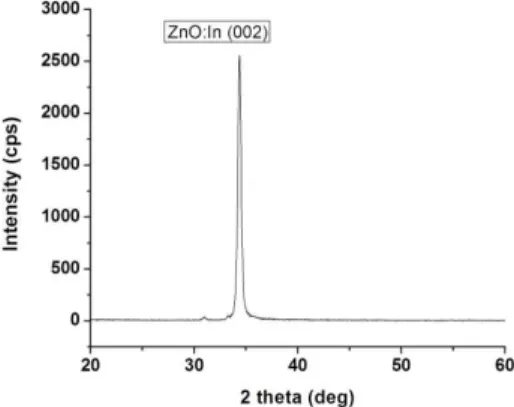
Fig. 2 shows the XRD spectrumof ZnO:In film on

Si wafer, which was deposited by DC magnetron

(3)

sputtering. The dominant peaks located at 34.31 0 is attributed to the IZO(002) diffraction. The result indicates that the IZO film has a hexagonal wurtzite structure and dominant orientation along the axis perpendicular to the substrate surface.

Fig.2.X-ray pattern of the IZO films.

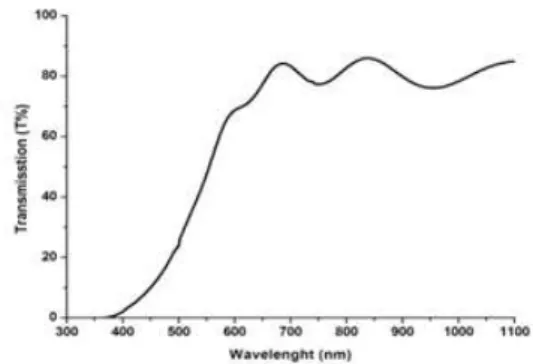
Fig. 3 shows the transmittance spectrum of the ZnO:In film deposited on glass substrate.The transmittance spectrum of the film exhibits an average transmittance over 85% in the visible region.

Electrical properties of the ZnO:In film were measured by four-point probe and Hall effect measurement. The resistivity of the ZnO:In film prepared by dc magnetron sputtering decreases to 1.09 x 10 -3 Ωm. The carrier concentration and the hall mobility are as high as 6.55 x 10 20 cm -3 and 8.78 cm 2 /V s, respectively.

Fig.3.Transmittance spectrum of the IZO film.

Fig.4. The I-V characteristics of the n-IZO/p-Si hetero-junctions.

Fig.5. Cross sectional FE-SEM image of n-IZO/p-Si hetero-structure.

Fig.4 shows the room temperature I–V characteristics of n-IZO/p-Si hetero-junction diode.

The hetero-junction clearly demonstrates rectifying diode like behavior. The n-IZO/p-Si hetero-junction has the threshold voltage of ~1.4V and a forward current between 0.15 and 1.09 mA.

Fig. 4 shows a semilog plot of I-V characteristics, which indicates that the current at low voltage (V <

2V) varies exponentially with voltage. The characteristics can be described by the stand diode equation [18]:

I=I 0 (e qV/nkT -1) (1)

(2)

Where q is the electronic charge, V is the voltage

at the junction, k is the Boltzmann constant, n is the

junction ideality factor, I s is the reverse saturation

(4)

current, and T is the absolute temperature. The value of the diode ideality factor of n-IZO/p-Si hetero-junctionis determined from the slope of the straight line region of the forward bias log I–V characteristics and using Eq. (2) [19]. At low forward bias (V < 2 V), the typical values of ideality factor and the reverse saturation current are n=11.5, I s =1.5108.10 -7 A.

The value of the ideality factor is higher than 2 (value of the ideality factor of diode), which may be due to the effect of series resistance [20]. This result is consistent with FE-SEM analysis. Fig.5 shows a cross-sectional SEM image of the IZO film deposited on p-Si wafer with sputtering power of 80W. The interface between the IZO film and p-Si wafer is flat.

3.2. Characterization of thin film p-ZnO:(In, N)/n-Si hetero-junction.

ZnO:(In, N) thin filmwere deposited on n-Si (100) wafer to fabricate p-ZnO:(In, N)/n-Si hetero-junctions. Fig.6 shows typical XRD pattern of the as-grown ZnO:(In, N) fims on Si wafer. Only one diffraction peak corresponding to the (002) plane is observed indicating preferred c-axis orientation, no other phases corresponding to Zn 3 N 2 or In-N peaks are detected obviously.

Fig. 6. XRD pattern of In-N co-doped ZnO thin film.

Electrical properties of the ZnO:(In, N) film were measured by four-point probe and Hall effect

Fig.7. Transmittance spectrum of ZnO:(In, N) film on glass substrate.

Fig. 8. RBS spectrum of Indium-nitrogen co-dopedZnO film.

measurement. p-type ZnO:(In, N) layer under optimum conditions shows p-type conductivity, with a low resistivity of 0.09 Ωm, mobility of 2.82 cm 2 /Vs and hole concentration of 2.26x10 19 cm -3 , respectively.

For the fabrication of p–n hetero-junctions, the p-type ZnO:(In,N) thin fims were prepared on n-type Si wafer (100) with the optimal conditions such as:

direct current of 0.35A; electrical potential of 520 V;

working pressure of 3x10 -3 Torr; substrate temperature of 350 0 C; the impurities concentrations of In is 2%wt, the gas ratio is 40%N 2 :60%Ar. After the thin films are synthesized, the Ag metal to cover on thin film and substrate as electrode.

In order to verify further p-type conduction of the ZnO:(In, N) thin fims, room temperature I–V characteristics of p-ZnO:(In–N)/n-Si hetero-junction diode is investigated and is shown in Fig.9. The hetero-junction clearly demonstrates rectifying diode like behavior, indicating that the p-type conduction is realized in the co-doped thin fim. The p-ZnO:(In–

N)/n-Si hetero-junction has the threshold voltage of

about0.7V and a forward current between 0.55 and

(5)

6.6mA. At low forward bias (V<1 V), the typical values of ideality factor and the reverse saturation current are n=10.14, I s =3.2689.10 -5 A, respectively. The value of the ideality factor is higher than 2 (value of the ideality factor of diode), which may be due to the effect of a series resistance.

Fig.9. Current–voltage characteristics of the p–ZnO:(In, N)/n-Si hetero-junction.

Ⅴ. Conclusion

Then-IZO/p-Si and p-ZnO:(In–N) / n-Si hetero-junction have been fabricated by dc magnetron sputtering method. For n-IZO/p-Si hetero-junction, IZO films were fabricated on p-Si wafer for very good electrical properties with resistivity of 1.09x10 -3 Ωm and the carrier concentration of 6.55x10 20 cm -3 . The I-V characteristics of n-IZO/p-Si hetero-junction exhibits clearly rectification characteristics. At low forward bias (V < 2 V), the typical values of ideality factorand the reverse saturation current are n=11.5, I s =1.5108.10 -7 A, respectively. For p-ZnO:(In–N)/n-Si hetero-junction, the ZnO:(In, N) films were deposited on n-Si wafer, the hetero-junction clearly demonstrates rectifying behavior with n=10.14, I s =3.2689.10 -5 A. The I–V characteristics derived from such structure exhibits clearly rectification characteristics, which implies a possibility to fabricate ZnO based on optoelectronic devices such as LEDs

and LDs in the future.

References

[1]. Bian JM, Li XM, Gao XD, Yu WD, Appl Phys Lett. 84, 2004, pp. 541-543.

[2]. Young SJ, Ji LW, Fang TH, Chang SJ, Su YK, Du XL, Acta Mater. 55, 2007, pp. 329-333.

[3]. Jiming Bian, Xiaomin Li, Lidong Chen, Qin Yao, Chemical Physics Letters. 393, 2004, pp. 256–

259.

[4]. Manoj Kumar, Sang-Kyun Kim, Se-Young Choi, Applied Surface Science. 256, 2009, pp. 1329–

1332.

[5]. S.Y. Liu, T. Chen, Y.L. Jiang, G.P. Ru, X.P. Qu, J. Appl. Phys.Vol.105, 2009.pp. 114504

[6]. W.I. Park, G.C. Yi, Adv. Mater. Vol. 16, 2004.pp. 87-90.

[7]. Ya.I. Alivov, E.V. Kalinina, A.E.

Cherenkov, D.C. Look, B.M. Ataev, A.K. Omaev, M.V. Chukichev, D.M. Bagnall, Appl. Phys. Lett.

Volt. 83, 2003.pp. 4719.

[8]. D.M. Nanditha, M. Dissanayake, R.A.

Hatton, R.J. Curry, S.R.P. Silva, Appl. Phys. Lett.

Vol. 90, 2007.pp.113505.

[9]. I.S. Jeong, J.H. Kim, S. Im, Appl. Phys.

Lett. Vol. 83, 2003.pp. 5313.

[10]. Y.S. Choi, J.Y. Lee, S. Im, S.J. Lee, J.

Vac. Sci. Technol. Vol. 20, 2002.pp. 2384.

[11]. P.L. Chen, X.Y. Ma, D.R. Yang, J. Appl.

Phys.101, 2007.pp. 053103.

[12]. J.W. Sun, Y.M. Lu, Y.C. Liu, D.Z. Shen, Z.Z. Zhang, B.H. Li, J.Y. Zhang, B. Yao, D.X. Zhao, X.W. Fan, J. Appl. Phys. Vol. 41, 2008.pp.155103.

[13]. J.D. Ye, S.L. Gu, S.M. Zhu, W. Liu, S.M.

Liu, R. Zhang, Y. Shi, Y.D. Zheng, Appl. Phys. Lett.

Vol. 88, 2006.pp. 141918.

[14]. Tao Chen, Shu-Yi Liu, Qi Xie, Christophe Detavernier, R. L. Van Meirhaeghe, Xin-Ping Qu, Appl. Phys A. Vol. 98, 2010.pp.

357-365

[15]. Chen LL, Ye ZZ, Lu JG, Chu PK, Control

and improvement of p-type conductivity in indium

and nitrogen codoped ZnO thin films, Appl Phys

Lett. 89, 2006, pp.252113.

(6)

[16]. Lung-Chien Chen and Chun-Nan Pan , P-ZnO/n-Si Photodiodes Prepared by Ultrasonic Spraying Pyrolysis Metho, The Open Crystallography Journal. 1,2008, pp. 10-13.

[17]. Manoj Kumar, Sang-Kyun Kim, Se-Young Choi, Formation of Al–N co-doped p-ZnO/n-Si (1 0 0) heterojunction structure by RF co-sputtering technique, Applied Surface Science. 256, 2009, pp.

1329–1332.

[18]. Manoj Kumar, Sang-Kyun Kim, Se-Young Choi, Applied Surface Science. Vol. 256, 2009, pp.

1329–1332.

[19]. He Bo, Ma Zhong Quan, Xu Jing Yin Yan Ting, Materials Science in Semiconductor Processing.Vol.12, 2009, pp. 248–252 .

[20]. J.D. Ye, S.L. Gu, S.M. Zhu, W. Liu, S.M.

Liu, R. Zhang, et al., Appl. Phys. Lett. Vol. 88, 2006, pp.182112

BIOGRAPHY

DaoAnhTuan

2008.8. Can Tho University, Faculty of Education, Dept. of Physics (BS).

2011.5. Can Tho University, Faculty of science, Dept. of Physics (MS).

2011 - now. University of Science (VNU.HCM), Hochiminh City, Faculty of Physics and Engineering Physics, Dept. of Applied Physics.

<Research Interests> Semiconductors and optoelectronics Devices, , thin film and nano technology, optics.

PhanThiKieuLoan

2011: Received bachelor's degree of science in physics at the University of Natural Sciences, Viet Nam National University - Ho Chi Minh City.

2012-2013: Work in faculty of physics and engineering physics, departments of applied physics, University of Natural Sciences, Viet Nam National University - Ho Chi Minh City.

< Research interests >: Semiconductors, thin films for applications in electro-optical devices.

NguyenVanHieu

1994.9. University of Hochiminh City, Dept. of Electronic Engineering ( BS).

1996.9. Hanoi Foreign Language, Dept. of English (BA)

2000. 6. University of Science (VNU.HCM), Hochiminh City, Dept. of Electronic Engineering ( MS).

2007. 3. Osaka University, Japan, Dept. of Physics, Electronic and Magnetic Devices (Ph.D) 2010. 3. Inviting Researcher, Ritsumeikan University, Japan, Dept. of Semiconductors and photonic Devices .

2011- now. Inviting Researcher, Semiconductors Technology, Saigon Hi-Tech Park Labs,HCM City, Vietnam.

2007.4- now: University of Science (VNU.HCM), Dept. of Electronic Engineering, senior lecturer, associate professor, head of dept.

<Research Interests> Semiconductors and photonic

Devices, Microelectronics, MEMS, Electronic

Engineering.

(7)

LeVuTuanHung

1994.7. University of Hochiminh City, Dept. of Applied Physics (BS).

1998. 12. University of Science (VNU.HCM), Hochiminh City, Dept. of Applied Physics (MS).

2000.5. University of Social Sciences and Humanities of Hochiminh city, Dept.

of English (BA)

2008. 2. University of Science (VNU.HCM), Hochiminh City, Dept. of Applied Physics (Ph. D) 1998.12- now: University of Science (VNU.HCM), Dept. of Applied Physics, senior lecturer, head of dept. Applied Physics, Dean of Physics &

Engineering Physics Faculty.

<Research Interests> Semiconductors and photonic

devices, thin film and nano technology, optics.

수치

Fig. 2 shows the XRD spectrumof ZnO:In film on Si wafer, which was deposited by DC magnetron
Fig. 4 shows a semilog plot of I-V characteristics, which indicates that the current at low voltage (V &lt;
Fig. 6. XRD pattern of In-N co-doped ZnO thin film.

참조

관련 문서

[r]

present everything to the students, but they should instead let students find a problem and solve it through various methods on their own to suit the STEAM class structure..

모든 사항 숙지 후, 동의하고 수강신청 진행... 연수지명번호 입력

전문기관에서 개발한 초등학교, 중학교, 고등학교 별 STEAM 프로그램 교사용 지도서 및 학생 활동지를

[r]

학술연구단체나 기술연구단체가 학술연구 또는 기술연구와 관련하여 공급하는 재화 또는 용역 (「산업교육진흥 및 산학연협력촉진에 관한 법률」에 따라

Fi g.7.Uni vari ate anal ysi s of 163 pati ents of gastri c adenocarci noma shows a si gni fi cantdi fference i n the overal lsurvi valaccordi ng to the Ets-1expressi on(p=0..

학교・유관기관・지역사회 협력