*Corresponding author: Sanki Kwon E-mail: [email protected]
Received January 13, 2014; Revised January 23, 2014;
Accepted January 27, 2014
암반손상대를 고려한 터널 안정성 민감도 분석
김진수1ㆍ권상기2*
1학생회원, 인하대학교 에너지자원공학과 석사과정
2비회원, 인하대학교 에너지자원공학과 교수
Sensitivity analysis of tunnel stability with a consideration of an excavation damaged zone
Jin-Soo Kim1, Sanki Kwon2*
1Graduate Student, Department of Energy Resources Engineering, Inha University
2Professor, Department of Energy Resources Engineering, Inha University
ABSTRACT: An Excavation Damaged Zone (EDZ), in which rock properties are permanently changed due to blasting impact or stress redistribution, can influence the behavior and stability of structures. In this study, the mechanical stability of an underground opening was simulated by using FLAC, which is a two-dimensional modeling code, with a consideration of EDZ. A sensitivity analysis was also carried out with fractional factorial design. From the modeling, it was found that the behavior and the stability of an underground tunnel are strongly dependent on the existence of the EDZ. The sensitivity analysis showed that the key parameters affecting the factor of safety around the tunnel are in-situ stress ratio, depth, cohesion, reduction ratio, internal friction angle, and height and width of the tunnel. It is necessary to consider the EDZ, which can significantly affect mechanical stability in tunnel design.
Keywords: Tunnel analysis, EDZ, FLAC, Design of experiment, Sensitivity analysis, Fractional factorial design
초 록: 발파충격 또는 응력재분배에 의해 발생하는 암반손상대(Excavation Damaged Zone, EDZ)는 암반의 여러 물성들을 변화시킴 으로써 구조물의 거동과 안정성에 영향을 미치게 된다. 본 연구에서는 EDZ를 고려한 터널에 대한 2차원 연속체 해석 코드인 FLAC을 이용하여 역학적 안정성을 해석하고 안정성에 관련된 인자들을 대상으로 부분요인설계법(Fractional Factorial Design)을 이용한 민감도 분석을 실시하였다. 모델링 결과 터널 주변의 거동과 안전율은 손상대 유·무에 따라 많은 차이가 있었다. 민감도 분석 결과 터널주변의 안전율에 많은 영향을 미치는 인자는 측압계수와 심도, 점착력, 물성 감소비, 터널의 폭, 내부 마찰각, 터널의 높이 순이었다.
EDZ는 터널 주변의 역학적 안전성에 많은 영향을 미칠 수 있기 때문에 터널 설계 시 고려하는 것이 필요하다.
주요어: 터널 해석, 암반손상대, FLAC, 실험계획법, 민감도 분석, 부분요인설계법
Copyright ⓒ2014, Korean Tunnelling and Underground Space Association
1. 서 론
지하암반 내 터널이나 지하 갱도, 지하 저장소 등을 건설하기 위한 발파작업의 충격과 굴착 후에 발생하 는 응력재분배는 암반의 물성에 영구적인 변화를 가 져올 수 있다. 이렇게 암반의 특성이 변하는 구간을
암반손상대(Excavation Damaged Zone, EDZ)라고 정 의한다. 터널 주변에 발생하는 암반손상대는 터널의 역학적 안정성과 변위, 응력분포에 영향을 주며 이의 규모 및 특성변화를 측정하고 영향을 평가하는 것은 구조물의 안정적인 설계, 건설 및 유지를 위해서 필요 하다.
암반손상대의 연구가 시작된 1980년대와 90년대 에는 ‘교란대(Excavation disturbed Zone, EdZ)’와 ‘손 상대(Excavation Damaged Zone, EDZ)’는 같은 뜻으 로 사용되었다(Kelsall et al. 1984; Pusch and Stanfors,
Fig. 1. Schematic of the EDZ around a tunnel in fractured rock (Rutqvist and Stephansson, 2003)
Table 1. Definitions of EdZ and EDZ
EdZ EDZ
Emsley et al.
(1997)
a disturbed zone outside the damaged zone dominated by changes in stress state and hydraulic head and
where changes in rock properties are small and mainly reversible and it is considered that there are
no or insignificant material property changes
a damaged zone closest to the drift wall dominated by changes in material properties which are mainly
irreversible
Tsang and Bernier (2004)
a zone with hydromechanical and geochemical modifications without major changes in flow and
transport properties
a zone with hydromechanical and geochemical modifications inducing significant changes in flow and transport properties. These changes can, for example, include one or more orders of magnitude increase in
flow permeability Bäckblom
(2008)
a zone dominated by change of state(e.g., stress, hydraulic head). The changes in rock mass properties
are insignificant or reversible.
a zone closest to the underground opening that has suffered irreversible deformation and in which
shearing of existing fractures
1992; Fairhurst and Damjanac, 1996). 하지만 ZEDEX (Zone of Excavation Disturbance EXperiment)에서 교란대와 손상대는 명백히 다르게 정의되었다 (Emsley et al., 1997). ZEDEX는 EDZ의 역학적인 거동에 대해 규명하고자 프랑스의 ANDRA (Agence Nationale pour la Gestion des Dechets Radioactifs)에 의해 시행된 프로젝트이다. 이에 따르면 손상대(EDZ) 는 ‘비가역적(irreversible)인 물성 변화에 의해 지배되 는 굴착된 벽면과 가장 가까운 영역’으로 정의된다.
여기서 비가역적이란 소성변형의 발생으로 변형계수 감소와 같은 암반의 손상과 수리전도도 증가와 같은 수리학적 흐름 변화를 의미한다(Bäckblom and Martin, 1999). 이러한 비가역적 거동이 발생하는 구간 을 암반손상대 또는 굴착손상대라고 한다. 한편, 교란 대(EdZ)는 ‘응력상태와 수리 수두(hydraulic head)의
변화에 의해 지배되는 손상대 바깥쪽에 존재하는 영 역으로 암반의 물성 변화가 적고 가역적인 영역’으로 정의된다. 이 영역에서는 암반의 물성 변화는 없거나 미미하다. 2003년 11월 룩셈부르크에서 개최된 EDZ Cluster Conference and Workshop에서 Tsang and Bernier (2004)는 교란대와 손상대를 다음과 같이 정 의하였다. 이에 따르면 손상대는 ‘지하수 유동에 큰 변화를 유발하는 수리역학적, 지구화학적 변화가 나 타나는 구간’이라고 정의하였다. 여기서 유동 물성의 변화란 1order 이상의 수리전도도 증가를 의미한다.
반면 교란대는 ‘수리역학적, 지구화학적으로 지하수 유동 물성에 큰 변화가 없는 구간’으로 정의하였다.
최근에 Bäckblom (2008)은 결정질 암반에서 손상대 와 교란대를 다음과 같이 정의하였다. 손상대는 ’새로 운 균열이 확대되고 비가역적 변형이 발생하는 지하
Table 2. EDZ size at different sites (modified from Lee, 2012)
Site Rock type Excavation method Measurement method EDZ size (m) Reference
KURT
(Korea) Granite Blasting
Rock core observation 2.0 Kwon et al.
(2009)
Goodman jack test 2.3 Kwon and Cho
(2008)
Porosity 2.4
Lee (2012)
P-wave velocity 1.1
S-wave velocity 1.3
Young’s modulus 1.3
UCS 1.1
Thermal conductivity 1.8 Äspö HRL
(Sweden) Granite
TBM P-wave velocity
Hydraulic conductivity Acoustic emission
0.03 Emsley et al. (1997) Bäckblom (2008)
Chandler et al.
(1996, 2002)
Drill & blast 0.3 (wall)
0.8 (floor)
URL
(Canada) Granite Drill & blast
Hydraulic conductivity 0.3 Chandler et al.
(1996) Micro-seismic & ultrasonic velocity 0.75
Carlson and Young (1993) Read and Martic (1996) Seismic refraction 0.25-
0.78 Chandler et al. (2002) Stripa
(Sweden) Granite Drill & blast Hydraulic conductivity 0.3 (wall) 1.2 (floor)
Gray (1993) Börgesson et al. (1992)
Mont Terri Rock Lab.
(Switzerland)
Opalinus clay
Blasting
Fracture frequency
0.3 -1.2
Bossart et al.
(2002, 2004) Pneumatic
hammering
0.7 -1.2
Road header 0.1
-0.9
공동과 가장 가까운 영역’이다. 교란대는 ‘상태(응력 과 수리 수두) 변화에 의해 지배받는 영역이고 이 구간에서 암반의 물성 변화는 미미하거나 가역적이 다.’라고 정의하였다. Lanyon et al. (2011)은 한 단계 더 나아가 HDZ (Highly Damaged Zone)의 존재를 제시하였고 HDZ를 ‘대규모 균열이나 스폴링(spalling) 이 발생할 수 있는 영역’으로 정의하였다. 즉, HDZ는 EDZ의 한 부분이다. EdZ와 EDZ에 대한 간략한 설명 을 Table 1에 나타내었고 Fig. 1은 터널 주변에 발생하 는 EDZ를 도식적으로 보여준 그림이다. 본 연구에서 언급되는 손상대는 암반의 물성이 변하는 EDZ를 의 미한다.
본 연구는 모델링을 통해 EDZ 유·무에 따라 역학적 안정성을 비교하고 터널 주변의 안전율에 영향을 미 치는 여러 인자들을 설정하여 실험계획법의 한 종류
인 부분요인설계법(Fractional Factorial Design)을 이 용한 민감도 분석을 실시하였다.
2. 암반손상대 연구
EDZ에 관한 연구는 1980년대 방사성폐기물 처분 연구를 위해 시행되어 지금까지 국내·외에서 여러 현 장 및 실내 시험이 수행되었다(Cai and Kaiser, 2005;
Martino and Chandler, 2004; Emsley et al., 1997;
Malmgren et al., 2007; Bossart et al., 2002; Sato et al., 2000; Lai et al., 2006; Ericsson et al., 2009;
Saiang and Nordlund, 2008; Saiang, 2011; Kown and Cho, 2008; Lee et al., 2011). Kwon et al. (2013)은 스웨덴 Äspö HRL에서 EDZ를 고려한 암반의 열-역학 적 복합 거동을 해석하여 국제 공동 프로젝트인
Table 3. Values of the deformation modulus for damaged and undamaged rock at various sites (modified from Saiang, 2011)
Site
Deformation modulus, Em
Difference
(%) Rock system Comment
Undamaged rock (GPa)
Damaged rock (GPa) URL
(Canada) 80 65 19 Hard brittle rock Collins and Young
(2003) Tono mine
(Japan) 1.5 0.4 73 Soft sedimentary rock Sato et al.
(2000) Kiirunavara mine
(Sweden) 85 31 64 Hard brittle rock Malmgen et al.
(2005) Äspö
(Sweden) 60 10.5 82 Hard brittle rock Bauer and Hommand
(1996) KURT
(Korea) 54.2 30.2 44 Hard brittle rock Kwon and Cho
(2008) KURT
(Korea) 15 8 47 Hard brittle rock Kim et al. (2009)
Average of difference 54
DECOVALEX (DEvelopment of COpled models and their VALidation against EXperiments)-2011에 발표 한 바 있다.
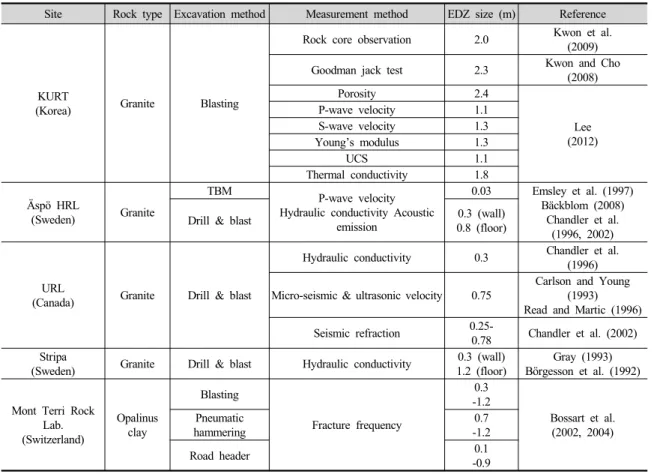
EDZ 크기는 현장 및 실험실 시험을 통한 물성 변화 로 평가되며 암반의 특성(강도, 강성, 절리 특성 등), 굴착 방법(drill, blast, rock boring, cutting machine 등), 발파 기법, 심도, 현지응력, 굴착 크기, 불연속면 등에 따라 다르게 나타난다. Table 2는 각각 다른 방법으로 굴착된 연구시설에서의 EDZ 크기를 보여준 다. 결정질 화강암 암반에서의 연구시설을 기준으로 작성하였다(Mont Terri Rock Lab.은 백점토질).
Bossart et al. (2002)은 발파에 의한 굴착과 Road header에 의한 기계 굴착을 비교하였다(Table 2의 Mont Terri Rock Lab. 참고). road header에 의한 기계 굴착은 발파에 의한 굴착보다 EDZ 범위와 aperture가 작게 나타났고 더 많은 균열이 나타났다고 설명하였 다. 또한, Stripa Mine과 Äspö HRL에서의 실험은 터널 측벽보다 터널 바닥에서 EDZ 크기는 더 큰 것을 알 수 있다. 이는 일반적으로 바닥면 발파공에 더 많은 폭약을 장약하는 발파작업 때문으로 판단된다 (Lee, 2012).
Table 3는 국내·외 여러 현장에서 측정한 변형계수
(deformation modulus)의 변화를 보여준다. 각 현장별 로 최소 19%에서 최대 82%까지 감소한 것을 알 수 있고 평균은 54%였다. 약 50% 정도의 평균 감소량은 모델링을 통한 분석 시 근거자료로 활용하였다.
3. 수치 모델링
3.1 모델링 개요
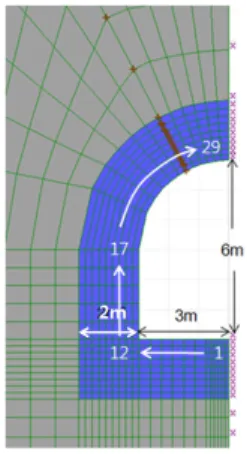
모델링 해석을 위해 ITASCA Consulting Group에 서 개발한 FLAC (Fast Lagrangian Analysis of Continua) Version 7.0을 이용하여 해석을 실시하여 수행하였다. 100 m 심도의 6×6 m 마제형 터널을 대상으로 모델링을 수행하였다. Fig. 2는 모델링을 위한 격자망(mesh)과 경계조건을 보여준다. 터널 주 변 격자망을 미세한 격자로 구현하여 정밀한 분석이 가능하도록 모사하였다. 모델의 가로와 세로 길이는 각각 50 m, 220 m 이고 암반손상대의 크기는 2 m로 설정하였다. 구성모델은 Mohr-Coulomb 탄소성 모델 이고 전체 암반을 균질, 등방성 모델로 가정하고 상부 면을 제외한 모든 면은 면의 수직방향 변위를 고정하 였다.
Fig. 2. Model mesh, geometry of the tunnel and boundary condition
A type (No EDZ)
B type (Uniform EDZ properties)
C type
(Non-uniform EDZ properties)
Fig. 3. Types for the mechanical stability of a tunnel with a consideration of EDZ
Table 4. Material properties used for the tunnel analysis Density
(kg/m3)
Bulk modulus (GPa)
Shear modulus (GPa)
Cohesion (MPa)
Friction angle (°)
Tensile strength
(MPa) Comment
A type 2724 34.6 22.8 12 47 5 J.W. Kim
et al. (2012)
B type 2587.8 17.3 11.4 6 23.5 2.5 Uniform EDZ
properties
C type
2696.8
∼ 2478.8
31.1
∼ 3.5
20.5
∼ 2.3
11.9
∼ 1.2
42.3
∼ 4.7
4.5
∼ 0.5
Non-uniform EDZ properties
3.2 암석 및 EDZ 물성
본 연구에서는 EDZ의 존재 및 손상구간에서의 물 성 변화가 구조 안정성에 미치는 영향을 확인하기 위해 Fig. 3에서 보듯이 굴착 후 나타나는 터널을 3가지 type으로 구분하였다. EDZ가 고려되지 않는 경우를 A type, 균등한 물성의 EDZ를 가정한 경우를
B type, 불균등한 물성을 갖는 EDZ를 C type으로 정의하였다. 본 연구에서는 B type의 물성 감소비 (reduction ratio)를 0.5로 설정하였다. C type은 EDZ 구간 터널 벽면에서부터 거리에 따라 90%에서 10%까 지 같은 간격으로 감소되는 것으로 가정하였다. B type을 절반으로 감소시킨 이유는 Table 3에서 보듯이 변형계수 감소량 평균이 약 50%이기 때문이고 A type
(a) Young’s modulus (Kwon and Cho, 2008) (b) P-wave velocity (Lee et al., 2011) Fig. 4. Change of Young’s modulus and P-wave velocity in KURT
(a) Major principal stress (b) Minor principal stress
(c) X-displacement (d) Y-displacement
Fig. 5. Variation of major and minor principal stresses, displacement along the checking points
과 C type의 변화를 좀 더 확실하게 구분하기 위함이다.
Table 4는 터널 해석에 사용된 암반 및 EDZ 구간에 서의 물성을 보여준다. A type은 암반의 물성을 그대 로 적용하였고 B type은 초기 물성을 절반으로 감소시 켰다. 밀도의 경우 감소폭이 미미할 것으로 판단되어 5%만을 감소시켰다. C type은 터널 벽면에서의 거리 를 고려하여 손상구간의 암반 물성을 90%에서 10%까 지 감소시켰다. Kwon and Cho (2008), Lee et al.
(2011)의 연구 보고에 의하면 한국원자력연구원
(KAERI) 내에 위치한 KURT (KAERI Underground Research Tunnel) 손상구간에서의 물성 변화는 터널 벽면에서의 거리에 따라 비선형적인 변화 양상을 보 였다(Fig. 4).
3.3 모델링 결과 및 분석
Fig. 5는 모델링에서 얻어진 결과를 보여준다. Type 에 따라 측압계수가 1.0일 때 터널의 최대 및 최소주응
(a) Mohr-Coulomb failure criterion (b) Factor of safety Fig. 6. Change of factor of safety based on Mohr-Coulomb failure criterion
Table 5. Results from the tunnel modeling In-situ
stress ratio Ratio of change Floor Wall Roof Average
B type C type B type C type B type C type B type C type
K=1.0
Ratio of major principal stress (%) -6.7 -24.0 -16.5 -45.6 -18.5 -49.1 -13.3 -38.1 Ratio of displacement (%) 142.3 325.7 176.2 337.1 180.6 171.5 164.4 266.3 Ratio of factor of safety (%) -31.4 -82.4 -23.2 -72.4 -24.3 -75.1 -27.5 -78.6
K=1.5
Ratio of major principal stress (%) -10.8 -52.2 -16.1 -45.7 -18.1 -62.0 -14.7 -55.1 Ratio of displacement (%) 162.6 342.0 155.4 288.1 202.9 187.7 177.3 269.5 Ratio of factor of safety (%) -29.2 -73.9 -23.9 -71.3 -24.7 -70.5 -26.4 -72.0
K=2.0
Ratio of major principal stress (%) -12.0 -66.7 -13.2 -34.7 -18.1 -68.2 -14.7 -61.8 Ratio of displacement (%) 183.3 514.1 143.8 426.6 232.9 294.6 195.3 408.8 Ratio of factor of safety (%) -29.5 -65.2 -26.4 -74.2 -27.2 -70.9 -27.5 -70.5
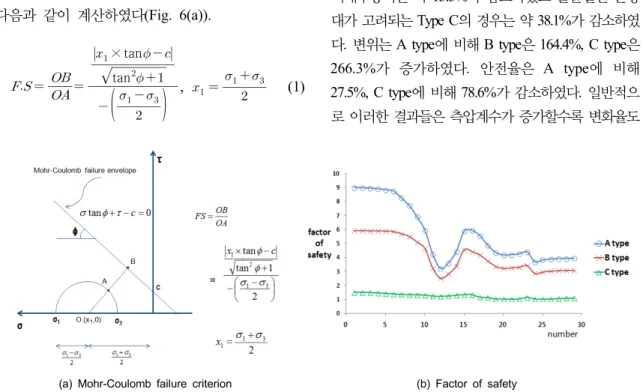
력과 X방향, Y방향의 변위를 나타내었다. 그래프의 x축은 터널 바닥부터 천정까지의 거리이다(Fig. 2 참 고). 최대주응력은 A type이 가장 크고 B type, C type 순으로 나타났으나 최소주응력의 변화는 거의 없었다. X방향 변위는 터널 측면에서 A type에 비해 B type, C type 순으로 증가하였고 Y방향 변위는 터널 바닥에서 A type보다 B type, C type 순으로 증가하였 다. 안전율은 Mohr-Coulomb 파괴기준에 근거하여 다음과 같이 계산하였다(Fig. 6(a)).
tan
× tan
,
(1)
여기서, c는 점착력, 는 내부마찰각, 은 최대주응 력, 은 최소주응력이다. 이렇게 계산된 안전율은 A type 보다 B type, C type 순으로 감소함을 알 수 있었다.
Table 5는 모델링을 통해 얻어진 결과들을 보여준 다. 측압계수가 1.0일 때, 암반손상대가 고려되지 않는 경우에 비해 균질한 손상대가 고려되는 B type의 경우 최대주응력은 약 13.3%가 감소하였고 불균질한 손상 대가 고려되는 Type C의 경우는 약 38.1%가 감소하였 다. 변위는 A type에 비해 B type은 164.4%, C type은 266.3%가 증가하였다. 안전율은 A type에 비해 27.5%, C type에 비해 78.6%가 감소하였다. 일반적으 로 이러한 결과들은 측압계수가 증가할수록 변화율도
Table 6. Total parameters related to factor of safety for sensitivity analysis
Total parameters Standard value
⓵ Depth 100 m
⓶ Height 6 m
⓷ Width 6 m
⓸ EDZ size 2 m
⓹ In-situ stress ratio 1.0
⓺ Poisson’s ratio 0.23
⓻ Cohesion 12 MPa
⓼ Friction angle 47°
⓽ Reduction ratio 0.5
⓾ Tensile strength 2.5 MPa
⑪ Young’s modulus 56 GPa
Table 7. Ratio of change of parameters affecting factor of safety with varying –50% to +50%
Parameters affecting factor of safety Ratio of change (%)
⓵ Depth 192.6
⓶ Height 21.6
⓷ Width 28.9
⓸ EDZ size 11.0
⓹ In-situ stress ratio 698.2
⓺ Poisson’s ratio 5.2
⓻ Cohesion 162.8
⓼ Friction angle 6.8
⓽ Reduction ratio 111.9
Tensile strength 0.2
Young’s modulus 0
증가하는 경향을 보였다. B type과 C type이 A type보 다 더 적은 응력이 작용함에도 불구하고 안전율이 더 낮은 이유는 점착력과 내부마찰각의 감소에 의한 영향이 더 크기 때문으로 보인다.
4. 민감도 분석을 위한 영향 인자 도출
터널의 안정성에 영향을 미치는 인자들의 민감도 분석을 수행하기 위해 총 11개의 관련 인자들을 설정 하였다. 선택된 인자들은 터널의 폭과 높이, 심도를 포함하여 암반의 여러 물성(탄성계수, 포아송비, 점착
력, 내부마찰각, 인장강도)과 측압계수, 물성 감소비 (reduction ratio), EDZ 크기이다. 각 인자들의 기준 물성은 Table 6과 같다.
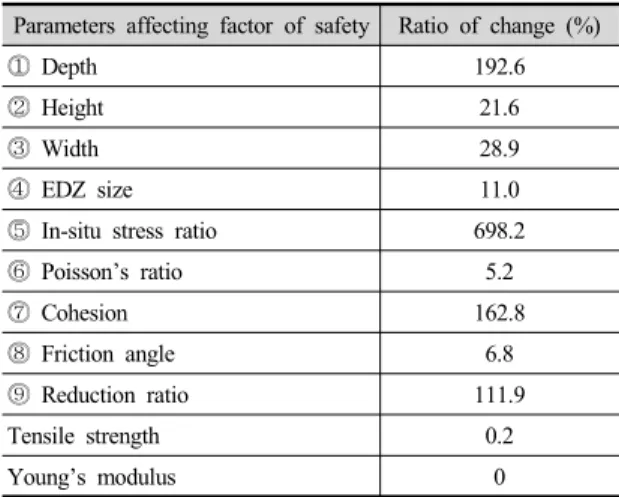
각 인자들에 대해 기준 물성을 –50%에서 +50%까 지 변화를 주었을 경우에 대한 모델링을 실시하였다. 기준 물성을 바탕으로 각각 물성이 변함에 따른 안전 율 변화를 계산하여 Table 7에 나타내었다. 측압계수 의 경우, 698%의 가장 큰 안전율 변화를 나타내었으며 그밖에도 심도, 점착력, 손상대에서의 물성 감소비 (reduction ratio)가 100% 이상의 안전율 변화를 나타 내었다. 탄성계수, 인장강도는 0%에 가까운 미미한 안전율 변화를 보였다. 따라서 탄성계수, 인장강도를 제외한 9개의 인자들로 부분요인설계법을 이용한 민 감도 분석을 실시하였다.
5. 민감도 분석
5.1 부분요인설계법(Fractional Factorial Design)
결과에 영향을 미치는 여러 인자들을 선정하고 이 들의 관계를 알아보기 위한 실험을 실시하여 이를 분석함으로써 최적의 조건을 찾아내고자 하는 방법을 실험계획법이라고 하고 이러한 방법으로 인자들의 변화에 따라 결과에 얼마만큼 영향을 미치는지 조사 하는 방법을 민감도 분석이라고 한다(Kim, 2007).
본 연구에서는 터널 주변의 여러 안전율 중 평균값을 기준으로 민감도 분석을 실시하였다.
실험계획법은 통계해석법을 기반으로 변동을 가져 오는 많은 원인 중에서 중요한 원인을 적은 비용으로 선정하여 그 효과를 수량적으로 측정하는 방법이라고 할 수 있다. 제품의 특성에 영향을 미치는 여러 가지 인자를 선정하고 이들의 관계를 알아보기 위한 실험 을 실시하여 자료를 얻고 이들의 관계를 알아보기 위한 실험을 실시하여 분석함으로써 올바른 제품의 최적 조건을 찾아내고자 하는 것이 실험계획법의 목 표라고 할 수 있다. 일반적으로 고려해야 할 인자들의
Table 8. Selected 29-p Fractional Factorial Designs Number of Factors
k Fraction Number of Runs Design Generators
9
29-2 128 x8=x1x3x4x6x7
x9=x2x3x5x6x7
29-3 64
x7=x1x2x3x4
x8=x1x3x5x6
x9=x3x4x5x6
29-4 32
x6=x2x3x4x5
x7=x1x3x4x5
x8=x1x2x4x5
x9=x1x2x3x5
29-5 16
x5=x1x2x3
x6=x2x3x4
x7=x1x3x4
x8=x1x2x4
x9=x1x2x3x4
개수가 많으면 총 실험횟수는 인자의 수가 늘어남에 따라 급격히 많아지게 된다. 예를 들어, 간단한 2수준 의 실험인 경우 인자의 수가 10개라면 실험 횟수는 210=1024가 되는데 현실적으로 1024번의 실험을 서 로 다른 조건 하에서 실험하는 것은 불가능하다. 하지 만 경험적으로 공업실험은 ‘Factor Sparsity’의 원칙을 따른다. 즉, 유의한 인자의 수는 많아야 3,4개이고 2인자 교호작용까지 포함하면 5, 6개를 넘지 않는다는 것이다. 따라서 1024번의 실험을 하는 것은 시간적, 경제적으로 낭비이다. 이처럼 인자의 수가 많은 경우 주효과와 관심 있는 몇 개의 2인자 교호작용만을 걸러 낼 수 있도록 실험을 할 필요가 있다. 이와 같이 전체 실험 중에서 일부만을 실시하여 관심 있는 효과들 중에서 유의한 효과들을 선별해 낼 수 있도록 일부분 의 실험만으로 인자들의 영향을 실시하는 방법을 부 분요인설계법이라고 한다(Park, 2010). 부분요인설계 법은 고차의 교호작용은 거의 존재하지 않는다는 가 정이 만족되어야 하며 일반적으로 이 가정은 거의 만족된다고 알려져 있다(Kim, 2007). 부분요인설계 법을 계획할 때에는 Table 9과 같은 직교배열표 (orthogonal array table)를 사용하는 것이 편리하다
(Park and Kim, 2011).
교락에 사용되는 교차효과를 Generator라고 하고 Table 8에서 보듯이 x6=x2x3x4x5, x7=x1x3x4x5와 같이 표현된다. 9개의 인자들은 심도(x1), 점착력(x2), 측압 계수(x3), 물성 감소비(x4), 터널의 폭(x5), 터널의 높이 (x6), EDZ 크기(x7), 내부마찰각(x8), 포아송비(x9)이 다. 즉, 요인(factor)의 개수는 k=9이다. 본 연구에서는 29=514번의 실험횟수를 29-4=32번으로 줄였다. 안전 율은 실험계획을 통한 결과로 반응치(response)라고 한다. Table 9에 직교배열표를 작성하였다.
5.2 민감도 분석 결과
터널 주변 각 요소 안전율의 평균값을 기준으로 인자들의 주효과(main effect)를 Fig. 7에 나타내었다.
주효과란 하나의 실험 인자의 수준이 변할 때 결과에 영향을 주는 정도의 크기를 정량적으로 표현한 것이 다. 즉, 주효과의 절대값이 크다는 것은 해당 인자가 결과에 의미 있는 변화를 일으키는 인자일 가능성이 높고 설계 시 중요한 인자로 다루어야 함을 의미한다. 주효과는 인자의 (+)수준의 평균에서 (–)수준의 평균
Table 9. Orthogonal Array Table for the 29-4 Factorial Design
Run x1 x2 x3 x4 x5 x6=
x2x3x4x5
x7= x1x3x4x5
x8= x1x2x4x5
x9=
x1x2x3x5 F.S
1 + + + + + + + + + 2.8
2 + + + + - - - - - 2.4
3 + + + - + - - - + 4.7
4 + + + - - + + + - 4.2
5 + + - + + - - + - 7.1
6 + + - + - + + - + 4.3
7 + + - - + + + - - 9.0
8 + + - - - - - + + 7.4
9 + - + + + - + - - 1.4
10 + - + + - + - + + 1.9
11 + - + - + + - + - 2.4
12 + - + - - - + - + 2.1
13 + - - + + + - - + 3.7
14 + - - + - - + + - 2.7
15 + - - - + + + + + 7.2
16 + - - - - - - - - 3.5
17 - + + + + + - - - 5.1
18 - + + + - - + + + 4.3
19 - + + - + - + + - 7.0
20 - + + - - + - - + 9.7
21 - + - + + - + - + 13.4
22 - + - + - + - + - 7.2
23 - + - - + + - + + 15.4
24 - + - - - - + - - 15.5
25 - - + + + - - + + 3.0
26 - - + + - + + - - 2.8
27 - - + - + + + - + 4.3
28 - - + - - - - + - 3.6
29 - - - + + + + + - 4.9
30 - - - + - - - - + 5.2
31 - - - - + - - - - 15.5
32 - - - - - + + + + 5.5
의 차이로 계산될 수 있다. 예를 들어 x1의 주효과는 Table 9를 참고하여 다음과 같이 계산된다.
⋯ ⋯
(2)
위의 식처럼 x2~x9의 주효과를 계산하면 Fig. 7과 같다. 주효과의 절대값이 1보다 큰 측압계수, 심도, 점착력, 물성 감소비, 폭, 내부마찰각, 높이 순으로 안전율에 많은 영향을 미친다는 것을 알 수 있다.
반면에 1보다 작은 EDZ 크기와 포아송비는 거의 영향
Fig. 7. Main effect of the parameters on factor of safety around a tunnel
Table 10. Interaction effect of the parameters on factor of safety x1
(depth)
x2
(cohesion) x3
(in situ stress ratio)
x4
(reduction ratio)
x5
(width)
x6
(height)
x7
(EDZ size) x8
(friction angle)
x9
(poisson’s ratio)
x1 -0.99 1.24 1.02 -0.32 0.59 0.47 1.56 0.13
x2 -0.99 -0.79 -0.49 -0.34 0.47 0.59 -0.09 0.52
x3 1.24 -0.79 1.01 -1.58 1.56 6.69 0.59 0.45
x4 1.02 -0.49 1.01 -0.21 0.13 0.52 0.45 0.59
x5 -0.32 -0.34 -1.58 -0.21 -0.47 -0.45 0.07 0.22
x6 0.59 0.47 1.56 0.13 -0.47 -0.64 1.24 1.03
x7 0.47 0.59 6.69 0.52 -0.45 -0.64 -0.79 -0.49
x8 1.56 -0.09 0.59 0.45 0.07 1.24 -0.79 1.01
x9 0.13 0.52 0.45 0.59 0.22 1.03 -0.49 1.01
을 미치지 않는 것을 의미한다. 또한 주효과가 (+)라면 안전율이 커지는 방향으로 영향을 미치고 (–)라면 안 전율은 작아지는 방향으로 영향을 미친다는 의미이 다. 예를 들어 점착력의 경우, 주효과가 3.1로 나타났 는데 이를 통해 점착력 증가에 의해 안전율이 증가함 을 알 수 있다. 반면 심도의 경우, 주효과가 –3.5로 나타났는데 이를 통해 터널의 심도가 증가함에 따라 안전율은 감소하며 그 변화의 폭은 점착력에 따른 안전율 변화에 비해 약간 크다는 것을 알 수 있다. 측압계수와 심도, 암반의 점착력과 물성 감소비, 터널 의 폭, 내부마찰각, 높이 순으로 주효과 절대값이 큰 것으로 보아 이 인자들은 안전율에 미치는 영향이 큰 것으로 판단된다.
두 가지 이상의 인자의 조합에서 발생할 수 있는
영향의 크기를 교호작용이라고 한다. 예를 들어 x1의 효과가 x2의 수준 변화에 따라 변하는 경우에 x1, x2
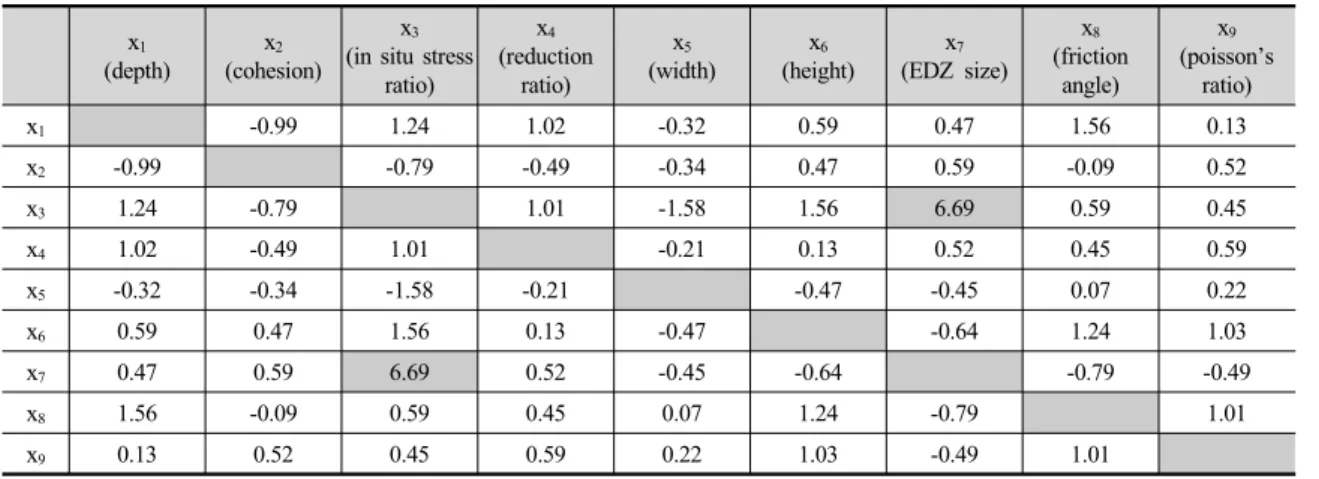
인자 간에 교호작용 x1×x2가 존재한다고 한다고 하고 x1, x2, x3 인자간의 조합으로 발생하는 영향이 존재할 경우에 교호작용 x1×x2×x3가 존재한다고 할 수 있다. 앞에서 언급했듯이 일반적으로 부분요인설계법에 의 한 방법은 고차의 교호작용은 무시할 수 있기 때문에 2인자 교호작용만을 구하여 Table 10에 나타내었다.
2인자 교호작용은 ‘측압계수(x3)×EDZ 크기(x7)’의 영 향이 6.69로 가장 큰 것으로 나타났다. 주효과 절대값 이 상대적으로 작은 EDZ 크기가 측압계수와의 조합 에서 발생하는 교호작용이 매우 크게 나타난 것으로 보아 EDZ의 발생으로 고려되는 EDZ 크기는 중요한 인자임을 알 수 있다.
6. 결론 및 제언
본 연구에서는 FLAC Version 7.0을 이용한 모델링 을 통해 지하 마제형 터널에서 발생하는 EDZ가 역학 적 안정성에 미치는 영향을 비교·분석하였다. EDZ를 고려하지 않는 경우를 A type, 균등한 물성과 불균등 한 물성을 갖는 EDZ를 각각 B type, C type으로 정의하 여 각 type별로 비교·분석하였다. 또한, 안전율에 영향 을 미칠 수 있는 여러 인자들을 선정하고 부분요인설 계법을 이용한 관련 인자들의 민감도 분석을 실시하 여 다음과 같은 결과를 도출하였다.
1. 터널 주변의 최대주응력은 A type을 기준으로 B, C type에서 각각 평균 13.3%, 38.1%가 감소하였고 변위는 164.4%, 266.3%가 증가하였다. 안전율은 27.5%, 78.6%가 감소하였다. B, C type이 A type보 다 더 적은 응력을 받음에도 불구하고 안전율이 더 낮은 이유는 점착력과 내부마찰각 감소에 의한 영향이 더 크기 때문으로 판단된다.
2. 부분요인설계법을 이용한 민감도 분석 결과안전 율에 가장 많은 영향을 미치는 인자는 측압계수였 고 심도, 점착력, 물성 감소비, 터널의 폭, 내부마찰 각, 터널의 높이 순으로 나타났다. EDZ 발생으로 인한 물성 감소비의 영향이 큰 것으로 보아 EDZ는 역학적 안정성에 많은 영향을 미치는 것으로 판단 된다.
3. 두 가지 인자의 조합에서 발생하는 영향의 크기는 측압계수와 EDZ 크기의 조합에서 가장 크게 나타 났다. EDZ 크기 단독으로는 다른 인자에 비해 상대 적으로 많은 영향을 미치지 않는 인자이지만 측압 계수와의 조합으로 생기는 효과는 가장 큰 것으로 나타났기 때문에 EDZ 크기 역시 중요한 인자로 판단된다.
4. 결론적으로 EDZ의 발생으로 인해 터널의 거동과 안정성 면에서 많은 변화가 나타났고 특히 물성 감소비는 터널 안정성에 큰 변화를 보였다. EDZ
크기는 측압계수와의 조합으로 안전율에 많은 영 향을 미치기 때문에 터널 설계 시 EDZ를 고려하여 설계하는 것은 필요하다.
모델링을 통해 터널 설계 시 역학적 안정성 면에서 EDZ를 고려해야 하는 필요성을 보여주었다. 또한, 구조물의 역학적 안정성을 위해 안전율에 많은 영향 을 미치는 인자들을 토대로 설계한다면 좀 더 안전하 게 구조물을 시공할 수 있을 것이라 생각된다. 앞으로 이러한 연구를 바탕으로 현장에서 정확하게 실측된 데이터를 가지고 현장 및 실험실 시험으로 본 연구와 비교한다면 좀 더 신뢰성 있는 결과를 얻을 수 있을 것이다.
감사의 글
본 연구는 산업통상자원부 자원개발특성화대학사 업과 2013년도 인하대학교(INHA_46430_01) 및 한 국원자력연구원의 지원을 받아 수행되었으며 이에 감사드립니다.
References
1. Börgesson, L., Pusch, R., Fredicksson, A., Hökmark, H., Kamland, O., Sandén, R., 1992, “Final report of zones disturbed by blasting and stress release”, Stripa Project 92-08, SKB, Stockholm.
2. Bossart, P., Meier, P.M., Moeri, A., Trick, T., Mayor, J., 2002, “Geological and hydraulic characterization of the excavation disturbed zone in the opalinus clay of the mont terri rock laboratory”, Engineering Geology 66, pp. 19-38.
3. Bäckblom, G., 2008, “Excavation damage and disturbance in crystalline rock – Results from experiments and analyses”, SKB technical report TR-08-08, SKB, Stockholm.
4. Cai, M., Kaiser, P.K., 2005, “Assessment of excavation damaged zone using a micromechanics model”,
Tunnelling and Underground Space Technology, pp. 301-310.
5. Carlson, S.R., Young, R.P., 1993, “Acoustic emission and ultrasonic velocity study of excavation-induced microcrack damage at the underground research laboratory”, International Journal of Rock Mechanics and Mining Science & Geomechanics Abstracts, Vol. 20, No. 7, pp. 901-907.
6. Chandler, N.A., Kozak, E.T., Martin, C.D., 1996,
“Designing the excavation disturbed zone for a nuclear repository in hard rock”, Proceeding of Can. Nucl. Soc., Sep 20, Winnipeg, Canada, Canadian Nuclear Society, Toronto.
7. Chandler, N.A., Cournut, A., Dixon, D.A., Fairhurst, C., Hansen, F., Gray, M., Hara, K., Ishijima, Y., Kozak, E., Martino, J., Matsumito, K., McCrank, G., Sugita, Y., Thompson, P., Tillerson, J., Vignal, B., 2002, “The five-year report of the Tunnel Sealing Experiment: An international project of AECL”, JNC, ANDRA and WIPP, Atomic Energy of Canada Limited Report AECL-12727, Chalk River, Canada.
8. Emsley, S., Olsson, O., Stenberg, L., Alheid, H.J., Falls, S., 1997, “A Study of damage and disturbance from tunnel excavation by blasting and tunnel boring”, ZEDEX, SKB(Swedish Nuclear Fuel and Waste Management Co.) Technical Report 97-30, p. 198.
9. Ericsson, L.O., Brinkhoff, P., Gustafson, G., Kvartsberg. S., 2009, “Hydraulic features of the excavation disturbed zone – laboratory investigations of samples taken from the Q- and S- tunnels at Äspö HRL”, SKB Report R-09-45.
10. Gray, M., 1993, “International stripa project 1980-1992”, Overview Volume Ⅲ, Engineered Barriers, SKB, Stockholm.
11. Itasca Consulting Group Inc., 2002, FLAC, FISH in FLAC, Minneapolis, Minnesota, USA.
12. Kim, H.C., 2007, “Introduction to design of experiment”, Hanol Publisher, pp. 1-2, p. 168, pp. 192-196.
13. Kim, J.S., Kwon, S., Cho, W.J., 2009, “An
assessment of the excavation damaged zone in the KAERI underground research tunnel”, Journal of Korean Society of Explosives & Blasting Engineering, Vol. 27, No. 1, pp. 21-31.
14. Kwon, S., Cho W.J., 2008, “Investigation of the Development an the Effect of an Excavation Damaged Zone at KAERI Underground Research Tunnel”, KAERI/TR-3533/2008.
15. Kwon, S., Lee, C.S., Cho, S.J., Jeon, S.W., Cho, W.J., 2009, “An investigation of the excavation damaged zone at the KAERI underground research tunnel”, Tunnelling and Underground Space Technology, Vol. 24, pp. 1-13.
16. Kwon, S., Lee, C.S., Jeon, S.W., Choi, H.J., 2013, “Thermo-mechanical coupling analysis for APSE using submodels and neural networks”, Journal of Rock Mechanical and Geotechnical Engineering, Vol. 5, pp. 32-43.
17. Lai, X., Cai, M., Ren, F., Xie, M., Esaki, T., 2006, “Assessment of rock mass characteristics and the excavation disturbed zone in the lingxin coal mine beneath the xitian river, china”, International Journal of Rock Mechanics & Mining Science 43, pp. 572-581.
18. Lanyon, G.W., Diederichs, M., Leech, R.E.H., Lam, T., Jensen, M., 2011, “Excavation damaged zone assessment”, OPG’s Deep Geological Repository for Low & Intermediate Level Waste, NWMO DGR TR-2011/21.
19. Lee, C.S., 2012, “Characterization of thermal- mechanical behavior of rock mass in the excavation damaged zone at KURT”, Ph.D. thesis of Seoul national university, pp. 78-79.
20. Lee, C.S., Kwon, S., Choi, J.W., Jeon, S., 2011,
“An Estimation of the Excavation Damaged Zone at the KAERI Underground Research Tunnel”, Tunnel & Underground Space, Vol. 21, No. 5, pp. 359-369.
21. Malmgren, L., Saiang, D., Töyrä, J., Bodare, A., 2007, “The Excavation Disturbed Zone (EDZ) at Kiirunavaara Mine, Sweden – by Seismic Measur- ements”, Journal of Applied Geophysics 61, pp.
1-15.
22. Martino, J.B., Chandler, N.A., 2004, “Excavation- induced damage studies at the underground research laboratory”, International Journal of Rock Mechanics & Mining Sciences 41, pp. 1413-1426.
23. Park, S.H., 2010, “Enforcement method of design of experiment”, p. 2.
24. Park, S.H., Kim, J.W., 2011, “Modern design of experiment using MINITAB”, Minyoung Publisher, p. 15, p. 324.
25. Read, R.S., Martin, C.D., 1996, “Technical summary of AECL’s Mine-By Experiment, Phase 1: Excavation Responses, AECL-11311, CoG-95-171, AECL, Pinawa, Canada.
26. Rutqvist, J., Stephansson, O., 2003, “The role of hydromechanical coupling in fractured rock engineering, Journal of Hydrogeology 11:7-40.
27. Saiang, D., 2011, “Blast-induced damaged zone studies”, Final Report to Trafikverket, Luleå University of Technology, Sweden.
28. Saiang, D., Nordlund, E., 2008, “Numerical study of the mechanical behavior of the damaged rock mass around an underground excavation”, Appendix D: 2008 Massmin Power Point Presentation, Luleå University of Technology, Sweden.
29. Tsang, C.F., Bernier, F., 2004, “Definitions of excavation disturbed zone and excavation damaged zone in impact of the excavation disturbed or damaged zone on the performance of radioactive waste geological repositories”, Proceedings European Commission CLUSTER Conference and Workshop on EDZ in Radioactive Waste Geological Repositories, Luxembourg.