JESK
http://jesk.or.kr eISSN:2093-8462A Study on Analysis of Industrial Injury Characteristics of Aging Workers in Agriculture
Yuchang Kim, Daesu Kim, Kyunghwan Park, Daesik Kim
Department of Industrial Management Engineering, Dong-eui University, Busan, 614-714
Corresponding Author Yuchang Kim
Department of Industrial Management Engineering, Dong-eui University, Busan, 614-714
Mobile : +82-10-4451-6114 Email : [email protected]
Received : September 22, 2014 Revised : October 10, 2014 Accepted : November 12, 2014
Objective:This study aims to devise industrial injury prevention measures by analyzing industrial injury characteristics including the status of industrial injuries, source of industrial injury and accident type in order to prevent aging workers' industrial injuries that account for more than half in the workplaces in agriculture.
Background: Continuous migration from farm to city takes place among young people in rural areas in Korea, a traditionally agricultural country due to rapid industrialization and economic development. The aging rate in rural areas in 2013 was 37.3%, about three times higher than the total aging rate of 12.2% in Korea.
According to industrial injury statistics of the Ministry of Employment and Labor, the number of industrial injuries in agriculture shows an uptrend and the industrial injuries of aging workers account for more than 50% each year.
Method: Of the 2,970 industrial injury cases occurred in the workplaces in agriculture for five years during 2008 and 2012 offered by a national agency related to health and safety, this study analyzed 1,767 industrial injury cases of aging workers.
Results: As a result of an analysis on aging workers' industrial injuries by company size in agriculture, 89.8% of the total number of industrial injuries were analyzed to occur in small scale company. According to aging workers' industrial injuries by source of industrial injury and accident type, the outdoor floor and a fall were analyzed to be the highest at 16.5% and 26.1%, respectively.
Conclusion: This study analyzed aging workers' industrial injuries by company size, age, job duration, accident severity, gender, nationality, the source of industrial injury and accident type in order to identify industrial injury characteristics in agriculture.
Application: The identification of industrial injury characteristics of aging workers in agriculture is judged to be helpful to devising effective measures to prevent industrial injuries.
Keywords: Aging workers, Agriculture, Industrial injury, Outdoor floor, Fall
Copyright@2014 by Ergonomics Society of Korea. All right reserved.
○cc This is an open-access article distributed under the terms of the Creative Commons Attribution Non-Commercial License (http://
creativecommons.org/licenses/by-nc/3.0/), which permits unrestricted non-commercial use, distribution, and reproduction in any medium, provided the original work is properly cited.
1. Introduction
In Korea, migration from farm to city continuously takes place among young people in rural areas, due to rapid industrialization and economic development. Due to such a trend, population aging becomes a problem at national level and the increasing trend of farmers' aging is much faster than that of cities. According to the Statistics Korea, the aging rate of rural areas was 37.3% in 2013 that went up 4.0%, compared to 33.3% in 2008 and it was more than 3 times higher than Korea's total aging rate
12.2% (Statistics Korea, 2014).
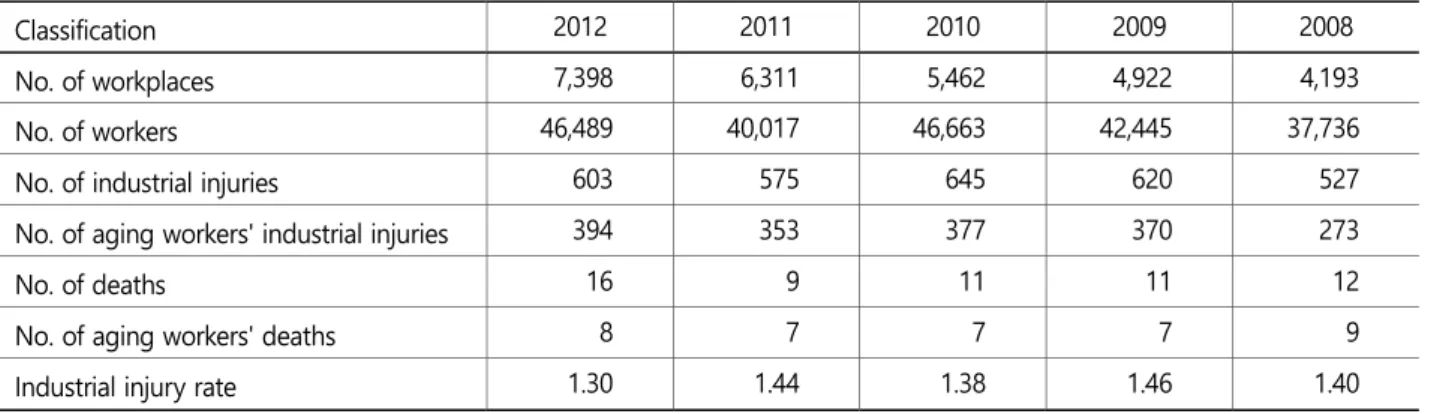
Agriculture gradually becomes large scale business and farming corporation, different from traditional industrial structure in the past. Through government's policy to encourage return to farming, the number of workers in agriculture steadily increased from 37,736 in 2008 to 42,445, 46,663, 40,017 and 46,489 in 2009, 2010, 2011 and 2012 respectively. As the number of workers in agriculture continually increases, the number of injuries is also on the rise. According to the industrial injury statistics of the Ministry of Employment and Labor (MOEL), the number of industrial injuries showed an increasing trend from 527 in 2008 to 620, 645, 575 and 603 in 2009, 2010, 2011 and 2012 respectively. The industrial injuries of aging workers accounted for more than 50% of the total industrial injuries each year (MOEL, 2013). From this, the number of industrial injuries in agriculture seems to take up high ratio. Consequently, safety measures for aging works are considered to be necessary.
In comparison of aging workers' physical characteristics with those of workers in their 30s, the farmer's endurance, agility, ability to react instantly and muscular strength were lower by 14%, 20%, 32% and 18% than those of the workers in their 30s respectively.
From the comparison result, it is known that the aging workers are more likely to have industrial injuries than young workers (KOSHA, 2006).
Farmers are exposed to various problems in industrial injury. But the investigation of relevance between work and disease and the subjects of industrial injury statistics in agriculture are limited to salary workers. Therefore, industrial injury rate in agriculture was forecast to be higher than statistical data because self-employed farmers who taking up most of the farmers are excluded from the statistics (Kim, 2009). According to the industrial injury statistics of MOEL, the industrial injury rate in agriculture was 1.30%
more than two times higher than the total industrial injury rate of 0.59% in Korea (MOEL, 2013). Currently, aging has been progressing rapidly in agriculture and the industrial injuries of aging workers in agriculture are projected to be far higher than statistics, if the self-employed farmers are included.
The definition of an aging worker refers to a person aged 55 and over under the Employment Promotion Act for the Aged. And a semi-aged person was stipulated as a person aged 50~under 55 in accordance with the Employment Promotion Act for the Aged. Therefore, the aged worker is classified as a person aged 50 and over in general (Choi, 2013). Liira et al. (1997) asserted the workforce of laborer diminishes especially after 50 years of age. Therefore, this paper defined an aging worker as a person aged 50 and over. Although, there were some studies on general injuries, not on industrial injuries, there was no study on the official industrial injury statistics in agriculture. The purpose of this study is to devise efficient measures to prevent industrial injuries by analyzing industrial injury characteristics including the status of industrial injuries, source of industrial injury and accident type.
2. Method
Of the 2,970 industrial injury cases that occurred in the workplaces in agriculture for recent five years (2008~2012) provided by a national agency related to safety and health, this study analyzed 1,767 industrial injury cases of the aging workers.
This paper analyzed industrial injury cases in various methods by company size, business type, accident type and the source of industrial injury.
3. Result
The industrial injury characteristics analysis in agriculture was carried out by dividing characteristics into following: the status of industrial injuries in agriculture and the numbers of aging workers' industrial injuries by company size, age, job duration, accident severity (projected treatment period), gender, nationality, the source of industrial injury and accident type respectively.
3.1 The status of industrial injuries in agriculture
The result of an analysis on the status of industrial injuries in agriculture for recent five years (2008~2012) is shown in Table 1. The total number of industrial injuries in agriculture was on the rise from 527 in 2008 to 620, 645, 575 and 603 in 2009, 2010, 2011 and 2012 respectively. Of the total industrial injuries in agriculture, the aging workers' industrial injuries accounted for more than 50% and showed an uptrend. The number of companies in agriculture sharply increased from 4,193 in 2008 to 4,922, 5,462, 6,311 and 7,398 in 2009, 2010, 2011 and 2012 respectively. This is analyzed that many workplaces increased as the government's support policy on agriculture changed from individual-centered assistance to workplace-targeted assistance (Kim et al., 2013).
3.2 The number of industrial injuries by company size
The result of an analysis on the aging workers' industrial injuries by company size in the workplaces in agriculture for recent five years (2008~2009) is shown in Table 2. 45.4% of total number of industrial injuries occurred in the workplaces with 5~29 employees, 36.0% in the workplaces with less than 5 employees and 8.4% in the workplaces with 30~49 employees in 2012.
Thus 89.8% of the total industrial industries occurred in the small scale workplaces with less than 50 employees. In view of the workplaces' characteristics in agriculture, most aging workers aged 50 and over worked in small scale workplaces. Their economic foundation was weak and working environment was inferior. Therefore, aging workers' injury rate in the workplaces in agriculture was judged to be high, compared to the workplaces in other fields.
Table 1. The status of industrial injuries in agriculture
Classification 2012 2011 2010 2009 2008
No. of workplaces 7,398 6,311 5,462 4,922 4,193
No. of workers 46,489 40,017 46,663 42,445 37,736
No. of industrial injuries 603 575 645 620 527
No. of aging workers' industrial injuries 394 353 377 370 273
No. of deaths 16 9 11 11 12
No. of aging workers' deaths 8 7 7 7 9
Industrial injury rate 1.30 1.44 1.38 1.46 1.40
Table 2. The number of industrial injury by company size
Classification 2012 2011 2010 2009 2008
Under 5 142 (36.0%) 136 (38.5%) 111 (29.4%) 85 (23.0%) 61 (22.3%)
5~29 179 (45.4%) 154 (43.6%) 190 (50.4%) 176 (47.6%) 142 (52.0%)
30~49 33 (8.4%) 37 (10.5%) 38 (10.1%) 47 (12.7%) 28 (10.3%)
50~299 36 (9.1%) 25 (7.1%) 37 (9.8%) 60 (16.2%) 40 (14.7%)
Over 300 4 (1.0%) 1 (0.3%) 1 (0.3%) 2 (0.5%) 2 (0.7%)
Total 394 (100%) 353 (100%) 377 (100%) 370 (100%) 273 (100%)
3.3 The number of industrial injuries by age
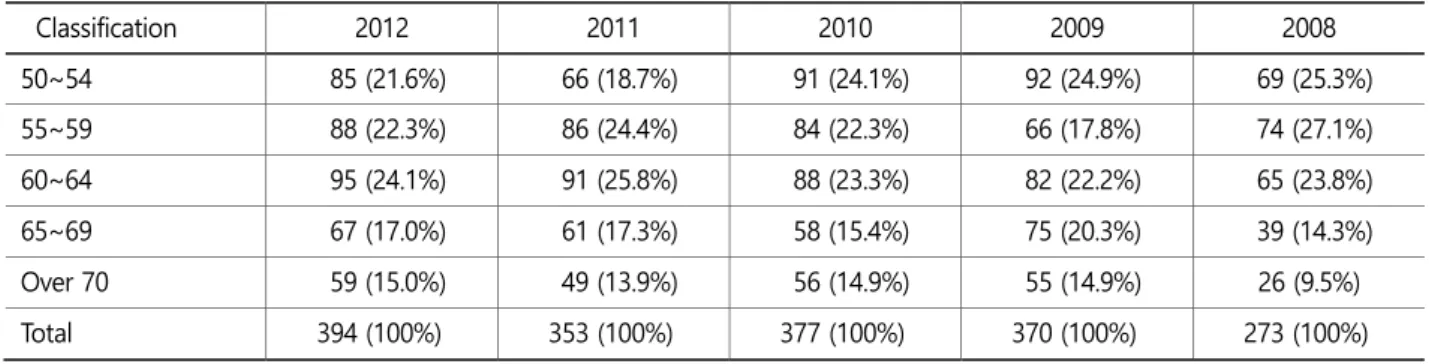
The result of an analysis on aging workers' industrial injuries by age in the workplaces in agriculture for recent five years (2008~2012) is shown in Table 3. 60~64 years of age accounted for the highest, or 24.1% of the total number of industrial injuries in 2012, followed by 22.3% between 55~59 and 21.6% between 50~54. Out of 603 industrial injuries in agriculture, aging workers' industrial injuries were analyzed to be 394 or 65.3%. Examining the industrial injury statistics released by MOEL in 2012, aging worker's industrial injuries in agriculture were higher than in the manufacturing industry (38.2%) and the construction industry (62.9%). In the meantime, the total aging workers' industrial injuries were 48.6% (MOEL, 2013). This means the industrial injuries of aging workers in agriculture increase, due to aging according to continuous migration from farm to city by young generation of rural area population.
3.4 The number of industrial injuries by job duration
The result of an analysis on the aging workers' industrial injuries by job duration in the workplaces in agriculture for recent five years (2008~2009) is shown in Table 4. 67.0% of the total industrial injuries were less than six months in terms of job duration in 2012, followed by 7.6% between 6 months and less than one year and 6.3% between 1 year and less than 2 years in job duration.
Kim et al. (2014) revealed that 23.9% of the total industrial industries in 2013 occurred to the aging workers aged 55 and over with less than one year of job duration. In the case of aging workers with short job duration, an injury may take place due to lacking physical strength or concentration (KOSHA, 2012). No good health status of aging workers raises the possibility to leave labor market within one year and lowers the possibility of employment remarkably (Nicoletti and Peracchi, 2001). In other words, the employment of aging workers is not related with their jobs during younger years and they don't always have lots of knowledge on safety. Therefore aging workers should receive thorough training upon their employment (Kim, 1999).
Table 3. The number of industrial injuries by age
Classification 2012 2011 2010 2009 2008
50~54 85 (21.6%) 66 (18.7%) 91 (24.1%) 92 (24.9%) 69 (25.3%)
55~59 88 (22.3%) 86 (24.4%) 84 (22.3%) 66 (17.8%) 74 (27.1%)
60~64 95 (24.1%) 91 (25.8%) 88 (23.3%) 82 (22.2%) 65 (23.8%)
65~69 67 (17.0%) 61 (17.3%) 58 (15.4%) 75 (20.3%) 39 (14.3%)
Over 70 59 (15.0%) 49 (13.9%) 56 (14.9%) 55 (14.9%) 26 (9.5%)
Total 394 (100%) 353 (100%) 377 (100%) 370 (100%) 273 (100%)
Table 4. The number of industrial injuries by job duration
Classification 2012 2011 2010 2009 2008
Under 6 month 264 (67.0%) 242 (68.6%) 229 (60.7%) 249 (67.3%) 166 (60.8%)
6 month-1 year 30 (7.6%) 41 (11.6%) 55 (14.6%) 44 (11.9%) 36 (13.2%)
1~2 years 25 (6.3%) 18 (5.1%) 29 (7.7%) 27 (7.3%) 26 (9.5%)
2~3 years 12 (3.0%) 19 (5.4%) 15 (4.0%) 12 (3.2%) 7 (2.6%)
3.5 The number of industrial injuries by accident severity
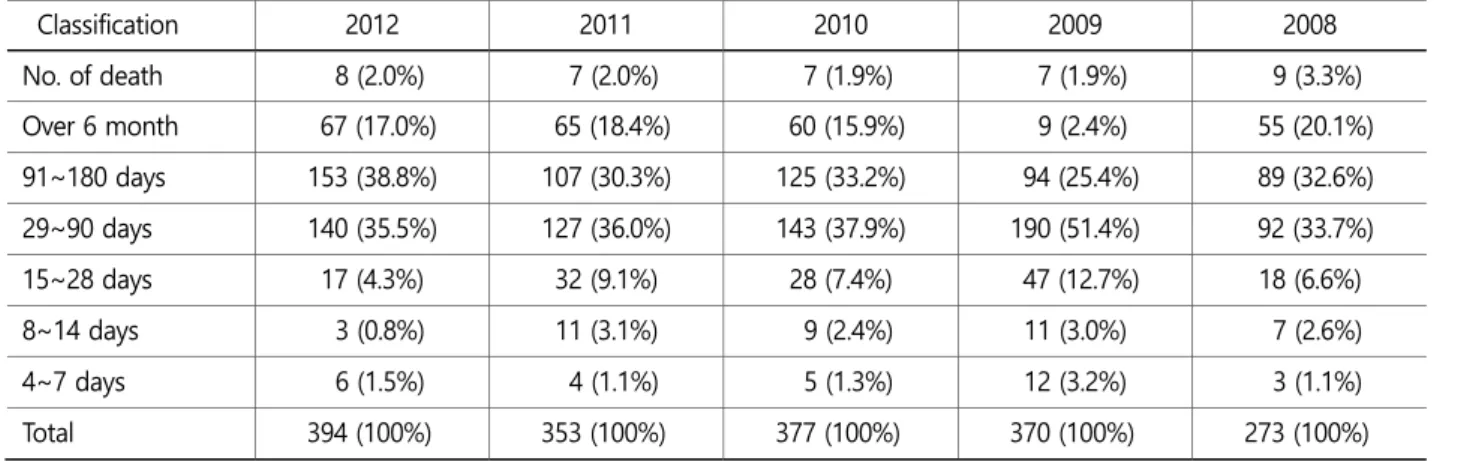
The result of an analysis on aging workers' industrial injuries by accident severity in agriculture for recent five years (2008~2012) is shown in Table 5. 38.8% of the total industrial injuries were 91~180 days in terms of treatment period in 2012. And 35.5% were 29~90 days and 17.0% were for more than six months. Thus more than 90% of the total industrial injuries were analyzed to have more than 29 days of projected treatment days.
3.6 The number of industrial injuries by gender
The result of an analysis on the aging workers' industrial injuries by gender in the workplaces in agriculture for recent five years (2008~2009) is shown in Table 6. 53.3% of the total industrial injuries were males and 46.7% were females in 2012. According to the industrial injury statistics released by MOEL in 2012, males took up 80.9% and females accounted or 19.1% in all industries.
As a result of an analysis on aging workers' industrial injury characteristics by KOSHA (2006), female aging workers' ratio was higher than male's. That is, the industrial injuries of female aging workers in agriculture occurred a lot. This is because rural areas' population is aging fast and there is almost no consideration on female aging workers in each workplace. Therefore appropriate work allocation and training are required for female aging workers to safely and efficiently work.
Table 4. The number of industrial injuries by job duration (Continued)
Classification 2012 2011 2010 2009 2008
3~4 years 16 (4.1%) 6 (1.7%) 5 (1.3%) 10 (2.7%) 7 (2.6%)
4~5 years 6 (1.5%) 3 (0.8%) 9 (2.4%) 5 (1.4%) 4 (1.5%)
5~10 years 21 (5.3%) 12 (3.4%) 21 (5.6%) 11 (3.0%) 17 (6.2%)
Over 10 years 20 (5.1%) 12 (3.4%) 13 (3.4%) 11 (3.0%) 10 (3.7%)
Unclassifiable 0 (0.0%) 0 (0.0%) 1 (0.3%) 1 (0.0%) 0 (0.0%)
Total 394 (100%) 353 (100%) 377 (100%) 370 (100%) 273 (100%)
Table 5. The number of industrial injuries by accident severity
Classification 2012 2011 2010 2009 2008
No. of death 8 (2.0%) 7 (2.0%) 7 (1.9%) 7 (1.9%) 9 (3.3%)
Over 6 month 67 (17.0%) 65 (18.4%) 60 (15.9%) 9 (2.4%) 55 (20.1%)
91~180 days 153 (38.8%) 107 (30.3%) 125 (33.2%) 94 (25.4%) 89 (32.6%)
29~90 days 140 (35.5%) 127 (36.0%) 143 (37.9%) 190 (51.4%) 92 (33.7%)
15~28 days 17 (4.3%) 32 (9.1%) 28 (7.4%) 47 (12.7%) 18 (6.6%)
8~14 days 3 (0.8%) 11 (3.1%) 9 (2.4%) 11 (3.0%) 7 (2.6%)
4~7 days 6 (1.5%) 4 (1.1%) 5 (1.3%) 12 (3.2%) 3 (1.1%)
Total 394 (100%) 353 (100%) 377 (100%) 370 (100%) 273 (100%)
3.7 The number of industrial injuries by nationality
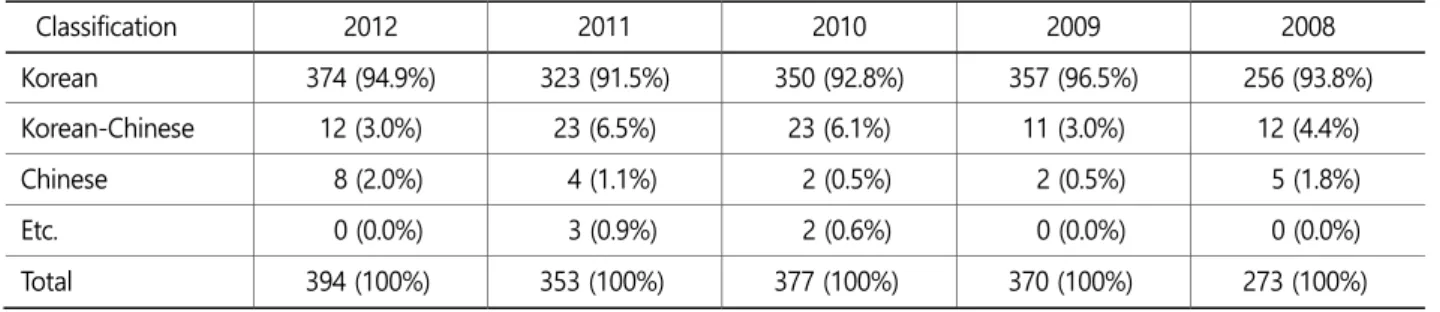
The result of an analysis on aging workers' industrial injuries by nationality in the workplaces in agriculture for recent five years (2008~2012) is shown in Table 7. 94.9% of the total industrial injuries occurred to Korean nationalities in 2012, followed by 3.0%
to Korean Chinese and 2.0% to Chinese. So far, there are many aging workers with Korean nationality. However the inflow of workers with other nationalities is conjectured to increase due to the effectuation of free trade agreements (FTA) and domestic worker's wage hike. In view of the characteristics of workplaces in agriculture, small companies employ low-waged foreign workers a lot to save labor cost. Consequently, measures to prevent industrial injuries of aging workers coming from other countries are also needed.
3.8 The number of industrial injuries by accident type
The result of an analysis on aging workers' industrial injuries by accident type in the workplaces in agriculture for recent five years (2008~2012) is shown in Table 8. A fall accounted for the most at 26.1% of total industrial injuries, followed by 23.6% of slip and 9.4% of narrowness in 2012. Kim (1999) revealed that narrowness accounted for 46%, slip 15% and fall 14% as a result of analysis on aging workers' industrial injuries in small scale company. The industrial injuries by a fall accounted for more in aging workers in agriculture than other industries. Jang et al. (2002) revealed that aging workers' industrial injuries from a slip took up 23.7% and a fall 12.4% in Busan city. Yoon et al. (2008) said a slip and a fall became the important factors of aging workers' industrial injuries, rather than general injuries such as narrowness and excessive motion, because physical functional features change when one is over 50 years old. The reason why industrial injuries from a fall and slip account for high ratios is that workers work outdoors in many cases and that they are closely related with outdoor floor and a moving ladder, deriving from an analysis of aging workers' industrial injuries by source of industrial injury. Especially, aging workers' equilibrium function declines, therefore, their possibility of falling and slipping is relatively higher than younger workers since they cannot properly keep their physical balance. For this reason, assigning the aging workers to work conducted at high location should be avoided and more careful safety measures are needed (Jang, 2002).
Table 6. The number of industrial injuries by gender
Classification 2012 2011 2010 2009 2008
Male 210 (53.3%) 203 (57.5%) 196 (52.0%) 190 (51.4%) 158 (57.9%)
Female 184 (46.7%) 150 (42.5%) 181 (48.0%) 180 (48.6%) 115 (42.1%)
Total 394 (100%) 353 (100%) 377 (100%) 370 (100%) 273 (100%)
Table 7. The number of industrial injuries by nationality
Classification 2012 2011 2010 2009 2008
Korean 374 (94.9%) 323 (91.5%) 350 (92.8%) 357 (96.5%) 256 (93.8%)
Korean-Chinese 12 (3.0%) 23 (6.5%) 23 (6.1%) 11 (3.0%) 12 (4.4%)
Chinese 8 (2.0%) 4 (1.1%) 2 (0.5%) 2 (0.5%) 5 (1.8%)
Etc. 0 (0.0%) 3 (0.9%) 2 (0.6%) 0 (0.0%) 0 (0.0%)
Total 394 (100%) 353 (100%) 377 (100%) 370 (100%) 273 (100%)
3.9 The number of industrial injuries by source of industrial injury
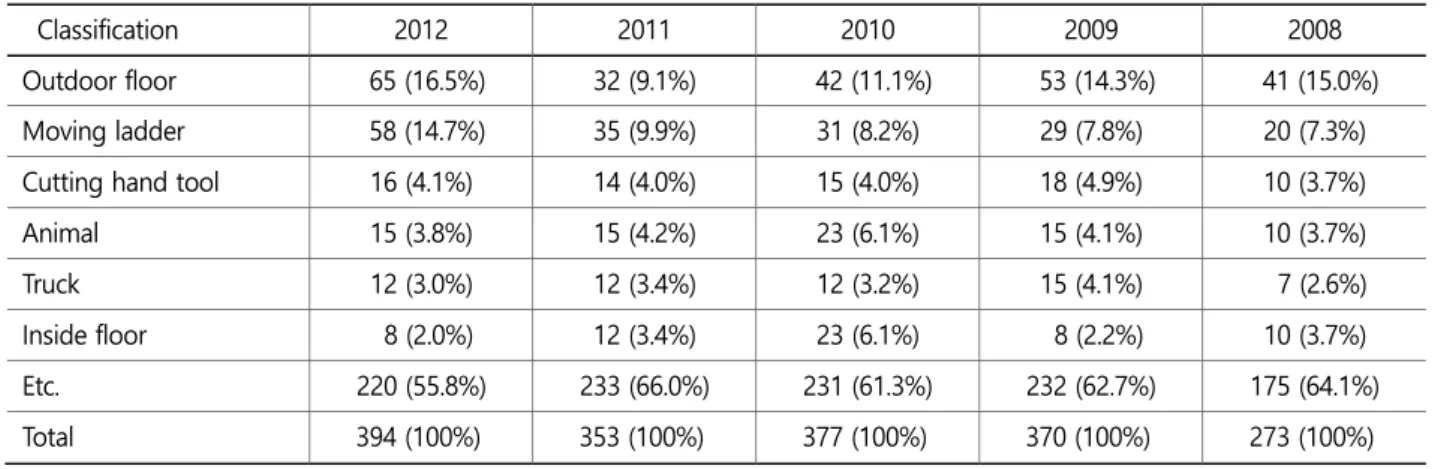
The result of an analysis on aging workers' industrial injuries by source of industrial injury in the workplaces in agriculture for recent five years (2008~2012) is shown in Table 9. Industrial injuries caused by outdoor floor accounted for the most at 16.5%, followed by 14.7% due to a moving ladder and 4.1% due to a cutting hand tool in 2012. The reason why many industrial injuries occurred due to outdoor floor and moving ladders is that outdoor working accounts for many cases in view of agricultural characteristics and the aging workers' equilibrium ability and muscle control ability are lower than those of younger workers.
Therefore the aging workers easily fall or slip. To prevent aging workers’ industrial injuries due to source of industrial injury, the development of training and equipment suitable for agricultural environment is necessary by examining the characteristics of the source of industrial injury.
Table 8. The number of industrial injuries by accident type
Classification 2012 2011 2010 2009 2008
Fall 103 (26.1%) 83 (23.5%) 66 (17.5%) 58 (15.7%) 45 (16.5%)
Slip 93 (23.6%) 97 (27.5%) 113 (30.0%) 110 (29.7%) 75 (27.5%)
Narrowness 37 (9.4%) 39 (11.0%) 33 (8.8%) 53 (14.3%) 40 (14.7%)
Work-Related disease 24 (6.1%) 14 (4.0%) 12 (3.2%) 13 (3.5%) 13 (4.8%)
Traffic accident 21 (5.3%) 14 (4.0%) 12 (3.2%) 13 (3.5%) 13 (4.8%)
Cut 19 (4.8%) 18 (5.1%) 17 (4.5%) 23 (6.2%) 15 (5.5%)
Collision 17 (4.3%) 22 (6.2%) 30 (8.0%) 22 (5.9%) 22 (8.1%)
Injury by animal 17 (4.3%) 14 (4.0%) 19 (5.0%) 12 (3.2%) 6 (2.2%)
Etc. 63 (16.0%) 59 (16.7%) 70 (18.6%) 63 (17.0%) 43 (15.8%)
Total 603 (100%) 575 (100%) 645 (100%) 620 (100%) 527 (100%)
Table 9. The number of industrial injuries by source of industrial injury
Classification 2012 2011 2010 2009 2008
Outdoor floor 65 (16.5%) 32 (9.1%) 42 (11.1%) 53 (14.3%) 41 (15.0%)
Moving ladder 58 (14.7%) 35 (9.9%) 31 (8.2%) 29 (7.8%) 20 (7.3%)
Cutting hand tool 16 (4.1%) 14 (4.0%) 15 (4.0%) 18 (4.9%) 10 (3.7%)
Animal 15 (3.8%) 15 (4.2%) 23 (6.1%) 15 (4.1%) 10 (3.7%)
Truck 12 (3.0%) 12 (3.4%) 12 (3.2%) 15 (4.1%) 7 (2.6%)
Inside floor 8 (2.0%) 12 (3.4%) 23 (6.1%) 8 (2.2%) 10 (3.7%)
Etc. 220 (55.8%) 233 (66.0%) 231 (61.3%) 232 (62.7%) 175 (64.1%)
Total 394 (100%) 353 (100%) 377 (100%) 370 (100%) 273 (100%)
4. Conclusion
This paper analyzed 1,767 cases of aging workers' industrial injuries that occurred in agriculture for recent five years (2008~2012) and the characteristics of aging workers' industrial injuries occurring in agriculture. The study results are as follows:
1) The aging workers' industrial injuries in agriculture account for more than 50% each year and they are on the rise annually.
2) 89.8% of aging workers' industrial injuries occurs in the small scale companies with less than 50 employees in agriculture.
Also, most industrial injuries occur within six months of employment of the aging workers.
3) The ratio of female aging workers' industrial injuries is 46.7% in the workplaces in agriculture, which is very high.
4) As a result of an analysis on aging workers' industrial injuries by accident type, the fall and slip were 26.1% and 23.6% respectively.
5) As a result of an analysis on aging workers' industrial injuries by source of industrial injury, the injuries through outdoor floor and moving ladders were 16.5% and 14.7% respectively.
To reduce the aging workers' industrial injuries in agriculture each year, studies on the characteristics of aging workers and adaptation to new work are necessary. The research in the segmented field is necessary with more data in the future. The aging workers' industrial injury characteristics in agriculture investigated through this study are judged to be helpful to devising effective measures to prevent aging workers' industrial injuries. In addition, safety training should be emphasized in consideration of aging workers' characteristics.
Acknowledgements
This work was supported by Dong-eui University Foundation Grant (2013).
References
Choi, D.W., Accident Characteristics and Safety Measures for Aging Workers in Korea, Seoul National University of Science and Technology, 2013.
Jang, S.R. and Kim, E.A., "A Study on Safety Management for Aging Society", Journal of Korean Society of Safety, 22(5), 201-208, 2002.
Kim, Y.C., "Analysis of Injury Characteristics of Elderly Workers in Small Manufacturing Factory", Journal of Korean Society of Safety, 14(3), 163-167, 1999.
Kim, Y.C., "A Survey on Ergonomic Evaluation Methods of Agricultural Work for Preventing WMSDs", Journal of Ergonomics Society of Korea, 30(4), 465-472, 2011.
Kim, Y.C., Kim, D.S., Park, K.H., Seo, D.H and, Lee, K.S., "A Study on Analysis of the Industrial Injury Characteristics in the Agriculture", Journal Article of Conference, Ergonomics Society of Korea, 2013.
Kim, Y.S., Kim, B.H. and Kim, H.M., "A Study on Occupational Accident of Older Workers and Vulnerable Working Condition", Journal of Health and Social Science, 35, 309-329, 2014.
Korea Occupational Safety & Health Agency, Occupational Safety & Health Research Institute, A Study on Industrial Injury Characteristics of Aging Workers and Management Plan of Safety/Health, 2006.
Korea Occupational Safety & Health Agency, Occupational Safety & Health Research Institute, Safety and Health of Aging Workers, 2006.
Korea Occupational Safety & Health Agency, Occupational Safety & Health Research Institute, A Study on Analysis of Current State and cause of Industrial Injury in Workplace, 2012.
Liira, J.E., Matikainen, H., Rytkonen, P., Mutanen, P., Leino-Arjas, P. and Juntunen, J., "Work ability of middle-aged Finnish construction workers-a follow-up study in 1991-1995", Conference of IEA, 1997.
Ministry of Employment and Labor,
2008 industrial accident examination
, 2009.Ministry of Employment and Labor,
2009 industrial accident examination
, 2010.Ministry of Employment and Labor,
2010 industrial accident examination
, 2011.Ministry of Employment and Labor,
2011 industrial accident examination
, 2012.Ministry of Employment and Labor,
2012 industrial accident examination
, 2013.Nicoletti, C. and Peracchi, F., "Aging in Europe: What can we learn from the Europanel?.", Pensions: More Information, Less Ideology, 153-187, Kluwer Academic Publisher, 2001.
Statistics Korea,
2013 Census of Agriculture, Forestry and Fisheries
, 2014.Yoon, J.H., Jang, S.R. and Lim, H.K., "A Study on Policy of Preventing Industrial Injury for Aging Workers According to the Industrial Injury Occur",
Proceeding of the 2008 Spring Conference of the Ergonomics Society of Korea, 8-11,
2008.Author listings
Yuchang Kim: [email protected]
Highest degree: Ph.D., Department of Industrial Engineering, KAIST
Position title: Professor, Department of Industrial Management Engineering, Dong-eui University Areas of interest: Ergonomics, Industrial Safety, WMSDs, Job Stress, Human Error
Daesu Kim: [email protected]
Highest degree: Ms, Department of Industrial Management Engineering, Dong-eui University Position title: Ph.D. course, Department of Industrial Management Engineering, Dong-eui University Areas of interest: Ergonomics, Industrial Safety, WMSDs, Job Stress, Human Error
Kyunghwan Park: [email protected]
Highest degree: Department of Industrial Management Engineering, Dong-eui University
Position title: Master candidate, Department of Industrial Management Engineering, Dong-eui University Areas of interest: Ergonomics, Industrial Safety, WMSDs, Job Stress, Human Error
Daesik Kim: [email protected]
Highest degree: Ms, Department of Industrial Management Engineering, Dong-eui University Position title: Ph.D. course, Department of Industrial Management Engineering, Dong-eui University Areas of interest: Ergonomics, Industrial Safety, WMSDs, Job Stress, Human Error