- 945 -
풍력발전 시스템용 새로운 형상의 축방향 자속형 스위치드 릴럭턴스 발전기 설계와 특성해석
강선일*, 오주환**, 권병일*
한양대학교*,대성전기 기술연구소**
Design and characteristics analysis of novel transverse flux switched reluctance generator for wind turbine
Sun-il Kang*, Ju-hwan Oh**, Byung-il Kwon*
DEPARTMENT OF MECHATRONICS ENGINEERING, Hanyang University*, Daesung co. research center**
Abstract - This paper presents design and characteristics analysis of transverse flux switched reluctance generator(TFSRG) for wind turbine. Dimension is calculated by using output equation and maximum magnetomotive force(mmf) equation per pole. Design specification within effective range of mechanical and electrical energy is suggested in order to perform the analysis. it is confirmed to torque, inductance and induced electromotive force(emf) for one phase through three dimension Finite Element Analysis. Then design specification can be verified by comparing with proposed specification.
1. INTRODUCTION
Gearbox is usually used to increase output power of wind power generation system. But there are disadvantages like heavier weight and expensive price. So recently, direct-drive generator concepts for wind turbines is more required to solve the disadvantages.
Switched Reluctance Generator(SRG) of direct-drive generator system types is being actively researched. [1] Winding of the SRG/SRM is only wound on stator for concentrated winding. And the rotor is produced only core. Therefore the machine has advantages which are simple structure, cheaper price and high power density due to large rate of torque/inertia. But despite these advantages, the SRG/SRM is hardly used in Wind Turbine because of developing high efficiency permanent magnet generator.[2]
Although we need to research TFSRG having advantages that flux path of TFSRG is shorter than existing RFSRG(Radial Flux Switched Reluctance Generator) and the TFSRG can increase high efficiency for no overhang of coil. Design and Analysis of TFSRG barely exist presently. [3]
Therefore this paper explains design structure and characteristic analysis of three phase TFSRG for wind turbine with stator core along the central axial. The feature of stator core along the central axial which has flux along the central axial do not need to laminate along the axial like Radial Flux types. It means TFSRG can have more poles. Then it can have larger MMF. And due to toroidal winding, it has shorter length of a turn than usual RFSRG.
As coil volume is also minimized, therefore there are advantages which are no end winding and its loss too. [4] And each misaligned stator is also designed likely skew in order to reduce torque ripple and compose three phase. In order to analyze this shape proceeds design verification and characteristic analysis by using 3D finite element method analysis.
2. DESIGN AND CHARACTERISTIC ANALYSIS OF TFSRG
2.1 THE STRUCTURE AND SHAPE
Fig. 1 depicts the structure of 3kW TFSRG. Proposed design structure is three phase stator and rotor which are 24poles each.
And one of the one phase stator including tooth toward rotor is designed like Fig.1(b). 24 shapes of one phase stator is arranged in a circle and each phase is misaligned with 5 degree difference.
The rotor is straight along axial inside to the stator. Machines of this type is laminated toward radial direction. Flux which flows
along axial direction is caused shorter flux path than exiting RFSRM that flux flows along radial direction. Therefore the machine can be reduced core loss. It can be also reduced copper loss as there is no end-winding. Due to these two advantages, TFSRG can get high efficiency than RFSRG.
Table. 1 shows specification and design dimensions of the machine.
(a) Whole of Generator (b) stator
<Fig 1> The structure of TFSRG
<Fig 2> Flux path of TFSRG
2.2 DESIGN THE STRUCTURE OF TFSRG
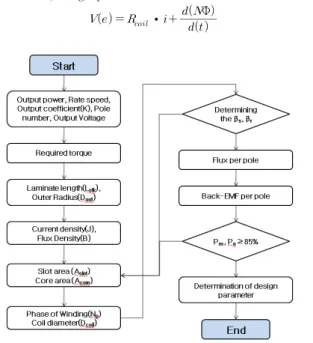
Basic outer dimension of TFSRG is decided by using output equation(1).
⨉
∙
(1) Where diameter of rotor(Dr) is same one of TFSRG and stack length(Lstk) is thickness of rotor. Equation(2) is for maximum mmf per pole.
∙
(2)
Where maximum/average ratio of mechanical output and electrical
output is defined about 2.25 and flux density(Bs) is 1.7T. After
consider maximum/average ratio to calculate maximum mmf per
pole, we can also calculate effective mmf per pole. If slot fill factor
is assumed 90%, cross sectional area of winding, turns per pole
and diameter of coil can be obtained. And considering mechanical
output and flux density from equation (2), cross sectional area of
core can be calculated too. Inner dimension of TFSRG is obtained
by considering the area of winding and core, pole arc of stator
and rotor considering inductance of proposed structure. Induced
emf and flux per pole can be decided from magnetic circuit and
voltage equation (3). And, when electric output obtained by
2011년도 대한전기학회 하계학술대회 논문집 2011. 7. 20 - 22