• 검색 결과가 없습니다.

Preoperative arterial embolization of heterotopic ossification around the hip joint

N/A
N/A
Protected

Academic year: 2021

Share "Preoperative arterial embolization of heterotopic ossification around the hip joint"

Copied!
5
0
0

로드 중.... (전체 텍스트 보기)

전체 글

(1)

Yeungnam Univ J Med 2018;35(1):130-134

Preoperative arterial embolization of heterotopic ossification around the hip joint

Jin Hyeok Kim

1

, Chankue Park

1

, Seung Min Son

2

, Won Chul Shin

2

, Joo Yeon Jang

1

, Hee Seok Jeong

1

, In Sook Lee

3

, Tae Young Moon

1

Departments of

1

Radiology and

2

Orthopedic Surgery, Pusan National University Yangsan Hospital, Yangsan;

3

Department of Radiology, Pusan National University Hospital, Busan, Korea

Heterotopic ossification (HO) around the hip joint is not uncommon following neurological injury. Often, sur- gical treatment is performed in patients with restricted motion and/or refractory pain due to grade III or IV HO according to Brooker classification. The major complication that occurs as a result of surgical HO removal is perioperative bleeding due to hyper-vascularization of the lesion. Here, we report a case of preoperative embolization in a 51-year-old male patient presenting with restricted bilateral hip range of motion (ROM) due to HO following a spinal cord injury. In the right hip without preoperative arterial embolization, massive blee- ding occurred during surgical removal of HO. Thus, the patient received a transfusion postoperatively due to decreased serum hemoglobin levels. For surgery of the left hip, preoperative embolization of the arteries supplying HO was performed. Surgical treatment was completed without bleeding complications, and the patient recovered without a postoperative transfusion. This case highlights that, while completing surgical removal for ROM improvements, orthopedic surgeons should consider preoperative arterial embolization in patients with hip HO.

Keywords: Hip; Heterotopic ossification; Arterial embolization; Gelatin sponge

Copyright ©2018 Yeungnam University College of Medicine

This is an Open Access article distributed under the terms of the Creative Commons Attribution Non-Commercial License (http://creative- commons.org/licenses/by-nc/4.0/) which permits unrestricted non-commercial use, distribution, and reproduction in any medium, provided the original work is properly cited.

Received: April 18, 2018, Revised: May 18, 2018 Accepted: May 21, 2018

Corresponding Author: Chankue Park, Department of Radiology, Pusan National University Yangsan Hospital, 20, Geumo-ro, Mulgeum-eup, Yangsan 50612, Korea Tel: +82-55-360-1840, Fax: +82-55-360-1848

E-mail: [email protected]

INTRODUCTION

Heterotopic ossification (HO) is defined as the abnormal formation of mature trabecular bone in extraskeletal soft tissues. It is not uncommon complication following trauma, surgery, neurological injury, and severe burns [1,2]. The hip is the most common site of HO, followed by the elbow, knee, and shoulder [3,4]. HO manifests in various manners, from islands of the bone within the soft tissues about the hip, to

apparent hip bone ankylosis. Although small foci of HO are not clinically significant, surgical treatment is sometimes re- quired in patients presenting with restricted motion or refrac- tory pain due to extensive HO [5]. Surgical excision of HO is challenging to surgeons for several important reasons. Pro- per timing of surgical intervention must be considered, exci- sion is a difficult technique, and HO has a possibility of re- currence. Furthermore, due to hypervascularization of HO and adhesion between the HO and the surrounding soft tis- sues, intra- and post-operative bleeding are major potential complications [6,7].

We report a case of preoperative arterial embolization of

HO in a patient presenting with restricted bilateral hip range

of motion (ROM). This case highlights that preoperative arte-

rial embolization is useful to reduce intra- and post-operative

bleeding complications if patients with hip joint HO require

(2)

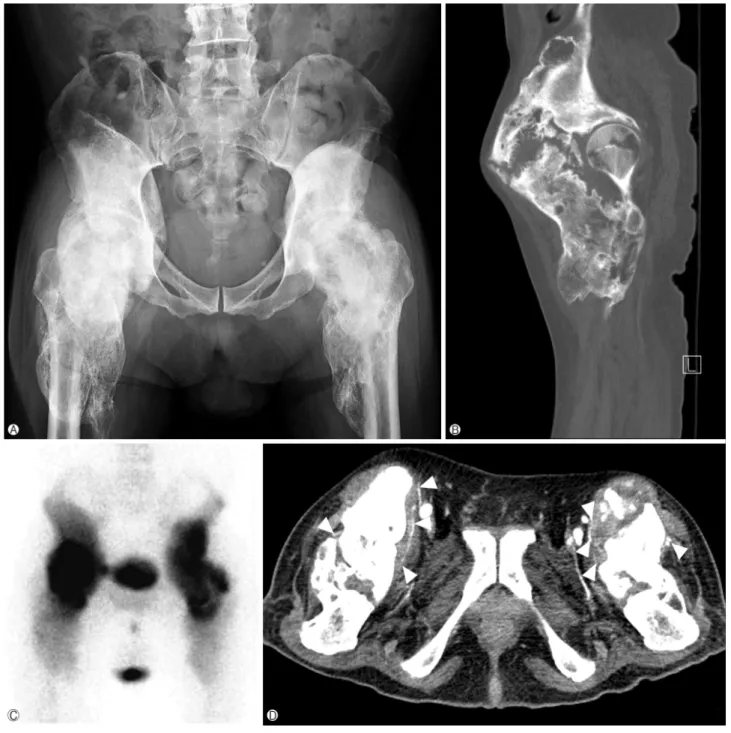
Fig. 1. (A) Pelvis anteroposterior radiograph shows diffuse heterotopic ossification around both hip joints. (B) Sagittal reconstruction computed tomography (CT) image shows nearly complete bone ankylosis of the left hip joint, causing total stiffness of the hip joint. (C) Technetium 99m-methyl diphosphonate bone scan shows intense uptake in bilateral hip joints. (D) Preoperative axial CT with contrast enhancement shows hypertrophied arteries (arrowheads) supplying the heterotopic bone formation around the bilateral hip joints.

HO removal for improvements in their ROM.

CASE

The patient and his family were informed that this case would be submitted for publication. A 51-year-old man visited

the hospital for progressively restricted hip motion. He expe-

rienced difficulties achieving proper seated posture due to

severe restricted ROM of the hip, and presented with severe

hip pain. He was in a paraplegic state due to T11 cord injury

following a fall 10 months ago. On physical examination,

he showed 30° of flexion contracture in both hip joints, and

(3)

Fig. 3. (A) Gross specimen showing multiple bone fragments with hemorrhage. (B) Passive flexion of the left hip joint was available after surgical removal of heterotopic ossification. (C) Immediate postoperative pelvis anteroposterior radiograph shows a decreased extent of heterotopic ossification compared with that in the preoperative pelvic radiograph.

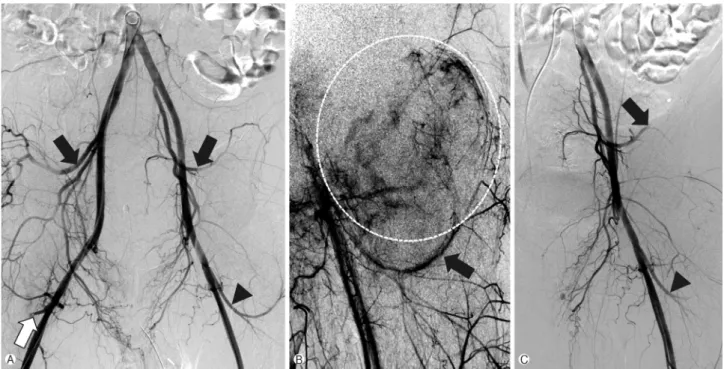
Fig. 2. (A) Common iliac arteriogram reveals hypertrophied bilateral superior gluteal arteries (black arrows), left lateral circumflex femoral artery (arrowhead), and the stump of right lateral circumflex femoral artery (white arrow), which was ligated during the previous surgery. (B) External iliac angiography demonstrates hypertrophied left lateral circumflex femoral artery (arrow) and diffuse hypervas- cular area involving the left hip joint (dashed circle). Note that the left lateral circumflex femoral artery arises from common femoral artery, as a normal anatomical variant. (C) Angiography obtained after embolization with gelatin sponge slurry shows decreased vascular flow in the left superior gluteal artery (arrow) and lateral circumflex femoral artery (arrowhead).

no further degree of ROM. The patient underwent radiologic and laboratory evaluations. Pelvic anteroposterior radiography and hip computed tomography (CT) showed massive hetero- topic bone formation around bilateral hip joints and apparent bone ankylosis of the joints (Fig. 1A, 1B). Scintigraphic bone scan showed increased uptake in bilateral hip joints, sugges- ting active lesion (Fig. 1C). Serum alkaline phosphatase (ALP) levels were measured as 329 IU/L (range, 30-120 IU/L). Serum

ALP levels were measured during follow-up outpatient appo-

intments until the HO matured. During the 1-year follow up,

ALP levels fell within the normal range, and the patient de-

cided to undergo surgery for persistent hip contracture and

limited ambulation necessitating wheelchair usage. Preopera-

tive CT with contrast enhancement showed heterotopic bone

formation in both hip areas. Hypertrophied bilateral superior

gluteal and lateral circumflex arteries supplying the hetero-

(4)

topic bone formation around the bilateral hip joints were also visualized (Fig. 1D). The surgeon planned a two-step sur- gery for heterotopic bone formation removal: the right side first, followed by the left side.

In the surgery around the right hip joint, it was difficult to detect the right lateral femoral circumflex artery due to bleeding and severe adhesion between the heterotopic bone formation and the surrounding soft tissue. Rupture of the right lateral circumflex femoral artery and subsequent massive blee- ding occurred. Ligation of the ruptured right lateral circumflex artery was performed, and surgery was finished after partial resection of the soft tissue bone formation. A preoperative he- moglobin concentration of 14.4 g/dL (hematocrit 40.4%) de- creased to 10.7 g/dL (hematocrit 30.6%) on postoperative day 1, 9.5 g/dL (hematocrit 27.6%) on postoperative day 2, and 8.3 g/dL (hematocrit 23.9%) on postoperative day 3. Two units of whole blood were administered to the patient, and the value increased to 11.0 g/dL (hematocrit 32.0%) on postoperative day 7.

Contrary to the right hip surgery, preoperative arterial em- bolization around the left hip joint was planned to prevent perioperative blood loss. Bilateral common iliac angiogra- phy, performed by puncturing the right femoral artery using the Seldinger method (a standard transfemoral approach) sho- wed hypertrophied bilateral superior gluteal arteries, a hyper- trophied left lateral circumflex femoral artery, and a stump of the ligated right lateral circumflex femoral artery (Fig. 2A).

On selective left external iliac angiography, a hypertrophied left lateral circumflex femoral artery and diffuse hypervascular area involving the left hip joint area were observed (Fig. 2B).

After selection of the left lateral circumflex femoral artery and left superior gluteal artery using a microcatheter (Rene- gade, Boston Scientific, Natick, MA, USA), embolization was performed with a gelatin sponge called a gelfoam (Cutan- plast, CureSys, Seoul, Korea). The gelatin sponge slurry was created by forcefully mixing small gelatin sponge particles with a solution of contrast material. Postembolization exter- nal iliac angiography revealed decreased vascular flow in the left lateral circumflex femoral artery and superior gluteal ar- tery supplying the heterotopic bone formation around the left hip joint (Fig. 2C). The patient was observed 6 hours post-in- tervention and did not have any complications. On the next day, surgical removal of the heterotopic bone formation was successfully performed without massive bleeding and ended

after confirmation of 100 degrees of left hip joint flexion by checking the intraoperative hip ROM(Fig. 3). Total surgery time of the right and left hips was 2 hours 40 minutes, and 2 hours, respectively. Blood loss of the right and left hip was 1,500 mL and 500 mL, respectively. Intraoperative trans- fusion was not performed in either right or left hip surgeries.

On postoperative day 3 of the left hip, the preoperative he- moglobin value of 11.0 g/dL (hematocrit 32.0%) reached a minimum value of 9.3 g/dL (hematocrit 27.4%), but recovered to 10.6 g/dL (hematocrit 33.0%) without transfusion. Patho- logy confirmed bone formation around both hip joints as HO.

A drainage catheter in the operated site was removed, and the patient began rehabilitation exercises, including continuous passive motion, on postoperative day 1. He was administered single radiation therapy of 800 Gy to the operated site, and started to take celecoxib 200 mg orally one time per day for a total of 6 weeks for prophylaxis of HO recurrence. He has been able to ambulate in a wheelchair without pain after sur- gery, and HO has yet to recur.

DISCUSSION

The hip region is the most common site of HO, a common complication (0-44% without prophylaxis) after hip arthro- scopy [3,4]. Although HO is usually asymptomatic, grade III or IV HO of Brooker classification around a joint signifi- cantly limits joint function, and may require a surgical treat- ment [5,8,9].

HO is initiated by local tissue damage, leading to increased bone morphogenic protein 2 targeting of the sensory nerves [10]. Subsequently, a cascade of molecular mechanisms indu- ces peripheral nerve remodeling [7]. The production of chon- dro-osseous, glial, vascular, and neural progenitor cells follo- wing the remolding induces vascularization, and increases lev- els of vascular endothelial growth factor that promotes vessel formation [6,7]. Due to the increased vascularization, bleeding is a major peri- and post-operative complication.

Preoperative transcatheter arterial embolization of hyper- vascular lesions is commonly performed to decrease blood loss during surgery, improve visualization of the surgical field, and shorten operative time [11,12]. Embolic materials are se- lected according to target vessel size and occlusion duration.

A gelatin sponge is the most widely used absorptive tempo-

rary embolic agent, typically lasting 3-6 weeks of vascular

(5)

occlusion. It is inexpensive, easy to use with a microcatheter, and can be modified depending on target vessel size [12,13].

By performing preoperative embolization with a gelatin sponge slurry, ischemia to other areas that are supplied by the same feeding arteries of the HO can be minimized by expecting recanalization of the occluded vessel after surgery.

Preoperative arterial embolization using a gelatin sponge may be useful for surgical removal of extensive HO in the hip joint area. Its purpose is to decrease blood loss, improve visualization of surgical field, and shorten operative time.

CONFLICT OF INTEREST

No potential conflict of interest relevant to this article was reported.

ORCID

Jin Hyeok Kim, https://orcid.org/0000-0001-6703-2419 Chankue Park, https://orcid.org/0000-0003-2937-114X

REFERENCES

1. Clements NC Jr, Camilli AE. Heterotopic ossification compli- cating critical illness. Chest 1993;104:1526-8.

2. Hannallah D, Peng H, Young B, Usas A, Gearhart B, Huard J. Retroviral delivery of Noggin inhibits the formation of het- erotopic ossification induced by BMP-4, demineralized bone

matrix, and trauma in an animal model. J Bone Joint Surg Am 2004;86:80-91.

3. Almangour W, Schnitzler A, Salga M, Debaud C, Denormandie P, Genêt F. Recurrence of heterotopic ossification after remo- val in patients with traumatic brain injury: a systematic review.

Ann Phys Rehabil Med 2016;59:263-9.

4. Bedi A, Zbeda RM, Bueno VF, Downie B, Dolan M, Kelly BT. The incidence of heterotopic ossification after hip arthro- scopy. Am J Sports Med 2012;40:854-63.

5. Board TN, Karva A, Board RE, Gambhir AK, Porter ML.

The prophylaxis and treatment of heterotopic ossification fol- lowing lower limb arthroplasty. J Bone Joint Surg Br 2007;

89:434-40.

6. Dilling CF, Wada AM, Lazard ZW, Salisbury EA, Gannon FH, Vadakkan TJ, et al. Vessel formation is induced prior to the appearance of cartilage in BMP-2-mediated heterotopic ossification. J Bone Miner Res 2010;25:1147-56.

7. Reichel LM, Salisbury E, Moustoukas MJ, Davis AR, Olmsted- Davis E. Molecular mechanisms of heterotopic ossification.

J Hand Surg Am 2014;39:563-6.

8. Warren SB, Brooker AF Jr. Intramedullary nailing of tibial nonunions. Clin Orthop Relat Res 1992;285:236-43.

9. Baird EO, Kang QK. Prophylaxis of heterotopic ossification - an updated review. J Orthop Surg Res 2009;4:12.

10. Salisbury E, Rodenberg E, Sonnet C, Hipp J, Gannon FH, Vadakkan TJ, et al. Sensory nerve induced inflammation con- tributes to heterotopic ossification. J Cell Biochem 2011;112:

2748-58.

11. Rilling WS, Chen GW. Preoperative embolization. Semin Intervent Radiol 2004;21:3-9.

12. Vogl TJ, Wolff JD, Balzer J, Skripitz R. Preoperative arterial embolization in heterotopic ossification: a case report. Eur Radiol 2001;11:962-4.

13. Medsinge A, Zajko A, Orons P, Amesur N, Santos E. A case- based approach to common embolization agents used in vas- cular interventional radiology. AJR Am J Roentgenol 2014;

203:699-708.

수치

Fig. 1. (A) Pelvis anteroposterior radiograph shows diffuse heterotopic ossification around both hip joints
Fig. 3.  (A) Gross specimen showing multiple bone fragments with hemorrhage. (B) Passive flexion of the left hip joint was available after surgical removal of heterotopic ossification

참조

관련 문서

(C-D) The hip anterioposterior and lateral radiograph shows bone ingrowth without subsidence or osteolysis after 62 months follow up after

The average position of the posterior superior alveolar artery, the wall thickness of the lateral wall, and the average volume of the maxillary sinus will

Increased immunolocalization was observed in the stratum lacunosum-moleculare (black arrows in B and C) and in stratum pyramidale (white arrows in G and

Table 2. Schatzker and Lambert assessment --- 18.. A), B) Preoperative anteroposterior and lateral radiograph of the left knee of a sixty-two-year-old man who

A,B Gradual lengthening with external fixator, C,D Lateral angulation of 4th metatarsal bone and 4th MTP joint subluxation, valgus deformity of 4th toe, E,F Corrective

The lateral size of the defect obtained from the deformation amount and the defect detection test using the shearing interferometer, width and depth of

Preoperative evaluation of pelvic lateral lymph node of patients with lower rectal cancer: comparison study of MR imaging and CT in 53 patients?.

core exercise program showed not only increasing peak torque of the right leg, left leg in Hip Extension of exercise group but also increasing peak torque of the right leg, left