Abstract (J. Kor. Oral Maxillofac. Surg. 2009;35:426-430)
Ⅰ.
서 론구강 내 소수술을 받기 위하여 내원하는 환자 중 항혈소 판제(anti-platelet)를 복용하고 있어 협의진료를 의뢰하는 사례가 많다. 이전에는 수술 시 발생할 수 있는 출혈의 위 험을 예방하기 위해 항혈소판제 중단을 위한 협의진료를 의뢰가 관행적으로 이루어져 왔다. 그러나 이러한 경우 협 의진료를 위해 심장내과를 재방문 해야 하는 상황에 불만 을 품는 환자가 적지 않으며, 협의진료 필요 여부에 대하여 임상에 적용할만한 체계화된 기준이 없는 실정이다.
항응고제를 복용하는 환자들은 자신의 의과적 병력과 협 의진료의 필요성을 잘 인지하고 있는 경우가 많다. 그러나
항혈소판제를 복용하는 외과적 수술 후의 출혈 위험성에 대해 인지하지 못하고 있는 경우가 많고, 심지어 자신이 항 혈소판제를 투약하고 있는지의 여부를 모르는 경우도 있 다. 이러한 환자들은 협의진료의 필요성에 대하여 설명하 고 설득시키는 데에 어려움이 따른다.
이러한 환자들에게 자주 쓰이는 항혈소판제로는 아세틸 살리실산 (Acetyl salicylic acid (ASA): Aspirin
�, Astrix
�, Rhonal
�)과 클로피도그렐 (Clopidogrel : Plavix
�, Plavitor
�, Platless
�), 트리플루살 (Triflusal : Disgren
�) 등이 있다.
항혈소판제를 복용하는 환자의 경우 항응고제(anticoagu- lant : warfarin, Coumadin
�)를 복용하는 환자에 비하여 심각 한 출혈 발생의 위험성은 적지만
1), 수술 후 출혈 시간이 지 연될 수 있다. 아세틸살리실산을 복용하는 환자의 약
20~25%에서 출혈 시간을 증가된다
2). 클로피도그렐을 복용
하는 환자의 수술 후 출혈에 대하여서는 보고된 바가 별로 없으나, 임상적으로 아세틸살리실산보다 출혈 위험이 높 지는 않다고 여겨진다
3). 트리플루살을 복용하는 환자는 아 세틸살리실산을 복용하는 환자에 비해 출혈의 위험은 유 의성 있게 적다고 보고되어 있다
4).
김 형 준
120-752
서울특별시 서대문구 성산로250
연세대학교 치과대학 구강악안면외과학교실 Hyung Jun Kim
Dept. of OMFS, College of Dentistry, Yonsei univ.
#250 Seongsanno, Sedaemun-gu, Seoul, 120-752, Korea.
Tel: 82-2-2228-3130 Fax: 82-2-364-0992 E-mail: [email protected]
항혈소판제 복용 환자의 구강 내 소수술 전 처치에 대한 제안
최지욱∙최세경∙김남균∙최의영*∙차인호∙김형준
연세대학교 치과대학 구강악안면외과학 교실, *연세대학교 의과대학 내과학 교실
PROPOSAL FOR PRETREATMENT OF PATIENTS IN ANTIPLATELET THERAPY REQUIRING MINOR ORAL SURGERY
Ji-wook Choi, Se-Kyung Choi, Nam-kyun Kim, Eui young Choi*, In-Ho Cha, Hyung Jun Kim Department of Oral and Maxillofacial Surgery, College of Dentistry, Yonsei University,
*Department of Internal medicine, College of Medicine, Yonsei University
Purpose: Many patients in anti-platelet therapy have been consulted for bleeding risks before minor oral surgery. However, there has not been an established pretreatment protocol for treating these patients. The purpose of this study is to make a protocol for the preoperative management for patients in anti-platelet therapy.
Patients and Methods: The existed consultation pattern of patients was examined in the Department of Oral and Maxillofacial Surgery, Yonsei Dental Hospital. Based on the observation, a protocol including classification of medical status of patients and the type of oral surgery in need was introduced. This protocol had been performed for 6 months.
Result: Following this protocol, the frequency of consultation for bleeding risk was decreased. The number of minor oral surgeries with concurrent anti-platelet therapy was increased. There was no severe bleeding event observed among minor oral surgeries that were performed while maintaining anti-platelet therapy.
Conclusion: This protocol can be used as a guideline for clinical practice of patients in anti-platelet therapy requiring minor oral surgery.
Key words: anti-platelet therapy, surgery, bleeding, aspirin, consultation
[원고접수일 2009. 9. 16 / 1차수정일 2009. 9. 30 / 2차수정일 2009. 10. 7 / 게재확정일 2009. 10. 19]
경피적 관상동맥 확장술 (PTCA : percutaneous translumi- nal coronary angioplasty) 등을 시행받은 환자는 아세틸살리 실산과 클로피도그렐을 동시에 사용하는 이중 항혈소판치 료 (dual-antiplatelet therapy)를 받고 있는 경우가 많으며, 이 러한 경우 한 가지의 약물만 사용할 때보다 출혈의 위험성 이 커진다.
최근의 문헌들은 항혈소판제는 유지하며 발치하는 것을 권장하고 있다. 항혈소판제를 유지하며 발치 후 문제가 될 정도의 출혈이 발생하는 경우는 드물게 보고되고 있고, 출 혈이 발생하더라도 국소적으로 조절 가능한 경우가 대부 분이며 치명적이지 않지만, 항혈소판제의 중단으로 인한 혈전증은 발생 빈도는 적지만 발생하는 경우 치명적인 결 과를 낳기 때문이다
6-12).
이에 저자들은 연세대학교 치과대학병원 구강악안면외 과 외래에 내원하는 항혈소판제 복용 환자의 협의진료 현 황을 조사하였다. 그리고 문헌 고찰 및 심장내과의 의견을 종합하여 항혈소판제 복용환자의 협의진료 기준을 세워 이를 임상에 적용한 결과를 보고하는 바이다.
Ⅱ.
연구대상 및 방법기존의 협의진료 상황을 파악하기 위하여 2007년 6월부 터 11월까지 6개월 간 연세대학교 치과대학병원 구강악안 면외과 외래에 내원한 환자의 협의진료 기록을 조사하였 다. 일반 진료 초진으로 내원한 3282명의 환자 중 의과적 협의진료를 시행한 60례를 대상으로 하였다.
그리고 심장내과에서 받은 항혈소판제 중단기준과 본과 에서 출혈 경향을 분류한 목록을 바탕으로 항혈소판제를 복용하는 환자에 대한 새로운 협의진료 절차를 구성하였 다.
새로운 협의진료 절차를 바탕으로 6개월 간 시행한 협의 진료 내용을 조사하여 기존의 경향과 비교하였다. 2008년 1월부터 6월까지 6개월 간 일반 진료 초진으로 내원하여 의과적 협의진료를 시행한 80례를 대상으로 시행하였다.
Ⅲ.
결 과항혈소판제 복용 환자에 대한 새로운 협의 진료 절차를 시행하기 전 6개월 간의 협의진료 현황은 Table 1과 같다.
협의진료를 시행한 환자들은 29~86세의 연령 분포를 보였 다. 이중 심장내과와의 협의 진료가 60%를 차지하였으며 심장내과의 회신 결과는 Table 2와 같다. 심장내과에 의뢰 한 환자 수의 2/3에 해당하는 24명이 항응고제 또는 항혈소 판제를 복용하고 있었으며 이 중 3명의 환자가 항응고제를 복용 중이었고, 21명의 환자가 항혈소판제를 복용하고 있 었다.
Table 1.
Consultations of patients examined for outpatient care at the Department of Oral and Maxillofacial Surgery at Yonsei Dental Hospital (2007.06~2007.11)Department Number of patient %
Cardiology 36 60
Neurology 6 10
Endocrinology 4 6.67
Nephrology 3 5
Transplant Surgery 3 5
Pulmonology 3 5
Others 5 8.33
Total 60 100
Table 2.
Consultation replies from Cardiology (2007.06~2007.11)Answer Number
% Reason for consultation of Patients
Dental treatment not contraindicated
as patient is not on anticoagulant 12 33.3 Hypertension, Angina pectoris, Arhythmia or antiplatelet therapy
Hypertension, Angina pectoris, Diabetes, Need to discontinue antiplatelet
18 50 Arthrosclerosis, Coronary artery occlusive disease,
agent before minor surgery Atrial fibrillation, Myocardial infarction, Ventricular septal defect, Stroke, Coronary artery bypass surgery, Heart valve surgery, PTCA Need to discontinue anticoagulant
3 8.3 Stroke, Heart valve surgery, PTCA, Pacemaker before minor surgery
Proceed with minor surgery while keeping
2 5.6 PTCA history
patient on dual-antiplatelet therapy Keep patient on dual-antiplatelet
1 2.8 Recent PTCA history
therapy and delay treatment
Total 36 100
구강악안면외과의 수술 종류에 따른 출혈 경향을 Table 3과 같이 분류하였고 연세대학교 세브란스 병원 심장내과 에서 제시한 항혈소판제의 중단기준을 바탕으로 Table 4와 같은 분류를 시행하였다.
상기 자료를 토대로 하여 구강 내 소수술을 위한 협의진 료 기준을 구성하였으며, 이러한 절차를 시행한 후 6개월 간의 협의 진료의 경향의 변화는 Table 5, 6과 같다.
Ⅳ.
고 찰기존의 협의진료 현황을 조사하였을 때, 심장내과와 협 의진료를 시행한 환자 중 58.3%가 항혈소판제를 복용하고 있었다. 이러한 항혈소판제를 복용하는 환자들 중 3명을 제외하고는 항혈소판제 중단 후 발치해도 좋다는 회신을
받았다. 항혈소판제를 중단할 수 없는 3명의 환자는 모두 경피적 관상동맥 확장술을 받았던 병력이 있었으며, 최근 에 시술을 받았던 1명의 환자는 수술의 연기가 필요하였 다.
협의진료를 시행하는 환자의 평균연령은 62.7세의 고령 으로 추가적인 심장내과 내원에 대해 어려움을 느끼는 경 우가 많았으며, 단지 고혈압만을 이유로 이러한 약물을 예 방적으로 복용하기도 하였다.
심장내과에서는 항혈소판제의 중단 시 나타날 수 있는 부작용이 치명적일 수 있으므로 대부분의 환자에서 가능 하다면 항혈소판제의 중단 없이 소수술을 시행하도록 권 고하였다. 만약 클로피도그렐 복용 환자의 경우 중단이 필 요하다면 수술 당일만 중단할 것을 권고하였다.
그리고 다음과 같은 항혈소판제 중단 기준을 제시해 주
Table 3.
Classification of bleeding tendency based on type of minor oral surgeryGroup A Simple extraction of small number of teeth with moderate periodontitis
Group B Multiple simple extractions of teeth with moderate periodontits Group C Multiple simple extractions of teeth with advanced periodontits
Surgical extraction of impacted teeth & supernumerary teeth Alveoloplasty, implant surgery,
Soft tissue surgery : benign tumor excision, vestibuloplasty, removal of epulis fissuratum Intrabony pathology : cyst enucleation, excision of intraosseous benign tumor
Group A : Low bleeding tendency; no need to discontinue antiplatelet therapy
Group B : Moderate bleeding tendency; need to discontinue at least one antiplatlet agent for patients on dual-antiplatelet therapy Group C : High bleeding tendency; bleeding control difficult if minor oral surgery is performed maintaining antiplatelet therapy.
Table 4.
Criteria for discontinuing antibiotic therapy employed by the Department of Cardiology, Severance Hospital at Yonsei UniversityWithin two weeks after balloon angioplasty Class I Within 30 days after insertion of bare metal stent
Within 1 year after insertion of drug eluting stent Class II All Patients who have undergone intervention of coronary
artery except those under Class I Atrial fibrillation
Peripheral arterial disease Class III Coronary artery bypass graft
Stent graft on aorta Prophylactic medication Class I. Need to delay minor oral surgery.
Class II. Continue antiplatelet therapy during minor surgery.
Class III. May discontinue antiplatelet therapy.
Table 5.
Consultations of patients examined for outpa- tient care at the Department of Oral and Maxillofacial Surgery at Yonsei Dental Hospital (2008.01~2008.06)Department Number of patient %
Cardiology 38 47.5
Endocrinology 8 10.0
Neurology 6 7.5
Others 28 35.0
Total 80 100
Table 6.
Consultation replies from Cardiology (2008.01~2008.06)Answer Number
of Patients % No ongoing anticoagulant, antiplatelet therapy
23 60.5
or Discontinue of medication can be possible Maintaining dual-antiplatelet therapy
10 26.3
during minor surgery
Recommend hospitalization for
5 13.2
heparinization & minor surgery
Total 38 100
었다. Balloon을 이용한 혈관성형술을 시행 후 2주 이내의 환자, Bare metal stent 삽입 후 30일 이내의 환자, Drug elut- ing stent 삽입 후 1년 이내의 이중 항혈소판제 치료를 시행 하는 환자는 항혈소판제를 중단해서는 안되며 수술의 연 기가 필요하다. 각각 이 시기가 지난 후에는 ASA 만 유지 하고 발치하여도 좋다. 최근 1달 이내에 불안정형 협심증 과 심근경색 등의 증상이 발생한 급성관상동맥증후군 (acute coronary syndrome) 환자의 경우 항혈소판제를 중단 하면 안 된다.
고혈압만을 이유로 항혈소판제를 복용하는 환자는 5~7 일 전 중단하여도 좋다. 대부분의 심방세동 환자와 말초동 맥폐쇄질환(Peripheral arterial occlusive disease) 환자의 경 우 병변의 중증도마다 다르나 대개 5~7일 전 항혈소판제의 중단이 가능하다.
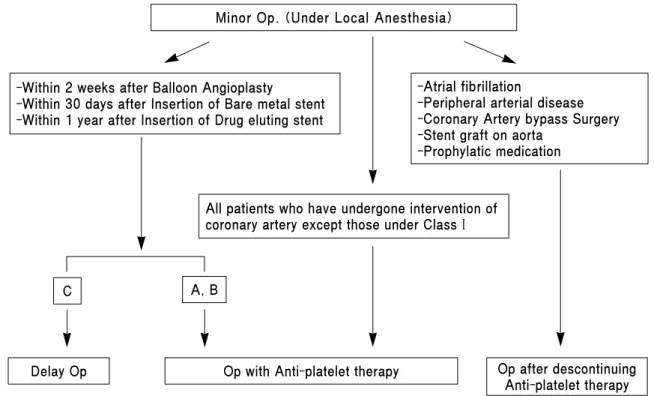
이를 바탕으로 구성한 새로운 항혈소판제 복용 환자에 대한 협의 진료 절차는 Fig. 1과 같다. Balloon을 이용한 혈 관성형술을 시행 후 2주 이내의 환자, Bare metal stent 삽입 후 30일 이내의 환자, Drug eluting stent 삽입 후 1년 이내의 환자에 있어서 Group A, B에 속하는 간단한 발치의 경우 항혈소판제를 유지하며 수술을 진행할 수 있다. 이러한 환 자가 심한 출혈이 예상되는 Group C에 해당하는 수술이 필 요할 경우 수술을 연기한다.
심실세동 환자, 말초 동맥 질환 환자, 관상동맥우회술을 시행받은 환자, Stent 이식술을 대동맥에 시행받은 환자, 일
차예방목적으로 항혈소판제를 복용하는 환자들은 항혈소 판제의 중단이 필요할 경우에 한하여 협의진료 없이 7일간 중단 후 수술을 진행한다.
위의 분류에 속하지 않은 관상동맥 시술을 시행 받은 모 든 환자는 항혈소판제를 유지하며 수술을 진행하는 것을 원칙으로 하였다.
구강악안면외과 외래에서 행해지는 소수술의 경우 항혈 소판제를 복용하는 환자는 병력 정보가 확실하다면 협의 진료를 거치지 않고, Fig. 1의 기준에 따라 항혈소판제 중단 여부를 결정하여 수술을 시행할 수 있도록 하였다. 내과적 치료를 받고 있는 환자가 자신이 투약하고 있는 약물이 무 엇인지 잘 모르는 경우나 구강악안면외과 의사가 환자의 내과적 병력에 따른 항혈소판제제의 중단 여부를 판단하 기 어려운 경우 협의진료를 시행하였다.
외래에는 항혈소판제를 복용하는 환자의 병력정보를 얻 기 위한 설문지와 출혈 가능성에 대한 안내문을 구비하였 다. 만약 환자가 협의진료가 필요함에도 이에 동의하지 않 고 불만을 호소하면 협의진료�없이 항혈소판제를 지속적 으로 복용하도록 하면서 소수술을 진행하기로 하였다. 이 러한 경우 미리 환자에게 출혈가능성에 대해 경고하고 국 소지혈제 사용 가능성 을 설명하였다.
이러한 절차를 시행한 후 전체 협의진료 중 심장내과의 협의진료 비율이 60%에서 47.5%로 감소하였다. 이는 불필 요한 심장내과 협의진료 의뢰가 감소한 결과로 추정할 수
Fig. 1. Pretreatment protocol for treating patients on antiplatelet therapy
*A, B, C indicate Groups A, B, C, respectively, in Table 3.
Minor Op. (Under Local Anesthesia)
-Within 2 weeks after Balloon Angioplasty
-Within 30 days after Insertion of Bare metal stent -Within 1 year after Insertion of Drug eluting stent
-Atrial fibrillation
-Peripheral arterial disease -Coronary Artery bypass Surgery -Stent graft on aorta
-Prophylatic medication
All patients who have undergone intervention of coronary artery except those under Class I
C A, B
Delay Op Op after descontinuing
Anti-platelet therapy Op with Anti-platelet therapy
있다. Table 6에 기술한 심장내과의 회신 내용에 대한 분류 에서 항혈소판제를 유지하며 수술을 진행하는 사례가 2건 에서 10건으로 증가하였다. 이는 심장내과의 최신 경향이 수술 시 항혈소판제를 유지하는 방향으로 변경되고 있음 을 의미한다.
항혈소판제 복용환자에 대한 협의진료 기준를 사용하여 협의진료 절차가 간소화되었으며 불평이 발생한 사례가 줄어들었다. 본원 심장내과로 협의 진료를 시행할 경우 항 혈소판제를 유지하며 수술을 진행하라는 회신이 늘어났 다. 항혈소판제제를 유지하며 소수술을 시행하여 국소적 인 조절이 불가능한 출혈이 발생한 사례는 아직까지 없었 다.
항혈소판제를 유지하며 수술하는 추세에 따라 앞으로 국 소적 지혈법이 중요하게 대두될 것이다. 구강악안면외과 외래에서 행해지는 구강 내 소수술의 대부분은 발치이다.
발치가 다른 수술과 구별되는 점은 주요 혈관을 건드릴 위 험이 적고 거즈(gauze) 물림으로 대부분 금방 지혈되며 여 러 가지 지혈재료들을 쓸 수 있다는 점이다
6).
Dodson 등의 연구에 따르면 3개 치아 이하의 단순 발치는 항응고제를 중단하지 않아도 안전하다
7). 그러나 그 이상의 발치가 필요할 경우 2~3개 치아씩 나누어서 발치하도록 추 천된다. 항혈소판제 복용 환자의 발치도 이에 준하여 진행 할 수 있을 것이다.
발치 후 출혈은 거즈 압박과 발치와의 봉합으로 대부분 조절이 가능하다. 젤라틴 스폰지의 사용과 봉합이 좋은 국 소지혈법으로 여겨져 왔다. 이외에도 산화 셀루로즈 (oxi- dised cellulose : Surgicel
�), 콜라겐 스폰지 등이 국소지혈제 로 쓰일 수 있다. 5% 트라넥사민산 (tranexamic acid) 구강 세척액을 2일 간 하루 4번씩 사용하면 피브린(fibrin)의 용 해를 방지할 수 있다.
항혈소판제를 복용하는 환자에게는 진통제로 비스테로 이드성 소염제나 선택적 COX (cyclooxygenase) -2 억제제 를 투여하지 않는 것이 좋다. 비스테로이드성 소염제는 항 혈소판작용이 있고 선택적 COX-2 억제제는 INR(Interna- tional normalized ratio)을 증가시키며 상부위장관�출혈 가 능성을 증가시킨다. 또한 감염 예방 목적으로 복용하는 아 목시실린, 세팔로스포린은 장기적으로 복용할 경우 INR 을 증가시켜 지연성 출혈 위험을 증가시킬 수 있다.
상기 협의진료 체계를 진행하면서 우려하는 문제점은 다
음과 같다. 이러한 협의진료 기준을 임상에 적용하기 위해 서는 치과의사가 환자의 내과적 병력 및 의무기록을 이해 할 수 있을 만큼의 심장내과적 지식을 갖추어야 하는 어려 움이 있다. 그리고 환자에게 일어날 수 있는 지연성 출혈의 위험 증가로 야간 응급진료 체계를 갖춘 대형병원이 아닌 곳에서는 시행에 무리가 따를 수 있다. 만약 협의진료 없이 수술을 진행하여 심각한 출혈이 발생할 경우에는 법적 책 임에 대한 논란이 있을 수 있다. 이러한 점에 대해서는 보 완과 연구가 필요하다.
치과치료를 위한 의과적 협의진료 기준이 전반적으로 부 재한 실정이다. 앞으로 전신질환을 가진 환자의 협의진료 에 대한 기준 확립과 보급이 필요하리라 사료된다.
참고문헌