연구논문
산채류 추출물의 항산화 활성 및 호흡기 질환을 유발하는 세균에 대한 항균활성
이인순, 문혜연*
Antimicrobial Activity on Respiration Diseases Inducing Bacteria and Antioxidant Activity of Water Extracts from Wild Edible Vegetables
In-Soon Lee and Hae-Yeon Moon*
접수: 2012년 3월 19일 / 게재승인: 2012년 4월 3일
© 2012 The Korean Society for Biotechnology and Bioengineering
Abstract:
1)To investigate the antimicrobial activity on bacteria causing a respiration disease and antioxidant effects of water extracts from 12 kinds of wild edible vegetables, we extracted the water extracts for 72 h in 7℃ using distilled water as solvent. The water extracts except Ixeris dentate and Alliummonanthum had high concentrationsof phenol compounds
and flavonoids. Liguraia fischeri specially had the highest level on total phenol compounds and flavonoids with 205 μg/mL and 98. 86 μg/mL, respectively. The each 0.05% extracts ofSedum sarmentosum and Liguraia fischeri had high effect
on the DPPH radical scavenging activity among wild edible vegetables and the most extracts promoted antioxidant activity with increasing concentration of extract. The catalase activity of Erysimum aurantiacum and Aralia elata showed more than 150 units per g of fresh tissue. The effect of antimicrobial activity on water extracts showed characteristic activity. OnlyStaphylococcus aureus KCTC 1928 and Corynebacterium diptheriae KCTC 3075 were inhibited cell growth on the
other hands, the remainder of bacteria was not inhibited cell growth. Nevertheless, the extracts of wild edible vegetables had specific concentration as MIC for antimicrobial activity respectively. In case of the extract of Aster scaber, Erysimumaurantiacum, and Allium monanthum had over 30% antimicrobial
대구대학교 생명공학과Department of Biotechnology, Daegu University, Jillyang, Kyungsan, Kyungpook, 712-714 Korea
Tel: +82-53-850- 6552, Fax: +82-53-850-6559 e-mail: address: [email protected]
activity on the bacteria causing a respiration disease. In results, the wild edible vegetables include high concentrations of total phenol compounds and flavonoids that give a good antioxidant activity and antimicrobial activity. Therefore the wild edible vegetables are functional food for anti-aging and physiological activation.
Keywords: Wild edible vegetables, Antioxidant activity,
Antimicrobial activity, Anti-aging, Respiration diseases1. 서론
경제성장에 따라 생활수준이 향상되면서 식생활에도 많은 변화가 진행되고 있다. 과거에는 서구화된 식생활 중 패스 트푸드에 대한 거부감이 적었으나 최근에는 건강에 대한 관심이 증가하면서 패스트푸드를 최소한으로 섭취하려는 경향이 늘어남에 따라 well-being 식단과 기능성 식품, slow food, color food 등에 대한 소비와 관심이 고조되고 있다.
특히, 노화와 각종 성인병 예방에 도움을 주는 야채와 과일 류, 천연식품들을 구입하고 소비하려는 추세가 연령에 구분 없이 증가하고 있다. 이들 천연식품의 특징은 노화의 직간접 적인 원인인 활성산소를 제거하는 항산화 활성이 우수하며 심혈관계 질환과 고혈압의 원인이 되는 고지혈증을 개선하여 심근경색과 동맥경화, 당뇨병, 소화기 질환, 비만 등에 탁월 한 효과가 있는 것으로 알려지고 있다. 뿐만 아니라 이러한 종류의 식품들은 식이요법이 필요한 환자들에게도 섭취가 강조되고 있는 주요 식자재로 면역력 강화와 생리활성 유도,
No. Strain Korea name Function & Characteristics 1
2 3 4 5 6 7 8 9 10 11 12
Artemisia princeps.
Aralia elata Sedum sarmentosum Aster scaber Portulace oleracea Liguraia fischeri Capsella bursa-pastoris Ledebouriella seseloids Ixeris dentate
Erysimum aurantiacum.
Spergularia marina Allium monanthum
쑥 두릅 돌나물 취나물 쇠비름
곰취 냉이 방풍나물
씀바귀 부지갱이나물
세발나물 달래
ascaris, female disorder: edibility, medicinal use
stomach cancer, discharge phlegm, healthiness, diabetes: edibility, medicinal use leucorrhea, blood: edibility, medicinal use
diuresis, cystitis, a tonic: edibility, medicinal use detoxification, beriberi, tonsillitis: edibility, medicinal use neuralgia, cough: edibility, medicinal use
diuresis, ascaris, asthma, edema: edibility , medicinal use
discharge phlegm, arthritis, antipyretics, headache, cold: edibility, medicinal use tranquilizer, stomachic, appetite: edibility, medicinal use
diuresis, stomachic, kidney, jaundice, anticancer, discharge phlegm: edibility, medicinal use rich of calcium & fibloid: edibility
cough, female disorder, insomnia, cold : edibility, medicinal use
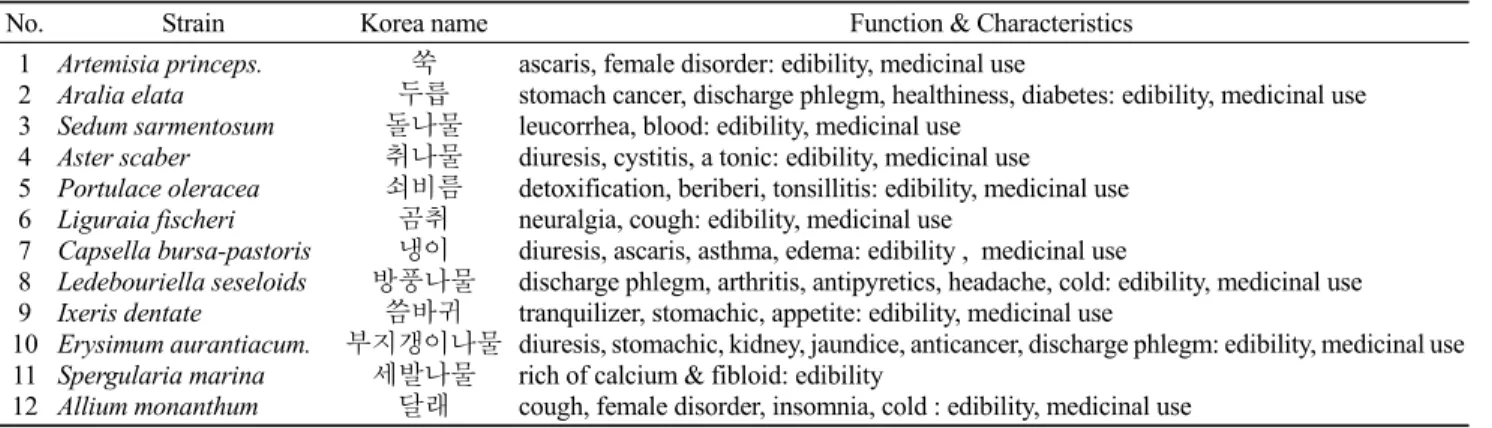
Table 1. List of the wild edible vegetables
만성질환, 대사증후군을 개선하는 등의 효능이 있는 것으로 보고되고 있다 [1,2].
산채류는 우리나라의 평야와 산중의 그늘에서 주로 자생 하며 2월에서 6월 사이에 가장 많은 종류가 채취, 생산되고 있다. 우리 선조들은 산채류를 봄철과 가뭄, 기근에 구황식품 으로 널리 식용하였을 뿐만 아니라 민간에서는 단방의 처방 약재로도 널리 애용하여 왔으며 최근에는 다양한 산채류가 특용작물로 분류되어 농가에서 재배, 생산되고 있다 [3]. 이 들은 제각기 독특한 맛과 향, 자생지역을 가지고 있으며 수용성 식이섬유가 풍부하고 각종 비타민, 미네랄, 기능성 물질들이 풍부한 저칼로리 식품으로 각광받고 있다 [4-14].
특히, 봄철에 부족하기 쉬운 영양분들을 공급해 주며 면역력 증강과 생리활성 촉진, 항암작용, 항균효과, 성인병 예방 등의 효능도 함께 가지고 있는 것으로 알려지고 있다 [15-17].
그러나 현재까지 보고된 산채류의 연구결과들은 국한된 종류에 대한 기능성 평가들만이 이루어지고 있는 실정이다.
따라서 본 연구에서는 3월과 4월에 생산되는 산채류 중 소비 자 선호도가 가장 높은 12가지 (쑥, 두릅, 돌나물, 취나물, 쇠비름, 곰취, 냉이, 방풍나물, 씀바귀, 부지갱이나물, 세발나 물, 달래)를 선정하고 이들로부터 추출한 추출물을 사용하여 항산화 활성을 비교 분석함과 동시에 환절기에 주로 유행하는 호흡기 질환의 원인 세균에 대한 항균활성을 조사하였다.
2. 재료 및 방법 2.1. 실험재료 및 추출
본 실험에 이용한 산채류 (Table 1)는 3월과 4월에 대형마 트에서 유통되고 있는 국산 제품으로 구입하여 이물질을 제거한 다음 생채 그대로를 추출용으로 사용하였다. 준비 된 산채류는 물을 추출용매로하여 1:20 (w/v)의 비율로 혼합한 후 분쇄기 (Switzerland)로 분쇄하여 7℃에서 72시 간 동안 추출한 다음 여과, 감압 농축 (Switzerland)한 후 동결 건조기 (Kansas, USA)를 이용하여 건조분말로 만들 어 실험에 사용하였다.
2.2. 균주 및 배지
실험에 사용한 균주 (Table 2)는 유전자 은행 (대전, 대한민
국)으로부터 분양 받았으며 배양배지는 blood agar (pH 7.3) 배지를 사용하였다.
Table 2. List of microorganism for the experiment of antimicrobial
activityStrain Characteristics & the name of disease
Staphylococcus aureus KCTC 1928
Corynebacterium diptheriae KCTC 3075 Mycobactrium sp. KCTC 1829 Fusobacterium nucleatum KCTC 2488 Klebsiella pneumonia KCTC 2245 Streptococcus pyogenes KCTC 3097 Neisseria gonorrhoeae KCTC 2746
anaerobic, Gram (+), pneumonia Gram (+), respiratory disease aerobic, Gram (+), tuberculosis Gram (-), sepsis (periodontal disease) Gram (-) respiratory disease Gram (+), pneumonia G(-), sepsis (septicemia)
2.3. 시약
시약은 Sigma회사 (St. Louis, USA)의 제품을 배지는 Difco사 (Lawrence, USA)의 제품을 구입하여 사용하였다.
2.4. 총 페놀화합물 및 플라보노이드 정량
총 페놀화합물은 Folin-Ciocalteu 비색법에 준하여 측정하 였다 [18]. 0.1% 추출물 0.5 mL에 Folin-Ciocalteu’s phenol reagent 2.5 mL을 첨가하여 실온 상에서 5분간 반응한 후 2 mL의 7.5% Na2CO3를 첨가하여 50℃에서 5분간 반응한 다음 분광계 (Kyoto, Japan)를 이용하여 760 nm에서 흡광 도를 측정하였다. Tannic acid (1 μg/mL)를 표준시료로 이 용하여 농도를 계산하였다. 플라보노이드는 Moreno 등 [19]
의 방법에 준하여 측정하였다. 0.1% 추출물 0.5 mL에 10%
aluminium nitrate 0.1 mL, 1 M potassium acetate 0.1 mL, 80% EtOH 4.3 mL를 차례로 가하여 혼합하고, 실온에서 40 분간 반응한 다음 415 nm에서 흡광도를 측정하였다.
Quercetin (1 μg/mL)을 표준시료로 사용하여 농도를 계산 하였다. 각 실험은 3번 반복 실행하여 값을 산출하였다.
2.5. 라디칼 소거활성 측정
추출물의 라디칼 소거활성을 알아보기 위해 1,1-Diphenyl-2- picryl hydrazyl (DPPH)을 이용하여 측정하였다 [20]. 0.1%와 0.05% 추출물 각각 1 mL을 DPPH 5 mL에 첨가하여 실 온에서 30분간 반응한 후 517 nm에서 흡광도를 측정하였 다. DPPH radical 소거활성은 전자공여능 (electron donating
ability, EDA %)으로 산출하였으며 대조군으로는 0.1%와 0.05% 인공 항산화제 butylated hydroxytoluene (BHT)를 사용하였다. DPPH 농도가 1/2로 감소하는데 필요한 추출물 의 양은 RC50으로 산출하였다.
EDA % = (Control absorbance - Sample absorbance)/Control absorbance) × 100
2.6. CAT활성 측정
Catalase 활성은 기질인 과산화수소의 감소량을 측정하는 방 법을 사용하였다 [21]. 산채류 생체 0.3 g을 0.05 M phosphate buffer (pH 7.0) 0.7 mL과 함께 얼음 위 유발에서 마쇄한 후 14,000 g에서 5분간 원심분리하여 얻은 상등액을 효소액 으로 사용하였으며 단백질 정량은 BSA를 표준물질로 하여 Bradford 방법으로 측정하였다. 효소활성을 측정하기 위한 반응액은 0.053 M H2O2 1 mL, 효소액 0.1 mL, 0.05 M phosphate buffer (pH 7.0) 1.9 mL을 혼합한 것으로 하였으며 효소활성 (unit)은 H2O2를 분해하는 정도를 240 nm에서 1분 간 흡광도 감소치를 측정 후 다음의 식으로 계산하였다. 식 에서 43.6은 240 nm에서 H2O2의 extinction coefficient이다.
Unit of CAT = (A/ min × dilution factor)/2 × 43.6 (extinction coefficient)
2.7. 항균효과 검정
호흡기 질환을 유발하는 세균에 대한 항균효과는 paper disc diffusion방법으로 실시하였다 [22]. 각 균주는 blood broth (pH 7.3) 배지에 접종한 다음 600 nm에서 흡광도가 0.3이 될 때까지 배양하여 blood agar 배지에 각각 200 μL씩 균일 하게 분주하여 도말, 건조한 후 멸균된 paper disc (dia. 10 mm, Tokyo, Japan)를 배지 위에 놓고 추출시료 5, 10 mg/mL을 각각 주입하여 20℃에서 1시간 방치한 다음 37℃에서 48시 간 배양하여 paper disc 주위에 생성된 inhibition zone의 직 경을 측정한 후 다음의 식으로 항균력을 계산하였다.
Inhibition rate % = [(diameter of treatment - diameter of control)/diameter of control] × 100 세균들에 대한 추출물의 minimum inhibitory concentration (MIC)를 알아보기 위해 최종 농도가 5, 10, 25, 50, 100 mg/mL 이 되도록 산채류 추출물을 배지에 각각 첨가하여 plate에 분주 후 응고시켰다. 여기에 blood broth (pH 7.3)에서 흡광 도 (600 nm) 0.3이 될 때까지 키운 균주를 200 μL씩 각각 분주한 다음 37℃에서 24시간 동안 배양한 후 미생물의 증 식여부를 확인하여 최소생육저해농도 (MIC)를 구하였다.
3. 결과 및 고찰
3.1. 산채류 추출물이 가지는 총 페놀화합물 함량
재료로 선택한 12가지 산채류로부터 추출된 추출물이 포함
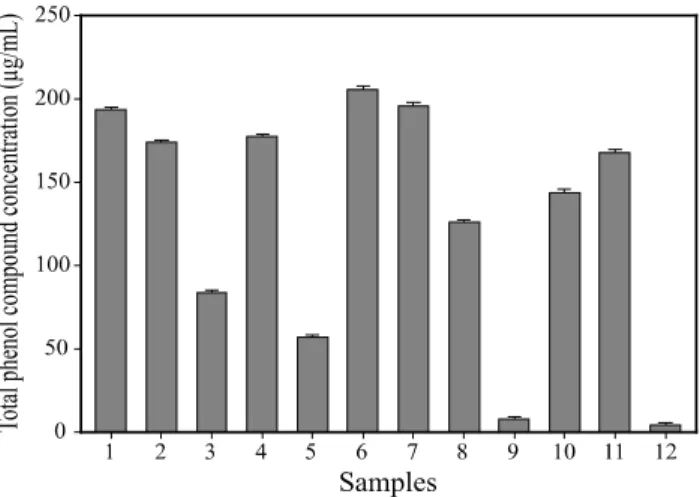
하고 있는 총 페놀 함량을 측정한 결과 시료 중 곰취가 가장 많은 함유량을 가지고 있었으며 주로 짙은 녹색을 가지는 산채류에서 총 페놀 함량의 농도가 높은 것으로 나타났 다 (Fig. 1). 뿌리조직인 씀바귀와 흰색부분의 조직을 가지 고 있는 달래는 총 페놀 함량이 비교적 낮은 농도를 가진 것으로 확인되었는데 이는 달래와 씀바귀가 수용성 성질의 페놀 화합물을 적은 양 함유하고 있는 것으로 추측되며 이 외의 산채류는 수용성 페놀 화합물을 다량 함유한 것으로 사료된다. 페놀성 화합물은 항암, 혈압강하, 간 보호, 항산 화 작용 등의 효과를 가지고 있는 기능성 물질임으로 산채 류는 페놀 화합물을 제공하는 좋은 식품으로 판단된다.
1-Artemisia princeps, 2-Aralia elata, 3-Sedum sarmentosum, 4-Aster scaber, 5-Portulace oleracea, 6-Liguraia fischeri, 7-Capsella
bursa-pastoris, 8-Ledebouriella seseloids, 9-Ixeris dentate,
10-Erysimum aurantiacum, 11-Spergularia marina, 12-Alliummonanthum
Fig. 1. The concentration of total phenol compound in 0.1% water
extracts from the wild edible vegetable. Each value is the mean ± S.D. of 3 times (P < 0.05).1-Artemisia princeps, 2-Aralia elata, 3-Sedum sarmentosum, 4-Aster
scaber, 5-Portulace oleracea, 6-Liguraia fischeri, 7-Capsella bursa-
pastoris, 8-Ledebouriella seseloids, 9-Ixeris dentate, 10-Erysimum
aurantiacum, 11-Spergularia marina, 12-Allium monanthum
Fig. 2. The concentration of flavonoid in 0.1% water extracts from
the wild edible vegetable. Each value is the mean ± S.D. of 3 times (P < 0.05).3.2. 산채류 추출물이 가지는 플라보노이드 함량
산채류 추출물에 포함된 플라보노이드 함량은 추출물 1 mL 당 40 μg이상인 그룹으로 쑥과 냉이, 곰취, 두릅, 취나물, 부지갱이나물이 있었으며 추출물 1 mL당 40 μg이하인 그룹 으로 돌나물, 쇠비름, 씀바귀, 달래로 나눌 수 있었다 (Fig. 2).
총 페놀 화합물 농도가 높았던 세발은 비교적 낮은 농도의 플라보노이드를 함유한 것으로 확인 되었으며, 씀바귀와 달 래는 총 페놀 함량의 결과와 같이 플라보노이드 함량 또한 낮은 농도를 가지는 것으로 밝혀졌는데 이는 이들 종류의 시료 자체가 비질소성 색소를 낮은 비율로 함유하는 것으로 판단된다. 플라보노이드는 항산화제 작용과 동맥경화, 심혈 관계질병 예방, 시력보호, 항염증, 항암 등의 효능을 가진 기능성 물질임으로 씀바귀와 달래를 제외한 나머지 산채류 는 이러한 기능성 물질을 다량 함유한 것으로 생각되어 정 확한 물질 종류를 밝혀내는 분석실험이 추가로 진행되어야 할 것으로 사료된다.
3.3. 라디칼 소거활성
12가지 산채류 추출물이 가지는 라디칼 소거활성을 알아보 기 위해 DPPH를 이용하여 측정한 결과 돌나물, 냉이, 방풍 나물, 곰취, 쇠비름 순으로 높은 활성을 보였으며 돌나물의 경우 총 페놀화합물과 플라보노이드 함량은 낮았으나 라디칼 소거활성은 우수한 것으로 밝혀졌다 (Table3). 산채류 추출 물 중 플라보노이드 함량이 많은 종류에서 라디칼 소거 활성 역시 높은 것으로 검정되어 플라보노이드가 항산화 작용에 관여하는 주요 물질임을 입증하였으며 시료로 선택한 12가 지 산채류 모두 우수한 라디칼 소거활성을 가지고 있음을 알 수 있었다. 또한, 추출물 농도를 0.1%, 0.05%로 구분하 여 라디칼 소거활성을 검정한 결과 시료의 농도가 증가함에 따라 활성도 증가하였으나 부지갱이나물의 추출물만은 농도 가 증가하여도 활성의 변화에는 큰 영향을 주지 않는 것으로 보아 적은 양을 섭취하여도 노화억제효과가 있는 우수한 산채
Table 3. DPPH radical scavenging activity of water extracts from
the wild edible vegetableSample†
DPPH radical scavenging activity (% of the control)
0.1% 0.05% RC50 (μg/mL) BHT (control)
Artemisia princeps.
Aralia elata Sedum sarmentosum Aster scaber Portulace oleracea Liguraia fischeri Capsella bursa-pastoris Ledebouriella seseloids Ixeris dentate
Erysimum aurantiacum.
Spergularia marina Allium monanthum
96 ± 0.80 53 ± 0.88 60 ± 0.38 86 ± 0.39 55 ± 0.66 64 ± 0.20 68 ± 0.39 72 ± 0.04 69 ± 0.19 31 ± 0.97 45 ± 0.42 51 ± 0.65 43 ± 0.19
95 ± 0.20 47 ± 0.97 47 ± 0.56 56 ± 0.51 42 ± 0.42 39 ± 0.44 58 ± 0.16 55 ± 0.84 49 ± 0.30 15 ± 0.25 48 ± 0.55 28 ± 0.01 16 ± 0.24
15 ± 0.04 78 ± 0.14 69 ± 0.92 47 ± 0.95 85 ± 0.31 80 ± 0.92 50 ± 0.21 49 ± 0.35 68 ± 0.86 132 ± 0.48 112 ± 0.26 101 ± 0.85 119 ± 0.40
† : water extract of the wild edible vegetable.
Each value is the mean ± S.D. of 3 times (P < 0.05).
류로 생각된다 [23]. 때문에 봄철에 생산되는 산채류를 섭취 하는 것은 인체의 생리활성을 촉진함과 동시에 노화방지, 피부미용에도 많은 도움을 주는 좋은 먹거리로 판단된다.
3.4. CAT 활성
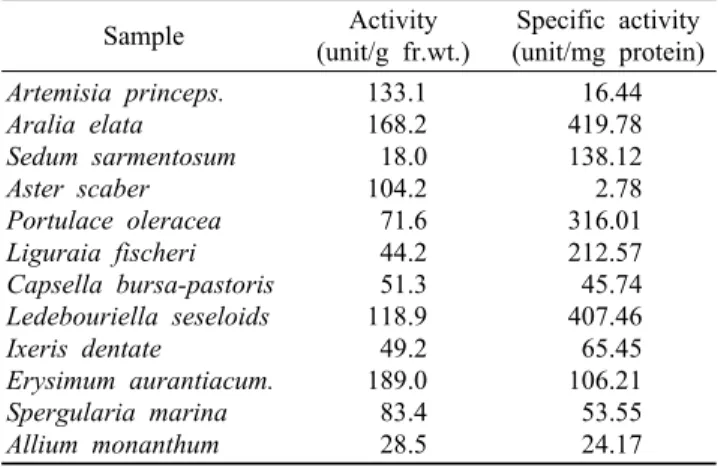
Catalase는 세포 내 대사과정에서 생성되는 H2O2를 H2O와 O2로 분해하여 안전하게 제거 하는 효소로 세포가 분비하 는 항산화 물질이며 식물의 경우 엽록체가 다량 함유하고 있어 소량으로도 효과적인 효소활성을 가지는 것이 특징이 다. 때문에 본 실험에서 선택한 12가지 산채류의 catalase 활성을 검정한 결과 부지갱이나물, 두릅, 쑥, 방풍나물, 취 나물 순으로 우수한 활성을 보였으며 두릅, 방풍나물, 쇠비 름의 경우 specific activity가 다른 산채류에 비해 매우 높은 값을 가지는 것으로 보아 이들 산채류는 H2O2 분해 대사를 촉진하며 세포 내 노폐물을 제거하고 생체의 homeostasis을 유지하는데 탁월한 효과가 있는 것으로 판단된다 (Table 4).
또한, catalase 활성이 높은 종류는 플라보노이드 함량이 많다는 공통점을 가지는 것으로 확인되어 엽록체가 발달된 산채류는 항산화 활성을 나타내는 다양한 기능성 물질들을 함유하고 있는 것으로 사료된다 [24].
Table 4. Catalase activity of water extracts from the wild edible
vegetableSample Activity
(unit/g fr.wt.)
Specific activity (unit/mg protein)
Artemisia princeps.
Aralia elata Sedum sarmentosum Aster scaber Portulace oleracea Liguraia fischeri Capsella bursa-pastoris Ledebouriella seseloids Ixeris dentate
Erysimum aurantiacum.
Spergularia marina Allium monanthum
133.1 168.2 18.0 104.2 71.6 44.2 51.3 118.9 49.2 189.0 83.4 28.5
16.44 419.78 138.12 2.78 316.01 212.57 45.74 407.46 65.45 106.21 53.55 24.17 Each value is the mean ± S.D. of 3 times (P < 0.05).
3.5. 항균활성
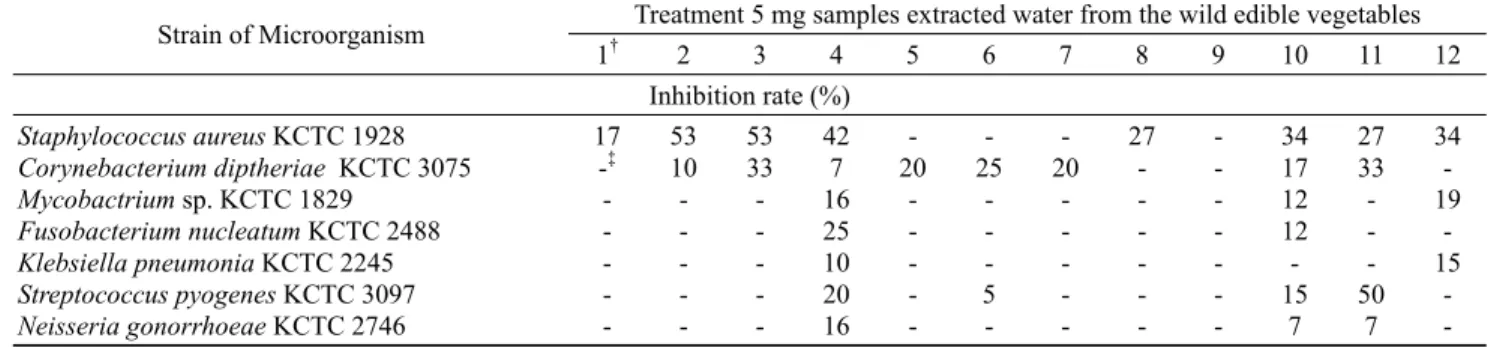
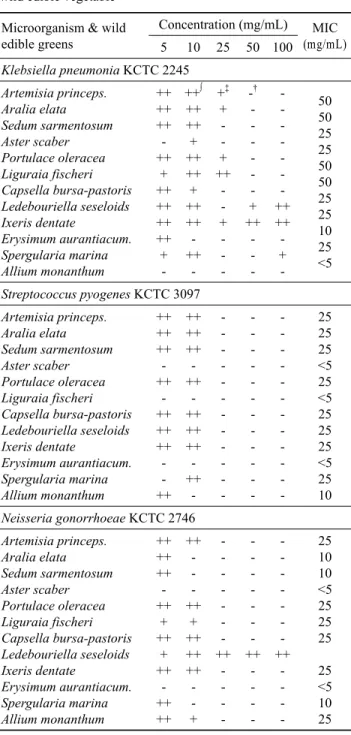
호흡기 질환을 유발하는 원인 세균에 미치는 산채류 추출물 의 항균활성을 알아 보기 위해 산채류 추출물 5, 10 mg/mL 을 각각 세균에 처리한 결과 Staphylococcus aureus KCTC 1928와 Corynebacterium diptheriae KCTC 3075에 대해서 만 농도와 무관하게 모두 항균활성을 보였으며 나머지 세균 들에 대해서는 특정 산채류만이 항균활성을 가지고 있음을 확인할 수 있었다 (Table 5,6). 특히, 취나물과 부지갱이나물 은 거의 모든 세균에 대해 항균활성을 가지고 있었으며 [23]
달래는 Fusobacterium nucleatum KCTC 2488와 Neisseria
gonorrhoeae KCTC 2746를 제외한 나머지 세균들에 대해
서만 항균활성을 가지고 있어 달래의 효능 중 살균작용과 관련이 있을 것으로 추측된다 [25]. 항균활성에 대한 산 채류 추출물의 최소생육저해농도 (MIC)를 알아본 결과Strain of Microorganism Treatment 5 mg samples extracted water from the wild edible vegetables
1† 2 3 4 5 6 7 8 9 10 11 12
Inhibition rate (%)
Staphylococcus aureus KCTC 1928
Corynebacterium diptheriae KCTC 3075 Mycobactrium sp. KCTC 1829
Fusobacterium nucleatum KCTC 2488 Klebsiella pneumonia KCTC 2245 Streptococcus pyogenes KCTC 3097 Neisseria gonorrhoeae KCTC 2746
17 -‡ - - - - -
53 10 - - - - -
53 33 - - - - -
42 7 16 25 10 20 16
- 20
- - - - -
- 25
- - - 5 -
- 20
- - - - -
27 - - - - - -
- - - - - - -
34 17 12 12 - 15
7 27 33 - - - 50
7 34
- 19
- 15
- -
† There are kinds of the wild edible vegetable that information has Table 1, ‡ do not have inhibition rate.
Inhibition rate % = [(diameter of treatment - diameter of control)/diameter of control] × 100.
Table 5. Antimicrobial activities of water extracts from the wild edible vegetable
Strain of Microorganism Treatment 10 mg samplesextracted water from the wild edible vegetable
1† 2 3 4 5 6 7 8 9 10 11 12
Inhibition rate (%)
Staphylococcus aureus KCTC 1928
Corynebacterium diptheriae KCTC 3075 Mycobactrium sp. KCTC 1829
Fusobacterium nucleatum KCTC 2488 Klebsiella pneumonia KCTC 2245 Streptococcus pyogenes KCTC 3097 Neisseria gonorrhoeae KCTC 2746
30 -‡
- - - - -
33 10 - - - - 11
41 10 7 12
- 7 14
42 - 32 25 - 27 16
- 10
- - - - -
21 25 -
-
- 20- - 7 - - - - -
16 - - - - - -
- 17
- - - - -
30 10 21 12 6 20 21
- 20
- - - - 8
24 6 16
- 33
7 -
†There are kinds of the wild edible vegetable that information has Table 1, ‡ do not have inhibition rate.
Inhibition rate % = [(diameter of treatment - diameter of control)/diameter of control] × 100.
Table 6. Antimicrobial activities of water extracts from the wild edible vegetable Mycobactrium sp. KCTC 1829 세균에 대해서만 항균활성이
나타나지 않았으며 나머지 세균들에 대해서는 일정 농도에 서 항균활성을 가지는 것으로 나타났다 (Table 7). 특이한 점은 세균에 따라 산채류 추출물의 농도가 10 mg/mL 보다 낮거나 50 mg/mL 보다 높은 경우 세균의 성장을 촉진하 는 현상이 나타난다는 것이다. 이는 추출물에 포함된 항균 물질이 적정농도로 처리되지 않을 경우 추출물에 포함된 phytochemical이 오히려 세균의 성장을 도와주는 물질로 작 용하고 있음을 알 수 있었다.
4. 결론
봄철에 주로 생산, 소비되고 있는 산채류 12가지 (쑥, 두릅, 돌나물, 취나물, 쇠비름, 곰취, 냉이, 방풍나물, 씀바귀, 부지 갱이나물, 세발나물, 달래)를 선정하여 물을 용매로 추출물 을 얻은 다음 이들 추출물이 가지고 있는 총 페놀화합물과 플라보노이드 함량, 라디칼 소거활성, catalase 활성, 항균활 성 등을 알아 보았다.
총 페놀화합물 함량의 경우 곰취가 가장 높은 농도를 가 지는 것으로 검정되었는데 추출물 1 mL당 205 μg의 페놀 성분을 함유하고 있었으며 씀바귀와 달래 추출물에는 추출 물 1 mL당 10 μg 이하를 가지는 것으로 검정되었다. 플라 보노이드 함량은 곰취 추출물 1 mL당 98.86 μg을 함유하고 있었으며 씀바귀와 달래 추출물은 1 mL당 10 μg이하로
가장 낮은 농도를 가지는 것으로 확인되었다. 산채류 추출 물이 가지는 라디칼 소거활성은 추출물을 0.1%와 0.05%
로 각각 나눈 다음 대조군인 인공 항산화제 BHT와 비교 검정한 결과 0.05% 농도의 곰취와 돌나물 추출물에서 BHT 의 55%에 해당되는 높은 라디칼 소거활성이 있음을 확인 하였고 0.1% 돌나물 추출물의 경우 BHT의 90%에 해당되 는 매우 우수한 라디칼 소거활성을 가지고 있었다. Catalase 활성의 경우 부지갱이나물과 두릅에서 생나물 g 당 150 unit 이상의 높은 활성을 보였다. 호흡기 질환을 유발하는 세균 들에 대한 항균활성은 취나물과 부지갱이나물 추출물 모두 세균의 종류에 관계없이 10% 이상의 항균활성을 보였으며 페놀화합물과 플라보노이드 함량이 낮은 씀바귀 추출물은 세균들에 대해 항균활성이 거의 없음을 확인하였다.
곰취 추출물은 수용성 플라보노이드와 페놀화합물을 다량 함유하고 있으며 우수한 라디칼 소거활성과 catalse 활성을 가지고 있음과 동시에 Corynebacterium diptheriae KCTC 3075에 대한 항균활성을 가지고 있어 환절기에 호흡기 질환을 예방하는 효과와 함께 항노화 작용을 하는 우수한 산채류로 판명되었다.
돌나물 추출물의 경우 페놀화합물과 플라보노이드 함량은 다른 산채류와 비교시 상대적으로 낮은 농도를 가지고 있 었으나 라디칼 소거활성은 매우 우수한 것으로 확인되었으 며 항균활성은 10 mg/mL을 세균에 처리했을 때 Klebsiella
pneumonia KCTC 2245를 제외한 모든 세균에 대해서 항균
활성을 가지는 것으로 확인되었다.Table 7. Minimum inhibitory concentration of water extracts from the wild edible vegetable
Microorganism & wildedible greens
Concentration (mg/mL) MIC (mg/mL)
5 10 25 50 100
Staphylococcus aureus KCTC 1928 Artemisia princeps.
Aralia elata Sedum sarmentosum Aster scaber Portulace oleracea Liguraia fischeri Capsella bursa-pastoris Ledebouriella seseloids Ixeris dentate
Erysimum aurantiacum.
Spergularia marina Allium monanthum
-† - - - ++
+ ++
++
- - - -
- - - - ++
- ++
++
+ - + -
+‡ - - - + - + - - + +- ++
++∫ - + + - - + - - ++
++
+ ++
+
+
+ - - + - - ++++
+ 10 50 25 25 50 5 25 10 10 5 10
Corynebacterium diptheriae KCTC 3075
Artemisia princeps.
Aralia elata Sedum sarmentosum Aster scaber Portulace oleracea Liguraia fischeri Capsella bursa-pastoris Ledebouriella seseloids Ixeris dentate
Erysimum aurantiacum.
Spergularia marina Allium monanthum
++
- - - - - - + + - - +
++
- - +-
- - - + + - - -
+ - - + - - - - - ++
- -
+ - - + - - - - - + - ++
- - - - + + - - - + - ++
100 <5 <5 5 50 50 <5 25 25 10 <5 10
Mycobactrium sp. KCTC 1829
Artemisia princeps.
Aralia elata Sedum sarmentosum Aster scaber Portulace oleracea Liguraia fischeri Capsella bursa-pastoris Ledebouriella seseloids Ixeris dentate
Erysimum aurantiacum.
Spergularia marina Allium monanthum
++
++
++
- ++
++
++
++
++
- ++
- ++
++
- - ++
++
++
++
++
- ++
- ++
++
- ++
++
++
++
++
++
++
++
++
++
++
+ ++
++
++
++
++
++
+ ++
++
+ ++
+ + + + ++
++
++
++
+ ++
25 10
10 10
Fusobacterium nucleatum KCTC 2488
Artemisia princeps.
Aralia elata Sedum sarmentosum Aster scaber Portulace oleracea Liguraia fischeri Capsella bursa-pastoris Ledebouriella seseloids Ixeris dentate
Erysimum aurantiacum.
Spergularia marina Allium monanthum
++
++
++
- ++
++
+ ++
++
- ++
+ + ++
- - + ++
++
++
++
- + +
- - ++
- - - ++
++
- - - ++
- - - - - - - - ++
- - ++
- - ++
- - - - + ++
- - -
25 25 10 <5 25 25 50 50 25
<5 25 100
† : no growth, ‡ : slightly growth, ∫ moderate.
Microorganism & wild edible greens
Concentration (mg/mL) MIC (mg/mL)
5 10 25 50 100
Klebsiella pneumonia KCTC 2245 Artemisia princeps.
Aralia elata Sedum sarmentosum Aster scaber Portulace oleracea Liguraia fischeri Capsella bursa-pastoris Ledebouriella seseloids Ixeris dentate
Erysimum aurantiacum.
Spergularia marina Allium monanthum
++
++
++
- ++
+ ++
++
++
++
+ -
++∫ ++
++
+ ++
++
+ ++
++
- ++
- +‡
+ - - + ++
- - + - - -
-† - - - - - - + ++
- - -
- - - - - - - ++
++
- + -
50 50 25 25 50 50 25 25 10 25
<5
Streptococcus pyogenes KCTC 3097
Artemisia princeps.
Aralia elata Sedum sarmentosum Aster scaber Portulace oleracea Liguraia fischeri Capsella bursa-pastoris Ledebouriella seseloids Ixeris dentate
Erysimum aurantiacum.
Spergularia marina Allium monanthum
++
++
++
- ++
- ++
++
++
- - ++
++
++
++
- ++
- ++
++
++
- ++
- - - - - - - - - - - - -
- - - - - - - - - - - -
- - - - - - - - - - - -
25 25 25
<5 25
<5 25 25 25
<5 25 10
Neisseria gonorrhoeae KCTC 2746
Artemisia princeps.
Aralia elata Sedum sarmentosum Aster scaber Portulace oleracea Liguraia fischeri Capsella bursa-pastoris Ledebouriella seseloids Ixeris dentate
Erysimum aurantiacum.
Spergularia marina Allium monanthum
++
++
++
- ++
+ ++
+ ++
- ++
++
++
- - - ++
+ ++
++
++
- - +
- - - - - - - ++
- - - -
- - - - - - - ++
- - - -
- - - - - - - ++
- - - -
25 10 10
<5 25 25 25 25
<5 10 25
† : no growth, ‡ : slightly growth, ∫ moderate.
부지갱이나물과 취나물 추출물은 다른 시료들과 비교시 평균 이상의 페놀 화합물과 플라보노이드, 라디칼 소거활성 을 가지는 것으로 확인되었으며 catalase 활성과 항균활성 또한 매우 탁월한 것으로 검정되었다. 항균활성의 경우 호 흡기 질환을 유발하는 원인 세균들 모두에 대해 억제효과를 보여 봄철에 생산되는 이들 나물을 꾸준하게 섭취할 경우 호흡기 질환 예방과 치료에 효과가 있을 것으로 판명되었 다. 그러므로 봄철에 생산되는 산채류는 기능성 소재인 페 놀화합물과 플라보노이드를 풍부하게 함유하고 있어 항산 화 활성과 항균활성이 우수하며 이들을 꾸준하게 섭취한다 면 노화를 억제하고 면역기능과 생리활성을 증진함과 동
시에 환절기 및 황사로 인한 호흡기 질환 예방 등의 효과 를 기대할 수 있는 기능성 제철 먹거리로 판단된다.
감사
이 논문은 2009학년도 대구대학교 학술연구비 지원에 의해 수행된 논문으로 이에 감사드립니다.
References
1. Seo, K. S. and K. W. Yun (2011) Antimicrobial activity and total polyphenol content of extracts from Artemisia capillaries Thunb. and Artemisia iwayomogi Kitam. Used as injin. Korean
J. Plant Res. 24: 10-16.
2. Choi, H. S., M. Y. Lee, Y. H. Jeong, and G. M. Shin (2004) Hepatoprotective effects of Allium monanthum MAX. extract on ethanol induced liver damage in rat. J. Food Sci. Nutr. 9: 245-252.
3. Cho, J. Y., S. Y. Yang, S. O. Yu, B. W. Kim, H. G. Jang, S. U.
Chon, Y. J. Park, and B. G. Heo (2005) The actual distributing states of the fresh wild vegetables at five-day traditional markets in jeonnam district. Korean J. Hort. Sci. Technol. 23: 396-401.
4. Lee, S. O., H. J. Lee, M. H. Yu, H. G. Im, and I. S. Lee (2005) Total polyphenol contents and antioxidant activities of methanol extracts from vegetables produced in ullung island. Korean J.
Food Sci. Technol. 37: 233-240.
5. Han, G. J., D. S. Shin, and M. S. Jang (2008) A study of the nutritional composition of Aralia continentalis Kitagawa and
Aralia continentalis Kitagawa leaf. Korean J. Food Sci. Technol.
40: 680-685.
6. Kim, W. H., S. J. Bae, and M. H. Kim (2002) The effects of
Sedum sarmentosum hunge on serum lipid concentration in
ovariectomized rats. J. Korean Soc. Food Sci. Nutr. 31: 290-294.7. Shin, K. H., S. H. Lee, D. H. Cho, and C. H. Park (1998) Analysis of vitamins and general components in the leaves of chwinamul.
Korean J. Plant Res. 11: 163-167.
8. Park, S. H., D. K. Kim, and J. H. Bae (2011) The antioxidant effect of Portulace oleracea extracts and its antimicrobial activity on Helicobacter pylori. Korean J. Food Nutr. 24:
306-311.
9. Kim, D. H., B. J. An, S. G. Kim, T. S. Park, G. H. Park, and J.
H. Son (2011) Anti-inflammatory effect of Ligularia fischeri,
Solidago virga-aurea and Aruncus diolicus complex extract in
raw 264.7 cells. J. Life sci. 21: 678-683.10. Kwak, J. H., M. H. Kweon, K. S. Ra, H. C. Sung, and H. C. Yang (1996) Purification and physicochemical properties of superoxide anion radical scavenger from Capsella bursa-pastoris. Korean
J. Food Sci. Technol. 28: 184-189.
11. Noh, K. S., M. O. Yang, and E. J. Cho (2002) Nitrite scavenging effect of Umbelliferaeceae. Korean J. Soc. Food Cookery Sci.
18: 8-12.
12. Kim, M. J., J. S. Kim, M. A. Cho, W. H. Kang, D. M. Jeong, and
S. S. Ham (2002) Biological activity of Ixeris dentata Nakai juice extracts. J. Korean Soc. Food Sci. Nutr. 31: 924-930.
13. Choi, M. G., H. S. Chung, and K. D. Moon (2008) Chemical components of Solidago virgaurea spp. Gigantean, Aster
glehni var. hondoensis and Aruncus dioicus var. kamtschaticus
grown on ulleung island, Korea. Korean J. Food Preserv. 15:576-581.
14. Gu, H. B., Y. J. Park, Y. S. Park, M. H. Im, K. T. Oh, and J. Y.
Cho (2009) Distribution status, physicochemical composition, and physiological activity of Spergularia marina cultivated in the western region in jeon-ra-nam-do. Korean J. Comm. Living
Sci. 20: 181-191.
15. Lyu, H. N., M. H. Park, S. G. Hong, D. Y. Lee, K. M. Han, J. S.
Yoon, S. Y. Kim, Y. D. Rho, and N. I. Baek (2007) Development of biological active compounds from edible plant sources-XXV.
Immunostimulating effect of edible plant extracts. Korean J.
Food Sci. Technol. 39: 708-714.
16. Kim, G. S., S. E. Lee, H. J. Lee, Y. M. Kim, S. Y. Jeon, C. G. Park, N. S. Seong, and K. S. Song (2004) Inhibitory activity of plant extracts against prolyl endopeptidase. Korean J. Med. Crop
Sci. 12: 1-9.
17. Kim, M. K. and Y. S. Kim (2000) Antagonism of new flavonoids from Sophorica japonica on IL-3-induced eosinophil activation.
Korean J. Asthma Allergy Clin. Immunol. 20: 725-730.
18. Chae, H. J., H. I. Hwang, I. S. Lee, and H. Y. Moon (2005) Comparison of on rat intestinal dige-stive enzyme inhibitory activity and anti-oxidant enzyme activity of Korean and Chinese Schizandrachinensis. J. Exp. Biomed. Sci. 11: 517-523.
19. Moreno, M. I. N, M. I. Lsla, A. R. Sampietro, and M. A. Vattuone (2000) Comparison of the free radical scavenging activity of propolis from several region of Argentiana. J. Enthropharmacol.
71: 109-114.
20. Lee, H. J., B. J. Lee, D. S. Lee, and Y. W. Seo (2003) DPPH radical scavenging effect and in vitro lipid peroxidation inhibition by Portulaca oleracea. Korean J. Biotechnol. Bioeng.
18: 165-169.
21. Jang, M. S., G. H. Huh, S. W. Kim, I. H. Park, R. L. Jang, and S. S. Kwak (1996) Comparison of catalase and other antioxidant enzyme activities in Various plant cell lines. Korean J. Plant
Tissue Cult. 23: 157-160.
22. Lim, M. K. and M. R. Kim (2001) Antimicrobial activity of methanol extract from soibirhym (Portulace oleracea) against food spoilage or foodborne disease microorganisms and the composition of the extract. Korean J. Soc. Food Cookery Sci.
17: 565-570.
23. Gonzalez-Paramas, A. M., C. Santos-Buelga, M. Duenas, and S. Gonzalez-Manzano (2011) Analysis of flavonoids in foods and biological sample. Mini Rev. Med. Chem. 11: 1239-1255.
24. C isow ska, A ., D . Wojnicz, and A . B . H endrich (2011) Anthocyanins as antimicrobial agents of natural plant origin.
Nat. Prod. Commun. 6: 149-156.
25. Baek, N. I., E. M. Ahn, H. Y. Kim, Y. D. Park, Y. J. Chang, and S. Y. Kim (2001) Development of biologically active compounds from edible plant sources-IV. Isolation of galactosyldiglyceride from the Allium monanthum Max. Korean J. Life Sci. 11: 93-96.