큰잎모자반 효소적 추출물의 항산화 활성
고석천1․강성명1․안긴내1․양현필2․김길남3․전유진1†
1
제주대학교 해양생명과학과
2
(주)키토라이프 기술연구소
3
제주하이테크산업진흥원 제주생물종다양성연구소
Antioxidant Activity of Enzymatic Extracts from Sargassum coreanum
Seok-Chun Ko1, Sung-Myung Kang1, Ginnae Ahn1, Hyun-Pil Yang2, Kil-Nam Kim3, and You-Jin Jeon1†
1Dept. of Marine Life Science, Jeju National University, Jeju 690-756, Korea
2Technology Research Center, Kitto Life Co., Ltd., Gyeonggi 459-050, Koera
3Jeju Biodiversity Research Institute (JBRI) and Jeju Hi-Tech Industry Development Institute (HiDI), Jeju 697-943, Korea
Abstract
In this study, Sargassum coreanum was enzymatically hydrolyzed to prepare water-soluble extracts by using five carbohydrates (Viscozyme, Celluclast, AMG, Termamyl and Ultraflo) and five proteases (Protamex, Kojizyme, Neutrase, Flavozyme and Alcalase) and their potential antioxidant activity were evaluated. The Celluclast and Neutrase extracts of Sargassum coreanum exhibited better DPPH radical scavenging activities (92.42% and 92.78%, respectively) and hydrogen peroxide (H
2O
2) scavenging activities (58.28% and 57.97%, respectively) compared to those of other enzymatic extracts. These results suggest that Sargassum coreanum would be a good raw materials for antioxidant and enzymatic hydrolysis would be a good strategy to prepare antioxidant extracts from seaweeds.
Key words: Sargassum coreanum, antioxidant, enzymatic extract, radical scavenging
†
Corresponding author. E-mail: [email protected]
†
Phone: 82-64-754-3475, Fax: 82-64-756-3493
서 론
산소는 인체 내 소화 및 에너지 생성 등 여러 대사과정에 관여하고 생물의 생존에 가장 필수적인 물질이지만, 반응성 이 매우 큰 활성산소로 전환되면 생체에 큰 영향을 미친다고 알려져 있다. 활성산소종(reactive oxygen species; ROS)의 종류로는 일반적으로 superoxide anion radical(․O
2-), hy- droxyl radical(․OH), hydrogen peroxide(H
2O
2), singlet oxygen(
1O
2) 등이 있고, 이들 ROS는 단백질, 불포화지방산 등과 결합하여 과산화지질을 생성하고, DNA나 RNA 등에 손상을 일으켜, 생체막의 손상, 면역능력의 약화와 함께 성 인병 및 각종 질병과 노화 더 나아가서는 암을 유발시키게 된다(1-3). 이러한 활성산소종 생성의 생체 내적 요인으로는 세포 대사작용, 산화효소, 박테리아 작용이 있으며, 세포외 적 요인으로는 오염된 공기, 대사율 증가, 흡연, 특정항생제, 자외선 등이 있고, 체내에서는 각종 항산화효소와 항산화물 질로 이를 제어하고 있다(4). 따라서 이러한 활성산소를 효 과적으로 억제하는 안전하고 경제적인 천연물의 생리활성
물질을 이용한 연구가 활발히 이루어지고 있다.
제주도는 지리적인 조건과 난류와 한류, 연안수 등 담수계 가 교류하는 이점을 가지고 있어 해조류가 풍부하게 서식하 고 있다(5). 해조류는 종류와 시기에 따라 성분에서 다소 차 이를 가지고 있으며, 대부분이 40~65%의 탄수화물을 가지 고 육상식물과는 다른 구조 형태가 많고, 해조류 내의 탄수 화물이 장관운동 활성화(6) 및 혈관 내 콜레스테롤 침착 방 지(7), 중금속 배출 촉진(8), anti-plasmin 억제활성(9), 고지 혈증 개선(10) 항돌연변이(11), 항균(12), 항바이러스 활성 (13) 등 식용 해조류로부터 생리활성 물질들이 확인되면서 기능성식품으로서의 개발에 관심이 모아지고 있다.
그중에서도 갈조류는 xanthopophyll, pigment, fucoidan,
phycocolloids, phlorotannins 그리고 fucoxanthin과 같은 다
양한 생리활성물질을 함유한다고 알려져 있고(14), 이러한
생리활성물질은 많은 연구자들에 의해 항산화, 항응고, 항고
혈압, 항균 그리고 항암 활성을 가진다는 것이 보고된 바
있다(12,15-18). 그러나 이러한 갈조류에 속하는 큰잎모자반
에 대한 생리활성 효과에 대한 연구는 찾아보기 힘들고, 비
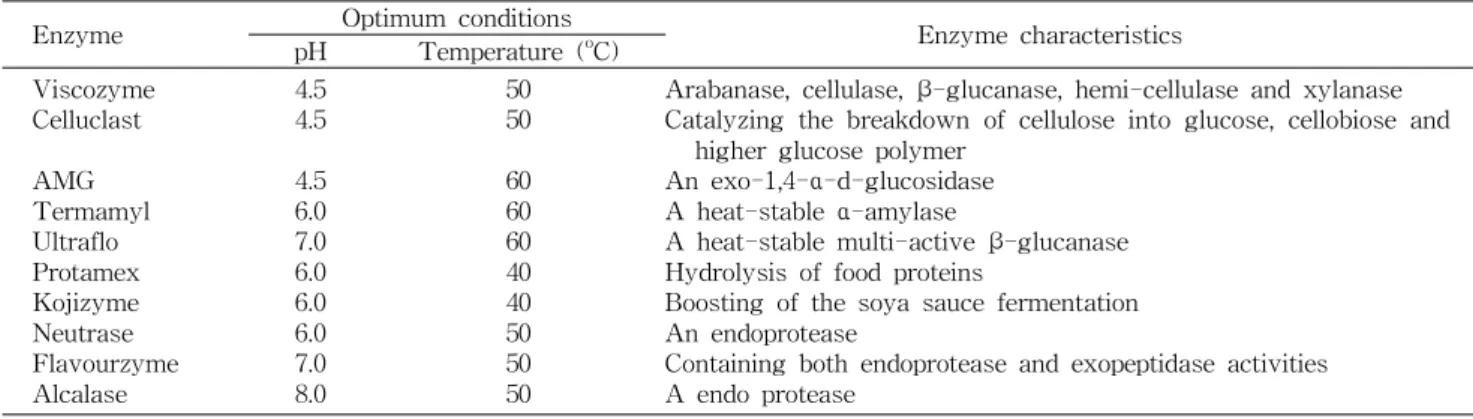
Table 1. Optimum hydrolytic conditions of particular enzymes
Enzyme Optimum conditions
Enzyme characteristics pH Temperature (
oC)
Viscozyme Celluclast AMG Termamyl Ultraflo Protamex Kojizyme Neutrase Flavourzyme Alcalase
4.5 4.5
4.5 6.0 7.0 6.0 6.0 6.0 7.0 8.0
50 50
60 60 60 40 40 50 50 50
Arabanase, cellulase, β-glucanase, hemi-cellulase and xylanase Catalyzing the breakdown of cellulose into glucose, cellobiose and
higher glucose polymer An exo-1,4-α-d-glucosidase A heat-stable α-amylase
A heat-stable multi-active β-glucanase Hydrolysis of food proteins
Boosting of the soya sauce fermentation An endoprotease
Containing both endoprotease and exopeptidase activities A endo protease
수용성 물질 추출, 낮은 수율, 고비용, 환경오염과 독성이 부각되고 있는 유기용매 추출법이 주를 이루고 있어 새로운 추출방법의 대안이 요구되어지고 있다. 이전 연구에서 유기 용매의 단점을 보완하기 위해 다양한 효소를 이용하는 효소 적 가수분해 방법을 시도하여 추출물을 얻은 후 활성산소에 대한 높은 소거능과 암세포에 대한 높은 증식 억제 활성이 보고된 바 있다(19,20).
이에 본 연구에서는 수용성 추출물을 높은 수율로 얻을 수 있고, 독성 없이 친환경적인 추출방법인 당 분해효소와 단백질 분해효소를 이용하는 효소적 가수분해 방법을 이용 하여 갈조류에 한 종류인 큰잎모자반으로부터 수용성 성분 을 추출한 후 각 효소 추출물의 항산화 효과를 확인하고자 하였다.
재료 및 방법
시약
단백질 분해효소(Protamex, Kojizyme, Neutrase, Flavourzyme, Alcalase)와 당 분해효소(Viscozyme, Celluclast, AMG, Termamyl, Ultraflo)는 Novo사 (Novozymes Nordisk, Bagsvaerd, Denmark)에서 구입하여 사용하였고, 1,1-diphenyl-2-pricrylhydrazyl(DPPH), 2- deoxyribose, peroxidase, ABTS(2,2'-azino-bis(3-ethyl- benzthiazoline)-6-sulfonic acid)는 Sigma 회사(St. Louis, MO, USA)에서 구입하여 사용하였다. 그 외 모든 시약은 분석용 특급 시약을 사용하였다.
큰잎모자반
본 실험에 사용된 큰잎모자반(
Sargassum coreanum)은 제주도 연안에 서식하고 있는 갈조류로 제주도 연안에서 채 집한 후 흐르는 물로 수세하여 염분과 협잡물을 제거하고 동결 건조하여 사용하였다.
일반성분 분석
큰잎모자반의 일반성분은 AOAC법(21)에 따라 수분 함 량은 105
oC 상압건조법, 조지방은 Soxhlet 추출법, 조단백질
은 Kjeldahl법, 조회분은 550
oC 건식회화법으로 분석하였으 며, 탄수화물 함량은 고형분의 총량에서 수분, 회분, 조단백 질 그리고 조지방의 함량을 뺀 값으로 나타내었다.
효소적 추출물의 조제
효소적 추출은 Heo 등(22)의 방법으로 Table 1의 조건에 따라 가수분해 하였다. 동결건조 후 곱게 간 큰잎모자반 1 g을 각각 100 mL의 증류수와 혼합한 후 100 μL의 단백질 분해효소와 당 분해효소를 첨가하였다. 효소적 가수분해 반 응물은 12시간 동안 최적의 조건에서 효소반응을 통해 추출 한 후 각 추출물을 3,000×
g에서 20분간 원심분리 하여 잔사 를 제거한 상층액을 취한 후 여과하여 농도를 2 mg/mL로 조절한 후 실험 시료로 사용하였다.
추출물의 수율 측정
수율은 큰잎모자반으로부터 유효성분을 제조방법에 따라 획득한 다음 양을 %로 계산하였다.
총 polyphenol 함량 측정
큰잎모자반의 총 polyphenol 함량 측정은 Shetty 등(23) 에 준하여 수행하였다. 각 추출물 1 mL에 95% 에탄올 용액 1 mL와 증류수 5 mL를 넣어 혼합한 후 50% Folin- Ciocalteu reagent(Sigma Chemical, St. Louis, MO, USA) 0.5 mL를 넣고 5분간 반응시켰다. 여기에 5% Na
2CO
3용액 1 mL를 가한 후 어두운 상태에서 1시간 동안 반응시킨 후 725 nm에서 흡광도를 측정하였다. 이때 표준검량곡선은 표 준물질로 gallic acid를 사용하여 동일한 방법으로 작성된 표준곡선으로부터 총 polyphenol 함량으로 환산하였다.
DPPH radical 소거활성 측정
각 추출물의 free radical 소거활성은 Blois(24)의 방법을 변형하여 측정하였다. 에탄올에 용해시킨 4×10
-4M DPPH 용액 2.9 mL에 각 추출물 0.1 mL를 넣고 혼합하여 30분간 반응시킨 후 516 nm에서 흡광도를 측정하였다. DPPH free radical 소거활성은 다음과 같이 계산하였다.
DPPH free radical 소거활성(%)=[1-(대조구흡광도-
시료흡광도)/대조구흡광도]×100
Table 2. Chemical compositions of Sargassum coreanum (%)
Scientific name Moisture Ash Protein Carbohydrate Lipid
Sargassum coreanum 4.30
1)12.77 14.40 67.21 1.33
1)
The values are averages of triplicate determinations.
Table 3. Yields and polyphenolic contents in enzymatic extracts of Sargassum coreanum
Enzyme extract Yield (%) Polyphenolic content (μg/mL)
Carbohydrases
Viscozyme Celluclast AMG Termamyl Ultraflo
47.32±0.17
c1)51.91±0.24
a41.25±0.13
g41.85±0.28
f43.17±0.23
e108.53±0.32
g115.15±0.31
d91.65±0.23
j94.63±0.42
i99.17±0.45
hProteases
Protamex Kojizyme Neutrase Flavourzyme Alcalase
47.12±0.32
c45.71±0.15
d47.94±0.12
b43.57±0.27
e43.43±0.15
e120.63±0.42
b116.45±0.37
c124.25±0.33
a113.77±0.45
e112.03±0.48
f1)
Means in the same column bearing different superscripts are significantly different (p<0.05).
Hydrogen peroxide 소거활성 측정
각 추출물의 hydrogen peroxide 소거활성은 Müller의 방 법(25)에 따라 수행하였다. 0.1 M phosphate buffer(pH 5.0) 와 각 추출물 100 μL을 각각 96 microwell plate에 넣어 혼합 시키고, 여기에 다시 20 μL의 hydrogen peroxide를 첨가시 키고 37
oC에서 5분간 반응시켰다. 반응이 끝난 후 1.25 mM ABTS와 peroxidase(1 unit/mL)를 각각 30 μL 첨가하여 최 종적으로 37
oC에서 10분간 반응시킨 후 405 nm에서 흡광도 를 측정하였다. Hydrogen peroxide 소거활성은 다음과 같이 계산하였다.
Hydrogen peroxide 소거활성(%)=[1-(대조구흡광도-
시료흡광도)/대조구흡광도]×100 Metal chelating 활성 측정
Metal chelating 활성은 Decker와 Welch의 방법(26)에 따 라 측정하였다. 시료 0.1 mL에 증류수 0.1 mL와 0.5 mM FeCl
20.025 mL를 혼합한 후 550 nm에서 흡광도(시료흡광 도 1)를 측정하고 이 혼합물에 2.5 mM ferrozine 0.025 mL를 첨가한 후 실온에서 20분간 방치한 다음 550 nm에서 흡광도 (시료흡광도 2)를 측정하였다. Metal chelating 활성은 다음 과 같이 계산하였다.
Metal chelating 활성(%)=[1-(시료흡광도 2-
시료흡광도 1)/(대조구흡광도 2-대조구흡광도 1)]×100 positive control: EDTA
통계처리
본 실험의 결과 자료는 3회 반복 측정하여 얻은 결과를 평균±표준편차로 나타내었으며, 통계처리는 ANOVA (one-way analysis of variance)를 이용하여 다중범위검정 (Duncan's multiple range test)을 실시하여 차이를 검정하 였다.
결과 및 고찰
큰잎모자반의 일반성분
본 실험에 사용한 큰잎모자반의 일반성분 조성은 Table 2와 같다. 탄수화물의 함량이 전체의 약 67%를 차지하였다.
여러 해조류들 중에 갈조류는 다당류를 비롯한 탄수화물 성 분을 다량으로 함유하고 있다고 알려져 있는데, 본 실험에서 또한 가장 많은 함량을 차지하고 있는 것을 확인하였다. 또 한 각종 미네랄 및 비타민들을 다량으로 함유하고 있어서 회분 함량도 12.77%를 나타내었고, 단백질의 함량이 14.4%
를 차지하였으며, 수분이 약 4.3%, 지방의 함량이 약 1.33%
내외의 함량을 나타내었다.
추출 수율
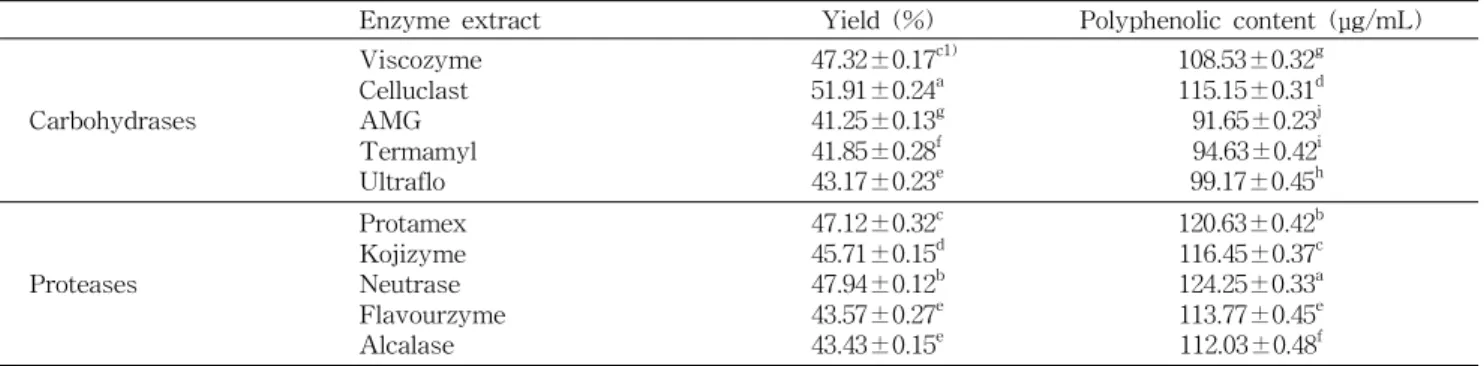
각 효소적 추출물의 유효성분 즉, 수율은 Table 3에 나타 내었다. 모든 추출물에서 40% 이상의 비교적 높은 수율을 보였다. 단백질 분해효소 추출물에서는 Neutrase 추출물이 47.91%, 당 분해효소 추출물에서는 Celluclast 추출물이 51.91%의 가장 높은 수율을 보였다. 이와 같은 결과로 보아 단백질 분해효소 추출물에서는 Neutrase 추출물이, 당 분해 효소 추출물에서는 Celluclast 추출물이 다른 효소 추출물보 다 많은 생리활성물질이 포함되어 있을 것이라 사료된다.
Lee 등(2)의 연구에서도 추출수율이 높은 효소 추출물에서 가장 우수한 항산화활성이 나타났다고 보고되었다.
총 polyphenol 함량
페놀성 물질은 식물계에 널리 분포되어 있는 2차 대사산
물의 하나로서 다양한 구조와 분자량을 가진다. 이들은 phe-
nol hydroxyl기를 가지기 때문에 단백질 및 기타 거대 분자
들과 결합하는 성질을 가지며, 항산화효과 등의 생리활성
기능도 가진다(27). 일반적으로 페놀성 화합물이 항산화작
용을 하는 대표적인 물질로 보고되어 있어 큰잎모자반의 효
소적 추출물에 함유된 페놀성 화합물의 함량을 측정하였다.
각 효소적 추출물의 페놀성 화합물 함량을 측정한 결과는 Table 3과 같다. 단백질분해효소 추출물에서는 Neutrase 추 출물이 0.1242 mg/mL, 당 분해효소 추출물에서는 Celluclast 추출물이 0.1151 mg/mL로 가장 많은 페놀성 화합물을 함유 하였다.
DPPH radical 소거활성
Free radical은 생물학적 손상의 주요 요인으로 알려져 있 고, DPPH는 천연 항산화제의 free radical 소거활성을 평가 하는데 일반적으로 사용된다(28). 따라서 큰잎모자반의 각 효소적 추출물로 DPPH free radical 소거능을 측정한 결과 를 Fig. 1에 나타내었다. 각 효소적 추출물은 90% 전후의 우수한 소거활성을 보였으며, 단백질 분해효소 추출물에서 는 Neutrase 추출물이 92.78%, 당 분해효소 추출물에서는 Celluclast 추출물이 92.42%로서 가장 높은 소거활성을 보였 다. 이러한 소거활성은 이전의 연구에서 보고된 상용되어지 고 있는 항산화제(α-tocopherol, BHA 및 BHT)와 유사한 수준이거나 보다 높은 소거활성을 보여 우수한 항산화력을 가지고 있는 것으로 보인다(29). 이러한 결과는 갈조류인 톳, 감태, 잘록이 고리매를 이용하여 효소적 추출을 통해 얻은 효소 추출물들의 우수한 DPPH radical 소거활성이 보고된 연구결과와 유사하였다(30-32). 또한 DPPH radical에 대한 많은 연구들이 페놀성 화합물과의 긍정적 상호관계를 보고 된 바 있는데(33,34), 이러한 연구결과와 비교하여 볼 때 효 소적 추출물이 유기용매 추출물보다 페놀성 화합물 함량이 낮음에도 불구하고 DPPH radical 소거활성이 높게 나타났 는데, 이러한 결과는 큰잎모자반 효소적 추출물의 유효성을 입증하는 것이라 사료된다.
Hydrogen peroxide 소거활성
Hydrogen peroxide는 체내 각 기관들의 DNA에 심각한 손상을 초래해 각종 질병과 노화를 유발한다고 알려져 있다
NS
Fig. 1. DPPH free radical scavenging activity of enzymatic extracts from Sargassum coreanum (2 mg/mL). V: Viscozyme ext, C: Celluclast ext, AMG: AMG ext, T: Termamyl ext, U:
Ultraflo ext, P: Protamex ext, K: Kojizyme ext, N: Neutrase ext, F: Flavourzyme ext, A: Alcalase ext. NS: not significant.
(35). 이러한 hydrogen peroxide 소거활성을 측정한 결과를 Fig. 2에 나타내었다. 모든 효소적 추출물에서 약 40~60%
의 소거활성을 보였다. 단백질 분해효소 추출물에서는 Neutrase 추출물이 57.97%, 당 분해효소 추출물에서는 Celluclast 추출물이 58.28%의 소거활성으로 가장 높은 소거 활성을 보였는데, Heo 등(22)의 보고에서보다는 비교적 낮 은 활성을 나타내었다. Kim 등(36)은 항산화성의 정도는 식 물의 종류 및 이들에 함유되어 있는 항산화 유효성분의 종류 와 추출방법에 따라 현저한 차이가 있음이 보고된 바 있다.
Metal chelating 활성
Peroxyl과 alkoxyl 라디칼은 분자재구성을 통해 여러 형 태의 과산화물로 전환되고, 그중 지질과산화물은 그 자체로 는 상당히 안정적이나 철이온과 같은 전이금속에 의해 분해 가 촉진되어 생성된 지질과산화 분해산물들은 다양한 유해 작용을 한다고 알려져 있다(37,38). 이와 관련한 metal che- lating 활성을 측정한 결과를 Fig. 3에 나타내었다. 단백질 분해효소 추출물에서는 Neutrase 추출물이 59.51%, 당 분해 효소 추출물에서는 Celluclast 추출물이 48.88%의 소거활성 으로 가장 높은 소거활성을 보였다. Lee 등(39)은 해수 미세
Fig. 2. Hydrogen peroxide scavenging activity of enzymatic extracts from Sargassum coreanum (2 mg/mL). Abbreviations are the same as in Fig. 1. Means with different letters are sig- nificantly different (p<0.05).
Fig. 3. Metal chelating activity of enzymatic extracts from
Sargassum coreanum (2 mg/mL). Abbreviations are the same
as in Fig. 1. Means with different letters are significantly different
(p<0.05).
조류를 이용한 효소적 추출물에서 우수한 metal chelating 활성을 보고한 바 있고, 이는 친수성 성분들에 의한다고 하 였다.
요 약
본 연구에서는 제주 연안에 서식하는 갈조류 중 큰잎모자 반의 항산화활성을 확인하기 위하여 큰잎모자반으로부터 효소적 가수분해를 이용하여 추출물을 제조한 후 이들로부 터 활성산소종의 소거활성을 확인하였다. 여기서 효소적 가 수분해를 이용하여 제조된 큰잎모자반의 효소적 추출물은 항산화활성이 우수하였으며, 효소적 추출물간의 유의적 차 이는 없었다. 또한 단백질 분해효소 추출물에서는 Neutrase 추출물이 항산화 활성이 우수하였으며, 당 분해효소 추출물 에서는 Celluclast를 이용하여 제조된 효소적 추출물이 다소 우수한 항산화효과를 나타내었다. 이와 같은 결과는 여러 가지 효소들이 복합되어진 효소가 세포벽에 있는 섬유질이 나 당단백질 혹은 알긴산 고분자물질 등을 분해시키는 작용 을 유도하였기 때문이라고 사료된다. 따라서 수용성의 추출 물은 유기용매 추출물의 단점을 보완할 수 있을 뿐만 아니라 큰잎모자반 효소적 추출물의 생리활성물질은 식품을 포함 한 다양한 분야에 응용시킬 수 있을 것으로 사료되며, 이상 의 결과로 큰잎모자반은 잠재적인 기능성식품 소재로서의 가능이 충분하다고 판단된다.
문 헌