Efficacy and safety of a switch from twice- daily tacrolimus to once-daily generic
tacrolimus in stable liver transplant patients
Jong Man Kim
1, Pyoung-Jae Park
2,3, Geun Hong
4, Dong Jin Joo
5, Kwan Woo Kim
6, Je Ho Ryu
7, Young Seok Han
8, Jai Young Cho
9, Gi-Won Song
10, Bong-Wan Kim
11, Dong-Sik Kim
2, Seong Hoon Kim
12, Sang Tae Choi
13, Young Kyoung You
14, Kyung-Suk Suh
15, Yang-Won Na
16, Koo Jeong Kang
17, Jae-Won Joh
11Department of Surgery, Samsung Medical Center, Sungkyunkwan University School of Medicine, Seoul, Korea
2Department of Surgery, Korea University College of Medicine, Seoul, Korea
3Department of Surgery, Korea University Guro Hospital, Seoul, Korea
4Department of Surgery, Ewha Woman's University School of Medicine, Seoul, Korea
5Department of Surgery, Yonsei University College of Medicine, Seoul, Korea
6Department of Surgery, Dong-A University Hospital, Dong-A University College of Medicine, Busan, Korea
7Department of Surgery, Pusan National University College of Medicine, Busan, Korea
8 Department of Surgery, Kyungpook National University Hospital, School of Medicine, Kyungpook National University, Daegu, Korea
9 Department of Surgery, Seoul National University Bundang Hospital, Seoul National University College of Medicine, Seongnam, Korea
10Department of Surgery, Asan Medical Center, University of Ulsan College of Medicine, Seoul, Korea
11 Division of Hepatobiliary Surgery and Liver Transplantation, Department of Surgery, Ajou University School of Medicine, Suwon, Korea
12Center for Liver Cancer, National Cancer Center, Goyang, Korea
13 Department of Surgery, Gachon University Gil Medical Center, Gachon University College of Medicine, Incheon, Korea
14Department of Surgery, College of Medicine, The Catholic University of Korea, Seoul, Korea
15Department of Surgery, Seoul National University College of Medicine, Seoul, Korea
16Department of Surgery, Ulsan University Hospital, University of Ulsan College of Medicine, Ulsan, Korea
17 Department of Surgery, Keimyung University Dongsan Hospital, Keimyung University School of Medicine, Daegu, Korea
Background: Once-daily tacrolimus reduces non-compliance relative to twice-daily tacrolimus. However, little is known about the safety and efficacy of conversion from twice-daily tacrolimus to generic once-daily tacrolimus in liver transplantation (LT).
Herein, we investigated the efficacy and safety of a switch from twice-daily tacrolimus to generic once-daily tacrolimus in patients with stable liver graft function.
Methods: This prospective, multicenter, open-label, single-arm study was conducted in 17 medical centers for 1 year from July 2019 to July 2020 (NCT04069065). Primary end- point was the incidence of biopsy-proven acute rejection (BPAR) for 24 weeks after con- version. Secondary endpoints were graft failure, patient death, and adverse events (AEs).
Results: Of 151 screened LT patients, 144 patients were enrolled. BPAR, graft failure, and patient death did not occur in this patient population. There were no statistical dif- ferences in blood tests, liver function tests, or biochemical tests between visits in any of the patients. Median tacrolimus trough level decreased abruptly from 4.7 ng/mL to 3.2 ng/mL after generic once-daily tacrolimus conversion, but median tacrolimus dose in- creased due to low tacrolimus trough level. Ninety-two adverse events occurred in 54 pa- tients. Liver enzyme levels increased in seven patients (4.9%) after the switch to generic once-daily tacrolimus, but the liver function tests of these patients normalized thereafter.
There were three cases of severe AEs not related to investigational drug.
Conclusions: Present study suggests that conversion from twice-daily tacrolimus to ge- neric once-daily tacrolimus is effective and safe in stable LT patients.
Keywords: Tacrolimus; Liver transplantation; Therapeutic equivalence; Immunosuppression
Received May 24, 2021 Revised August 27, 2021 Accepted September 9, 2021 Corresponding author: Jae-Won Joh Department of Surgery, Samsung Medical Center, Sungkyunkwan University School of Medicine, 81 Irwon-ro, Gangnam-gu, 06351 Seoul, Korea
Tel: +82-2-3410-3466 Fax: +82-2-3410-0040 E-mail: [email protected]
© The Korean Society for Transplantation This is an Open Access article distributed under the terms of the Creative Commons Attribution Non-Commercial License (http://creativecommons.org/licenses/
by-nc/4.0/) which permits unrestricted non-commercial use, distribution, and reproduction in any medium, provided the original work is properly cited.
pISSN 2671-8790
eISSN 2671-8804
INTRODUCTION
Tacrolimus is an effective immunosuppressant in liv- er transplantation (LT) and is most often prescribed as twice-daily immediate-release tacrolimus [1-3]. Once-daily extended-release tacrolimus was developed to enhance adherence to treatment because nonadherence is a com- mon and major cause of transplant failure [4,5]. The formu- lation of once-daily extended-release tacrolimus with ethyl cellulose and hypromellose results in a prolonged drug release profile after administration [6,7]. In addition, the re- lease of tacrolimus typically occurs more distally along the gastrointestinal tract, which results in slower absorption kinetics of tacrolimus compared with twice-daily imme- diate-release tacrolimus [6,7]. Several studies performed in Korean populations have shown comparable systemic drug exposure, as well as efficacy and safety profiles, after 1:1 (mg:mg) dose conversion from twice-daily tacrolimus to once-daily extended-release brand-name tacrolimus in stable liver transplant recipients [8-11].
The cost of immunosuppressants and care in trans- plant patient remains high despite efforts to reduce these costs [12]. The patent for tacrolimus expired in 2008. Since then, generic tacrolimus, which has met all standards for bioequivalence and is therapeutically equivalent to brand- name tacrolimus, has been introduced worldwide [13,14].
Generic tacrolimus is now widely prescribed for liver trans- plant recipients in many countries.
Tacrobell (Chong Kun Dang Pharmaceutical, Seoul, Ko- rea) is a generic formulation of twice-daily tacrolimus that was approved in 2004 by the Korea Ministry of Food and Drug Safety (KMFDS) [15]. The criteria for approval of a ge- neric formulation by the KMFDS are similar to those of the U.S. Food and Drug Administration and the European Me- dicinal Agency [16]. The KMFDS requires the manufacturer to conduct a bioequivalence study in healthy volunteers as a clinical trial [15-17]. Twice-daily generic tacrolimus was
demonstrated to be safe and effective for LT patients in Korea [15,17,18].
However, the efficacy and safety of generic once-daily tacrolimus, Tacrobell SR (Chong Kun Dang Pharmaceuti- cal), for adult LT patients in Korea have not yet been report- ed. We therefore investigated the impact of transition from twice-daily tacrolimus to generic once-daily tacrolimus in patients with a stable liver graft.
METHODS Study Design
This prospective, multicenter, single-arm group study was conducted in 17 medical centers for one year from July 2019 to July 2020. Written informed consent was obtained from all patients following approval from each institute’s Institutional Review Board (IRB No. SMC-2019-05-006). All participants received generic once-daily tacrolimus from twice-daily tacrolimus. This study was registered at Clini- calTrial.gov (NCT04069065).
Patients
Study participants had received a first LT from living or deceased donors more than one year prior to the start of this study. Inclusion criteria were: age ≥20 years, use of twice-daily tacrolimus at screening, stable kidney function (serum creatinine level, ≤2.0 mg/dL), stable liver function (serum aspartate aminotransferase [AST] and alanine aminotransferase [ALT] levels within normal ranges), and maintenance of the same immunosuppressive dosing regimen more than 1 month before enrollment. Patients who received any drugs known to interfere with tacrolimus pharmacokinetics and those enrolled in other immunosup- pressant study protocols were not eligible for the study.
Exclusion criteria included non-Korean, multiorgan recip- ients or a previous transplant of any organ; liver donated after cardiac death; trough level of tacrolimus at screening
≤2 ng/mL; an acute rejection episode within 6 months be- fore enrollment; leukopenia (<1,500/mm
3) and/or serum creatinine > 2.0 mg/dL prior to enrollment; use of any oth- er investigational drug within 4 weeks before screening; a history of malignancy other than hepatocellular carcinoma (HCC) or skin cancer; donor with positive hepatitis B sur- face antigen (HBsAg) liver graft; positive HIV status of do- nor or recipient; history of liver support system; unstable concurrent medical condition; presence of severe gastro- HIGHLIGHTS
• Biopsy-proven acute rejection, graft failure, and pa- tient death did not occur after conversion to generic once-daily tacrolimus in stable liver transplant patients.
• Therefore, present study suggests that switch from
twice-daily tacrolimus to generic once-daily tacrolimus
is effective and safe.
intestinal complications such as diarrhea or severe peptic ulcer disease at screening; clinically significant infection;
women of childbearing potential unwilling to use an effec- tive form of contraception for the duration of the study;
women who were pregnant or lactating; persons unable to communicate because of psychological problems.
Tacrolimus Concentrations
Once-daily tacrolimus was administered at 8 AM, and the dose was adjusted according to the daily trough level of the drug (C0 or Cmin). Trough levels of tacrolimus were measured by liquid chromatography-tandem mass spec- trometry using a Waters 2795 Alliance HT system (Waters Ltd., Watford, UK) and a Micromass Quattro Micro API mass spectrometer (Waters Corp., Milford, MA, USA).
Before and after conversion, all tacrolimus doses were ad- justed according to the trough level of the drug to obtain a therapeutic window of 2–8 ng/mL.
Immunosuppression
Immunosuppressive therapy after LT was based on the combination of calcineurin inhibitor (tacrolimus) and/or mycophenolate mofetil. All patients were converted to once-daily generic tacrolimus on a 1:1 mg basis for the total daily dose. However, some dose adjustments were permitted depending on the patient’s condition, and other immunosuppressants were allowed to be used according to standard practice at scheduled every visit. Serum trough levels of tacrolimus and clinical assessments for safety and rejection were completed four weeks after the conver- sion; then, parameters were evaluated routinely according to the patient follow-up schedules. Doses of tacrolimus at baseline and during follow-up were adjusted on an individ- ual basis according to the serum trough level of the drug.
Assessment
Study visits took place within 4 weeks before enrollment (screening), at enrollment (visit 1), and at 2 weeks (visit 2), 4 weeks (visit 3), 12 weeks (visit 4), and 24 weeks (visit 5) after enrollment. At each visit, a complete physical exam- ination was performed, laboratory values indicative of kid- ney and liver function were assessed, and hematology pa- rameters and trough levels of tacrolimus were measured.
Blood pressure, weight, and any problems between visits were documented. We examined renal function based on serum creatinine level and the estimated glomerular filtra- tion rate (eGFR) calculated using the modification of diet in renal disease (MDRD) formula [19]. Drug compliance
was measured by the oral pill counts returned of the pre- scribed drug. Data were recorded, entered into an electron- ic database, and re-evaluated by external monitors. Study monitoring and database analyses were performed, and all adverse and serious adverse events were documented.
Endpoints
Primary efficacy endpoint was biopsy-proven acute rejec- tion (BPAR) and secondary endpoints were graft failure, patient death, and adverse events (AEs) until 24 weeks after enrollment. Allograft loss was presumed to have occurred if a patient required re-transplantation. Safety assessments included incidences of AEs and serious AEs (SAEs). Serial laboratory results and the proportion of pa- tients with clinically notable abnormalities were reported.
Statistical Analysis
Previous clinical trial of once-daily tacrolimus reported that the failure rate of efficacy in once-daily tacrolimus was 22.4% [20]. Based on the results of this study, the tolerance for non-inferiority was set at 11.2% compared with 50% of the control effect. A sample size of 146 for a single-arm group was determined to be required to assess the primary endpoint assuming a one-sided significance level (α) of 2.5%, power of 80%, 11.2% non-inferiority com- pared with 50% of the control effect based on previous study, and a 25% dropout rate. Statistical analyses were conducted using IBM SPSS ver. 22.0 (IBM Corp., Armonk, NY, USA). Data are expressed as medians and ranges or as frequencies (percentages). Categorical variables were an- alyzed using the chi-square test or Fisher’s exact test and continuous variables were analyzed using the Mann Whit- ney U-test. In the present study, P-values of <0.05 were considered significant.
RESULTS Baseline Characteristics
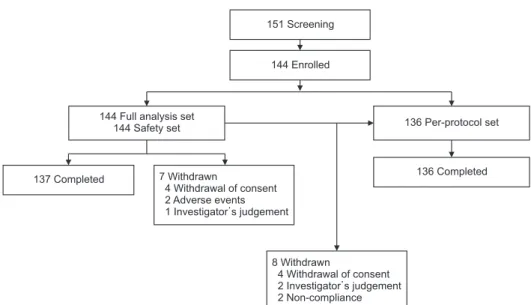
Out of 151 screened liver transplant patients, 144 patients
were enrolled; they comprised the full-analysis set (FAS)
population. Two patients in the FAS were excluded due to
protocol violation and eight patients were excluded in the
per-protocol set (PPS) due to withdrawal of consent, in-
vestigator’s judgement, and non-compliance. Investigator
judgement cases (n=2) are cases in which it is difficult to
participate in the study. Bone metastasis due to recurrent
HCC was diagnosed in one case and the other case was not suitable for the study because of high ALP due to bili- ary complications. Non-compliance cases were two cases.
One participant took twice-daily tacrolimus after once-dai- ly conversion. The other participant was injected with the contraindicated drug herpes zoster vaccine. A total of 142 patients in the FAS and 136 patients in the PPS completed the study follow-up and the study drug regimen (Fig. 1).
Baseline characteristics of patients at screening are summarized in Table 1. Most patients were male (70.8%, n=102) and the median age of patients was 58 years (range, 22–75 years). The incidence of living donor LT (LDLT) was higher than that of deceased donor LT (DDLT) (58.3% vs. 41.7%, respectively). The median model for end- stage liver disease (MELD) score was 16 (range, 6–40).
The reason for the LT was HBV in more than half of the patients (52.8%, n=76), and 67.4% (n=97) of patients had the coexistence of HCC in explant liver. The incidence of ABO-incompatible (ABOi) LDLT was 11.1% (n=16). Median time from LT to screening was 3 years (range, 1–12 years).
One patient had positive HBsAg and six patients had posi- tive anti- HCV immunoglobulin G (anti-HCV IgG) at screen- ing. However, no patients were positive for HBV DNA or HCV RNA.
Compliance and Trough Level of Tacrolimus
Median blood trough levels of mycophenolate mofetil at screening time, enrollment, 2, 4, 12, and 24 weeks in the FAS population are shown in Fig. 2, and median doses of tacrolimus at the same time points are shown. Median tac-
Table 1. Baseline characteristicsLiver transplantation Value
Etiology
HBV 76 (52.8)
Alcoholics 28 (19.4)
NBNC 33 (23.6)
HCV 2 (1.4)
Others 5 (3.5)
Co-existence of HCC 97 (67.4)
MELD score 16 (6–40)
Type of liver transplantation
LDLT 84 (58.3)
DDLT 60 (41.7)
ABO-incompatible LDLT 16 (11.1)
Screening
Sex (male) 102 (70.8)
Age (yr) 58 (22–75)
Body mass index (kg/m
2) 23.5 (16.5–31.4)
HBsAg (positive) 1 (0.7)
Anti-HCV (positive) 6 (4.2)
Period after liver transplantation (yr) 3 (1–12)
1–2 23 (16.0)
2–5 46 (31.9)
5–10 52 (36.1)
>10 23 (16.0)
Values are presented as number (%) or median (range).
HBV, hepatitis B virus; NBNC, non-B, non-C hepatitis; HCV, hepatitis C virus; HCC, hepatocellular carcinoma; MELD, model for end-stage liver disease; LDLT, living donor liver transplantation; DDLT, deceased donor liver transplantation; HBsAg, hepatitis B surface antigen.
151 Screening
144 Enrolled
144 Full analysis set
144 Safety set 136 Per-protocol set
137 Completed 7 Withdrawn
4 Withdrawal of consent 2 Adverse events 1 Investigator s judgement
8 Withdrawn
4 Withdrawal of consent 2 Investigator s judgement 2 Non-compliance
136 Completed
Fig. 1. Patient distribution and study popu-
lation.
rolimus trough level decreased abruptly from 4.7 ng/mL at visit 1 to 3.2 ng/mL at visit 2 after once-daily generic tacro- limus conversion (P<0.001). Median tacrolimus dose from visit 2 to visit 3 increased due to low tacrolimus trough level. Median tacrolimus trough level and tacrolimus dose were maintained at constant levels after visit 3.
Participants with less than 80% compliance were con- sidered low compliance patients and were excluded from the PPS. Median compliance of all participants was 100%
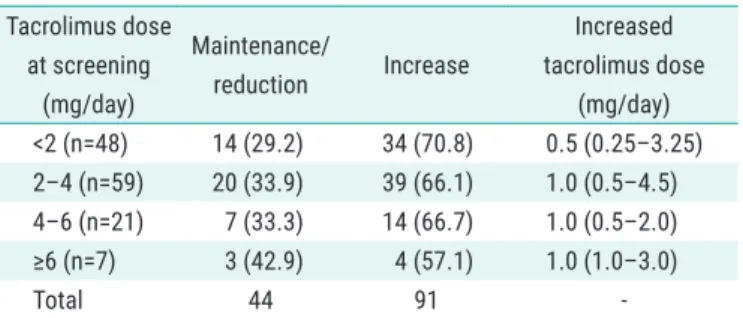
(range, 80.4%–106.0%), and none of the participants had less than 80% compliance. Of the 128 patients in the PPS who received a tacrolimus dose <6 mg/day at screening,
the dose for about 70% of patients was increased (Table 2).
Efficacy
BPAR, graft failure, and patient death did not develop in the PPS. median total bilirubin, AST, and ALT did not increase even though tacrolimus trough level decreased in visit 2 compared to visit 1 after generic once-daily tacrolimus conversion. Median total bilirubin, AST, and ALT did not in- crease after visit 3 (Table 3). In addition, median creatinine and eGFR levels remained stable even when tacrolimus dose and trough level increased.
Safety
Ninety-two AEs occurred in 54 patients (Table 4). A total of nine adverse drug reactions, including elevated liver enzymes, were reported in seven patients (4.9%) for which
Visit 1 (allocation) 5.0
4.0
3.0
2.0
1.0
0
Tumor
Tacrolimus (ng/mL) Dose (mg/day) Tacrolimus (n=144)
Visit 2 (2 wk)
Visit 3 (4 wk)
Visit 4 (12 wk)
Visit 5 (24 wk) 4.7
2.0
3.2
2.0
3.9
2.5
3.9
2.5
4.0
2.5
Fig. 2. Median trough level and median dose of tacrolimus at each visit.
Table 2. Tacrolimus dose change after extended-release tacrolimus
conversion
Tacrolimus dose at screening
(mg/day)
Maintenance/
reduction Increase
Increased tacrolimus dose
(mg/day)
<2 (n=48) 14 (29.2) 34 (70.8) 0.5 (0.25–3.25) 2–4 (n=59) 20 (33.9) 39 (66.1) 1.0 (0.5–4.5) 4–6 (n=21) 7 (33.3) 14 (66.7) 1.0 (0.5–2.0)
≥6 (n=7) 3 (42.9) 4 (57.1) 1.0 (1.0–3.0)
Total 44 91 -
Values are presented as number (%) or median (range).
Table 3. Laboratory findings at regular visits
Variable Visit 1
(allocation, n=150)
Visit 2 (2 wk, n=141)
Visit 3 (4 wk, n=140)
Visit 4 (12 wk, n=137)
Visit 5 (24 wk, n=137) White blood cell (/uL) 4.9 (2.0–10.4) 5.2 (2.4–10.4) 5.3 (1.6–11.3) 5.3 (2.6–11.3) 5.3 (2.0–10.9) Hemoglobin (g/dL) 14.1 (9.1–18.5) 14.3 (9.1–18.5) 14.4 (9.2–19.5) 14.5 (8.5–18.9) 14.4 (8.7–18.3)
Platelet count (/uL) 174 (55–309) 175 (43–320) 177 (46–315) 179 (45–316) 171 (58–302)
BUN (mg/dL) 16.7 (8–37) 16 (6–38) 17.4 (8–37) 16 (6.1–48.5) 17 (6.1–57.4)
Creatinine (mg/dL) 1.0 (0.6–1.8) 1.0 (0.6–2.1) 1.0 (0.6–1.9) 1.0 (0.6–2.1) 1.0 (0.6–1.8)
eGFR (mL/min/1.73m
2) 75 (37–127) 72 (33–127) 75 (35–121) 72 (32–121) 73 (29–148)
Glucose (mg/dL) 111 (75–289) 110 (50–239) 110 (71–272) 111 (80–229) 110 (78–247)
HbA1c (%) 5.6 (4.1–8.7) - - 5.6 (4.3–9.9) 5.7 (4.3–9.5)
AST (U/mL) 23 (11–96) 23 (10–264) 23 (12–116) 23 (12–273) 24 (12–142)
ALT (U/mL) 18 (6–129) 19 (6–425) 18 (6–200) 21 (5–173) 20 (6–133)
Total bilirubin (mg/dL) 0.8 (0.3–2.7) 0.8 (0.2–3.0) 0.8 (0.2–2.3) 0.8 (0.2–2.6) 0.8 (0.3–2.6)
Potassium (mEq/L) 4.5 (3.4–5.8) 4.5 (3.6–5.7) 4.6 (3.5–5.8) 4.5 (3.5–6.0) 4.4 (3.5–6.0)
Phosphorous (mg/L) 3.1 (2.1–4.5) 3.1 (1.9–4.5) 3.0 (1.9–4.6) 3.1 (1.8–4.4) 3.1 (1.4–4.5)
Uric acid (mg/dL) 5.8 (2.8–11.5) 5.7 (2.7–11.1) 5.6 (2.8–10.0) 5.5 (2.8–10.7) 5.5 (1.9–9.2)
BUN, blood urea nitrogen; eGFR, estimated glomerular filtration rate; HbA1c, hemoglobin A1c; AST, aspartate transaminase; ALT, alanine transaminase.
a causal relationship with the investigational drug could not be excluded. There were three cases of severe AEs (cerebral infarction, incisional hernia, and intestinal ob- struction) unrelated to the investigational drug. There was no change in tacrolimus dose in the three cases of severe adverse events. Incisional hernia and intestinal obstruction
were recovered by surgery, and the symptoms of cerebral infarction patients improved with active drug treatment in the early stages. Liver enzyme levels increased in seven patients after the switch to generic once-daily tacrolimus switch, but the liver function tests of these patients nor- malized during tacrolimus dose increase or observation.
Visit 1 (allocation) 6
5 4 3 2 1 0
ABOi ABOc
A
Visit 2 (2 wk)
Visit 3 (4 wk)
Visit 4 (12 wk)
Visit 5 (24 wk)
Visit 1 (allocation) 26
25 24 23 22 21 20 19
B
Visit 2 (2 wk)
Visit 3 (4 wk)
Visit 4 (12 wk)
Visit 5 (24 wk)
ABOi ABOc
Visit 1 (allocation) 25
20
15
10
5
0
C
Visit 2 (2 wk)
Visit 3 (4 wk)
Visit 4 (12 wk)
Visit 5 (24 wk)
ABOi ABOc
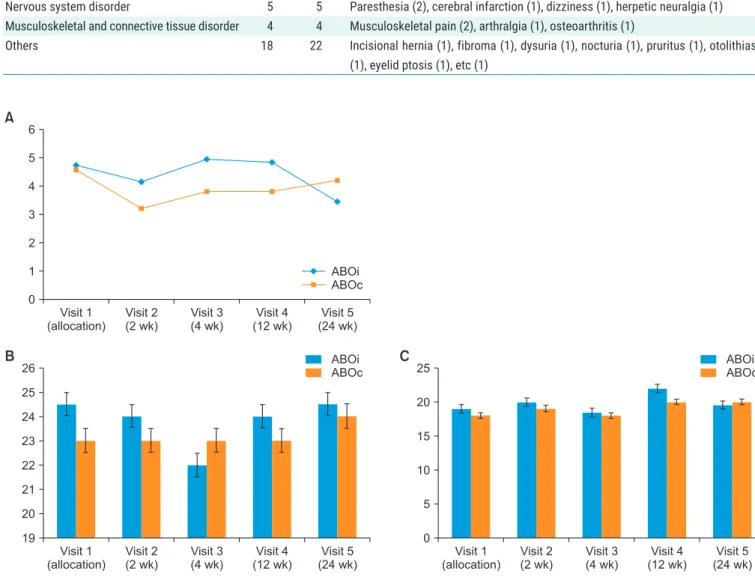
Fig. 3.
ABO-incompatible (ABOi) living donor liver transplantation and ABO-compatible (ABOc) liver transplantation. (A) Tacrolimus trough level. (B) Aspartate aminotransferase. (C) Alanine aminotransferase.
Table 4. Detailed adverse events