DOI 10.17480/psk.2016.60.2.58
초음파 처리 인삼열매 엑스의 인삼사포닌 변화
홍정태 · 남윤민 · 김신정* · 고성권# 세명대학교 한방식품영양학부, *고연 인삼연구소
(Received December 21, 2015; Revised March 7, 2016; Accepted March 7, 2016)
The Change of Ginsenoside Composition in Ginseng Berry Extract by the Ultrasonication Process
Jeong Tae Hong, Yun Min Nam, Shin Jung Kim* and Sung Kwon Ko# Department of Oriental Medical Food & Nutrition, Semyung University, Jecheon 390-711, Korea
*Ginseng Research Center, Koyeon, Jecheon 390-711, Korea
Abstract — The purpose of this study is to develop a new preparation process of ginseng berry extracts having high con- centrations of ginsenoside Rh1, Rg2, Rg5, F4, a special component of red and black ginseng. Chemical transformation from ginseng saponin glycosides to prosapogenin was analyzed by the HPLC. Extracts of ginseng (Panax ginseng) berry was pro- cessed under several treatment conditions including ultrasonication treatments. The content of total saponin reached their heights at 6 hr (UGB-6, 61.760%) of ultrasonication treatment, followed by 10 hr (UGB-10, 53.009%) and 9 hr (UGB-9, 50.652%) of ultrasonication treatment at 100oC. Results of those treatments showed that the quantity of ginsenoside Rh1 increased by over 15% at 10 hr of ultrasonication treatment at 100oC. The results of processing with UGB-10 indicate that the ultrasonication processed ginseng berry extracts that had gone through 10 hr treatments were found to contain the larg- est amount of ginsenoside Rh1 (15.358%), Rg2 (6.301%), Re (4.567%) and F4 (2.658%). In addition, UGB-6 contained gin- senoside Rg3 (13.632%) at high concentrations. It is thought that such results provide basic information in preparing ginseng berry extracts with functionality enhanced.
Keywords □ ginseng berry, Re, Rg2, Rh1, ultrasonication
인삼(Panax ginseng C. A. Meyer)은 식의약으로 오래전부터 사용하여온 생약으로 인삼사포닌, 단백질, 다당체, 폴리아세칠렌, 페놀성 물질 등을 함유한다. 특히, 인삼사포닌은 주요한 생리활 성물질로서 ginsenoside라고 불리우고, 다양한 약리작용이 보고 되었다.1-4)또한, 인삼열매에는 ginsenoside Rb1, Rb2, Rd, Re, Rg1, Rg2 그리고 Rh15)을 함유하고, 항당뇨작용,2)항비만작용,6) 항노화작용,7)항스트레스작용,8)항알러지작용,9)항암작용10)등 이 보고되었다. 그중에서도, ginsenoside Re는 건조된 인삼열매 의 약 6% 정도 함유되어있는 주성분으로 물리화학적 가수분해 에 의하여 ginsenoside Rg2와 Rh1과 같은 생리활성 강화 성분
으로 화학전환될 수 있다.5)
한편, Wu 등11)은 인삼에 초음파처리를 통하여 인삼사포닌을 3배 빠르게 추출할 수 있다고 보고하였고, 곽 등12)은 인삼화뢰에 식초를 가하고, 100oC에서 초음파처리함으로써, prosapogenin 성 분 고농도 함유 조성물 제조에 대하여 보고하였다.
따라서, 본 연구는 초음파를 이용하여 인삼열매의 인삼사포닌 배당체 성분을 인삼 프로사포게닌 성분으로 화학 전환하여 프로 사포게닌 고농도 함유 조성물을 개발하고자 한다. 구체적으로는 인삼열매 엑스에 증류수를 가하고 100oC에서 초음파 처리를 실 시하여 ginsenoside Rg2, Rh1, F4와 같은 활성형 프로사포게닌 을 고농도로 함유하는 최적 처리 조건을 탐색하고자 한다.
실험재료 및 방법
실험재료
4년생 인삼(재배지: 충청북도 음성군, 재배자: 남성엽)으로부터
#
Corresponding Author Sung Kwon Ko
Department of Oriental Medical Food & Nutrition, Semyung University, Jecheon 390-711, Korea
Tel.: 043-649-1433 Fax.: 043-649-1759 E-mail: [email protected]
Short Report
종설완숙한 열매를 2013년 8월 20일 채취하였으며, 시료 표본은 세 명대학교 한방식용식물학 연구실에 보관(표본번호: GBE-130820) 하고 있다(Fig. 1 참조).
에탄올 엑스의 조제
완숙한 인삼열매를 분쇄하여 드라이 오븐에서 건조(70oC)하고, 세말한후, 정확히 측량한 시료 5 kg에 10 l의 에탄올(EtOH)을 넣 고, 2시간 4회 반복 추출한 후, 여과(여과지: Nylon membrane filters 7404-004; Whatman, Dassel, Germany)하고 감압농축하 여 에탄올 엑스(GB)를 얻었다.
초음파 처리 인삼열매 엑스 조제
위에서 얻은 에탄올 엑스 1.5 kg과 20 l의 증류수를 초음파 처 리기(KODO, Hwaseong, Korea, 출력 1,200 W, 주파수 28 KHz) 에 넣고, 100oC에서 1시간(UGB-1), 2시간(UGB-2), 3시간(UGB- 3), 4시간(UGB-4), 5시간(UGB-5), 6시간(UGB-6), 7시간(UGB- 7), 8시간(UGB-8), 9시간(UGB-9), 10시간(UGB-10), 11시간 (UGB-11), 12시간(UGB-12), 13시간(UGB-13), 14시간(UGB- 14), 15시간(UGB-15), 16시간(UGB-16), 17시간(UGB-17), 18시 간(UGB-18), 19시간(UGB-19), 그리고 20시간(UGB-20) 처리하 여 초음파 처리 인삼열매 엑스를 얻었다.
조사포닌 조제13)
초음파 처리 인삼열매 엑스 각 2 g에 디에틸에테르(diethylether) 50 ml를 가하여 1시간씩 3회 초음파 세정기(고도기업, 4020P, 한 국)로 추출한 후, 원심분리 하여 상등액을 제거한다. 얻은 잔사 에 수포화 부탄올(butanol) 50 ml를 가하여 2시간씩 3회 추출하 고, 원심분리 하여 상등액을 취하여 여과하고, 감압 농축을 하여 조사포닌을 얻었다.
인삼사포닌 분석(HPLC법)
위에서 얻은 엑스를 이 등13)의 조건을 응용하여 HPLC를 실 시하고, 상법에 따라 표품과 직접 비교하여 인삼사포닌의 함량 및 조성을 각 시료당 3회 반복 실험하여 결과의 재현성을 확인 하여 분석하였다. 표품은 Chromadex(USA)와 엠보연구소(Korea)
로부터 구입한 순도 99% 이상의 ginsenoside를 사용하였다.
사용한 HPLC 장치는 Waters 1525 binary HPLC system (Waters, Milford, MA, USA)이며, 컬럼은 Eurospher 100-5 C18(3×250 mm; Knauer, Germany)을 사용하였다. 이동상은 acetonitrile(HPLC grade; Sigma-Aldrich Chem Co., USA)과 증류수(HPLC급, B&J, USA)이며, acetonitrile의 비율을 17%
(0 min)에서 25%(25 min), 40%(50 min), 60%(105 min) 그리고 100%(110 min)로 순차적으로 늘려주고 마지막으로 다시 17%로 조절하였다. 전개온도는 실온, 유속은 분당 0.8 ml, 크로마토그램 은 uv/vis Waters 2487 Dual λ Absorbance Detector(Waters, U.S.A.) 검출기를 이용하여 203 nm에서 검출하였다.
결과 및 고찰
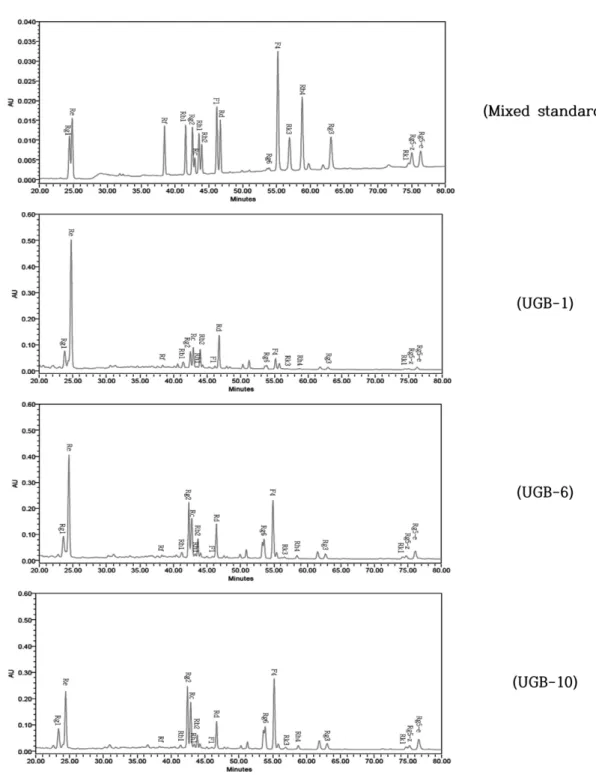
인삼열매 엑스에 증류수를 가하고 100oC에서 초음파 처리를 실시하여 ginsenoside Rg2, Rh1, F4와 같은 활성형14)프로사포 게닌을 고농도로 함유하는 조성물을 개발하고자 하였다. 인삼사 포닌 성분분석은 Fig. 2에서 보는 바와 같이, ginsenosides Rb1, Rb2, Rc, Rd, Re, Rf, Rg1, Rg2, Rg3, Rg5, Rg6, Rh1, Rh4, Rk1, Rk3, F1 그리고 F4를 대상으로 HPLC법으로 검토하였다.
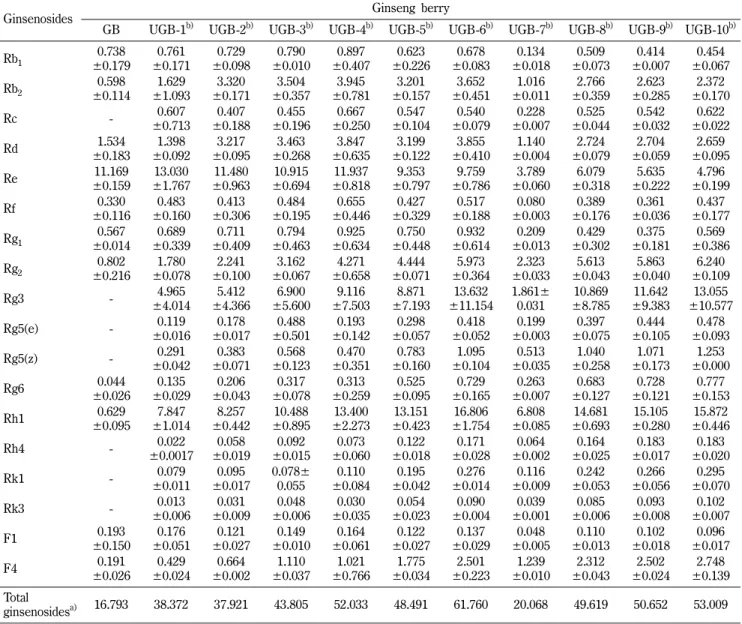
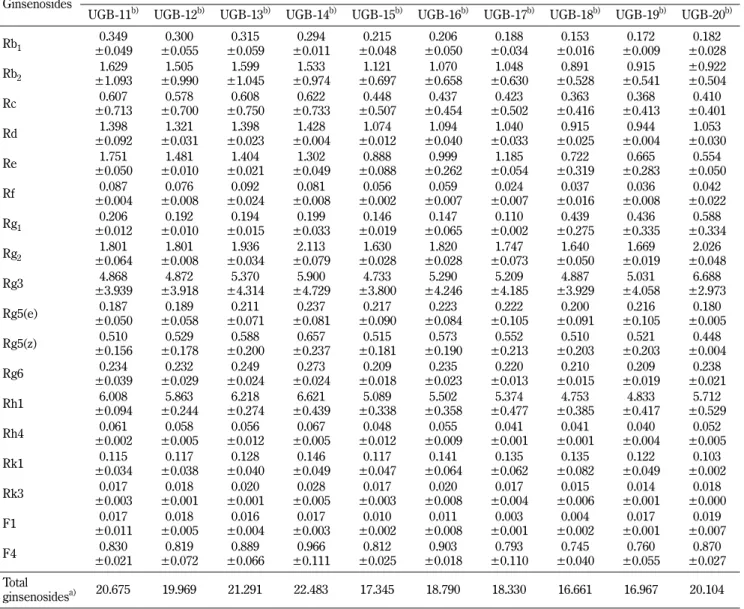
Table I에서와 같이 각 진세노사이드의 총합인 총사포닌(total saponin) 함량에 있어서는 UGB-6이 61.760%이었으며 UGB-10 은 53.009%이었으며, UGB-9는 50.652%로서 초음파 6시간 처 리 인삼열매 엑스의 총사포닌이 높은 함량을 보여주었다. UGB- 6의 총사포닌 함량은 인삼열매 에탄올 엑스(GB, 16.793%)에 비 하여 약 3.7배 높은 함량을 보여주었다. 이와 같은 결과는 초음 파 처리에 의하여 추출 수율도 높아졌음을 확인할 수 있었다.
인삼사포닌 배당체는 열이나, 산(acid)에 의해서 프로사포게닌 성분으로 화학전환되어 생리활성이 높아진다고 알려져 있다.
Ginsenoside Re 및 Rg2가 가수분해되어 생성되는 성분으로 항 알러지 작용15)이 보고된 ginsenoside Rh1의 경우, UGB-10이 15.872%로서 가장 높은 함량을 나타내었으며, UGB-9(15.105%), UGB-5(14.681%)의 순으로 높은 함량을 나타내었다. 초음파 10 시간 처리 인삼열매 엑스의 진세노사이드 Rh1의 함량은 인삼열 매 에탄올 엑스(GB, 0.629%)에 비하여 약 25배 높은 함량을 보 여주었고, 김 등의 논문16)에서는 인삼열매 엑스에 20분 초단파 식초 처리를 통하여 1.280%를 함유하는 최적 조건을 확인하였 으나, 본 연구에서는 10시간 초음파 처리 인삼열매 엑스(UGB- 10)가 약 12배 높은 진세노사이드 Rh1 함유량을 보여주었다.
또한, 항암작용,17)혈압강하작용,18)뇌신경세포 보호작용,19)항 혈전작용,20)항산화작용21)을 나타내는 ginsenoside Rg3는 UGB- 6이 13.632%로서 가장 높은 함량을 나타내었으며, UGB-10 (13.055%), UGB-9(11.642%)의 순으로 높은 함량을 나타내었다.
그러나, 인삼열매 에탄올 엑스(GB)에는 함유되어 있지 않았다.
Fig. 1 − Photograph of ginseng berry.
또한, 이와 같은 결과는 UGB-6이 김 등이 보고16)한 초단파 식 초 처리 인삼열매 엑스(0.833%)보다 약 16배 높은 진세노사이드 Rg3 함유량을 보여주었다.
한편, 주름개선작용22)을 나타내는 진세노사이드 Rg2의 함량에 있어서는 UGB-10이 6.240%로서 가장 높은 함량을 나타내었으
며, UGB-6(5.973%), UGB-9(5.863%)의 순으로 높은 함량을 나 타내었다. 이와 같은 결과는 UGB-10이 인삼열매 에탄올 엑스 (GB, 0.802%)에 비하여 약 7.8배 높은 함량을 보여주었고, 김 등 이 보고16)한 초단파 식초 처리 인삼열매 엑스(2.275%)보다 약 2.7배 높은 진세노사이드 Rg2 함유량을 보여주었다.
Fig. 2 − HPLC chromatogram of ginsenosides in the ginseng berry processed with ultrasonication.
항암작용,23)관절연골조직 보호작용24)이 보고된 ginsenoside F4의 경우, UGB-10이 2.748%로 가장 높은 함량을 나타내었으 며, UGB-9(2.502%), UGB-6(2.501%)의 순으로 높은 함량을 나 타내었다. 이와 같은 결과는 UGB-10이 인삼열매 에탄올 엑스 (GB, 0.191%)에 비하여 약 14배 높은 함량을 보여주었고, 김 등 이 보고16)한 초단파 식초 처리 인삼열매 엑스(1.011%)보다 약 2.7배 높은 진세노사이드 F4 함유량을 보여주었다.
한편, Wu 등11)은 인삼에 초음파처리를 통하여 인삼사포닌을 3배 빠르게 추출할 수 있다고 보고하였고, 곽 등12)은 인삼화뢰에 식초를 가하고, 100oC에서 초음파처리함으로써, prosapogenin 성 분 고농도 함유 조성물 제조에 대하여 보고하였다.
따라서, 본 연구를 통하여 인삼열매에 증류수만 가하고, 초음
파처리를 통하여 prosapogenin 성분 고농도 함유 조성물 제조에 대하여는 처음으로 보고하는 것으로 기능성 강화 인삼열매 신소 재 개발이 가능할 것으로 기대된다.
결 론
본 연구를 통하여 인삼열매 엑스에 100oC에서 초음파 10시간 처리시 홍삼특유 기능성분인 ginsenoside Rh1(15.872%), Rg2 (6.240%), F4(2.748%)가 고농도로 함유하는 조성물을 제조할 수 있음을 확인하였고, 6시간 처리 시 ginsenoside Rg3가 13.632%
로 고농도로 함유하는 조성물을 제조할 수 있음을 확인할 수 있 었다.
Table I − Ginsenoside composition of the ginseng berry extracts processed with ultrasonication over time (%, w/w)
Ginsenosides Ginseng berry
GB UGB-1
b)UGB-2
b)UGB-3
b)UGB-4
b)UGB-5
b)UGB-6
b)UGB-7
b)UGB-8
b)UGB-9
b)UGB-10
b)Rb
10.738
±0.179
0.761
±0.171
0.729
±0.098
0.790
±0.010
0.897
±0.407
0.623
±0.226
0.678
±0.083
0.134
±0.018
0.509
±0.073
0.414
±0.007
0.454
±0.067
Rb
20.598
±0.114
1.629
±1.093
3.320
±0.171
3.504
±0.357
3.945
±0.781
3.201
±0.157
3.652
±0.451
1.016
±0.011
2.766
±0.359
2.623
±0.285
2.372
±0.170
Rc - 0.607
±0.713
0.407
±0.188
0.455
±0.196
0.667
±0.250
0.547
±0.104
0.540
±0.079
0.228
±0.007
0.525
±0.044
0.542
±0.032
0.622
±0.022
Rd 1.534
±0.183
1.398
±0.092
3.217
±0.095
3.463
±0.268
3.847
±0.635
3.199
±0.122
3.855
±0.410
1.140
±0.004
2.724
±0.079
2.704
±0.059
2.659
±0.095
Re 11.169
±0.159
13.030
±1.767
11.480
±0.963
10.915
±0.694
11.937
±0.818
9.353
±0.797
9.759
±0.786
3.789
±0.060
6.079
±0.318
5.635
±0.222
4.796
±0.199
Rf 0.330
±0.116
0.483
±0.160
0.413
±0.306
0.484
±0.195
0.655
±0.446
0.427
±0.329
0.517
±0.188
0.080
±0.003
0.389
±0.176
0.361
±0.036
0.437
±0.177
Rg
10.567
±0.014
0.689
±0.339
0.711
±0.409
0.794
±0.463
0.925
±0.634
0.750
±0.448
0.932
±0.614
0.209
±0.013
0.429
±0.302
0.375
±0.181
0.569
±0.386
Rg
20.802
±0.216
1.780
±0.078
2.241
±0.100
3.162
±0.067
4.271
±0.658
4.444
±0.071
5.973
±0.364
2.323
±0.033
5.613
±0.043
5.863
±0.040
6.240
±0.109
Rg3 - 4.965
±4.014
5.412
±4.366
6.900
±5.600
9.116
±7.503
8.871
±7.193
13.632
±11.154
1.861±
0.031
10.869
±8.785
11.642
±9.383
13.055
±10.577
Rg5(e) - 0.119
±0.016
0.178
±0.017
0.488
±0.501
0.193
±0.142
0.298
±0.057
0.418
±0.052
0.199
±0.003
0.397
±0.075
0.444
±0.105
0.478
±0.093
Rg5(z) - 0.291
±0.042
0.383
±0.071
0.568
±0.123
0.470
±0.351
0.783
±0.160
1.095
±0.104
0.513
±0.035
1.040
±0.258
1.071
±0.173
1.253
±0.000
Rg6 0.044
±0.026
0.135
±0.029
0.206
±0.043
0.317
±0.078
0.313
±0.259
0.525
±0.095
0.729
±0.165
0.263
±0.007
0.683
±0.127
0.728
±0.121
0.777
±0.153
Rh1 0.629
±0.095
7.847
±1.014
8.257
±0.442
10.488
±0.895
13.400
±2.273
13.151
±0.423
16.806
±1.754
6.808
±0.085
14.681
±0.693
15.105
±0.280
15.872
±0.446
Rh4 - 0.022
±0.0017
0.058
±0.019
0.092
±0.015
0.073
±0.060
0.122
±0.018
0.171
±0.028
0.064
±0.002
0.164
±0.025
0.183
±0.017
0.183
±0.020
Rk1 - 0.079
±0.011
0.095
±0.017
0.078±
0.055
0.110
±0.084
0.195
±0.042
0.276
±0.014
0.116
±0.009
0.242
±0.053
0.266
±0.056
0.295
±0.070
Rk3 - 0.013
±0.006
0.031
±0.009
0.048
±0.006
0.030
±0.035
0.054
±0.023
0.090
±0.004
0.039
±0.001
0.085
±0.006
0.093
±0.008
0.102
±0.007
F1 0.193
±0.150
0.176
±0.051
0.121
±0.027
0.149
±0.010
0.164
±0.061
0.122
±0.027
0.137
±0.029
0.048
±0.005
0.110
±0.013
0.102
±0.018
0.096
±0.017
F4 0.191
±0.026
0.429
±0.024
0.664
±0.002
1.110
±0.037
1.021
±0.766
1.775
±0.034
2.501
±0.223
1.239
±0.010
2.312
±0.043
2.502
±0.024
2.748
±0.139 Total
ginsenosides
a)16.793 38.372 37.921 43.805 52.033 48.491 61.760 20.068 49.619 50.652 53.009
a) Sum of individual ginsenosides content, b) UGB-1 : ginseng berry extract processed with ultrasonication for 1 hr, Values represent
the mean (%,W/W)±S.E. (n=3).
감사의 말씀
“본 연구는 농림부 고부가가치식품기술개발사업의 지원에 의 해 이루어진 것임”.
References
1) Namba, T. : The encyclopedia of Wakan-Yaku with color pictures, Hoikusha, Osaka, p. 1 (1980).
2) Park, J. D. : Recent studies on the chemical constituents of Korean ginseng (Panax ginseng C. A. Meyer). Korea J. Ginseng Sci. 20, 389 (1996).
3) Sanata, S., Kondo, N., Shoji, J., Tanaka, O. and Shibata, S. : Studies on the saponins of ginseng. I. Structure of ginseng-Ro, Rb1, Rb2, Rc and Rd. Chem. Pharm. Bull. 22, 421 (1974).
4) Kitagawa, I., Taniyama, T., Shibuya, H., Nota, T. and Yoshikawa, M. : Chemical studies on crude drug processing. V. On the constituents of ginseng radix rubra (2) : Comparison of the constituents of white ginseng and red ginseng prepared from the same Panax ginseng root. Yakugaku Zasshi 107, 495 (1987).
5) Ko, S. K., Bae, H. M., Cho, O. S., Im, B. O., Chung, S. H. and Lee, B. Y. : Analysis of ginsenoside composition of ginseng berry and seed. Food Sci. Biotechnol. 17, 1379 (2008).
6) Dey, L., Zhang, L. and Yuan, C. S. : Anti-diabetic and anti-obese
Table I − Continued (%, w/w)
Ginsenosides Ginseng berry
UGB-11
b)UGB-12
b)UGB-13
b)UGB-14
b)UGB-15
b)UGB-16
b)UGB-17
b)UGB-18
b)UGB-19
b)UGB-20
b)Rb
10.349
±0.049
0.300
±0.055
0.315
±0.059
0.294
±0.011
0.215
±0.048
0.206
±0.050
0.188
±0.034
0.153
±0.016
0.172
±0.009
0.182
±0.028
Rb
21.629
±1.093
1.505
±0.990
1.599
±1.045
1.533
±0.974
1.121
±0.697
1.070
±0.658
1.048
±0.630
0.891
±0.528
0.915
±0.541
±0.922
±0.504
Rc 0.607
±0.713
0.578
±0.700
0.608
±0.750
0.622
±0.733
0.448
±0.507
0.437
±0.454
0.423
±0.502
0.363
±0.416
0.368
±0.413
0.410
±0.401
Rd 1.398
±0.092
1.321
±0.031
1.398
±0.023
1.428
±0.004
1.074
±0.012
1.094
±0.040
1.040
±0.033
0.915
±0.025
0.944
±0.004
1.053
±0.030
Re 1.751
±0.050
1.481
±0.010
1.404
±0.021
1.302
±0.049
0.888
±0.088
0.999
±0.262
1.185
±0.054
0.722
±0.319
0.665
±0.283
0.554
±0.050
Rf 0.087
±0.004
0.076
±0.008
0.092
±0.024
0.081
±0.008
0.056
±0.002
0.059
±0.007
0.024
±0.007
0.037
±0.016
0.036
±0.008
0.042
±0.022
Rg
10.206
±0.012
0.192
±0.010
0.194
±0.015
0.199
±0.033
0.146
±0.019
0.147
±0.065
0.110
±0.002
0.439
±0.275
0.436
±0.335
0.588
±0.334
Rg
21.801
±0.064
1.801
±0.008
1.936
±0.034
2.113
±0.079
1.630
±0.028
1.820
±0.028
1.747
±0.073
1.640
±0.050
1.669
±0.019
2.026
±0.048
Rg3 4.868
±3.939
4.872
±3.918
5.370
±4.314
5.900
±4.729
4.733
±3.800
5.290
±4.246
5.209
±4.185
4.887
±3.929
5.031
±4.058
6.688
±2.973
Rg5(e) 0.187
±0.050
0.189
±0.058
0.211
±0.071
0.237
±0.081
0.217
±0.090
0.223
±0.084
0.222
±0.105
0.200
±0.091
0.216
±0.105
0.180
±0.005
Rg5(z) 0.510
±0.156
0.529
±0.178
0.588
±0.200
0.657
±0.237
0.515
±0.181
0.573
±0.190
0.552
±0.213
0.510
±0.203
0.521
±0.203
0.448
±0.004
Rg6 0.234
±0.039
0.232
±0.029
0.249
±0.024
0.273
±0.024
0.209
±0.018
0.235
±0.023
0.220
±0.013
0.210
±0.015
0.209
±0.019
0.238
±0.021
Rh1 6.008
±0.094
5.863
±0.244
6.218
±0.274
6.621
±0.439
5.089
±0.338
5.502
±0.358
5.374
±0.477
4.753
±0.385
4.833
±0.417
5.712
±0.529
Rh4 0.061
±0.002
0.058
±0.005
0.056
±0.012
0.067
±0.005
0.048
±0.012
0.055
±0.009
0.041
±0.001
0.041
±0.001
0.040
±0.004
0.052
±0.005
Rk1 0.115
±0.034
0.117
±0.038
0.128
±0.040
0.146
±0.049
0.117
±0.047
0.141
±0.064
0.135
±0.062
0.135
±0.082
0.122
±0.049
0.103
±0.002
Rk3 0.017
±0.003
0.018
±0.001
0.020
±0.001
0.028
±0.005
0.017
±0.003
0.020
±0.008
0.017
±0.004
0.015
±0.006
0.014
±0.001
0.018
±0.000
F1 0.017
±0.011
0.018
±0.005
0.016
±0.004
0.017
±0.003
0.010
±0.002
0.011
±0.008
0.003
±0.001
0.004
±0.002
0.017
±0.001
0.019
±0.007
F4 0.830
±0.021
0.819
±0.072
0.889
±0.066
0.966
±0.111
0.812
±0.025
0.903
±0.018
0.793
±0.110
0.745
±0.040
0.760
±0.055
0.870
±0.027 Total
ginsenosides
a)20.675 19.969 21.291 22.483 17.345 18.790 18.330 16.661 16.967 20.104
a) Sum of individual ginsenosides content, * b) UGB-11 : ginseng berry extract processed with ultrasonication for 11 hr, Values
represent the mean (%,W/W)±S.E. (n=3).
effects of ginseng berry extract : Comparison between intraperitoneal and oral administrations. Am. J. Chin. Med. 30, 645 (2002).
7) Huo, Y. S. : Anti-senility action of saponin in Panax ginseng fruit in 327 cases. Zhong Xi Yi Jie He Za Zhi 4, 593 (1984).
8) Zhang, S. C. and Jiang, X. L. : The anti-stress effect of saponins extracted from Panax ginseng fruit and the hypophyseal- adrenal system. Yao Xue Xue Bao 16, 860 (1981).
9) Bae, H. M., Cho, O. S., Kim, S. J., Im, B. O., Cho, S. H., Lee, S., Kim, M. G., Kim, K. T., Leem, K. H. and Ko, S. K. : Inhibitory effects of ginsenoside Re isolated from ginseng berry on histamine and cytokine release in human mast cells and human alveolar epithelial cells. J. Ginseng Res. 36, 369 (2012).
10) Wang, W., Zhao, Y., Rayburn, E. R., Hill, D. L., Wang, H. and Zhang, R. : In vitro anti-cancer activity and structure-activity relationships of natural products isolated from fruits of Panax ginseng. Cancer Chemother. Pharmacol. 59, 589 (2007).
11) Wu, J., Lin, L. and Chau, F. T. : Ultrasound-assisted extraction of ginseng saponins from ginseng roots and cultured ginseng cells. Ultrason. Sonochem. 8, 347 (2001).
12) Gwak, H. W., Hong, J. T., Ahn, C. H., Kim, K. J., Kim, S. G., Yoon, S. S., Im, B. O., Cho, S. H., Nam, Y. M. and Ko, S. K. : The change of ginsenoside composition in the ginseng (Panax ginseng) flower buds by the ultrasonication and vinegar process.
Natural Product Sciences 21, 1 (2015).
13) Lee, S. A., Jo, H. K., Im, B. O., Kim, S., Whang, W. K. and Ko, S. K. : Changes in the contents of prosapogenin in the red ginseng (Panax ginseng) depending on steaming batches. J.
Ginseng Res. 36, 102 (2012).
14) Ko, S. K., Lee, K. H., Hong, J. K., Kang, S. A., Sohn, U. D., Im, B. O., Han, S. T., Yang, B. W., Chung, S. H. and Lee, B. Y. : Change of ginsenoside composition in ginseng extract by the vinegar process. Food Sci. Biotechnol. 14, 509 (2005).
15) Zheng, H., Jeong, Y., Song, J. and Ji, G. E. : Oral administration of ginsenoside Rh1 inhibits the development of atopic dermatitis-like skin lesions induced by oxazolone in hairless mice. Int. Immunopharmacol. 11, 511 (2011).
16) Kim, S. J., Kim, J. D. and Ko, S. K. : Changes in ginsenoside composition of ginseng berry extracts after a microwave and vinegar process. J. Ginseng Res. 37, 269 (2013).
17) Keum, Y. S., Han, S. S., Chun, K. S., Park, K. K., Park, J. H., Lee, S. K. and Surh, Y. J. : Inhibitory effects of the ginsenoside Rg3 on phorbol ester-induced cyclooxygenase-2 expression, NF-kappaB activation and tumor promotion. Mutat. Res. 523, 75 (2003).
18) Kim, N. D., Kang, S. Y., Park, J. H. and Schini-Kerth, V. B. : Ginsenoside Rg3 mediates endothelium-dependent relaxation in response to ginsenosides in rat aorta: role of K+ channels.
Eur. J. Pharmacol. 367, 41 (1999).
19) Yang, L., Hao, J., Zhang, J., Xia, W., Dong, X., Hu, X., Kong, F.
and Cui, X. : Ginsenoside Rg3 promotes beta-amyloid peptide degradation by enhancing gene expression of neprilysin. J.
Pharm. Pharmacol. 61, 375 (2009).
20) Lee, W. M., Kim, S. D., Park, M. H., Cho, J. Y., Park, H. J., Seo, G. S. and Rhee, M. H. : Inhibitory mechanisms of dihydroginsenoside Rg3 in platelet aggregation: Critical roles of ERK2 and cAMP. J. Pharm. Pharmacol. 60, 1531 (2008).
21) Keum, Y. S., Park, K. K., Lee, J. M., Chun, K. S., Park, J. H., Lee, S. K., Kwon, H. and Surh, Y. J. : Antioxidant and anti- tumor promoting activities of the methanol extract of heat- processed ginseng. Cancer Lett. 150, 41 (2000).
22) Jeong, S. J., Han, S. H., Kim, D. Y., Lee, J. C., Kim, H. S., Kim, B. H., Lee, J. S., Hwang, E. H. and Park, J. K. : Effects of m Rg2, a mixture of ginsenosides containing 60% Rg2, on the ultraviolet B-induced DNA repair synthesis and apoptosis in NIH3T3 cells. Int. J. Toxicol. 26, 151 (2007).
23) Chen, B., Shen, Y. P., Zhang, D. F., Cheng, J. and Jia, X. B. : The apoptosis-inducing effect of ginsenoside F4 from steamed notoginseng on human lymphocytoma JK cells. Nat. Prod. Res.
27, 2351 (2013).
24) Lee, J. H., Lim, H., Shehzad, O., Kim, Y. S. and Kim, H. P. : Ginsenosides from Korean red ginseng inhibit matrix metalloproteinase-13 expression in articular chondrocytes and prevent cartilage degradation. Eur. J. Pharmacol. 724, 145 (2014).