- 650 -
Change in the Composition of Ginseng Sikhye during the Saccharification Process
Sang-Sun Hur†
Department of Oriental Medicine and Food Biotechnology Joongbu University, Keumsan, 312-940, Korea
인삼식혜 당화공정중 성분의 변화
허상선†
중부대학교 한방건강식품학과
Abstract
Ginseng sikhye is a unique beverage containing medicinal ingredients and having the unique flavor of ginseng.
In this study, changes in the sugar composition of ginseng sikhye were investigated during the saccharification process. The concentration of ginseng sikhye was varied and the sugar content analyzed during the process. The amount of ginseng powder was varied from 3% to 12% in a mixture of malt (20 g), steamed rice (400 g) and 0.2 mL α-amylase (Teramyl). With increasing time and temperature during the saccharification process, the sugar content in the ginseng sikhy eincreased, reaching levels similar to commercial sikhye. However, based on analysis of free sugars, the maltose content in ginseng sikhye was over 4.3%, which was higher than for commercial sikhye.
Therefore, ginseng sikhye shows excellent marketability quality.
Key words:ginseng, sikhye, saccharification, sugar degree, free sugar
Introduction
1)
The Korean traditional beverage, Sikhye, is also called as Dansul or Gamju. Sikhye is cooked by addition of a mixture of steamed glutinous rice and malt to water. Steamed glutinous rice from the fermented mixture are washed in cold water.
The mixture is boiled after putting some sugar and ginger.
After that, washed steamed glutinous rice are put in the mixture lastly(1-3).
Mass produced Sikhye in factory scale is deviated from the custom and it can not have consistency in quality and streamline the process in consequence. Many food manufacturers of Sikhye in factory scale even put much sugar for the reason of sugar degree increasement and browning prevention, but the traditional flavor of Sikhye was lost in this process(4). It will be the best way to maintain traditional
†Corresponding author. E-mail:[email protected], Phone:82-41-750-6207, Fax:82-41-752-0905
flavor of Sikhye how to increase maltose contents because the main composition in Sikhye is maltose(5). Generally starch from malt in Sikhye is saccharized to maltose only 45% and about 55% of starch saccharized to limit dextrin(6).
Many researches are conducting about Sikhye. However, most of researches are limited to quality of rice or malt which are main compositions. These researches are focused on cultivar of rice(7), sprouting rice(8), and malt(9). Besides these researches, some researches have been conducted into amyloytic enzyme, morphology of steamed rice, or packing of Sikhye(10-11). Most researches about Sikhye were focused on the changes of ingredients during processes or recipe. On the other side, it is necessary to maintain taste and characteristics to increase competitiveness of Sikhye within the country and to make globalization as the korean traditional beverage.
In this study, we want to show fundamental data to establish manufacturing processes for the new-style beverage, ginseng
Sikhye, with Sikhye's traditional taste and medicinal characteristics of ginseng at the points of increasement of maltose content, saccharification, and quality changes by addition of ginseng power.
Materials and Methods
Materials
The rice used in this study was Icheon-Rice ('Chucheongbyeo') which was cultivated near Icheon, Kyunggi-do area in 2004 and the malt (crude protein 9.42%, reducing sugar 7.85%, moisture 18.0%) was produced by Hamyang-Nonghyup which is a branch of NACF(National Agricultural Cooperative Federation) in Korea.
Ginsengs(Panax ginseng C.A. Meyer) were selected from 4-year-old fresh Ginsengs harvested at Geumsan, Chungcheongnam -do in 2004. In this study, Ginsengs were dried by a hot wind drying machine at 40℃ until moisture contents was 13%
and pulverized of 60~80 mesh. We used amyloytic enzymes(100 unit/㎎) of pullulanase or teramyl produced by Sigma Co., Ltd.
Saccharification degree using amyloytic enzyme to steamed rice
The enzyme concentrations in 400 g steamed rice were varied from 0.1 mL up to 1.0 mL by 0.1 mL intervals.
Measured °Brix with refractometer (Hand refractometer, Atago, Japan) after fermentation for 6 hours in water bath at 60℃ following titration to pH 6.0 by using citric acid 1M (pH 5.0) into 200 mL of the raw material.
Methods of manufacturing ginseng Sikhye
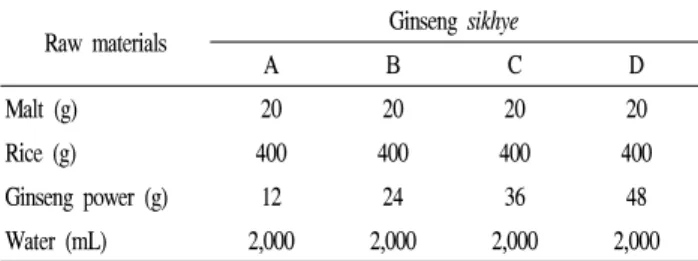
In order to set the optimum condition, ginseng sikhye was manufactured by various amounts of ginseng powder in raw materials, which were 12 g, 24 g, 36 g, and 48 g respectively.
Table 1 shows the compositions of raw materials for ginseng sikhye changed only by the amount of ginseng powder.
Commercial malt was pulverized by using blender and malt that used was calculated according to Table 1 in dry weight base.
Put 1,500 mL water (50℃) into malt and digested for 2 hours. After that, take 1,200 mL of supernatant and adjust to 2,000 mL by addition of extra water of 800 mL. Put 2,000 mL supernatant into an electric rice cooker (34×42 cm, 100 volts, 50 watt) with 400 g of steamed rice and ginseng powder by various addition of 3%, 6%, 9%, and 12% respectively for 6 hours at 60℃.
Table 1. The compositions of raw materials for ginseng sikhye
Raw materials Ginseng sikhye
A B C D
Malt (g) 20 20 20 20
Rice (g) 400 400 400 400
Ginseng power (g) 12 24 36 48
Water (mL) 2,000 2,000 2,000 2,000
Quality analysis
Sugar degree of sikhye measured by using refractometer (Hand refractometer, Atago, Japan). pH value measured at room temperature by pH meter (PP-50, Eyela, Japna). Free sugar analyzed by the methods of AOAC(12) and Wilson(13).
Samples (10 mL) of fermented sikhye were collected from various compositions and add 90 mL to make the volume of 100 mL and centrifuged (N-103N, Kakusan, Japan) at 3,000 rpm for 30 min. Supernatants were purified. Take 20 μL of the remainder after filtration of 0.45 μm membrane filter and separate free sugars by using high performance liquid chromatography. Table 2 shows the condition of HPLC for free sugars analysis in ginseng sikhye. Total Acidity(%, w/v) of sikhye measured as follows: the sample volume was 10 mL which is exactly same to the sample volume of pH measurement by adding 0.1N NaOH until pH 8.3 and then converted the amount of used NaOH to acetic acid followed by the AOAC method(12). Turbidity measured transmittance(%) using spectrophotometer(shimadzu UV-1601) at the wavelength of 675 nm. Each measurement was replicated three times.
The average values of measurements of these replications were used.
Table 2. The condition of HPLC for free sugars analysis in ginseng sikhye
Item conditions
Instrument Water M 244( Water Associate Co., USA)
Column Sugar-pak colu mn 6.5×300 ㎜
Mobile phase Water
Detector RI(Water refractive index)
Flow rate 0.5 mL/min
Injection volume 20 μL
Results and Discussion
Saccharification process by using commercial enzyme
Saccharification process by using commercial enzymes in
0 5 10 15 20
0.1 0.4 0.7 1
Enzyme concentration(ml/100ml)
Sugar degree
Teramyl Pullulanase
Fig. 1. Effect of commercial amylolytic enzyme concentration on the sugar degree of saccharification of steamed rice.
Rice 400 g, reaction : 60℃ for 6 hr.
sikhye manufacturing had been analyzed the quality in this experiment. Fig. 1 shows sugar degree changes by using pullulanase or teramyl in steamed rice(400 g).
Teramyl raised sugar degree about 18 °Brix at the concentration of 0.2 mL but higher concentration lowered sugar degree. However, pullulanase raised sugar degree until 0.3 mL but lowered in high concentrations. On the other hand, if limit dextrin is exhausted, Sikhye doesn't have savory taste(14). It is critical to set the concentrations of additive enzymes which do not compete with enzymes from malt in the consideration of sugar degree and time for sikhye manufacturing. Therefore, teramyl at 0.2 mL concentration is best for α-amylase activity and thermal resistance property for maximum sugar degree and shortened processing time in ginseing sikhye.
Sugar degree changes by various amounts of ginseng powder
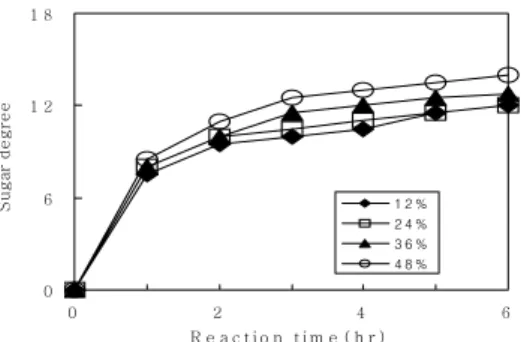
Fig. 2 shows the sugar degree change with no additive commercial enzyme from the composition shown in Table 1. Ginseng powder volume was varied from 12 g up to 48 g for 6 hours at 60℃ under saccharification process. Sugar degree of ginseng sikhye shows 10~15 °Brix after 6 hours, regardless of the amount of additive ginseng powder. On the other hand, the sugar degree of commercial sikhye was 11.6~12.5 °Brix and fruit juice or beverage was 12~14
°Brix. Turbidity, sugar degree, and viscosity in ginseng sikhye under the composition shown in Table 1 were increased and bitterness was reduced compared to commercial sikhye(15).
Therefore, from this experiment, the optimum amount of ginseng powder for ginseng sikhye in the consideration of manufacturing time, cost, and chromaticity was 6% of steamed rice weight.
0 6 1 2 1 8
0 2 4 6
R e a c t i o n t i m e ( h r )
Sugar degree
1 2 % 2 4 % 3 6 % 4 8 %
Fig. 2. Effect of ginseng powder content on sugar degree in ginseng sikhye.
Rice 400 g, malt 20 g, teramyl 0.2 mL, reaction temp. 60℃.
Sugar degree changes by temperature changes
Generally the temperature of sikhye for saccharification is 60℃. In this experiment, temperature for ginseng sikhye by adding ginseng powder and commercial enzyme was varied at 60℃, 70℃, 80℃, and 90℃ respectively. Fig. 3 shows sugar degree changes from various temperatures during sikhye manufacturing. At this time, manufacturing time was 6 hours.
Sugar degree of ginseng sikhye was increased when temperature was raised. Especially sugar degree reached over 12 °Brix only after 3 hours at the temperature of 90℃(Fig.
3). Therefore, it is obvious that the temperature at 80~90℃
in ginseng sikhye manufacturing process by addition of ginseng powder was adequate and it seems that high temperature might shorten time for saccharification. It is also thought that teramyl which was used as additive enzyme increased sugar degree because of its thermostable property.
0 5 1 0 1 5 2 0 2 5
0 1 2 3 4 5 6
R e a c t i o n t i m e ( h r )
Sugar degree
6 0 ℃ 7 0 ℃ 8 0 ℃ 9 0 ℃
Fig. 3. Effect of saccharification temperature on the sugar degree in ginseng sikhye.
Rice 400 g, malt 20 g, teramyl 0.2 mL, ginseng powder 24 g.
Free sugar content changes during saccharification process
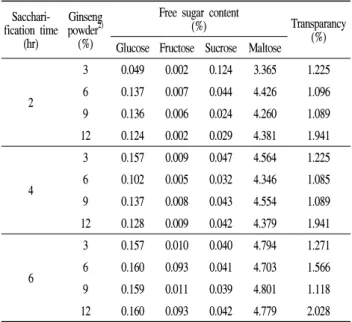
Table 3 shows comparison of free sugars content, and transparency in ginseng sikhye. In this experiment, the condition of ginseng sikhye was set to 80℃ for 6 hours with
addition of teramyl(0.2 mL) and compositions were followed by Table 1.
Maltose content was ranged from 3.3% to 4.8%. Moreover, when ginseng powder was 24 g, maltose content was over 4.4% only after 3 hours in saccharification processes.
Generally, β-amylase could not hydrolyze the α-1,6-bonds at the branch points, so only 45% of starch can be saccharized(16). Additive teramyl, however, can break the branch points of the α-1,6-bonds. It will be positive effects in the consideration of saccharification efficiency and shortening reaction time. It could be established the optimum condition and manufacturing processes for ginseng sikhye with traditional flavor and functional ingredient of ginseng.
On the other side, contents of glucose, fructose, and sucrose increased after 2 hours, but these were lower than commercial sikhye.
Table 3. The comparison of free sugars content and transparency during saccharification process in ginseng sikhye1)
Sacchari- fication time
(hr)
Ginseng powder2)
(%)
Free sugar content
(%) Transparancy
Glucose Fructose Sucrose Maltose (%)
2
3 0.049 0.002 0.124 3.365 1.225
6 0.137 0.007 0.044 4.426 1.096
9 0.136 0.006 0.024 4.260 1.089
12 0.124 0.002 0.029 4.381 1.941
4
3 0.157 0.009 0.047 4.564 1.225
6 0.102 0.005 0.032 4.346 1.085
9 0.137 0.008 0.043 4.554 1.089
12 0.128 0.009 0.042 4.379 1.941
6
3 0.157 0.010 0.040 4.794 1.271
6 0.160 0.093 0.041 4.703 1.566
9 0.159 0.011 0.039 4.801 1.118
12 0.160 0.093 0.042 4.779 2.028
1)Reaction : 80℃ for 6 hr, teramyl 0.2 mL, Compositions of raw materials for ginseng sikhye were followed by Table 1.
2)Ratio weight of steamed rice volume.
Quality comparison
The quality comparison between 3 kinds of commercial sikhye and ginseng sikhye was shown in Table 4. The compositions in ginseng sikhye were malt(20 g), glutinous rice(400 g), and ginseng powder(24 g) with teramyl( 0.2 mL) for 4 hours at 80℃. The maltose content in ginseng sikhye was higher than commercial sikhye. It is positive for flavor in sikhye, because fresh and sweet taste comes from maltose.
Ginseng sikhye has much higher maltose content of 4.3%
than commercial sikhye of 0.4~2.0%. Most commercial sikhye manufacturer has added much sugar for sweet taste, but maltose content was not increased compared to ginseng sikhye. However, there is not obvious difference in turbidity.
Table 4. Comparison of free sugars content and transparancy in commercial sikhye and ginseng sikhye
Sample Fructose (%) Glucose
(%) Sucrose (%) Maltose
(%) Transparancy (%) Ginseng sikhye1) 0.102 0.005 0.032 4.346 1.085
A2) ND3) 0.217 11.76 0.426 2.093
B 0.035 0.071 12.11 ND 0.788
C 0.104 0.264 10.32 1.071 1.191
1)Rice 400 g, malt 20 g, ginseng power 24 g, teramyl 0.2 mL, reaction temperature 80℃, reaction time 4 hr.
2)A~C : Different commercial sikhye.
3)ND: not detected.
요 약
식혜 고유의 시원한 맛과 인삼의 독특한 맛을 가미한 인삼식혜를 제조하기 위해 본 연구에서는 엿기름 20 g, 고두 밥 400 g을 기준으로 하여 여기에 각 인삼분말을 고두밥 양의 3~12%, teramyl효소 0.2 mL을 각각 첨가한 후 인삼식 혜 제조에 있어 당화공정의 특성을 분석하였다. 인삼식혜 의 당화공정은 일반 식혜의 당화공정과 같이 당화 온도 및 당화 시간이 증가할수록 당화력이 증가 하는 경향을 보였다. 하지만 본 실험에서 제조한 인삼식혜의 유리당 분 석을 한 결과 식혜고유의 주성분인 말토오스 함량이 일반 식혜보다 훨씬 높은 4.3%이상의 농도를 나타내고 있어 시 판식혜에 비해 우수한 품질의 특성을 보였다.
References
1. Sohn, J.W. (1994) Literature review on Sik-hye(rice beverage). Korean J. Dietary Culture. 9, 231-240 2. Lee, S.W. (1978) The history of Korean foods.
Hyangmoonsa. Seoul. p.136
3. Lee, C.H. and Kim, S.Y. (1991) Literature on the korean traditional non-alcoholic beverages. Korean J. Dietary Culture. 6, 43-54
4. Lee, S.W. and Ann, Y.G. (1995) A study of sikhye.
Korean J. Food Nutri., 3, 165-171
5. Lee, S.W. and Ann, Y.G. (1996) Some problems of sikhye production an improvement method of sikhye quality.
Korean J. Food Nutri., 1, 45-51
6. Fuwa, H. (1954) A new method for micro-determination of amylase activity by the use of amylose as the substance.
J. Biochem., 41, 583
7. Kim, S.Y., Lee, W.J. and Kim, S.S. (1998) Characteristics of germinated colored rice as a potential raw material for Sikhe. Korean J. Food Sci., Technol., 30, 1092-1096 8. Yoo, C. and Cho, S.C. (1996) Application of
heat/moisture-treated rices for Sikhe. Korean J. Food Sci., Technol., 28, 1119-1125
9. Kim, K.H., Choi, Y.H. and Kang, M.Y. (2001) Varietal difference in processing and sensory characteristics of Sikhe in rice. J. Korean Soc. Breeding. 33, 65-72 10. Kim, S.K., Choi, Y.B. and Kim, J.M. (2000) Effect of
Sikhye manufacturing conditions on the rice shape. J.
Dietary Culture. 15, 1-8
11. Hur, Y.H., Chae, S.K. and Yang, C.Y (1997) Studies on the quality evalution of shicke beverage and its manufacturing process. Annual Bulletin of Korean Institute of Health Research. 1, 1-10
12. A.O.A.C. (1990) Official Methods of Analysis. 15th ed., Association of official analytical chemists. Washington D.C. USA
13. Wilson, A.M, Work, T.M., Bushway, A.A. and Bushway, R.J. (1981) HPLC determination of fructose, glucose and sucrose in potatoes. J. Food Sci., 46, 300
14. Yoo, C., and Hwang, Y.H., Pek, U.H. and Park, K.H.
(1990) Preparation of Shikhae with starch hydrolysing enzymes/malt mixture in teabag. Korean J. Food Sci., Technol., 22, 296-299
15. Kim, M.R., Seo, J.H., Heo, O.S., Oh, S.H. and Lee, K.S.
(2002) Physicochemical and sensory qualities of commercial sikhes. J. Korean Soc. Food Sci. Nutr., 5, 728-732
16. Jeong, E.R., Kim, K.A. and Jung, L.H. (1998) Morphological changes of cooked rice kernel during saccharification for Sikha. Korean J. Soc Food Sci., 14, 91
(접수 2007년 8월 9일, 채택 2007년 11월 30일)