47(4) : 352∼ 359 (2016)
352
초음파 처리에 의한 인삼 잎과 줄기의 진세노사이드 성분 변화
남윤민1·신호준1·양병욱2·박종대2·조순현3·김형춘4*·고성권1*
1세명대학교 한방식품영양학부, 2고려인삼연구(주), 3대원대학교 제약품질과, 4강원대학교 약학대학
Changes in Ginsenosides Composition of Ginseng Leaf and Stem after an Ultrasonication Process
Yun Min Nam1, Ho June Shin1, Byung Wook Yang2, Jong Dae Park2, Soon Hyun Cho3, Hyoung Chun Kim4* and Sung Kwon Ko1*
1The Department of Oriental Medical Food & Nutrition, Semyung University, Jecheon 390-711, Korea
2Korean Ginseng Research Co. Ltd, Yangpyeong 476-841, Korea
3Department of Pharmaceutical Quality Control, Daewon University College, Jecheon 390-702, Korea
4College of Pharmacy, Kangwon National University, Chunchon 200–701, Korea
Abstract − The purpose of this study is to develop a new preparation process of ginseng leaf and stem extracts having high concentrations of ginsenoside Rg2, Rg3, Rg5, Rh1, a special component of red and black ginseng. Chemical transformation from ginseng saponin glycosides to prosapogenin was analyzed by the HPLC. Extracts of ginseng (Panax ginseng) leaf and stem were processed under several treatment conditions including ultrasonication treatments. The content of total saponin reached their heights at 17 hr (UGL-17) of ultrasonication treatment, followed by 16 hr (UGL-16) and 7 hr (UGL-7) of ultra- sonication treatment at 100oC. UGL-17 findings show that the ginseng leaf and stem that had been processed with ultra- sonication for 17 hours peaked in the level of Rg2, Rg3 and Rh1. In addition, UGL-16 contained ginsenoside Rg5 at high concentrations. It is thought that such results provide basic information in preparing ginseng leaf and stem extracts with func- tionality enhanced.
Key words − Ginseng, Leaf, Ultrasonication, Ginsenoside Rg2, Rg3, Rh1
인삼(Panax ginseng C.A. Meyer)은 두릅나무과(Araliaceae) 식물로 한반도가 원산인 한국의 특산 약용식물이며, 5,000 여년 전부터 보원기제로 사용되어온 중요한 한방약 중의 하 나이다. 동양에서 가장 오래된 본초서인 신농본초경에 인삼 은 오장을 보하고, 원기를 보충한다고 기록되어 있다.1) 인
삼의 생리활성은 체계적인 약리학적 접근으로 심혈관계,2)
면역계,3)신경계4)에 대한 효능과 해독작용,5)항암작용6)그 리고 항당뇨작용7) 등이 보고되었다.
인삼의 주요한 생리활성물질은 인삼사포닌(ginsenosides), polyacetylenes, 산성다당체, 인삼단백질, 페놀성 물질 등이 알려져 있다.8-10) 그 중에서 인삼사포닌은 Shibata 등9)의 연 구에 의해서 그 화학구조가 명확히 확인되었고, 항당뇨 활 성7)을 비롯하여 항암작용, 항산화작용, 동맥경화 및 고혈압
의 예방, 간 기능 촉진 및 숙취제거효과, 항 피로 및 항 스 트레스 작용, 노화방지 작용, 두뇌활동 촉진작용, 항염활성, 알레르기성 질환치료, 단백질합성능력의 촉진 등이 보고되 었다.8)
특히, 수삼을 쪄서 건조한 홍삼은 열에 의해서 생성되는 홍삼 특유 성분인 ginsenoside Rg2, Rg3, Rh1, Rh2등이 암 예방작용, 암세포성장 억제작용,11, 12)혈압강하 작용,13)뇌신 경세포 보호작용,14) 항혈전작용,15) 항산화작용11)이 있다고 하여 홍삼만의 특·장점으로 주목받고 있다.
또한, 홍삼 특유 성분은 인삼사포닌 배당체가 열에 의해 서 가수 분해 되어 생성되는 prosapogenin 형태의 인공물인 데, 최근에 열이나 압력과 같은 물리적인 방법16)과 효소를 이용한 생화학적인 방법17,18)에 의해서 고농도 인삼 prosapogenin 제제가 개발되고 있다.
한편, 1976년 Tanaka등19, 20)은 고려인삼 잎의 사포닌 분 획에서 6종의 기지 사포닌 성분인 ginsenoside-Rb1, -Rb2,
*교신저자(E-mail):[email protected], [email protected] (Tel): +82-33-250-6917, +82-43-649-1433
-Rc, -Rd, -Re, -Rg1을 확인하였다. 또한 그들은 나머지 3종 사포닌은 새로운 배당체로 구명하였는데 즉, 20-O-β-D- glucopyranosyl-20(S)-protopanaxatriol인 gisenoside F1, 3.20- di-O-β-D-glucopyranosyl-20(S)-protopanaxadiol인 gisenoside F2 및 20-O-(-arbinopyranosyl (1→6)-β-D-glucopyranosyl)- 20(S)-propanaxatriol인 ginsenoside F3 등이다.
1978년 Tanaka 등은 dammarane type의 side chain이 변 형된 ginseniside-F6a, ginsenoside-F6bc와 꽃봉오리로부터 ginsenoside M7cd21)를 분리하였다.
1987년 Chen등8)은 고려인삼에서 항암성분으로 알려진 ginsenoside Rh2의 C-20 epimer인 20(R)-ginsenoside Rh2를 분리, 동정하였는데 이 화합물은 아직 뿌리에서는 보고되지 않아 주목을 받고 있다. 한편 그들은 3β, 12β-dihydroxy- dammar-24-diene-3-O-β-D-glucopyranoside인 ginsenoside Rh3를 분리하였다. 1989년 Zhang 등 22)은 새로운 23- oxygenated dammarane 사포닌을 분리하여 ginsenoside La 로 명명하고 1990년에는 미량의 사포닌으로서 3, β, 6α, 12β-trihydroxy-dammar-20(22), 24-diene-6-O-α-L-rhamnopy- ranosyl-(1→2)-β-D-glucopyranoside로 분리하여 ginsenoside F4로 명명하였다.23)
이전에 prosapogenin에 대한 연구로는 열(120oC, 1기압) 을 가하여 백삼에는 없는 새로운 진세노사이드(-F4, -Rg3, -Rg5., -Rg6 -Rk1, -Rk3, -Rs3, -Rs4, -Rs5)를 생성시킨 경 우,16) 식초 처리만 한 경우,24) 수삼, 백삼, 인삼 열매, 인삼 잎 줄기, 서양삼, 전칠삼에 대한 초단파25-30)처리 연구, 홍삼, 인삼 열매, 인삼꽃대에 대한 초음파31-34) 처리 연구가 보고 되었다.
그러나, 인삼 재배 부산폐기물인 인삼 잎과 줄기에 대한
초음파 처리 연구가 아직 시행되지 않은 점에 착안하여 건 조한 인삼 잎과 줄기에 100oC에서 초음파로 처리를 했을 때 인삼사포닌 배당체가 인삼 prosapogenin으로 전환되는 것을 HPLC법으로 확인하여 진세노사이드 Rg2, Rg3, Rh1 등의 인삼 활성 prosapogenin을 고농도로 함유하는 엑스 개발의 최적 조건을 확인하고자 한다.
재료 및 방법
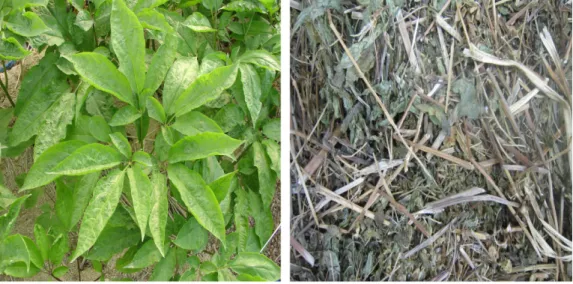
실험재료 − 본 연구에 사용한 인삼 잎과 줄기는 충청북도 음성(재배자: 남성엽)에서 2010년 9월 20일에 수삼 채굴시 폐기되는 4년 근 인삼 지상부(열매를 제외한 잎과 줄기 포 함) 10 kg을 채집하였고, 건조는 음성의 충북인삼영농조합 법인(대표: 남성엽)에서 시행하였으며, 제품표본(Fig. 1)은 세명대학교 한방식품연구실에 보관하고 있다.
인삼 잎 및 줄기 초음파 처리 엑스(UGLS) 조제 − 건조 한 인삼 잎 줄기 1.5 kg에 2 l의 증류수를 초음파 처리기 (KODO, Hwaseong, Korea, 출력 1,200 W, 주파수 28 KHz) 에 넣고, 100oC에서 매 1시간씩 초음파 처리할 때마다 초음 파 처리액 100 ml씩을 떠내고 나서, 증류수 100 ml씩을 넣 어 처리하였다. 이와 같은 방법으로 1시간(UGLS-1), 2시간 (UGLS-2), 3시간(UGLS-3), 4시간(UGLS-4), 5시간(UGLS- 5), 6시간(UGLS-6), 7시간(UGLS-7), 8시간(UGLS-8), 9시간 (UGLS-9), 10시간(UGLS-10), 11시간(UGLS-11), 12시간 (UGLS-12), 13시간(UGLS-13), 14시간(UGLS-14), 15시간 (UGLS-15), 16시간(UGLS-16), 17시간(UGLS-17), 18시간 (UGLS-18), 19시간(UGLS-19), 그리고 20시간(UGLS-20) 초음파 처리 인삼 잎 줄기 처리액을 얻었고, 이를 감압농축
Fig. 1. Figure of ginseng (Panax ginseng) leaf and stem.
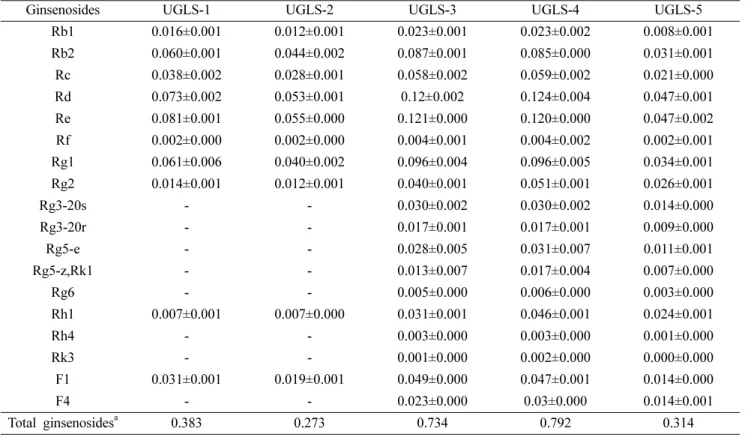
Table I. Ginsenoside composition of the ginseng leaf and stem extracts processed with ultrasonication over time (%,w/w)
Ginsenosides UGLS-1 UGLS-2 UGLS-3 UGLS-4 UGLS-5
Rb1 0.016±0.001 0.012±0.001 0.023±0.001 0.023±0.002 0.008±0.001
Rb2 0.060±0.001 0.044±0.002 0.087±0.001 0.085±0.000 0.031±0.001
Rc 0.038±0.002 0.028±0.001 0.058±0.002 0.059±0.002 0.021±0.000
Rd 0.073±0.002 0.053±0.001 0.12±0.002 0.124±0.004 0.047±0.001
Re 0.081±0.001 0.055±0.000 0.121±0.000 0.120±0.000 0.047±0.002
Rf 0.002±0.000 0.002±0.000 0.004±0.001 0.004±0.002 0.002±0.001
Rg1 0.061±0.006 0.040±0.002 0.096±0.004 0.096±0.005 0.034±0.001
Rg2 0.014±0.001 0.012±0.001 0.040±0.001 0.051±0.001 0.026±0.001
Rg3-20s - - 0.030±0.002 0.030±0.002 0.014±0.000
Rg3-20r - - 0.017±0.001 0.017±0.001 0.009±0.000
Rg5-e - - 0.028±0.005 0.031±0.007 0.011±0.001
Rg5-z,Rk1 - - 0.013±0.007 0.017±0.004 0.007±0.000
Rg6 - - 0.005±0.000 0.006±0.000 0.003±0.000
Rh1 0.007±0.001 0.007±0.000 0.031±0.001 0.046±0.001 0.024±0.001
Rh4 - - 0.003±0.000 0.003±0.000 0.001±0.000
Rk3 - - 0.001±0.000 0.002±0.000 0.000±0.000
F1 0.031±0.001 0.019±0.001 0.049±0.000 0.047±0.001 0.014±0.000
F4 - - 0.023±0.000 0.03±0.000 0.014±0.001
Total ginsenosidesa 0.383 0.273 0.734 0.792 0.314
(%,w/w)
Ginsenosides UGLS-6 UGLS-7 UGLS-8 UGLS-9 UGLS-10
Rb1 0.020±0.001 0.020±0.000 0.013±0.001 0.013±0.000 0.011±0.001
Rb2 0.077±0.003 0.083±0.002 0.056±0.002 0.054±0.005 0.046±0.004
Rc 0.056±0.003 0.060±0.004 0.042±0.003 0.039±0.001 0.033±0.002
Rd 0.115±0.002 0.128±0.002 0.090±0.001 0.086±0.002 0.075±0.001
Re 0.112±0.003 0.120±0.004 0.082±0.002 0.075±0.001 0.062±0.002
Rf 0.006±0.002 0.008±0.002 0.005±0.001 0.005±0.001 0.005±0.001
Rg1 0.080±0.006 0.086±0.002 0.057±0.004 0.052±0.004 0.043±0.001
Rg2 0.078±0.001 0.102±0.003 0.083±0.003 0.092±0.002 0.088±0.001
Rg3-20s 0.040±0.001 0.053±0.000 0.044±0.001 0.049±0.001 0.049±0.001 Rg3-20r 0.021±0.000 0.026±0.001 0.020±0.000 0.024±0.001 0.023±0.000 Rg5-e 0.029±0.003 0.041±0.007 0.036±0.001 0.044±0.004 0.044±0.004 Rg5-z,Rk1 0.019±0.005 0.032±0.008 0.031±0.006 0.031±0.003 0.030±0.004
Rg6 0.011±0.002 0.013±0.001 0.010±0.001 0.011±0.001 0.011±0.001
Rh1 0.083±0.007 0.112±0.006 0.093±0.007 0.107±0.006 0.104±0.003
Rh4 0.005±0.000 0.006±0.000 0.005±0.000 0.006±0.000 0.006±0.000
Rk3 0.003±0.000 0.004±0.001 0.003±0.001 0.003±0.001 0.004±0.001
F1 0.048±0.001 0.053±0.003 0.037±0.002 0.035±0.003 0.032±0.002
F4 0.044±0.001 0.058±0.001 0.044±0.001 0.052±0.002 0.050±0.001
Total ginsenosidesa 0.845 1.006 0.751 0.778 0.716
*UGL-11: ginseng leaf and stem extract processed with ultrasonication for 11 hr, a)Sum of individual ginsenosides content, Values represent the mean±S.E. (n=3)
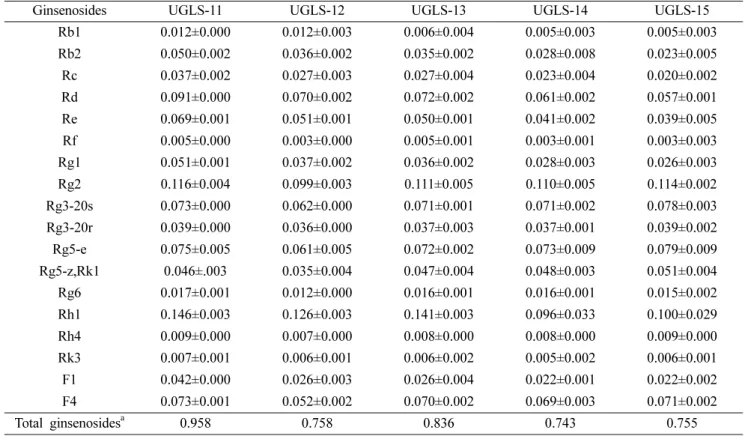
Table I. Continued (%,w/w)
Ginsenosides UGLS-11 UGLS-12 UGLS-13 UGLS-14 UGLS-15
Rb1 0.012±0.000 0.012±0.003 0.006±0.004 0.005±0.003 0.005±0.003 Rb2 0.050±0.002 0.036±0.002 0.035±0.002 0.028±0.008 0.023±0.005
Rc 0.037±0.002 0.027±0.003 0.027±0.004 0.023±0.004 0.020±0.002
Rd 0.091±0.000 0.070±0.002 0.072±0.002 0.061±0.002 0.057±0.001
Re 0.069±0.001 0.051±0.001 0.050±0.001 0.041±0.002 0.039±0.005
Rf 0.005±0.000 0.003±0.000 0.005±0.001 0.003±0.001 0.003±0.003
Rg1 0.051±0.001 0.037±0.002 0.036±0.002 0.028±0.003 0.026±0.003 Rg2 0.116±0.004 0.099±0.003 0.111±0.005 0.110±0.005 0.114±0.002 Rg3-20s 0.073±0.000 0.062±0.000 0.071±0.001 0.071±0.002 0.078±0.003 Rg3-20r 0.039±0.000 0.036±0.000 0.037±0.003 0.037±0.001 0.039±0.002 Rg5-e 0.075±0.005 0.061±0.005 0.072±0.002 0.073±0.009 0.079±0.009 Rg5-z,Rk1 0.046±.003 0.035±0.004 0.047±0.004 0.048±0.003 0.051±0.004 Rg6 0.017±0.001 0.012±0.000 0.016±0.001 0.016±0.001 0.015±0.002 Rh1 0.146±0.003 0.126±0.003 0.141±0.003 0.096±0.033 0.100±0.029 Rh4 0.009±0.000 0.007±0.000 0.008±0.000 0.008±0.000 0.009±0.000 Rk3 0.007±0.001 0.006±0.001 0.006±0.002 0.005±0.002 0.006±0.001
F1 0.042±0.000 0.026±0.003 0.026±0.004 0.022±0.001 0.022±0.002
F4 0.073±0.001 0.052±0.002 0.070±0.002 0.069±0.003 0.071±0.002
Total ginsenosidesa 0.958 0.758 0.836 0.743 0.755
(%,w/w)
Ginsenosides UGLS-16 UGLS-17 UGLS-18 UGLS-19 UGLS-20
Rb1 0.005±0.004 0.009±0.004 0.004±0.004 0.003±0.002 0.003±0.003 Rb2 0.034±0.014 0.034±0.016 0.018±0.000 0.017±0.005 0.015±0.000
Rc 0.030±0.013 0.031±0.012 0.021±0.002 0.019±0.003 0.025±0.008
Rd
Re 0.046±0.011 0.045±0.016 0.024±0.001 0.023±0.002 0.022±0.003
Rf 0.006±0.001 0.006±0.002 0.006±0.003 0.004±0.001 0.004±0.001
Rg1 0.033±0.006 0.032±0.008 0.017±0.002 0.017±0.000 0.017±0.005 Rg2 0.159±0.035 0.178±0.057 0.110±0.004 0.117±0.006 0.094±0.015 Rg3-20s 0.123±0.031 0.126±0.045 0.083±0.003 0.087±0.009 0.082±0.008 Rg3-20r 0.058±0.013 0.063±0.022 0.044±0.001 0.042±0.004 0.028±0.015 Rg5-e 0.145±0.029 0.142±0.041 0.093±0.002 0.101±0.006 0.088±0.001 Rg5-z,Rk1 0.094±0.033 0.091±0.036 0.057±0.009 0.061±0.012 0.055±0.010 Rg6 0.024±0.004 0.026±0.007 0.016±0.001 0.018±0.000 0.023±0.015 Rh1 0.205±0.046 0.232±0.085 0.140±0.008 0.155±0.018 0.094±0.003 Rh4 0.014±0.003 0.014±0.005 0.009±0.000 0.007±0.006 0.009±0.001 Rk3 0.009±0.000 0.009±0.001 0.006±0.002 0.006±0.001 0.005±0.001
F1 0.026±0.011 0.026±0.009 0.014±0.001 0.013±0.003 0.011±0.002
F4 0.112±0.029 0.117±0.041 0.075±0.005 0.085±0.011 0.056±0.030
Total ginsenosidesa 1.196 1.257 0.781 0.820 0.671
*UGL-11: ginseng leaf and stem extract processed with ultrasonication for 11 hr, a)Sum of individual ginsenosides content, Values represent the mean±S.E. (n=3)
하여 초음파 처리 인삼 잎 줄기 엑스를 얻었다(Table I 참조).
조 사포닌(Crude Saponin) 조제34)− 초음파 처리 인삼 잎 줄기 엑스 각 2 g에 디에틸에테르(diethylether) 50 ml를 가하여 1시간씩 3회 초음파 세정기(고도기업, 4020P, 한국) 로 추출한 후, 원심분리 하여 상등액을 제거한다. 얻은 잔 사에 수포화 부탄올(butanol) 50 ml를 가하여 2시간씩 3회
추출하고, 원심분리 하여 상등액을 취하여 여과하고, 감압 농축을 하여 조사포닌을 얻었다.
HPLC-ginsenoside의 분석 − 위에서 얻은 엑스를 이 등35) 의 조건을 응용하여 HPLC를 실시하고, 상법에 따라 표품 과 직접 비교하여 인삼사포닌의 함량 및 조성을 각 시료당 3회 반복 실험하여 결과의 재현성을 확인하여 분석하였다.
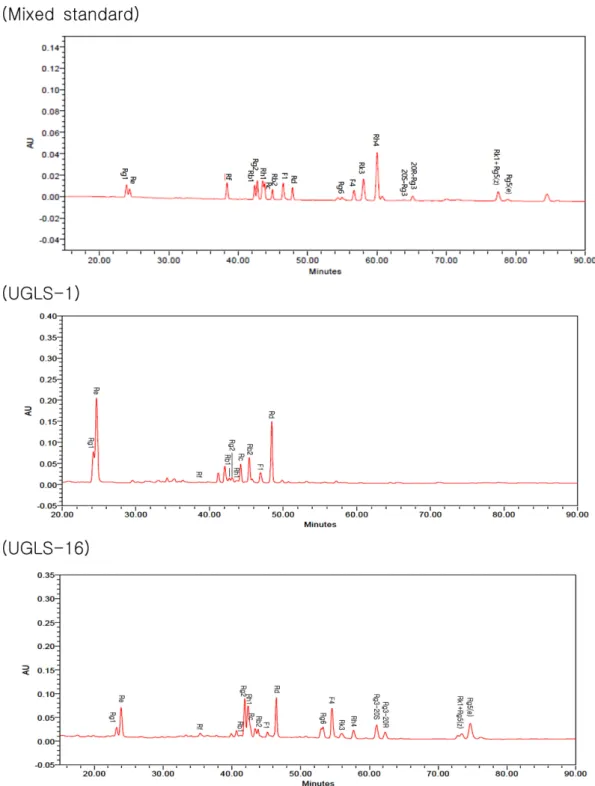
Fig. 2. HPLC chromatogram of ginsenosides in the ginseng leaf and stem processed with ultrasonication.
표품은 Chromadex(U.S.A.)와 엠보연구소(Korea)로부터 구 입한 순도 99% 이상의 ginsenoside(ginsenosides Rb1, Rb2, Rc, Rd, Re, Rf, Rg1, Rg2, 20S-Rg3, 20R-Rg3, 20E-Rg5, 20Z-Rg5, Rg6, Rh1, Rh4, Rk1, Rk3, F1, F4)를 사용하였다.
사용한 HPLC 장치는 Waters 1525 binary HPLC system (Waters, Milford, MA, U.S.A.)이며, 컬럼은 Eurospher 100- 5 C18(3×250 mm; Knauer, Born, Germany)을 사용하였다.
이동상은 acetonitrile(HPLC grade; Sigma-Aldrich Chem Co., U.S.A.)과 증류수(HPLC급, B&J, U.S.A.)이며, acetonitrile의 비율을 17%(0 min)에서 25%(25 min), 40%
(50 min), 60%(105 min) 그리고 100%(110 min)로 순차적으 로 늘려주고 마지막으로 다시 17%로 조절하였다. 전개온도 는 실온, 유속은 분당 0.8 ml, 크로마토그램은 UV 디텍터 [UV/Vis Waters 2487 Dual λ Absorbance Detector(Waters, Milford, MA, U.S.A.]를 이용하여 203 nm에서 검출하였다.
결과 및 고찰
건조한 인삼 잎 줄기에 증류수를 가하고 100oC에서 초음 파 처리를 실시하여 ginsenoside Rg2, Rg3, Rg5, Rh1과 같 은 prosapogenin을 고농도로 함유하는 조성물을 개발하고자 하였다. 인삼사포닌 성분분석은 Fig. 2에서 보는바와 같이, ginsenosides Rb1, Rb2, Rc, Rd, Re, Rf, Rg1, Rg2, Rg3, Rg5, Rg6, Rh1, Rh4, Rk1, Rk3, F1 그리고 F4를 대상으로 HPLC법으로 검토하였다.
Table I에서 보는바와 같이 각 진세노사이드의 총 합인 총 사포닌(total saponin) 함량에 있어서는 UGLS-17이 1.257%
이었으며 UGLS-16는 1.196%이었으며, UGLS-7는 1.006%
로서 초음파와 100oC에서 17시간 처리한 인삼 잎, 줄기 엑 스의 총 사포닌이 높은 함량을 보여주었다.
홍삼 가공 시 찔 때 열에 의해서 생성되는 인공물(artifact)
인 진세노사이드로서 주름개선효능35)이 알려진 진세노사이
드 Rg2의 함량에 있어서는 UGLS-17이 0.178로서 가장 높 은 함량을 나타내었으며, UGLS-16(0.159%), UGLS-19 (0.117%)의 순으로 높은 함량을 나타내었다. 17시간 초음파 처리한 인삼 잎 줄기 엑스의 진세노사이드 Rg2의 함량은 1 시간 초음파 처리한 인삼 잎 줄기 엑스에 비하여 약 12배 의 함량을 보여주었다.
또한, 홍삼 특유성분으로 항암작용,36) 혈압강하작용,37)뇌 신경세포 보호작용,38) 항혈전작용,39) 항산화작용40)을 나타내 는 진세노사이드 Rg3의 경우, UGLS-17이 0.189%로서 가 장 높은 함량을 나타내었으며, UGLS-16(0.181%), UGLS- 19(0.129%)의 순으로 높은 함량을 나타내었다.
한편, 흑삼의 주함유성분41)인 진세노사이드 Rg5의 경우, UGLS-16이 0.145%로서 가장 높은 함량을 나타내었으며, UGLS-17(0.142%), UGLS-19(0.101%)의 순으로 높은 함량 을 나타내었다. 최근 항알러지작용42)이 알려진 진세노사이 드 Rh1에 있어서는 UGLS-17이 0.232%로서 가장 높은 함 량을 나타내었으며, UGLS-16(0.205%), UGLS-19(0.155%) 의 순으로 높은 함량을 나타내었다.
결 론
본 연구를 통하여 인삼 잎 줄기 엑스에 초음파 17시간 처 리시 홍삼특유 기능성분인 ginsenoside Rg2, Rg3, Rh1이 0.178%, 0.189%, 0.232%로 홍삼 및 흑삼의 특유활성성분 함유 엑스를 제조할 수 있음을 확인하였고, 따라서, 이와 같 은 결과를 통하여 기능성 강화 신소재 개발로 초음파 처리 인삼 잎 줄기 엑스를 활용할 수 있을 것으로 기대된다.
Fig. 2. Continued.
사 사
“이 논문은 2015학년도 세명대학교 교내학술연구비 지원
에 의해 수행된 연구임”.
인용문헌
1. Ko, S. K. and Im, B. O. (2009) The science of Korean gin- seng, 47-52, Yakupsinmunsa, Seoul.
2. Lee, D. C., Lee, M. O., Kim, C. Y. and Clifford, D. H. (1981) Effect of ether, ethanol and aqueous extracts of ginseng on cardiovascular function in dogs. Can. J. Comp. Med. 45: 182- 187.
3. Jie, Y. H., Cammisuli, S. and Baggiolini, M. (1984) Immu- nomodulatory effects of Panax ginseng C.A. Meyer in the mouse. Agents Actions 15: 386-391.
4. Kim, Y. C., Kim, S. R., Markelonis, G. J. and Oh, T. H.
(1998) Ginsenosides Rb1 and Rg3 protect cultured rat cor- tical cells from glutamate-induced neurodegeneration. J. Neu- rosci. Res. 53: 426-432.
5. Joo, C. N., Koo, J. D., Kim, D. S. and Lee, S. J. (1977) Bio- chemical studies of ginseng saponins. XI. The effects of gin- seng saponins on alcohol dehydrogenase. Hanguk Saenghwa Hakhoe Chi 10: 109-120.
6. Tahara, M., Kono, H., Mune, S. and Odashima, S. (1985) Action of ginsenosides on tumor cells. Growth inhibition and redifferentiation of neoplasia. Wakan Yaku Gakkaishi 2: 170- 171.
7. Yokozawa, T., Kobayashi, T., Oura, H. and Kawashima, Y.
(1985) Studies on the mechanism of the hypoglycemic activ- ity of ginsenoside-Rb2 in streptozotocin-diabetic rats. Chem.
Pharm. Bull. 33: 869-872.
8. Park, J. D. (1996) Recent studies on the chemical constituents of Korean ginseng. Korean J. Ginseng Sci. 20: 389-415.
9. Sanata, S., Kondo, N., Shoji, J., Tanaka, O. and Shibata, S.
(1974) Studies on the saponins of ginseng. I. Structure of gin- seng-R0, Rb1, Rb2, Rc and Rd. Chem. Pharm. Bull. 22: 421- 428.
10. Kitagawa, I., Taniyama, T., Shibuya, H., Nota, T. and Yoshi- kawa, M. (1987) Chemical studies on crude drug processing.
V. On the constituents of ginseng radix rubra (2); Comparison of the constituents of white ginseng and red ginseng prepared from the same Panax ginseng root. Yakugaku Zasshi 107:
495-505.
11. Keum, Y. S., Park, K. K., Lee, J. M., Chun, K. S., Park, J. H., Lee, S. K., Kwon, H. and Surh, Y. J. (2000) Antioxidant and anti-tumor promoting activities of the methanol extract of heat-processed ginseng. Cancer Lett. 150: 41-48.
12. Kim, S. E., Lee, Y. H., Park, J. H. and Lee, S. K. (1999) Gin- senoside-Rs3, a new diol-type ginseng saponin, selectively elevates protein levels of p53 and p21WAF1 leading to
induction of apoptosis in SK-HEP-1 cells. Anticancer Res.
19: 487-491.
13. Kim, W. Y., Kim, J. M., Han, S. B., Lee, S. K., Kim, N. D., Park, M. K., Kim, C. K. and Park, J. H. (2000) Steaming of ginseng at high temperature enhances biological activity. J.
Nat. Prod. 63: 1702-1704.
14. Bao, H. Y., Zhang, J., Yeo, S. J., Myung, C. S., Kim, H. M., Kim, J. M., Park, J. H., Cho, J. S. and Kang, J. S. (2005) Memory enhancing and neuroprotective effects of selected ginsenosides. Arch. Pharm. Res. 28: 335-342.
15. Jung, K. Y., Kim, D. S., Oh, S. R., Lee, I. S., Lee, J. J., Park, J. D., Kim, S. I. and Lee, H. K. (1998) Platelet activating fac- tor antagonist activity of ginsenosides. Biol. Pharm. Bull. 21:
79-80.
16. Kwon, S. W., Han, S. B., Park, I. H., Kim, J. M., Park, M. K.
and Park, J. H. (2001) Liquid chromatographic determination of less polar ginsenosides in processed ginseng. J. Chro- matogr. 921: 335-339.
17. Hasegawa, H., Sung, J. H., Matsumiya, S. and Uchiyama, M.
(1996) Main ginseng saponin metabolites formed by intes- tinal bacteria. Planta Med. 62: 453-457.
18. Hasegawa, H., Sung, J. H. and Benno, Y. (1997) Role of human intestinal Prevotella oris in hydrolyzing ginseng sapo- nins. Planta Med. 63: 436-440.
19. Yahara, S., Tanaka, O. and Komori, T. (1976) Saponins of the leaves of Panax ginseng C. A. Meyer. Chem. Pharm. Bull.
24: 2204-2208.
20. Yahara. S., Matsuura. K., Kasai. R. and Tanaka. O. (1976) Saponins of buds and flowers of Panax ginseng (I). Isolation of ginsenosides Rd, Re, and Rg1. Chem. Pharm. Bull., 24:
3212-3213.
21. Yahara. S., Kaji. K. and Tanaka. O. (1979) Further study on dammarane-type saponins of roots, leaves, flower buds, and fruits of Panax ginseng C. A. Meyer. Chem. Pharm. Bull. 27:
88-92.
22. Zhang. S., Yao. X., Chen, Y., Cui. C., Tezuka. Y. and Kikuchi.
T. (1989) Ginsenoside La, a novel saponin from the leaves of Panax ginseng. Chem. Pharm. Bull. 37: 1966-1968.
23. Zhang. S., Takeda. T., Zhu. T., Chen. Y., Yao. X., Tanaka, O.
and Ogihara. Y. (1990) A new minor saponin from the leaves of Panax ginseng. Planta Med. 56: 298-300.
24. Ko, S. K., Lee, K. H., Hong, J. K., Kang, S. A., Sohn, U. D., Im, B. O., Han, S. T., Yang, B. W., Chung, S. H. and Lee, B.
Y. (2005) Change of ginsenoside composition in ginseng extract by vinegar process. Food Sci. Biotechnol. 14: 509- 513.
25. Kim, S. J., Kim, J. D. and Ko, S. K. (2013) The change of ginsenoside composition in ginseng leaf and stem extract by the microwave and vinegar process. Kor. J. Pharmacogn. 44:
149-153.
26. Kim, S. J., Kim, J. D. and Ko, S. K. (2013) Changes in gin- senoside composition of ginseng berry extracts after a micro-
wave and vinegar process.J. Ginseng Res. 37: 269-272.
27. Jo, H. K., Im, B. O. and Ko, S. K. (2014) The change of gin- senoside composition in white ginseng and fine white gin- seng extract by the microwave and vinegar process. Kor. J.
Pharmacogn. 45: 77-83.
28. Jo, H. K., Gwak, H. H., Im, B. O., Cho, S. H. and Ko, S. K.
(2014) The change of ginsenoside composition in American ginseng (Panax quinquefolium) extract by the microwave and vinegar process. Kor. J. Pharmacogn. 45: 107-112.
29. Jo, H. K., Cho, S. H. and Ko, S. K. (2014) The change of gin- senoside composition in Notoginseng root (Panax notogin- seng) extract by the microwave and vinegar process. Kor. J.
Pharmacogn. 45: 320-325.
30. Kim, S. G., Kim, K. J., Nam, Y. M., Kim, S. J., Cho, S. H., Lee, B. O. and Ko, S. K. (2016) Microwave heating rapidly alters ginsenoside composition of fresh ginseng (Panax gin- seng CA Meyer). Journal of Food and Nutrition Research 4:
394-399.
31. Gwak, H. H., Hong, J. T., Ahn, C. H., Kim, K. J., Kim, S. G., Yoon, S. S., Im, B. O., Cho, S. H., Nam, Y. M. and Ko, S. K.
(2015) The change of ginsenoside composition in the ginseng (Panax ginseng) flower buds by the ultrasonication and vin- egar process, Natural Product Sciences 21: 1-5.
32. Nam, Y. M., Kwon, J. H., Hong, J. T., Yang, B. W. and Ko, S. K. (2015) Changes in ginsenoside composition of ginseng flower buds extracts after a ultrasonication process, Kor. J.
Pharmacogn. 47: 73-78.
33. Hong, J. T., Nam, Y. M., Kim, S. J. and Ko, S. K. (2016) The change of ginsenoside composition in ginseng berry extract by the ultrasonication process. Yakhak Hoeji 60: 58-63.
34. Yoon, S. H., Nam, Y. M., Hong, J. T., Kim, S. J. and Ko, S.
K. (2016) Modification of ginsenoside composition in red ginseng (Panax ginseng) by ultrasonication. J. Ginseng Res.
40: 300-303.
35. Jeong, S. J., Han, S. H., Kim, D. Y., Lee, J. C., Kim, H. S.,
Kim, B. H., Lee, J. S., Hwang, E. H. and Park, J. K. (2007) Effects of m Rg2, a mixture of ginsenosides containing 60%
Rg2, on the ultraviolet B-induced DNA repair synthesis and apoptosis in NIH3T3 cells. Int. J. Toxicol. 26: 151-158.
36. Keum, Y. S., Han, S. S., Chun, K. S., Park, K. K., Park, J. H., Lee, S. K. and Surh, Y. J. (2003) Inhibitory effects of the gin- senoside Rg3 on phorbol ester-induced cyclooxygenase-2 expression, NF-kappaB activation and tumor promotion.
Mutat. Res. 523: 75-85.
37. Kim, N. D., Kang, S. Y., Park, J. H. and Schini-Kerth, V. B.
(1999) Ginsenoside Rg3 mediates endothelium-dependent relaxation in response to ginsenosides in rat aorta: role of K+
channels. Eur. J. Pharmacol. 367: 41-49.
38. Yang, L., Hao, J., Zhang, J., Xia, W., Dong, X., Hu, X., Kong, F. and Cui, X. (2009) Ginsenoside Rg3 promotes beta-amy- loid peptide degradation by enhancing gene expression of neprilysin. J. Pharm. Pharmacol. 61: 375-380.
39. Lee, W. M., Kim, S. D., Park, M. H., Cho, J. Y., Park, H. J., Seo, G. S. and Rhee, M. H. (2008) Inhibitory mechanisms of dihydroginsenoside Rg3 in platelet aggregation: critical roles of ERK2 and cAMP. J. Pharm. Pharmacol. 60: 1531-1536.
40. Keum, Y. S., Park, K. K., Lee, J. M., Chun, K. S., Park, J. H., Lee, S. K., Kwon, H. and Surh, Y. J. (2000) Antioxidant and anti-tumor promoting activities of the methanol extract of heat-processed ginseng. Cancer Lett. 150: 41-48.
41. Lee, S. A., Jo, H. K., Im, B. O., Kim, S. G., Whang, W. K.
and Ko, S. K. (2012) Changes in the contents of prosapo- genin in the red ginseng(Panax ginseng) depending on steaming batches. J. Ginseng Res. 36: 102-106.
42. Zheng, H., Jeong, Y., Song, J. and Ji, G. E. (2011) Oral administration of ginsenoside Rh1 inhibits the development of atopic dermatitis-like skin lesions induced by oxazolone in hairless mice. Int. Immunopharmacol. 11: 511-518.
(2016. 11. 06 접수; 2016. 12. 15 심사;
2016. 12. 19 게재확정)