갈조류 미역(Undaria pinnatifida)의 분리당화발효와 다양한 효모를 이용한 바이오에탄올의 생산
웬 트룽 하우, 라채훈, 박미라, 정귀택, 김성구*
부경대학교생물공학과
Received: October 27, 2016 / Revised: November 24, 2016 / Accepted: November 24, 2016
서 론
바이오에탄올은탄수화물을포함하는다양한바이오매스 로부터생산할수있다. 전통적으로, 에탄올은옥수수, 밀, 사 탕수수등의제 1 세대바이오매스를이용하여생산되었다
[1]. 그러나이러한원료는동물사료또는인간의식품과경
쟁으로도덕적문제와가격상승의문제가발생하고있다[4].
제 2 세대바이오매스로부터생산된바이오에탄올은리그노 셀룰로오스바이오매스와농업폐기물을이용하여생산된다. 그원료는옥수수대, 풀, 짚, 목재칩이있다. 그러나, 2 세대 바이오매스원료는낮은전처리수율및전처리공정으로인 해가수분해과정에서전처리비용이높다[2].
제 3 세대바이오매스인해조류는생육과성장이매우우
수하고연안해역을이용하기때문에가용재배면적이넓고 비료등의자원을투입할필요가없어제 1 및제 2 세대바 이오매스를교체할수있는가장적합한바이오매스이다. 해 조류 중 갈조류, 특히 다시마(Saccharina japonica), 김 (Porphyra sp.), 미역(Undaria pinnatifida)은한국에서널
리 재배되고 있다[7]. 갈조류의 주요 탄소화물은 만니톨
(mannitol), 라미나린(laminarin), 알지네이트(alginate)로부 터구성되며, 열산가수분해(HT acid hydrolysis) 후효모를 이용한바이오에탄올생산의단당으로이용할수있다[11].
따라서본연구에서는미역을바이오매스로선택하여바이 오에탄올발효를수행하였다.
해조류로부터전처리조건의최적화를위해반응표면분석 법(Response Surface Method, RSM)을사용하여독립변수 (황산농도, 가열처리시간, 슬러리농도)의상호작용에따른 종속변수(전처리효율)의변화에대한최대반응치를나타내 는최적조건을분석하였다. 본연구에서는 RSM 방법으로 열산가수분해를수행한뒤, 상업적효소를이용하여효소당 Bioethanol Production from Seaweed Undaria pinnatifida Using Various Yeasts by Separate Hydrolysis and Fermentation (SHF)
Trung Hau Nguyen, Chae Hun Ra, Mi-Ra Park, Gwi-Taek Jeong, and Sung-Koo Kim*
Department of Biotechnology, Pukyong National University, Busan 48513, Republic of Korea
Bioethanol was produced using the separate hydrolysis and fermentation (SHF) method with macroalgal polysaccharides from the seaweed, Undaria pinnatifida as biomass. This study focused on the pretreat- ment, enzymatic saccharification, and fermentation of yeasts in co-culture. Ethanol fermentation with 14.5% (w/v) seaweed hydrolysate was performed using the yeasts, Saccharomyces cerevisiae KCTC 1126 alone, Pichia angophorae KCTC 17574 alone, and their co-cultures with the yeasts either adapted to manni- tol or not. Among the combinations, the co-culture of non-adapted S. cerevisiae and P. angophorae adapted to mannitol showed high bioethanol production of 12.2 g/l and an ethanol yield (YEtOH) of 0.41. Co-culture in the SSF process was employed in this study, to increase the ethanol yields of 35.2% and reduction of 33.3%
in fermentation time. These results provide suitable information on ethanol fermentation with marine sea- weeds for bioenergy production.
Keywords: Brown seaweed, Undaria pinnatifida, ethanol fermentation, SHF
*Corresponding author
Tel: +82-51-629-5868, Fax: +82-51-629-5863 E-mail: [email protected]
© 2016, The Korean Society for Microbiology and Biotechnology
화를실시하였다. 전처리와효소당화가끝난후에효과적인 에탄올생산을위해 Saccharomyces cerevisiae KCTC 1126 과 Pichia angophorae KCTC 17574를이용하여에탄올발 효및생산효율을비교하였다.
재료 및 방법
실험재료
본연구에서는에탄올발효를위한바이오매스로국산미 역(Undaria pinnatifida)을사용하였으며, 기장물산주식회 사(기장, 부산)에서공급받아자연건조후분쇄기로갈아서 입자크기가 355 μm (45 mesh) 이하의분말을사용하였다. 미역의구성성분분석은부경대학교사료영양연구소에의뢰 하였으며, AOAC 방법에의해분석을실시하였다[12].
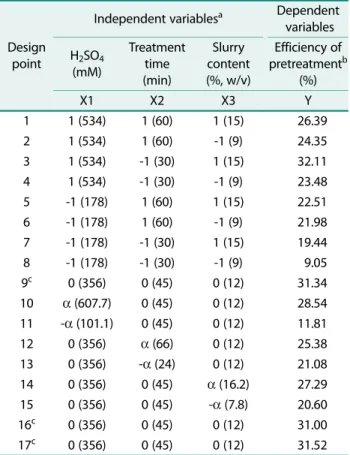
반응표면분석법(RSM)을 이용한 미역의 전처리 최적화 당생성에영향을미칠수있는변수즉, 독립변수(Xn)는 H2SO4 (%, v/v, X1), 가열처리시간(min, X2), slurry content (%, w/v, X3)이며, 각 조건들은 −α (−1.414), −1, 0, 1, α (1.414)로서 5단계로부호화하였고, 실험값은 Table 1에나 타내었다. Table 1에나타낸독립변수는 central composite design (CCD)에따라 17개의실험군으로설정하였다. 또한 독립변수에영향을받는종속변수(Y)는생성되는단당의총 량을 HPLC로측정하여전처리효율(Ep, %) 값을회귀분석 에사용하였으며, 이때세가지독립변수와종속변수에대한 2차회귀모형은다음의식 (1)과같다.
Y = β0+β1X1+β2X2+β3X3+β11X12+β22X22
+ β33X32+β12X1X2+β13X1X3+β23X2X3 (1) 여기서 Y는종속변수, X1, X2, X3은독립변수, β0는절편, βn
는회귀계수이다. 중심합성법에의해얻은실험결과를바탕 으로 SAS ver. 9.1 (SAS Institute, USA)을이용하여통계 적으로분석하여회귀방정식을구하였다.
전처리효율(Ep, %)은다음식 (2)로나타낼수있다. (2)
여기서 ∆Smono는열산가수분해시생성되는총단당의농도 (g/l)이며, TC는미역의총탄수화물(total carbohydrate) 함 량(g/l)이다.
상업적 효소를 이용 미역 열산 가수분해물의 효소당화 효소당화를위해전처리후 10 N NaOH를이용하여 pH 5.0로중화하였다. 효소당화는 ViscozymeL (121 β-glucanase U/ml; Novozymes, Bagsvaerd, Denmark)과 Celluclast
1.5 L (854 endo-glucanase U/ml; Novozymes, Bagsvaerd, Denmark)를단독혹은혼합하여 16 U/ml로첨가하여 45℃ 에서 48시간동안반응시켰다. 또한효소농도를 8, 16, 24,
그리고 32 U/ml로첨가하여효소의최적농도를확인하였
다. 효소당화의처리효율(Es, %)은식 (3)로나타낼수있다. (3)
여기서 ΔSglc는효소 가수분해시생성되는 glucose의농도 (g/l)이며, C는미역(U. pinnatifida)의셀룰로오스(cellulose) 함량(g/l)이다.
분리당화발효(separate hydrolysis and fermentation, SHF)
갈조류 U. pinnatifida을이용하여열산가수분해와효소
당화전처리를실시하고, 전처리된 U. pinnatifida 가수분해 산물을이용하여에탄올발효를진행하였다. 에탄올발효효 모 S. cerevisiae KCTC 1126와 P. angophorae KCTC 17574의 균 성장(dry cell weight, g/l)은 YPD medium (yeast extract 10.0 g/l, peptone 20.0 g/l, glucose 20.0 g/l)을이용 하여 150 rpm, 24시간동안 1차종균배양을실시하였다. 고 농도당순치(adaptive evolution)를한효모는당흡수율과 에탄올생산이증가한다고보고되고있으며[3], 여러단당이 혼합되어있는미역가수분해산물에서 S. cerevisiae KCTC 1126와 고농도 mannitol에 순치한 P. angophorae KCTC 17574를단독혹은혼합하여사용하였다. 분리당화발효(SHF) 에사용된고농도당순치효모 S. cerevisiae KCTC 1126와 P. angophorae KCTC 17574는 YPD broth에서 5 ml의균 을취하여 2차배양배지 100 ml 플라스크안에 50 ml working volume의 YPHM (Yeast extract 10.0 g/l, Peptone 20.0 g/l, High concentration of Mannitol 120.0 g/l)에 접종하였다. 이후 36시간동안배양하고배양이완료된 YPHM broth에 서원심분리기를이용하여배지를제거하고, 순치된효모 (0.35 g DCW/l)를미역가수분해산물에접종하였다. 다양한
단당 및에탄올 함량 분석을위해시료를 14,240 × g에서
10분동안 원심분리 한후 상층액을 HPLC (Agilent 1100 Series, Agilent. Inc., USA)를이용하여분석하였다. 에탄올 수율(YEtOH, g/g)은식 (4)로나타낼수있다.
(4)
여기서 [EtOH]max는에탄올발효로인해생성되는최종에
탄올의 농도(g/l)이며, [Sugar]ini는 에탄올 발효초기 단당 (mannitol + glucose)의농도(g/l)이다. 최대이론적에탄올수 율(YEtOH, g/g)은 0.51이다.
Ep %( ) ΔSmono
--- 100TC ×
=
Es( )% ΔSglc
--- 100C ×
=
YEtOH (g/g) [EtOH]max Sugar [ ]ini ---
=
분석방법
단당으로 glucose 및 mannitol, 저해물질로서 5-hydroxy- methylfurfural (HMF), 에탄올의양측정은 HPLC (Agilent 1100 Series, Agilent. Inc., USA)와 RID (refractive index detector)를이용하였다. 컬럼은 Biorad Aminex HPX-87H column (300.0 × 7.8 mm)를사용하여 온도 65℃, 이동상 5 mM 황산, 유속 0.6 ml/min로하여각시료를 40분간분석 하였다.
결과 및 고찰
미역의 성분 분석
갈조류인미역의구성성분을 AOAC 방법으로분석한결 과탄수화물 48.5%, 섬유 3.5%, 단백질 18.2%, 지방 1.8%,
ash 28% 등으로구성되어있었다. 이결과를통해미역에서
사용할수있는총탄수화물함량은섬유를포함한 52%이며, 이는에탄올생산에적합한바이오매스라고판단되어실험 에사용하였다.
반응표면분석법을 이용한 미역의 전처리 최적화
Central composite design에따라 Table 1에나타낸바와 같이각독립변수의범위를설정한후, Design Expert를이 용하여 Table 2와같이 17가지의전처리조건을설정하여미 역을전처리하였다. H2SO4 (%, v/v, X1), 가열처리시간(min, X2), 미역의 slurry content (%, w/v, X3)를독립변수로설정 하고종속변수(전처리효율, Ep)에대한회귀방정식을얻어 전처리조건에서독립변수의상호영향및최적전처리조건 을구하였다. 중심합성계획에따라얻은 17개의실험값을 이용하여아래와같은식을구하였다.
Y = −27.956221 + 0.029682 X1+ 0.030348 X2 + 10.466485 X3−0.000058709 X12−0.000479 X22
− 0.448534 X32+ 0.000136 X1· X2+ 0.000509 X1· X3
− 0.002056 X2· X3
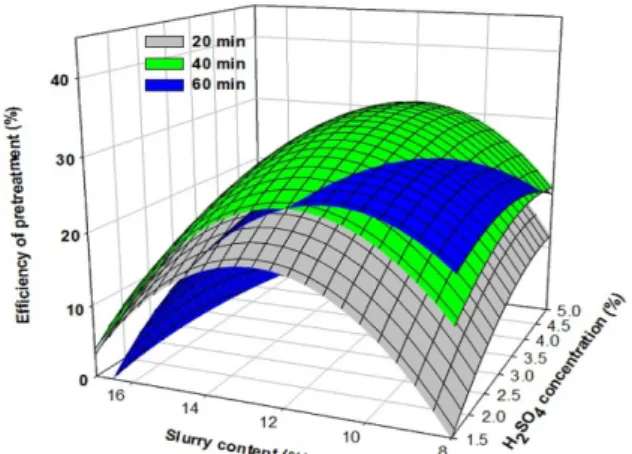
전처리조건에대한반응표면은 Fig. 1에나타내었으며전 처리효율(Ep)에대한결정계수(R2)는 0.94로황산농도와가
열처리시간에따라전처리효율(Ep)이증가하였으며, 황산농 도보다는가열처리시간에따라전처리효율(Ep)에상대적
으로크게영향을미치는것으로나타났다(Fig. 1). 최대총
단당의생성량은 24.5 g/l로 Ep 32.5%를나타내었으며, 이때
최적의조건으로판단되는전처리조건은황산농도 387.3 mM
(v/v), 가열처리시간 40 min, 슬러리농도 14.5% (w/v)이었다. Table 1. Code and level of variables used for central compos-
ite design of pretreatment.
Variable Symbol code
Range and levels -α
(-1.414) -1 0 1 Α
(1.414) H2SO4 (mM) X1 101.1 178.0 356.0 534.0 607.7
Time (min) X2 24 30 35 60 66
Slurry (%) X3 7.8 9.0 12.0 15.0 16.2
Table 2. Response surface level combinations of independent variables in the experimental design and responses of dependent variables.
Design point
Independent variablesa Dependent variables H2SO4
(mM)
Treatment time (min)
Slurry content (%, w/v)
Efficiency of pretreatmentb
(%)
X1 X2 X3 Y
1 1 (534) 1 (60) 1 (15) 26.39
2 1 (534) 1 (60) -1 (9) 24.35
3 1 (534) -1 (30) 1 (15) 32.11
4 1 (534) -1 (30) -1 (9) 23.48
5 -1 (178) 1 (60) 1 (15) 22.51
6 -1 (178) 1 (60) -1 (9) 21.98
7 -1 (178) -1 (30) 1 (15) 19.44
8 -1 (178) -1 (30) -1 (9) 9.05
9c 0 (356) 0 (45) 0 (12) 31.34
10 α (607.7) 0 (45) 0 (12) 28.54
11 -α (101.1) 0 (45) 0 (12) 11.81
12 0 (356) α (66) 0 (12) 25.38
13 0 (356) -α (24) 0 (12) 21.08
14 0 (356) 0 (45) α (16.2) 27.29
15 0 (356) 0 (45) -α (7.8) 20.60
16c 0 (356) 0 (45) 0 (12) 31.00
17c 0 (356) 0 (45) 0 (12) 31.52
RSM: response surface methodology.
aExperimental codes, ranges, and levels of the independent variables:
X1= H2SO4 (mM) [-α = 101.1 mM, -1 = 178.0 mM, 0 = 356.0 mM, 1 = 534.0 mM, α = 607.7 mM]
X2 = Thermal hydrolysis time (min) [-α = 24 min, -1 = 30 min, 0 = 45 min, 1 = 60 min, α = 66 min]
X3 = slurry content (%, w/v) [-α = 7.8%, -1 = 9.0%, 0 = 12.0%, 1 = 15%, α = 16.2%]
The second-order polynomial equations (Efficiency of pretreat- mentb):
Y =−27.956221 + 0.029682 X1+ 0.030348 X2+ 10.466485 X3
− 0.000058709 X12− 0.000479 X22− 0.448534 X32+ 0.000136 X1·X2+ 0.000509 X1·X3− 0.002056 X2·X3, F-value = 11.98, Proba- bility of F = 0.0018
cCentral points.
미역을산과열을이용하여전처리하면단당외에도 5- HMF, acetic acid 등의발효저해제가생성된다. 미역을이 용한전처리과정에서생산되는발효저해제는 5-HMF (0.5 g/l), acetic acid (0.3 g/l)가검출되어에탄올생산을위한효모의 성장에는크게영향을미치지않을것으로판단되었다[9, 10].
효소 가수분해
열산가수분해를실시한후 5N NaOH를이용하여 pH를 5.0으로중화한뒤미역가수분해산물의효소당화를실시하 였다. Fig. 2는 16 U/ml의단일혹은복합효소를이용하여 45℃에서 48시간동안효소당화를실시하였으며, 효소종류 (Fig. 2A) 및효소농도(Fig. 2B)에따른 glucose 생성량을분 석하였다.
효소당화초기에나타난 16.3 g/l의 glucose는 14.5% (w/v) 미역을열산가수분해실시하였을때생성되었다. Fig. 2A에
서효소종류에따른단일혹은복합효소의가수분해효율(Es) 은 Celluclast 1.5 L, Viscozyme L, mixed enzyme (C + V) 에서각각 69%, 53%, 42%로나타났으며, Celluclast 1.5 L 를단독으로사용하는것이당화효율이가장높음을알수 있었다. 또한 Fig. 2B에서나타난바와같이 Celluclast 1.5 L 를 8, 16, 24, 그리고 32 U/ml로다양한농도로첨가하여효 소의최적농도를확인한결과 24 U/ml에서 Es가 82%로가 장높은값을나타내기분리당화발효(SHF)에적용하는효 소당화조건은 24 U/ml의 Celluclast 1.5 L를단독으로사 용하는것을선택하여실험을진행하였다.
효모 2종을 이용한 에탄올 발효
Fig. 3는전처리한 U. pinnatifida 가수분해산물로부터비 순치(non-adapted) 효모 S. cerevisiae KCTC 1126와고농 도 mannitol에순치한효모 P. angophorae KCTC 17574를 단독혹은혼합사용하여당소비와에탄올생산수율(YEtOH) 을비교분석하였다.
Fig. 3A는 비순치 S. cerevisiae KCTC 1126를 30℃, 150 rpm으로 108시간 동안 발효한 결과이며, 36시간에 glucose가완전히소비되었고 6.58 g/l의에탄올을생산하였 다. 그러나 36시간이후 mannitol 농도는전혀감소되지않 았으며, 최종에탄올수율(YEtOH)은 0.23로낮은수율을나타 내었다. 반면 고농도 mannitol에 순치한 S. cerevisiae KCTC 1126의 발효 결과, glucose가 완전히 소비된 이후 mannitol 농도는전혀감소되지않았다(data not shown). 이 는 S. cerevisiae KCTC 1126는 mannitol을사용하지못한
다는것을알수있었고[6], 따라서효모2종을이용한공배
양발효(co-culture)에서 glucose의빠른섭취를위해비순치 S. cerevisiae KCTC 1126를사용하였다.
Fig. 3B는비순치 P. angophorae KCTC 17574를 30℃, 150 rpm으로 108시간 동안 발효한 결과이며, 48시간에 Fig. 1. Response surface plot showing the influences of
sulfuric acid concentration, thermal hydrolysis time, and slurry content on the efficiency of pretreatment (Ep) from U.
pinnatifida.
Fig. 2. Effect of (A) enzyme type and (B) enzyme dosage on glucose release from U. pinnatifida hydrolysate with 14.5% (w/v) slurry at pH 5.0, 45℃, for 48 h after thermal acid hydrolysis. The initial glucose concentration was 16.0 g/l after thermal acid hydro- lysis such as control.
glucose가완전히소비되었고 7.28 g/l의에탄올을생산하였 다. 또한 36시간이후 mannitol이흡수되기시작하였으나, 3.20 g/l의 mannitol이배양액에남아있는것을확인할수 있었다. 최종에탄올수율(YEtOH)은 0.25로낮은수율을나타 내었다. Fig. 3C는고농도 mannitol에순치한 P. angophorae KCTC 17574를 30℃, 150 rpm으로 108시간동안발효한결 과이며, 48시간에 glucose가모두소비되었으며, 48시간이 후 mannitol이흡수되기시작하여 96시간에 mannitol이모 두소비되었다. 발효 96시간에 10.2 g/l의에탄올이생산되 었으며, 에탄올수율(YEtOH)은 0.33으로나타났다. Fig. 3D는 비순치 S. cerevisiae KCTC 1126와고농도 mannitol에순 치한 P. angophorae KCTC 17574를 이용하여 30℃, 150 rpm으로 108시간동안공배양발효(co-culture)한결과 이며, 36시간에 glucose가모두소비되었으며, 36시간이후 mannitol이흡수되기시작하여 72시간에 mannitol이모두 소비되었다. Fig. 3의발효를보면전반적으로 glucose 소모 속도가느리게나타나는데, 일반적으로전분당화액의경우 에 glucose는약 24시간안에소모하는것으로알려져있다. 그 러나전처리한 U. pinnatifida 가수분해산물에는저해제로
알려진 5-hydroxy methylfurfural (5-HMF), levulinic acid, 그리고 formic acid 등이포함되어있어효모의생장과당대
사과정에영향을끼쳤을것으로판단된다[5]. 발효 72시간에
12.2 g/l의 에탄올이생산되었으며, 에탄올 수율(YEtOH)은 0.41로나타났다. 고농도 mannitol에순치한 P. angophorae KCTC 17574의에탄올수율(YEtOH)인 0.33 (Fig. 3C)과비교 하였을 때, 비순치 S. cerevisiae KCTC 1126와 고농도 mannitol에순치한 P. angophorae KCTC 17574를이용하 여공배양발효(Fig. 3D)를수행한에탄올전환수율이높음 을알수있었다. 한편, S. cerevisiae KCTC 1126는 mannitol을
사용하지 못하기 때문에 고농도 mannitol에 순치한 S.
cerevisiae KCTC 1126와 순치한 P. angophorae KCTC
17574의공배양발효는 Fig. 3D와비슷한결과를나타내었
다(data not shown). Lee와 Lee [8]는 갈조류로부터 S.
cerevisiae를이용하여 2.7 g/l의바이오에탄올을생산하였으 며, Tan과 Lee [13]는 macroalgae cellulosic residue (MCR)
로부터발효를통해 14.1 g/l의바이오에탄올을생산한것으
로보고하였다. 따라서다양한단당의해조류가수분해산물 로부터특정당섭취에효과적인효모 2종을이용한공배양 Fig. 3. Ethanol production by SHF with 14.5% (w/v) U. pinnatifida hydrolysate at 30℃, 150 rpm for 108 h using (A) non-adapted S. cerevisiae KCTC 1126, (B) non-adapted P. angophorae KCTC 17574, (C) adapted P. angophorae KCTC 17574 to high mannitol concentration, (D) co-culture of non-adapted S. cerevisiae KCTC 1126 and adapted P. angophorae KCTC 17574 to high mannitol concentration.
발효(co-culture)는기존에알려진바이오에탄올생산수율 보다높거나비슷한것으로판단되며, 에탄올생산및생산 수율(YEtOH)을높이는데효과적인공정임을알수있었다.
요 약
해조류중갈조류인미역으로부터분리당화발효(SHF)를 위한전처리및효소당화를검토하고, 기존의분리당화발효 (SHF)를개선하기위해공배양발효(co-culture)를수행하였 다. 비순치효모와고농도 mannitol에순치(adaptive evolution) 한효모를이용한공배양발효를실시한결과발효 72시간에 12.2 g/l의에탄올과에탄올 수율(YEtOH) 0.41을나타내었 다. 이러한기존의분리당화발효(SHF)를개선한공배양발효 를통해에탄올생산수율이 0.23에서 0.41로 35.2% 증가하 였으며, 에탄올발효시간도 108시간에서 72시간으로 33.3%
감소하였다. 이러한연구결과는해양바이오매스인해조류 로부터바이오연료생산과정에있어유용한정보를제공하 는것으로판단된다.
Acknowledgments
This work was supported by a Research Grant of Pukyong National University (2016).
References
1. Bothast RJ, Schlicher MA. 2005. Biotechnological processes for conversion of corn into ethanol. Appl. Microbiol. Biotechnol. 67:
19-25.
2. Chiaramonti D, Prussi M, Ferrero S, Oriani L, Ottonello P, Torre P, et al. 2012. Review of pretreatment processes for lignocellu- losic ethanol production. Biomass. Bioenergy 46: 25-35.
3. Cho HY, Ra CH, Kim SK. 2014. Ethanol production from the sea-
weed Gelidium amansii, using specific sugar acclimated yeasts.
J. Microbiol. Biotechnol. 24: 264-269.
4. Dias MOS, Esinas AV, Nebra SA, Filho RM, Rossell CEV, Maciel MRW. 2009. Production of bioethanol and other bio-based materials from sugarcane bagasse: integration to conventional bioethanol production process. Chem. Eng. Res. Des. 87: 1206- 1216.
5. Daroch M, Geng S, Wang G. 2013. Recent advances in liquid biofuel production from algal feedstocks. Appl. Energy 102:
1371-1381.
6. Heredia CF, Sols A, De La Fuente G. 1968. Specificity of the con- stitutive hexose transport in yeast. Eur. J. Biochem. 5: 321-329.
7. Jang JS, Cho YK, Jeong GT, Kim SK. 2012. Optimization of sac- charification and ethanol production by simultaneous saccha- rification and fermentation (SSF) from seaweed Saccharina japonica. Bioprocess Biosyst. Eng. 35: 11-18.
8. Lee SM, Lee JH. 2012. Ethanol fermentation for main sugar components of brown-algae using various yeasts. J. Ind. Eng.
Chem. 18: 16-18.
9. Morimoto S, Murakami M. 1967. Studies on fermentation prod- ucts from aldehyde by microorganisms: the fermentative pro- duction of furfural alcohol from furfural by yeasts (part I). J.
Ferment. Technol. 45: 442-446.
10. Palmqvist E, Almeida JS, Hahn-Hagerdal B. 1999. Influence of furfural on anaerobic glycolytic kinetics of Saccharomyces cere- visiae in batch culture. Biotechnol. Bioeng. 62: 447-454.
11. Ra CH, Kim SK. 2013. Optimization of pretreatment conditions and use of a two-stage fermentation process for the produc- tion of ethanol from seaweed, Saccharina japonica. Biotechnol.
Bioprocess Eng. 18: 715-720.
12. Sanchez-Machado DI, Lopez-Cervantes J, Paseiro-Losada P, Lopez-Hernandez J. 2004. Fatty acids, total lipid, protein and ash contents of processed edible seaweeds. Food Chem. 85:
439-444.
13. Tan IS, Lee KT. 2015. Solid acid catalysts pretreatment and enzymatic hydrolysis of macroalgae cellulosic residue for the production of bioethanol. Carbohydr. Polym. 124: 311-321.