ABSTRACT
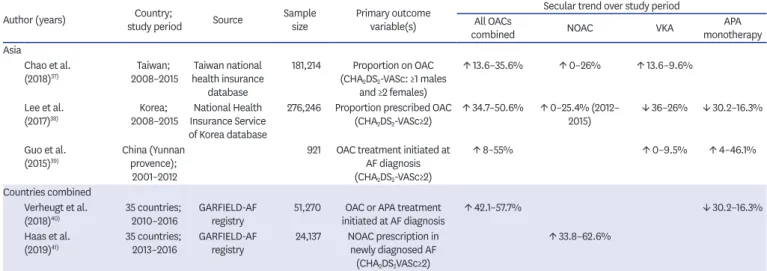
Atrial fibrillation (AF) is a significant risk factor for avoidable stroke. Among high-risk patients with AF, stroke risk can be mitigated using oral anticoagulants (OACs), however reduction is largely contingent on physician prescription and patient persistence with OAC therapy. Over the past decade significant advances have occurred, with revisions to clinical practice guidelines relating to management of stroke risk in AF in several countries, and the introduction of non-vitamin K antagonist OACs (NOACs). This paper summarises the evolving body of research examining guideline-based clinician prescription over the past decade, and patient-level factors associated with OAC persistence. The review shows clinicians' management over the past decade has increasingly reflected guideline recommendations, with an increasing proportion of high-risk patients receiving OACs, driven by an upswing in NOACs. However, a treatment gap remains, as 25–35% of high- risk patients still do not receive OAC treatment, with great variation between countries.
Reduction in stroke risk directly relates to level of OAC prescription and therapy persistence.
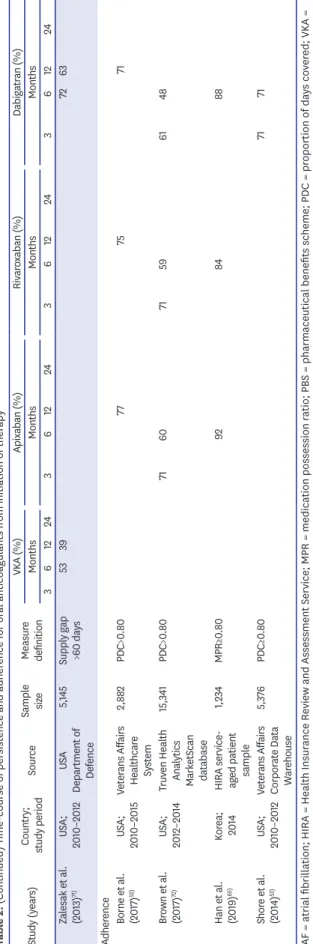
Persistence and adherence to OAC thromboprophylaxis remains an ongoing issue, with 2-year persistence as low as 50%, again with wide variation between countries and practice settings. Multiple patient-level factors contribute to poor persistence, in addition to concerns about bleeding. Considered review of individual patient's factors and circumstances will assist clinicians to implement appropriate strategies to address poor persistence. This review highlights the interplay of both clinician's awareness of guideline recommendations and understanding of individual patient-level factors which impact adherence and persistence, which are required to reduce the incidence of preventable stroke attributable to AF.
Keywords: Atrial fibrillation; Oral anticoagulant; Prescription; Persistence (or adherence);
Temporal trends
Review Article
Received: Jul 16, 2019 Accepted: Jul 17, 2019 Correspondence to Nicole Lowres, PhD, BPhty
Heart Research Institute, Charles Perkins Centre, John Hopkins Dr, Sydney NSW 2006, Australia.
E-mail: [email protected]
*Nicole Lowres and Katrina Giskes contributed equally to this work.
Copyright © 2019. The Korean Society of Cardiology
This is an Open Access article distributed under the terms of the Creative Commons Attribution Non-Commercial License (https://
creativecommons.org/licenses/by-nc/4.0) which permits unrestricted noncommercial use, distribution, and reproduction in any medium, provided the original work is properly cited.
ORCID iDs Nicole Lowres
https://orcid.org/0000-0001-9061-3406 Katrina Giskes
https://orcid.org/0000-0003-2266-0336 Charlotte Hespe
https://orcid.org/0000-0002-4582-7728 Ben Freedman
https://orcid.org/0000-0002-3809-2911 Funding
Nicole Lowres is funded by a NSW Health Early Career Fellowship (H16/52168). Katrina Giskes is supported by the Royal Australian College of General Practitioners with funding from the Australian Government under the Australian General Practice Training program.
Nicole Lowres , PhD, BPhty
1,2,*, Katrina Giskes , MBBS, PhD, BHlthSc
1,3,*, Charlotte Hespe , MBBS
3, and Ben Freedman , MBBS, PhD
1,2,41
Heart Research Institute, Charles Perkins Centre, Camperdown, Australia
2
Faculty of Medicine and Health, The University of Sydney, Sydney, Australia
3
School of Medicine, The University of Notre Dame, Sydney, Australia
4