ABSTRACT
Objective: We aimed to investigate the association between statin use and the risk of major osteoporotic fractures in patients with metabolic syndrome (MetS).
Methods: A nested case-control study was performed in patients with MetS (≥50 years) who had no history of osteoporotic fracture using the Korean National Health Insurance Service- Health Screening Cohort. This study included 17,041 patients diagnosed with new-onset osteoporotic fractures and controls matched in a 1:1 ratio by age, sex, body mass index, cohort entry date, and follow-up duration. Conditional logistic regression analysis was used to evaluate covariate-adjusted odds ratios (ORs) and 95% confidence intervals (CIs).
Results: During a 4-year follow-up period, the risk of major osteoporotic fractures was significantly reduced by 9% (OR, 0.91; 95% CI, 0.85–0.97) in statin users compared with that in non-users. Among subtypes of major osteoporotic fracture, a risk reduction with statin therapy was significant for vertebral fracture (OR, 0.86; 95% CI, 0.79–0.94) but not for non-vertebral fracture (OR, 0.97; 95% CI, 0.88–1.06). Longer duration (OR, 0.97; 95% CI, 0.96–0.99, per 1-year increase) and higher cumulative dose (OR, 0.97; 95% CI, 0.95–0.99, per 365 defined daily doses) of statins were negatively associated with the risk of major osteoporotic fracture.
Conclusion: This study supports the hypothesis that statin therapy has a beneficial effect on major osteoporotic fractures, especially vertebral fractures, in patients with MetS.
Keywords: HMG-CoA reductase inhibitor; Statin; Osteoporotic fractures; Metabolic syndrome;
Case-control studies
INTRODUCTION
Metabolic syndrome (MetS) is a clustering of multiple risk factors for metabolic dysregulation and atherosclerotic cardiovascular disease (CVD), including abdominal obesity, dyslipidemia, hyperglycemia and hypertension.1 Osteoporosis is a common metabolic disorder
characterized by low bone mass and micro-architectural deterioration of bone tissue, and is
Original Article
Received: Feb 16, 2021 Revised: May 7, 2021 Accepted: Jun 28, 2021 Correspondence to Nam Hoon Kim
Division of Endocrinology and Metabolism, Department of Internal Medicine, Korea University College of Medicine, 73 Goryeodae-ro, Seongbuk-gu, Seoul 02841, Korea.
E-mail: [email protected]
Copyright © 2021 The Korean Society of Lipid and Atherosclerosis.
This is an Open Access article distributed under the terms of the Creative Commons Attribution Non-Commercial License (https://
creativecommons.org/licenses/by-nc/4.0/) which permits unrestricted non-commercial use, distribution, and reproduction in any medium, provided the original work is properly cited.
ORCID iDs Kyoung Jin Kim
https://orcid.org/0000-0001-7925-2515 Jimi Choi
https://orcid.org/0000-0003-2834-2718 Ji Yoon Kim
https://orcid.org/0000-0001-6626-2124 Jae Hyun Bae
https://orcid.org/0000-0002-1384-6123 Kyeong Jin Kim
https://orcid.org/0000-0002-5878-6005 Hee Young Kim
https://orcid.org/0000-0002-7268-2624
Kyoung Jin Kim ,1 Jimi Choi ,2 Ji Yoon Kim ,1 Jae Hyun Bae ,1
Kyeong Jin Kim ,1 Hee Young Kim ,1 Hye Jin Yoo ,1 Ji A Seo ,1 Nan Hee Kim ,1 Kyung Mook Choi ,1 Sei Hyun Baik ,1 Sin Gon Kim ,1 Nam Hoon Kim 1
1 Division of Endocrinology and Metabolism, Department of Internal Medicine, Korea University College of Medicine, Seoul, Korea
2Department of Biostatistics, Korea University College of Medicine, Seoul, Korea
Statin Therapy and the Risk of
Osteoporotic Fractures in Patients
with Metabolic Syndrome: a Nested
Case-Control Study
Hye Jin Yoo
https://orcid.org/0000-0003-0600-0266 Ji A Seo
https://orcid.org/0000-0002-1927-2618 Nan Hee Kim
https://orcid.org/0000-0003-4378-520X Kyung Mook Choi
https://orcid.org/0000-0001-6175-0225 Sei Hyun Baik
https://orcid.org/0000-0002-0665-9266 Sin Gon Kim
https://orcid.org/0000-0002-7430-3675 Nam Hoon Kim
https://orcid.org/0000-0002-9926-1344 Funding
This study was supported by the big data analysis grant from The Korean Society of Lipid and Atherosclerosis.
Conflict of Interest
The authors have no conflicts of interest to declare.
Author Contributions
Conceptualization: Kim KJ1, Kim NH2; Data curation: Kim KJ1, Choi J, Bae JH, Kim KJ2, Kim HY, Yoo HJ, Seo JA, Kim NH1, Choi KM, Baik SH, Kim SG, Kim NH2; Formal analysis:
Kim KJ1, Choi J, Kim JY, Bae JH, Kim KJ2, Kim HY, Yoo HJ, Seo JA, Kim NH1, Choi KM, Baik SH, Kim SG, Kim NH2; Funding acquisition: Kim KJ1; Investigation: Kim NH2; Methodology: Kim KJ1, Choi J; Project administration: Kim KJ1, Kim SG, Kim NH2; Supervision: Kim SG, Kim NH2; Validation:
Kim KJ1, Choi J, Kim JY, Bae JH, Kim KJ2, Kim HY, Yoo HJ, Seo JA, Kim NH1, Choi KM, Baik SH, Kim SG, Kim NH2; Visualization: Kim KJ1, Kim NH2; Writing - original draft: Kim KJ1, Kim NH2; Writing - review & editing: Kim KJ1, Choi J, Kim JY, Bae JH, Kim KJ2, Kim HY, Yoo HJ, Seo JA, Kim NH1, Choi KM, Baik SH, Kim SG, Kim NH2.
Kim KJ1, Kyoung Jin Kim; Kim KJ2, Kyeong Jin Kim.
Kim NH1, Nan Hee Kim; Kim NH2, Nam Hoon Kim.
associated with an increased risk of fracture.2 Both conditions are major healthcare problem with a growing prevalence due to an ageing society. Existing evidence suggests that MetS and osteoporosis are closely linked as they share common risk factors and pathophysiologic mechanisms, such as sedentary lifestyle, disturbed calcium homeostasis, induction of inflammatory response, and increased oxidative stress.3,4
Statins, a 3-hydroxy 3-methylglutaryl coenzyme A reductase inhibitor, is a lipid-modifying drug with proven efficacy in the primary and secondary prevention of CVD.5 Given their possible pleiotropic effects on bone metabolism, including reduction of bone resorption and stimulation of bone formation, statins may have beneficial effects on bone mineral density.6-12 However, clinical evidence has not consistently shown an association between statin use and risk of fracture.13-17 Statins are widely used in patients at risk of developing CVD and also in those with established CVD.18 Thus, a detailed analysis of the effects of statins on bone health is required in this population.
We aimed to evaluate the association between statin use and the risk of major osteoporotic fracture in subjects with MetS using a nested case-control analysis. We also assessed the dose-effect relationship between statins and fractures.
MATERIALS AND METHODS
1. Data sources
This study was designed as a case-control study nested in the MetS cohort using the Korean National Health Insurance Service-Health Screening Cohort (NHIS-HEALS) database. This database includes 514,866 individuals, who were aged between 40 and 79 years in 2002, and who were followed up until 2015. This comprised 10% of the total number of health screening participants between 2002 and 2003. The NHIS required all insured employees and self-employed persons, as well as their dependents, to undertake a general health screen biannually to improve the health status of Koreans through the prevention and early detection of diseases. This database contains longitudinal information such as personal demographics, medical and pharmaceutical information including disease code records according to the International Classification of Disease, 10th Revision (ICD-10), medical procedures, hospitalization, information of prescribed drugs, and death records. The detailed cohort protocol has been previously demonstrated.19
This study was approved by the Institutional Review Board (IRB) of the Korea University Anam Hospital (IRB No. 2019AN0284). Informed consent was waived, because data from the NHIS-HEALS do not involve any personally identifiable data.
2. Study population
From the NHIS-HEALS database, we assembled the MetS cohort that included all subjects diagnosed with MetS from January 1, 2004, to December 31, 2014, and followed up until December 31, 2015. According to the Adult Treatment Panel III guidelines, subjects were considered to have MetS if they had 3 or more of the following criteria: abdominal obesity (waist circumference ≥90 cm for men and ≥80 cm for women on the basis of an Asian- specific cutoff point), high triglyceride level ≥150 mg/dL, low HDL cholesterol level (<40 mg/
dL for men and <50 mg/dL for women), high blood pressure (≥130/85 mmHg) or treatment for hypertension, high fasting glucose (≥100 mg/dL) or use of antidiabetic medication
(Supplementary Table 1).20 Subjects younger than 50 years or those who had previously been diagnosed with any osteoporotic fractures prior to the cohort entry date were excluded. Each individual in the study cohort was followed up from the cohort entry date to the earliest occurrence of any osteoporotic fracture, death, or the end of the study period.
Using the ICD-10 code, we defined cases as those who developed osteoporotic fractures, and controls as those who did not. Osteoporotic fractures are defined as fractures caused by low-level trauma, for example equivalent to a fall from a standing height or less.21 The most commonly occurring osteoporotic fractures are spine, distal radius, hip, and humerus in order of frequency in Korea.22 In our study, the definition of major osteoporotic fractures is also summarized in Supplementary Table 1. For each patient, one control subject was randomly selected from all subjects who had accrued at least the same length of follow-up as the case and matched on the basis of age, sex, baseline body mass index (BMI) (±0.15 kg/m2), and the cohort entry date. The index date for the MetS patients was the date of first osteoporotic fracture, and the index date for each control was the same. Thus, cases and controls were matched for the duration of follow-up.
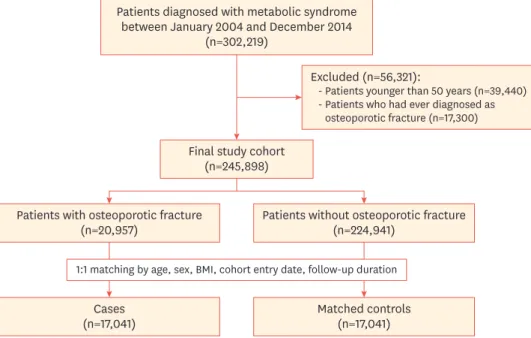
Fig. 1 shows the flow of the study subject selection. From the NHIS-HEALS database, 302,219 patients were diagnosed with MetS between January 2004 and December 2014 and enrolled in the MetS cohort. After applying our exclusion criteria, we identified 20,957 major osteoporotic fracture cases and 224,941 controls in the study cohort. After 1:1 matching by age, sex, BMI, cohort entry date, and follow-up duration, a total of 17,041 cases and 17,041 matched controls were used in the analysis.
3. Exposure assessment
Statin users were defined as those who used any of the following statins for at least 30 consecutive days during the period ranging from 1 year prior to the cohort entry date to the index date: atorvastatin, fluvastatin, lovastatin, pitavastatin, pravastatin, and rosuvastatin.
Patients diagnosed with metabolic syndrome between January 2004 and December 2014
(n=302,219)
Excluded (n=56,321):
- Patients younger than 50 years (n=39,440) - Patients who had ever diagnosed as osteoporotic fracture (n=17,300) Final study cohort
(n=245,898)
Patients with osteoporotic fracture
(n=20,957) Patients without osteoporotic fracture (n=224,941)
Cases
(n=17,041) Matched controls
(n=17,041) 1:1 matching by age, sex, BMI, cohort entry date, follow-up duration
Fig. 1. Study flow diagram.
BMI, body mass index.
Those who had never received a statin prescription or who had taken less than 30 days of treatment were included in the non-user group. For the exposure assessment, we calculated the cumulative duration of statins during the follow-up period by summing all the prescription days and dividing patients into 3 categories: 1) less than 30 days (non-user group), 2) 31-364 days, or 3) more than 365 days. In addition, we calculated the cumulative dose for each statin by multiplying the defined daily doses (cDDD) and the prescription days of statin, with the total cumulative dose of statins by summing the cumulative dose for each statin. The cDDD of each statin was based on the World Health Organization ATC classification.9,23
4. Covariates
Covariates included BMI close to the point of fracture event or at the end of study, smoking status (current, ever, or never), alcohol consumption (none, ≤twice per week, or ≥three times per week), physical activity (none, ≤twice per week, or ≥three times per week), socioeconomic status (lowest 30%, middle 40%, or highest 30%), waist circumference, systolic blood pressure, fasting blood glucose level, total cholesterol level, gamma-glutamyl transpeptidase (GGT), hemoglobin, comorbidities (diabetes mellitus, hypertension, dyslipidemia, chronic kidney disease (CKD), CVD, cancer, chronic obstructive pulmonary disease (COPD), hyperthyroidism, hyperparathyroidism, chronic liver disease, rheumatoid arthritis (RA), osteoporosis, Cushing's syndrome), and concurrent medication (statin, fibrate, anti-osteoporotic agents, calcium, vitamin D, glucocorticoid, antihypertensive agents, antidiabetic agents, antidepressants, and anticonvulsants). Comorbidities and medication used were defined as relevant claim codes during the period ranging from 1 year prior to the cohort entry date to the index date. The details are summarized in Supplementary Table 1.
5. Statistical analysis
Data were summarized as means±standard deviations for continuous variables and numbers (%) for categorical variables. The baseline characteristics of cases (statin users) and
matched controls (statin non-users) were compared using conditional logistic regression models for matched pairs. To evaluate the association between statin use and osteoporotic fracture risk, we also used conditional logistic regression models and presented the results as odds ratios (ORs) with corresponding 95% confidence intervals (CIs). Two models were considered: 1) model 1, adjusted for follow-up BMI, smoking, alcohol consumption, regular exercise, income status, comorbidities, and concurrent medication described above, and 2) model 2, adjusted for clinical findings including systolic blood pressure, fasting glucose, total cholesterol, GGT, hemoglobin, and all variables in model 1. The same analysis was performed for statin use with cDDD. Additionally, we conducted subgroup analyses stratified by sex (male, female), age (<65 and ≥65 years), BMI (<25 and ≥25 kg/m2), the presence of pre-existing diseases (hypertension, diabetes mellitus, dyslipidemia, CKD, CVD, osteoporosis, RA), and concurrent medications (bisphosphonate, other osteoporotic medications). The interaction term between the statin variable and the above stratification factor was added to the models and the difference in the effect of statin on osteoporotic fracture risk across subgroups.
A p-values are 2-sided, and statistical significance was set at p<0.05. Statistical analyses were performed using SAS Enterprise Guide version 7.1 (SAS Institute, Cary, NC, USA).
RESULTS
1. Baseline characteristics
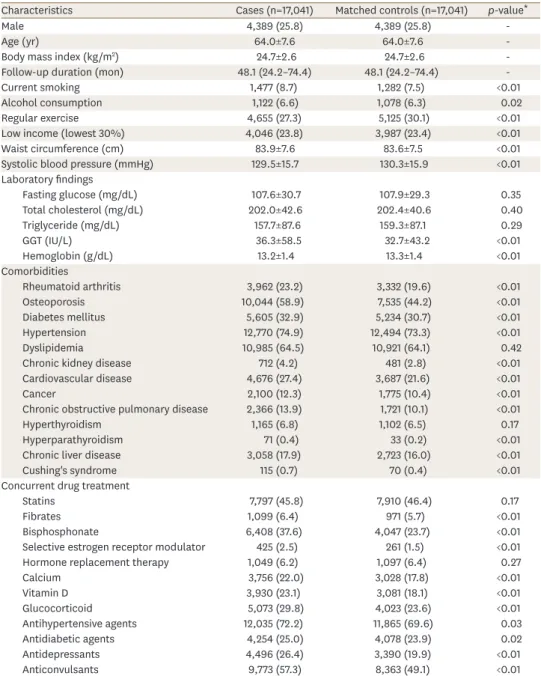
The median follow-up duration was 48.1 months (interquartile range, 24.2–74.4). Subjects in the MetS cohort had a higher prevalence of risk factors for fracture, such as current smoking, alcohol consumption, lower regular exercise, lower income, higher waist circumference, higher GGT level, and lower hemoglobin level compared with controls (Table 1). They also had a higher prevalence of comorbidities including RA, osteoporosis, diabetes mellitus, hypertension, CKD, CVD, cancer, COPD, hyperparathyroidism, chronic liver disease, and Cushing's syndrome, as well as higher use of medications including bisphosphonates,
Table 1. Baseline characteristics of study subjects
Characteristics Cases (n=17,041) Matched controls (n=17,041) p-value*
Male 4,389 (25.8) 4,389 (25.8) -
Age (yr) 64.0±7.6 64.0±7.6 -
Body mass index (kg/m2) 24.7±2.6 24.7±2.6 -
Follow-up duration (mon) 48.1 (24.2–74.4) 48.1 (24.2–74.4) -
Current smoking 1,477 (8.7) 1,282 (7.5) <0.01
Alcohol consumption 1,122 (6.6) 1,078 (6.3) 0.02
Regular exercise 4,655 (27.3) 5,125 (30.1) <0.01
Low income (lowest 30%) 4,046 (23.8) 3,987 (23.4) <0.01
Waist circumference (cm) 83.9±7.6 83.6±7.5 <0.01
Systolic blood pressure (mmHg) 129.5±15.7 130.3±15.9 <0.01
Laboratory findings
Fasting glucose (mg/dL) 107.6±30.7 107.9±29.3 0.35
Total cholesterol (mg/dL) 202.0±42.6 202.4±40.6 0.40
Triglyceride (mg/dL) 157.7±87.6 159.3±87.1 0.29
GGT (IU/L) 36.3±58.5 32.7±43.2 <0.01
Hemoglobin (g/dL) 13.2±1.4 13.3±1.4 <0.01
Comorbidities
Rheumatoid arthritis 3,962 (23.2) 3,332 (19.6) <0.01
Osteoporosis 10,044 (58.9) 7,535 (44.2) <0.01
Diabetes mellitus 5,605 (32.9) 5,234 (30.7) <0.01
Hypertension 12,770 (74.9) 12,494 (73.3) <0.01
Dyslipidemia 10,985 (64.5) 10,921 (64.1) 0.42
Chronic kidney disease 712 (4.2) 481 (2.8) <0.01
Cardiovascular disease 4,676 (27.4) 3,687 (21.6) <0.01
Cancer 2,100 (12.3) 1,775 (10.4) <0.01
Chronic obstructive pulmonary disease 2,366 (13.9) 1,721 (10.1) <0.01
Hyperthyroidism 1,165 (6.8) 1,102 (6.5) 0.17
Hyperparathyroidism 71 (0.4) 33 (0.2) <0.01
Chronic liver disease 3,058 (17.9) 2,723 (16.0) <0.01
Cushing's syndrome 115 (0.7) 70 (0.4) <0.01
Concurrent drug treatment
Statins 7,797 (45.8) 7,910 (46.4) 0.17
Fibrates 1,099 (6.4) 971 (5.7) <0.01
Bisphosphonate 6,408 (37.6) 4,047 (23.7) <0.01
Selective estrogen receptor modulator 425 (2.5) 261 (1.5) <0.01
Hormone replacement therapy 1,049 (6.2) 1,097 (6.4) 0.27
Calcium 3,756 (22.0) 3,028 (17.8) <0.01
Vitamin D 3,930 (23.1) 3,081 (18.1) <0.01
Glucocorticoid 5,073 (29.8) 4,023 (23.6) <0.01
Antihypertensive agents 12,035 (72.2) 11,865 (69.6) 0.03
Antidiabetic agents 4,254 (25.0) 4,078 (23.9) 0.02
Antidepressants 4,496 (26.4) 3,390 (19.9) <0.01
Anticonvulsants 9,773 (57.3) 8,363 (49.1) <0.01
Values are mean±standard deviation, number (%), or median (interquartile range).
GGT, gamma-glutamyl transferase.
*p-value by conditional logistic regression model.
selective estrogen receptor modulators (SERM), calcium, vitamin D, glucocorticoid, fibrate, antihypertensive agents, antidiabetic agents, antidepressants, and anticonvulsants than controls. The proportion of statin use was not significantly different between the groups.
2. Risk of major osteoporotic fractures
A total of 7,797 patients (45.8%) in the statin-user group and 9,244 (50.3%) in the non-user group developed major osteoporotic fractures. Among subtypes of osteoporotic fractures, 8,857 (52.0%) vertebral fractures, 1,274 (7.5%) hip fractures, and 7,030 (41.3%) humerus and distal radius fractures occurred. The incidence rate of all osteoporotic fractures was 13.25 cases per 1,000 person-years, which was higher than that of general population21,22,24 probably by the characteristics of MetS patients who were older and had more risk factors of fractures.
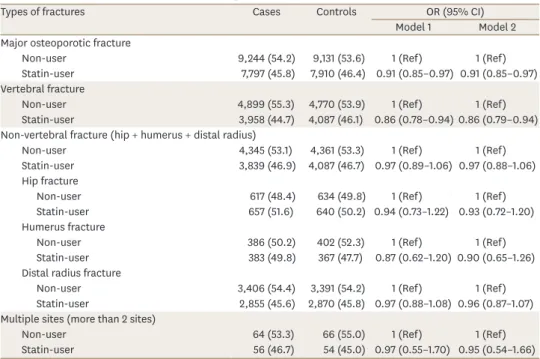
Table 2 shows the comparative risk of osteoporotic fractures by skeleton sites between statin users and non-users. Overall, statin use was associated with a lower risk of developing major osteoporotic fractures after full adjustment for covariates among patients with MetS (adjusted OR [aOR], 0.91; 95% CI, 0.85–0.97, in model 2). Among subtypes of major osteoporotic fractures, the risk of vertebral fractures was also lower in the statin-user group than in the non-user group (aOR, 0.86; 95% CI, 0.79–0.94). However, the risks of non- vertebral fractures including hip, humerus, and distal radius fractures were not different between groups.
Table 2. Effect of statins on fracture risk according to the sites
Types of fractures Cases Controls OR (95% CI)
Model 1 Model 2
Major osteoporotic fracture
Non-user 9,244 (54.2) 9,131 (53.6) 1 (Ref) 1 (Ref)
Statin-user 7,797 (45.8) 7,910 (46.4) 0.91 (0.85–0.97) 0.91 (0.85–0.97) Vertebral fracture
Non-user 4,899 (55.3) 4,770 (53.9) 1 (Ref) 1 (Ref)
Statin-user 3,958 (44.7) 4,087 (46.1) 0.86 (0.78–0.94) 0.86 (0.79–0.94) Non-vertebral fracture (hip + humerus + distal radius)
Non-user 4,345 (53.1) 4,361 (53.3) 1 (Ref) 1 (Ref)
Statin-user 3,839 (46.9) 4,087 (46.7) 0.97 (0.89–1.06) 0.97 (0.88–1.06) Hip fracture
Non-user 617 (48.4) 634 (49.8) 1 (Ref) 1 (Ref)
Statin-user 657 (51.6) 640 (50.2) 0.94 (0.73–1.22) 0.93 (0.72–1.20) Humerus fracture
Non-user 386 (50.2) 402 (52.3) 1 (Ref) 1 (Ref)
Statin-user 383 (49.8) 367 (47.7) 0.87 (0.62–1.20) 0.90 (0.65–1.26) Distal radius fracture
Non-user 3,406 (54.4) 3,391 (54.2) 1 (Ref) 1 (Ref)
Statin-user 2,855 (45.6) 2,870 (45.8) 0.97 (0.88–1.08) 0.96 (0.87–1.07) Multiple sites (more than 2 sites)
Non-user 64 (53.3) 66 (55.0) 1 (Ref) 1 (Ref)
Statin-user 56 (46.7) 54 (45.0) 0.97 (0.55–1.70) 0.95 (0.54–1.66)
Values are presented as number (%).
Model 1: adjusted for follow-up body mass index, smoking, alcohol consumption, regular exercise, income status, comorbidities (rheumatoid arthritis, osteoporosis, chronic kidney disease, cardiovascular disease, cancer, chronic obstructive pulmonary disease, hyperthyroidism, hyperparathyroidism, chronic liver disease, and Cushing's syndrome) and concurrent medication (statins, fibrates, bisphosphonate, selective estrogen receptor modulator, hormone replacement therapy, calcium vitamin D, glucocorticoid, antihypertensive agents, antidiabetic agents, antidepressants, and anticonvulsants). Model 2: adjusted for model 1 plus clinical findings (systolic blood pressure, fasting glucose, total cholesterol, gamma-glutamyl transpeptidase, hemoglobin).
OR, odds ratio; CI, confidence interval.
3. Analyses of the dose-effect relationship
Table 3 describes the relationship between the duration and dose of statin therapy and the risk of major osteoporotic fractures. A dose-dependent relationship between statin use and the reduced risk of major osteoporotic fractures was observed. The risk of osteoporotic fracture was decreased by 3% with a 1-year increase in the duration of statin therapy (aOR, 0.97; 95% CI, 0.96–0.99). Specifically, the aOR was 0.89 (95% CI, 0.82–0.95) in those treated with statins for more than 1 year. In addition, as the statin cDDD increased, the risk of major osteoporotic fractures decreased with the estimated aORs of 0.92 (95% CI, 0.86–0.99) in 30 to 364, and 0.88 (95% CI, 0.82–0.95) in ≥365 cDDD.
4. Subgroup analyses
Fig. 2 shows a subgroup analysis of the association between statin use and major osteoporotic fractures in patients with MetS. Overall, statin use was associated with a lower risk of osteoporotic fractures, regardless of patient characteristics. However, the beneficial effects of statins were more prominent in the older age group (≥65 years) than in the younger group (<65 years) (p for interaction=0.04), and in those with pre-existing osteoporosis (p for interaction=0.04) or treated with bisphosphonate (p for interaction=0.02). Additionally, we assessed risk of major osteoporotic fracture by intensity or types of statins (Supplementary Table 2), which showed no significant interaction between subgroups.
5. Sensitivity analyses
We performed a sensitivity analysis including subjects only who had taken anti-osteoporotic agents (bisphosphonate, SERM, and hormone replacement therapy) with further adjusting for the number of dual-energy X-ray absorptiometry examinations (Supplementary Table 3). The results revealed a similar association between statin use and decreased risk of major osteoporotic fractures (aOR, 0.85; 95% CI, 0.78–0.93).
Table 3. Association between duration and doses of statin therapy and risk of major osteoporotic fractures
Subgroup analysis Cases Controls OR (95% CI)
Model 1 Model 2
By cumulative duration of statin use
Duration (per 1 yr) 0.97 (0.96–0.99) 0.97 (0.96–0.99)
Non-user 9,244 (54.3) 9,131 (53.6) 1 (Ref) 1 (Ref)
<1 yr 3,174 (18.6) 3,097 (18.2) 0.94 (0.87–1.01) 0.93 (0.87–1.01)
≥1 yr 4,623 (27.1) 4,813 (28.2) 0.89 (0.82–0.95) 0.89 (0.82–0.95)
By cumulative dose of statin use
cDDD (per 365 cDDD) 0.97 (0.95–0.99) 0.97 (0.95–0.99)
<30 cDDD 9,702 (56.9) 9,554 (56.1) 1 (Ref) 1 (Ref)
30–364 cDDD 1,223 (21.1) 3,604 (21.2) 0.92 (0.86–0.99) 0.92 (0.86–0.99)
≥365 cDDD 2,162 (22.0) 3,883 (22.8) 0.88 (0.82–0.95) 0.88 (0.82–0.95) Values are presented as number (%).
Model 1: adjusted for follow-up body mass index, smoking, alcohol consumption, regular exercise, income status, comorbidities (rheumatoid arthritis, osteoporosis, chronic kidney disease, cardiovascular disease, cancer, chronic obstructive pulmonary disease, hyperthyroidism, hyperparathyroidism, chronic liver disease, and Cushing's syndrome) and concurrent medication (statins, fibrates, bisphosphonate, selective estrogen receptor modulator, hormone replacement therapy, calcium vitamin D, glucocorticoid, antihypertensive agents, antidiabetic agents, antidepressants, and anticonvulsants). Model 2: adjusted for model 1 plus clinical findings (systolic blood pressure, fasting glucose, total cholesterol, gamma-glutamyl transpeptidase, hemoglobin).
cDDD, cumulative dose for each statin by multiplying the defined daily doses; OR, odds ratio; CI, confidence interval.
DISCUSSION
This nested case-control study has shown that statin use was associated with a decreased risk of major osteoporotic fractures, especially vertebral fractures in patients with MetS. A dose-response relationship between statin use and the risk reduction of major osteoporotic fractures was also observed.
Previous studies have suggested that MetS, or the conditions associated with it, are linked to low bone mass with an increase in susceptibility to fractures.3,25 Evidence has shown that patients with MetS have lower bone mineral density and are at higher risk of fracture than those without MetS.3,4,25,26 Even hypertriglyceridemia on its own is associated with an increased risk of osteoporotic fracture.27 The underlying mechanisms linking MetS and osteoporosis has not been fully elucidated. However, the imbalance between adipocyte and osteoblast differentiation
Subgroup Cases Controls aOR (95% CI) p for interaction
Statin user/total Statin user/total
Sex 0.162
Male 1,840/4,389 1,817/4,389 0.97 (0.87–1.08)
Female 5,957/12,652 6,093/12,652 0.89 (0.83–0.95)
Age (at entry) 0.035
<65 years 4,239/8,862 4,297/8,862 0.96 (0.88–1.04)
≥65 years 3,558/8,179 3,673/8,179 0.86 (0.79–0.93)
BMI (at entry) 0.858
<25 4,211/9,480 4,259/9,470 0.91 (0.84–0.99)
≥25 3,586/7,561 3,651/7,571 0.90 (0.83–0.98)
Hypertension 0.562
No 1,156/4,271 1,217/4,547 0.93 (0.83–1.04)
Yes 6,641/12,770 6,693/12,494 0.90 (0.84–0.96)
Diabetes mellitus 0.765
No 4,546/11,436 4,827/11,807 0.91 (0.84–0.98)
Yes 3,251/5,605 3,083/5,234 0.92 (0.84–1.01)
Dyslipidemia 0.828
No 59/6,056 65/6,120 0.95 (0.65–1.38)
Yes 7,738/10,985 7,845/10,921 0.91 (0.85–0.97)
CKD 0.830
No 7,301/16,329 7,580/16,560 0.91 (0.85–0.97)
Yes 496/712 330/481 0.93 (0.71–1.22)
CVD 0.229
No 4,977/12,365 5,567/13,354 0.92 (0.86–0.99)
Yes 2,820/4,676 2,343/3,687 0.86 (0.78–0.96)
Osteoporosis 0.043
No 2,811/6,997 3,948/9,506 0.96 (0.88–1.04)
Yes 4,986/10,044 3,962/7,535 0.87 (0.80–0.94)
Rheumatoid arthritis 0.347
No 5,739/13,079 6,135/13,709 0.92 (0.86–0.98)
Yes 2,058/3,962 1,775/3,332 0.87 (0.78–0.97)
Bisphosphonate 0.020
No 4,496/10,633 5,668/12,994 0.94 (0.88–1.01)
Yes 3,301/6,408 2,242/4,047 0.84 (0.76–0.92)
Other osteoporosis medication 0.637
No 4,912/11,859 5,454/12,765 0.91 (0.85–0.98)
Yes 2,885/5,182 2,456/4,276 0.89 (0.81–0.98)
1.0 0.8 0.9 0.7
0.6 1.1 1.2 1.3
Favors statin user Favors non-user 1.4 Fig. 2. Subgroup analysis of association between statin use and risk of major osteoporotic fracture.
aOR, adjusted odds ratio; CI, confidence interval; BMI, body mass index; CKD, chronic kidney disease; CVD, cardiovascular disease.
possibly increases osteoclastogenesis induced by activated peroxisome proliferator-activated receptor-γ, or by receptor activator of nuclear factor-κB (RANK)/RANK ligand (RANKL)/
osteoprotegerin (OPG) and Wnt-ß catenin signaling pathways.3
Multiple studies have suggested pleiotropic osteoprotective effects of statins. Recently, evidence has shown that metabolic reprogramming plays an important role in osteoclast differentiation and function. Thus lowering lipid load in osteoclasts by statins could be beneficial in bone metabolism.28 Beyond metabolic improvement, statins directly affect bone cells by suppressing osteoclastogenesis, inhibiting osteoblast apoptosis, and promoting osteogenesis by 1) increasing bone morphogenetic protein-2 and Runt-related transcription factor 2 through the Ras-PI3K-Akt/MAPK signaling pathway, 2) inhibiting the mevalonate pathway, 3) the TGF-/ß/Smad3 pathway, and 4) RANK/RANKL/OPG pathway.6,29,30 Through these possible mechanisms, both lipid and bone metabolism can be improved by statin therapy, which could explain the decreased risk of fracture in patients with MetS in our study.
Our study consistently showed that statin use was beneficial for osteoporotic fracture. Longer duration statin therapy and higher cumulative doses were associated with a greater reduction in osteoporotic fracture, indicating a possible direct relationship between them. These results are in line with previous studies conducted in the general population.6,7,31,32 However, we noted that the beneficial effects of statins were mainly for non-vertebral fractures in previous studies. A recent meta-analysis of observational studies indicated that statin use was significantly associated with a reduced risk of hip fracture (relative risk [RR], 0.73; 95%
CI, 0.64–0.82) and lower extremity fracture (RR, 0.69; 95% CI, 0.54–0.88), but not with vertebral fracture.34 The reason for opposing results in our study is unclear. We propose that a lower BMI in our study compared to previous studies may have led to the increased susceptibility vertebral fractures, although this is not definitive.33,34 One notable finding of our study is that patients with osteoporosis benefited more from statin therapy than those without. This suggests that the osteoprotective effects of statins may be stronger in subjects with profoundly dysregulated bone metabolism than in healthy people, strengthening the proposed direct effect of statins on bones.
In terms of the association between the types of statin and osteoporotic fracture, several observational studies have shown that lipophilic statins (atorvastatin, lovastatin, simvastatin, and pitavastatin) rather than hydrophilic statins (fluvastatin, pravastatin, and rosuvastatin) had better outcomes for osteoporotic fractures possibly explained by differences in their polarity and bone bioavialbility.35,36 Furthermore, a recent study supported that high-intensity statins might have potential role in lowering risks of osteoporotic fractures although the underlying mechanism has remained to be elucidated.8 However, our study did not find any differential effects on the risk of osteoporotic fracture according to the types or intensity of statins. So, further studies are warranted to confirm these findings.
There are several limitations to the current study. First, the disease information of the NHIS-HEALS cohort is primarily based on a claim database, so we did not obtain relevant data of clinically meaningful outcomes such as silent fractures. However, information on major fractures that required hospitalization or treatment was fairly accurate, and had been previously validated.37,38 Second, there might be a detection bias that is difficult to handle in this type of analysis. To minimize a potential bias, we performed a sensitivity analysis for those who treated with anti-osteoporotic medications, and by further adjusting for number of dual-energy X-ray absorptiometry examinations. As a result, it showed similar
results as original ones. Third, we were also unable to address a direct causal relationship between statin use and risk reduction of osteoporotic fracture. Fourth, we could not consider nutritional information such as data on dietary calcium intake, additional calcium or vitamin D due to lack of relevant data. These factors should be considered in future studies.
In conclusion, the current study provides evidence that statin use was associated with a reduced risk of major osteoporotic fractures with a dose-effect relationship in patients with MetS. This may indicate an additional pleiotropic effect of statins beyond lipid-modifying effects.
SUPPLEMENTARY MATERIALS
Supplementary Table 1
Definitions and ICD-10 codes used for defining key conditions, comorbidities, and drug treatments in this study
Click here to view
Supplementary Table 2
Association between the types of statin and major osteoporotic fractures Click here to view
Supplementary Table 3
Association between statin use and risk of osteoporotic fractures among patients concomitantly using anti-osteoporotic agents
Click here to view
REFERENCES
1. Alberti KGMM, Eckel RH, Grundy SM, Zimmet PZ, Cleeman JI, Donato KA, et al. Harmonizing the metabolic syndrome: a joint interim statement of the International Diabetes Federation Task Force on Epidemiology and Prevention; National Heart, Lung, and Blood Institute; American Heart Association;
World Heart Federation; International Atherosclerosis Society; and International Association for the Study of Obesity. Circulation 2009;120:1640-1645.
PUBMED | CROSSREF
2. Sugimoto T, Sato M, Dehle FC, Brnabic AJ, Weston A, Burge R. Lifestyle-related metabolic disorders, osteoporosis, and fracture risk in Asia: a systematic review. Value Health Reg Issues 2016;9:49-56.
PUBMED | CROSSREF
3. Wong SK, Chin KY, Suhaimi FH, Ahmad F, Ima-Nirwana S. The relationship between metabolic syndrome and osteoporosis: a review. Nutrients 2016;8:347.
PUBMED | CROSSREF
4. Kim HY, Choe JW, Kim HK, Bae SJ, Kim BJ, Lee SH, et al. Negative association between metabolic syndrome and bone mineral density in Koreans, especially in men. Calcif Tissue Int 2010;86:350-358.
PUBMED | CROSSREF
5. Chou R, Dana T, Blazina I, Daeges M, Jeanne TL. Statins for prevention of cardiovascular disease in adults: evidence report and systematic review for the US Preventive Services Task Force. JAMA 2016;316:2008-2024.
PUBMED | CROSSREF
6. An T, Hao J, Sun S, Li R, Yang M, Cheng G, et al. Efficacy of statins for osteoporosis: a systematic review and meta-analysis. Osteoporos Int 2017;28:47-57.
PUBMED | CROSSREF
7. Jin S, Jiang J, Bai P, Zhang M, Tong X, Wang H, et al. Statin use and risk of fracture: a meta-analysis. Int J Clin Exp Med 2015;8:8269-8275.
PUBMED
8. Lin TK, Liou YS, Lin CH, Chou P, Jong GP. High-potency statins but not all statins decrease the risk of new-onset osteoporotic fractures: a nationwide population-based longitudinal cohort study. Clin Epidemiol 2018;10:159-165.
PUBMED | CROSSREF
9. Lin SM, Wang JH, Liang CC, Huang HK. Statin use is associated with decreased osteoporosis and fracture risks in stroke patients. J Clin Endocrinol Metab 2018;103:3439-3448.
PUBMED | CROSSREF
10. Rea F, Bonassi S, Vitale C, Trifirò G, Cascini S, Roberto G, et al. Exposure to statins is associated to fracture risk reduction in elderly people with cardiovascular disease: evidence from the AIFA-I-GrADE observational project. Pharmacoepidemiol Drug Saf 2017;26:775-784.
PUBMED | CROSSREF
11. Adams AL, Shi JM, Reynolds K, Haque R, Cheetham TC, Kawatkar AA, et al. Statins and hip fracture risk in men: a population-based case-control study. Ann Epidemiol 2015;25:844-848.
PUBMED | CROSSREF
12. Helin-Salmivaara A, Korhonen MJ, Lehenkari P, Junnila SY, Neuvonen PJ, Ruokoniemi P, et al. Statins and hip fracture prevention--a population based cohort study in women. PLoS One 2012;7:e48095.
PUBMED | CROSSREF
13. van Staa TP, Wegman S, de Vries F, Leufkens B, Cooper C. Use of statins and risk of fractures. JAMA 2001;285:1850-1855.
PUBMED | CROSSREF
14. LaCroix AZ, Cauley JA, Pettinger M, Hsia J, Bauer DC, McGowan J, et al. Statin use, clinical fracture, and bone density in postmenopausal women: results from the Women's Health Initiative Observational Study.
Ann Intern Med 2003;139:97-104.
PUBMED | CROSSREF
15. Vangala C, Lenihan CR, Montez-Rath ME, Nair SS, Navaneethan SD, Ramanathan V, et al. Statin use and hip fractures in U.S. kidney transplant recipients. BMC Nephrol 2017;18:145.
PUBMED | CROSSREF
16. Peña JM, Aspberg S, MacFadyen J, Glynn RJ, Solomon DH, Ridker PM. Statin therapy and risk of fracture:
results from the JUPITER randomized clinical trial. JAMA Intern Med 2015;175:171-177.
PUBMED | CROSSREF
17. Smeeth L, Douglas I, Hall AJ, Hubbard R, Evans S. Effect of statins on a wide range of health outcomes: a cohort study validated by comparison with randomized trials. Br J Clin Pharmacol 2009;67:99-109.
PUBMED | CROSSREF
18. Savarese G, Gotto AM Jr, Paolillo S, D'Amore C, Losco T, Musella F, et al. Benefits of statins in elderly subjects without established cardiovascular disease: a meta-analysis. J Am Coll Cardiol 2013;62:2090-2099.
PUBMED | CROSSREF
19. Seong SC, Kim YY, Park SK, Khang YH, Kim HC, Park JH, et al. Cohort profile: the National Health Insurance Service-National Health Screening Cohort (NHIS-HEALS) in Korea. BMJ Open 2017;7:e016640.
PUBMED | CROSSREF
20. Expert Panel on Detection, Evaluation, and Treatment of High Blood Cholesterol in Adults. Executive summary of the third report of the National Cholesterol Education Program (NCEP) Expert Panel on Detection, evaluation, and treatment of high blood cholesterol in adults (Adult Treatment Panel III).
JAMA 2001;285:2486-2497.
PUBMED | CROSSREF
21. Yoo JH, Moon SH, Ha YC, Lee DY, Gong HS, Park SY, et al. Osteoporotic fracture: 2015 position statement of the Korean society for bone and mineral research. J Bone Metab 2015;22:175-181.
PUBMED | CROSSREF
22. Park C, Ha YC, Jang S, Jang S, Yoon HK, Lee YK. The incidence and residual lifetime risk of osteoporosis- related fractures in Korea. J Bone Miner Metab 2011;29:744-751.
PUBMED | CROSSREF
23. World Health Organization. The ATC/DDD methodology [Internet]. Geneva: World Health Organization;
2021 [accessed on 5 February 2021]. Available from: https://www.who.int/tools/atc-ddd-toolkit/
methodology#:~:text=The%20ATC%2FDDD%20methodology%20facilitates,sizes%2C%20pricing%20 and%20customary%20dosages.
24. Kim CS, Han KD, Jung JH, Choi HS, Bae EH, Ma SK, et al. Incidence and risk factors for osteoporotic fractures in patients with systemic lupus erythematosus versus matched controls. Korean J Intern Med 2021;36:154-163.
PUBMED | CROSSREF
25. Hwang DK, Choi HJ. The relationship between low bone mass and metabolic syndrome in Korean women. Osteoporos Int 2010;21:425-431.
PUBMED | CROSSREF
26. Wang D, Liu N, Gao Y, Li P, Tian M. Association between metabolic syndrome and osteoporotic fracture in middle-aged and elderly Chinese peoples. Cell Biochem Biophys 2014;70:1297-1303.
PUBMED | CROSSREF
27. Wang Y, Dai J, Zhong W, Hu C, Lu S, Chai Y. Association between serum cholesterol level and osteoporotic fractures. Front Endocrinol (Lausanne) 2018;9:30.
PUBMED | CROSSREF
28. Park-Min KH. Metabolic reprogramming in osteoclasts. Semin Immunopathol 2019;41:565-572.
PUBMED | CROSSREF
29. Gonyeau MJ. Statins and osteoporosis: a clinical review. Pharmacotherapy 2005;25:228-243.
PUBMED | CROSSREF
30. Kim H, Oh B, Park-Min KH. Regulation of osteoclast differentiation and activity by lipid metabolism.
Cells 2021;10:89.
PUBMED | CROSSREF
31. Wang PS, Solomon DH, Mogun H, Avorn J. HMG-CoA reductase inhibitors and the risk of hip fractures in elderly patients. JAMA 2000;283:3211-3216.
PUBMED | CROSSREF
32. Shi R, Mei Z, Zhang Z, Zhu Z. Effects of statins on relative risk of fractures for older adults: an updated systematic review with meta-analysis. J Am Med Dir Assoc 2019;20:1566-1578.e3.
PUBMED | CROSSREF
33. Bow CH, Cheung E, Cheung CL, Xiao SM, Loong C, Soong C, et al. Ethnic difference of clinical vertebral fracture risk. Osteoporos Int 2012;23:879-885.
PUBMED | CROSSREF
34. Ballane G, Cauley JA, Luckey MM, El-Hajj Fuleihan G. Worldwide prevalence and incidence of osteoporotic vertebral fractures. Osteoporos Int 2017;28:1531-1542.
PUBMED | CROSSREF
35. Hatzigeorgiou C, Jackson JL. Hydroxymethylglutaryl-coenzyme A reductase inhibitors and osteoporosis: a meta-analysis. Osteoporos Int 2005;16:990-998.
PUBMED | CROSSREF
36. Jadhav SB, Narayana Murthy PS, Singh MM, Jain GK. Distribution of lovastatin to bone and its effect on bone turnover in rats. J Pharm Pharmacol 2006;58:1451-1458.
PUBMED | CROSSREF
37. Ahn SH, Park SM, Park SY, Yoo JI, Jung HS, Nho JH, et al. Osteoporosis and osteoporotic fracture fact sheet in Korea. J Bone Metab 2020;27:281-290.
PUBMED | CROSSREF
38. Kim SH, Yi SW, Yi JJ, Kim YM, Won YJ. Association between body mass index and the risk of hip fracture by sex and age: a prospective cohort study. J Bone Miner Res 2018;33:1603-1611.
PUBMED | CROSSREF