www.cmj.ac.kr
Comparative Effects of Statin Therapy versus Renin-Angiotensin System Blocking Therapy in Patients with Ischemic Heart Failure Who Underwent Percutaneous Coronary Intervention
Jumin Won, Young Joon Hong*, Myung Ho Jeong, Hyuk Jin Park, Min Chul Kim, Woo Jin Kim, Hyun Kuk Kim, Doo Sun Sim, Ju Han Kim, Youngkeun Ahn, Jeong Gwan Cho, and Jong Chun Park
Division of Cardiology, Chonnam National University Hospital, Cardiovascular Convergence Research Center Nominated by Korea Ministry of Health and Welfare, Gwangju, Korea
Statins and renin-angiotensin system (RAS) blockers are key drugs for treating pa- tients with an acute myocardial infarction (AMI). This study was designed to show the association between treatment with statins or RAS blockers and clinical outcomes and the efficacy of two drug combination therapies in patients with ischemic heart failure (IHF) who underwent revascularization for an AMI. A total of 804 AMI patients with a left ventricular ejection fraction <40% who undertook percutaneous coronary inter- ventions (PCI) were analyzed using the Korea Acute Myocardial Infarction Registry (KAMIR). They were divided into four groups according to the use of medications [Group I: combination of statin and RAS blocker (n=611), Group II: statin alone (n=112), Group III: RAS blocker alone (n=53), Group IV: neither treatment (n=28)]. The cumulative incidence of major adverse cardiac and cerebrovascular events (MACCEs) and in- dependent predictors of MACCEs were investigated. Over a median follow-up study of nearly 1 year, MACCEs had occurred in 48 patients (7.9%) in Group I, 16 patients (14.3%) in Group II, 3 patients (5.7%) in Group III, 7 patients (21.4%) in Group IV (p=0.013). Groups using RAS blocker (Group I and III) showed better clinical outcomes compared with the other groups. By multivariate analysis, use of RAS blockers was the most powerful independent predictor of MACCEs in patients with IHF who under- went PCI (odds ratio 0.469, 95% confidence interval 0.285-0.772; p=0.003), but statin therapy was not found to be an independent predictor. The use of RAS blockers, but not statins, was associated with better clinical outcomes in patients with IHF who un- derwent PCI.
Key Words: Myocardial Infarction; Heart failure; Hydroxymethylglutaryl-CoA Reductase Inhibitors; Renin-Angiotensin System
This is an Open Access article distributed under the terms of the Creative Commons Attribution Non-Commercial License (http://creativecommons.org/licenses/by-nc/4.0) which permits unrestricted non-commercial use, distribution, and reproduction in any medium, provided the original work is properly cited.
Article History:
Received February 25, 2016 Revised March 16, 2016 Accepted March 23, 2016
Corresponding Author:
Young Joon Hong
Division of Cardiology, Chonnam National University Hospital, Cardiovascular Convergence Research Center Nominated by Korea Ministry of Health and Welfare, 42 Jaebong-ro, Dong-gu, Gwangju 61469, Korea Tel: +82-62-220-6978 Fax: +82-62-223-3105 E-mail: [email protected]
INTRODUCTION
Statin therapy is a key treatment for patients with coro- nary heart disease (CHD). Multiple randomized trials have shown beneficial effects of statin therapy for reducing the rate of recurrent myocardial infarction (MI), coronary dis- ease mortality, the need for revascularization, and stroke.1,2 Inhibitors of the renin-angiotensin system (RAS) such as angiotensin converting enzyme (ACE) inhibitors and angiotensin receptor blockers (ARB) are important drugs
for patients with any potential causes of systolic heart fail- ure (HF). RAS blockers improve morbidity and mortality in these patients and also has been recommended for MI patients with HF or left ventricular ejection fraction (LVEF) less than 40%.3-5
The post-hoc analysis of a GREACE (Greek Atorvastatin and Coronary Heart Disease Evaluation) study showed the
‘synergic effect’ of statins and ACE inhibitors in reducing vascular events in patients with CHD. Aggressive statin use in the absence of an ACE inhibitor also substantially
FIG. 1. Study flow sheet. KAMIR: Korea Acute Myocardial Infarction Registry, CABG: coronary artery bypass graft, LVEF: left ven- tricular ejection fraction, RAS: renin-angiotensin system.
reduced cardiovascular events. Treatment with an ACE in- hibitor without statins use did not significantly reduce clin- ical events in comparison to patients not treated with an ACE inhibitor.6
The aim of the present study is to compare these two drugs, statins and RAS blockers, and to assess which drugs would be more effective for the reduction of major adverse cardiac and cerebrovascular events (MACCEs) in IHF pa- tients who underwent percutaneous coronary intervention (PCI) for acute myocardial infarction (AMI).
MATERIALS AND METHODS 1. Patient population
The study population was selected from the Korea Acute Myocardial Infarction Registry (KAMIR). This is a Korean prospective multicenter data collection registry reflecting real-world treatment practices and outcomes in Asian pa- tients diagnosed with AMI.7 The registry includes 53 com- munities and teaching hospitals with facilities for primary PCI and on-site cardiac surgery. The KAMIR was sup- ported by a research grant from the Korean Circulation Society in commemoration of its 50th anniversary. Data was collected by a trained study coordinator using a stand- ardized case report form and protocol. The study protocol was approved by the ethics committee at each participating institution.
Between November 2011 and July 2014, 9,369 AMI pa-
tients were enrolled. Inclusion criteria for the present anal- ysis were patients aged over 18, diagnosed as AMI with a LVEF <40%, and who underwent PCI. The exclusion cri- teria for the study were patients who had died during hospi- talization druing the index procedure; were lost to fol- low-up; and lacked information for the LVEF.
From the registered patients, a total of 804 patients were included in this analysis (Fig. 1). Patients were divided into four groups according to the documentation of drugs pre- scribed at discharge [Group I, combination of statins and RAS blockers (n=611), Group II, statins alone (n=112), Group III, RAS blockers alone (n=53), and Group IV, nei- ther treatment (n=28)].
2. PCI procedure
PCI was performed using a standard technique. All pa- tients received a 300 mg loading dose of aspirin and a 300 to 600 mg loading dose of clopidogrel before PCI unless they had previously received these antiplatelet drugs. Antico- agulation during PCI was performed according to current practice guidelines established by the Korean Society of Interventional Cardiology. The decision for thrombus aspi- ration, pre-dilatation, direct stenting, and post-adjunctive balloon inflation, and the administration of glycoprotein IIb/IIIa inhibitors were left to the discretion of individual operators. Drug eluting stents were used without res- trictions. The duration of the dual antiplatelet therapy was determined by the operators.
TABLE 1. Baseline clinical characteristics Variable, n (%)
Group I, n=611 (statin and RAS blocker combination)
Group II, n=122 (statin alone)
Group III, n=53 (RAS blocker alone)
Group IV, n=28
(neither treatment) p value
Age (years) 66.6±12.0 67.2±11.6 69.1±11.9 66.8±9.9 0.462
Male gender 435 (71.2%) 84 (75.0%) 36 (67.9%) 15 (53.6%) 0.155
Diabetes mellitus 243 (39.8%) 34 (30.4%) 26 (49.1%) 18 (64.3%) 0.005
Hypertension 329 (53.8%) 54 (48.2%) 32 (60.4%) 19 (67.9%) 0.209
Dyslipidemia 63 (10.3%) 13 (11.6%) 9 (17.0%) 1 (3.6%) 0.276
Smoking 339 (55.5%) 52 (46.4%) 22 (41.5%) 13 (46.4%) 0.081
Family history of CAD 29 (4.8%) 7 (6.3%) 2 (3.8%) 0 (0.0%) 0.558
Past history of MI 75 (12.3%) 16 (14.3%) 10 (18.9%) 3 (10.7%) 0.533
Previous history of PCI 59 (9.7%) 13 (11.6%) 8 (15.1%) 1 (3.6%) 0.364
Previous CABG 4 (0.7%) 1 (0.9%) 0 (0.0%) 0 (0.0%) 0.885
Previous CVA 46 (7.5%) 7 (6.3%) 7 (13.2%) 3 (10.7%) 0.406
Previous history of HF 16 (2.62%) 3 (2.68%) 2 (3.77%) 2 (7.1%) 0.543
Killip class≥III 180 (29.5%) 33 (29.5%) 29 (54.7%) 15 (53.6%) <0.001
Killip class IV 54 (8.8%) 8 (6.6%) 8 (15.1%) 5 (17.9%) 0.152
Ejection fraction 32.0±5.8 31.0±6.6 31.6±6.3 30.3±7.0 0.421
STEMI 350 (57.3%) 70 (62.5%) 29 (54.7%) 11 (39.3%) 0.166
NSTEMI 261 (42.7%) 42 (37.5%) 24 (45.3%) 17 (60.7%) 0.166
BMI (kg/m2) 23.4±3.3 22.6±3.3 22.6±3.4 22.9±2.8 0.089
eGFR (mL/min/1.73 m2) 73.7±27.4 65.1±31.1 63.2±26.6 58.0±4.1 0.001
Total cholesterol (mg/dL) 174±46 170±40 150±39 163±37 0.003
LDL cholesterol (mg/dL) 109±47 107±37 81±39 94±42 <0.001
CK-MB (ng/mL) 145±212 170±243 173±472 118±137 0.201
Glucose (mg/dL) 194±103 189±95 204±84 219±115 0.385
Troponin I (ng/mL) 73±130 96±135 43±64 62±91 0.384
Aspirin 610 (99.8%) 122 (100.0%) 53 (100.0%) 28 (100.0%) 0.957
blocker 534 (87.4%) 78 (69.6%) 43 (81.1%) 15 (53.6%) <0.001
CCB 19 (3.1%) 7 (6.2%) 2 (3.8%) 2 (7.1%) 0.316
RAS: renin-angiotensin system, CAD: coronary artery disease, MI: myocardial infarction, PCI: percutaneous coronary intervention, CABG: coronary artery bypass graft, CVA: cerebrovascular accident, HF: heart failure, STEMI: ST segment elevation myocardial in- farction, NSTEMI: non-ST segment elevation myocardial infarction, BMI: body mass index, eGFR: estimated glomerular filtration rate, LDL: low-density lipoprotein, CK-MB: creatine kinase MB isoenzyme, CCB: calcium channel blocker.
3. Definitions and outcomes
MI was diagnosed by the presence of a characteristic clin- ical presentation, serial changes on electrocardiogram suggesting infarction, and increased cardiac enzymes.
ST-segment elevation myocardial infarction (STEMI) was diagnosed as a suggestive symptom with a ST-segment ele- vation >2 mm in ≥2 precordial leads, ST-segment ele- vation >1 mm in ≥2 limb leads, or a new left bundle branch block on the 12-lead electrocardiogram with a concomitant increase of at least one cardiac enzyme. Heart failure is de- fined as decreased ventricular function and ischemic haert failure is described as heart failure with any ischemic cause such as coronary artery disease. A left ventricular ejection fraction of <40% by echocardiogram is diagnosed as heart failure. The study end point was the time beginning with the first MACCEs lasting for 2 years. MACCE included death of cardiac origins, non-fatal MI, repeated PCI, the need for a coronary artery bypass graft, and a cerebro- vascular accident.
4. Statistical analysis
Baseline characteristics and angiographic character- istics were summarized with the use of descriptive sta- tistics, between-group differences were assessed by means of the Kruskal-Wallis test. All other data, which were non-parametrically distributed and are expressed as me- dian values with inter-quartile ranges, were analyzed with the use of the Kruskal-Wallis test for between-group com- parisons. Survival curves were constructed with Kaplan- Meier estimates and compared with the log rank test; data was censored at the time of the last visit.
The Cox proportional-hazards model was used to identi- fy factors associated with an increased risk of MACCEs.
Factors associated with MACCEs with a p value of less than 0.20 in the univariate analysis were entered in the multi- variate model, and non-significant factors were removed by means of a backward-selection procedure. All statistical analyses were done with SPSS 18.0 (Statistical Package for the Social Sciences, SPSS-PC Inc, Chicago, IL, U.S.A.). A p value<0.05 was considered statistically significant.
TABLE 2. Coronary angiographic findings Variable, n (%) Group I, n=611
(statin and RAS blocker combination)
Group II, n=122 (statin alone)
Group III, n=53 (RAS blocker alone)
Group IV, n=28
(neither treatment) p value
LAD involvement 403 (66.0%) 73 (65.2%) 27 (50.9%) 16 (57.1%) 0.139
Multi-vessel involvement 374 (61.2%) 69 (61.6%) 35 (66.0%) 17 (60.7%) 0.921
Culprit only PCI 477 (78.1%) 84 (68.9%) 36 (67.9%) 20 (71.4%) 0.316
Multi-vessel PCI 134 (21.9%) 28 (23.0%) 17 (32.1%) 8 (28.6%) 0.316
PCI with stent 559 (91.5%) 98 (87.5%) 45 (84.9%) 21 (71.0%) 0.013
BMS 4 (0.7%) 0 (0.0%) 0 (0.0%) 0 (0.0%)
DES 555 (99.3%) 98 (100.0%) 45 (100.0%) 21 (100.0%)
Type of lesion, B2 or C 540 (83.4%) 94 (83.9%) 48 (90.6%) 24 (85.7%) 0.522
Pre-PCI TIMI flow, 0 or 1 370 (60.6%) 80 (71.4%) 29 (54.7%) 18 (64.3%) 0.112
Post-PCI TIMI flow, 3 591 (96.7%) 105 (93.8%) 48 (90.6%) 25 (89.3%) 0.034
Stent diameter (mm) 3.13±0.41 3.08±0.44 3.04±0.39 3.08±0.43 0.362
Stent length (mm) 26.5±7.6 25.8±7.9 27.2±7.8 24.7±7.5 0.574
RAS: renin-angiotensin system, LAD: left anterior descending, PCI: percutaneous coronary intervention, BMS: bare-metal stent, DES:
drug-eluting stent, TIMI: thrombolysis in myocardial infarction.
TABLE 3. Cumulative incidences of major adverse cardiac and cerebrovascular events Variable
Group I, n=611 (statin and RAS blocker combination)
Group II, n=122
(statin alone) Group III, n=53
(RAS blocker alone) Group IV, n=28
(neither treatment) p value
Total MACCE 48 (7.9%) 16 (14.3%) 3 (5.7%) 6 (21.4%) 0.013
Cardiac death 28 (4.6%) 9 (8.0%) 2 (3.8%) 2 (7.1%) 0.430
Non-cardiac death 10 (1.6%) 2 (1.8%) 1 (1.9%) 3 (10.7%) 0.010
Myocardial infarction 9 (1.5%) 3 (2.7%) 0 (0.0%) 2 (7.1%) 0.088
Re-PCI 16 (2.6%) 5 (4.5%) 1 (1.9%) 3 (10.7%) 0.079
CABG 2 (0.3%) 2 (1.8%) 0 (0.0%) 1 (0.6%) 0.056
CVA 8 (1.3%) 0 (0.0%) 1 (1.9%) 1 (3.6%) 0.471
RAS: renin-angiotensin system, MACCE: major adverse cardiac and cerebrovascular events, PCI: percutaneous coronary intervention, CABG: coronary artery bypass graft, CVA: cerebrovascular accident.
RESULTS
1. Baseline clinical characteristics
Baseline clinical characteristics are shown in Table 1.
There were no significant differences among the treatment groups except for those with a history of diabetes mellitus, Killip class ≥III on admission, an estimated glomerular filtration rate (eGFR), total cholesterol and low density lip- oprotein (LDL) cholesterol levels, and the proportion re- ceiving blockers with respect to the overall demographic characteristics. Group IV had a highest prevalence of dia- betes mellitus and the lowest eGFR. Group III and IV had higher rates of Killip class ≥III on admission.
2. Procedural characteristics
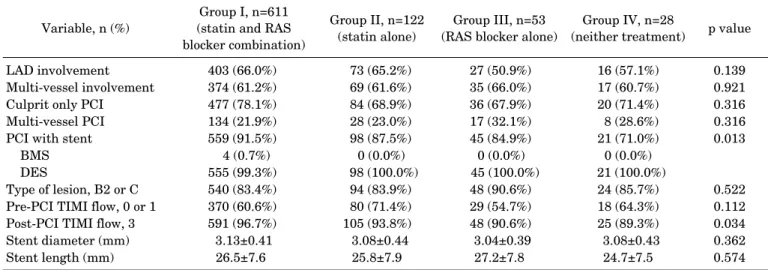
The coronary angiographic and procedural character- istics are shown in Table 2. The prevalence of left anterior descending artery or multi-vessel involvement did not dif- fer, and the rate of severe lesion and pre-PCI Thrombolysis in Myocardial Infarction (TIMI) flow were also similar and
there were no significant differences in stent diameter or length among the four groups. However, Group IV had the lowest proportion of stent use and the lowest rate of post-procedural TIMI flow with a grade of 3.
3. Clinical outcomes
The median duration of follow-up was 362 days (inter- quartile range 186-686). Table 3 shows the cumulative clin- ical outcomes of the study groups. MACCEs occurred in 48 patients (7.9%) in Group I, in 16 patients (14.3%) in Group II, in 3 patients (5.7%) in Group III, and in 7 patients (21.4%) in Group IV (p=0.013).
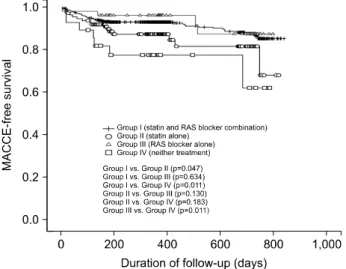
Fig. 2 shows a Kaplan-Meier curve for MACCE-free survival. The four groups did not show the same survival curves (p=0.005). In post-hoc analysis, Group I showed a better outcome compared with Group II (p=0.047) or Group IV (p=0.011), but did not show a difference compared with Group III (p=0.634). Group III also showed better outcome compared with Group IV (p=0.011). All other inter-group analysis showed no significant difference between Group
FIG. 2. Kaplan-Meier curve for MACCE-free survival of each groups at 24-month follow-up. MACCE: major adverse cardiac and cerebrovascular events.
TABLE 4. Univariate analysis of the independent predictors of major adverse cardiac and cerebrovascular events
Variable Odds ratio 95% confidence interval p value
eGFR (3.72-149.44 mL/min/1.73 m2) 0.985 0.978-0.992 <0.001
STEMI 2.010 1.295-3.120 0.002
RAS blocker 0.482 0.297-0.781 0.003
Multi-vessel involvement 2.070 1.239-3.458 0.005
Hypertension 1.775 1.120-2.814 0.015
Age (34-94 years) 1.023 1.003-1.043 0.023
BMI (13.59-39.88 kg/m2) 0.931 0.873-0.993 0.029
Heart failure 2.090 0.846-5.167 0.110
Pre-PCI TIMI grade flow 0 or 1 0.706 0.456-1.094 0.119
CVA 1.616 0.834-3.134 0.155
Diabetes mellitus 1.405 0.886-2.227 0.248
Post-PCI TIMI flow grade 3 0.620 0.250-1.538 0.303
Statin 0.729 0.386-1.376 0.330
blockers 0.843 0.488–1.456 0.547
Killip class IV 0.711 0.287-1.763 0.463
Multi-vessel PCI 0.944 0.542-1.643 0.838
eGFR: estimated glomerular filtration rate, STEMI: ST segment elevation myocardial infarction, RAS: renin-angiotensin system, BMI:
body mass index, PCI: percutaneous coronary intervention, TIMI: thrombolysis in myocardial infarction, CVA: cerebrovascular accident.
II and III (p=0.130), and between Group II and IV (p=0.183).
4. Independent predictors of MACCE
Table 4 shows the univariate analysis of the independent predictors for the development of a MACCE. Age, previous history of hypertension, eGFR, body-mass index, mul- ti-vessel involvement, STEMI, and use of RAS blockers were also associated. Table 5 shows the multivariate analy- sis of the independent predictors for development of MACCE. The use of RAS blockers [Odds ratio (OR) 0.469, 95% confidence interval (CI) 0.285-0.772, p=0.003], eGFR (OR 0.989, 95% CI 0.981-0.997, p=0.005), multi-vessel in- volvement (OR 1.810, 95% CI 1.049-3.125, p=0.033), and
a previous history of hypertension (OR 1.691, 95% CI 1.015-2.817, p=0.044) were the independent predictors of MACCEs in patients with IHF who underwent PCI for AMI.
DISCUSSION
This study was analyzed retrospectively using the KAMIR data. This gives a comprehensive view of the con- temporary treatments and outcomes of patients with AMI in Korea. The present study found that in patients with AMI with reduced left ventricular systolic function who un- derwent PCI, the use of RAS blockers was associated with a 53% reduction in the risk of cardiac death, MI, revascula- rization, or a cerebrovascular accident. However. statin use did not show a reduction of the incidence of MACCEs.
To analyze the results regarding the MACCE-free sur- vival curve, the ratio of the patients who suffered a MACCE in Group IV was much higher than that in other groups.
As mentioned above, Group IV had a higher prevalence of diabetes mellitus, higher rates of Killip class ≥III, lower eGFR, lower LDL cholesterol level, lower rates of stent use, and lower rates of post-PCI TIMI flow III. Although there was no statistical difference among the 4 groups, Group IV had a higher prevalence of hypertension and heart failure, as well as a higher rate of female patients than Group I or II. These differences of the baseline characteristics might make have led to a poorer prognosis in Group IV. The high- est number of non-cardiac death and the lowest frequency of prescribed blockers in Group IV indicated that Group IV patients had poor general health conditions such as low blood pressure or slow heart rate. The small number of pa- tients in Group IV, only 28 persons, prevents the results from this study to be widely generalized. After excluding
TABLE 5. Multivariate analysis of the independent predictors of major adverse cardiac and cerebrovascular events
Variables Odds ratio 95% confidence interval p value
RAS blocker 0.469 0.285-0.772 0.003
eGFR (3.72-149.44 mL/min/1.73 m2) 0.989 0.981-0.997 0.005
Multi-vessel involvement 1.810 1.049-3.125 0.033
Hypertension 1.691 1.015-2.817 0.044
RAS: renin-angiotensin system, eGFR: estimated glomerular filtration rate.
Group IV, comparing Group I with Group II and Group I with Group III. RAS blockers showed a statistically sig- nificant beneficial effect (p=0.047) but the statin dose did not (p=0.638).
ACE inhibitors can reduce morbidity and mortality due to major cardiovascular events in patients with left ven- tricular systolic dysfunction after AMI.8-10 The effective- ness of ARB showed weaker results than that of ACE inhibitors. However, in the Valsartan in Acute Myocardial Infarction (VALIANT) trial, valsartan was superior to cap- topril in patients with left ventricular systolic dysfunction after AMI.11 Therefore, the guidelines recommend that ACE inhibitors should be started and continued in all pat- ents with a LVEF less than 0.40 after AMI and ARBs should be considered as an alternative in patients who are intoler- ant to ACE inhibitors.4,5 Recent studies show that ARB is better than ACE inhibitors in some specific subgroups such as patients with STEMI with preserved left ventricular systolic function.12 In the present study, RAS blockers re- duced MACCEs effectively compared to statin use alone or neither using RAS blockers nor statins. As RAS blockers have similar mechanisms, we congregate ACE inhibitors and ARB into one group. All ARBs look the same and show a class effect, but ARBs can be classified as insurmountable or surmountable. Insurmountable ARBs were more effec- tive on long-term clinical outcomes than surmountable ARBs in patients with AMI, those with a LVEF greater than 40% with a low Killip class, or those with normal renal function.13 Further studies are needed to evaluate the ef- fectiveness of rhw subclasses of ARBs.
Statins also lower the risk of coronary heart disease death, recurrent MI, stroke, and the need for coronary re- vascularization in patients stabilized after an acute coro- nary syndrome.14,15 All patients with coronary heart dis- ease should receive long-term intensive lipid lowering therapy with a statins.4,5 When it comes to patients with HF, however, the efficacy and safety of statin therapy is still controversial. Large observational and post hoc analyses from large clinical trials have suggested that statins could provide clinical benefits to patients with HF.16-18 However, two recent, large, randomized controlled trials have dem- onstrated that rosuvastatin does not affect clinical out- comes in patients with chronic HF, even in ischemic cases.19,20 So the current guidelines do not recommend sta- tins solely for HF in the absence of other indications for their use.3 Some concerns have been raised that the results cannot be generalized to all patients with HF because the
enrolled patients had moderate to severe disease and were older, only low to moderate doses of rosuvastatin were test- ed, and ischemic events occur less frequently in patients with HF compared with the broad population of patients with established cardiovascular disease.21 More recently, in a large scale prospective propensity score matched co- hort study, statins were associated with improved out- comes, specifically in the presence of ischemic heart disease.22 A meta-analysis also found that statin therapy significantly decreases the rate of hospitalization for wor- sening HF and increased left ventricular ejection fraction, though it does not decrease all-cause or cardiovascular mortality compared with placebo.23 Statin therapies for hy- percholesterolemia and primary and secondary pre- vention of CAD has been established, however, their effects on patients with HF have remained unclear. In the present study, statins did not show any beneficial effects in the pre- vention of the occurrence of future events. However, there was a small number of patients who did not use statins (81 patients, 10% of total patients). Therefore, a large, pro- spective, randomized trial is needed to determine the effec- tiveness of statin therapy for ischemic heart failure.
There were several limitations to this study. First, this was a non-randomized study based on a prospective, ob- servational registry. Therefore, a selection bias was largely unavoidable. The baseline demography showed the differ- ences in the 4 groups. RAS blocker users more frequently prescribed blockers as well. In this study blockers were not shown to be statistically effective (OR 0.843, 95% CI 0.488-1.456, p=0.547), but blockers are also a key drug in patients with HF and proven to reduce mortality. block- ers may induce some or all of the positive effects of RAS blockers, especially the prevention of MACCEs. Although most confounders were included in the multivariate analy- sis, it is possible that some potential bias was included.
Second, the types and doses of the prescribed statins were variable. There were four different types of statins and each had three or four variation of dosage. Third, KAMIR data does not have information on why physicians did not pre- scribe a RAS blocker or statin, because of the limitations of our database. Finally, a median follow-up of 12-months might be too short to conclusively determine the long term efficacy of treatment. These findings support the need for prospective, randomized, blinded, placebo-controlled tri- als to determine the effectiveness of statin therapy for IHF.
RAS blockers showed beneficial effects in patients with IHF who underwent PCI for AMI. But statins were not as-
sociated with better clinical outcomes compared with RAS blockers or neither treatment.
ACKNOWLEDGEMENTS
This study was supported by grants from the following organizations: the Korean Health Technology R&D Project, Ministry of Health & Welfare, Republic of Korea (HI13- C1527), and the Korean Health Technology R&D Project (HI14C2069), and the National Research Foundation of Korea Grant funded by the Korean Government (2011-000- 8875), and the Korean Health Technology R&D Project, Ministry of Health & Welfare, Republic of Korea (HI13- C0163), and the Bio & Medical Technology Development Program of the National Research Foundation (NRF) fund- ed by the Korean government (MEST) (2012M3A9C60- 49744).
CONFLICT OF INTEREST STATEMENT None declared.
REFERENCES
1. Ridker PM, Cannon CP, Morrow D, Rifai N, Rose LM, McCabe CH, et al; Pravastatin or Atorvastatin Evaluation and Infection Therapy-Thrombolysis in Myocardial Infarction 22 (PROVE IT-TIMI 22) Investigators. C-reactive protein levels and out- comes after statin therapy. N Engl J Med 2005;352:20-8.
2. Schwartz GG, Olsson AG, Ezekowitz MD, Ganz P, Oliver MF, Waters D, et al; Myocardial Ischemia Reduction with Aggressive Cholesterol Lowering (MIRACL) Study Investigators. Effects of atorvastatin on early recurrent ischemic events in acute coronary syndromes: the MIRACL study: a randomized controlled trial.
JAMA 2001;285:1711-8.
3. WRITING COMMITTEE MEMBERS, Yancy CW, Jessup M, Bozkurt B, Butler J, Casey DE Jr, et al; American College of Cardiology Foundation/American Heart Association Task Force on Practice Guidelines. 2013 ACCF/AHA guideline for the man- agement of heart failure: a report of the American College of Cardiology Foundation/American Heart Association Task Force on practice guidelines. Circulation 2013;128:e240-327.
4. Amsterdam EA, Wenger NK, Brindis RG, Casey DE Jr, Ganiats TG, Holmes DR Jr, et al; ACC/AHA Task Force Members. 2014 AHA/ACC guideline for the management of patients with non-ST-elevation acute coronary syndromes: a report of the American College of Cardiology/American Heart Association Task Force on Practice Guidelines. Circulation 2014;130:e344-426.
5. O'Gara PT, Kushner FG, Ascheim DD, Casey DE Jr, Chung MK, de Lemos JA, et al; American College of Cardiology Founda- tion/American Heart Association Task Force on Practice Guidelines. 2013 ACCF/AHA guideline for the management of ST-elevation myocardial infarction: a report of the American col- lege of cardiology foundation/American heart association task force on practice guidelines. Circulation 2013;127:e362-425.
6. Athyros VG, Mikhailidis DP, Papageorgiou AA, Bouloukos VI, Pehlivanidis AN, Symeonidis AN, et al; GREACE Study
Collaborative Group. Effect of statins and ACE inhibitors alone and in combination on clinical outcome in patients with coronary heart disease. J Hum Hypertens 2004;18:781-8.
7. Lee KH, Jeong MH, YoungkeunAhn, Kim SS, Rhew SH, Jeong YW, et al; KAMIR (Korea Acute Myocardial Infarction Registry) Investigators. One-year clinical impact of cardiac arrest in pa- tients with first onset acute ST-segment elevation myocardial infarction. Int J Cardiol 2014;175:147-53.
8. Pfeffer MA, Braunwald E, Moyé LA, Basta L, Brown EJ Jr, Cuddy TE, et al. Effect of captopril on mortality and morbidity in patients with left ventricular dysfunction after myocardial infarction.
Results of the survival and ventricular enlargement trial. The SAVE Investigators. N Engl J Med 1992;327:669-77.
9. Effect of ramipril on mortality and morbidity of survivors of acute myocardial infarction with clinical evidence of heart failure. The Acute Infarction Ramipril Efficacy (AIRE) Study Investigators.
Lancet 1993;342:821-8.
10. Køber L, Torp-Pedersen C, Carlsen JE, Bagger H, Eliasen P, Lyngborg K, et al. A clinical trial of the angiotensin-convert- ing-enzyme inhibitor trandolapril in patients with left ven- tricular dysfunction after myocardial infarction. Trandolapril Cardiac Evaluation (TRACE) Study Group. N Engl J Med 1995;333:1670-6.
11. McMurray J, Solomon S, Pieper K, Reed S, Rouleau J, Velazquez E, et al. The effect of valsartan, captopril, or both on athero- sclerotic events after acute myocardial infarction: an analysis of the Valsartan in Acute Myocardial Infarction Trial (VALIANT).
J Am Coll Cardiol 2006;47:726-33.
12. Yang JH, Hahn JY, Song YB, Choi SH, Choi JH, Lee SH, et al.
Angiotensin receptor blocker in patients with ST segment ele- vation myocardial infarction with preserved left ventricular sys- tolic function: prospective cohort study. BMJ 2014;349:g6650.
13. Jeong HC, Jeong MH, Ahn Y, Chae SC, Hur SH, Hong TJ, et al;
Korea Acute Myocardial Infarction Registry Investigators.
Comparative assessment of angiotensin II type 1 receptor block- ers in the treatment of acute myocardial infarction: surmountable vs. insurmountable antagonist. Int J Cardiol 2014;170:291-7.
14. Sacks FM, Pfeffer MA, Moye LA, Rouleau JL, Rutherford JD, Cole TG, et al. The effect of pravastatin on coronary events after my- ocardial infarction in patients with average cholesterol levels.
Cholesterol and Recurrent Events Trial investigators. N Engl J Med 1996;335:1001-9.
15. Pedersen TR, Kjekshus J, Berg K, Haghfelt T, Faergeman O, Faergeman G, et al; Scandinavian Simvastatin Survival Study Group. Randomised trial of cholesterol lowering in 4444 patients with coronary heart disease: the Scandinavian Simvastatin Survival Study (4S). 1994. Atheroscler Suppl 2004;5:81-7.
16. Horwich TB, MacLellan WR, Fonarow GC. Statin therapy is asso- ciated with improved survival in ischemic and non-ischemic heart failure. J Am Coll Cardiol 2004;43:642-8.
17. Mozaffarian D, Nye R, Levy WC. Statin therapy is associated with lower mortality among patients with severe heart failure. Am J Cardiol 2004;93:1124-9.
18. Go AS, Lee WY, Yang J, Lo JC, Gurwitz JH. Statin therapy and risks for death and hospitalization in chronic heart failure. JAMA 2006;296:2105-11.
19. Kjekshus J, Apetrei E, Barrios V, Böhm M, Cleland JG, Cornel
JH, et al; CORONA Group. Rosuvastatin in older patients with systolic heart failure. N Engl J Med 2007;357:2248-61.
20. Tavazzi L, Maggioni AP, Marchioli R, Barlera S, Franzosi MG, Latini R, et al; Gissi-HF Investigators. Effect of rosuvastatin in patients with chronic heart failure (the GISSI-HF trial): a rando- mised, double-blind, placebo-controlled trial. Lancet 2008;372:
1231-9.
21. Masoudi FA. Statins for ischemic systolic heart failure. N Engl J Med 2007;357:2301-4.
22. Alehagen U, Benson L, Edner M, Dahlström U, Lund LH.
Association between use of statins and outcomes in heart failure with reduced ejection fraction: prospective propensity score matched cohort study of 21 864 patients in the Swedish Heart Failure Registry. Circ Heart Fail 2015;8:252-60.
23. Preiss D, Campbell RT, Murray HM, Ford I, Packard CJ, Sattar N, et al. The effect of statin therapy on heart failure events: a col- laborative meta-analysis of unpublished data from major rando- mized trials. Eur Heart J 2015;36:1536-46.