• 검색 결과가 없습니다.

A Case of Unruptured Aneurysm of the Right Sinus of Valsalva with Right Ventricular Outflow Obstruction

N/A
N/A
Protected

Academic year: 2022

Share "A Case of Unruptured Aneurysm of the Right Sinus of Valsalva with Right Ventricular Outflow Obstruction"

Copied!
4
0
0

로드 중.... (전체 텍스트 보기)

전체 글

(1)

274 Copyright © 2014 The Korean Society of Cardiology Korean Circulation Journal

Introduction

Aneurysms of the sinus of Valsalva are rare cardiac anomalies that may be congenital or, in rare cases, acquired, and most commonly involve the right coronary sinus (90%).

1-4)

Congenital aneurysms are often caused by weakness at the junction of the aortic media and the annulus fibrosus.

3)

The acquired forms are caused by infection, degenerative disease or thoracic trauma. Although the majority of unruptured aneurysms do not produce symptoms of cardiac dys- function until aneurysm rupture occurs, there have been a few re- ported cases in which patients with an unruptured aneurysm of the sinus of Valsalva presented with exertional dyspnea due to right

Case Report

http://dx.doi.org/10.4070/kcj.2014.44.4.274 Print ISSN 1738-5520 • On-line ISSN 1738-5555

A Case of Unruptured Aneurysm of the Right Sinus of Valsalva with Right Ventricular Outflow Obstruction

Eun Chung, MD 1 , Ju Yeol Baek, MD 2 , Han Hee Chung, MD 1 , Seong Il Park, MD 1 , Ji Hye Jang, MD 1 , Hyun A Yu, MD 1 , Gi Hyeon Woo, MD 1 , and Ho Joong Youn, MD 1

1

Department of Internal Medicine, The Catholic University of Korea College of Medicine, Seoul,

2
Department of Internal Medicine, Chengju St. Mary’s Hospital, Cheongju, Korea

A 66-year-old man presented with exertional dyspnea. He was found to have an unruptured aneurysm of the right sinus of Valsalva caus- ing significant right ventricular outflow obstruction. This aneurysm was diagnosed by transthoracic two-dimensional echocardiography, transthoracic three-dimensional echocardiography, transesophageal echocardiography, contrast echocardiography and 64-slice multide- tector cardiac computed tomography. Because unruptured aneurysms of the sinus of Valsalva are rarely symptomatic, they can be difficult to detect. However, the unruptured aneurysm of the right sinus of Valsalva in this case caused significant right ventricular outflow tract obstruction, resulting in exertional dyspnea. (Korean Circ J 2014;44(4):274-277)

KEY WORDS: Sinus of Valsalva; Aneurysm; Ventricular outflow obstruction.

Received: September 16, 2013 Revision Received: October 15, 2013 Accepted: October 17, 2013

Correspondence: Ju Yeol Baek, MD, Department of Internal Medicine, Cheongju St. Mary’s Hospital, 173-19 Juseong-ro, Sangdang-gu, Cheongju 360-568, Korea

Tel: 82-43-219-8198, Fax: 82-43-211-9030 E-mail: [email protected]

• The authors have no financial conflicts of interest.

This is an Open Access article distributed under the terms of the Creative Commons Attribution Non-Commercial License (http://creativecommons.

org/licenses/by-nc/3.0) which permits unrestricted non-commercial use, distribution, and reproduction in any medium, provided the original work is properly cited.

ventricular outflow tract (RVOT) obstruction.

5)6)

We report the case of a patient who presented with exertional dyspnea and was found to have an unruptured aneurysm of the sinus of Valsalva causing significant RVOT obstruction.

Case

A 66-year-old man with a medical history of hypertension and type 2 diabetes presented at our cardiology clinic with a 3-year his- tory of worsening dyspnea on exertion (New York Heart Association class I-II). On admission, blood pressure was 132/62 mm Hg, pulse rate was 80/min, body temperature was 36.7°C and respiratory rate was 22/min. A systolic ejection murmur, grade III/IV, was heard at the second and third intercostal spaces along the left sternal border. The rest of the physical examination was normal. Plain chest X-ray revealed normal chest findings. Electrocardiography demon- strated a normal sinus rhythm with left ventricular hypertrophy.

Coronary angiography indicated that there was no significant ste- nosis of the coronary artery. B-type natriuretic peptide was 450 ng/

mL. Laboratory findings were unremarkable except for mild protein-

uria on urinalysis. On transthoracic echocardiography, the left ven-

tricular ejection fraction was 55% with normal wall motion, and

mild diastolic dysfunction was present (E/A ratio 0.8 deceleration

time 250 msec). Transthoracic two-dimensional (2D) and three-di-

mensional (3D) echocardiography revealed a 1.35×3.0 cm unruptured

(2)

275 Eun Chung, et al.

http://dx.doi.org/10.4070/kcj.2014.44.4.274 www.e-kcj.org

aneurysm of the right sinus of Valsalva protruding into the RVOT (Fig.

1) with mild aortic regurgitation. Color Doppler echocardiography showed turbulent flow acceleration around the aneurysm, but did not indicate left to right shunt flow (Fig. 2A). Continuous wave Dop- pler demonstrated that the peak velocity at the level of the aneu- rysm was 3.38 m/s, and the calculated peak pressure gradient was 46 mm Hg (Fig. 2B).

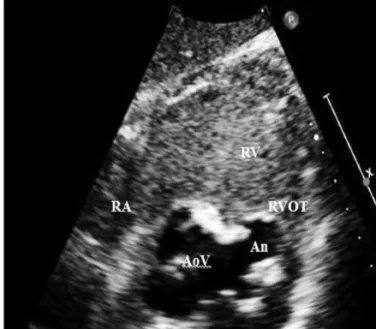
As mentioned above, transesophageal echocardiography re- vealed aneurysm; however, further cardiac abnormalities were not identified. On contrast echocardiography, subcostal images dem- onstrated a significant border between the body of the aneurysm and the chamber of the right ventricle upon administration of intra- venous echo contrast (Fig. 3). 64-slice multidetector computed to- mography (MDCT) showed the presence of an eccentric, lobulated, 3.5 cm aneurysm protruding into the RVOT, with the upper lobulated

part located just below the pulmonary valve and the digital- shaped lower part obstructing the RVOT (Fig. 4).

Discussion

Aneurysms of the sinus of Valsalva are rare cardiac abnormalities that may be congenital or acquired. Congenital aneurysms, which are more common than the acquired varieties, slowly progress with- out symptoms of cardiac dysfunction until aneurysm rupture occurs.

However, in rare cases, unruptured congenital aneurysms may produce symptoms of cardiac dysfunction due to RVOT obstruction.

A B

Fig. 1. Transthoracic two-dimensional and three-dimensional echocardiography revealed a 1.35×3.0 cm unruptured aneurysm of the right sinus of Valsal- va protruding into the RVOT. A: parasternal- and subcostal-view transthoracic echocardiography demonstrates an unruptured aneurysm of the right sinus of Valsalva. B: subcostal-view real-time three-dimensional echocardiography. An: body of the aneurysm, AoV: aortic valve, PA: main pulmonary artery, RA:

right atrium, RV: right ventricle, RVOT: right ventricular outflow tract, LV: left ventricle, Ao: aorta.

A B

Fig. 2. High flow acceleration around the aneurysm demonstrated that right ventricular outflow tract had been obstructed by it. A: color Doppler echocardiography demonstrates the turbulent flow associated with right ventricular outflow obstruction by an unruptured aneurysm of the sinus of Valsalva. B: continuous wave Doppler demonstrates the pressure gradient at the level of the aneurysm, suggesting right ventricular outflow obstruc- tion. An: body of the aneurysm, RV: right ventricle.

Fig. 3. The substernal view after administration of intravenous echo con-

trast demonstrates the significant border between the body of the aneurysm

and the right ventricle. An: body of the aneurysm, AoV: aortic valve, PA: main

pulmonary artery, RA: right atrium, RV: right ventricle, RVOT: right ventric-

ular outflow tract.

(3)

276 Unruptured Aneurysm of the Right Sinus of Valsalva

http://dx.doi.org/10.4070/kcj.2014.44.4.274 www.e-kcj.org

In our case, the patient was asymptomatic during his adolescence and most of his adulthood and had no history of risk factors for ac- quired aneurysm. Moreover, he had experienced progressively-wors- ening exertional dyspnea over the course of 3 years. Therefore, we regarded the etiology of his condition to be a congenital unruptured aneurysm of the right sinus of Valsalva. We then came to the con- clusion that his symptoms may have been due to the slowly pro- gressive nature of congenital aneurysms, which eventually led to significant RVOT obstruction.

In this case, the patient was diagnosed with an unruptured an- eurysm of the sinus of Valsalva using transthoracic 2D echocardiog- raphy, transthoracic 3D echocardiography, transesophageal echo- cardiography, contrast echocardiography and 64-slice MDCT. Al- though transthoracic 2D echocardiography is the initial diagnostic tool typically used to detect aneurysms of the sinus of Valsalva

4)7)

and is sufficient to confirm diagnosis, in the present case, it was dif- ficult to determine the shape of the aneurysm and neighboring st- ructures. Therefore, 64-slice MDCT and real-time 3D echocardiog- raphy were used to evaluate the anatomy of this aneurysm and to demonstrate the mechanism of RVOT obstruction. In addition, con- trast echocardiography is a useful tool for detecting aneurysms through differentiation of the border between the body of aneurysm and the chamber of the right ventricle.

For patients with unruptured aneurysms of the sinus of Valsalva, symptoms of cardiac dysfunction are important indications for tr- eatment.

2)3)8)

However, whether asymptomatic patients with unrup- tured aneurysms require surgical intervention remains a contro- versial issue. Nevertheless, if unruptured aneurysms show progressive enlargement on serial evaluation, surgical intervention is needed.

This patient was found to have an unruptured aneurysm arising

from the right coronary sinus. We determined that his exertional dyspnea was attributable to RVOT obstruction by an unruptured an- eurysm of the right sinus of Valsalva, as all other causes were ruled out. Surgical repair could be an appropriate treatment for aneu- rysms exhibiting progressive enlargement and the potential for rupture.

Acknowledgments

The abstract of this article was presented at the 64th Annual Conference of the Korean Association of Internal Medicine in 2013.

References

1. Yang Y, Zhou Y, Ma L, Ni Y. Unruptured aneurysm of the sinus of Val- salva presenting with thrombosis and right ventricular outflow ob- struction. J Card Surg 2008;23:782-4.

2. Moustafa S, Mookadam F, Cooper L, et al. Sinus of Valsalva aneu- rysms--47 years of a single center experience and systematic over- view of published reports. Am J Cardiol 2007;99:1159-64.

3. Feldman DN, Roman MJ. Aneurysms of the sinuses of Valsalva. Cardi- ology 2006;106:73-81.

4. Dev V, Goswami KC, Shrivastava S, Bahl VK, Saxena A. Echocardio- graphic diagnosis of aneurysm of the sinus of Valsalva. Am Heart J 1993;126:930-6.

5. Thankachen R, Gnanamuthu R, Doshi H, Shukla V, Korula RJ. Unrup- tured aneurysm of the sinus of Valsalva presenting with right ventric- ular outflow obstruction. Tex Heart Inst J 2003;30:152-4.

6. Kiefaber RW, Tabakin BS, Coffin LH, Gibson TC. Unruptured sinus of Valsalva aneurysm with right ventricular outflow obstruction diag- nosed by two-dimensional and Doppler echocardiography. J Am Coll Cardiol 1986;7:438-42.

7. Terdjman M, Bourdarias JP, Farcot JC, et al. Aneurysms of sinus of Fig. 4. 64-slice multidetected computed tomography (MDCT) made it easy to determine the shape of the aneurysm and neighboring structures around it.

A: 64-slice MDCT demonstrates an eccentric, lobulated aneurysm protruding into the right ventricular outflow tract. An arrow indicates the body of the aneurysm. B: a three-dimensional reconstruction demonstrates an unruptured aneurysm of the sinus of Valsalva. Arrows indicates the body of aneurysm.

AoV: aortic valve, PA: main pulmonary artery, RV: right ventricle.

A B

(4)

277 Eun Chung, et al.

http://dx.doi.org/10.4070/kcj.2014.44.4.274 www.e-kcj.org

Valsalva: two-dimensional echocardiographic diagnosis and recogni- tion of rupture into the right heart cavities. J Am Coll Cardiol 1984;3:

1227-35.

8. Ott DA. Aneurysm of the sinus of valsalva. Semin Thorac Cardiovasc

Surg Pediatr Card Surg Annu 2006:165-76.

수치

Fig. 2. High flow acceleration around the aneurysm demonstrated that  right ventricular outflow tract had been obstructed by it

참조

관련 문서