aPrivate Practice.
bProfessor, cFormer Professor, dProfessor Emeritus, Department of Dental Biomaterials Science, Dental Research Institute, School of Dentistry, Seoul National University.
eAssociate Professor, Department of Orthodontics, School of Den- tistry, Seoul National University.
Corresponding author:Seung-Hak Baek.
Department of Orthodontics, School of Dentistry, Dental Re- search Institute, Seoul National University, 28, Yeongeon-dong, Jongno-gu, Seoul 110-768, Korea
+82 2 2072 3952; e-mail, [email protected].
Received May 14, 2009; Last Revision October 19, 2009;
Accepted October 21, 2009.
DOI:10.4041/kjod.2010.40.1.40
Comparison of transition temperature range and phase transformation behavior of nickel-titanium wires
Yu-Hyun Lee, DDS, PhD,a Bum-Soon Lim, BA, PhD,b Yong-Keun Lee, DDS, PhD,c Cheol-We Kim, DDS, PhD,d Seung-Hak Baek, DDS, PhDe
Objective: The aim of this research was to evaluate the mechanical properties (MP) and degree of the phase transformation (PT) of martensitic (M-NiTi), austenitic (A-NiTi) and thermodynamic nickel-titanium wire (T-NiTi). Methods: The samples consisted of 0.016 × 0.022 inch M-NiTi (Nitinol Classic, NC), A-NiTi (Optimalloy, OPTI) and T-NiTi (Neo-Sentalloy, NEO). Differential scanning calorimetry (DSC), three-point bending test, X-ray diffraction (XRD), and microstructure examination were used. Statistical evaluation was undertaken using ANOVA test. Results: In DSC analysis, OPTI and NEO showed two peaks in the heating curves and one peak in the cooling curves. However, NC revealed one single broad and weak peak in the heating and cooling curves. Austenite finishing (Af) temperatures were 19.7oC for OPTI, 24.6oC for NEO and 52.4oC for NC. In the three-point bending test, residual deflection was observed for NC, OPTI and NEO. The load ranges of NC and OPTI were broader and higher than NEO. XRD and microstructure analy- ses showed that OPTI and NEO had a mixture of martensite and austenite at temperatures below Martensite finishing (Mf). NEO and OPTI showed improved MP and PT behavior than NC. Conclusions:
The mechanical and thermal behaviors of NiTi wire cannot be completely explained by the expected de- gree of PT because of complicated martensite variants and independent PT induced by heat and stress.
(Korean J Orthod 2010;40(1):40-49)
Key words: Transition temperature range, Phase transformation, Ni-Ti wires
INTRODUCTION
Nickel-titanium (NiTi) wire has been widely used in the orthodontic field due to its shape memory effect,
super-elasticity and good biocompatibility.1 There are three microstructural phases in the NiTi alloys ie. the austenitic phase, the high-temperature and low-stress form; the martensitic phase, the low-temperature and high-stress form; and the R-phase, an intermediate phase between martensite and austenite transforma- tion.2 The relative proportion of the austenitic and mar- tensitic phases within transformation temperature range (TTR) seems to play an important role in the mechan- ical characteristics of NiTi wire.2-4
When NiTi wire is ligated to brackets on misaligned teeth in a temperature-fluctuant oral 0environment, slight thermal change can considerably modify the load level of NiTi wire.5,6 A discrepancy between trans- formation characteristics and related mechanical prop- erties of NiTi wires has also been reported.7-10
Species Code Brand name Batch number Manufacturer
M-NiTi NC Nitinol classic W5084 3M Unitek, U.S.A.
A-NiTi OPTI Optimalloy NO20805-016 Jinsung Meidcal, Korea
T-NiTi NEO Neo sentalloy E589 Tomy International, Japan
M-NiTi means work-hardened martensitic type; A-NiTi, super-elastic austenitic type; T-NiTi, thermodynamic type.
Table 1. Nickel-Titanium (NiTi) orthodontic wires used in this study Several commercially available NiTi wires are avail-
able such as the work-hardened martensitic type (M- NiTi), superelastic austenitic (A-NiTi) and thermody- namic (T-NiTi). Although M-NiTi wires can exhibit shape memory characteristics, their TTR does not seem to be clinically relevant for this property to be used for orthodontic treatment.11 Burstone et al.12 and Miura et al.13 introduced A-NiTi for superelasticity. More re- cently, T-NiTi wires have been developed for shape memory effect as well as superelasticity.14 However, these NiTi wires exhibit unexpected mechanical prop- erties under stepwise temperature changes.10,15 There- fore, the purpose of this study was to evaluate the me- chanical properties and degree of the phase trans- formation of commercially available M-, A- and T- NiTi wires under conditions of controlled temperature.
MATERIAL AND METHODS
Three types of 0.016 × 0.022 inch commercially available NiTi wires, M-NiTi (Nitinol Classic, 3M- Unitek, Monrovia, CA, USA; NC), A-NiTi (Optimal- loy, Jinsung Medical, Seoul, Korea; OPTI), and T-NiTi (Neo Sentalloy, GAC, Tokyo, Japan; NEO) were used in this study (Table 1).
Differential scanning calorimetry (DSC) anal- ysis
Transformation temperatures were measured using DSC 204 (Netzche, Germany). Specimens of each wire with the same length (4 mm) were sealed in an alumi- num cell and placed into the measuring chamber, which was filled with argon gas. α-alumina was used as the reference material. The scanning temperature ranged from −20 to 100oC at 5oC/min. The measure-
ments were taken three times and were statistically an- alyzed using analysis of variance (ANOVA).
Three-point bending test
Three-point bending tests were performed using a universal testing machine (Instron 4465, UK) in a tem- perature-controlled water bath. The span length be- tween the two supports was 14 mm. A bending load was applied to the wire specimen at a rate of 1.0 mm/
minute to give a 2.0 mm deflection, and the load was subsequently removed at the same rate. The wire de- flection was carried out at four different temperatures (0, 20, 37 and 60oC). The measurements were taken three times and were statistically analyzed by ANOVA.
Microstructure examination
The specimens were embedded in a self-curing resin and were electropolished for 6 - 7 minutes in a CH3COOH and HClO4 solution. The final surface was prepared by etching with a mixture of hydrofluoric acid (48% concentration), nitric acid (70% concen- tration), and deionized water in proportions of 1:4:
10 by volume to reveal the grain boundary micro- structure. Microstructure was examined using the met- allurgy microscope (IEM405, Zeiss, Germany).
X-ray diffraction (XRD) analysis
XRD was used to identify the crystal structure and relative portion of the austenite and martensite at vari- ous temperatures. An XRD Image Processor (DIP 2030, MAC science, Japan) was used with Cu-Kα ra- diation at 40 KV and 80 mA for the low temperature measurements (−20, 5 and 20oC). In a pilot study, the
XRD results at 0oC where the three-point bending test was performed could not be differentiated with that of the 5oC data. Therefore, the XRD test was performed at −20oC. The sampling stage was oscillated from 0 to 60o, 2θ in 0.01 degree steps to minimize the effect of the preferred orientation of wires. For the phase dis- tribution analysis of martensite (002 peak) and austen- ite (110 peak) wires, FWHH (full width at half height) was compared. Powder XRD (D5005, Bruker, Ger- many) was used for the higher temperature measure- ments (37 and 60oC). The temperature was controlled by an electrothermic system and liquid nitrogen.
RESULTS
In the definitions of the transformation temperatures such as Ms, Mf, As, and Af, M means martensite; A, austenite; S, starting temperature; and f, finishing tem- perature, respectively.
DSC analysis
For NC (M-NiTi type), one single broad and weak peak was observed in the heating and cooling curves, respectively (Fig 1A). However, OPTI (A-NiTI type) and NEO (T-NiTi type) exhibited two endothermic peaks in the heating curves. It indicates that there may be an intermediate phase (R-phase: rhombohedral phase) during transformation. One exothermic peak (around 15 - 18oC) observed on the OPTI and NEO in the cooling curves could be considered as the reverse trans- formation from austenite phase to martensite phase (Fig 1B and C).
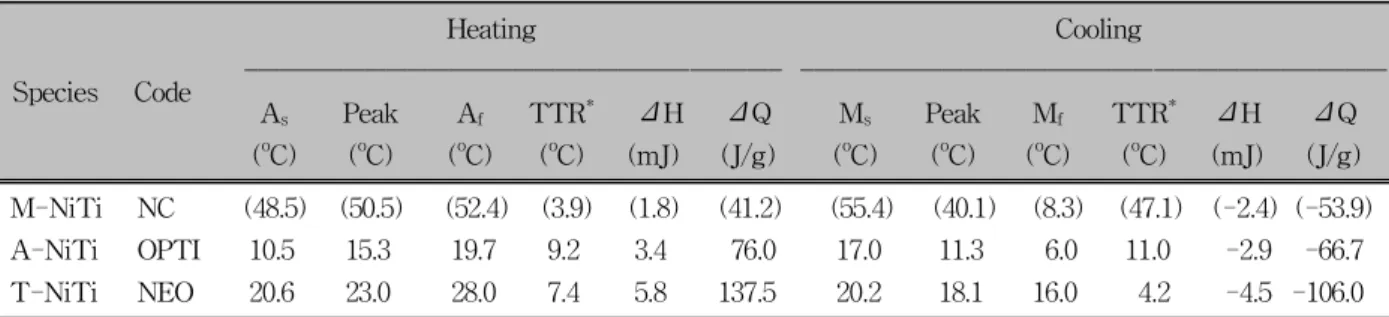
The TTRs for the three specimens were statistically different (p < 0.05, Table 2). Ms in the cooling proc- ess of NEO (T-NiTi type, 20.2oC) was higher than OPTI (A-NiTi type, 17.0oC). Various Af were found;
19.7oC for OPTI (A-NiTi type), 24.6oC for NEO (T- NiTi type) and 52.4oC for NC (M-NiTi type), re- spectively (Table 2).
Fig 1. Heating and cooling curves of nickel-titanium with differential scanning calorimetry (DSC). A, Nitinol Classic (NC, 3M-Unitek, Monrovia, CA, USA; martensitic(M)- NiTi type); B, Optimalloy (OPTI, Jinsung Medical, Seoul, Korea; austenitic(A)-NiTi type); C, Neo Sentalloy (NEO, GAC, Tokyo, Japan; thermodynamic(T)-NiTi type). Ar- rows in A means broad and weak peaks occurred during the heating and cooling cycle, respectively. Two peaks in the heating curves of B and C indicates the existence of R (rhombohedral) phase.
Heating Cooling
‐‐‐‐‐‐‐‐‐‐‐‐‐‐‐‐‐‐‐‐‐‐‐‐‐‐‐‐‐‐‐‐‐‐‐‐‐‐‐‐‐‐‐‐‐‐‐‐‐‐‐‐‐‐‐‐‐‐‐‐‐‐‐‐‐‐‐‐‐‐‐‐‐‐‐‐ ‐‐‐‐‐‐‐‐‐‐‐‐‐‐‐‐‐‐‐‐‐‐‐‐‐‐‐‐‐‐‐‐‐‐‐‐‐‐‐‐‐‐‐‐‐‐‐‐‐‐‐‐‐‐‐‐‐‐‐‐‐‐‐‐‐‐‐‐‐‐‐‐‐‐‐‐‐‐‐‐‐‐‐
Species Code
As Peak Af TTR* ΔH ΔQ Ms Peak Mf TTR* ΔH ΔQ
(oC) (oC) (oC) (oC) (mJ) (J/g) (oC) (oC) (oC) (oC) (mJ) (J/g) M-NiTi NC (48.5) (50.5) (52.4) (3.9) (1.8) (41.2) (55.4) (40.1) (8.3) (47.1) (-2.4) (-53.9)
A-NiTi OPTI 10.5 15.3 19.7 9.2 3.4 76.0 17.0 11.3 6.0 11.0 -2.9 -66.7
T-NiTi NEO 20.6 23.0 28.0 7.4 5.8 137.5 20.2 18.1 16.0 4.2 -4.5 -106.0
ANOVA test was done. *Means p < 0.05; M, martensite; A, austenite; S, starting temperature; f, finishing temperature;
TTR, transformation temperature range; ΔH, transition enthalpy; ΔQ, transition energy; M-NiTi, work-hardened martensitic type; A-NiTi, super-elastic austenitic one T-NiTi, thermodynamic one. ( ): not in the graphs, but was pitched with peak-picfing function.
Table 2. Comparison of the peak temperature during heating and cooling curves according to differential scanning calorimetry (DSC) analysis
Three-point bending test
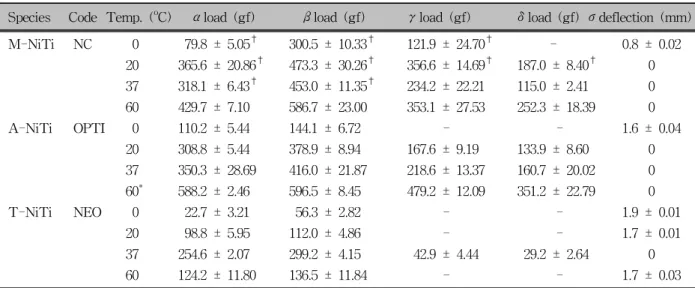
In NC (M-NiTi type), the superelasticity loop ap- peared at 60oC (Fig 2A and Table 3). Total recovery (δ = 0) was observed at 20oC and 37oC (Table 3),
where the superelasticity loop did not appear (Fig 2A).
Partial recovery at 0oC (δ= 0.8 ± 0.02, Table 3) might be an expression of the plastic deformation in the mar- tensite phase.
In OPTI (A-NiTI type), total recovery was observed Fig 2. Load-deflection curves of the nickel-titanium wires with changes in temperature. A, NC (M-NiTi type), B, OPTI (A-NiTi type), C, NEO (T-NiTi type).
Species Code Temp. (oC) αload (gf) βload (gf) γload (gf) δload (gf) σdeflection (mm) M-NiTi NC 0 79.8 ± 5.05† 300.5 ± 10.33† 121.9 ± 24.70† - 0.8 ± 0.02
20 365.6 ± 20.86† 473.3 ± 30.26† 356.6 ± 14.69† 187.0 ± 8.40† 0 37 318.1 ± 6.43† 453.0 ± 11.35† 234.2 ± 22.21 115.0 ± 2.41 0 60 429.7 ± 7.10 586.7 ± 23.00 353.1 ± 27.53 252.3 ± 18.39 0 A-NiTi OPTI 0 110.2 ± 5.44 144.1 ± 6.72 - - 1.6 ± 0.04
20 308.8 ± 5.44 378.9 ± 8.94 167.6 ± 9.19 133.9 ± 8.60 0 37 350.3 ± 28.69 416.0 ± 21.87 218.6 ± 13.37 160.7 ± 20.02 0 60* 588.2 ± 2.46 596.5 ± 8.45 479.2 ± 12.09 351.2 ± 22.79 0 T-NiTi NEO 0 22.7 ± 3.21 56.3 ± 2.82 - - 1.9 ± 0.01
20 98.8 ± 5.95 112.0 ± 4.86 - - 1.7 ± 0.01 37 254.6 ± 2.07 299.2 ± 4.15 42.9 ± 4.44 29.2 ± 2.64 0 60 124.2 ± 11.80 136.5 ± 11.84 - - 1.7 ± 0.03 ANOVA test was done. * Means p < 0.01. The four force change points and residual deflection were measured. α, Martensite transformation start point; β, martensite transformation finish point; γ, austenite re-transformation start point; δ, austenite re-transformation finish point; σ, residual deflection value at load reached zero in the unloading;
M-NiTi, work-hardened martensitic type; A-NiTi, super-elastic austenitic type; T-NiTi, thermodynamic type; -, not-measurable parameters; † No discernible plateau.
Table 3. Comparison of the mechanical properties according to a function of temperature
except at 0oC (Fig 2B and Table 3). Since Af of OPTI is 19.7oC (Table 2), the phases at 20, 37 and 60oC may be austenite. The position of the hysteresis loop at 60oC (Fig 2B) indicates that the load increased ac- cording to the increase in temperature (p < 0.01, Table 3). The residual deflection at 0oC (δ= 01.6 ± 0.04, Table 3) might imply the existence of deforma- tion in the martensite structure.
NEO (T-NiTi type) exhibited superelasticity behav- ior only at 37oC (Fig 2C and Table 3). Since 37oC falls above the Af of NEO (24.6oC, Table 2), the phase at 37oC may be austenite and the mechanical behavior is associated with formation of stress-induced marten- site upon loading and by reverse transformation upon unloading. A partial recovery at 0oC and 20oC (δ=
1.9 ± 0.01, δ= 1.7 ± 0.01, respectively, Table 3) in- dicates that the residual stress remained within the wire and that the reverse transformation did not occur com- pletely during unloading. A residual deflection at 60oC was also observed (δ= 1.7 ± 0.03, Table 3).
Microstructure examination
In NC (M-NiTi type), a wavy pattern like striated band was not identified, but a deformation line made by a work-hardening process was observed (Fig 3A).
The stabilized work-hardened martensite plate, which might not undergo total retransformation, was observed in NC (M-NiTi type).
In OPTI (A-NiTi type), a wavy pattern like striated band was obvious (Fig 3B). NEO (T-NiTi type) showed evenly dispersed non-metallic inclusions and holes in the NiTi matrix (Fig 3C). Both OPTI (A-NiTi type) and NEO (T-NiTi type) showed mixed structures with a martensite plate in an austenite matrix (Fig 3B and C).
XDR analysis
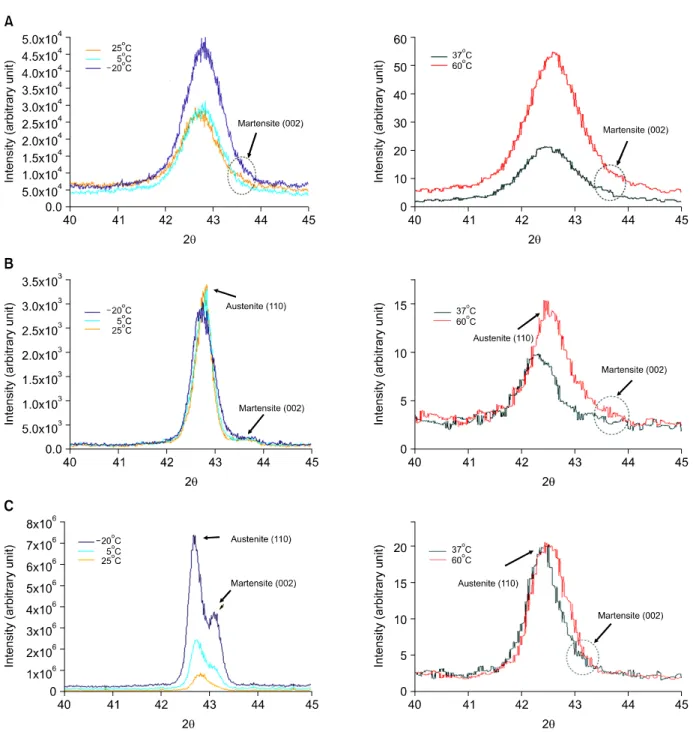
For NC (M-NiTi type), the peak change could not be clearly analyzed due to the eccentric preferred ori- entation produced by work-hardening (Fig 4A).
The mixed pattern of a strong peak for austenite (PA, 110) and a weak peak for martensite (PM, 002)
was observed in OPTI (A-NiTi type, Fig 4B). The PM (002) did not become obvious when the temperature decreased to −20oC (Fig 4B).
In NEO (T-NiTi type), there was a mixed pattern of strong PA (110) and mild PM (002) at 5oC (Fig 4C).
However, the finding that relatively stronger PM (002) and weaker PA (110) existed at −20oC than at 5 and 25oC (Fig 4C) indicates that even at a temperature be- low Mf, T-NiTi wire appeared to have a two-phase structure, not a single crystal structure of martensite.
The PM (002) gradually disappeared when the temper- ature was increased above 25oC (Fig 4C).
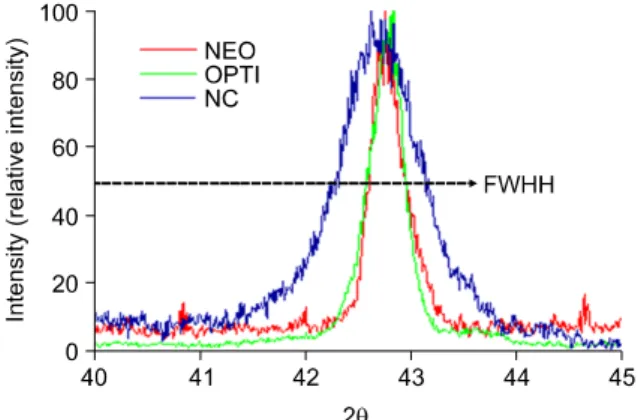
The peak width is an indication for degree of cold work. Compared with full width at half height (FWHH) of the PA (110) peak, NC (M-NiTi type) exhibited a wid- er peak (more cold work) than either NEO (T-NiTi type) or OPTI (A-NiTi type) (Fig 5).
DISCUSSION
DSC and XRD analyses can provide useful infor- mation about the phase transformation and microstruc- ture which are related with the mechanical properties of the NiTi wires.11,15-17 Since the transformation tem- perature of NiTi wires, Af and Ms, are critical factors in their transformation behavior,18 it is important to choose an alloy with the correct Af (for example, less than 37oC) to be clinically relevant. In this study, Af
of NC (M-NiTi type, 52.4oC, Table 2) determined by DSC analysis seems to be too high for clinical use.
Since the heating DSC curves suggest that NEO (T- NiTi type) and OPTI (A-NiTi type) are completely austenitic in an oral environment (Fig 1), NEO and OPTI could be considered to act as superelastic wires.
Since the two endothermic peaks in the heating curves of OPTI and NEO (Fig 1) means an existence of R phase, differences in the DSC curves and XRD Fig 3. Optical micrographs of the nickel-titanium wires at room temperature. A, NC (M-NiTi type); B, OPTI (A-NiTi type); C, NEO (T-NiTi type).
Fig 4. X-ray diffraction patterns of the nickel-titanium wires at various temperatures. A, NC (M-NiTi type); B, OPTI (A-NiTi type); C, NEO (T-NiTi type).
analyses among the three types of NiTi wires might be explained by the influence of the interposition of the R-phase in NEO and OPTI wires (Figs 1, 4 and 5 and Table 2).
The deformation temperatures are divided into four temperature regions; T < Ms, Ms < T < Af, Af < T < Td and Td < T (where Td represents the critical
temperature where the plastic deformation by dis- location motion starts). The common features of the curves in Fig 2 are the presence of a residual de- flection after unloading at 0oC (T < Ms), and the per- fect recovery of the deflection at 37oC in all samples and 60oC (T > Ms) in OPTI (A-NiTi type) and NC (M-NiTi type). At 60oC, martensite re-transformation
Fig 5. X-ray diffraction patterns of the nickel-titanium wires at room temperature. NC, M-NiTi type; OPTI, A-NiTi type; NEO, T-NiTi type. FWHH means full width at half height.
appears to be inhibited by the plastic deformation in- duced by dislocation in NEO (T-NiTi type) (Fig 2 and Tables 2 and 3).
At the temperatures below Mf, the martensite crystal is attained by continuous growth of the martensite plates and the nucleation of new martensite plates.2 When the specimen is heated, the martensite plates re- vert completely to the parent phase and to the original lattice orientation.2,5 Another mechanism for achieving crystallographic reversibility is with the use of the stress-induced martensite phenomena.19 The mechanical behavior of OPTI (A-NiTi type) at room temperature (Fig 1B) is associated with the formation of stress-in- duced martensite upon loading and by reverse trans- formation on unloading. In general, the martensite is induced when T < Ms or the boundaries between the martensites or internal twin boundaries begin to move.
As the environmental temperature is elevated, the crit- ical load of stress-induced martensite transformation is also increased. This is because the parent phase is more stable at high environmental temperatures. There is a negative linear relationship between the stress and the temperature with respect to the induction of mar- tensite; a decrease in temperature is equivalent to an increase in stress.20,21 According to this relationship, the critical stress to induce martensite in a low Af wire is higher than that in a high Af wire. Therefore, the load, α, in Ni-Ti wire with a low Af (OPTI, A-NiTi type, 19.7oC, Table 2) would be relatively high (p <
0.01, Table 3).
The mean mouth temperature throughout a 24-hour period is known to be around 35oC with variation ac- cording to time and location.21-23 Since a transient change in the oral temperature associated with in- gestion of cold/hot food can lead to marked changes in the phase transformation of NiTi wires, difference in force magnitude of the NiTi wires can cause irrever- sible tissue damage, extensive hyalinization of the pe- riodontal ligament and root resorption or retardation of tooth movement.16,24 Therefore, the mechanical proper- ties of these wires need to be measured in clinical temperature ranges.5,25-34 The results of this study clear- ly indicate that the mechanical properties of NiTi wires are substantially affected by temperature changes (Table 3). When the temperature was varied between 0 and 60oC, the load ranged between 22.7 and 124.2 gf for NEO (T-NiTi type), between 110.7 and 588.2 gf for OPTI (A-NiTi type), and between 79.8 and 429.7 gf for NC (M-NiTi type) (Table 3). The broad force range according to temperature change in OPTI (A- NiTi type) and NC (M-NiTi type) compared with NEO (M-NiTi type) (Table 3) might not guarantee a light and constant force for effective and efficient tooth movement.
Although the results of this study may explain the reason why commercially available M-, A- and T-NiTi wires exhibited complicated and unexpected mechan- ical properties according to temperature change, the de- tails of the transformation behavior and mechanical properties of NiTi wires cannot be fully described.
Therefore, further studies concerning the relationship among microstructure, phase transformation behavior and mechanical properties of NiTi wires will be needed.
CONCLUSION
1. NEO and OPTI showed better mechanical properties and phase transformation behavior than NC.
2. The mechanical and thermal behaviors of NiTi wire cannot be completely explained by the expected phase distribution and phase ratio from TTR be- cause NiTi alloy has complicated martensite variants and independent phase transformation induced by
heat and stress.
- 국문초록 -
니켈-타이타늄 호선의 상전이 온도 범위와 상전이 행동 비교
이유현aㆍ임범순bㆍ이용근cㆍ김철위dㆍ백승학e
본 연구의 목적은 martensitic (M-NiTi), austenitic (A-NiTi) 및 thermodynamic nickel-titanium wire (T-NiTi)의 물리적 특 징과 상전이 정도를 평가하는 것이다. 재료는 0.016 × 0.022 inch의 M-NiTi (Nitinol Classic, NC), A-NiTi (Optimalloy, OPTI)와 T-NiTi (Neo-Sentalloy, NEO)이었으며, differential scanning calorimetry (DSC), 3점굽힘실험, X-ray diffraction (XRD), 미세구조 분석을 시행하였으며, ANOVA test로 통계 처리하였다. DSC분석 결과 OPTI와 NEO는 heating curve 에서 2개의 peak, cooling curve에서 1개의 peak를 보였고, NC는 heating과 cooling curve에서 1개의 넓고 약한 peak를 보였다. Austenite finishing (Af) 온도는 OPTI 19.7oC, NEO 24.6oC, NC 52.4oC였다. 3점굽힘실험 결과 NC, OPTI, NEO 모두 residual deflection을 보였으며, NC와 OPTI의 load range가 NEO보다 컸다. XRD와 미세구조 분석결과 OPTI와 NEO는 Martensite finishing (Mf)에서 martensite와 austen- ite가 섞여 있음이 관찰되었다. NEO와 OPTI는 NC보다 개선 된 물리적 특징과 상전이 행태를 보였다. NiTi 호선의 물리 적, 온도에 따른 행태는 예상되었던 상전이 정도에 의해 완 벽하게 설명되지 않았으며, 그 이유는 복잡한 martensite variants의 존재와 열과 stress에 의해 유도된 독립적인 상전 이에 기인한다고 생각된다.
주요 단어: Transition temperature range, Phase trans- formation, Ni-Ti wires
REFERENCES
1. Sakima MT, Dalstra M, Melsen B. How does temperature in- fluence the properties of rectangular nickel-titanium wires? Eur J Orthod 2006;28:282-91.
2. Gil FJ, Planell JA. Shape memory alloys for medical appli- cations. Proc Inst Mech Eng [H] 1998;212:473-88.
3. Khier SE, Brantley WA, Fournelle RA. Bending properties of superelastic and nonsuperelastic nickel-titanium orthodontic wires. Am J Orthod Dentofacial Orthop 1991;99:310-8.
4. Ren CC, Bai YX, Wang HM, Zheng YF, Li S. Phase trans- formation analysis of varied nickel-titanium orthodontic wires.
Chin Med J (Engl) 2008;121:2060-4.
5. Meling TR, Ødegaard J. The effect of temperature on the elas- tic responses to longitudinal torsion of rectangular nickel tita- nium archwires. Angle Orthod 1998;68:357-68.
6. Meling TR, Ødegaard J. The effect of short-term temperature changes on the mechanical properties of rectangular nickel tita- nium archwires tested in torsion. Angle Orthod 1998;68:369- 76.
7. Kusy RP, Wilson TW. Dynamic mechanical properties of straight titanium alloy arch wires. Dent Mater 1990;6:228-36.
8. Santoro M, Beshers DN. Nickel-titanium alloys: stress-related temperature transitional range. Am J Orthod Dentofacial Orthop 2000;118:685-92.
9. Brantley WA, Iijima M, Grentzer TH. Temperature-modulated DSC provides new insight about nickel-titanium wire trans- formations. Am J Orthod Dentofacial Orthop 2003;124:387-94.
10. Iijima M, Ohno H, Kawashima I, Endo K, Mizoguchi I.
Mechanical behavior at different temperatures and stresses for superelastic nickel-titanium orthodontic wires having different transformation temperatures. Dent Mater 2002;18:88-93.
11. Bradley TG, Brantley WA, Culbertson BM. Differential scan- ning calorimetry (DSC) analyses of superelastic and non- superelastic nickel-titanium orthodontic wires. Am J Orthod Dentofacial Orthop 1996;109:589-97.
12. Burstone CJ, Qin B, Morton JY. Chinese NiTi wire - a new orthodontic alloy. Am J Orthod 1985;87:445-52.
13. Miura F, Mogi M, Ohura Y, Hamanaka H. The super-elastic property of the Japanese NiTi alloy wire for use in ortho- dontics. Am J Orthod Dentofacial Orthop 1986;90:1-10.
14. Brantley WA, Guo W, Clark WA, Iijima M. Microstructural- studies of 35 degrees C copper Ni-Ti orthodontic wire and TEM confirmation of low-temperature martensite transfor- mation. Dent Mater 2008;24:204-10.
15. Iijima M, Ohno H, Kawashima I, Endo K, Brantley WA, Mizoguchi I. Micro X-ray diffraction study of superelastic nickel-titanium orthodontic wires at different temperatures and stresses. Biomaterials 2002;23:1769-74.
16. Thayer TA, Bagby MD, Moore RN, DeAngelis RJ. X-ray dif- fraction of nitinol orthodontic arch wires. Am J Orthod Dentofacial Orthop 1995;107:604-12.
17. Brantley WA, Iijima M, Grentzer TH. Temperature-modulated DSC provides new insight about nickel-titanium wires trans- formations. Am J Orthod Dentofacial Orthop 2003;124:387-94.
18. Barwart O, Rollinger JM, Burger A. An evaluation of the tran- sition temperature range of superelastic orthodontic NiTi springs using differential scanning calorimetry. Eur J Orthod 1999;21:497-502.
19. Rondelli G, Vicentini B. Evaluation by electrochemical tests of the passive film stability of equiatomic Ni-Ti alloy also in presence of stress-induced martensite. J Biomed Mater Res 2000;51:47-54.
20. Airoldi G, Riva G. Innovative materials: the NiTi alloys in orthodontics. Biomed Mater Eng 1996;6:299-305.
21. Airoldi G, Riva G, Vanelli M, Filippi V, Garattini G. Oral en- vironment temperature changes induced by cold/hot liquid intake. Am J Orthod Dentofacial Orthop 1997;112:58-63.
22. Volchansky A, Cleaton-Jones P. Variations in oral temperature.
J Oral Rehabil 1994;21:605-11.
23. Moore R J, Watts JT, Hood JA, Burritt DJ. Intra-oral temper-
ature variation over 24 hours. Eur J Orthod 1999;21:249-61.
24. Dalstra M, Melsen B. Does the transition temperature of Cu-NiTi archwires affect the amount of tooth movement dur- ing alignment? Orthod Craniofac Res 2004;7:21-5.
25. Yoneyama T, Doi H, Hamanaka H, Yamamoto M, Kuroda T.
Bending properties and transformation temperatures of heat- treated Ni-Ti alloy wire for orthodontic appliances. J Biomed Mater Res 1993;27:399-402.
26. Tonner RI, Waters NE. The characteristics of super-elastic Ni-Ti wires in three-point bending. Part I: the effect of temperature. Eur J Orthod 1994;16:409-19.
27. Bishara SE, Winterbottom JM, Sulieman AA, Rim K, Jakobsen JR. Comparisons of the thermodynamic properties of three nickel-titanium orthodontic archwires. Angle Orthod 1995;65:
117-22.
28. Filleul MP, Jordan L. Torsional properties of Ni-Ti and copper Ni-Ti wires: the effect of temperature on physical properties.
Eur J Orthod 1997;19:637-46.
29. Oltjen JM, Duncanson MG Jr, Ghosh J, Nanda RS, Currier GF. Stiffness-deflection behavior of selected orthodontic wires.
Angle Orthod 1997;67:209-18.
30. Nakano H, Satoh K, Norris R, Jin T, Kamegai T, Ishikawa F, et al. Mechanical properties of several nickel-titanium alloy wires in three-point bending tests. Am J Orthod Dentofacial Orthop 1999;115:390-5.
31. Gurgel JA, Kerr S, Powers JM, LeCrone V. Force-deflection properties of superelastic nickel-titanium archwires. Am J Orthod Dentofacial Orthop 2001;120:378-82.
32. Wilkinson PD, Dysart PS, Hood JA, Herbison GP. Load-de- flection characteristics of superelastic nickel-titanium ortho- dontic wires. Am J Orthod Dentofacial Orthop 2002;121:483- 95.
33. Fischer-Brandies H, Es-Souni M, Kock N, Raetzke K, Bock O.
Transformation behavior, chemical composition, surface top- ography and bending properties of five selected 0.016″×
0.022″NiTi archwires. J Orofac Orthop 2003;64:88-99.
34. Parvizi F, Rock WP. The load/deflection characteristics of ther- mally activated orthodontic archwires. Eur J Orthod 2003;25:
417-21.