Effect of malocclusion or orthodontic treatment on oral health-related quality of life in adults
Objective: The purpose of this study was to evaluate the effect of malocclusion or orthodontic treatment on oral health-related quality of life (OHRQoL) in adults. Methods: The sample consisted of 860 adults (378 men and 482 women, aged 18–39 years) who were clinically evaluated for malocclusion or orthodontic treatment experience. Participants were divided into 4 groups as follows:
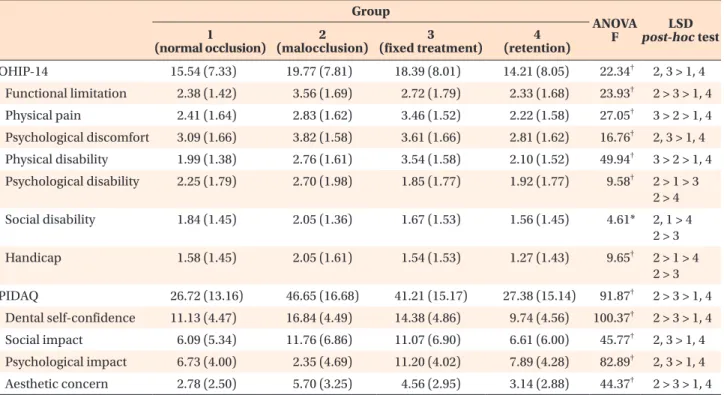
normal occlusion, malocclusion, fixed treatment, and retention. OHRQoL was assessed with the short form of the Oral Health Impact Profile (OHIP-14) and Psychosocial Impact of Dental Aesthetics Questionnaire (PIDAQ). Results: The malocclusion group and the fixed treatment group had significantly higher OHIP-14 scores than the normal occlusion group and the retention group (p < 0.001). The malocclusion group had the highest PIDAQ score, while the normal occlusion group and the retention group had the lowest PIDAQ score (p < 0.001). Women had higher OHIP-14 and PIDAQ scores than men. A significant positive correlation was found between OHIP-14 and PIDAQ scores (p < 0.01). Conclusions: Malocclusion has a negative impact on OHRQoL, but this could be improved in adults through orthodontic treatment. These OHRQoL questionnaires can provide additional useful information on specific aspects of orthodontic patients’ psychological state.
[Korean J Orthod 2014;44(6):304-311]
Key words: Psychology, Orthodontic treatment, Malocclusion, Quality of life Jang-Mi Kang
Kyung-Hwa Kang
© 2014 The Korean Association of Orthodontists.
The authors report no commercial, proprietary, or financial interest in the products or companies described in this article.
This is an Open Access article distributed under the terms of the Creative Commons Attribution Non-Commercial License (http://creativecommons.org/licenses/by-nc/3.0) which permits unrestricted non-commercial use, distribution, and reproduction in any medium, provided the original work is properly cited.