근위축측삭경화증 환자에 동반되는 행동심리증상의 임상적 특징과 예후에 대한 영향
오성일·김희진·박아람·오기욱 곽현승·김승현
한양대학교 의과대학 신경과학교실
Clinical Features and Prognostic Effects of Behavioral and
Psychological Symptoms in Patients with Amyotrophic Lateral Sclerosis
Seong-il Oh, M.D., Hee-Jin Kim, M.D., Aram Park, M.A., Ki-Wook Oh, M.D., Hyun Seung Gwak, M.D., Seung Hyun Kim, M.D.
Department of Neurology, College of Medicine, Hanyang University, Seoul, Korea
Background: The evaluation of behavioral and psychological symptoms (BPS) in ALS is important be- cause its existence may serve as a prognostic factor and suggest a shared pathology with frontotempo- ral dementia (FTD) in ALS. In this study, we sought to identify the prevalence of the BPS of ALS patients and evaluate its relationship with the clinical profiles and survival of ALS patients. Methods: One hundred sixty-six patients were enrolled in a cross-sectional cohort analysis from September 2008 to February 2012. All patients had sporadic ALS without a genetic mutation and were collected clinical profiles. The t- test and chi-square test were used to assess differences in the clinical characteristics and caregiver-ad- ministered neuropsychiatric inventory (CGA-NPI) scores. The Kaplan-Meier method and Cox proportion- al hazard model were used for the survival analysis. Results: Forty-two patients had clinically significant BPS (42/166, 25.3%). ALS patients with BPS had worse clinical dementia rating (CDR), ALS Functional Rating Scale-Revised (ALSFRS-R) score, and progression rate of disease than those without BPS.
Among CGA-NPI subscales, depression, irritability, apathy, and agitation were higher prevalent than the others. There was a trend for ALS patients with BPS having short survival time than those without BPS in the Kaplan-Meier analysis (p=0.006). However, in the Cox proportional hazard model, BPS in ALS pa- tients were not associated with poor survival. Conclusions: These results support the presence of an overlapping spectrum between ALS and FTD and emphasize the importance of neuropsychiatric evalua- tions in ALS. Although the association between BPS and prognosis are not explained clearly, these re- sults could be used to stratify ALS patients according to neuropsychiatric symptoms and help investiga- tors to evaluate the BPS in ALS patients.
Received: March 17, 2014 Revision received: March 29, 2014 Accepted: March 29, 2014
Address for correspondence Seung Hyun Kim, M.D.
Department of Neurology, College of Medicine, Hanyang University, 222 Wangsimni-ro, Seongdong-gu, Seoul 133-791, Korea Tel: +82-2-2290-8371
Fax: +82-2-2296-8370 E-mail: [email protected]
This study was supported by a grant from the Korea Healthcare Technology R&D Project, Ministry for Health, Welfare & Family Affairs,
Republic of Korea (A101712). Key Words: Amyotrophic lateral sclerosis, Frontotemporal dementia, Neuropsychiatric symptoms, Behavioral and psychological symptoms, Neuropsychological inventory
서 론
근위축측삭경화증(Amyotrophic lateral sclerosis, ALS)은 운동신경 세포에 퇴행성 변화가 생겨 근육 쇠약 및 위축을 일으키며, 증상 발 생 후 3-5년 이내에 사망하는 치명적인 질환이다[1]. ALS 환자에서 주로 나타나는 운동신경 관련 증상 외에도 인지장애 및 행동심리 증상(Behavioral and psychological symptom)을 나타나는 경우가 많
으며 집단과 인종, 검사 방법의 차이에 따라 10-70% 까지 다양한 분 포로 보고되고 있고[1, 2], 본 연구팀이 발표한 국내 연구에서도 절반 정도의 ALS 환자에서 인지장애 또는 행동심리증상이 있음을 확인 하였다[3, 4]. ALS 환자의 행동심리증상과 관련된 기존의 연구에서 는 주로 탈억제, 과민성, 감정둔화, 공감저하, 우울, 무감동이 나타나 는 것으로 보고 하였다[1, 5]. 이러한 행동심리증상은 이전에는 질병 자체의 심각한 신체적 제약으로 인해 이차적으로 발생한 행동심리
© 2014 Korean Dementia Association
This is an Open Access article distributed under the terms of the Creative Commons Attribution Non-Commercial License (http://creativecommons.org/licenses/by-nc/3.0) which permits unrestricted non-commercial use, distribution, and reproduction in any medium, provided the original work is properly cited.
증상과의 연관성이 있을 것으로 간주되어 비교적 많은 관심을 받지 않았던 부분이었지만, 최근에는 ALS와 전두측두엽치매(Frontotem- poral dementia, FTD)가 단일 질환의 스펙트럼으로 생각하여 ALS에 서 동반되는 행동심리증상의 확인이 ALS와 FTD의 공통된 발병기 전과 예후를 예측하는데 중요한 요소가 되고 있다[5-7].
본 연구에서는 국내 ALS 환자에서 관찰되는 행동심리증상의 유 병률을 확인하고 행동심리증상의 여부에 따른 ALS의 타 임상지표 와 생존기간과의 연관성을 확인하고자 하였다.
대상과 방법
대상2008년 9월부터 2012년 2월까지 한양대학교병원 신경과 ALS 클 리닉에 방문한 환자 중, revised El Escorial criteria of World Federation of Neurology에서[8] clinically possible, probable, probable—laboratory- supported 또는 definite ALS의 산발성 ALS로 진단받은 환자를 대상 으로 전향적으로 등록하였다. 산발성 ALS는 기존의 연구를 통해 ALS 후보 유전자로 알려진 SOD1, C9ORF72, FUS, TARDBP, ANG, OPTN 유전자 음성이 확인되고[9, 10], ALS 및 FTD의 가족력이 없는 경우로 정하였다. 이 중 인지 기능에 영향을 주게 되는 신경학적 질 환인 뇌졸중, 외상성 뇌질환, 학습장애, 중증의 간질 등은 제외하였 으며, 알코올 중독의 기왕력이나 정신병이 있거나 고용량의 정신과 적 약물을 복용하고 있을 때에도 제외하였고, 신경심리학적 검사 를 수행할 때에 문제가 될 수 있는 문맹이나 운동 또는 감각기능의 심각한 저하가 있을 경우에도 제외하였다. 결과적으로, 신경심리검 사와 Caregiver-Administered Neuropsychiatric Inventory (CGA-NPI) 를[11] 시행한 166명의 환자들을 연구 대상으로 하였다.
임상평가
환자의 연령, 학력, 성별 등 인구사회학적 정보를 수집하였다. 교 육수준은 정규 학교 교육을 받은 년수를 지표로 삼았다. 행동심리 증상에 대한 평가를 위해 보호자에게 CGA-NPI를 작성하도록 하 였다. CGA-NPI에서 개개의 세부 검사 항목에서 2점 이상의 점수를 보일 경우에 세부항목별 장애가 있는 것으로 판단하였으며, 두 가 지 이상의 행동심리증상이 관찰된 경우 임상적으로 유의한(Clini- cally significant) 행동심리증상이 있는 것으로 정의하였다[12]. 각 세 부 항목에서 모든 환자들에게 전반적인 인지기능의 측정을 위해 Korean Mini-Mental Status Examination (K-MMSE) [13], Clinical De- mentia Rating (CDR) scale을[14] 시행하였고 자세한 인지기능의 평가
를 위해 서울신경심리검사(Seoul Neuropsychological Screening Bat- tery)를 이용하여 주의집중능력, 언어능력, 시공간 지각 능력 및 구 성능력, 기억력, 전두엽기능 항목들을 평가하였으며, geriatric depres- sion scale (GDS)을 이용하여 우울을 평가하였다[12]. ALS의 직접적 인 임상 지표로는 첫 증상 발현부위, 질병 유병기간(증상 발현으로 부터 본원에서 질병 진단시점까지의 기간), ALS Functional Rating Scale-Revised (ALSFRS-R; range 0-48; normal, 48) [15], 강제폐활량 (Forced vital capacity, FVC), 질병 진행속도 (Progression rate of disease, [48 - ALSFRS-R 점수]/질병 유병기간[개월]) [16] 등을 조사하였다. 본 연구는 한양대학교병원 기관생명윤리위원회(IRB)의 승인을 받아 연구를 진행하였다.
통계분석
전체 참여 환자의 인구사회학적 특성은 기술통계를 이용하였고 행동심리증상 유무에 따른 대상군 간의 나이, 발병 연령, 학력, ALS 의 질병 유병기간, ALSFRS-R, K-MMSE, 점수, CGA-NPI 총점과 세부 항목들의 점수 차이, 첫 증상 발현 부위 등은 Student’s t-test 또는 Chi-square 검정으로 비교하였다. CGA-NPI 총점 또는 장애가 있는 CGA-NPI 항목수와 ALSFRS-R, 질병 유병기간, K-MMSE, GDS 등 여 러 임상지표와의 관계를 분석하기 위해 상관분석(bivariate correla- tion)을 이용하였다. 증상 발현 시점부터 사망한 시점까지를 생존기 간으로 정하고 ALS 진단 시점에서의 행동심리증상이 가져오는 생 존에 대한 영향을 분석하기 위하여 Kaplan-Meier 생존방법을 사용 하였으며, 임상지표들의 예후인자 확인을 위해 Cox 회귀분석을 적 용하였다. 모든 통계분석에 SPSS 18 프로그램을 사용하였고 p<0.05 인 경우를 통계적 유의수준으로 하였다.
결 과
연구대상의 인구학적 및 임상적 특성166명의 ALS 환자의 진단 시 평균 나이는 55.7±10.8세였고, 남자 는 98명, 여자는 69명이었다. 평균 학력은 11.2±4.5년이고, ALS의 평 균 유병기간은 17.3±10.1개월이었고, ALSFRS-R 점수는 37.9±5.4이 었다. 첫 증상 발현 부위는 43명이 구 마비로 시작되었고, K-MMSE 의 평균 점수는 26.4± 2.9점, CDR의 평균은 0.14± 0.25이며, CGA- NPI 전체 평균은 5.3±10.6점이었다. 행동심리증상의 유무에 따른 두 군으로 분류하여 보면 42명(25.3 %)의 환자에서 의미 있는 행동 심리증상을 보이고 있었다. 행동심리증상이 있는 군과 없는 군으로 나누어 비교한 인구학적 및 임상적 특성은 Table 1에 제시하였다.
CDR, GDS 점수와 CGA-NPI 총점은 행동심리증상이 없는 군에 비 해 행동심리증상이 있는 군에서 유의하게 높았다. 행동심리증상이 있는 군이 일상생활의 기능 정도를 나타내는 ALSFRS-R 점수가 더 낮았으며, 질병 진행속도는 유의하게 높은 것으로 확인되어 질병이 더 빠르게 진행되는 것을 알 수 있었다. 진단 시 나이와 발병 시 나 이, 성별, 교육수준, 유병기간, K-MMSE, 첫 증상 발현 부위, 그리고 강제폐활량에서는 유의한 수준의 차이는 없었다.
행동심리증상의 세부 항목별 유병률과 CGA-NPI 세부항목들의 점수
전체 ALS 환자들의 79명(47.6%)에서 한 가지 이상의 행동심리증 상이 관찰되었으며, 임상적으로 유의한 두 가지 이상의 행동심리증 상이 관찰된 환자는 42명(25.3%)이다. 각각의 세부항목에서 2점 이 상의 점수에 해당하는 행동심리증상은 Fig. 1에 제시하였다. 전체 166명의 환자 중에서 우울(depression), 과민(irritability), 무감동(apa- thy), 초조(agitation)에서 각각 31.3%, 19.9%, 17.5%, 13.3%로 비교적 높 은 빈도를 보이고 있었고, 환각(hallucination), 망상(delusions), 이상 운동행동(aberrant motor behavior)는 각각 1.2%, 3.0%, 3.0%로 비교적 낮은 빈도를 보였다.
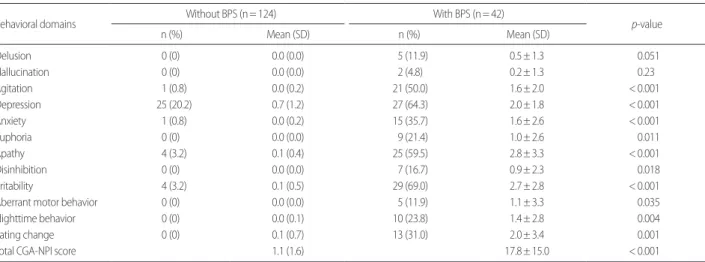
행동심리증상이 있는 군과 없는 군으로 분류하여 CGA-NPI 세 부항목의 점수의 점수를 비교하여보면(Table 2), 양쪽 대상군에서 망상, 환각을 제외한 항목에서 점수의 차이가 있었다.
행동심리증상과 임상적 특성 간의 연관성
모든 환자의 CGA-NPI 총점 또는 이상이 있는 CGA-NPI 항목수 와 다른 임상지표들과의 상관관계를 확인하였다. CGA-NPI 총점과 장애가 있는 CGA-NPI 항목수는 ALSFRS-R 점수(r =-0.310 [p<0.001], r =-0.354 [p<0.001]), 질병 진행속도(r = 0.258 [p<0.001], r = 0.327 [ p <0.001]), K-MMSE (r =-0.317 [ p <0.001], r =-0.263 [p = 0.001]), CDR (r = 0.386 [p <0.001], r = 0.409 [p <0.001]), GDS (r = 0.276 [p<0.001], r = 0.277 [p<0.001])와 통계적으로 유의한 상관 관계를 보였지만, 진단 시 나이, 강제폐활량과는 상관관계가 없었 다. 각 세부항목의 점수들과 ALSFRS-R 점수와의 상관관계에서는 초조, 불안, 무감동, 과민에서 p<0.01의 수준으로 유의한 상관관계 를 보였지만 상관계수가 0.4 이하로 낮았다. 세부항목과 질병 진행 속도와의 상관관계에서는 초조, 우울, 다행감, 무감동, 과민에서 p<0.05의 수준에서 유의한 상관관계를 보였지만 상관계수가 0.3 이 하로 낮았다.
행동심리증상과 ALS 생존기간과의 관계
생존분석은 행동심리증상의 여부에 따라 질병 시작부터 사망까 지의 생존시간을 기준으로 분석하였다. 행동심리증상이 있는 군 (29.4± 2.7)이 행동심리증상이 없는 군(46.0± 2.1)에 비해 평균 생존 기간이 더 짧았고, 생존분석에서도 행동심리증상이 없는 군에서 좋은 예후를 보이고 있었다(log-rank test: p= 0.006) (Fig. 2). Cox 비례 위험 모델에서 성별, 진단 시 나이, 첫 증상발현 부위(구 마비), 행동 심리증상 유무, K-MMSE, CDR, 질병 진행속도를 변수로 사용하여 생존분석을 시행하였다. 진단 시 나이(β=1.044, p= 0.002), 질병 진행 속도(β=3.381, p<0.001)는 나쁜 예후와 관련된 것으로 보였으나, 성 Table 1. Clinical characteristics of the patients with or without behavioral
and psychological symptoms (BPS) with amyotrophic lateral sclerosis Without BPS With BPS
p-value Mean (SD) Mean (SD)
n (%) 124 (74.7) 42 (25.3)
Age at diagnosis (yr) 55.5 (11.3) 56.2 (9.2) 0.716 Age at symptom onset (yr) 54.1 (11.3) 54.8 (9.6) 0.704
Male (%) 72 (58.1) 26 (61.9) 0.662
Education (yr) 11.5 (4.6) 10.3 (4.1) 0.135
Disease duration (mo) 17.4 (10.0) 17.0 (10.5) 0.833
K-MMSE 26.6 (2.6) 25.8 (3.5) 0.179
CDR 0.09 (0.20) 0.30 (0.32) < 0.001
GDS 16.4 (7.3) 20.5 (6.4) 0.004
Total CGA-NPI score 1.1 (1.6) 17.8 (15.0) < 0.001 Impaired CGA-NPI number 0.3 (0.5) 4.0 (1.9) < 0.001
Bulbar onset (%) 29 (23.3) 14 (33.3) 0.204
ALSFRS-R score 39.0 (5.1) 34.9 (5.3) < 0.001 Progression rate of disease 0.63 (0.44) 0.99 (0.55) < 0.001 Forced vital capacity 72.5 (65.3) 22.2 (21.8) 0.082 K-MMSE, Korean Mini-Mental Status Examination; CDR, Clinical Dementia Rating;
GDS, Geriatric Depression Scale ; CGA-NPI, Caregiver-Administered Neuropsychiat- ric Inventory; ALSFRS-R, ALS Functional Rating Scale-Revised.
Delusion Hallucina
tion Agitation
Depression Anxiet y
Euphoria Apa thy
DisinhibitionIrritabilit y
Aberr ant mot
or beha vior
Nigh ttime beha
vior
Eating ch ange 50
45 40 35 30 25 20 15 10 5 0 (%)
Fig. 1. Prevalence of behavioral and psychological symptoms in patients with ALS using the caregiver-administered neuropsychiatric inventory (CGA-NPI).
별, 첫 증상발현 부위, 행동심리증상 유무, K-MMSE, CDR 점수는 생존기간과는 의미 있는 관계는 보이지 않았다.
고 찰
이번 연구를 통해 전체 ALS 환자의 25%에서 의미 있는 행동심리 증상이 관찰되었으며, 세부항목 중에서는 우울, 과민, 무감동, 초조 가 다른 항목에 비해 비교적 높은 빈도를 보이고 있었다. 이런 행동
심리증상은 ALS에 동반될 수 있는 FTD와 관련된 증상으로 나타날 수 있으며, 인지장애나 행동심리증상이 아직 심하지 않아 FTD의 진단기준에는 만족하지 못하는 단계의 경도장애에 있는 환자들에 게서도 나타날 수 있는 것으로 보고되었다[1, 4, 6]. 2009년 Strong 등 [17]이 ALS에서 인지장애와 행동심리증상에 대한 양상과 범위에 대 한 설명을 위해 연구자들의 협의를 거친 합의성 기준(Consensus cri- teria)을 발표한 바가 있으며, 이를 통해 이전에 비해 체계적인 연구 를 진행할 수 있게 되었다. 저자들도 이전에 보고된 협의 내용과 유 사한 방식으로 ALS 환자에 동반된 인지장애, 행동심리증상, 그리고 치매가 동반된 환자들의 양상에 대해 보고하였다[3, 4]. 이전 다른 연구자들의 연구에서는 사용된 도구와 포함되는 행동심리증상의 중증도에 따라 차이가 있었지만, 17-88%에서 경도 이상의 행동심리 증상이 동반되는 것으로 보고되어 있다[1-4, 6]. 유럽과 미국 등 서구 문화권에서 2011년 C9ORF72 유전자변이가 발견된 이후 이와 관련 된 임상적 특성에 대한 연구를 보면 행동심리증상에서는 환각, 망 상 등의 정신병적 증상과의 연관성이 있다고 보고하였으며[18, 19], 이 결과는 기존의 TDP-43 병리를 가진 ALS 환자에서 주로 나타나 고 있었던 행동심리증상인 무감동 등이 많이 나타나는 것과는 다 른 양상으로 나타나는 것을 알 수 있었다[6, 20]. 이러한 임상적 차이 는 국내 ALS와 FTD의 유전자 연구에서 C9ORF72 유전자변이가 발견되지 않음으로써[9, 21] 유전적 배경이 상이함을 확인하였고, 이 로 인해 국내 ALS 환자에서는 C9ORF72 유전자가 아닌 다른 형태 의 병리기전에 의해 발병한 증상일 가능성이 높은 상태라고 볼 수 있다.
행동심리증상이 있는 환자는 증상이 없는 환자에 비해 CDR, GDS에서 높은 점수를 보여 더 나쁜 상태를 의미하고 있으며, ALS 의 경과와 관련된 임상지표에서 ALSFRS-R 점수가 낮게 나타나서 신체적 기능이 좋지 않은 것과 질병 진행속도가 더 빠른 속도를 보 Table 2. Subscales prevalence and scores of CGA-NPI in ALS patients with or without behavioral and psychological symptoms (BPS)
Behavioral domains Without BPS (n= 124) With BPS (n= 42)
p-value
n (%) Mean (SD) n (%) Mean (SD)
Delusion 0 (0) 0.0 (0.0) 5 (11.9) 0.5± 1.3 0.051
Hallucination 0 (0) 0.0 (0.0) 2 (4.8) 0.2± 1.3 0.23
Agitation 1 (0.8) 0.0 (0.2) 21 (50.0) 1.6± 2.0 < 0.001
Depression 25 (20.2) 0.7 (1.2) 27 (64.3) 2.0± 1.8 < 0.001
Anxiety 1 (0.8) 0.0 (0.2) 15 (35.7) 1.6± 2.6 < 0.001
Euphoria 0 (0) 0.0 (0.0) 9 (21.4) 1.0± 2.6 0.011
Apathy 4 (3.2) 0.1 (0.4) 25 (59.5) 2.8± 3.3 < 0.001
Disinhibition 0 (0) 0.0 (0.0) 7 (16.7) 0.9± 2.3 0.018
Irritability 4 (3.2) 0.1 (0.5) 29 (69.0) 2.7± 2.8 < 0.001
Aberrant motor behavior 0 (0) 0.0 (0.0) 5 (11.9) 1.1± 3.3 0.035
Nighttime behavior 0 (0) 0.0 (0.1) 10 (23.8) 1.4± 2.8 0.004
Eating change 0 (0) 0.1 (0.7) 13 (31.0) 2.0± 3.4 0.001
Total CGA-NPI score 1.1 (1.6) 17.8± 15.0 < 0.001
CGA-NPI, Caregiver-Administered Neuropsychiatric Inventory; ALS, Amyotrophic lateral sclerosis.
Fig. 2. Kaplan-Meier survival plots of the ALS patients according to be- havioral and psychological symptoms (BPS) during the post-symptom onset period until death.
1.0
0.8
0.6
0.4
0.2
0.0
Estimated survival
Survival time since onset of disease (months) p= 0.006
BPS (-) (+) (-) -censored (+) -censored
0.0 20.0 40.0 60.0
이고 있음을 알 수 있었다(Table 1). 상관관계 분석에서도 CGA-NPI 총점과 항목수가 ALSFRS-R 점수, 질병 진행속도, K-MMSE, CDR, GDS와 상관관계가 있고, 이는 질병의 발병나이나, 유병기간, 교육 수준, 성별보다는 질병의 진행 정도와 질병 자체의 경과와 관련된 것으로 판단할 수 있으며, 이러한 결과는 기존에 인지장애나 행동 심리증상이 있었던 환자들에게서 비교적 빠른 질병의 악화와 나쁜 예후를 나타냈던 결과와도 연결되어 설명할 수 있을 것이다. 이러한 나쁜 예후 인자와 행동심리증상과의 연관성에 대해서는 명확히 밝 혀지지 않았지만 임상적 접근을 할 때에 환자의 분류 및 치료 등에 있어 계층화된 접근을 할 수 있도록 도와줄 수 있을 것이다.
이번 연구에서 흥미로운 점 하나는 환각과 망상이 행동심리증상 중에서 비교적 낮은 빈도로 발견되었지만, ALS에서 FTD로 진행이 된 ALS-FTD 환자에서 주로 나타나고 있다는 점이다. 각각 망상은 5 명 중 4명이 ALS-FTD 환자에서 나타났으며, 환각은 2명이 모두 ALS-FTD 환자였다. 이는 환각과 망상이 ALS에서 치매의 단계까지 진행되지 않은 환자보다는 치매까지 진행된 환자에서 주로 나타난 다는 점을 확인할 수 있는 것으로 생각할 수 있으며, ALS에서 이러 한 항목이 관찰될 경우 ALS-FTD로 진행할 가능성에 대해 의심해 볼 수 있을 것이다.
우울은 행동심리증상이 있는 군 뿐만 아니라 행동심리증상이 없는 군에서도 비교적 높은 빈도(25%)로 관찰되었다. 이것은 GDS 점수(20.5±6.4 vs 16.4±7.3)를 통해서도 확인될 수 있었는데, 높은 우 울감은 ALS에서 동반될 수 있는 FTD의 병리증상으로써 발현되었 을 가능성 이외에도 질병 자체의 진행으로 인한 근력 약화 등과 같 은 신체적 제약으로 인해 이차적으로 나타날 수 있는 것으로 설명 하고 있다. 우울감은 여러 원인에 의해 복합적으로 발생할 수 있지 만, 삶의 질의 저하, 질병 부담, 그리고 보존적 치료에의 순응도에도 영향을 줄 수 있는 인자로 작용할 수 있기 때문에, ALS 환자들을 대 상으로 우울감을 확인하고 이에 대한 적절한 치료를 필요로 할 것 이다[6].
생존분석에서는 Kaplan-Meier 분석을 통해 행동심리증상이 있 는 환자에서 나쁜 예후를 보이고 있었다. 그러나 다른 교란변수들 과의 Cox 비례위험 모델에서는 진단 시 나이와 질병 진행속도는 생 존에 영향을 미치고 있으며 행동심리증상 자체는 생존에 영향을 주지 않았다. 이는 생존기간에 영향을 줄 수 있는 영양공급 또는 호 흡기 적용 등의 보존적 치료 등이 이러한 생존분석에 영향을 주었 을 가능성이 있다. 따라서 추후에 행동심리증상의 독립적인 영향 을 확인할 수 있는 연구설계를 통해서 정확한 생존에 대한 영향을 확인할 필요가 있다.
본 연구의 한계점으로는 첫째로 행동심리증상을 확인하는 도구 인 CGA-NPI 가 ALS 환자의 행동심리증상에 특화된 도구로 개발된 것이 아니기 때문에 이로 인해 결과에 영향을 주었을 가능성 있다
는 점이다. 지금까지 ALS에서 행동심리증상에 대한 표준화된 검사 방법은 현재까지 없지만, 많은 연구에서 Neuropsychiatric Inventory (NPI), Cambridge Behavioural Inventory-Revised (CBI-R), Frontal Sys- tems Behavior Scale (FrSBe), Frontal Behavioural Inventory (FBI) 등의 검사들이 사용되고 있으며[2, 5, 22], 최근에는 ALS의 운동능력 저하 로 인해 과대 평가되는 행동심리증상을 최소화하기 위한 Amyo- trophic Lateral Sclerosis-Frontotemporal Dementia-Questionnaire (ALS-FTD-Q)가 개발되기도 하였다[23]. 그러나 조금 더 정확한 평 가를 위해서 ALS의 질병 자체 및 ALS-FTD에 관련된 행동심리증상 을 확인할 수 있는 특화된 도구의 추후 개발이 필요하다. 둘째, 질병 이 많이 진행되어 사지위약, 구음장애, 호흡장애와 관련된 증상으 로 신경심리검사를 하지 못한 환자들은 포함되지 않은 점으로 인 해 행동심리증상의 정도와 연관성이 높은 요인으로 확인된 진행된 질병 상태와 빠른 진행속도를 가진 심각한 환자들을 일부 포함할 수 없었으며, 이러한 검사상의 한계가 있는 환자들에게서 정확하게 행동심리증상를 측정하기 어렵다는 것이 결과 분석에 영향을 미쳤 을 것이다.
본 연구에 포함된 환자들은 산발성 ALS로 확인되었고 기존에 ALS와 관련된 유전자로 확인된 SOD1, C9ORF72, FUS, TARDBP, ANG, OPTN 유전자변이가 없는 환자군으로 구성되어 있어 비교적 균일한 환자를 대상으로 한 점이 장점으로 작용할 수 있지만, 추후 관련된 아직까지 밝혀지지 않은 유전적 배경에 대한 연구가 필요로 할 것이다.
결론적으로, ALS의 행동심리증상은 질병의 단계나 진행속도, 인 지기능의 저하와는 관련성이 있으나, 생존기간 및 예후와는 상관이 없는 것으로 나타났다. 이번 연구를 통해 생존곡선에 영향을 줄 수 있는 행동심리증상과 그 외의 임상적 요인들을 확인하게 되었으며, 추후 ALS 환자가 보이는 행동심리증상의 임상적, 병리적 상관성에 대한 장기적이고 종적인 연구의 필요함을 제기하는 바이다.
참고문헌
1. Consonni M, Iannaccone S, Cerami C, Frasson P, Lacerenza M, Lunetta C, et al. The cognitive and behavioural profile of amyotrophic lateral sclerosis: application of the consensus criteria. Behav Neurol 2013; 27:
143-53.
2. Phukan J, Pender NP, Hardiman O. Cognitive impairment in amyo- trophic lateral sclerosis. Lancet Neurol 2007; 6: 994-1003.
3. Baek WK, Park A, Kim HY, Kim SH. Amyotrophic Lateral Sclerosis in Korea: Clinical Characteristics and Prognostic Factors. J Korean Neurol Assoc 2011; 29: 16-24.
4. Oh SI, Park A, Kim HJ, Oh KW, Choi H, Kwon MJ, et al. Spectrum of Cognitive Impairment in Korean ALS Patients without Known Genetic Mutations. PLoS One 2014; 9: e87163.
5. Lillo P, Mioshi E, Zoing MC, Kiernan MC, Hodges JR. How common are behavioural changes in amyotrophic lateral sclerosis? Amyotroph Lateral Scler 2011; 12: 45-51.
6. Goldstein LH, Abrahams S. Changes in cognition and behaviour in amyotrophic lateral sclerosis: nature of impairment and implications for assessment. Lancet Neurol 2013; 12: 368-80.
7. Robberecht W, Philips T. The changing scene of amyotrophic lateral scle- rosis. Nat Rev Neurosci 2013; 14: 248-64.
8. Brooks BR, Miller RG, Swash M, Munsat TL, World Federation of Neu- rology Research Group on Motor Neuron D. El Escorial revisited: re- vised criteria for the diagnosis of amyotrophic lateral sclerosis. Amyo- troph Lateral Scler Other Motor Neuron Disord 2000; 1: 293-9.
9. Jang JH, Kwon MJ, Choi WJ, Oh KW, Koh SH, Ki CS, et al. Analysis of the C9orf72 hexanucleotide repeat expansion in Korean patients with famil- ial and sporadic amyotrophic lateral sclerosis. Neurobiol Aging 2013; 34:
1311 e1317-9.
10. Kwon MJ, Baek W, Ki CS, Kim HY, Koh SH, Kim JW, et al. Screening of the SOD1, FUS, TARDBP, ANG, and OPTN mutations in Korean pa- tients with familial and sporadic ALS. Neurobiol Aging 2012; 33: 1017 e1017-23.
11. Kang SJ, Choi SH, Lee BH, Jeong Y, Hahm DS, Han IW, et al. Caregiver- Administered Neuropsychiatric Inventory (CGA-NPI). J Geriatr Psychia- try Neurol 2004; 17: 32-5.
12. Chin J, Seo SW, Kim SH, Park A, Ahn HJ, Lee BH, et al. Neurobehavior- al dysfunction in patients with subcortical vascular mild cognitive im- pairment and subcortical vascular dementia. Clin Neuropsychol 2012;
26: 224-38.
13. Kang Y. A normative study of the Korean-Mini Mental State Examina- tion (K- MMSE) in the elderly. Korean Journal of Psychology 2006; 25:
1-12.
14. Morris JC. The Clinical Dementia Rating (CDR): current version and scoring rules. Neurology 1993; 43: 2412-4.
15. Gordon PH, Miller RG, Moore DH. Alsfrs-R. Amyotroph Lateral Scler Other Motor Neuron Disord 2004; 5 Suppl 1: 90-3.
16. Kimura F, Fujimura C, Ishida S, Nakajima H, Furutama D, Uehara H, et al. Progression rate of ALSFRS-R at time of diagnosis predicts survival time in ALS. Neurology 2006; 66: 265-7.
17. Strong MJ, Grace GM, Freedman M, Lomen-Hoerth C, Woolley S, Goldstein LH, et al. Consensus criteria for the diagnosis of frontotempo- ral cognitive and behavioural syndromes in amyotrophic lateral sclerosis.
Amyotroph Lateral Scler 2009; 10: 131-46.
18. Cooper-Knock J, Shaw PJ, Kirby J. The widening spectrum of C9ORF72- related disease; genotype/phenotype correlations and potential modifiers of clinical phenotype. Acta Neuropathol 2014; 127: 333-45.
19. Kertesz A, Ang LC, Jesso S, MacKinley J, Baker M, Brown P, et al. Psy- chosis and hallucinations in frontotemporal dementia with the C9ORF72 mutation: a detailed clinical cohort. Cogn Behav Neurol 2013; 26: 146- 54.
20. Raaphorst J, Beeldman E, De Visser M, De Haan RJ, Schmand B. A sys- tematic review of behavioural changes in motor neuron disease. Amyo- troph Lateral Scler 2012; 13: 493-501.
21. Kim EJ, Kwon JC, Park KH, Park KW, Lee JH, Choi SH, et al. Clinical and genetic analysis of MAPT, GRN, and C9orf72 genes in Korean pa- tients with frontotemporal dementia. Neurobiol Aging 2014; 35: 1213 e1213-7.
22. Lillo P, Savage S, Mioshi E, Kiernan MC, Hodges JR. Amyotrophic later- al sclerosis and frontotemporal dementia: A behavioural and cognitive continuum. Amyotroph Lateral Scler 2012; 13: 102-9.
23. Raaphorst J, Beeldman E, Schmand B, Berkhout J, Linssen WH, van den Berg LH, et al. The ALS-FTD-Q: a new screening tool for behavioral disturbances in ALS. Neurology 2012; 79: 1377-83.