• 검색 결과가 없습니다.

Behavioral and Psychological Symptoms of Dementia Treated with Korean Medicine: A Case Report

N/A
N/A
Protected

Academic year: 2021

Share "Behavioral and Psychological Symptoms of Dementia Treated with Korean Medicine: A Case Report"

Copied!
9
0
0

로드 중.... (전체 텍스트 보기)

전체 글

(1)

Behavioral and Psychological Symptoms of Dementia Treated with Korean Medicine: A Case Report

Sue-jin Song, Yung-wei Sung, Byung-soo Koo

Department of Neuropsychiatry, College of Oriental Medicine, Dongguk University

Received: November 25, 2017 Revised: December 21, 2017 Accepted: December 21, 2017

Objectives: To determine the effects of Korean medicine on behavioral and psychological symptoms of dementia (BPSD) of an Alzheimer's disease (AD) patient.

Methods: A 85-year old female patient diagnosed with AD was treated with herbal medicine formula Chungsimyeonja-tang (淸心蓮子湯), Woohwangchungsim-won (牛黃淸心元), and acupuncture.

Korean version of Mini-mental State Examination (MMSE-K) scores were used at baseline and post treatment as outcome measures to evaluate clinical symptoms of the patient.

Results: Improvements in MMSE-K post treatment scores were observed compare to those at baseline.

BPSD were also alleviated. Such changes were visually noticeable.

Conclusions: Herbal medicine and acupuncture treatment were effective in alleviating symptoms of AD. Further studies with a larger sample size and randomized clinical trials are needed to obtain more reliable and valid treatment outcomes.

Key Words: Alzheimer’s disease, Behavioral and psychological symptoms of dementia (BPSD), Korean medical treatment.

Correspondence to Byung-soo Koo

Department of Neuropsychiatry, Dongguk University Ilsan Oriental Hospital, 814, Siksa-dong, Ilsandong-gu, Goyang, Korea.

Tel: +82-31-961-9140 Fax: +82-31-961-9009 E-mail: [email protected]

Copyright © 2017 by The Korean Society of Oriental Neuropsychiatry. All rights reserved.

CC
This is an open access article distributed under the terms of the Creative Commons Attribution Non-Commercial License (http://creativecommons.org/licenses/by-nc/4.0) which

permits unrestricted non-commercial use, distribution, and reproduction in any medium, provided the original work is properly cited.

(2)

I. INTRODUCTION

Dementia is a clinical syndrome caused by neuro- degeneration and characterized by progressive deteri- oration in cognitive ability and capacity for in- dependent living which makes it difficult to perform learning, memory, language, executive function, com- plex attention, perceptual-motor, social cognition

1).

Alzheimer’s disease (AD) is the most common type of dementia, accounting for up to 70% of all cases of dementia

2)

. The earliest clinical symptom is progressive loss of memory which is a gradually worsening ability to remember new information. As the disease pro- gresses cognitive and behavioral abilities decline. In the advanced stages, patients need help with basic ac- tivities of daily living, such as bathing, dressing, eating and using the bathroom, and finally become reliant on around-the-clock care

3)

.

The cause and mechanism of AD has not yet been clearly identified and there are no current pharmaco- logical treatments available that can slow down or to stop the damage and destruction of neurons causing Alzheimer’s symptoms. However, there are many treat- ment strategies exist that can alleviate some symptoms

4)

. Oriental medical theory considers dementia to be a more holistic and integrated approach, rather than a problem in just one organ. According to the theory, dementia is caused by (1) deficiency of vital energy of the Kidney, Marrow, Heart and Spleen, and (2) stagna- tion of Blood and/or Phlegm. Herbal medicine is an in- creasingly common form of complementary and alter- native therapy. Recent clinical studies have demon- strated that some herbal medicines show benefits for dementia

5)

.

In this article, we present a case of AD patient suf- fering from behavioral and psychological symptoms of dementia (BPSD) who was significantly improved using Korean medical treatment. The contents of this case are as follows.

II. CASE

1. Patient: Female, 85 years old

2. Chief complaints 1) Cognitive impairment 2) Sleep talking

3) Gait disturbance

3. Onset of symptoms

January, 2017 (6 months before admission)

4. Duration of treatment July 3∼July 31, 2017

September 25∼October 26, 2017

5. Current medical history

A 85-year old female patient diagnosed with Alzheimer’s disease in 2000. This patient had a history of hospitalization 30 years ago due to two episodes of stroke. Following the stroke daily living and walking was possible.

There is significant weakness in the lower ex- tremities that has been progressing gradually, and since January 2017 she is unable to stand up from her bed. Additionally, her cognitive function deterioration has further increased.

For treatment purposes, she was admitted to Oriental neuropsychiatry department of ** Oriental Hospital.

6. Past medical history

1) Hypertension: diagnosed in 1978 2) Dyslipidemia: diagnosed in 1978

3) Heart failure, Atrial fibrillation: diagnosed in 1978 4) Stroke: diagnosed in 1979, 1980

5) Total knee arthroplasty, both: operated in 1991

(3)

7. Current medication Pravastatin 40 mg 0.5T#1 Candesartan 16 mg 1T#1 Bisoprolol 5 mg 1T#1 Edoxaban 30 mg 1T#1 Dicamax 1000 tab 1T#1 Donepezil 10 mg 1T#1 Memantine 10 mg 1T#1 Escitalopram 10 mg 1T#1 Acetylcarnitine 500 mg 1T#2

8. Family history Brother - Hypertension

9. Social history

1) Height and weight: 160 cm, 68 kg 2) Smoking history: None

3) Drinking history: None 10. Initial assessment

1) Appearance: not so ill looking and appropriate eye contact

2) Mental examination (1) Mental status: alert

(2) Pupil reflex: isocoric, prompt

(3) Orientation: time/place/person (−/−/+) (4) Memory: immediate/recent/remote (−/−/+) (5) Obey command: 1 step possible

(6) Communication: comprehension (+) expression (+) repeating (+) fluency (+)

3) Manual Muscle Test (MMT) Upper Extremity 3−/3−

Lower Extremity 3−/3−

4) Mobility

Roll over (−) sit up (−) stand up (−) Head control (+) trunk control (+−) Sit alone (moderate assist)

5) Activities of daily living Feeding: moderate assist Dressing: maximal assist Toileting: maximal assist Hygiene: maximal assist

6) Pulse diagnosis: sinking pulse (沈脈)

7) Tongue diagnosis: pink tongue with no coating (舌淡紅 無苔)

11. Review of system (ROS)

1) Sleep: poor, insufficient sleep talking several times every day

2) Appetite and digestion: fine normal regular diet 1 bowl, 3 times/day

3) Urination: voiding sense (−) diaper change 6∼8 times/day

4) Defecation: defecation sense (−) normal form, 1∼2 times/day

12. Initial examination findings

1) Vital sign

Blood pressure 147/89 mmHg Pulse 86 times/minute

Respiration rate 20 times/minute Body temperature 36.6°C

2) Complete blood count (CBC)

Total Protein 6.3↓, LDH 250↑, Calcium 8.6↓,

PT-INR 1.17↑

(4)

Table 1. The Change of Herbal Medication

Herbal medication Composition of herbal medication (per one dose) Treatment period Remark Chungsimyeonja-tang

(淸心蓮子湯)

Nelumbinis Semen (蓮子肉), Dioscoreae Rhizoma (山藥) each 8 g, Asparagi Tuber (天門冬), Liriopis seu Ophiopogonis Tuber (麥門冬), Polygalae Radix (遠志), Acori Graminei Rhizoma (石菖蒲), Zizyphi Semen (酸棗仁), Longanae Arillus (龍眼肉), Thujae Semen (柏子仁), Scutellariae Radix (黃芩), Raphani Semen (萊菔子) each 4 g, Chrysanthemi Indici Flos (甘菊) 2 g

2nd∼29th 2 dose #3 per 1 day

Gagam Sohaphyang-won (加減蘇合香元)

Salviae Miltiorrhizae Radix (丹參) 12 g, Piperis Longi Fructus (蓽撥) 10 g, Cnidii Rhizoma (川芎) 8 g, Myristicae Semen (肉荳蔲) 6 g, Typhae Pollen (蒲黃) 4 g, Syzygii Flos (丁香) 3 g, Santali Lignum Alba (白檀香) 3 g, Storax Liquidambaris (蘇合香) 1.5 g

9th∼29th 2g #1 per 1 day

Woohwangchungsim-won (牛黃淸心元)

Dioscoreae Rhizoma (山藥) 263 mg, Glycyrrhizae Radix (甘草) 188 mg, Civet Musk (靈猫香) 114 mg, Typhae Pollen (蒲黃), Massa Medicata Fermentata (神麯), Ginseng Radix (人蔘) each 94 mg, Glycine Semen Germinatum (大豆黃卷), Cinnamomi Cortex (肉桂), Asini Cornii Colla (阿膠) each 66 mg, Paeoniae Radix (芍藥), Liriopis Tuber (麥門冬), Scutellariae Radix (黃芩), Angelicae Gigantis Radix (當歸),

Saposhnikoviae Radix (防風), Atractylodis Rhizoma alba (白朮) each 56 mg, Bupleuri Radix (柴胡), Platycodonis Radix (桔梗), Armeniacae Semen (杏仁), Poria Sclerotium (茯苓), Cnidii Rhizoma (川芎) each 47 mg, Bovis Calculus (牛黃) 45 mg, Borneolum (龍腦), Gazellae seu Saigae Cornu (羚羊角) each 38 mg, Ampelopsis Radix (白蘞), Zingiberis Rhizoma (乾薑) each 28 mg, Honey Mel (蜂蜜) 4.17 g

54th∼107th 0.5 pill #1 per 1 day

108th∼116th 0.5 pill #2 per 1 day

Gami Chungshimyeonja-tang (加味淸心蓮子湯)

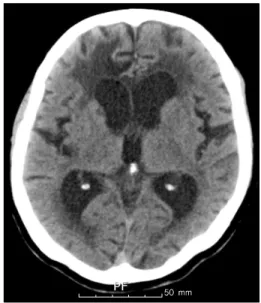
Chungsimyeonja-tang+Bambusae Concretio Silicea (天竺黃) 2 g 86th∼116th 2 dose #3 per 1 day Fig. 1. Brain CT at admission.

3) Urinalysis:

WBC 25 (1+)↑, WBC (microscopy) 5∼9↑

4) Electrocardiography: atrial fibrillation

5) Chest x-ray: cardiomegaly with no active lung lesion

6) Brain CT (Fig. 1)

Focal cerebromalacic lesion in right posterior insular or subinsular region, r/o chronic ICH or chronic infarction.

Diffuse severe brain atrophic change with marked ventriculomegaly, r/o associated hydrocephalus.

Mild atherosclerotic calcified plaques at both distal VAs, ICAs and possibly ACA.

13. Treatments

1) Herb medicine (Table 1)

(1) Chungsimyeonja-tang ( 淸心蓮子湯 )

The prescription was applied from July 4 to July 31.

(5)

Table 2. The Change of Western Medication

Treatment period 1st~

30th 31st~

46th 47th~

101st 102nd~

112nd 113th~

116th

Pravastatin 40 mg ○ ○ ○ ○ ○

Candesartan 16 mg ○ ○ ○

Candesartan 8 mg ○

Bisoprolol 5 mg ○ ○ ○ ○ ○

Edoxaban 30 mg ○ ○ ○ ○ ○

Dicamax 1000 tab ○ ○ ○ ○ ○

Donepezil 10 mg ○ ○ ○ ○ ○

Memantine 10 mg ○ ○ ○ ○ ○

Escitalopram 10 mg ○ ○ ○ ○ ○

Acetylcarnitine 500 mg ○ ○ ○ ○ ○

Amlodipine 5 mg 1T#1 ○ ○ ○

Quetiapine 25 mg 0.5T#1 ○ ○ ○ ○

Quetiapine 25 mg 1T#1 ○ ○ ○

From September 25 to October 26, 2 grams of Bambusae Concretio Silicea (天竺黃) were added. Those were or- ally administered two-dose three-pack at 120 cc, two hours after each meal.

(2) Gagam Sohaphyang-won ( 加減蘇合香元 ) 2 grams of pills made in Vignae Radiatae Semen size (綠豆大) were administered once a day from July 11 to July 31.

(3) Woohwangchungsim-won ( 牛黃淸心元 ) Half of a bullet-sized pill (彈子大) were administered once a day from August 25 to October 16, and then twice a day from October 17 to October 26 increasing the dosage.

2) Acupuncture

Using 0.20 mm×30 mm sterilized disposable nee- dles which were manufactured from Dong Bang Acupuncture Incorporation, acupuncture treatment was administered once a day. Needle retention time was set at 15 minutes, and acupuncture was per- formed on GV20 (百會), LI04 (合谷), KI10 (陰谷), LR08 (曲泉), ST36 (足三里), ST37 (上巨虛), ST39 (下巨虛), SP06 (三陰交), LR04 (中封), LR03 (太衝).

3) Western medicine (Table 2)

Because of the high blood pressure, Amlodipine 5mg was added on August 18. However, diastolic blood pressure had been consistently low since October, so Candesartan was eventually discontinued by tapering the dose.

On August 2, Quetiapine 25 mg 0.5 tablet was added. The dosage gradually increased, and 1.5 tablets began to be given from August 18.

4) Rehabilitation (1) Physical therapy

Thermoelectric therapy, bobath therapy, sitting bal- ance exercise, sit to stand training, tilting

(2) Occupational therapy

Activities of daily living training, range of motion exercise

14. Assessment tools

1) MMSE-K (Korean version of Mini-Mental State Examination)

2) GDS (Global Deterioration Scale) 3) CDR (Clinical Dementia Rating) 15. Clinical course and outcome

1) Admission 1st day

This patient had neither temporal orientation nor spatial orientation. However, there was partial ori- entation to person only in case of the close acquaint- ance, such as son, daughter and caregiver.

She was not motivated to perform any activities nor

try to answer the questions from medical staff. It was

difficult to hold her head up by herself in sitting

position. She was able to grasp the spoon, but she

could not use it. Therefore, overall help was needed

during every meal. Irritation and aggressive language

were often observed.

(6)

Table 3. Change of Korean Mini-Mental State Examination Scores 1st day 116th day

Orientation 0 0

Memory registration 0 3

Memory recall 0 0

Attention 0 0

Naming 0 2

Following commands 2 2

Judgement 0 1

Copying pentagon 0 0

Total 2 8

Table 4. Changes of GDS (Global Deterioration Scale) Scores, CDR (Clinical Dementia Rating) Scores, and MMT (Manual Muscle Test) Scores

1st day 116th day

GDS 5 5

CDR 17 17

MMT (upper limb) 3−/3− 3+/3−

MMT (lower limb) 3−/3− 3−/3−

Table 5. Changes of ADL (Activities of Daily Living) Scores

1st day 116th day

Feeding Moderate assist Minimal assist Dressing Maximal assist Maximal assist Toileting Maximal assist Maximal assist Hygiene Maximal assist Maximal assist

2) Admission 2nd∼29th day

She seemed to have trouble in adapting to un- familiar environment of the hospital at the beginning.

She babbled 3∼4 times in her sleep consistently.

Over time, she gradually responded to questions more easily, but her conversation was still incoherent.

At the end this period, she was able to recognize who the doctor was.

3) Admission 30th∼53rd day

Disobedience increased during the rehabilitation treatment. She did not cooperate with a loud voice, so treatment did not work well. She had more temper tantrums when things did not go her way, swearing occasionally. Misidentification was occured in this pe- riod, such as calling a visitor a fox or a rabbit.

4) Admission 54th∼85th day

The patient gradually became obedient during the rehabilitation treatment. Irritation and aggressive lan- guage decreased by degrees. Also, upper body’s move- ment showed more activities. She began to have a meal on her own by holding the spoon.

5) Admission 86th∼107th day

She had been home during the Chuseok holiday.

After returning to hospital, she made some incoherent delirious words in her sleep more often and louder al-

though irritation remained diminished. It was not stop- ped when others restrained her.

6) Admission 108th∼116th day

The frequency of sleep talking decreased, and it stopped when others restrained her. The patient's ability to answer the questions and have a meal on her own was significantly improved. MMT scores in right upper limb improved accordingly. She was able to hold her head up in sitting position and showed a nat- ural upper body movement, but still had no will to stand up or walk.

The following tables show the progress of the in- patient (Table 3∼5). On the 116th day of treatment, improvement was checked by 8 scores of K-MMSE, al- though the GDS and CDR scores did not change with the treatment.

III. DISCUSSION

Alzheimer’s disease (AD) refers to a clinical syn-

drome with loss of memory and other intellectual

functions caused by progressive, neurodegenerative

brain disease

6)

. As AD progresses, beta-amyloid and

(7)

tau proteins accumulate in the brain, leading to in- flammation, neuronal atrophy, and cell death

7)

. The typical clinical syndrome of AD includes an amnestic type of memory defect with difficulty learning and re- calling new information, progressive language disorder beginning with anomia and progressing to fluent aphasia. All cognitive deficits worsen

8)

. Though neither consensus concerning pathogenesis nor perfect ther- apy for AD is available at present, progress has been made.

According to the Oriental medical theory, dementia is complex and may involve multiple causes in a holis- tic integrated view. It is believed that the disease is highly correlated to the abnormal functions of other organs including the Kidney, Liver, Heart and Spleen, although the pathological site of dementia is in the brain

9)

. For example, dementia patients who initially have Kidney deficiency may also develop stagnation of Blood and Phlegm leading to dementia. All these clin- ical experiences, stagnation of blood and kidney defi- ciency, become two important concepts in Oriental medicine to explain the origin of sickness leading to dementia.

A 85-year old female patient was admitted to the hospital for treatment of cognitive impairment and be- havioral and psychological symptoms (BPSD). This pa- tient had a history of two-time stroke and heart disease. Initially, she was not motivated to perform any activity of daily life. We diagnosed her as not only stag- nation of blood and kidney deficiency, but also Tae-Eum type, and used Chungsimyeonja-tang (淸心蓮 子湯) at the first period (2nd∼29nd day). This herbal medicine formula is originated in “Longevity and Life Preservation of the Eastern Medicine (東醫壽世保元)”

which describes Sasang typology.

The Sasang typology was devised by Jema Lee in 1894. It is a person-centered personalized medicine dividing human beings into four types of Tae-Yang, So-Yang, Tae-Eum, and So-Eum, based on their phys-

iological characteristics

10)

. Among four Sasang types, Tae-Eum type was reported to have a higher preva- lence of hypertension, diabetes, obesity, and metabolic disease and a lower sympathetic activity than others

11)

. Chungsimyeonja-tang, one of the herbal medicine for- mulas for Tae-Eum type, has long been prescribed as a treatment for cerebral infarction to increase cerebral blood flow and to recover injured brain cells

12)

.

Additionally, we used Woohwangchungsim-won (牛 黃淸心元) at the second period (54th∼116th day). The prescription aimed to relieve irritation and alleviate sleep talking. It has been used to treat anxiety, epi- lepsy, cardio-cerebral-vascular and neurological dis- eases, as well as acute stroke in oriental medical hospitals. It has a preventive effect on ischemia-in- duced brain damage

13)

.

Among the evaluation tools used in this report, the MMSE-K (Korean version of Mini-Mental State Examination) is a neurocognitive test designed to screen cognitive impairment. It is used to assess mod- erate to severe dementia patients within 10 minutes, with scores ranging from 0 to 30

14)

. This instrument is composed of orientation (10 points), short-term memory registration and recall (6 points), attention (5 points), naming (2 points), following verbal commands (4 points), judgment (2 points), and copying a double pentagon (1 point).

GDS (Global Deterioration Scale) and CDR (Clinical Dementia Rating) are both observer rating scales de- signed to rate severity in dementia patients. The GDS consists of a description of seven major, clinically dis- tinguishable dementia stages, ranging from “no cogni- tive decline” (GDS 1) to “very severe” (GDS 4–7), with

“normal with subjective memory impairment” (GDS 2) and “mild dementia” (GDS 3) as the intermediate stages

15)

. The CDR contains 6 performance areas:

memory, orientation, judgment, problem-solving, com- munity affairs, home and hobbies, and personal care.

It rates each area in a 5 point scale where 0 represents

(8)

the absence of dementia, 0.5 questionable, 1 mild, 2 moderate, and 3 severe dementia

16)

. The sum CDR scores in these 6 areas were used in this case.

As a result of the evaluation, the patient showed a significant MMSE-K score improvement. The MMSE-K post treatment scores were 8 scores, while baseline scores were 2 scores. Memory registration was also relatively improved compare to the time of admission, and it became possible to recognize objects and speak their names. In addition, when questioned, she was able to answer to some degree by self-judgment. On the other hand, there was no change in scores of GDS and CDR. In other words, any further deterioration of cognitive function was not observed in spite of old age, given that the patient was treated for more than 100 days, a considerably long period of time. Conse- quently, this case presents a significant result that herbal medicine and acupuncture treatment was effective.

Meanwhile, one problem needs to be further addressed. There is no evaluation tool that can accu- rately assess the BPSD, so it is highly regrettable to rely solely on the patient’s subjective reports. It has been reported that BPSD, including aggression, agitation, screaming, wandering, hallucinations, and delusions occur in 20∼80% of patients with dementia

17)

. These symptoms impair the activities of daily living in pa- tients with dementia, impose great burdens on care- givers, hasten hospital admission. In this case, symp- toms of the patient deteriorated after going out to her home from the hospital. Dementia patients are more difficult to adapt to complex environments, so the consistent environment should be made so that they can live in a safe and simple environment.

This case was treated with Korean medicine for a dementia patient with BPSD. The principle of treat- ment for dementia is that it should be coped con- sistently, continuously with homeostasis. Treatment of cognitive impairment and the BPSD is the most im-

portant, but the maintenance and environmental as- pects of daily living should also be included in the treatment.

IV. CONCLUSION

To treat a patient who was admitted to the hospital with progressive cognitive impairment and BPSD, Korean medical treatment was performed. As noted above, significant effects were observed. Western medicine for dementia has no clear treatment yet. If Korean medical treatment is applied under accurate pattern identification diagnosis, it will be a better treatment than western medical treatment which shows various side effects. However, since objective criteria is insufficient to evaluate systematic treatment and improvement of symptoms, more research and re- ports are needed. Further studies with a larger sample size and randomized clinical trials are needed for a more reliable and valid treatment outcome.

REFERENCES

1. American Psychiatric Association. Diagnostic and Statistical Manual of Mental Disorders, Fifth Edition (DSM-5), American Psychiatric Association, Arlington 2013.

2. Brookmeyer R, Evans DA, Hebert L, Langa KM, Heeringa SG, Plassman BL, Kukull WA. National estimates of the prevalence of Alzheimer’s disease in the United States.

Alzheimer's & Dementia. 2011;7(1):61-73.

3. Lancet. Amnesic disorders. 2012;380(9851):1429-40.

4. Alzheimer’s Association. 2017 Alzheimer's disease facts and figures. Alzheimer's & Dementia. 2017;13(4):325-73.

5. Yan H, Li L, Tang XC. Treating senile dementia with tradi- tional Chinese medicine. Clinical interventions in aging.

2007;2(2):201.

6. Na DR. Clinical Appraoch of Dementia. Journal of Korean Medical Association. 2002;45(4):361-7.

7. Wang J, Zuo X, Dai Z, Xia M, Zhao Z, Zhao X, Jia J, Han Y, He Y. Disrupted functional brain connectome in in- dividuals at risk for Alzheimer's disease. Biological psychiatry. 2013;73(5):472-81.

8. Cummings JL, Cole G. Alzheimer Disease. JAMA. 2002;

287(18); 2335-8.

(9)

9. Ho YS, So KF, Chang RC. Drug discovery from Chinese medicine against neurodegeneration in Alzheimer's and vascular dementia. Chinese medicine, 2011;6(1):15.

10. Lim S H, Jeon ES, Lee J, Han SY, Chae H. Pharmacog- nostic outlooks on medical herbs of Sasang typology.

Integrative Medicine Research. 2017;6(3):231.

11. Kim JY. Noble D. Recent progress and prospects in Sasang constitutional medicine: A traditional type of physiome-based treatment. Progress in biophysics and molecular biology. 2014;116(1):76-80.

12. Jeong HJ, Choi IY, Kim MH, Kim HM, Moon PD, Hong JW, Kim SH. Chungsim-Yeunja-Tang decreases the in- flammatory response in peripheral blood mononuclear cells from patients with cerebral infarction through an NF- κ B dependent mechanism. Journal of neuroinflam - mation. 2010;7(1):85.

13. Jung WS, Ryu JM, Kim YJ, Park SU, Jahng GH, Park JM, Moon SK, Ko CN, Cho KH. Uhwang Chungsim Won de- creases blood oxygen level-dependent fMRI signal re-

sponse to a motor stimulation task. Chinese journal of in- tegrative medicine, 2015;21(7):493-9.

14. Lee DY, Lee KU, Lee JH, Kim KW, Jhoo JH. A normative study of Mini-Mental State Examination in the Korean elderly. Journal of the Korean Neurological Association.

2002;41(3):508-25.

15. Choi SH, Na DL, Lee BH, Hahm DS, Jeong JH, Jeong Y, Koo EJ, Ha CK, Ahn SS. The validity of the Korean version of Global Deterioration Scale. Journal of the Korean Neurological Association. 2002;20(6):612-7.

16. Choi SH, Na DL, Lee BH, Hahm DS, Jeong JH, Yoon SJ, Yoo KH, Ha CK, Han IW. Estimating the validity of the Korean version of expanded clinical dementia rating (CDR) scale. Journal of the Korean Neurological Association. 2001;19(6):585-91.

17. Lawlor BA. Behavioral and psychological symptoms in

dementia: the role of atypical antipsychotics. Journal of

Clinical Psychiatry. 2004;65(11):5-10.

수치

Table 1. The Change of Herbal Medication
Table 2. The Change of Western Medication Treatment period 1st~ 30th 31st~46th 47th~101st 102nd~112nd 113th~116th Pravastatin 40 mg ○ ○ ○ ○ ○ Candesartan 16 mg ○ ○ ○ Candesartan 8 mg ○ Bisoprolol 5 mg ○ ○ ○ ○ ○ Edoxaban 30 mg ○ ○ ○ ○ ○ Dicamax 1000 tab ○ ○
Table 4. Changes of GDS (Global Deterioration Scale) Scores, CDR  (Clinical Dementia Rating) Scores, and MMT (Manual Muscle Test)  Scores 1st day 116th day GDS 5 5 CDR 17 17 MMT (upper limb) 3−/3− 3+/3− MMT (lower limb) 3−/3− 3−/3−

참조

관련 문서

Conclusion: These results suggest that old patient who expressed typically intoxicated symptoms, lower GCS and blood pressure, shown acidosis in gas analysis,

Korean Aspects to Scenario 4, LG HC with decelerating TPER This case requires Korean government to maintain nuclear energy and pursue alternative

The study conducted a study of literature and research, and in literature, the study of cosmetic behavior, nail behavior, self esteem, and

This study was conducted to examine the satisfaction of blended learning classes using online videos with Korean elementary and middle school students and

Underwater sports showed a high response in social and psychological satisfaction, There was a statistically signifiant difference in social, psychological, and

This certificate will be highly appreciated in the process of selection of Korean Government Scholarship recipients and the admissions to a Korean university. Please

This study verified that after correcting variables, affecting dementia of prostate cancer patients, the ADT treatment group had a higher risk of dementia as

First, there was no significant difference as a result of analyzing the differences in psychological capital, achievement goal orientation, and game roots