치매 진행 정도에 따른 조기발현과 지연발현 알츠하이머병 환자의 행동심리증상 비교
윤여주 *·김은주
†·홍창희
‡인제대학교 해운대백병원 정신건강의학과*,
부산대학교 의과대학 신경과학교실†,
부산대학교 심리학과‡
Comparison of Behavioral and Psychological Symptoms between Early and Late Onset Alzheimer’s Disease According to the Progression of Dementia
Yeo-Ju Yoon, M.A.*, Eun-Joo Kim, M.D.
†, Chang Hee Hong, Ph.D.
‡Department of Psychiatry*, Inje university paik-hospital, Busan; Department of Neurology†, Pusan National University Hospital, Pusan National University School of Medicine and Medical Research Institute, Busan;
Department of Psychology‡, Pusan National University, Busan, Korea
The aim of this study was to investigate behavioral and psychological symptoms of dementia (BPSD) measured by caregiver-administered neuropsychiatric inventory (CGA-NPI) as a function of dementia severity in early onset (EOAD) versus late onset Alzheimer’s disease (LOAD). A total of 113 patients with AD consisting of 49 patients with EOAD and 64 patients with LOAD were enrolled consecutively. General cognitive function and severity of dementia were assessed by the Korean version of mini-mental status examination and clinical dementia rating (CDR), respectively. In the mild stage (CDR 0.5-1), LOAD pa- tients had a significantly higher total CGA-NPI score than EOAD patients. Subgroup analysis demon- strated that disinhibition and night-time behavior were more common and severe in the LOAD group than the EOAD group. However, in the moderate to severe stage (CDR 2-3), EOAD patients had a significant- ly higher total CGA-NPI score with higher subscores in hallucination, agitation/aggression, irritability/labili- ty, aberrant motor behavior, and appetite/eating change. This study suggested that the heterogeneity of BPSD in AD might be accounted for by dementia severity as well as age at symptoms onset.
Received: November 4, 2014 Revision received: December 14, 2014 Accepted: December 14, 2014
Address for correspondence Changhee Hong, Ph.D.
Department of Psychology, Pusan National University, 2 Busandaehak-ro 63beon-gil, Geumjeong-gu, Busan 609-735, Korea Tel : +82-51-510-2144
Fax:+82-51-581-1457
E-mail : [email protected] Key Words: Behavioral and psychological symptoms of dementia, Early onset Alzheimer’s diseases, Agitation, Caregiver-administered neuropsychiatric inventory
서 론
국민건강보험공단 건강보험정책연구원에 따르면 최근 6년간 치매 환자는 2006년 10만 5천명에서 2011년 31만 2천명으로 무려 296.3%가 증가하였고, 특히 2007년을 기점으로 65세 미만 치매 환자의 수는 더욱 급격하게 증가하고 있다고 한다. 경제적, 사회적 활동을 하는 40대~60대 초반 치매 환자의 증가는 환자 본인뿐 아니라 주변 가족 들에게 심리적, 경제적인 부담감을 더욱 크게 주기에 이에 대한 평가 와 치료가 더욱 중요하다[1, 2]. 전체 치매 중 가장 높은 비율(50-70%) 을 차지하는 알츠하이머병은 발현시기에 따라 65세 미만에 발현하 는 조기발현 알츠하이머병(early-onset alzheimer’s disease, EOAD) 집 단과 65세 이상에서 발현하는 지연발현 알츠하이머병(late-onset al- zheimer’s disease, LOAD) 집단으로 분류되기도 한다[3]. 이 두 하위유
형은 임상적인 경과나 신경심리학적 증상, 신경영상학적으로 확인 되는 영역에서 뚜렷한 차이를 보인다. EOAD 집단은 LOAD 집단에 비해 인지적 감퇴속도가 빠르고 경과도 나쁘다[4, 5]. 또한 LOAD 집 단보다 유전적 소인이 커 가족력을 가진 환자가 더 많고, 기억장애 이외의 시공간기능, 언어기능, 집행기능의 저하 및 실행증을 보이는 비전형적인 양상의 환자가 많다[6, 7]. 대뇌 시냅스의 손실이나 노인 반(senile plaque)과 신경섬유 농축제(neurofibrillary tangle)의 침착이 심하고, 측두엽만이 아니라 전두엽과 두정엽이 위축되어 있고 대사 도 저하되어 있다[8-10].
이처럼 유전적, 신경심리학적, 신경영상학적 연구에서 보이는 EOAD 집단과 LOAD 집단의 차이는 행동심리증상(behavioral &
psychological symptoms of dementia, BPSD)에도 반영될 것이다. 행동 심리증상이란 치매 진행 과정에서 주로 발생하는 지각, 사고내용,
© 2014 Korean Dementia Association
This is an Open Access article distributed under the terms of the Creative Commons Attribution Non-Commercial License (http://creativecommons.org/licenses/by-nc/3.0) which permits unrestricted non-commercial use, distribution, and reproduction in any medium, provided the original work is properly cited.
정서 또는 행동 증상으로 치매환자의 60-95%가 경험하며, 치매의 진단과 경과에 대한 중요한 정보를 제공한다[11]. 행동심리증상은 인지장애보다 보호자에게 더 큰 스트레스를 주는 요인으로 가족 에게 심리적, 신체적, 경제적 부담감을 안겨주지만 인지기능과는 달 리 조기에 발견하여 치료하면 조절이 가능하므로 행동심리증상의 양상과 경과에 대해 보다 깊은 이해가 요구된다[12].
이러한 이론적, 실제적 함의에도 불구하고 발현시기에 따라 EOAD 집단과 LOAD 집단의 행동심리증상을 비교한 연구가 드물 뿐 아니라 그나마 실시된 연구들 사이에서도 일관성이 없는 실정이 다[13, 14]. 그 이유는 치매의 진행 정도에 따라 나타나는 행동심리 증상의 빈도나 심각성이 다름에도 불구하고 결과에 영향을 미칠 수 있는 치매의 진행 정도를 고려하지 못했기 때문인 듯 하다.
이 연구에서는 알츠하이머병의 치매 진행 정도(경도/중등도-중 증)를 고려하여 발현시기(EOAD/LOAD)에 따른 행동심리증상을 비교하였다. 특히 행동심리증상을 요인 수준과 개별적인 증상 수준 에서 비교하여 EOAD 집단과 LOAD 집단의 행동심리증상을 보다 체계적이고 구체적으로 이해하고자 하였다.
대상과 방법
본 연구는 2009년 3월부터 2011년 10월까지 인지기능저하를 주소 로 부산대학병원 신경과 외래에 내원한 환자들 중 신경과 전문의의 임상적 소견, 신경심리학적 평가, 신경학적 검사, 임상병리검사, 뇌영 상검사를 통해 알츠하이머병으로 진단받은 환자 113명을 대상으로 하였다. 상기 환자들은 정신장애의 진단 및 통계 편람 제4판(diag- nostic and statical maual of mental disorder, 4th edition, DSM-Ⅳ)의 알 츠하이머병 진단기준(1994)과 미국 국립보건원 신경, 의사소통 질 환 및 뇌졸중 연구소/알츠하이머 및 연관질환 협회(National Insti- tute of Neurological and Communicative Disease and Stroke/Alzheimer’s Disease and Related Disorders Association, NINCDS-ADRDA)의 Probable Alzheimer’s disease 진단기준(1984)에 부합하였다. 또한 모 든 환자들에게 뇌자기공명영상검사를 시행하여 뇌혈관질환을 지 닌 환자들을 배제하였고, Hachinski 허혈성 척도 점수가 4점 이하인 경우로 정의하였다[15]. 본 연구는 부산대학교병원의 연구윤리위원 회(institutional review board, IRB)의 승인을 거친 후 시행되었다.
행동심리증상을 측정하기 위해 caregiver-administered neuropsy- chiatric inventory (CGA-NPI)를 사용하였고, 전반적인 인지기능과 치매 진행 정도를 측정하기 위해 한국판 간이정신상태검사(Korean version of mini-mental status examination, K-MMSE)와 한국판 임상 치매평가척도(clinical dementia rating, CDR)를 사용하였다[16-18]. 발 현시기에 따라서 알츠하이머병 환자를 65세 미만의 EOAD 집단과 65세 이상의 LOAD 집단으로 나누었고, CGA-NPI를 사용하여 두
집단의 차이가 있는지 알아보았다. 또한 경도(mild) 집단은 CDR 0.5- 1, 중등도-중증(moderate to severe) 집단은 CDR 2-3으로 구성하고, 치매의 진행 정도별 발현시기가 다른 두 집단의 행동심리증상에 대 해 비교하였다.
수집된 자료는 SPSS 18.0 for Windows를 사용하여 분석하였다. 두 집단 간 인구통계학적 변인은 chi-square 분석과 독립 t-test를 실시하 였고, 두 집단의 치매 진행 정도와 발현시기에 따른 행동심리증상 은 변량분석(ANOVA)를 실시하였다. 또한 치매 진행 정도와 발현시 기에 따른 행동심리증상의 요인과 각 하위항목에 대해 1차적으로 다변량분석(MANOVA)을 실시하였고, 2차적으로 치매 진행 정도 를 두 집단으로 나눈 후, Mann-Whitney 검정을 실시하여 EOAD 집 단과 LOAD 집단 간의 행동심리증상의 요인별 항목과 각 하위항목 들을 비교하였다.
결 과
Table 1은 집단별 연령 및 발현연령, 유병기간, 교육수준, 치매 진 행 정도를 나타내는 검사들의 평균과 표준편차이다. EOAD 집단에 서는 성별의 차이가 없었으나, LOAD 집단에서는 여성이 의미있게 더 많은 양상이었고, EOAD가 8.85년으로 LOAD에 비해 더 높은 교 육수준을 보였다. 그 외 유병기간에는 차이가 없었고, 치매 진행 정 도를 나타내는 K-MMSE, CDR 점수에서도 차이를 보이지 않았다.
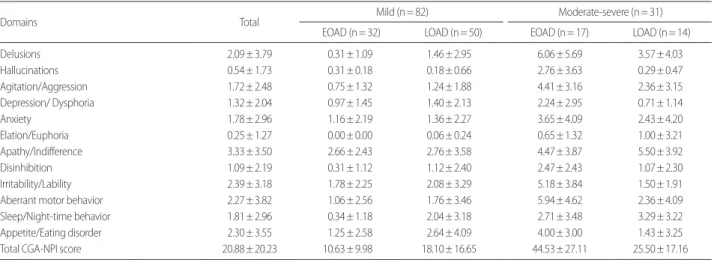
발현시기(EOAD/LOAD)와 치매 진행 정도(경도/중등도-중증)에 따른 행동심리증상의 전체점수를 이원변량분석하였다. Table 2는 발현시기와 치매 진행 정도에 따른 행동심리증상의 평균과 표준편 차를 나타낸 것이다. 전체 환자의 CGA-NPI의 평균 점수는 20.88점 이었고, 가장 높은 점수를 보인 증상은 무감동/무관심(3.33점)이었 고, 그 뒤로 과민/불안정(2.39점), 야간의 행동(2.30점), 비정상적인 반복행동(2.27점), 망상(2.09점) 순으로 나타났다. 가장 낮은 점수를 Table 1. Demographic and clinical features between EOAD and LOAD group
EOAD (n= 49) LOAD (n= 64) t or χ2
Sex (M/F) 25/24 20/44 4.53*
Age 62.96± 6.01 77.13± 5.12
Onset age 58.18± 5.78 72.73± 4.87
Duration 4.78± 2.76 4.39± 3.38 0.65
Education 8.85± 4.89 5.46± 4.94 3.63†
K-MMSE 14.80± 6.92 15.48± 4.66 -0.60
CDR 1.35± 0.67 1.18± 0.57 1.41
CDR 0.5 (n= 15) 6 9
CDR 1 (n= 67) 26 41
CDR 2 (n= 26) 14 12
CDR 3 (n= 5) 3 2
*p<0.05; †p< 0.01.
K-MMSE, Korean-mini mental state examination; CDR, clinical dementia rating.
보인 증상은 다행감/기분이 들뜸(0.25점)이었다. 전체 CGA-NPI 점 수에서 중등도-중증 알츠하이머병 환자집단의 점수는 경도 환자집 단 보다 유의하게 높았으나[F(1,109)=31.76, p<0.001], EOAD 환자와 LOAD 환자의 전체점수 간의 차이는 나타나지 않았다[F(1,109) = 2.49, p> 0.1]. 그러나 Fig. 1과 같이 치매 진행 정도와 발현시기의 상호 작용 효과는 유의하게 나타났다[F(1,109)=13.08, p<0.001]. 즉, 경도에 서 전체 증상의 점수는 LOAD 집단이 EOAD 집단보다 유의하게 높 았고[F(1,80) =5.23, p <0.05], 중등도-중증에서는 EOAD 집단이 LOAD 집단보다 유의하게 높은 점수를 보였다[F(1,29)=5.17, p<0.05].
발현시기(EOAD/LOAD)와 치매 진행 정도(경도/중등도-중증)에 따른 행동심리증상의 하위 항목을 분석하기 위해 이전 연구에서
개발된 요인을 사용하였다. Lange RT, Hopp GA, Kang N (2004)은 neuropsychiatric inventory-nursing home version (NPI-NH)를 요인분 석하여 다섯 가지 요인을 보고하였는데, 첫 번째 요인은 초조(Agita- tion)로 구성항목은 초조/공격성, 과민/불안정으로 구성되었고, 두 번째 요인인 기분(Mood)은 우울/낙담, 무감동/무관심, 불안, 세 번 째 요인인 정신증적 증상(Psychosis)은 망상, 환각, 네 번째 요인인 수 면/운동활동(Sleep/Motor Activity)은 비정상적인 반복행동, 야간의 행동, 다섯 번째 요인인 고양된 행동(Elevated Behavior)은 다행감/기 분이 들뜸, 탈억제로 구성되었다[19]. 먼저 치매 진행 정도와 발현시 기에 따른 행동심리증상의 요인과 각 하위항목에 대해 다변량분석 (MANOVA)을 실시하였으나, 행동심리증상 점수의 표준편차가 매
Table 2. Subscale score of CGA-NPI between EOAD and LOAD according to the progression of dementia
Domains Total Mild (n= 82) Moderate-severe (n= 31)
EOAD (n= 32) LOAD (n= 50) EOAD (n= 17) LOAD (n= 14)
Delusions 2.09± 3.79 0.31± 1.09 1.46± 2.95 6.06± 5.69 3.57± 4.03
Hallucinations 0.54± 1.73 0.31± 0.18 0.18± 0.66 2.76± 3.63 0.29± 0.47
Agitation/Aggression 1.72± 2.48 0.75± 1.32 1.24± 1.88 4.41± 3.16 2.36± 3.15
Depression/ Dysphoria 1.32± 2.04 0.97± 1.45 1.40± 2.13 2.24± 2.95 0.71± 1.14
Anxiety 1.78± 2.96 1.16± 2.19 1.36± 2.27 3.65± 4.09 2.43± 4.20
Elation/Euphoria 0.25± 1.27 0.00± 0.00 0.06± 0.24 0.65± 1.32 1.00± 3.21
Apathy/Indifference 3.33± 3.50 2.66± 2.43 2.76± 3.58 4.47± 3.87 5.50± 3.92
Disinhibition 1.09± 2.19 0.31± 1.12 1.12± 2.40 2.47± 2.43 1.07± 2.30
Irritability/Lability 2.39± 3.18 1.78± 2.25 2.08± 3.29 5.18± 3.84 1.50± 1.91
Aberrant motor behavior 2.27± 3.82 1.06± 2.56 1.76± 3.46 5.94± 4.62 2.36± 4.09
Sleep/Night-time behavior 1.81± 2.96 0.34± 1.18 2.04± 3.18 2.71± 3.48 3.29± 3.22
Appetite/Eating disorder 2.30± 3.55 1.25± 2.58 2.64± 4.09 4.00± 3.00 1.43± 3.25
Total CGA-NPI score 20.88± 20.23 10.63± 9.98 18.10± 16.65 44.53± 27.11 25.50± 17.16
CGA-NPI, caregiver-administered neuropsychiatric inventory.
Mild Moderate-severe 50
40 30 20 10 0
EOAD LOAD
Fig. 1. Comparison of total score of CGA-NPI between EOAD and LOAD according to the progression of dementia.
Table 3. Comparison of subscale score of CGA-NPI between EOAD and LOAD according to the progression of dementia
Domains
Mild (n= 82) Moderate-severe (n= 31) EOAD
(n= 32)
LOAD (n= 50)
EOAD (n= 17)
LOAD (n= 14)
Delusions 664.50 93.00
Hallucinations 744.00 60.00*
Agitation/Aggression 702.00 65.00*
Depression/Dysphoria 718.00 74.50
Anxiety 777.00 89.50
Elation/Euphoria 752.00 104.00
Apathy/Indifference 717.00 98.00
Disinhibition 638.00* 74.00
Irritability/Lability 749.50 47.00†
Aberrant motor behavior 726.00 67.00*
Sleep/ Night-time behavior 532.00† 104.00 Appetite/Eating disorder 656.00 52.50† Total CGA-NPI score 582.50* 72.00
*p<0.05; †p< 0.01.
Mann-Whitney test; CGA-NPI, caregiver-administered neuropsychiatric inventory.
우 크며, 변량 동질성 검증 결과, 각 집단의 변량이 동질하지 않다는 문제가 있었다. 그래서 증상의 요인별 항목과 각 하위항목에 대해서 는 Mann-Whitney 검정을 실시하였다. 치매의 진행 정도가 경도일 때 는 수면/운동활동에서 LOAD 집단이 EOAD 집단보다 유의하게 더 높은 점수를 보였고[U=559.50, p<0.05], 중등도-중증에서는 초조에 서 EOAD 집단이 LOAD 집단보다 유의하게 더 높은 점수를 보였다 [U=51.00, p <0.01]. 행동심리증상의 각 하위 항목에 대한 Mann- Whitney 검정 결과를 Table 3에 제시하였다. 치매의 진행 정도가 경 도일 때는 특히 탈억제[U = 638.00, p <0.05]와 야간의 행동[U = 532.00, p<0.01]에서 LOAD 집단이 EOAD 집단보다 유의하게 더 높 은 점수를 보였고, 중등도-중증에서는 환각[U= 60.00, p<0.05], 초 조/공격성[U= 65.00, p<0.05], 과민/불안정[U= 47.00, p<0.01], 비정상 적인 반복행동[U= 67.00, p <0.05], 식욕/식습관의 변화[U=52.50, p<0.01]항목에서 EOAD 집단이 LOAD 집단보다 유의하게 더 높은 점수를 보였다.
고 찰
이 연구에서는 발현시기(EOAD/LOAD)와 치매 진행 정도(경도/
중등도-중증)에 따라 알츠하이머병을 구분함으로써 행동심리증상 의 차이를 발견하고자 하였다. 경도의 치매 상태에서는 LOAD 집단 이 더 높은 행동심리증상 점수를 나타내었고, 중등도-중증에서는 EOAD 집단이 더 높은 행동심리증상 점수를 나타내었다. 즉, 경도 상태에서는 EOAD 집단의 행동심리증상이 LOAD 집단보다 심하 지 않으나, 중등도-중증으로 진행하면 심해지는 양상으로서 치매 진행 경과에 따라 EOAD 집단에서 행동심리증상은 더욱 가파른 증 가를 보였다.
두 집단 간 행동심리증상에 대한 세부항목에서도 차이를 보였는 데, 경도의 치매 상태에서는 LOAD 환자가 수면/운동활동 관련요 인, 세부적으로 보면, 탈억제와 야간의 행동에서 더 심각한 양상을 보였다. 중등도-중증에서는 EOAD 환자가 초조관련 요인, 세부적으 로 보면 환각, 초조/공격성, 과민/불안정, 비정상적인 반복행동, 식 욕/식습관의 변화에서 더 심각한 양상을 보였다. 이러한 행동심리 증상의 세부적인 차이는 신경영상학적 연구와도 관련이 될 듯 한 데, EOAD 집단이 LOAD 집단보다 전두엽의 심한 대사저하를 나타 내었고, 또한 초조 증상이 전두엽 변성과 관련성이 높음을 알 수 있 다. 초조는 직접적인 필요성이나 혼돈 상태에 의해 발생하지 않는 부적절한 언어적, 음성적, 행동적 이상으로 정의되며[20], 세로토닌, 노르에피네프린, 도파민 등의 신경전달물질의 변화와 함께 뇌섬엽 (insula)과 전측대상피질(anterior cingulate cortex), 안와전두엽(orbito- frontal lobe) 기능부전과의 관련성이 보고된다[21-24]. 이러한 증거는 이 연구에서 나타나는 결과와 같이, 치매가 진행함에 따라 EOAD
집단에서 초조/공격성과 과민/불안정, 비정상적인 반복행동과 같은 전두엽과 관련성이 높은 행동심리증상이 더 심각하게 나타남을 시 사할 수 있다.
본 연구에서는 치매 진행 정도와 발현시기에 따라 알츠하이머병 을 구분함으로써 두 집단에서 행동심리증상의 차이를 발견하고자 하였다. EOAD 집단은 LOAD 집단과 유전적, 신경심리학적 증상, 신 경영상학적 대뇌 영역, 임상경과, 그리고 행동심리증상에서도 많은 차이를 보이므로 두 집단을 질병학적으로 구분하고 차별적인 치료 계획을 수립할 필요성이 있다.
후속 연구에서는 EOAD집단에서 더 많이 나타나는 초조행동에 대해 주목하면서 신경영상학을 접목한 연구를 통해 유사한 결과가 나타나는지 살펴보아야 하겠다. 또한 치매 진행 정도에 대해서는 횡 적 연구를 통해 비교한 한계가 있어 개인 간 변산성을 통제하지 못 했으므로 추후로는 종적 연구를 통해 치매가 진행함에 따라 행동 심리증상이 어떤 양상으로 변화하고, 발현시기에 따른 두 집단의 행동심리증상의 세부항목이 어떤 차이를 보이는지 알아보아야 할 것 같다.
참고문헌
1. Luscombe G, Brodaty H, Freeth S. Younger people with dementia: diag- nostic issues, effects on carers and use of services. International Journal of Geriatric Psychiatry 1998; 13: 323-30.
2. Sampson EL, Warren JD, Rossor MN. Young onset dementia. Postgrad- uate Medical Journal 2004; 80: 125-39.
3. Amaducci LA, Rocca WA, Schoenberg BS. Origin of the distinction be- tween Alzheimer’s disease and senile dementia: how history can clarify nosology. Neurology 1986; 36: 1497-9.
4. Heyman A, Wilkinson WE, Hurwitz BJ, Helms MJ, Haynes CS, Utley CM, et al. Early-onset Alzheimer’s disease: clinical predictors of institu- tionalization and death. Neurology 1987; 37: 980-4.
5. Jacobs D, Sano M, Marder K, Bell K, Bylsma F, Lafleche G, et al. Age at onset of Alzheimer’s disease: relation to pattern of cognitive dysfunction and rate of decline. Neurology 1994; 44: 1215-20.
6. Koedam EL, Lauffer V, van der Vlies AE, van der Flier WM, Scheltens P, Pijnenburg YA. Early-versus late-onset Alzheimer’s disease: more than age alone. Journal of Alzheimer’s Disease 2010; 19: 1401-8.
7. Koss E, Edland S, Fillenbaum G, Mohs R, Clark C, Galasko D, et al.
Clinical and neuropsychological differences between patients with earlier and later onset of Alzheimer’s disease: A CERAD analysis, Part XII. Neu- rology 1996; 46: 136-41.
8. Bigio EH, Hynan LS, Sontag E, Satumtira S, White CL. Synapse loss is
greater in presenile than senile onset Alzheimer disease: implications for the cognitive reserve hypothesis. Neuropathology and Applied Neurobiol- ogy 2002; 28: 218-27.
9. Kim EJ, Cho SS, Jeong Y, Park KC, Kang SJ, Kang E, et al. Glucose metab- olism in early onset versus late onset Alzheimer’s disease: an SPM analysis of 120 patients. Brain 2005; 128(Pt 8): 1790-801.
10. Mielke R, Herholz K, Grond M, Kessler J, Heiss WD. Differences of re- gional cerebral glucose metabolism between presenile and senile dementia of Alzheimer type. Neurobiology of Aging 1992; 13: 93-8.
11. Finkel S. Introduction to behavioural and psychological symptoms of de- mentia (BPSD). International Journal of Geriatric Psychiatry 2000; 15 Suppl 1: S2-4.
12. Matsumoto T, Adachi H, Hirono N, Tanabe H. Caregiver burden associ- ated with behavioral and psychological symptoms of dementia in elderly people in the local community. Dementia and Geriatric Cognitive Disor- ders 2007; 23: 219-24.
13. Hori K, Oda T, Asaoka T, Yoshida M, Watanabe S, Oyamada R, et al. First episodes of behavioral symptoms in Alzheimer’s disease patients at age 90 and over, and early-onset Alzheimer’s disease: comparison with senile de- mentia of Alzheimer’s type. Psychiatry Clinical Neurosciences 2005; 59:
730-5.
14. Toyota Y, Ikeda M, Shinagawa S, Matsumoto T, Matsumoto N, Hokoishi K, et al. Comparison of behavioral and psychological symptoms in early-onset and late-onset Alzheimer’s disease. International Journal of Geriatric Psy- chiatry 2007; 22: 896-901.
15. Hachinski VC, Iliff LD, Zilhka E, Du Boulay GH, McAllister VL, Marshall J, et al. Symon L.Cerebral blood flow in dementia. Arch Neurol. 1975; 32:
632-7.
16. Kang SJ, Choi SH, Lee BH, Jeong Y, Hahm DS, Han IW, et al. Caregiver-
Administered Neuropsychiatric Inventory (CGA-NPI). Journal of Geriat- ric Psychiatry and Neurology 2004; 17: 32-5.
17. Kang Y, Na DL, Hahn S. A validitiy study on the Korean Mini-Mental State Examination (K-MMSE) in dementia patients. J Korean Neurol Assoc 1997; 15: 300-8.
18. Choi SH, Lee BH, Hahm DS, Jeong JH, Yoon SJ. Estimating the validity of the Korean version of Expanded Clinical Dementia Rating (CDR) scale.
J Korean Neurol Assoc 2001; 19: 585-91.
19. Lange RT, Hopp GA, Kang N. Psychometric properties and factor struc- ture of the Neuropsychiatric Inventory Nursing Home version in an elderly neuropsychiatric population. International Journal of Geriatric Psychiatry 2004; 19: 440-8.
20. Cohen-Mansfield J, Marx MS, Rosenthal AS. A description of agitation in a nursing home. Journal of Gerontology 1989; 44(3): M77-84.
21. Bruen PD, McGeown WJ, Shanks MF, Venneri A. Neuroanatomical cor- relates of neuropsychiatric symptoms in Alzheimer’s disease. Brain 2008;
131(Pt 9): 2455-63.
22. Tekin S, Mega MS, Masterman DM, Chow T, Garakian J, Vinters HV, et al. Orbitofrontal and anterior cingulate cortex neurofibrillary tangle bur- den is associated with agitation in Alzheimer disease. Annals of Neurology 2001; 49: 355-61.
23. Trzepacz PT, Yu P, Bhamidipati PK, Willis B, Forrester T, Tabas L, et al.
Frontolimbic atrophy is associated with agitation and aggression in mild cognitive impairment and Alzheimer’s disease. Alzheimers Dement 2013;
9: S95-S104.
24. Cho H, Seo SW, Kim JH, Kim C, Ye BS, Kim GH, et al. Changes in sub- cortical structures in early- versus late-onset Alzheimer’s disease. Neurobi- ol Aging 2013; 34: 1740-7.