Risk Factors for Complex Hypersensitivity and Irritation Reactions after an Ultrasound-Guided Cyanoacrylate Closure
Seunggoo Lee, Sungsin Cho, Jin Hyun Joh
Department of Surgery, Kyung Hee University Hospital at Gangdong, Kyung Hee University School of Medicine, Seoul, Korea
Received November 10, 2020 Revised December 13, 2020 Accepted December 21, 2020
Purpose: Cyanoacrylate closure (CAC) has been introduced for the treatment of the in- competent saphenous vein. Although there have been no severe procedure- or device-related adverse events, the post-treatment complex hypersensitivity and irritation reactions (CHAIR) might be a troublesome complication.
Methods: A retrospective review was performed from prospectively collected data of CAC patients. The CAC was performed in patients with symptomatic great saphenous veins (GSV), small saphenous veins (SSV), and/or accessory saphenous veins (ASV) in a single session. We assessed the possible risk factors for the development of a hypersensitivity re- action including the amount of injected adhesive, access site, treated segment, compression stocking application, and other clinical factors. For the statistical analyses, data were ana- lyzed using the IBM SPSS Statistics ver. 22.0 (IBM Co., Armonk, NY, USA). P-value <0.05 was considered statistically significant.
Results: During the study period, 190 saphenous veins were treated in 100 patients.
Sixty-four (64%) patients were female. The mean age was 55.5 ± 12.8 years (19-84).
Complete occlusion was achieved in all patients. After CAC, the mean visual analogue scale (VAS) was 2.59 and 0.32 on postoperative 0 and 7 days, respectively (P < 0.001). Post-treat- ment CHAIR occurred in 5 (5%) patients. The significant risk factors for the development of CHAIR were younger age, GSV treatment, and below-the-knee access site for the in- troduction of a catheter.
Conclusion: CHAIR occurred when the adhesive was injected at the below-the-knee GSV segment. The mechanical irritation due to knee joint movement might be a possible mecha- nism for the development of the hypersensitivity reaction.
Keywords: Varicose veins, Cyanoacrylates, Hypersensitivity reaction, Inflammation, Phlebitis
Correspondence to:
Jin Hyun Joh
Department of Surgery, Kyung Hee University Hospital at Gangdong, Kyung Hee University School of Medicine, 892 Dongnam-ro, Gangdong-gu, Seoul 05278, Korea Tel: +82-2-440-6261
Fax: +82-2-440-6296 E-mail: [email protected]
INTRODUCTION
The treatment of the incompetent saphenous vein has been rapidly changed from the conventional stripping to the minimally invasive endovenous treatments. For about 2 decades, the endovenous thermal ablations including ra-
diofrequency ablation (RFA) and endovenous laser ablation (EVLA) have been the key modalities to treat it.(1,2) RFA demonstrated statistically significant differences with re- gard to decreased pain and better global and physical scores in quality-of-life (QOL) measurements.(3) EVLA was comparable with conventional stripping in terms of the
JSU
Journal of Surgical Ultrasound J Surg Ultrasound 2021;8:19-24
https://doi.org/10.46268/jsu.2021.8.1.19
abolition of reflux and improvement in disease‐specific quality of life as well as the earlier return to normal activity.(4)
In 2015, cyanoacrylate closure (CAC) using the VenaSeal Closure System (Medtronic, Dublin, Ireland), was approved by the US Food and Drug Administration for commercial use in the United States as a nonthermal, nontumescent therapy for the treatment of saphenous insufficiency.
Previous prospective clinical trials provided the results on the safety and effectiveness of CAC. The first in human trial reported a 94.7% closure rate at 12 months that remained unchanged at 24 and 36 months.(5) Recently, five-year ex- tension study of patients from a randomized clinical trial comparing CAC versus RFA for the treatment of in- competent great saphenous veins was reported.(6) They re- ported that CAC and RFA were effective in achieving com- plete target vein closure of the GSV at long-term follow-up, with CAC demonstrating continued noninferiority to RFA.
CAC was also associated with sustained improvements in symptoms and quality of life, lower CEAP class, and high level of patient satisfaction without serious adverse events between 36 and 60 months.
However, one of unique complication after CAC was the glue-induced inflammatory reaction which showed pain, heating sensation, itching, induration, erythema, and/or generalized hives. Although the proper mechanism of this complication has not been reported, clinical and patho- logic finding demonstrated the complex hypersensitivity and irritation reaction (CHAIR) due to the injected glue.(7) The purpose of this study is to evaluate the incidence and possible risk factors for the development of CHAIR after CAC procedure.
METHODS
We reviewed the clinical outcomes of 100 consecutive patients who underwent CAC procedure. Preoperative risk factors including baseline demographic information, pro- cedure time, treated truncal veins such as great saphenous vein (GSV) and small saphenous vein (SSV), and the access
site for the introduction of glue were analyzed.
Patients with symptomatic saphenous vein reflux eval- uated at our institution’s vascular laboratory were included in this study. The indications for CAC were clinical grade C2 to C6 with symptoms present. Colorized duplex scan- ning was performed before the procedure. The CAC proce- dure was performed with local anesthesia with or without sedation in the operating room. An 18 G angiocatheter was inserted into the saphenous vein under ultrasound guidance. Access sites were chosen according to the extent of refluxed saphenous vein. Access site for GSV treatment was chosen around the knee joint and the lower calf for the SSV treatment. The procedure was performed under manu- facturer’s instructions for use (IFU). The most proximal po- sition of catheter was 5 cm distal to the SFJ or SPJ that was measured by electronic caliper-equipped in ultrasound machine. Concomitant phlebectomy was performed in al- most all cases. We measured the pain score immediately af- ter the procedure in patients who were not sedated. In se- dated patients, we measured the pain score after full recov- ery from the sedation. Technical success was defined as no patent lumen along the vein segment that the glue was injected.
Patients were followed at 1 week and 3 months after the CAC procedure. At each follow-up visit, the Revised Venous Clinical Severity Score (rVCSS) and quality of life (QoL) was measured with the Aberdeen Varicose Vein Questionnaire (AVVQ). At all subsequent visits, the patients were exam- ined clinically and with duplex scanning. At 1-week after the procedure, duplex scanning was performed to confirm saphenous vein closure and to evaluate any complications.
The CHAIR was defined as the presence of pain, heating sensation, itching, and erythema at the glue injected site with or without generalized hives (Fig. 1).
For the statistical analysis, all data are presented as mean ± standard deviation. Statistical analysis included a two-tailed Fisher’s exact test for categorical values. A two-tailed Student t-test was used to calculate statistical significance for con- tinuous variables. Two groups with CHAIR and without CHAIR were compared with the independent t-test to evaluate the risk
Fig. 1. Typical feature of the complex hypersensitivity and irritation reaction (CHAIR). The patient had a pain, itching and localized heating sensation throughout the treatment site and an erythema and induration was seen along the glue-injected vein.
Table 1. Procedure Details (N = 100)
Number (%) Treated truncal vein with one session
1 31 (31.0)
2 50 (50.0)
3 17 (17.0)
4 2 (2.0)
Total 100 (100)
Technical success 100 (100)
CHAIR 5 (5.0)
Endovenous glue-induced thrombosis 9 (9.0) CHAIR = Complex hypersensitivity and irritation reaction.
Table 2. Clinical Outcomes (N = 100)
Mean ± SD P value*
Pain score with visual analog scale <0.001
Postoperative 0 1.8 ± 1.4
Postoperative 7 0.9 ± 1.4
Venous clinical severity score <0.001
Preoperative 4.7 ± 2.3
Postoperative 7 1.3 ± 1.3 <0.001
Quality of life score†
Preoperative 13.2 ± 9.2
Postoperative 7 9.1 ± 5.8
*Statistical analysis was performed by paired t-test. †Quality of life score was measured by Aberdeen Varicose Vein Questionnaire.
SD = Standard deviation.
factor. SPSS version 22.0 (IBM, Armonk, NY) was used for all statistical analyses. A P value of <0.05 was considered statisti- cally significant.
RESULTS
One hundred and ninety saphenous veins were treated in in 100 patients. Sixty-four patients (64%) were female. The mean age was 55.5 ± 12.8 years (19-84). Table 1 provides procedure details. If the patient had the refluxed saphe- nous vein in bilateral legs, we treated it in one session simultaneously. One truncal vein treatment in one session was done in 31 patients. Two, three, and four saphenous veins were simultaneously treated in 50, 17, and 2 patients, respectively. Technical success was achieved in all patients. Thrombus extension into the deep vein, so called
endovenous glue-induced thrombosis (EGIT), was devel- oped in 9 saphenous veins (9/190, 4.7%) in 9 patients (9%).
The incidence of CHAIR was 5 cases (5%).
All patients with CHAIR were managed by non-steroidal anti-inflammatory drugs (NASID) and/or antihistamines.
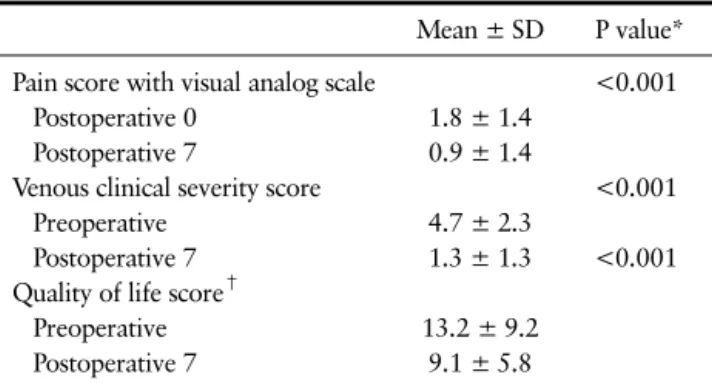
During the follow-up period, there was no patient with re- canalization of the treated saphenous vein. The occlusion rate was 100%. The clinical outcomes obtained immedi- ately after the procedure and at 7 and 90 days post- operatively were improved significantly. The pain score measured by a visual analog scale immediately after the procedure was 1.8 ± 1.4. Most patients experienced pain during the phlebectomy, but not during the CAC procedure. Clinical outcomes are summarized in Table 2.
The pain scores were improved to 0.9 ± 1.4 on post- operative day 7 (P < 0.001). The rVCSS was significantly improved 7 days after the procedure compared with pre- operative time (4.7 ± 2.3 vs 1.3 ± 1.3, P < 0.001). The pa- tient QoL score was improved from 13.2 ± 9.2 immediately after the procedure and to 9.1 ± 5.8 on postoperative day 7 (P < 0.001).
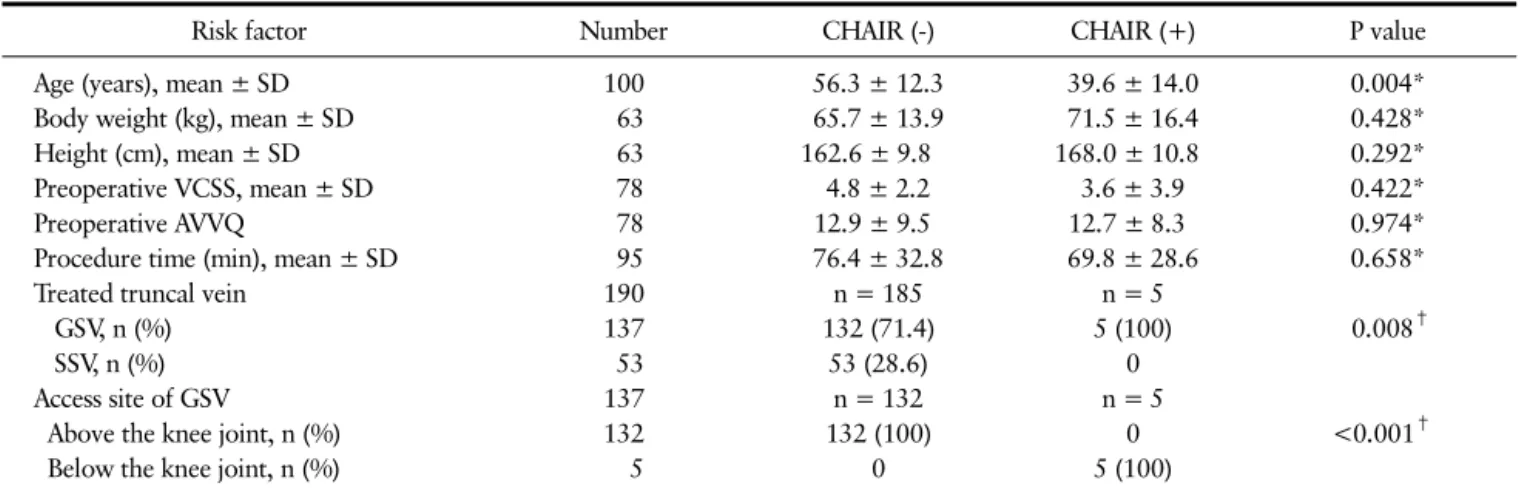
We compared the baseline demographics, treated vein, and procedure details of two groups with and without CHAIR (Table 3). The mean age of patients with CHAIR was significantly younger (56.3 ± 12.3 years vs 39.6 ± 14.0 years, P = 0.004). The other factors including body weight, height, preoperative VCSS and AVVQ were similar in two
Table 3. Risk Factor of the Complex Hypersensitivity and Irritation Reaction (CHAIR)
Risk factor Number CHAIR (-) CHAIR (+) P value
Age (years), mean ± SD 100 56.3 ± 12.3 39.6 ± 14.0 0.004*
Body weight (kg), mean ± SD 63 65.7 ± 13.9 71.5 ± 16.4 0.428*
Height (cm), mean ± SD 63 162.6 ± 9.8 168.0 ± 10.8 0.292*
Preoperative VCSS, mean ± SD 78 4.8 ± 2.2 3.6 ± 3.9 0.422*
Preoperative AVVQ 78 12.9 ± 9.5 12.7 ± 8.3 0.974*
Procedure time (min), mean ± SD 95 76.4 ± 32.8 69.8 ± 28.6 0.658*
Treated truncal vein 190 n = 185 n = 5
GSV, n (%) 137 132 (71.4) 5 (100) 0.008†
SSV, n (%) 53 53 (28.6) 0
Access site of GSV 137 n = 132 n = 5
Above the knee joint, n (%) 132 132 (100) 0 <0.001†
Below the knee joint, n (%) 5 0 5 (100)
*Statistical analysis was performed by the independent t-test. †Statistical analysis was performed by the Fisher’s exact test.
SD = Standard deviation, VCSS = Venous clinical severity score, AVVQ = Quality of life score with Aberdeen Varicose Vein Questionnaire, GSV = Great saphenous vein, SSV = Small saphenous vein.
groups. In addition, the procedure times of two groups were similar. There was no patient with CHAIR after treat- ment of SSV. The CHAIR was developed after treatment of GSV in all cases. The access site for the introduction of glue was below the knee joint level in all CHAIR cases.
DISCUSSION
This study showed that CAC is a safe and effective mo- dality for treatment of incompetent saphenous veins.
There were no technical failures. The occlusion of treated saphenous vein was achieved in all patients during the fol- low-up period. All clinical parameters such as pain score, the VCSS, and the AVVQ were significantly improved. The incidence of EGIT was 9 saphenous veins (9/190, 4.7%) in 9 patients (9%). The incidence of CHAIR, which was the most troublesome complication after CAC procedure, was 5%.
The occlusion rate after CAC procedure was superior compared with RFA or EVLA.(8) Although limited, the 2-year CAC data are superior. There is negligible difference between RFA and EVLA plots from 6 months onward. Partial and complete recanalization rates were lowest in CAC group throughout the period of follow-up. However, the optimal definition for occlusion has not been reported. If
the occlusion was defined as the stump length of <50 mm measured after procedure, the occlusion rate was 90.5% on the postoperative day 7. At the 3- and 6-month post- operative follow-ups, 90.5% and 91.2% of patients had a stump length of <50 mm, respectively.(9)
Thrombus extension into the deep vein, so called endo- venous glue-induced thrombosis (EGIT), may be another worrisome complication of CAC procedure. The incidence of EGIT has been reported from 0% to 21.1%.(5,10,11) The risk factor for the development of EGIT was the smaller di- ameter of the saphenous vein.(9) The diameter of GSV in the EGIT (+) group was significantly smaller than that measured for the EGIT (-) group. Also, the peak reflux ve- locity of the saphenous vein in the EGIT (+) group was sig- nificantly lower than that of the EGIT (-) group.
Multivariate analysis was performed on the various possi- ble risk factors resulting in EGIT. A saphenous vein diame- ter of <5 mm was the only significant risk factor.
The clear mechanism of CHAIR has not been released.
Tang and Tiwari (12) reported that abnormal cutaneous er- ythema was an adverse event thought to be a delayed hy- persensitivity reaction to cyanoacrylate. Although it looked like phlebitis, it was generally more widespread, occurring 7-14 days post-procedure with predilection in the great sa- phenous vein location and in females. The course was
self-limiting. Korkmaz et al.(13) explained that this re- action occurred with local inflammation after injecting the cyanoacrylate glue. Inflammation is activated when an or- ganism is triggered by stimulants. An acute inflammatory reaction is characterized by neutrophil predominance in the region of the event.(14) No statistically significant changes were detected between pre- and postoperative counts of either WBC or neutrophils in our study.(13) Therefore, acute inflammation in the endovenous admin- istration of cyanoacrylate was therefore most likely lo- calized in the vein wall and surrounding tissues. Jones et al.(7) reported a severe case with this complication. On postoperative 13 days, the patient complained of leg pain and redness. This was thought to be either phlebitis or an allergic reaction. On postoperative 17 days, she com- plained of progressive leg pain, chills, and erythema over the medial thigh as a systemic symptom. Histopathologic evaluation of the removed tissue showed intraluminal for- eign material and evidence of mononuclear cell inflammation. There was dense chronic inflammation that was localized to the luminal aspect of the vessel. Trichrome elastin and periodic acid-Schiff stains showed the absence of transmural inflammation, specifically with absence of destructive changes toward the periphery of the vessel.
Immunohistochemical stain showed that a majority of the mononuclear cells were T lymphocytes, and most of these were of the T4 subset. They concluded that it was the per- sistent type IV hypersensitivity. However, this complication did not show the recurrence after initial development.
Theoretically, hypersensitivity reaction can be developed any time unless the causative organism or foreign body re- moved from the body.
Typical features of this complication show abnormal skin finding such as erythema, itching, pain, edema, and tenderness over the treated vein area and/or systemic symptom such as fever, chills, generalized hives. Park et al.(15) mentioned that this reaction was a phlebitis-like ab- normal reaction. Gibson et al.(16) analyzed the frequency and severity of this complication. They suggested the hy- persensitivity reaction for this complication. Navarro-
Triviño et al.(2) explained that this complication occurred due to the allergic contact dermatitis. In conclusion, this complication might be developed with contact or irritation of vein after injecting the cyanoacrylate glue. In some pa- tient, hypersensitivity reaction with/without systemic symptoms is developed. Therefore, CHAIR can be the most reasonable terminology.
The risk factors for this complication have been re- ported variably. Tang and Tiwari (12) mentioned that the great saphenous vein location and female gender as risk factor according to their experience. Our study showed that the significant risk factors were younger age, GSV treatment, and below-the-knee access site for the in- troduction of catheter. However, Gibson et al.(16) reported that no predictive patient or procedural factors were found to be associated with this complication.
There are several limitations of this study. The results are derived from a small number of patients. All data were col- lected retrospectively. The laboratory tests including WBC, neutrophil or eosinophil counts as the risk factor analysis were not included in this study.
In conclusion, CAC procedure was an effective and safe modality to treat the saphenous vein insufficiency. The in- cidence of CHAIR was 5%. The CHAIR occurred when the adhesive was injected at the below-the-knee GSV segment.
The mechanical irritation due to knee joint movement might be the possible mechanism for the development of hypersensitivity reaction.
REFERENCES
1. Almeida JI, Javier JJ, Mackay EG, Bautista C, Cher DJ, Proebstle TM. Thirty-sixth-month follow-up of first-in-human use of cyanoacrylate adhesive for treatment of saphenous vein incompetence. J Vasc Surg Venous Lymphat Disord 2017;5:
658-66.
2. Navarro-Triviño FJ, Cuenca-Manteca J, Ruiz-Villaverde R.
Allergic contact dermatitis with systemic symptoms caused by VenaSeal. Contact Dermatitis 2020;82:185-7.
3. Lurie F, Creton D, Eklof B, Kabnick LS, Kistner RL, Pichot O, et al. Prospective randomised study of endovenous radio- frequency obliteration (closure) versus ligation and vein strip- ping (EVOLVeS): two-year follow-up. Eur J Vasc Endovasc Surg
2005;29:67-73.
4. Darwood RJ, Theivacumar N, Dellagrammaticas D, Mavor AI, Gough MJ. Randomized clinical trial comparing endovenous laser ablation with surgery for the treatment of primary great saphenous varicose veins. Br J Surg 2008;95:294-301.
5. Almeida JI, Javier JJ, Mackay E, Bautista C, Proebstle TM. First human use of cyanoacrylate adhesive for treatment of saphe- nous vein incompetence. J Vasc Surg Venous Lymphat Disord 2013;1:174-80.
6. Morrison N, Gibson K, Vasquez M, Weiss R, Jones A. Five-year extension study of patients from a randomized clinical trial (VeClose) comparing cyanoacrylate closure versus radio- frequency ablation for the treatment of incompetent great sa- phenous veins. J Vasc Surg Venous Lymphat Disord 2020;8:
978-89.
7. Jones AD, Boyle EM, Woltjer R, Jundt JP, Williams AN.
Persistent type IV hypersensitivity after cyanoacrylate closure of the great saphenous vein. J Vasc Surg Cases Innov Tech 2019;5:372-4.
8. Dimech AP, Cassar K. Efficacy of cyanoacrylate glue ablation of primary truncal varicose veins compared to ex- istingendovenous techniques: a systematic review of the literature. Surg J (N Y) 2020;6:e77-86.
9. Cho S, Gibson K, Lee SH, Kim SY, Joh JH. Incidence, classi- fication, and risk factors of endovenousglue-induced throm- bosis after cyanoacrylate closure of the incompetent saphe- nous vein. J Vasc Surg Venous Lymphat Disord 2020;8:991-8.
10. Proebstle TM, Alm J, Dimitri S, Rasmussen L, Whiteley M, Lawson J, et al. The European multicenter cohort study on cy- anoacrylate embolization of refluxing great saphenous veins. J Vasc Surg Venous Lymphat Disord 2015;3:2-7.
11. Morrison N, Gibson K, McEnroe S, Goldman M, King T, Weiss R, et al. Randomized trial comparing cyanoacrylate emboliza- tion and radiofrequency ablation for incompetent great sa- phenous veins (VeClose). J Vasc Surg 2015;61:985-94.
12. Tang TY, Tiwari A. The VenaSealTM abnormal red skin re- action: looks like but is not phlebitis! Eur J Vasc Endovasc Surg 2018;55:841.
13. Korkmaz Ö, Göksel S, Gül M, Başçil H, Yildir Y, Berkan Ö. Does the use of N-butyl-2 cyanoacrylate in the treatment of lower extremity superficial varicose veins cause acute systemic in- flammation and allergic reactions? Cardiovasc J Afr 2018;29:
213-7.
14. Anderson JM, Rodriguez A, Chang DT. Foreign body reaction to biomaterials. Semin Immunol 2008;20:86-100.
15. Park I, Jeong MH, Park CJ, Park WI, Park DW, Joh JH. Clinical features and management of “phlebitis-like abnormal re- action” after cyanoacrylate closure for the treatment of in- competent saphenous veins. Ann Vasc Surg 2019;55:239-45.
16. Gibson K, Minjarez R, Rinehardt E, Ferris B. Frequency and severity of hypersensitivity reactions in patients after VenaSealTM cyanoacrylate treatment of superficial venous insufficiency. Phlebology 2020;35:337-44.