Holocene Environmental Change and Human Impact in Hoya San Nicolas, Guanajuato, Mexico
Jungjae Park*
멕시코 과나하토주의 호야산 니콜라스 지역에서 있었던 홀로세 환경변화와 인간의 영향
박정재*
Abstract:This paper presents a paleoenvironmental study on Hoya San Nicolas, a maar lake in Valle de Santiago in Central Mexican Bajio. Maar lake sediments have been widely used for high-resolution reconstruction of paleoenvironment. Many different paleoenvironmental proxy data such as stable isotopes, pollen, and sediment chemistry were produced in this study. These data help to reveal paleoenviromental changes throughout the whole period covered by sediment materials from this study site. The evidence indicates that during ca. 11,000 - ca. 8,900 cal yr B.P. there was dry climate; during ca. 8,900 - ca. 7,000 cal yr B.P. it was wetter; during ca. 7,000 - ca. 4,000 cal yr B.P. drier; during ca. 4,000 cal yr B.P - the present wetter. Prominent dominance of Pinus pollen during ca. 11,000 - ca.
8,900 cal yr B.P. and during ca. 7,000 - ca. 4,000 cal yr B.P. may reflect very low lake levels resulting in poor preservation of pollen. Pinus pollen, the most resistant pollen type, may have been able to survive severe deterioration due to arid climate, but other pollen types may not. Due to likely droughts in these periods, a sedimentation gaps are probably present in the core.
Key Words : Highland Central Mexico, Holocene environmental change, human impact, pollen analysis, sediment chemistry, stable isotope
요약:본 연구에서는 중부 멕시코 바히오 지방에 위치한 바예 데 산티아고 시의 마르 호수 중 하나인 호야 산 니콜라스에서 채취한 시료를 분석하여 고환경을 복원하였다. 마르 호수 퇴적물은 고해상의 고환경 복원이 가능하기 때문에 널리 이용되고 있다. 연구방법 으로 화분, 동위원소, 지화학적 분석 등을 시도하였다. 분석결과를 보면, 11,000년 전에서 8,900년 전까지 기후는 건조하였고, 8,900 년 전부터 7,000 년 전까지는 습했으며, 7,000년 전부터 4,000 년 전까지 건조하였고, 4,000년 전부터 현재까지는 다시 습했다. 두 건조한 기간(ca. 11,000 - ca. 8,900 cal yr B.P., ca. 7,000 - ca. 4,000 cal yr B.P.)에 소나무 화분이 비율이 아주 높게 나온다. 이는 건 조한 기후로 호수가 마르면서 전체적으로 화분이 파괴되었음을 의미한다. 다시 말하면, 가장 단단한 화분중의 하나인 소나무 화분은 건조한 상태에서 다른 화분보다 상대적으로 잘 버티므로 소나무 화분의 높은 비율은 기후가 건조했음을 뜻한다고 볼 수 있다. 두 건 조 시기에는 호숫물이 말라 퇴적이 중단된 기간이 있었을 것으로 사료된다.
주요어 : 중부 고위 멕시코, 홀로신 환경 변화, 인간의 영향, 화분 분석, 지화학적 분석, 동위원소
* Research fellow, Institute for Korean Regional Studies, Seoul National University, San 56-1, Shinlim-Dong, Kwanak-Gu, Seoul, [email protected]
1. Introduction
Palaeoenvironmental work in highland Central Mexico began in the 1940s (Deevy, 1944). Since then a number of studies have produced plenty of paleoenvironmental data, which however are typically difficult to interpret for several reasons.
Most paleoenvironmental research in highland Central Mexico has been carried out in major cultural centers such as the Valley of Mexico and the Patzcuaro basin where serious human disturbance after 3500 B.P. obscures the evidence of climate change (Watts and Bradbury, 1982;
Metcalfe et al., 1991; Lozano García et al., 1993;
Lozano García and Ortega Guerrero, 1994, 1998;
Caballero and Ortega Guerrero, 1998). More reliable chronology is needed on a number of studies (Brown, 1984; Straka and Ohngemach, 1989). Many complacent pollen diagrams with the dominance of pine and oak hamper a detailed reconstruction of vegetation change (Lozano García and Xelhauntzi Lopez, 1997).
Due to these barriers, the results are difficult to bring together to make a comprehensible story as to the nature of Holocene climate change in highland Central Mexico. It is necessary to perform multidisciplinary research in order to obtain more precise information, which helps distinguish climatic change from other environmental changes. For an understanding of regional climate change, paleoenvironmental data should be produced from as many different sites throughout highland Central Mexico as possible.
This paper presents a paleoenvironmental study on Hoya San Nicolas, a maar lake in Valle de Santiago in Central Mexican Bajio (Figure 1).
Maar lake sediments have been widely used for high-resolution reconstruction of paleoenvironment.
The Valle de Santiago area is currently on the northern limit of agriculture without irrigation.
This area might have been occupied and abandoned in association with the level of precipitation. The proxy data from this area could indicate human disturbance which is more or less related to a climate. We could possibly test Armillas’hypothesis that the northern frontier of Mesoamerica was shifted southward due to drought at the end of the Classic (Armillas, 1969).
In 1979, Brown recovered a 5.85 m core from Hoya San Nicolas and produced a pollen diagram (1984). His diagram has since been often mentioned as a critical paleoecological record from central Mexico (Brown, 1985; Metcalfe et al., 1989, 1994, 2000). The results of his study have influenced many archaeologists interested in Holocene climate change and agricultural impact in the area. However, the only available data on this area is provided by Brown’s work.
We assume that Hoya San Nicolas has been shallow enough to be sensitive to even subtle climate changes in the area. Having more detailed data on Hoya San Nicolas are helpful towards obtaining a clearer understanding of the paleoenvironment in this area and Central Mexico as well.
One valuable way to reconstruct paleoen- vironment is through coupled palynological studies and chemical analyses of lake sediment since the results from these two should produce independent data. This approach could be powerful in separating climatic from anthropogenic signals. In particular, the highland in Central Mexico has been severely disturbed by human activities. It is not likely that pollen records from the area show clear trends of climate change; however, stable isotope analyses
could suffice. We produce a new pollen diagram from Hoya San Nicolas with more levels and more pollen counted per level than Brown (1984). Also, this paper provides other proxy data such as data collected from the study of stable isotopes and XRF analyses as well as pollen record to reconstruct paleoenvironment of Central Mexico.
2. Study Area and Site Description
The Mexican Volcanic Belt (MVB) is an East- West trending continental magnetic region, which stretches across Mexico between latitiude 19°and 21°N. It has been developed by the subduction of the Cocos/Rivera plate system. It is about 1,000 km long and 20 to 200 km wide (Negendank et al., 1985). The MVB consists of several zones that have specific morphology, structure, or chemical characteristics (Pasquaré et al., 1987). There are thousand of volcanic vents within the belt. In particular, maar lakes are scattered in Altiplano area in the eastern part of the MVB (Negendank et al., 1985) and
Michoacán-Guanajuato Volcanic Field in the north-central MVB (Ordoñez, 1906).
The maars of the Valle de Santiago are located in the Michoacán-Guanajuato Volcanic field, 100 km SW of Queretaro. There are at least 7 maars in the area. Two of the maars hold water while the others have already desiccated. The water table in Hoya Rincon de Parangueo and La Alberca began to drop about 50 years ago. Since lake level is now 20 m lower, it is easy to gain access to sediments on the lake floor. Hoya San Nicolas has recently dried out though shallow water is seen in the central part of this mar during the wet season.
The Lateglacial of Central Mexico was previously cool and dry. In the early Holocene, the climate may have become relatively warmer and wetter. Many records indicates a dry period sometime between 5000 and 6000 B.P and a number of dry intervals during the last 3000 years (Metcalfe, 2000). The present climate of the area is strongly seasonal in terms of precipitation.
Eighty percent of precipitation falls between May and October when the Bermuda high shifts northward and Easterlies blow across the Mexican plateau. Mean annual precipitation in the area is 650 mm, with a precipitation gradient 800-500 mm from south to north. Mean annual temperature in the area is fairly constant, averaging 19℃ and ranging from 14℃ in January to 23℃ in May (Mosiño Alemán and García, 1974).
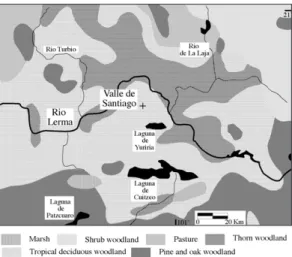
The dominant types of vegetation in the area before the introduction of modern agriculture were bosque tropical cadudifolio (tropical deciduous forest) and matorral subtropical (subtropical scrub forest) (Aguilera Gómez, 1991) (Figure 2). Bosque tropical caductifolio is mainly composed of members of the Burseraceae and Figure 1. Map of the study area.
Fabaceae. On the other hand, matorral subtropical generally includes Ipomoea murucoides, Acacia pennatula Acacia farnesiana, Opuntia spp., Lysiloma microphylla and Eysenhardtia polystachya. Currently, valley floors are occupied by various crops including wheat, broccoli, watermelon, and corn. Though some of natural woodlands could survive on the slopes of the volcanic craters, locals use even these for firewood, livestock grazing, wild fruit, and medicinal plants (Aguilera Gómez, 1991).
Hoya San Nicolas (20°23、N, 101°17、W) is one of seven major late Pleistocene volcanic craters in Valle de Santiago, Guanajuato (Figure 1). Hoya San Nicolas was desiccated around 1979 (Brown, 1984). The desiccated lake floor is located at
about 1700 m and the drainage basin embraces 2.4 km2(Metcafe et al. 1989). There is no outlet for the lake. Groundwater overexploitation induced by increasing agriculture and overgrazing has made the lake floor dried out.
3. Methods
In 2001 we recovered three 5m + long cores at Hoya San Nicolás with a 6 m long, 6.5 cm diameter PVC tube and a piston attached to a steel cable. The tube was fitted with a steel head and pushed into the sediments by sledge hammering from a 6 m high scaffold. Cores were raised with a block and tackle and returned to the Department of Geophysics at UNAM (Juriguilla). Subsequently the cores were split, one half archived and the other half used for analysis.
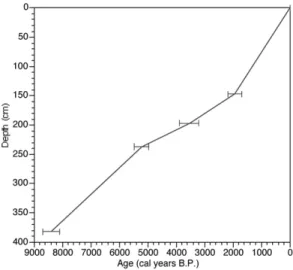
The chronology was established based on four AMS radiocarbon dates for Hoya San Nicolás core (Table 1). These dates are on charcoal picked from the 125㎛ sieved fragments.
Calibrated ages were selected using a median of 2 sigma range calculated with the CALIB 4.4 program written by Stuiver et al. (1998).
For pollen analysis, samples were taken at 5 - 10 cm intervals. Pollen was extracted using standard palynological procedures as described
Table 1. Radiocarbon Dates from Hoya San Nicolás
Core Depth Material Laboratory Age Two σage Median
(m) dated numbera (14C yr B.P.) range(cal yr B.P.)a (cal yr B.P.)a
SNP-5 1.475 charcoal CAMS-102239 2000 +/- 110 1706-2306 1965
SNP-5 1.975 charcoal CAMS-102240 3280 +/- 140 3164-3877 3523
SNP-5 2.375 charcoal CAMS-102241 4560 +/- 100 4882-5575 5210
SNP-5 3.82 charcoal OS-46420 7390 +/- 75 8036-8361 8219
aAll dates were calibrated with the intcal98.14c data set(Stuiver et al,.1998) Figure 2. Vegetation map of study area
by Faegri and Iverson (1989). Two tablets of Lycopodium spores were added to each sample to calculate pollen concentration (Stockmarr, 1971). The samples were mounted on microscope slides with silicone oil. Pollen counts were made on a Leitzmicroscope with a 40x Planapochromat objective and a total magnification of 400x. Pollen identification was aided by the U.C. Berkeley Department of Geography reference collection and published keys. A minimum of 378 pollen and spores were counted at 56 levels. Below 4.35 m, on additional 7 levels, pollen counting was stopped when 100 Lycopodium spores were encountered due to extremely low pollen concentration. Poaceae pollen with a long axis greater than 60 ㎛ and regularly spaced columellae were identified as Zea mays (Whitehead and Langham, 1965; Irwin and Barghoorn, 1965). Pollen concentrations and influx were calculated with the ratios of Lycopodium spores and radiocarbon dates.
Pollen diagrams were produced using Calpalyn computer program.
For isotope analysis, we took samples at 5 cm intervals throughout a whole core. Samples containing about 10 to 100 microgram calcite or aragonite were used for both carbon and oxygen isotope analyses, which were determined using a GV IsoPrime mass spectrometer with Dual-Inlet and MultiCarb systems. Several replicates of two international standards NBS18 and NBS19, and one lab standard HKC-I were measured along with samples for each run. The overall external analytical precision is ± 0.04‰ (internal precision: ±0.004‰) for 13C and ±0.07‰
(internal precision: ±0.007‰) for 18O.
Loss on ignition analyses were carried out to determine sediment composition as follows: oven drying at 100℃ for 24 hours for water content,
heating at 550℃ for 1 hour for organic content.
Residue of sediment samples was then analyzed with a Philips PW 2400 X-Ray Florescence scanner (XRF) to determine chemical composition.
4. Results
1) Stratigraphy and chronology
The visual lithology of the San Nicolás core shows little variation. The sediments are mostly fine silt and clay. In the basal section, 520 cm to 417 cm, the sediments were alternately dark grey and blue in color prior to exposure after which they changed to olive (5Y 5/3). From 417 cm to 220 cm the oxidized sediments are olive green in color (5Y 3/2). Between 220 cm to 190 cm there are lenses of coarse sand and small pebbles or concretions. The upper part of the core is again mostly fine silt and dark grayish brown in color (2.5Y 3/2), with a narrow laminated section between 165 and 155 cm. Four tephras have so
Figure 3. Hoya San Nicolas age-depth profile
far been identified and others are likely present.
Four radiocarbon dates were obtained from concentrated charcoal samples to avoid problems related to old carbon effect. The age model for the San Nicolás core was developed with linear interpolations between dates and an extrapolation to the base of the core. The age depth curve suggests there may be a hiatus between the 200 cm and 230 cm in depth (Figure 3).
2) Pollen and LOI
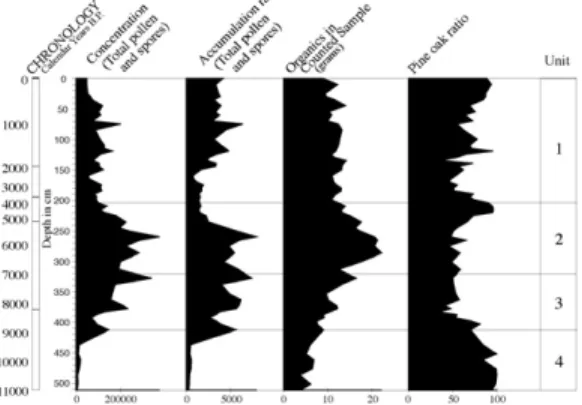
Four units are recognized mainly based on stratigraphic changes in pollen composition (Figure 4, 5) and isotopic ratios. The pollen diagram was plotted using percentages of Arboreal pollen sum. Unit 4 (515-415 cm, ca.
11,000 - ca. 8,900 cal. yr B.P., Pleistocene- Holocene transition) is characterized by an extremely poor preservation of pollen. In this unit, pollen percentages are not statistically reliable because pollen concentration values were so low that we could not count enough number of pollen. Pinus pollen is remarkably important. Pine-oak ratio is very high. Pollen concentration value and accumulation rate both are severely low. Organic concentration increases toward the top of the unit.
Unit 3 (415-320 cm, ca. 8,900 - ca. 7,000 cal yr B.P., early Holocene) is marked by the first appearance of Zea mays. Poaceae and Cyperaceae pollen both are important, averaging
> 50% of the arboreal pollen sum.
Amaranthaceae and high spine Asteraceae pollen have small peaks. Pinus pollen percentage first decreases to < 3% and rebounds in the upper part of the unit while Quercus percentage increases to > 40%. Pollen accumulation rate
abruptly increases at the 4/3 boundary as does pollen concentration. Organic content continues to rise.
In the Unit 2 (320-205cm, ca. 7,000 - ca. 4,000 cal yr B.P., middle Holocene), Pinus and Quercus pollen both are relatively important, both averaging about 40% of the arboreal pollen sum. Pinus pollen frequencies start to increase from around 250 cm and attain > 80% at the 2/1 boundary; on the conatrary, Quercus pollen shows a steep drop in the uppermost part. Alnus and Poaceae pollen are less important as compared to Unit 3. Cyperaceae pollen percentage decreases toward the top, thereby
Figure 4. Hoya San Nicolas pollen diagram
Figure 5. Hoya San Nicolas pollen concentration, pollen accumulation rate, organic matter, and pine oak ratio
being very low at the 2/1 bondary. Zea mays is absent for the lower 2/3 of the unit and reappears at 250 cm. Pine-Oak ratio rises to > 80
% in the top part. Pollen accumulation rate continues to rise but drops sharply around 250 cm. Organic concentration gains its highest values (> 20% dry weight) around 260 cm and begins to decline from there.
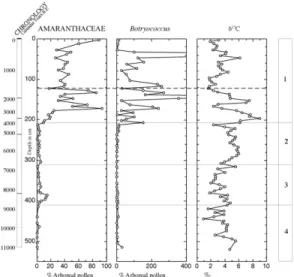
Unit 1 (205-0 cm, ca. 4,000 cal yr B.P. - the present, late Holocene) is characterized by spikes of Cyperaceae and Amaranthaceae. Cyperaceae percentage amazingly rises from 5% to 190% at the base of the unit although it drops back to about 30% immediately. Amaranthaceae pollen which gradually increases at the beginning, dramatically rises up to > 80% around 170 cm.
After keeping its high values with several peaks, Amaranthaceae rapidly declines to < 40% around 130 cm. Pinus pollen drastically decreases in the basal part while Quercus pollen increases to >
40%. After that, Pinus pollen increases progressively toward the surface whereas Quercus pollen decreases. High and low spine Asteraceae and Zea mays pollen become more important in comparison with Unit 2. The biggest Zea mays pollen (> 83㎛) is found. Pine-Oak ratio that severely decreases in the basal part starts to increase from around 170 cm. Low values in pollen accumulation are prevalent in the lower part of the unit while a steady increase in pollen accumulation is found in the upper part. Organic concentration levels are > % dry weight throughout the unit without any significant change. Additionally, frequencies of Botryococcus are very high in a lower half.
3) Stable isotopes, chemical analysis(XRF), and magnetic susceptibility
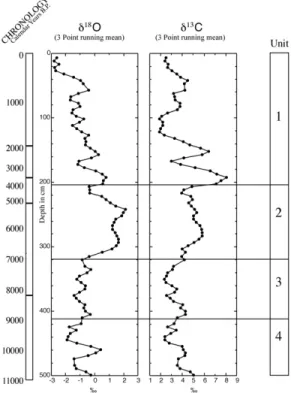
The isotopic data (3-point running mean) are displayed in Figure 6. Downcore changes in δ18O and δ13C values are basically coherent. The results of chemical analyses(XRF) and magnetic susceptibility are shown in Figure 7. Generally, SiO2occupies a large portion as 40-60% except a basal section (515-415cm). Na2O concentration is also relatively high showing an inverse trend to SiO2. For the description of these data, we use the same units as the pollen records.
In the unit 4 (515-415 cm), Na2O and SO3concentrations show three conspicuous spikes. Al2O3, Fe2O3, and TiO2 values decrease toward the top of the unit. SiO2is relatively low because it is affected by the amount of Na2O.
Na2O and SO3 decrease drastically at the 4/3 boundary; on the contrary, SiO2 rapidly increases. δ18O and δ13C values are much variable in unit 4. Magnetic susceptibility values
Figure 6. Hoya San Nicolas isotopic data
are very low throughout the unit.
In the unit 3 (415-320 cm), Na2O and SO3
maintain their low values while Al2O3, Fe2O3, and TiO2 continue to decrease. δ18O and δ13C values do not demonstrate any significant changes.
Magnetic susceptibility values slightly increase but are still low.
The unit 2 (320-205 cm) is marked by high values of δ18O. δ18O shows a marked increase at the bottom and keeps its high values up to the top. Then, δ18O value declines sharply at the 2/1 boundary. δ13C shows relatively similar patterns.
It shows a continuous increase up to 6 ‰ in the lower half and an abrupt decrease at the top.
Na2O and Cl concentrations gradually increase attaining high values around 240 cm and it declines sharply after that. Al2O3 and Fe2O3
concentrations both reach their lowest values(2-4
%) around 310 cm. SO3 concentration is also very low. Magnetic susceptibility values do not change much from the previous unit.
The unit 1 (205-0 cm) is characterized by high percentages of Al2O3, Fe2O and TiO2. Al2O3and Fe2O values dramatically rise at 170 cm and slightly increase afterwards. CaO concentration displays a prominent peak around 190 cm. SO3
has relatively high values in the lower half. Na2O and Cl concentrations sharply increase in the
basal part but it immediately drops and gradually declines toward the top. δ18O value progressively declines throughout the unit whereas δ13C demonstrates a couple of noticeable peaks in a lower half. Unlike previous units, δ18O and δ13C do not show a clear correlation. Magnetic susceptibility values steadily rise up toward the top.
5. Discussion
The majority of the pollen records from Central Mexico are very difficult to interpret since percentages of important taxa such as Pinus and Quercus do not change significantly (Lozano- García and Xwlhuantzi-Lopez, 1997). Pollen records from Hoya San Nicolás however show interesting alterations of dominant taxa. As its low lake levels has obviously been susceptible to even subtle climate changes throughout Holocene, environmental shifts should be well recorded in the sediment core. Brown already tried to interpret this conspicuous change of pollen composition in his diagram and made plausible suggestions (1984). Our pollen records likewise display a marked fluctuation of pine and oak percentages, indicating that our study materials are somewhat sensitive to climate change. Other proxy data such as stable isotopes and sediment chemistry also show that important climate changes took place in this area throughout Holocene.
Unit 4 (515-415 cm, ca.11,000 - ca. 8,900 cal.
yr B.P., Pleistocene-Holocene transition) In this unit, dry climates are indicated by extremely low number of total pollen and high percentage of Pinus pollen. Pinus pollen, the most resistant pollen type to destruction, may have been able Figure 7. Hoya San Nicolas sediment chemistry
(results of XRF analyses) and magnetic susceptibility
to survive severe deterioration resulting from arid climate, but other pollen types may not. Indeed, Hall and Valastro (1995) reported that increases in importance of conifer pollen could result from postdepositional destruction of nonconifer pollen. Low magnetic susceptibility values may reflect little soil erosion in the lake catchment under dry conditions. Also, dry conditions are suggested by high Na2O and SO3 concentration and relatively high isotopic ratios.
Unit 3 (415-320 cm, ca. 8,900 - ca. 7,000 cal yr B.P., early Holocene) The abrupt increase in pollen accumulation rate reflects that this period was more humid than the previous. Wetter conditions are also indicated by low Na2O and SO3concentration, low values of stable isotopes, and high percentages of Alnus pollen. Raised values of magnetic susceptibility may have resulted from more soil erosion under wetter conditions. Metcalfe et al. (2000) summarized the central Mexican paleoenvironmnetal records and suggested that in the early Holocene, conditions seem to have become warmer and wetter. A large Poaceae pollen (58 ㎛) is found at 385 cm, implying that wild relatives of Zea mays, possibly teosinte, may have grown in this area at the time.
We scanned this particular level several times to confirm and could find more grass pollen with that size. Not only large grass pollen is found but also Poaceae, Amaranthaceae, and Asteraceae pollen all increase during this period. There could be two possible causes for this interesting event: human agricultural activities and climate change. Agricultural activities hypothesis does not seem to fit in other previously reported evidence that suggests much later beginning of corn domestication. It is however possible that that corn cultivation started this early and this finding can be a good topic for future research.
Indeed, this is supported by increased percentages of Amaranthaceae and Asteraceae, which are weedy plants growing in the area disturbed by agricultural activities. Natural climate changes also could be the cause of shifts in pollen composition. Apparently, the climate during this period is characterized by a wetter condition and higher seasonality than late Pleistocene. Changes in climate possibly may have given rise to the increase of herb species.
Unit 2 (320-205 cm, ca. 7,000 - ca. 4,000 cal yr B.P., middle Holocene) Dry climate is suggested by high values of stable isotopes, especially δ18O and high Na2O and Cl concentrations. Low Al2O3 and Fe2O3
concentrations and low values of magnetic susceptibility all indicate that significant erosions did not occur since dry conditions prevailed at the time. Arnauld et al. (1997) suggested that Zacapu lake in Michoacán reached the lowest water level 6,000 through 4,000 B.P.
Paleolimnological records from Central Mexico indicate low lake levels approximately between 4,400 - 6,100 cal yr B.P (Fritz et al., 2001). Also, Metcalfe et al. (2000) pointed out that a large number of data from central Mexico indicate a dry period sometime between 5000 - 6000 yr B.P.
In the uppermost part of this unit, a remarkably high Pinus pollen percentage and low total pollen accumulation rates reflect a severe dry phase. Like the unit 4, this prominent dominance of Pinus pollen may reflect very low lake levels resulting in poor preservation of pollen.
Percentages of most other pollen taxa decline drastically. Especially, Quercus pollen almost disappears in the pollen record. Such a difference between the frequencies of Pinus and Quercus pollen is an implication of differential deterioration. Due to likely droughts in this
period, a sedimentation gap is probably present in the core. Based on our chronology and sedimentation rates, we assume that sedimentation hiatus may have happened sometime between 4000-5000 cal yr B.P. Large grass pollen attributable to Zea mays (>60 ㎛) is first found around 252 cm (about ca. 5,500 cal yr B.P.), but this finding may not imply the beginning of maize agriculture since this period does not demonstrate evidence of human impacts.
Unit 1 (205-0 cm, ca. 4,000 cal yr B.P. - the present, late Holocene) Cyperaceae pollen rises abruptly right after the plummet of Pinus pollen, indicating that climate became more favourable enough to bring aquatic plants in the lake after a dry phase in the previous unit. But as lake levels continuously rose up, the number of aquatic plants in the crater may have dramatically decreased in a short time as indicated in pollen records. Progressively declining δ18O values imply that wet conditions became prevalent in
this period. After 3,000 yr B.P., water levels rosed up in Chalco lake from Central Mexico(Lozano- García et al., 1993; Fritz et al., 2001). Arnauld et al. (1997) implied that the marsh in the Zacapu lake basin expanded again around 4,000 B.P.
Also, relatively high pollen accumulation rates in the upper 2/3 of the unit indicate that wet conditions were resumed in late Holocene.
Although it seems that wet conditions were widespread throughout this period, dry conditions have again prevailed in the area since ca. 1400 cal yr B.P according to paleoenv- ironmental data from Hoya Raincon de Parangueo (Park, 2005). This last dry phase is not indicated here though because the uppermost period was seriously affected by human impacts.
Our multiproxy data show that human impacts on the environment were remarkable since 4000 cal yr B.P and that the major occupation of the lake took place during the time of Chupicuaro culture (Figure 8). Human impacts during this time are clearly indicated here by 1) High percentages of Amaranthaceae (increased agricultural activities) 2) High percentages of Botryococcus(lake eutrification) and 3) High values of δ13C (high productivity in a lake). All these three proxy start to decrease around 1600 cal yr B.P. when Chupicuaro culture waned probably because of climate change.
Climate change reconstructed in this study seems to fit in other paleoenvironmental data produced from various sites in Central Mexico (Figure 9). Especially, climate shifts shown in this study correspond well to the change of Zacapu lake levels (Metcalfe, 1995). Indeed, most diagrams in Figure 9 exhibit relatively good correlations in terms of the timing of climate shifts except the top sections which were affected by human impacts.
Figure 8. Multiproxy data indicating human impacts on the environment during Chupicuaro culture
Conclusion
Our pollen record from Hoya San Nicolás is relatively sensitive to climate changes unlike other records produced from Central Mexico.
Other proxy data such as stable isotopes, sediment chemistry, and magnetic susceptibility also reveal important climate change in the research area throughout Holocene. In summary, based on paleolimnological evidence we obtained, our findings of climate change in the study area are:
1) In the Unit 4 (515-415 cm, ca. 1,1000 - ca.
8,900 cal. yr B.P., Pleistocene-Holocene transition), dry conditions are implied by extremely low number of total pollen and spores, high percentage of Pinus pollen, and high Na2O and SO3concentration.
2) In the unit 3 (415-320 cm, ca. 8,900 - ca.
7,000 cal yr B.P., early Holocene), the climate is characterized by wetter conditions and higher seasonality than the unit 4. Wetter conditions are indicated by low Na2O and SO3 concentration, low values of stable isotopes, increasing pollen accumulation rates and high percentages of Alnus pollen. Changes in climate may have
resulted in an increase of herb species.
3) In the unit 2 (320-205 cm, ca. 7,000 - ca.
4,000 cal yr B.P., middle Holocene), dry climates are suggested by high values of stable isotopes, especially δ18O and high Na2O and Cl conce- ntrations. Low Al2O3 and Fe2O3 concentrations and low values of magnetic susceptibility all indicate that significant erosions did not occur since dry conditions prevailed at the time.
4) In the unit 1 (205-0 cm, ca. 4,000 - ca. 0 cal yr B.P., late Holocene), progressively declining δ
18O values imply that wet conditions became prevalent in this period. Intensive agriculture began in the crater and that human disturbance on the environment was serious since 4000 cal yr B.P.
References
Aguilera Gómez, L.I., 1991, Estudio Floristico y Sinecologico de la Vegetacion en el crater “Hoya de Rincon de Parangueo”, Valle de Santiago, Gto., Unpublished Masters thesis, Colegio de Postgraduados, Montecillo, Mexico.
Arnauld, C., Metcalfe, S., and Petrequin, P., 1997, Holocene climatic change in the Zacapu lake basin, Michoacán: synthesis of results, Quarternary International, 43/44, 173-179.
Brown, R.B., 1984, The paleoecology of the northern frontier of Mexoamerica, Unpublished Ph.D.
Thesis, University of Arizona, Tucson.
Brown, R.B., 1985, A summary of late-Quaternary pollen records from Mexico west of the Isthmus of Tehuantepec, in Bryant, V.M. and Holloway, R.G.(eds.), Pollen Records of Late Quaternary North American Sediments, American Association of Stratigraphic Palynologists, 71-93.
Caballero, M., Ortega B., Valadez, F., Metcalfe, S., Luis Macias, J., and Sugiura, Y., 2002, Sta, Cruz Figure 9. The evidence of long term climate trends
from sites in Central Mexico: Hoya San Nicolas and Hoya Rincon de Parangueo (Park, 2005) and Patzcuaro, Zacapu, La Piscina de Yuriria, and Chignahuapan (Caballero et al. 2002)
Atizapan: a 22-ka lake level record and climatic implications for the late Holocene human occupation in the Upper Lerma Basin, Central Mexico, Palaeogeography, Palaeoclimatology, Palaeoecology, 186, 217-235.
Caballero, M. and Ortega Guerrero, B., 1998, Lake levels since about 40,000 years ago at lake Chalco, near Mexico city, Quaternary Research, 50, 69- 79.
Deevey, E.S., 1944, Pollen analysis and Mexican archaeology, an attempt to apply the method.
American Antiquity, 10, 135-149.
Faegri, K. and Iversen, J., 1989, Textbook of Pollen Analysis, Blackwell Scientific Publications, London.
Fritz, S., Metcalfe, S.E., and Dean, W., 2001, Holocene Climate Patterns in the Americans Inferred from Paleolimnological Records, in Markgraf, V.(ed.), Interhemispheric Climate Linkages, Academic Press, San Diego, 241-263.
Hall, S.A. and Valastro, S., 1995, Grassland vegetation in the southern Great-Plains during the Last Glaicial Maximum, Quaternary Research, 44, 237-245.
Irwin, H. and E.S. Barghoorn, 1965, Identification of the pollen of maize, teosinte and tripsacum by phase contrast microscopy, Botanical Museum Leaflets, 21, 37-47.
Lozano García, M.S. and Ortega Guerrero, B., 1994, Palynological and magnetic susceptibility records of Lake Chalco, central Mexico, Palaeogeography, Palaeoclimatology, Palaeo- ecology, 109, 177-191.
Lozano García, M.S. and Ortega Guerrero, B., 1998, Late Quaternary environmental changes of the central part of the Basin of Mexico; correlation between Texcoco and Chalco basins, Review of Palaeobotany and Palynology, 99, 77-93.
Lozano García, M.S., Ortega Guerrero, B., Caballero Miranda, M., and Urrutia Fucugauchi, J., 1993, Late Pleistocene and Holocene paleoenvironments of Chalco Lake, central
Mexico, Quaternary Research, 40, 332-342.
Lozano García, M.S. and Xelhauntzi Lopez, M.S., 1997, Late Quaternary environmental changes of the central part of the Basin of Mexico; correlation between Texcoco and Chalco Basins, Review of Palaeobotany and Palynology, 99, 77-93.
Metcalfe, S.E., 1995, Holocene environmental change in the Zacapu Basin, mexico: a diatom-record, The Holocene, 5, 196-208.
Metcalfe, S.E., O’Hara, S.L., Caballero, M., and Davies, S.J., 2000, Records of Late Pleistocene-Holocene climatic change in Mexico - a review, Quaternary Science Reviews, 19, 699-721.
Metcalfe, S.E., Street-Perrott, F.A., Brown, R.B., Hales, P.E., Perrott, R.A., and Steininger, F.M., 1989, Late Holocene human impact on lake basins in central Mexico, Geoarchaeology, 4, 119-141.
Metcalfe, S.E., Street-Perrott, F.A., O’Hara, S.L., Hales, and P.E. Perrott, R.A., 1994, The Palaeolimnological record of environmental change: Examples from the arid frontier of Mesoamerica, in Millington, A.C. and Pye, K.(eds.), Environmental Change in Drylands:
Biogeographical and Geomorphological Perspecitves, Wiley, New York, 131-145.
Metcalfe, S.E., Street-Perrott, F.A., Perrott, R.A., and Harkness, D.D., 1991, Palaeolimnology of the Upper Lerma Basin, Central Mexico: A record of climatic change and anthropogenic disturbance since 11,600 yr BP, Journal of Paleolimnology, 5, 197-218.
Mosiño Alemán, P.A. and García, E., 1974, The Climate of Mexico, in Bryson, R.A. and Hare, F.H.(eds.), Climate of North America, World Survey of Climatology, Vol 11, Elsevier, Amsterdam, 345- 390.
Negendank, J.F.W., Emmermann, R., Krawczyk, R., Mooser, F., Tobschall, H., and Werle, D., 1985, Geological and geochemical investigations on the eatern Trans-Mexicoan Volcanic Belt, Geofisica International, 24, 477-485.
Ordoñez, E., 1906, Los xalapazcos del Estado de Puebla,
segunda parte, Paragones del Instituto Geologico de Mexico, 1, 349-393.
Pasquaré, G., Vessoli, L., and Zanchi, A., 1987, Morphological and structural model of Mexican Volcanic Belt, Geofisica Internacionl, 26, 159- 176.
Park, J., 2005, Holocene environmental change and human impact in Hoya Rincon de Parangueo, Guanajuato, Mexico. The Korean Journal of Ecology(in press)
Stomarr, J., 1971, Tablets with spores used in absolute pollen analysis, Pollen et Spores, 13, 614-621.
Straka, H. and Ohngemach, D., 1989, Late Quaternary vegetation history of the Mexican highland, Plant Systematics and Evolution, 162, 115-132.
Watts, W.A. and Bradbury, J.P., 1982, Paleoecological studies at Lake Patzcuaro on the west-central Mexican plateau and at Chalco in the Basin of
Mexico, Quaternary Research, 17, 56-70.
Whitehead, D.R. and E.J. Langham, 1965, Measurement as a means of identifying fossil maize pollen, Bulletin of the Torrey Botanical Club, 92, 7-20.
Correspondence: Jungjae Park, Institute for Korean Regional Studies, Seoul National University, San 56-1, Shinim-Dong, Kwanak-Gu, Seoul, 151-742 Korea (e-mail: [email protected], Phone: 02- 880-6358)
교신:박정재, 151-742, 서울시 관악구 신림동 산 56-1, 서울대학교 국토문제연구소 (이메일: jungjae@
yahoo.com, 전화: 02-880-6358)
Received April 28, 2005 Accepted June 3, 2005