Introduction
Pain in the lateral calf is common and often diag- nosed by clinicians as L5 radiculopathy. If there is no evidence of L5 radiculopathy in evaluation of hypesthe- sia and paresthesia of the lateral calf, the cause of the pain tends to be regarded as a musculoskeletal problem rather than a nerve injury. The lateral sural cutane- ous nerve (LSCN) is one of the cutaneous branches of the peroneal nerve, which innervates the lateral calf.
It continues to travel and merge with the medial su- ral cutaneous nerve (MSCN) branching from the tibial nerve, forming the sural nerve.1 LSCN neuropathy is a rare neurological abnormality, and few reports have fo- cused on this condition. Therefore, it is not commonly evaluated. In addition, this nerve is so small that MRI or ultrasound evaluation is difficult. Therefore, an elec- trodiagnostic approach may be necessary to evaluate LSCN neuropathy. This facilitates accurate diagnosis and prevents inappropriate treatment.
Case Report
A 35-year-old man presented with sensory impair- ment of the right lateral calf that had developed sud- denly two months previously. There were no specific
ISSN 1229-6066 https://doi.org/10.18214/jkaem.2019.21.1.27 J Korean Assoc EMG Electrodiagn Med 21(1):27-31, 2019
J Korean Assoc
Electrodiagn MedEMG
Copyright © by Korean Association of EMG Electrodiagnostic Medicine
This is an Open Ac cess article distributed under the terms of the Creative Commons Attribution Non-Commercial License (http://creativecommons.org/licenses/by-nc/4.0) which permits unrestricted non-commercial use, distribution, and reproduction in any medium, provided the original work is properly cited.
Received March 4, 2019 Revised May 15, 2019 Accepted June 3, 2019
Corresponding Author: Seung Nam Yang
Department of Physical Medicine & Rehabilitation, Korea University Guro Hospital, 148 Gurodong-ro, Guro-gu, Seoul 08308, Korea
Tel: 82-2-2626-1500, Fax: 82-2-2626-1513, E-mail: [email protected]
외측비복피신경병증: 증례보고
최준호, 양승남
고려대학교 구로병원 재활의학과
Lateral Sural Cutaneous Nerve of the Calf Neuropathy: A Case Report
Jun Ho Choi, Seung Nam Yang
Department of Physical Medicine & Rehabilitation, Korea University Guro Hospital, Seoul, Korea
The lateral sural cutaneous nerve (LSCN) is one of the cutaneous branches of the peroneal nerve. LSCN neuropathy is a rare neurological abnormality. This condition is hard to diagnose on imaging studies such as ultrasound or magnetic resonance imaging (MRI), so an electrodiagnostic approach may be necessary to evaluate LSCN neuropathy. We report LSCN neuropathy in a 35-year-old man with a 2-month history of hypesthesia and paresthesia in the right lateral calf. He was diagnosed with LSCN neuropathy by a special nerve conduction study of the LSCN. After sono-guided injection with a local anesthetic and steroid mixture, the symptoms improved.
Key Words: lateral sural cutaneous nerve, electrodiagnosis, ultrasound
findings related to the patient’s history, and no trauma related to symptoms. The patient worked as a motor- cycle mechanic. An orthopedic surgeon at a different hospital had performed a diagnostic arthroscopic oper- ation to treat the patient’s symptoms one month previ- ously. A right lateral meniscus tear was confirmed dur- ing the operation, and a right lateral meniscus repair was performed. However, the patient had no improve- ment in symptoms. One month after the operation, he visited our hospital.
On physical examination, muscle power and deep tendon reflex were normal, and no pathological re- flex was observed. Sensory symptoms included 30%
hypesthesia and paresthesia from the fibular head to the lower third of the posterolateral aspect of the right lower leg. The straight leg raise test and Tinel sign at the right fibular head showed a negative response. The patient had pain in the right fibular head and pretibial area, the lateral side of the foot and ankle, and Achilles area (Fig. 1).
A routine blood test showed no abnormal findings.
We performed a routine nerve conduction study (NCS) on the peroneal nerve, tibial nerve, superficial pero- neal nerve, and sural nerve. Then we performed needle electromyography (EMG). There was no evidence of
lumbar radiculopathy or peripheral neuropathy on routine NCS or EMG. The patient then underwent a special NCS for the LSCN. The marked point was posterior to the fibular head. The cathode was 4 cm proximal to the marked point. The active recording electrode was placed 12 cm distal to the cathode along a line connection the cathode and tip of the calcaneus.
The antidromic conduction study was performed (Fig.
2). The sensory nerve action potential amplitude of the right LSCN was 3.4 mV. When NCS of the LSCN was performed on the contralateral side, an amplitude of 8.4 mV was confirmed. The SNAP amplitude of LSCN was reduced by 50% or more on the affected side (Fig. 3).
X-ray and MRI were performed. There were no ab- normal findings on X-ray examination. On MRI exami- nation, contusion or inflammatory change of the right peroneal nerve was suspected on the posterolateral corner of the right knee (Fig. 4).
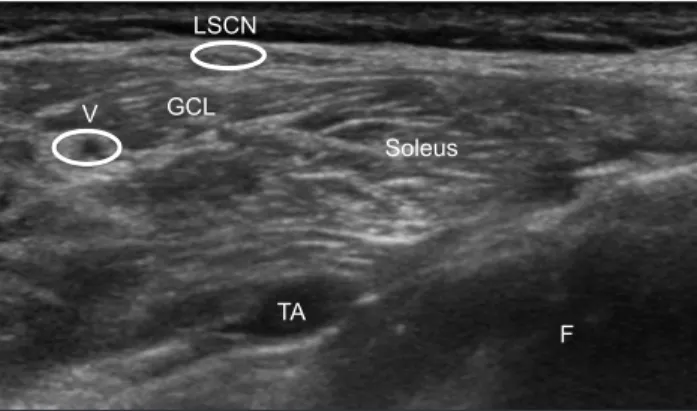
We performed sono-guided injection of a local anes- thetic and steroid mixture (2 ml of 0.5% lidocaine, 20 mg of triamcinolone acetonide). We used ultrasound to trace the peroneal nerve down the sciatic nerve in the thigh. The LSCN branched posteromedially from the popliteal fossa, passed down the posterior side of the fibular head, and merged with the MSCN at the lower third of the leg. There was no space-occupying lesion around the LSCN, and the LSCN showed the largest
Fig. 1. Hypesthesia and paresthesia and pain on the right lateral calf, pretibial area, and lateral ankle.
Anode Cathode
4 cm 2 cm 8 cm Fibular head
E1 E2
Fig. 2. Lateral sural cutaneous antidromic conduction studies.
swelling near the fibular head. The cross sectional area of the LSCN was 3.2 mm2. Injection was performed at the site that showed maximal swelling through ultra- sound (Fig. 5).
Thereafter, the patient’s hypesthesia and paresthe- sia have improved in the lateral calf area. The patient showed gradual improvement in symptoms, which had almost disappeared at the last follow-up. However, apart from this, the pain in the lateral ankle persisted, and subsequent injury of the ligament was confirmed
by MRI. The pain was controlled after administering nonsteroidal anti-inflammatory drugs (NSAIDs) and physiotherapy.
Discussion
The LSCN is a cutaneous branch of the peroneal nerve that innervates the lateral aspect of the calf. A literature review of cadaveric studies indicates that the LSCN branches from the common peroneal nerve at the popliteal crease or the medial, posteromedial, or poste- rior sides of the upper or lower triangle of the popliteal fossa.1 The lateral sural cutaneous nerve courses down between the lateral head of the gastrocnemius and cru- ral fascia, on average 9 mm dorsal to the fibular head.
It frequently ramifies subfascially, and the branches penetrate the fascia at different sites, but always within the proximal two-thirds of the leg. In 63% of cases, the LSCN and MSCN combine to form the sural nerve.
In 27% of cases, the MSCN represented the sural nerve without a communicating branch between the MSCN and LSCN. The LSCN was absent in 7% of cases, and in 3% of cases, the LSCN represented the sural nerve without a communicating branch between the MSCN and LSCN.1 In the current study, ultrasonography con- firmed that the LSCN originated posteromedially in the lower triangle of the popliteal fossa from the common peroneal nerve and merged with the MCSN and the distal lower leg to form the sural nerve.
Fig. 4. MRI of the lower leg: the right peroneal nerve (arrow) shows a contusion or inflammatory change.
Fig. 3. Nerve conduction study of the lateral sural cutaneous nerve. 1, right side; 2, left side.
LSCN
V GCL
TA F
Soleus
Fig. 5. Ultrasound of the lateral sural cutaneous nerve around the fibular head. LSCN: lateral sural cutaneous nerve, V: vein, GCL:
gastrocnemius, lateral head, F: fibula, TA: tibial artery.
There is only one article about nerve conduction study technique for the LSCN.2 In our study, the nerve was stimulated as we have described above. Through this technique, 81% of antidromic responses were found bilaterally. Therefore, if antidromic response has been obtained on the uninvolved side, the probability that antidromic response will be obtained on the in- volved side is more than 80%.
To date, there have been only a few reports of neu- ropathy in the LSCN. Haimovici et al.3 reported entrap- ment of the LSCN from the common peroneal nerve in the popliteal fossa in a study of 48 patients (60 limbs) with symptoms on the lateral side of the popliteal fossa.
Local anesthetic injection was performed in symptom- atic patients (52 limbs), and complete relief was seen in 87.2% of cases, partial relief in 11.5%, and no response in 5.8%.
There have also been some single case reports. Fi- nelli et al.4 reported the case of a 54-year-old male with underlying peripheral polyneuropathy who com- plained of decreased feeling on the lateral aspect of both legs from the knee to approximately two-thirds of the way down the legs. He spent most of his time watching TV, and when he sat down, he often flexed his legs under his buttocks. He was clinically diagnosed with an abnormality of the LSCN. Afterwards, the pa- tient was instructed not to twist or fold his legs, and 90% of his symptoms improved after 10 days. Gessini et al.5 reported the case of a 61-year-old female, who complained of pain on the lateral surface of the right knee and spreading to the adjacent portion of the calf.
The patient had night pain, worsening pain on walk- ing, and burning paresthesia. She was diagnosed with diabetes and had a high level of glycated hemoglobin.
The patient was clinically diagnosed with LSCN injury.
She was prescribed carabamazepine (600 mg/24 hrs), followed by additional diabetic control, leading to improved symptoms 2 weeks later. Hackam et al.6 re- ported that congenital entrapment mononeuropathy of the LSCN occurs by the biceps femoris tendon; tendons were transected and repaired with Z-plasty, and symp-
toms disappeared afterwards.
Some reports identified three cases of LSCN neurop- athy through ultrasound study. Ginanneschi7 reported the case of a 58-year-old man with a 5-month history of progressive numbness and pain on the posterior aspect of the right leg. The patient had abnormal find- ings of the LSCN according to electrodiagnostic study, and peri-popliteal cystic bursitis was confirmed by ultrasound of the knee and leg. Schneider8 reported on a 33-year-old man with 6 days of numbness and a tingling sensation in the left proximal lateral calf. LSCN neuropathy was diagnosed by electrodiagnostic study.
They prescribed topical nonsteroidal gels, and in- structed the patient to avoid running and compression on the popliteal space of the left leg. Unfortunately, symptoms did not improve. Khalil et al.9 reported the case of a 35-year-old man with severe burning pain with numbness, tingling, itching, and hypersensitivity to touch with a 2-year history of sensory symptoms.
After electrodiagnostic study, LSCN neuropathy was diagnosed, and they performed injection twice with EMG-guided local anesthetics and a steroid mixture at 3-month intervals. The patient showed a 2-week improvement after each injection, but the symptoms recurred, so an operation was performed. Through the operation, entrapment of the LSCN was confirmed to be due to a fibrous band near the fibular head, so the fibrous band was transected. The patient showed pro- gressive symptom improvement after the operation, and the symptoms totally disappeared after 1 year.
With the development of electrodiagnosis, it is pos- sible to evaluate the nerves that uncommonly show ab- normalities through an EMG approach. We report this case because of the uniqueness of LSCN neuropathy.
We also suggest the possibility of the underestimated LSCN injury. In addition, our case was the first to ad- minister sono-guided injection to the LSCN, and the patient showed improvement in symptoms after the injection.
References
1. Riedl O, Frey M: Anatomy of the sural nerve: cadaver study and literature review. Plastic and reconstructive surgery 2013: 131: 802-810
2. Campagnolo DI, Romello MA, Park YI, Foye PM, Delisa JA:
Technique for studying conduction in the lateral cutaneous nerve of calf. Muscle Nerve 2000: 23: 1277-1279
3. Haimovici H: Peroneal sensory neuropathy entrapment syn- drome. Archives of surgery (Chicago, Ill : 1960) 1972: 105:
586-590
4. Finelli PF, DiBenedetto M: Bilateral involvement of the lat- eral cutaneous nerve of the calf in a diabetic. Annals of neu- rology 1978: 4: 480-481
5. Gessini L, Jandolo B, Pascucci P, Pietrangeli A: Diabetic neuropathy of the lateral cutaneous nerve of the calf. A case
report. Italian journal of neurological sciences 1985: 6: 107- 108
6. Hackam DG, Zwimpfer TJ: Congenital entrapment of the lateral cutaneous nerve of the calf presenting as a personal sensory neuropathy. The Canadian journal of neurological sciences Le journal canadien des sciences neurologiques 1998: 25: 168-170
7. Ginanneschi F, Rossi A: Lateral cutaneous nerve of calf neu- ropathy due to peri-popliteal cystic bursitis. Muscle & nerve 2006: 34: 503-504
8. Schneider DS, Reddy S: The lateral cutaneous nerve of the calf revisited. PM & R: the journal of injury, function, and rehabilitation 2010: 2: 579-580
9. Khalil NM, Nicotra A, Kaplan C, O'Neill KS: Entrapment of the lateral cutaneous nerve of the calf. BMJ case reports 2013: 2013