1
A Comparison of Gemcitabine in Two Doses for Stage III or IV Non-small Cell Lung Cancer: a Multi-Institutional Phase II Study
Purpose: Since the combination of cisplatin plus gemcitabine (CG) had a significant survival advantage for the treatment of patients with chemotherapy- naïve advanced or metastatic non-small cell lung cancer (NSCLC), CG com- bination have been evaluated with different schedules. However, the best schedule is still unclear. We designed to compare the efficacy and toxicity of CG combination chemotherapy in two different doses of gemcitabine (1,000 or 1,250 mg/m2 3-weekly). Materials and Methods: We randomized patients with stage III or IV NSCLC into either gemcitabine 1,250 mg/m2 or gemcitabine 1,000 mg/m2. Patients received cisplatin 60 mg/m2 intravenously on day1 of each 3-week cycle. Gemcitabine was administered intravenously on days 1 and 8 of each 3-week cycle. Results: From April 2002 until July 2004, 125 patients were enrolled from four university hospitals (55 patients in the gemcitabine 1,000 mg/m2 arm and 70 patients in the gemcitabine 1,250 mg/m2 arm). Response rates were not significantly different in both arms (56.4% vs.
55.7%). However, grade 3 neutropenia was significantly lower in gemcitabine 1,000 mg/m2 arm compared to gemcitabine 1,250 mg/m2 arm (11.0% vs.
15.8%). No differences in non-haematologic toxicities in both arms except anorexia were observed. The median survival was 13.4 months for gemcitabine 1,000 mg group compared with 15.8 months for gemcitabine 1,250 mg group.
There were no statistically significant differences in survival between the groups. Conclusion: For stage III or IV non-small cell lung cancer, combination chemotherapy with gemcitabine 1,000 mg/m2 showed equivalent response rate with lesser neutropenia and anorexia compared to treatment with gemcitabine 1,250 mg/m2. (J Lung Cancer 2007;6(1):1 7)
Key Words: Cisplatin, Gemcitabine, Non-small cell lung cancer, 3-week cycle, Two different doses, Chemotherapy-naïve
Hee Sun Park1 Jin Young An1 Yeun Seun Lee1 Mi Kyong Joung1 Yu Jin Lee1 Sung Soo Jung1 Hwan-Jung Yun1 Ju Ock Kim1 Kyu Sik Kim2 Young Chul Kim2 Maan Hong Jung3 Jeong Seon Ryu4 and Sun Young Kim1
Department of Internal Medicine, College of Medicine, 1Chungnam Na- tional University Hospital & Cancer Research Institute, Daejeon, 2Chon- nam National University, Gwangju,
3Kosin University, Busan, 4Inha Uni- versity, Incheon, Korea
Received: June 1, 2007 Accepted: June 16, 2007
Address for correspondence Sun Young Kim, M.D.
Department of Internal Medicine, Col- lege of Medicine, Chungnam National University Hospital, 640, Daesa-dong, Jung-gu, Daejeon 301-721, Korea Tel: 82-42-220-7154
Fax: 82-42-257-5753 E-mail: [email protected]
INTRODUCTION
Despite of antismoking efforts and advances in treatment, lung cancer is the most common cause of cancer death worldwide(1,2). Among the difficulties in determining the optimal therapy is the fact that advanced non-small cell lung cancer (NSCLC) is a very heterogenous group. However, platinum-based chemotherapy was the most widely used for
patients with advanced NSCLC. The combination of cisplatin and gemcitabine (CG) is one of the most active regimens currently available in the treatment of advanced NSCLC.
Platinum-containing regimens, especially CG regimen, achieve response rates ranging from 26% to 54%, with significant survival benefit(3∼10). One of the most commonly used schedules for CG is to deliver cisplatin 100 mg/m2 on day 1 or 2, and gemcitabine 1,000 mg/m2 on days 1, 8, and 15 of
a 4-week schedule. However, the high incidence of more than grade 3 haematologic toxicities compromises gemcitabine dose intensity (DI), because at least 50% of patients require a reduction in or omission of the day 15 dose(8,9). In order to improve compliance while maintaining DI, particularly for gemcitabine, the 4-week schedule was modified in a rando- mized phase III trial by eliminating day-15 infusion of gemci- tabine, increasing the gemcitabine dose to 1,250 mg/m2, and shortening the cycle duration to 21 days(11). The response rate for the 3-week schedule was similar to that achieved with the 4-week schedule. Also a phase II randomized trial demonstrated the superior in the arm with the lower cisplatin dose (100 mg/m2 vs. 70 mg/m2) with a milder toxicity(12). In conjunc- tion with these studies, a randomized phase II study showed similar DI in the 3-week schedule to the 4-week schedule of gemcitabine and 70 mg/m2 of cisplatin(13).
In this study, we firstly demonstrate 3-week schedule of cisplatin 60 mg/m2 plus gemcitabine 1,000 mg/m2 in patients with advanced NSCLC.
MATERIALS AND METHODS 1) Eligibility Criteria
The diagnosis of NSCLC was confirmed by the histologic or cytologic findings in all cases. Additional eligibility criteria consisted of: at least one bidimensionally measurable or assess- able disease; age ≥18 years; Eastern Cooperative Oncology Group performance status (PS) ≤2; leucocyte count ≥4,000/L;
platelet count ≥100,000/L; bilirubin level ≤1.5 mg/dl; creati- nin level ≤1.5 mg/100 ml and 24-hour creatinine clearance greater than 60 ml/min/m2; absence of active infection; no prior chemotherapy or radiotherapy; no history of myocardial infarc- tion in the last 6 months and no congestive heart failure or significant arrhythmia; and no prior second primary cancer.
Each patient underwent the following studies including studies described above: chest radiography and computed tomography (CT) scan of the thorax and abdomen, MRI of brain and radionuclide bone scan if any finding suggests the presence of tumour metastasis in these organs, fiberoptic bronchoscopy, and pulmonary function studies and arterial blood gas measure- ments if signs or symptoms of respiratory insufficiency are present.
All patients signed written informed consent. The study was
approved by the institutional review board of Chungnam Na- tional University Hospital and was conducted in compliance with institutional review board regulations.
2) Pretreatment Evaluation and Evaluations during Treatment
Before starting treatment and each cycles of therapy, all patients underwent a history, physical examination, deter- mination of performance status, complete blood count with differential, blood chemistry analysis, urine test, electrocar- diogram, bronchoscopy, bone scan, limited MRI for brain, and cytologic or tissue examination. A chest X-ray and chest and abdominal CT scans were performed as required to evaluate bidimensionally measurable disease. If a chest X-ray was ade- quate to document bidimensionally measurable disease, it was repeated before each cycle. Chest or abdominal CT scans were performed every 2 or 3 cycles of treatment course to document bidimensionally measurable disease. The limited brain MRI was modified from conventional MRI by omitting T2-weighted axial, proton density axial, and contrast-enhanced T1-weighted images as previously described(14). After we started treatment, all patients were obtained the complete blood count with differential on days 1, 8, and 15 of each cycle.
3) Treatment Schedules
Patients were randomized into two groups. The protocol dose per infusion for gemcitabine was 1,000 mg/m2 or 1,250 mg/m2. Gemcitabine was administered intravenously over 30 to 60 min diluted in 125 ml of 5% dextrose water at either dose on days 1 and 8 of a 3-week schedule. Cisplatin was administered intravenously at 60 mg/m2 over two to three hours dissolved in 500 ml of half saline on day 1. Patients received pre- and post-treatment intravenous hydration according to institutional guidelines for cisplatin administration. Briefly, patients were administered intravenously 1 L of normal saline and induced diuresis.
4) Dose Adjustments during Treatment
Patients who developed either granulocytopenic fever that required antibiotic therapy or bleeding associated with throm- bocytopenia received a 25% dose reduction of both cisplatin and gemcitabine for subsequent treatment cycle. When the neutrophil count was below 0.99×10⁹/L and the platelet count
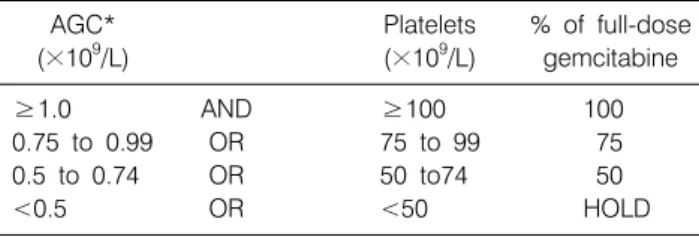
Table 1. Intracycle Dose Adjustments (Hematologic Toxicities)
AGC* Platelets % of full-dose
(×109/L) (×109/L) gemcitabine
≥1.0 AND ≥100 100
0.75 to 0.99 OR 75 to 99 75
0.5 to 0.74 OR 50 to74 50
<0.5 OR <50 HOLD
*AGC: absolute granulocyte count
was below 99×109/L, the treatment was omitted for subsequent cycles. A cycle was not started until the absolute granulocyte count (AGC) was greater than 1.5×10⁹/L and platelet count was greater than 100×109/L. Intracycle (gemcitabine) dosage adjust- ments were made based on AGC and platelet count (Table 1).
Serum creatinine was evaluated on the first treatment day of each cycle. Cisplatin dose was reduced by 25% for a serum creatinine level of 1.6 to 2.0 mg/dl.
Patients with nonhaematologic toxicities grade 0 to 2 (includ- ing grade 3 nausea/vomiting) received the full dose of cisplatin and gemcitabine. For grade 3 nonhaematologic toxicity, except for nausea, vomiting, and alopecia, we reduced cisplatin and gemcitabine dose by 25%. For grade 4 nonhaematologic toxi- cities, cisplatine and gemcitabine were held.
5) Response and Toxicity Criteria
The response assessment after treatment was performed according to the WHO (World Health Organization) criteria. A complete remission (CR) was defined as the complete disa- ppearance of all clinically detectable cancer and the return of all abnormal tests to normal values for a period of at least 4 weeks after cancer was perfectly eliminated clinically. In addition, a partial remission (PR) was defined as the size of the measurable lesion was reduced by over 50% without any new lesion occurring and this condition was maintained at least over four weeks. The no response (SD) was defined as the following status; the size of measurable lesion was reduced by less than 50% or increased by less than 25% while new lesion did not occur. The progressive disease (PD) was defined as the following status the new lesion occurred or the size of lesion increased by more than 25%. Toxicity was classified in accor- dance with guideline from the National Cancer Institute (NCI) Common Terminology Criteria for Adverse Events v3.0(15).
6) Statistics
The objective of this study was to conclude that the response rate of 1,000 mg/2 regimen is not less than 15% compared to the 1,250 mg/m2 regimen. The response rate of 1,250 mg/m2 regimen was assumed to be 55%. To conclude non-inferiority of 1,000 mg/m2 regimen with a probability of 0.8 and one sided significance level of 0.05, 136 patients were needed in each group. Considering about 10% drop out rate, the planned sample size was 150 patients in each group.
This study analyzed by using the SPSS (version 11.0) statistical program, and compared and inspected the differences of the response rate and the occurring rate of toxicity according to each dose of gemcitabine, by using the Chi-square test. Also, as for the dose intensity, we researched the ratio of does when the whole dose was administered and the ratio when the dose was reduced to be administered, and the ratio when the administration was omitted, and compared and inspected these three ratios by using the Chi-square test.
The overall survival was estimated by Kaplan-Meier survival curves and the standard log-rank test. Overall survival was defined as the interval from the date of random treatment assignment to the date of death or last follow-up information for patients who remained alive.
Patient characteristics were compared by using Pearson Chi- square contingency table analysis. Age was compared by using the Wilcoxon test.
RESULTS 1) Patient Characteristics
Between April 2002 to July 2004, 141 patients (116 men and 25 women) were enrolled from 4 institutions (Table 2). Seventy patients were randomly assigned to gemcitabine 1,000 mg/m2 and 71 patients to gemcitabine 1,250 mg/m2. But 15 patients in gemcitabine 1,000 mg/m2, (personal conflict [n=12], protocol violation [n=2], or lost to follow-up [n=1]) and 1 patients in 1,250 mg/m2 (lost to follow-up) were excluded for analysis.
There were no statistical differences between the characteristics of patients in the gemcitabine dose of 1,000 mg/m2 group and 1,250 mg/m2 group. Fifty-five patients were received 1,000 mg/m2 of gemcitabine and 70 patients were received 1,250 mg/m2 of gemcitabine. Patient ages ranged from 30 to 78 years,
Table 2. Patients Characteristics
Gemcitabine Gemcitabine (1,000 mg/m2) (1,250 mg/m2)
(n=55) (n=70)
No. of No. of
patients (%) patients (%) Age (years)
Median 64 65
Range 40∼76 30∼78
Sex
Male 47 (85.5) 58 (82.9)
Female 8 (14.5) 12 (17.1)
ECOG
0 8 (14.5) 15 (21.4)
1 38 (69.1) 46 (65.7)
2 9 (16.4) 9 (12.9)
Stage*
IIIA 17 (30.9) 11 (15.8)
IIIB 20 (36.4) 31 (44.2)
IV 18 (32.7) 28 (40.0)
Histology
Adenocarcinoma 20 (36.4) 29 (41.4) Squamous cell 32 (58.2) 34 (48.6) Large cell 2 (3.6) 1 (1.4)
Others 1 (2.8) 6 (8.6)
*: p value is 0.129 compared 1,000 mg/m2 group with 1,250 mg/m2 group
Table 3. Comparision of Response between Two Groups Gemcitaine Gemcitabine (1,000 mg/m2) (1,250 mg/m2)
p
No. of No. of
% %
patients patients
Complete
1 1.8 2 2.9
response Partial
30 54.5 37 52.9
response Overall
31 56.4 39 55.7 0.54
response Stable
20 36.4 20 28.6
disease
Progression 4 7.3 11 15.7
Fig. 1 Kaplan-Meier survival curves for all patients by treatment group.
with a median age of 64 years on patients who received 1,000 mg/m2 of gemcitabine and a median age of 65 years on patients received 1,250 mg/m2 of gemcitabine. One hundred and seven patients (85.6%) had ECOG performance status no more than 1 and 18 patients (14.4%) had performance status of 2. Twenty- eight patients (22.4%) had stage IIIA, 51 patients (40.8%) had stage IIIB, and 46 patents (36.8%) had stage IV. Most patients had squamous cell carcinoma (52.8%), followed by adenocar- cinoma (39.2%), large cell carcinoma (2.4%), and ademosqua- mous cell carcinoma (5.6%).
2) Tumour Response
All 125 patients were estimated tumor responses (Table 3) after every 2 or 3 cycles. There were 1 CRs (1.8%) and 30 PRs (54.5%) with overall response rate of 56.3% in 1,000 mg/m2 of gemcitabine group. There were 2 CRs (2.9%) and 37 PRs (52.9%) with overall response rate of 55.8% in 1,250 mg/m2 of gemcitabine group. There was no statistical dif- ferences between two groups (p=0.54).
3) Survival
Median follow-up time was 13.9 months (34 days to 79 months). The median survival was 13.4 months (95% con- fidence interval [CI], 262 to 540 days) for gemcitabine 1,000 mg group compared with 15.8 months (95% CI, 348 to 600 days) for gemcitabine 1,250 mg group. There were no sta- tistically significant differences in survival between the groups (p=0.979) (Fig. 1). The overall 1-year survival rate was esti- mated at 55.7% (51.5% for 1,000 mg group vs. 44.0% for 1,250 mg group). The overall 2-year survival rate was 26.0% (27.7%
for 1,000 mg group vs. 26.5% for 1,250 mg group).
Table 5. Comparison of Causes of Death between Two Group Gemcitabine Gemcitabine (1,000 mg/m2) (1,250 mg/m2) Variable
Number of patients
Total deaths 32 53
Cause
Pneumonia 5 3
Lung cancer 24 46
Septic shock 0 4
Radiation pneumonitis 3 0
Table 6. Comparision of Dose-Intensity between Two Groups Gemcitabine Gemcitabine
(1,000 mg/m2) (1,250 mg/m2)
(n*=480) (n*=618)
p
No. % No. %
Full doses 444 92.5 531 86.0 0.046
Reduced doses 31 6.5 76 12.3 0.038
Omitted doses 5 1.0 11 1.7 0.240
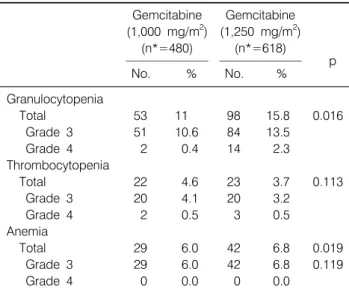
*: delivered number of chemotherapy Table 4. Comparison of Hematologic Toxicities between Two
Groups
Gemcitabine Gemcitabine (1,000 mg/m2) (1,250 mg/m2)
(n*=480) (n*=618)
p
No. % No. %
Granulocytopenia
Total 53 11 98 15.8 0.016
Grade 3 51 10.6 84 13.5
Grade 4 2 0.4 14 2.3
Thrombocytopenia
Total 22 4.6 23 3.7 0.113
Grade 3 20 4.1 20 3.2
Grade 4 2 0.5 3 0.5
Anemia
Total 29 6.0 42 6.8 0.019
Grade 3 29 6.0 42 6.8 0.119
Grade 4 0 0.0 0 0.0
*: delivered number of chemotherapy
4) Toxicity Evaluation
Myelosuppression was the most common toxicity in both haematologic and non-haematologic toxicities (Table 4). As expected, neutropenia was significantly more pronounced with patients with 1,250 mg/m2 of gemcitabine (98/618, 15.8%) than patients with 1,000 mg/m2 of gemcitabine (53/480, 11%) (p=0.016). As for the thrombocytopenia and anaemia, there were no differences between two groups. The non-haematologic side effects were mostly grades 1 and 2. Grade 3 nausea and vomiting occurred 101 times (9.2%) and stomatitis occurred 57 times (5.2%). Grade 4 hepatobiliary toxicities were noted in 2 patients on patients with 1,250 mg/m2 of gemcitabine. During the treatment, 8 patients developed pneumonia. Among these patients, 3 patients were in the 1,000 mg/m2 of gemcitabine group and 5 patients were in the 1,250 mg/m2 of gemcitabine group. Among these 8 patients who developed pneumonia, 2 patients died from respiratory failure. One of 2 patients, who died of pneumonia, was related to neutropenia after the treat- ment in the 1,250 mg/m2 of gemcitabine group.
All causes of death during the follow-up period were listed on Table 5.
5) Treatment Delivery and Dose-intensity
The median numbers of cycles of chemotherapy administered were 4 in each treatment groups. A total of 975 times (88.8%)
were administered. The planned doses were administered 444 times (92.5%) in patients with 1,000 mg/m2 of gemcitabine and 531 times (86.0%) in patients with 1,250 mg/m2 of gemcita- bine. Accordingly, the planned doses were administered more frequently in 1,000 mg/m2 of gemcitabine group than in 1,250 mg/m2 of gemcitabine group (p=0.046). In the 4 cycles of treatment, 6.5% dose reductions were observed in patients with 1,000 mg/m2 of gemcitabine group and 12.3% in patients with 1,250 mg/m2 of gemcitabine group. Sixteen times of total administrations were omitted. In 1,000 mg/m2 of gemcitabine group, treatments were omitted 5 times bone marrow failure, pneumonia, and patients’ denial. In gemcitabine 1,250 mg/m2 group, 11 times were omitted (bone marrow failure, and denial of treatment, severe grade 4 hepatobiliary toxicities, severe fatigue, and sudden death) (Table 6).
DISCUSSION
In advanced NSCLC, the most commonly used schedule is 3 or 4 weeks with cisplatin (100 mg/m2) on day 1 or 2 and gemcitabine (1,000 or 1,250 mg/m2) on days 1, 8, and/or 15.
Several noncomparative phase II studies have indicated that
gemcitabine 1,000 mg/m2 plus cisplatin 70 or 100 mg/m2 is an effective and relatively well-tolerated treatment for advanced NSCLC(10,12,13). These studies indicated that a gemcitabine 1,000 mg/m2 plus cisplatin 70 or 100 mg/m2 is active and has a comparable response rate. However, myelotoxicity, namely neutropenia and thrombocytopenia, has been observed in a large percentage of patients, and results in a reduction in DI of both drugs and a need for supportive therapy.
Our results demonstrate that despite the expected lower gemcitabine DI with gemcitabine 1,000 mg/m2 regimen, it showed better compliance (92.5 vs. 86%) with fewer dose modifications (1.0 vs. 1.7%) significantly compared with that of gemcitabine 1,250 mg/m2 regimen. There was significant dose modification in gemcitabine 1,250 mg/m2 group due to high incidence of severe neutropenia and anaemia. Grade 3 and 4 neutropenia seems to be more common when cisplatin was given on day 15 and thrombocytopenia more common when cisplatin was given on day 1 or 2(4∼6,8,10,12,16). It post- ulates that different schedules seem to influence toxicity. In this study, thrombocytopenia was not the reason of dose reduction.
Sixteen patients omitted treatment because of toxicities, 11 patients in gemcitabine 1,250 mg/m2 group and 5 patients in gemcitabine 1,000 mg/m2 group.
The 3-week schedule used in this study caused mild myelo- suppression with grade 3 or 4 neutropenia affecting 15.8% of patients in gemcitabine 1,250 mg/m2 group and 11.0% for gemcitabine 1,000 mg/m2 group, and grade 3 or 4 anaemia affecting 6.8% of patients in gemcitabine 1,250 mg/m2 group and 6.0% for gemcitabine 1,000 mg/m2 group. Cardinal et al.
administered gemcitabine 1,250 mg/m2 on days 1 and 8 plus cisplatin 100 mg/m2 on day 1 3-week interval to 69 advanced NSCLC patients. The toxicity level was acceptable. However, grade 3 and 4 WHO neutropenia and thrombocytopenia were reported in 64% and 55% of patients, respectively, and febrile neutropenia was observed in 7% of cases. Grade 3 anaemia was recorded in 22% of patients and 29% required packed RBC.
In our study, thrombocytopenia did not influence significant differences in affecting the planned drug administration between the groups. Sandler et al. treated advanced NSCLC with gemcitabine 1,000 mg/m2 on days 1, 8, and 15 every 28 days.
We delivered cisplatin at 60 mg/m2 instead of 70 or 100 mg/m2, and this regimen showed no difference in response rates
that were observed in NSCLC, and objective responses were comparable to those reported in other studies.
Since CG regimens in advanced NSCLC have to be eva- luated with different schedules, DI is an important issue, and toxicity profile and feasibility become important to improve compliance.
The present phase II study shows the feasibility of a 3-week schedule for gemcitabine 1,000 mg/m2 and cisplatin doses of 70 mg/m2, while maintaining the planned dose intensity for both drugs. This is the first study compared 3-weekly gemci- tabine 1,000 mg/m2 plus cisplatin regimen with 3-weekly ge- mcitabine 1,250 mg/m2 plus cisplatin 60 mg/m2 regimen.
Patients on gemcitabine 1,250 mg/m2 received 86% of the intended gemcitabine DI; patients on gemcitabine 1,000 mg/m2 received 92.5% of the intended gemcitabine DI (p<0.046). The results of this trial also indicate that both schedules are active, with overall response rates of 55.7% for gemcitabine 1,250 mg/m2 group and 56.4% for gemcitabine 1,000 mg/m2 group.
These results are comparable to those obtained response rates of 40% to 47% in trials of three-week schedule of CG with gemcitabine dose of 1,250 mg/m2, cisplatin 100 mg/m2 or cisplatin 70 mg/m2 (11∼13,17). And also there was no statistically superiority in median survival (13.4 months vs 15.8 months, p=0.9793).
The limitation of this study was an unexpectedly higher rate of withdrawal in gemcitabine 1,000 mg/m2 arm, even though the characteristics of patients between two groups were not significantly different. In the interim analysis, we found that the trend toward similar response rate between the two arms was significant enough to terminate the enrollment earlier.
CONCLUSION
Tri-weekly gemcitabine 1,000 mg/m2 plus cisplatin regimen demonstrated similar response rates with lesser haematologic toxicity profiles especially granulocytopenia and anaemia compared with 3-weekly gemcitabine 1,250 mg/m2 plus cispla- tin regimen. Despite the small sample size, we might conclude that 3-weekly gemcitabine 1,000 mg/m2 plus cisplatin regimen provides a feasible alternative chemotheutic option for patients with advanced NSCLC.
REFERENCES
1. Landis SH, Murray T, Bolden S, Wingo PA. Cancer statistics, 1998. CA Cancer J Clin 1998;48:6-29.
2. Sause W, Kolesar P, Taylor SI, et al. Final results of phase III trial in regionally advanced unresectable non-small cell lung cancer: Radiation Therapy Oncology Group, Eastern Cooperative Oncology Group, and Southwest Oncology Group. Chest 2000;117:358-364.
3. Non-small Cell Lung Cancer Collaborative Group. Chemoth- erapy in non-small cell lung cancer: a meta-analysis using updated data on individual patients from 52 randomised clinical trials. BMJ 1995;311:899-909.
4. Abratt RP, Bezwoda WR, Goedhals L, Hacking DJ. Weekly gemcitabine with monthly cisplatin: effective chemotherapy for advanced non-small-cell lung cancer. J Clin Oncol 1997;15:
744-749.
5. Shepherd FA, Cormier Y, Burkes R, et al. Phase II trial of gemcitabine and weekly cisplatin for advanced non-small cell lung cancer. Semin Oncol 1997;24:S8-27-S8-30.
6. Anton A, Diaz-Fernandez N, Gonzalez Larriba JL, et al. Phase II trial assessing the combination of gemcitabine and cisplatin in advanced non-small cell lung cancer (NSCLC). Lung Cancer 1998;22:139-148.
7. Schiller JH, Harrington D, Belani CP, et al. Comparison of four chemotherapy regimens for advanced non-small-cell lung cancer. N Engl J Med 2002;346:92-98.
8. Crino L, Scagliotti G, Marangolo M, et al. Cisplatin-gemcita- bine combination in advanced non-small-cell lung cancer: a phase II study. J Clin Oncol 1997;15:297-303.
9. Crino L, Scagliotti GV, Ricci S, et al. Gemcitabine and cisplatin versus mitomycin, ifosfamide, and cisplatin in ad- vanced non-small-cell lung cancer: a randomized phase III
study of the Italian Lung Cancer Project. J Clin Oncol 1999;
17:3522-3530.
10. Sandler AB, Nemunaitis J, Denham C, et al. Phase III trial of gemcitabine plus cisplatin versus cisplatin alone in patients with locally advanced or metastatic non-small-cell lung cancer.
J Clin Oncol 2000;18:122-130.
11. Cardenal F, Lopez-Cabrerizo MP, Anton A, et al. Randomized phase III study of gemcitabine-cisplatin versus etoposide- cisplatin in the treatment of locally advanced or metastatic non-small-cell lung cancer. J Clin Oncol 1999;17:12-18.
12. Rinaldi M, Crino L, Scagliotti GV, et al. A three-week schedule of gemcitabine-cisplatin in advanced non-small-cell lung cancer with two different cisplatin dose levels: a phase II randomized trial. Ann Oncol 2000;11:1295-1300.
13. Soto Parra H, Cavina R, Latteri F, et al. Three-week versus four-week schedule of cisplatin and gemcitabine: results of a randomized phase II study. Ann Oncol 2002;13:1080-1086.
14. Kim SY, Kim JS, Park HS, Screening of brain metastasis with limited magnetic resonance imaging (MRI): clinical implica- tions of using limited brain MRI during initial staging for non-small cell lung cancer patients. J Korean Med Sci 2005;
20:121-126.
15. Trotti A, Colevas AD, Setser A, et al. CTCAE v3.0: de- velopment of a comprehensive grading system for the adverse effects of cancer treatment. Semin Radiat Oncol 2003;13:
176-181.
16. Steward WP, Dunlop DJ, Dabouis G, Lacroix H, Talbot D.
Phase I/II study of gemcitabine and cisplatin in the treatment of advanced non-small cell lung cancer: preliminary results.
Semin Oncol 1996;23:43-47.
17. Ostoros G, Szondy K, Gergely-Farnos E, et al. Efficacy of gemcitabine--cisplatin treatment in stage IIIA (“bulky”N2), IIIB and IV non-small cell lung cancer. Anticancer Res 2005;
25:471-475.