Effects of 6 Week Thoracic Flexibility Exercise on Balance, Gait
Parameters and Fall Risk in Patients with Chronic Stroke; A
randomized controlled study
Donghwan Park1, Kang-Seong Lee2*
1Department of Physical Therapy, Gyeong-in Medical Rehabilitation Center Hospital
2Department of Biomedical Engineering Welfare Technology, Hanseo University
6 주간의 체간 유연성 운동이 만성 뇌졸중 환자의 균형과 보행,
낙상 위험도에 미치는 영향
박동환1, 이강성2*
1경인의료재활센터병원, 2한서대학교 의료복지공학과
Abstract The purpose of this study was to examine the effects of thoracic flexibility exercise on sitting balance, static standing balance, gait parameters, and the fall risk of patients with chronic stroke. The participants were randomized into the control (n=12) and thoracic flexibility exercise groups (n=12). Both groups received standard rehabilitation therapy for 30 minutes per session. The subjects in the experimental group performed additional thoracic flexibility exercises 3 times a week for 6 weeks. The trunk impairment scale, static standing balance, gait speed, cadence, and fall risk were assessed for all the participants before and after the intervention. The thoracic flexibility exercise group showed greater improvement than did the control group on the trunk impairment scale (t=-3.57, p=.002), static standing balance (t=5.37, p<.001), gait speed (t=-3.29, p=.003), cadence (t=-2.77, p=.011), and fall risk (t=6.33, p<.001). Furthermore, the thoracic flexibility exercise group significantly improved all the outcomes compared to the baseline values (P<.05). This study showed that the thoracic flexibility exercise improved the functional ability of patients with chronic stroke.
요 약 본 연구는 만성 뇌졸중 환자를 대상으로 체간 유연성 운동이 앉은 자세 균형, 정적 균형, 보행 척도, 그리고 낙상 위험도에 어떠한 영향을 미치는지를 규명하고자 실시되었다. 만성 뇌졸중 참가자는 대조 그룹(12명)과 체간 유연성 운동 그룹(12명)으로 무작위로 배정되었다. 두 그룹 모두 표준 재활 치료 30분을 실시하였고, 체간 유연성 운동 그룹은 체간 유연성 운동을 일주일에 3번, 6주간 추가로 시행하였다. 모든 참가자는 체간 장애 척도, 정적 균형 능력, 보행 속도, 분당 보행 수, 그리고 낙상 위험도를 운동 전과 운동 종료 후에 평가하였다. 본 연구 결과에서 체간 유연성 운동 그룹은 대조 그룹과 비교하여 체간 장애 척도(t=-3.57, p=.002)와 보행 속도(t=-3.29, p=.003) 그리고 분당 보행 수(t=-2.77, p=.011)는 유의하게 증가하였고, 정적 균형 능력(t=5.37, p<.001)과 낙상 위험도(t=6.33, p<.001)는 유의하게 감소되었 다. 또한, 체간 유연성 운동 그룹은 초기 평가와 비교하여 모든 평가 항목에서 유의하게 개선되었다(p<.05). 이상의 결과 에서 6주간의 흉추 유연성 운동 후, 만성 뇌졸중 환자에게 있어 앉은 자세 균형 능력, 정적 균형 능력, 보행 척도, 그리고 낙상 위험도에서 긍정적인 효과가 나타났으며, 이후 다른 운동과 비교하여 효과를 검증하는 후속연구가 필요한 것으로 사료된다.
Keywords : Thoracic Flexibility Exercises, Stroke Rehabilitation, Postural Balance, Gait Analysis, Fall Risk
*Corresponding Author : Kang-Seong Lee(Hanseo Univ.) email: [email protected]
Received April 9, 2020 Revised May 11, 2020 Accepted June 5, 2020 Published June 30, 2020
1. Introduction
Stroke is caused by infarction or hemorrhage in the brain, causing local brain lesions, and requires long-term treatment [1]. Stroke patients have chronic motor impairments such as impaired coordination, abnormal movement patterns, sensory impairment, muscle weakness, and reduced joint mobility, resulting in reduced balance ability, abnormal gait patterns, and increased risk of falling [2-3]. Balance, walking ability, and fall risk are important evaluation scales in the rehabilitation of stroke patients and are related to the independence and social participation of stroke patients [4]. Also, reduced spinal stability and restricted trunk movement due to stroke are accompanied by weakness of the trunk muscles [5]. In addition, the restricted trunk movements lead to thoracic stiffness, abnormal trunk flexure, and move the center of gravity backward, which impairs balance, gait, and increases fall risk on standing or walking [5-6]. Therefore, the focus of rehabilitation exercise for stroke patients is on functional recovery according to trunk exercise related to posture control [7].
Various interventions, such as core strengthening [8], stretching exercises [9], and augmenting trunk muscle strength [5] have been used to improve balance ability, gait function, and functional movement in individual patients with stroke. Sharma and Kaur [8] reported that core strengthening with pelvic proprioceptive neuromuscular facilitation intervention improved trunk impairment, balance, and gait in chronic stroke patients. Ghasemi et al. [9] showed that functional stretching exercises resulted in significant improvement in spasticity and gait function. In addition, Karatas et al. [5] reported that trunk muscle strength correlates with balance, stability, and functional ability.
Recent research has focused on thoracic flexibility exercise (TFE) to help restore normal
range of motion, balance, and functional ability in patients with chronic low back pain [10-11].
TFE is a form of spinal exercise that is performed to facilitate the extension of the thoracic spine, which reduces tension in the intervertebral disc and surrounding tissue, increasing respiration [12-13]. The TFE improves the restoration of normal movements of the trunk, which improves the level of proximal trunk control leads to improvement in distal lower limb control, thereby improving balance and walking ability [14-15]. TFE also reduces the lumbar compensation movement and improves the mechanical stability of the lumbar spine, effecting increased thoracic flexibility [5, 11]. In addition, increased thoracic mobility has been shown to coordinate balance; reduce tension, muscle spasms, and pain; and enhance the completeness of physical activities [16-17].
Although TFE improves balance and functional ability in individuals with low back pain, to date it appears that its usefulness in patients with chronic stroke has not been investigated. Thus, the purpose of this study was to examine the effects of a 6-week program of TFE on sitting balance, static standing balance, gait speed, cadence, and fall risk in patients with chronic stroke. The research hypothesis was that the TFE group would produce better improvements in sitting balance, static standing balance, gait speed, cadence, and fall risk than the control group in patients with chronic stroke.
2. Methods
2.1 SubjectsA pilot test was performed on 6 volunteers to determine the number of chronic stroke patients required for this study. A power analysis was performed using G-power software (G-power software 3.1.2; Franz Faul, University of Kiel, Kiel, Germany) to achieve a significant power of
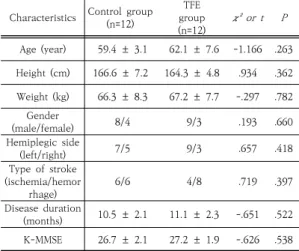
Table 1. Clinical information of the patients with stroke Characteristics Control group (n=12)
group TFE
(n=12) χ² or t P Age (year) 59.4 ± 3.1 62.1 ± 7.6 -1.166 .263 Height (cm) 166.6 ± 7.2 164.3 ± 4.8 .934 .362 Weight (kg) 66.3 ± 8.3 67.2 ± 7.7 -.297 .782
Gender
(male/female) 8/4 9/3 .193 .660
Hemiplegic side
(left/right) 7/5 9/3 .657 .418
Type of stroke (ischemia/hemor
rhage) 6/6 4/8 .719 .397
Disease duration
(months) 10.5 ± 2.1 11.1 ± 2.3 -.651 .522 K-MMSE 26.7 ± 2.1 27.2 ± 1.9 -.626 .538 TFE, Trunk flexibility exercise. K-MMSE, Korean Mini-Mental State Examination. Values are expressed as mean ± standard deviation or frequency.
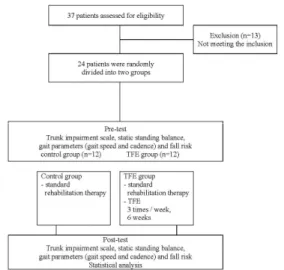
0.80, effect size of 2.06, and α level of 0.05. The results of the power analysis showed that this study required 6 patients per group. A total of 37 stroke patients were assessed for eligibility. Out of it, 13 patients were excluded for not meeting the inclusion criteria. The present study involved 24 patients with chronic stroke from Y hospital, Seoul, and was randomly assigned to two groups (control group= 12, TFE group= 12). The inclusion criteria were as follows: a diagnosis of hemiplegia due to hemorrhagic or ischemic stroke ≥6 months after onset to minimize the effects of natural recovery; an independent gait possible over 10 meters without assistive devices;
a minimum score of 24 on the Korean Mini-Mental State Examination; and the ability to perform the exercises. The exclusion criteria were as follows: a history of surgery in the lower extremities, recurrent stroke, brainstem or cerebellar stroke, severe spasticity (modified Ashworth scale grade≥3), or severe flaccidity in the lower limbs and upper limbs. Before the study, all participants were informed of the purpose and procedure of the study, in accordance with the ethical standards of the Declaration of Helsinki. Only those who voluntarily signed an informed consent form
were enrolled as subjects. In addition, it was announced that if the subject complained of pain during the experiment or decided to drop off, there would be no disadvantages and that no information related to personal information would be disclosed. The physical characteristics of the patients are summarized in Table 1.
2.2 Experimental procedure
This study used a randomized controlled trial with 2 groups. Participants were randomly assigned to either the TFE group (n=12) or the control group (n=12) group using the second generator (1 or 2, 1 indicating the control group and 2 indicating the TFE group) to generate random processing permutations from the online randomization program (http://www.randomization.com). The recruitment period for this study was from November 1 to November 29, 2019, and was conducted on 24 chronic stroke patients who participated in the experiment from December 2, 2019, to January 31, 2020. The participant characteristics and outcome measures, specifically sitting balance, static standing balance, gait speed, cadence, and fall risk, were assessed on study day 1 and 1 day after 6 weeks of intervention, were measured by an examiner who was blinded to the grouping. Throughout the trial, all subjects underwent the same standard rehabilitation therapy for 30 minutes per session:
the first 10 minutes of the active and passive range of motion exercises were allocated to the lower limb of the affected side, the next 10 minutes was spent on weight-bearing training during sitting and standing, and the final 10 minutes was allotted to walking. After standard rehabilitation therapy, 10 minutes of rest was performed and a TFE group was performed an additional 10 minutes of treatment for TFE. The TFE conducted two exercise programs for stroke patients 3 times a week for 6 weeks, 10 minutes a day, according to the programs proposed by
Howe and Read [18] and Park et al. [11]. The TFE group performed 3 times a week for 6 weeks at the same location under the guidance of the same physical therapist to ensure consistent performance of the protocol and the safety of all enrolled participants (Figure 1).
Fig. 1. Design and flow of participants through the trial. Abbreviations: TFE, thoracic flexibility exercise
2.3 TFE training
The participants individually performed the TFE (seated thoracic extension with foam roller and kneeling thoracic extension) training (Figure 2). The TFE performed two exercise programs for stroke patients 3 times a week for 6 weeks, 10 minutes a day. The steps for the seated thoracic extension with foam roller include the following [11]: the exercise was started by sitting in a high-back chair with a foam roller across the thoracic spine; the chin was pulled in, the spine straightened, and then the participant crossed their arms on their chest to maintain alignment;
they then breathed in and extended back behind the chair. This was performed for 10 seconds while maintaining a neutral posture. Finally, they returned to the start position, rested for 20 seconds, and repeated the procedure 10 times.
The steps for the kneeling thoracic extension
were as follows [18]: the participant kneeled in front of the bench, faced the box, and placed the their elbows on the bench shoulder-width apart, with hands interdigitated; the participant then pushed their hips back on their heels and simultaneously pressed their chest towards the ground to make a thoracic extension. The aim was to stretch their ribs towards the ground as far as possible. They maintained this position for 10 seconds, returned to the starting position and rested for 20 seconds before repeating the procedure 10 times.
Fig. 2. Application of TFE (A: seated thoracic extension with foam roller, B: kneeling thoracic extension exercise)
2.4 Outcome measurements
The sitting balance test was performed pre- and post-treatment using the trunk impairment scale (TIS), which consists of three main categories: static and dynamic sitting balance and trunk coordination in a sitting position. The TIS score ranges from 0 to a maximum of 23 points, with a higher score indicating better trunk performance. For each test, a 2, 3, or 4 point ordinal scale was used. The reliability of the TIS was found to be 0.99 [19].
The static standing balance and fall risk tests were performed pre- and post-treatment using a Biodex Balance System SD (Biodex, Shirley, NY),
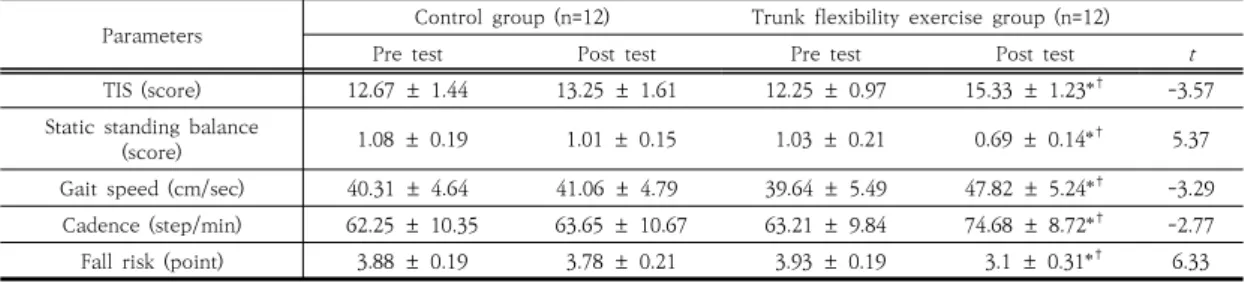
Table 2. Changes in the intervention in each group
Parameters Control group (n=12) Trunk flexibility exercise group (n=12)
Pre test Post test Pre test Post test t
TIS (score) 12.67 ± 1.44 13.25 ± 1.61 12.25 ± 0.97 15.33 ± 1.23*† -3.57
Static standing balance
(score) 1.08 ± 0.19 1.01 ± 0.15 1.03 ± 0.21 0.69 ± 0.14*† 5.37
Gait speed (cm/sec) 40.31 ± 4.64 41.06 ± 4.79 39.64 ± 5.49 47.82 ± 5.24*† -3.29 Cadence (step/min) 62.25 ± 10.35 63.65 ± 10.67 63.21 ± 9.84 74.68 ± 8.72*† -2.77 Fall risk (point) 3.88 ± 0.19 3.78 ± 0.21 3.93 ± 0.19 3.1 ± 0.31*† 6.33 TIS, trunk impairment scale; Values are expressed as mean ± standard deviation. *P<0.05 indicate a significant difference between pre- and post-interventions within the group; †P<0.05 indicate a significant difference between the change scores between the groups; t indicate a significant difference between the groups post test.
which is an apparatus that provides real-time visual biofeedback for balance testing and training. For static measures, the stability index is measured as the angular excursion of the center of gravity of the patient. A high score indicates significant movement and thereby, poor balance. The test was performed for 30 seconds, repeated three times, and the average value of three trials of the static balance test was computed. The reliability of the Biodex Balance System SD was previously found to be 0.89 [20].
Gait speed and cadence were measured using the GAITRite system (CIR Systems, Easton, PA, USA). The GAITRite includes a 366 cm long, 61 cm wide electronic gait mat in which 13,824 sensors are vertically arranged at intervals of 1.27 cm to collect foot placement data. For this study, the patients were instructed to stand in front of the gait board at a distance of 1 m, and then walk at a comfortable speed until they reached the end of the board. Measurement of gait parameters was repeated three times, and the mean value of three trials was computed. The reliability of the GAITRite system was previously found to be 0.82 and 0.92 [21].
2.4 Statistical analysis
The PASW Statistics 18 software suite (SPSS, Chicago, IL, USA) was used for all statistical analyses. Normality was examined using the one-sample Kolmogorov-Smirnov test. Baseline demographic variables were compared between
the groups using an independent t-test for continuous data and the chi-square test of independence for categorical data. After the 6-week intervention, independent t-tests were used to compare differences between group means, and paired t-tests were used to compare within-group means. Statistical significance was set at p values of ɑ=.05.
3. Results
As a result of verifying the homogeneity of age, height, weight, gender, hemiplegic side, type of stroke, disease duration, and K-MMSE of the patients with stroke, there was no significant difference between the TFE and the control group. The outcome measurements are shown in Table 2. No significant differences were observed between the groups in any of the measured baseline values. After the 6-week intervention, the mean TIS was significantly increased in the TFE group compared to the control group (p=.002). Static standing balance scores were significantly decreased in the TFE group compared to the control group (t=-3.57, p=.002).
Static standing balance was significantly decreased in the TFE group relative to the control group (t=5.37, p<.001). Similarly, gait speed was significantly increased in the TFE group relative to the control group (t=-3.29, p=.003). Cadence was significantly increased in
the TFE group relative to the control group (t=-2.77, p=.011). Fall risk significantly decreased in the TFE group compared to the control group (t=6.33, p<.001). Moreover, only the TFE group significantly improved in all outcomes compared to baseline (p<.001).
4. Discussion
In the present study, we investigated the effects of the TFE on the TIS, static standing balance, gait speed, cadence, and fall risk in chronic stroke patients. The results indicated that the TFE group demonstrated significant improvements in all measured parameters in comparison to the baseline following completion of the intervention. In addition, the TFE group demonstrated significant improvements in TIS, static stand balance, gait speed, cadence, and fall risk in comparison with the control group, after the 6-week intervention. To the best of our knowledge, this is the first investigation to demonstrate TFE intervention benefits in chronic stroke patients.
After 6 weeks of the trial protocol, the TIS score significantly increased in the TFE group by 81.2% compared with the control group. Also, the static standing balance score significantly decreased in the TFE group by 75.8% compared with the control group. Notably, our results mirror those of previous studies [22-23]. Cho et al. [22] applied mid-thoracic spine mobilization to patients with chronic stroke, inspiratory function, and the global rating of change which produced significant improvements in balance, compared with the control group. Jung et al. [23] reported significant improvements in patients with stroke for muscle activation, postural control, and gait speed following trunk exercises on the balance pad application, and their balance results were similar to those in the present study. In stroke patients, the trunk is flexed and the center of
gravity of the body moves backward, resulting in a decrease in balance ability [5-6]. In our study, the 6-week repeated seated thoracic extension with foam roller exercise may provide thoracic flexibility, lumbar stability, and lumbar anterior-posterior tilting movement using foam rollers in a sitting position during intervention, which would have an effect on the improve in the balance ability. In addition, the kneeling thoracic extension exercise may improve shoulder, neck, and lumbar movements through exercise, which inhibits excessive compensatory action of the lumbar spine. Therefore, the TFE may have facilitated thoracic mobility and improved the thoracic curve by reducing tension in the intervertebral disc and surrounding tissues [11, 12]. As a result, the patient may have improved trunk control and reduced body sway within the base plane, thus improving balancing ability compared to standard rehabilitation therapy. For this reason, the TFE also seemed to improve sitting and standing compared to the control group. Therefore, our results indicated that TFE effectively improved balance ability in patients with chronic stroke.
We found that gait speed and cadence significantly improved in the TFE group by 81.2%
and 75.8% compared with the control group, respectively; these results mirror those of previous studies [14-15]. Rai et al. [14] reported significant improvements in TIS, Berg balance scale, gait speed, and cadence following trunk rehabilitation exercise (upper and lower parts of the trunk in the supine and sitting positions) for patients with chronic stroke. Karthikbabu et al.
[15] applied selective trunk muscle exercise to patients with chronic stroke, which produced significant improvements in TIS, Berg balance scale, gait speed, cadence, and stride length compared with pre-intervention. Their gait speed and cadence results were similar to those in the present study. The TFE reduces tension in the surrounding tissues of the spine and intervertebral
discs, resulting in increased mechanical stability of the pelvis and lumbar spine with extension of the spinal extensor muscles [25- 26]. Restoration of trunk movement is an important goal in maintaining balance and walking in stroke patients [27]. In the present study, compared with standard rehabilitation therapy, repeated the seated thoracic extension with foam roller and kneeling thoracic extension exercise may enhance symmetrical pelvic movements and re-education the movement pattern of spinal muscles, thus better weight shifting towards affected distal lower extremity. In addition, increased stability of the pelvis and lumbar spine may have enhanced the ability of patients to shift weight towards the affected leg thereby improving control of the leg allowing optimum force during walking [14, 28]. This may have provided a greater stabilizing force for the lumbar area in the TFE group patients compared with the control group. Also, flexion and extension movements of the thoracic region may improve the level of proximal trunk control, leading to improvement in distal lower limb control [14], which helps in attaining better gait speed and cadence. These factors likely contribute to the greater increases in gait speed and cadence in the TFE group relative to that in the control group.
After the completion of the study interventions, fall risk significantly decreased in the TFE group (87.9%) compared with the control group. These results are consistent with those of previous studies [29-30] Mackintosh et al. [30] examined the predictors related to falls after stroke and found that reduced balance ability, slower walking speed, and lack of activity may increase cases of falls, therefore enhanced balance and walking ability help to prevent falls. Jijimol et al.
[29] compared the correlation between trunk impairment and balance in patients with chronic stroke and found that a highly significant correlation exists between the TIS and Tinetti balance scale (rho = 0.911). These results indicate
that trunk impairment is associated with poor balance and fall risk. Furthermore, their fall risk results were similar to those in the present study.
Postural control problems in stroke patients include loss of activation of the trunk muscles during voluntary movements, increased sway during static standing, reduced weight bearing on the paretic limb, and increased fall risk [31]. The findings of the present study indicate that the use of the TFE in addition to standard stroke rehabilitation therapy was beneficial in improving sitting balance, static standing balance, and gait parameters of chronic post-stroke hemiplegic patients. The improvements in trunk control may be because the TFE mainly consisted of trunk extension exercises that increase the flexibility of trunk muscles. In addition, as motor control progresses, the enhanced trunk control leads to improvement in the distal lower limb movement, which helps the patient attain better balance and gait [14-15]. We suggest that the TFE may improve balance along with gait parameters, which may contribute to a decrease in the fall risk by improving trunk control and body sway when standing up. Thus, interventions to improve trunk flexibility and movement may reduce fall risk. For this reason, the TFE also seems to decrease fall risk compared to the control group.
This study has several limitations. First, this study did not include long-term follow-up assessment; therefore, the carryover effect of the TFE was not studied. Future studies are required to elucidate the long-term effects. Second, this study could not be compared with other exercise interventions. Follow-up studies are needed to compare stabilization exercises, stretching, and functional training to identify the objective effects of the TFE. Finally, the findings may not be generalized to all stroke patients, as our study was performed with chronic stroke patients having minor or moderate physical impairment.
Further research is required to study these specific issues in the future.
5. Conclusion
This study examined the effects of the TFE with respect to sitting balance, static standing balance, gait speed, cadence, and fall risk in patients with chronic stroke. Our findings indicate that the TFE significantly improves TIS, static standing balance, gait speed, cadence, and fall risk compared to the control group. In addition, the TFE interventions significantly improved all outcomes compared to the baseline.
Taken together, these findings will be the basis for new therapeutic interventions to improve function for people with chronic stroke.
References
[1] P. Langhorne, J. Bernhardt, G. Kwakkel, "Stroke rehabilitation," The Lancet, Vol.377, No.9778, pp.1693-1702, 2011.
DOI: https://doi.org/10.1016/S0140-6736(11)60325-5 [2] R. Carandang, S. Seshadri, A. Beiser, M. Kelly-Hayes,
C. S. Kase, W. B. Kannel, et al., "Trends in incidence, lifetime risk, severity, and 30-day mortality of stroke over the past 50 years," Jama, Vol.296, No.24, pp.2939-2946, 2006.
DOI: https://doi.org/10.1001/jama.296.24.2939 [3] H. S. Jørgensen, H. Nakayama, H. O. Raaschou, T. S.
Olsen, "Recovery of walking function in stroke patients: the Copenhagen Stroke Study," Archives of physical medicine and rehabilitation, Vol.76, No.1, pp.27-32, 1995.
DOI: https://doi.org/10.1016/s0003-9993(95)80038-7 [4] G. Verheyden, A. Nieuwboer, H. Feys, V. Thijs, K.
Vaes, W. De Weerdt, "Discriminant ability of the Trunk Impairment Scale: a comparison between stroke patients and healthy individuals," Disability and rehabilitation, Vol.27, No.17, pp.1023-1028, 2005.
DOI: https://doi.org/10.1080/09638280500052872 [5] M. Karatas, N. Çetin, M. Bayramoglu, A. Dilek, "Trunk
muscle strength in relation to balance and functional disability in unihemispheric stroke patients,"
American journal of physical medicine &
rehabilitation, Vol.83, No.2, pp.81-87, 2004.
DOI: https://doi.org/10.1097/01.PHM.0000107486.99756.C7 [6] T. Tsuji, M. Liu, K. Hase, Y. Masakado, N. Chino,
"Trunk muscles in persons with hemiparetic stroke evaluated with computed tomography," Journal of rehabilitation medicine, Vol.35, No.4, pp.184-188, 2003.
DOI: https://doi.org/10.1080/16501970306126V [7] C. L. Hsieh, C. F. Sheu, I. P. Hsueh, C. H. Wang, "Trunk
control as an early predictor of comprehensive activities of daily living function in stroke patients,"
Stroke, Vol.33, No.11, pp. 2626-2630, 2002.
DOI: https://doi.org/10.1161/01.str.0000033930.05931.93 [8] V. Sharma, J. Kaur, "Effect of core strengthening with
pelvic proprioceptive neuromuscular facilitation on trunk, balance, gait, and function in chronic stroke,"
Journal of exercise rehabilitation, Vol.13, No.2, pp.200-2005, 2017.
DOI: https://doi.org/10.12965/jer.1734892.446 [9] E. Ghasemi, K. Khademi-Kalantari, M.
Khalkhali-Zavieh, A. Rezasoltani, M. Ghasemi, A. A.
Baghban, et al., "The effect of functional stretching exercises on functional outcomes in spastic stroke patients: A randomized controlled clinical trial,"
Journal of bodywork and movement therapies, Vol.22, No.4, pp.1004-1012, 2018.
DOI: https://doi.org/10.12965/jer.1734892.446 [10] Y. B. Sung, J. H. Lee, Y. H. Park, "Effects of thoracic
mobilization and manipulation on function and mental state in chronic lower back pain," Journal of physical therapy science, Vol.26, No.11, pp.1711-1714, 2014.
DOI: https://doi.org/10.1589/jpts.26.1711
[11] D. H. Park, J. U. Won, J. H. Roh, E. H. Ko, "Effects of the thoracolumbar exercise program on static standing balance and pain in low back pain patients,"
Orthopaedic Physical Therapy Practice, Vol.24, No.2, pp. 78-84, 2012.
[12] M. Y. Heo, K. Kim, B. Y. Hur, C. W. Nam, "The effect of lumbar stabilization exercises and thoracic mobilization and exercises on chronic low back pain patients," Journal of physical therapy science, Vol.27, No.12, pp.3843-3846, 2015.
DOI: https://doi.org/10.1589/jpts.27.3843
[13] M. S. Reis, J. L. Q. Durigan, R. Arena, B. R. O. Rossi, R. G. Mendes, A. Borghi-Silva, "Effects of posteroanterior thoracic mobilization on heart rate variability and pain in women with fibromyalgia," Rehabilitation research and practice, Vol.2014. pp.1-6, 2014.
DOI: https://doi.org/10.1155/2014/898763
[14] R. K. Rai, L. Arora, S. Sambyal, R. Arora, "Efficacy of trunk rehabilitation and balance training on trunk control, balance and gait in post stroke hemiplegic patients: a randomized controlled trial," Journal of Nursing and Health Science, Vol.3, No.3, pp.27-31, 2014.
[15] S. Karthikbabu, M. S. John, N. Manikandan, K. R.
Bhamini, M. Chakrapani, N. Akshatha, "Role of trunk rehabilitation on trunk control, balance and gait in patients with chronic stroke: a pre-post design,"
Neuroscience & Medicine. Vol.2011, No.2, pp.61-67, 2011.
DOI: https://doi.org/10.4236/nm.2011.22009
[16] A. Y. Jones, E. Dean, C. C. Chow, "Comparison of the
oxygen cost of breathing exercises and spontaneous breathing in patients with stable chronic obstructive pulmonary disease," Physical therapy, Vol.83, No.5, pp. 424-431, 2003.
DOI: https://doi.org/10.1093/ptj/83.5.424
[17] W. B. Katzman, D. E. Sellmeyer, A. L. Stewart, L. Wanek, K.
A. Hamel, "Changes in flexed posture, musculoskeletal impairments, and physical performance after group exercise in community-dwelling older women,"
Archives of physical medicine and rehabilitation, Vol.88, No.2, pp.192-199, 2007.
DOI: https://doi.org/10.1016/j.apmr.2006.10.033 [18] L. Howe, P. Read, "Thoracic spine function: Assessment
and self-management," Professional Strength &
Conditioning Journal. No.39, pp.21-30, 2015.
[19] G. Verheyden, A. Nieuwboer, J. Mertin, R. Preger, C.
Kiekens, W. De Weerdt, "The Trunk Impairment Scale:
a new tool to measure motor impairment of the trunk after stroke," Clinical rehabilitation. Vol.18, No.3, pp.326-334, 2004.
DOI: https://doi.org/10.1191/0269215504cr733oa [20] M. R. Hinman, "Factors affecting reliability of the
Biodex Balance System: a summary of four studies,"
Journal of sport rehabilitation. Vol.9, No.3, pp.240-252, 2000.
DOI: https://doi.org/10.1123/jsr.9.3.240
[21] H. B. Menz, M. D. Latt, A. Tiedemann, M. M. San Kwan, S. R. Lord, "Reliability of the GAITRite® walkway system for the quantification of temporo-spatial parameters of gait in young and older people," Gait & posture.
Vol.20, No.1, pp.20-25, 2004.
DOI: https://doi.org/10.1016/S0966-6362(03)00068-7 [22] J. Cho, E. Lee, S. Lee, "Effectiveness of mid-thoracic
spine mobilization versus therapeutic exercise in patients with subacute stroke: A randomized clinical trial," Technology and Health Care, Vol.27, No.2, pp.149-158, 2019.
DOI: https://doi.org/10.3233/THC-181467
[23] K. S. Jung, H. Y. Cho, T. S. In, "Trunk exercises performed on an unstable surface improve trunk muscle activation, postural control, and gait speed in patients with stroke," Journal of physical therapy science, Vol.28, No.3, pp.940-944, 2016.
DOI: https://doi.org/10.1589/jpts.28.940
[24] J. D. Drake, S. L. Fischer, S. H. Brown, J. P. Callaghan,
"Do exercise balls provide a training advantage for trunk extensor exercises? A biomechanical evaluation," Journal of manipulative and physiological therapeutics, Vol.29, No.5, pp.354-362, 2006.
DOI: https://doi.org/10.1016/j.jmpt.2006.04.011 [25] K. Singer, L. Giles, "Manual therapy considerations at
the thoracolumbar junction: an anatomical and functional perspective," Journal of manipulative and physiological therapeutics, Vol.13, No.2, pp,83-88, 1990.
[26] D. W. Vaughn, E. W. Brown, "The influence of an
in-home based therapeutic exercise program on thoracic kyphosis angles," Journal of Back and Musculoskeletal Rehabilitation, Vol.20, No.4, pp.155-165, 2007.
[27] S. F. Renald, J.R. Regan, "Efficacy of Trunk Exercises on Swiss Ball versus Bed in Improving Trunk Control in Hemiparetic Patients," International Journal of Physiotherapy and Research. Vol.4, No.2, pp.1444-1450, 2016.
DOI: https://doi.org/10.16965/ijpr.2016.115
[28] P. M. Davies, "Right in the middle: selective trunk activity in the treatment of adult hemiplegia."
Springer Science & Business Media; 1990, pp.31-65 [29] G. Jijimol, R. Fayaz, P. Vijesh, "Correlation of trunk
impairment with balance in patients with chronic stroke," NeuroRehabilitation, Vol.32, No.2, pp.323-325, 2013.
DOI: https://doi.org/10.3233/NRE-130851
[30] S. F. Mackintosh, K. D. Hill, K. J. Dodd, P. A. Goldie, E. G. Culham, "Balance score and a history of falls in hospital predict recurrent falls in the 6 months following stroke rehabilitation," Archives of physical medicine and rehabilitation, Vol.87, No.12, pp.
1583-1589, 2006.
DOI: https://doi.org/10.1016/j.apmr.2006.09.004 [31] G. Yavuzer, F. Eser, D. Karakus, B. Karaoglan, H. J.
Stam, "The effects of balance training on gait late after stroke: a randomized controlled trial," Clinical rehabilitation, Vol.20, No.11, pp.960-969, 2006.
DOI: https://doi.org/10.1177/0269215506070315
Donghwan Park [Regular member]
• Feb. 2011 : Yonsei Univ., Occupational Health, MS
• Aug. 2019 : Yonsei Univ., Physical Therapy, PhD
• Oct. 2003 ∼ current : Gyeong-in Medical Rehabilitation Center Hospital. Physical Therapist
<Research Interests>
Physical therapy, Rehabilitation, Manual therapy
Kang-Seong Lee [Regular member]
• Feb. 2001 : Hanseo Univ., Physical Therapy, MS
• Aug. 2012 : Soon Chun Hyang Univ., Health Science, PhD
• Sept. 2017 ~ Jul. 2018 : International O&P School., ISPO CATⅡ Lower Limb Prosthetics, in Germany
• Feb. 2003 ~ current : Hanseo Univ., Dept. of Biomedical Engineering Welfare Technology, Professor
<Research Interests>
Physical therapy, Orthotics, Prosthetics