ABSTRACT
Background: Patients with rheumatoid arthritis (RA) undergoing targeted therapy have a higher risk of developing tuberculosis (TB). This requires diagnosis and treatment of latent tuberculosis infection (LTBI). We aimed to evaluate whether diagnosis and treatment of LTBI in RA are effective in Korea, and to estimate the risk of TB development by calculating the incidence rate of active TB among RA patients receiving targeted therapy.
Methods: We analyzed data from two prospective cohort studies of RA patients who received biologic disease-modifying antirheumatic drugs (bDMARDs) or Janus kinase (JAK) inhibitor.
We selected new starters of targeted therapy and classified them into three groups receiving tumor necrosis factor (TNF) inhibitor, non-TNF inhibitor, and JAK inhibitor, respectively. We then compared LTBI prevalence, treatments, and active TB incidence during first-line therapy in each group.
Results: A total of 765 RA patients (574 TNF inhibitor users, 132 non-TNF inhibitor users, and 59 JAK inhibitor users) were included in this study. Observation periods were 1,255.2 person- years (PYs), 264.7 PYs, and 53.3 PYs, respectively. All 765 patients underwent LTBI screening, and the positivity rate was 26.5% (n = 203). Of the 203 LTBI-positive patients, 189 (93.1%) received treatment. Only one patient, who was in the TNF inhibitor group, and was negative for the interferon gamma release assay (IGRA), did not receive LTBI treatment and developed active TB during follow-up.
Conclusion: Although the prevalence of LTBI in RA patients who started targeted therapy was slightly elevated, the Korean guidelines specifying LTBI screening and treatment were effective in preventing latent TB from becoming active.
Keywords: Latent Tuberculosis Infection; Rheumatoid Arthritis; Biologic Disease-Modifying Antirheumatic Drugs; Janus Kinase Inhibitor
INTRODUCTION
Patients with rheumatoid arthritis (RA) are more susceptible to infection than other people.1 Patients treated with biologic disease-modifying antirheumatic drugs (bDMARDs), especially tumor necrosis factor (TNF) inhibitors, are at increased risk of developing tuberculosis eISSN 1598-6357·pISSN 1011-8934
Original Article
Received: Sep 30, 2020 Accepted: Jan 6, 2021 Address for Correspondence:
Yoon-Kyoung Sung, MD, PhD, MPH Department of Rheumatology, Hanyang University Hospital for Rheumatic Diseases, 222-1 Wangsimni-ro, Seongdong-gu, Seoul 04763, Korea.
E-mail: [email protected]
© 2021 The Korean Academy of Medical Sciences.
This is an Open Access article distributed under the terms of the Creative Commons Attribution Non-Commercial License (https://
creativecommons.org/licenses/by-nc/4.0/) which permits unrestricted non-commercial use, distribution, and reproduction in any medium, provided the original work is properly cited.
ORCID iDs Yeo-Jin Song
https://orcid.org/0000-0001-9420-2129 Soo-Kyung Cho
https://orcid.org/0000-0003-4493-8837 Hyoungyoung Kim
https://orcid.org/0000-0003-1415-461X Hye Won Kim
https://orcid.org/0000-0001-9270-3800 Eunwoo Nam
https://orcid.org/0000-0001-5175-7095 Sang-Cheol Bae
https://orcid.org/0000-0003-4658-1093 Dae Hyun Yoo
https://orcid.org/0000-0002-0643-4008 Yoon-Kyoung Sung
https://orcid.org/0000-0001-6691-8939
Yeo-Jin Song , Soo-Kyung Cho , Hyoungyoung Kim , Hye Won Kim , Eunwoo Nam , Sang-Cheol Bae , Dae Hyun Yoo , and Yoon-Kyoung Sung
Department of Rheumatology, Hanyang University Hospital for Rheumatic Diseases, Seoul, Korea
Risk of Tuberculosis Development in Patients with Rheumatoid Arthritis Receiving Targeted Therapy:
a Prospective Single Center Cohort Study
Immunology, Allergic
Disorders & Rheumatology
Funding
This research was supported by a grant of Patient-Centered Clinical Research Coordinating Center funded by the Ministry of Health & Welfare, Republic of Korea (grant number: HI19C0481, HC19C0052). The registry of JAK inhibitor was sponsored by Pfizer Inc.
Disclosure
DHY received research grants from Celltrion and HR, and is on the speakers bureau of Celltrion and Celltrion Healthcare. YKS received research grants from Bristol-Myers Squibb, Eisai, Pfizer, and JW Pharmaceutical.
YJS, SKC, HK, HWK, EN, and SCB have no disclosures to declare. All authors declare no conflict of interest associated with this work.
Author Contributions
Conceptualization: Cho SK, Kim H, Sung YK.
Data curation: Song YJ, Cho SK, Kim H, Kim HW, Nam E. Formal analysis: Cho SK, Kim HW, Nam E. Investigation: Song YJ, Cho SK.
Methodology: Cho SK, Kim HW, Nam E, Bae SC, Yoo DH, Sung YK. Writing - original draft:
Song YJ, Cho SK, Sung YK. Writing - review &
editing: Cho SK, Kim H, Kim HW, Nam E, Bae SC, Yoo DH, Sung YK.
(TB), predominantly via reactivation of latent tuberculosis infection (LTBI).2 LTBI is now recognized as an incipient phase of TB with a potential risk of progressing to active infection;
consequently, it is seen as requiring treatment for greatest benefit.3 Accordingly, screening for LTBI is required to prevent TB infection in RA patients undergoing bDMARDs treatment.4 There are two widely used methods for diagnosing LTBI: the tuberculin skin test (TST) and the interferon gamma release assay (IGRA). The TST has long been used in LTBI diagnosis, and while it is very cost effective, it requires two clinic visits to get results. Also, false positivity caused by Bacillus Calmette–Guérin (BCG) vaccination and nontuberculous mycobacteria (NTM) infection and false negativity in immunosuppressed patients are drawbacks.5 On the other hand, the IGRA has relatively high specificity and is not affected by BCG vaccination status.6 Thus, it is more useful in countries with a high rate of BCG vaccination such as Korea though it is more expensive than the TST and requires a well- equipped laboratory and skilled technicians.7
The World Health Organization (WHO) published updated guidelines for LTBI management in 2018, recommending the TST and IGRA equally for LTBI diagnosis.8 In the Korean guidelines, the TST alone, IGRA alone, or a two-step TST/IGRA protocol are recommended for diagnosing LTBI in immunocompetent people.9 However, in immunocompromised patients, TST alone is not recommended; rather, IGRA alone or the two-step TST/IGRA is recommended.9 According to the 2017 Korean guidelines for TB, immunocompromised patients who are recommended to undergo LTBI treatment include patients with human immunodeficiency virus (HIV) and those who are initiating or using immunosuppressive drugs and TNF inhibitors.9 Apart from TNF inhibitors, bDMARDs are not discussed in the Korean guidelines; however, the American College of Rheumatology (ACR) recommends screening all RA patients for LTBI if they are being considered for receiving bDMARDs or tofacitinib10; in addition, IGRA test is recommended for patients with a history of BCG vaccination rather than TST.10
Tofacitinib is the first oral Janus kinase (JAK) inhibitor to be released. Studies have suggested that its administration leads to increased TB reactivation.11,12 Thus, as with TNF inhibitor, LTBI screening and treatment are recommended prior to starting tofacitinib.11,12 However, there is a lack of information about how LTBI screening and treatment affect the positivity rate and incidence of active TB in patients about to start tofacitinib treatment compared with patients about to start TNF inhibitors or other bDMARDs.
In this study, we examined whether the diagnosis and treatment of latent TB in RA patients are effective in Korea. We also estimated the risk of TB development by calculating the incidence rate of active TB among RA patients receiving targeted therapy.
METHODS
Data extraction and study population
We analyzed data from two prospective cohort studies. Data were extracted from two registries of patients receiving bDMARDs and JAK inhibitors, respectively, at a single academic referral hospital in Seoul, Korea. Patients with RA who started bDMARDs between July 2011 and May 2019 and those who started JAK inhibitors between March 2017 and August 2019 were included in this study. New starters for each targeted therapy were selected after
exclusion of patients who had previously received any bDMARD or JAK inhibitor treatment before. Hence, all participants were bDMARD-naïve and JAK inhibitor-naïve RA patients. We divided the patients into three groups: those receiving TNF inhibitor, non-TNF inhibitor, and JAK inhibitor.
Positivity of LTBI screening tests and treatment
Three kinds of tests were used for LTBI screening: the TST and two different IGRAs: the QuantiFERON-TB Gold In-Tube (QFT-GIT; Cellestis, Carnegie, Victoria, Australia) and the T-SPOT.TB test (Oxford Immunotec, Abingdon, United Kingdom). A positive TST was defined as an induration ≥10 mm after 48–72 hours regardless of BCG vaccination in accord with the Korean National Guidelines9,13 because the effect of BCG vaccination on TST results is controversial.14,15 We compared the rates of LTBI screening, and LTBI prevalences for each group: TNF inhibitor, non-TNF inhibitor, and JAK inhibitor, and calculated the LTBI positivity rates from the individual test results. We also used the combination of two tests to develop a composite rule for patients with discordant test results: patients who were positive on either TST or IGRA were classified as LTBI positive and patients with two negative test results were classified as LTBI negative. Patients whose IGRA result was indeterminate were classified as indeterminate if their TST result was negative. We also investigated whether the LTBI was treated and which treatment was used.
The active TB incidence rate during first-line targeted therapy
The active TB incidence rate during first-line targeted therapy was calculated for each treatment group. The observation period included the time until the patient stopped
treatment, switched to another bDMARD or JAK inhibitor, or active TB was diagnosed. When none of these occurred, observations were terminated in May 2019 for bDMARDs and August 2019 for JAK inhibitors. The clinical characteristics of patients who developed TB were examined in detail. We reviewed previous studies of LTBI prevalence and TB incidence in RA patients using bDMARDs in Korea, and compared their findings with our study findings.
Statistical analyses
Categorical variables are presented as frequencies and percentages, and continuous variables are presented as means with standard deviations or medians with interquartile ranges. The chi-square test or Fisher's exact test was performed to assess the significance of differences in categorical variables, and the Kruskal-Wallis test was performed for continuous variables.
The Bonferroni correction was used for multiple comparisons between the three groups for categorical variables, and the Dwass-Steel-Critchlow-Fligner test for continuous variables.
After evaluating the positivity of each LTBI test and the two-test combinations, we used Cohen's kappa to assess agreement between the TST and IGRA in patients who received both tests. We calculated crude TB incidence rates during the observation period and active TB incidence rates were calculated per 100,000 person-years (PYs) with 95% confidence intervals (CIs). All analyses were performed using SAS 9.4 (SAS Institute, Cary, NC, USA). P values < 0.05 were considered statistically significant.
Ethics statement
This study was approved by the Institutional Review Board (IRB) of the Hanyang University Hospital (IRB No. HYUH 2020-08-051). We used the existing prospective cohort data for patients using bDMARDs (IRB No. HYUH 2011-05-008-029) or JAK inhibitor (IRB No.
HYUH 2016-08-037-001), and informed consent was obtained from all patients enrolled in each registry. The information on the subjects could not be identified directly or through
identifiers linked to the subjects.
RESULTS
Baseline characteristics of the study population
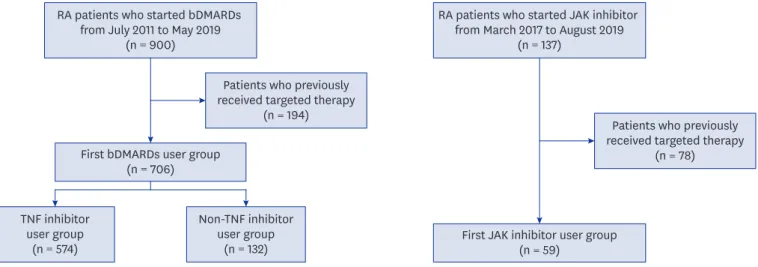
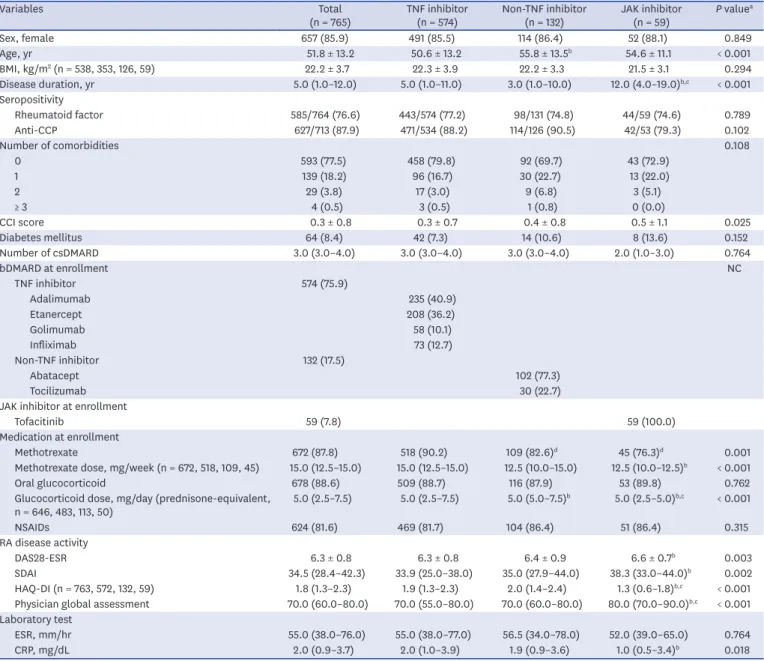
A total of 765 RA patients who started their first bDMARD or JAK inhibitor treatment (TNF inhibitors: n = 574, non-TNF inhibitors: n = 132, and JAK inhibitor: n = 59) were included in this study (Fig. 1). Baseline characteristics are described in Table 1. The mean age of the study population at the start of treatment was 51.8 (± 13.2) years, and 85.9% of the patients were female. Duration of RA was significantly longer in the JAK inhibitor group (12.0 [4.0–19.0]
years) than in the TNF inhibitor group (5.0 [1.0–11.0] years; P < 0.001) or the non-TNF inhibitor group (3.0 [1.0–10.0] years; P < 0.001).
In the TNF inhibitor group, adalimumab (40.9%) was the most common treatment followed by etanercept (36.2%), infliximab (12.7%), and golimumab (10.1%). In the non-TNF inhibitor group, abatacept (77.3%) was administered as a first-line therapy more frequently than tocilizumab (22.7%). All patients in the JAK inhibitor group received tofacitinib (100.0%).
RA disease activity was higher in the JAK inhibitor group than the TNF inhibitor group, as measured by the Disease Activity Score 28 with ESR (DAS28-ESR) (P = 0.003), and the Simple Disease Activity Index (SDAI) (P = 0.002). However, the Health Assessment Questionnaire- Disability Index (HAQ-DI) was lower in the JAK inhibitor group than the others (P < 0.001).
Visual analogue scale scores by physician's global assessment were higher in the JAK inhibitor group than the TNF inhibitor group (P < 0.001) or the non-TNF inhibitor group (P = 0.001) with significant differences.
Performance of LTBI screening tests
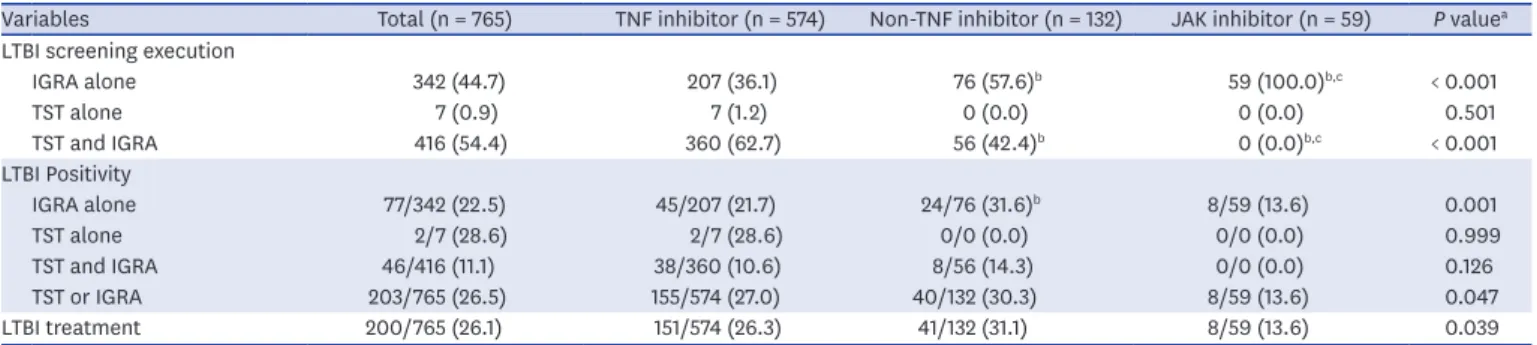
All 765 patients underwent at least one LTBI screening test. The QFT-GIT test was the most commonly used method of screening. Of the 765 patients, 758 (99.1%) had the IGRA test and 423 (59.9%) had the TST. The numbers of IGRA alone, TST alone, and the TST/IGRA
RA patients who started bDMARDs from July 2011 to May 2019
(n = 900)
Patients who previously received targeted therapy
(n = 194) First bDMARDs user group
(n = 706)
First JAK inhibitor user group (n = 59)
TNF inhibitor user group
(n = 574)
Non-TNF inhibitor user group
(n = 132)
RA patients who started JAK inhibitor from March 2017 to August 2019
(n = 137)
Patients who previously received targeted therapy
(n = 78)
Fig. 1. Flow diagram of patient selection.
RA = rheumatoid arthritis, bDMARDs = biologic disease-modifying antirheumatic drugs, TNF = tumor necrosis factor, JAK = Janus kinase.
two-step test are given in Table 2. There were 342 patients who received the QFT-GIT test only, 7 patients who received TST only, and 416 patients who received both. Only one patient received the T-SPOT.TB test, and this patient also received the QFT-GIT test in combination with the TST. The IGRA alone has most often been used for LTBI screening since 2017, so the JAK inhibitor group did not receive the TST.
Positivity for LTBI tests among all the patients based on at least one test was 26.5% (203/765).
Table 1. Baseline characteristics of the RA patients according to targeted therapy
Variables Total
(n = 765) TNF inhibitor
(n = 574) Non-TNF inhibitor
(n = 132) JAK inhibitor
(n = 59) P valuea
Sex, female 657 (85.9) 491 (85.5) 114 (86.4) 52 (88.1) 0.849
Age, yr 51.8 ± 13.2 50.6 ± 13.2 55.8 ± 13.5b 54.6 ± 11.1 < 0.001
BMI, kg/m2 (n = 538, 353, 126, 59) 22.2 ± 3.7 22.3 ± 3.9 22.2 ± 3.3 21.5 ± 3.1 0.294
Disease duration, yr 5.0 (1.0–12.0) 5.0 (1.0–11.0) 3.0 (1.0–10.0) 12.0 (4.0–19.0)b,c < 0.001
Seropositivity
Rheumatoid factor 585/764 (76.6) 443/574 (77.2) 98/131 (74.8) 44/59 (74.6) 0.789
Anti-CCP 627/713 (87.9) 471/534 (88.2) 114/126 (90.5) 42/53 (79.3) 0.102
Number of comorbidities 0.108
0 593 (77.5) 458 (79.8) 92 (69.7) 43 (72.9)
1 139 (18.2) 96 (16.7) 30 (22.7) 13 (22.0)
2 29 (3.8) 17 (3.0) 9 (6.8) 3 (5.1)
≥ 3 4 (0.5) 3 (0.5) 1 (0.8) 0 (0.0)
CCI score 0.3 ± 0.8 0.3 ± 0.7 0.4 ± 0.8 0.5 ± 1.1 0.025
Diabetes mellitus 64 (8.4) 42 (7.3) 14 (10.6) 8 (13.6) 0.152
Number of csDMARD 3.0 (3.0–4.0) 3.0 (3.0–4.0) 3.0 (3.0–4.0) 2.0 (1.0–3.0) 0.764
bDMARD at enrollment NC
TNF inhibitor 574 (75.9)
Adalimumab 235 (40.9)
Etanercept 208 (36.2)
Golimumab 58 (10.1)
Infliximab 73 (12.7)
Non-TNF inhibitor 132 (17.5)
Abatacept 102 (77.3)
Tocilizumab 30 (22.7)
JAK inhibitor at enrollment
Tofacitinib 59 (7.8) 59 (100.0)
Medication at enrollment
Methotrexate 672 (87.8) 518 (90.2) 109 (82.6)d 45 (76.3)d 0.001
Methotrexate dose, mg/week (n = 672, 518, 109, 45) 15.0 (12.5–15.0) 15.0 (12.5–15.0) 12.5 (10.0–15.0) 12.5 (10.0–12.5)b < 0.001
Oral glucocorticoid 678 (88.6) 509 (88.7) 116 (87.9) 53 (89.8) 0.762
Glucocorticoid dose, mg/day (prednisone-equivalent,
n = 646, 483, 113, 50) 5.0 (2.5–7.5) 5.0 (2.5–7.5) 5.0 (5.0–7.5)b 5.0 (2.5–5.0)b,c < 0.001
NSAIDs 624 (81.6) 469 (81.7) 104 (86.4) 51 (86.4) 0.315
RA disease activity
DAS28-ESR 6.3 ± 0.8 6.3 ± 0.8 6.4 ± 0.9 6.6 ± 0.7b 0.003
SDAI 34.5 (28.4–42.3) 33.9 (25.0–38.0) 35.0 (27.9–44.0) 38.3 (33.0–44.0)b 0.002
HAQ-DI (n = 763, 572, 132, 59) 1.8 (1.3–2.3) 1.9 (1.3–2.3) 2.0 (1.4–2.4) 1.3 (0.6–1.8)b,c < 0.001 Physician global assessment 70.0 (60.0–80.0) 70.0 (55.0–80.0) 70.0 (60.0–80.0) 80.0 (70.0–90.0)b,c < 0.001 Laboratory test
ESR, mm/hr 55.0 (38.0–76.0) 55.0 (38.0–77.0) 56.5 (34.0–78.0) 52.0 (39.0–65.0) 0.764
CRP, mg/dL 2.0 (0.9–3.7) 2.0 (1.0–3.9) 1.9 (0.9–3.6) 1.0 (0.5–3.4)b 0.018
Values are presented as means ± standard deviations, medians (interquartile ranges) or numbers (%).
NC = not calculated, RA = rheumatoid arthritis, TNF = tumor necrosis factor, JAK = Janus kinase, BMI = body-mass index, Anti-CCP = anti-cyclic citrullinated peptide, CCI = Charlson comorbidity index, csDMARDs = conventional synthetic disease-modifying antirheumatic drugs, bDMARDs = biologic DMARDs, NSAIDs = nonsteroidal anti-inflammatory drugs, DAS = disease activity score, ESR = erythrocyte sedimentation rate, SDAI = simple disease activity index, HAQ-DI = health assessment questionnaire-disability index. CRP = C-reactive protein.
aComparison among three groups: the chi-square test or Fisher's exact test for categorical variables and Kruskal-Wallis test for continuous variables;
bSignificantly different compared with TNF inhibitor group by the Dwass-Steel-Critchlow-Fligner test as a post-hoc comparison; cSignificantly different compared with non-TNF inhibitor group by the Dwass-Steel-Critchlow-Fligner test as a post-hoc comparison; dSignificantly different compared with TNF inhibitor group as a post-hoc comparison after chi-square test (Bonferroni correction).
Positivity rates for the individual LTBI tests were 21.8% (165/758) for QFT-GIT and 19.9%
(84/423) for TST. Positivity for IGRA in patients who received only IGRA was 21.7% in the TNF inhibitor group, 31.6% in the non-TNF inhibitor group, and 13.6% in the JAK inhibitor group.
The IGRA results were indeterminate in 18 of the 416 patients who received both TST and IGRA. After excluding those 18 patients, we assessed the agreement between TST and IGRA and found moderate agreement (Cohen's κ = 0.432, Table 3). Of the RA patients with positive IGRA results, 52.3% (46/88) were positive for the TST. In contrast, only 10.6% (33/310) of those with negative IGRA results were positive on TST.
LTBI treatment for RA patients initiating targeted therapy
A total of 189 patients (93.1%) of the 203 patients who tested positive on LTBI screening test received LTBI treatment. Of the 14 patients who did not receive treatment despite their positive LTBI tests, 5 had a history of active TB and completion of anti-TB medication, and 5 patients tested positive on the TST and negative on the IGRA. The other 4 patients tested positive on IGRA alone but did not receive any LTBI treatment; no reason was recorded.
In contrast, 7 patients who were negative for LTBI screening received treatment; 3 patients presented with TB scarring on chest radiography but did not have a definite history of active TB;
3 patients had a previous positive IGRA, and 1 patient had an induration of 9 mm on the TST.
All patients receiving LTBI treatment were given isoniazid (INH) except one who received rifampin after developing urticaria on INH. In accordance with the guidelines, INH was used for 9 months and rifampin for 4 months.9
Table 2. Rates of execution and positivity of LTBI screening tests, and rates of treatment in RA patients according to targeted therapy
Variables Total (n = 765) TNF inhibitor (n = 574) Non-TNF inhibitor (n = 132) JAK inhibitor (n = 59) P valuea LTBI screening execution
IGRA alone 342 (44.7) 207 (36.1) 76 (57.6)b 59 (100.0)b,c < 0.001
TST alone 7 (0.9) 7 (1.2) 0 (0.0) 0 (0.0) 0.501
TST and IGRA 416 (54.4) 360 (62.7) 56 (42.4)b 0 (0.0)b,c < 0.001
LTBI Positivity
IGRA alone 77/342 (22.5) 45/207 (21.7) 24/76 (31.6)b 8/59 (13.6) 0.001
TST alone 2/7 (28.6) 2/7 (28.6) 0/0 (0.0) 0/0 (0.0) 0.999
TST and IGRA 46/416 (11.1) 38/360 (10.6) 8/56 (14.3) 0/0 (0.0) 0.126
TST or IGRA 203/765 (26.5) 155/574 (27.0) 40/132 (30.3) 8/59 (13.6) 0.047
LTBI treatment 200/765 (26.1) 151/574 (26.3) 41/132 (31.1) 8/59 (13.6) 0.039
Values are presented as numbers (%).
LTBI = latent tuberculosis infection, RA = rheumatoid arthritis, TNF = tumor necrosis factor, JAK = Janus kinase, IGRA = interferon gamma release assay, TST = tuberculin skin test.
aComparison among three groups: the chi-square test or Fisher's exact test; bSignificantly different compared with TNF inhibitor group as a post-hoc comparison after chi-square test (Bonferroni correction); cSignificantly different compared with non-TNF inhibitor group as a post-hoc comparison after chi-square test (Bonferroni correction).
Table 3. Agreement between TST and IGRA
LTBI screening test IGRA positive IGRA negative Total Kappa
TST positive 46 (11.6) 33 (8.3) 79 (19.8) 0.432
TST negative 42 (10.6) 277 (69.6) 319 (80.2)
Total 88 (22.1) 310 (77.9) 398 (100.0)
Values are presented as numbers (%).
TST = tuberculin skin test, IGRA = interferon gamma release assay, LTBI = latent tuberculosis infection, Kappa = Cohen's kappa.
Risk of TB development during first targeted therapy
During the 1,573.2 PYs of follow-up, only one patient in the TNF inhibitor group developed active TB (1,255.2 PYs); none developed active TB in the non-TNF inhibitor (264.7 PYs) and JAK inhibitor (53.3 PYs) groups. The incidence rate was 63.6 per 100,000 PYs (95% CI, 3.2–313.5). The patient who developed TB was diagnosed with pulmonary TB after 7 months of adalimumab use. She did not receive LTBI treatment because her IGRA result was negative, though her induration result for TST was 10 mm.
DISCUSSION
In this study, we estimated that 26.5% of RA patients initiating bDMARD or JAK inhibitor treatment had LTBI. There was no significant difference in LTBI prevalence among the RA patients starting TNF inhibitors, non-TNF inhibitors, or JAK inhibitors. Most patients were appropriately treated according to the guidelines, and LTBI treatment was mainly with INH. Consequently, the active TB incidence rate during the first targeted therapy was low (63.6/100,000 PYs).
There have been 6 previous studies of LTBI prevalence and TB incidence in RA patients using bDMARDs in Korea,16-21 and we conducted a literature review of those studies (Table 4). LTBI prevalence in RA patients ranged from 19.4% to 47.7% in those studies, compared with our 26.5% prevalence among all patients. TB incidence rates in previous studies (313.8–1,317.0 per 100,000 PYs) were higher than in our study in point estimates (63.6 per 100,000 PYs).
It is possible that this low incidence, even with the relatively large numbers of patients, was because the study population was limited to first users of targeted therapy or because our institution screened and treated LTBI rigorously in accordance with clinical practice guidelines. It is important to note that the TB incidence rate has not increased recently, even though only IGRA has been used since the Korean guidelines for TB were released in 2017.
There was one case of active TB development in the TNF inhibitor group; this can be explained in two ways.
Table 4. Literature review on LTBI prevalence and TB incidence in patients with RA receiving targeted therapy in Korea Study, year Study population Targeted therapy Enrollment period LTBI prevalence
(%) LTBI treatment rate
(%) TB incidence rate (95% CI) Seong et al., 200716 193 RA Infliximab, Etanercept Jan 2001–Dec 2005 Infliximab: 29.6 Infliximab: 12.2 1,317.0/100,000 PYs
(220.8–4352.0)a Etanercept: 33.7 Etanercept: 24.3
Kim et al., 201417 222 RA Infliximab, Etanercept,
Adalimumab, Golimumab Jan 2001–Aug 2011 25.2 25.2 771.6/100,000 PYs
(337.5–1526.0) Sung et al., 201518 355 RA Infliximab, Etanercept,
Adalimumab Dec 2000–Jun 2011 19.4 29.6 313.8/100,000 PYs
(52.6–1037.0)a Lee et al., 201519 342 RA or AS Infliximab, Etanercept,
Adalimumab Aug 2007–Oct 2013 47.7 47.7 410.9/100,000 PYs
(150.5–910.7)a Cho et al., 201720 4,638 RA Infliximab, Etanercept,
Adalimumab, Golimumab Jan 2009–Dec 2013 Not available 22.3 948.3/100,000 PYs (758.0–1172.0) Jeong et al., 201821 476 RA or AS Infliximab, Etanercept,
Adalimumab, Golimumab Jan 2011–Jun 2017 42.9 39.9 2 patientsb
Our study 765 RA Infliximab, Etanercept,
Adalimumab, Golimumab, Abatacept, Tocilizumab, Tofacitinib
Jul 2011–Aug 2019 26.5 26.1 63.6/100,000 PYs
(3.2–313.5)
LTBI = latent tuberculosis infection, TB = tuberculosis, RA = rheumatoid arthritis, CI = confidence interval, AS = ankylosing spondylitis.
aSource: Own calculation. Open source statistics for public health was used (https://www.openepi.com/PersonTime1/PersonTime1.htm); bObservation period was not available.
First, using a TNF inhibitor might create a higher risk of TB activation than using a non-TNF inhibitor or a JAK inhibitor, because there were no instances of active TB development in the latter groups. TNF inhibitors are known to facilitate LTBI progression to active TB by inhibiting phagosome maturation and inducing T-cell apoptosis, complement-dependent cytotoxicity, and antibody-dependent cell-mediated cytotoxicity, all increasing susceptibility to TB reactivation.22 On the other hand, it is not yet clear how JAK inhibitors increase the incidence of TB or other infections.23 However, non-TNF inhibitors or JAK inhibitors cannot be considered safer than TNF inhibitors based on our study because of the differences in LTBI positivity and follow-up duration between the groups. The positivity rates for IGRA test on its own were 21.7% (TNF inhibitor group), 31.6% (non-TNF inhibitor group), and 13.6% (JAK inhibitor group), indicating that RA patients who had been IGRA positive were more likely to have been treated with non-TNF inhibitors and least likely to have been treated with JAK inhibitors. Moreover, the follow-up duration for JAK inhibitor use was only 53.3 PYs, while that for bDMARDs was 1,519.9 PYs. Therefore, further long-term study of treatment safety is required to elucidate the risk of active TB development in JAK inhibitor users.
Second, the diagnostic performance of each LTBI screening test should be considered. One patient who developed active TB was negative on the IGRA and equivocal on the TST with an induration of 10 mm. This raises the question of whether it is appropriate to not treat LTBI in patients who are shown to be negative by IGRA alone. According to the current Korean guidelines for TB published in 2017, patients initiating TNF inhibitors can be diagnosed with LTBI by the TST/IGRA two-step test or IGRA alone, which is the same as for immunocompromised patients.9 As many studies continue to confirm the efficiency of the IGRA, an increasing number of patients undergo IGRA alone for LTBI screening.16,19 Although the agreement between TST and IGRA results is moderate or low,24-27 LTBI screening based on IGRA can sufficiently lower TB incidence, as this study demonstrates.
Further research is needed regarding screening for LTBI with the TST/IGRA two-step test versus IGRA alone. There should also be renewed debate regarding the need to repeat LTBI screening to identify newly developed TB infection in patients using TNF inhibitors, non-TNF inhibitors, and JAK inhibitors for long durations.28
Of the 197 patients who received LTBI treatment, 196 received INH monotherapy. INH is a major drug in LTBI treatment, but the long regimen duration (6–9 months) reduces compliance.29,30 Although INH treatment is associated with liver-function test abnormalities, our previous work showed that it does not lead to discontinuation of bDMARDs.31 In the present study, none of the patients who received INH monotherapy developed active TB.
This means that INH monotherapy is effective as an LTBI treatment, but further research is needed on the long-term effects in patients receiving targeted therapy, especially patients who received sequential treatment with bDMARDs and JAK inhibitors.
Our study has several limitations. First, the observation period was limited to the period when the first bDMARD or JAK inhibitor was used. A short observation period, especially for JAK inhibitors, might have resulted in measuring a low active TB incidence. However, in previous studies, the median times between TB infection and treatment with bDMARDs and JAK inhibitors in RA patients were 7.9 months (95% CI, 4.0–36.1) and 64 weeks (range, 15–161), respectively.11,29 Thus, the results from this study are still valuable. The safety of JAK inhibitors should be evaluated in a future study where long-term data are collected. Second, patients often receive more than one bDMARD or JAK inhibitor, but that was not reflected in this study. Further research is needed on how sequential treatment with bDMARDs and
JAK inhibitors and continuous exposure to these substance affects TB activation. Third, it is difficult to generalize from our results because data were collected from a single institution, which may have introduced a selection bias that influenced active TB incidence.
In conclusion, TB incidence in RA patients receiving TNF inhibitor, non-TNF inhibitor, or JAK inhibitor treatment was low. LTBI screening and treatment with INH according to the Korean guidelines are appropriate. However, further study is needed to evaluate the efficacy of IGRA on its own for screening LTBI, and to evaluate the long-term risk of TB development in patients who use JAK inhibitors.
ACKNOWLEDGMENTS
We would like to thank eWorldEditing (www.eworldediting.com) for editing and reviewing this manuscript for English language.
REFERENCES
1. Doran MF, Crowson CS, Pond GR, O'Fallon WM, Gabriel SE. Frequency of infection in patients with rheumatoid arthritis compared with controls: a population-based study. Arthritis Rheum 2002;46(9):2287-93.
PUBMED | CROSSREF
2. Shim TS. Diagnosis and treatment of latent tuberculosis infection due to initiation of anti-tnf therapy.
Tuberc Respir Dis (Seoul) 2014;76(6):261-8.
PUBMED | CROSSREF
3. Jeon D. Latent tuberculosis infection: recent progress and challenges in South Korea. Korean J Intern Med 2020;35(2):269-75.
PUBMED | CROSSREF
4. Iannone F, Cantini F, Lapadula G. Diagnosis of latent tuberculosis and prevention of reactivation in rheumatic patients receiving biologic therapy: international recommendations. J Rheumatol Suppl 2014;91(0):41-6.
PUBMED | CROSSREF
5. Ponce de León D, Acevedo-Vásquez E, Sánchez-Torres A, Cucho M, Alfaro J, Perich R, et al. Attenuated response to purified protein derivative in patients with rheumatoid arthritis: study in a population with a high prevalence of tuberculosis. Ann Rheum Dis 2005;64(9):1360-1.
PUBMED | CROSSREF
6. Pai M, Zwerling A, Menzies D. Systematic review: T-cell-based assays for the diagnosis of latent tuberculosis infection: an update. Ann Intern Med 2008;149(3):177-84.
PUBMED | CROSSREF
7. Dewan PK, Grinsdale J, Liska S, Wong E, Fallstad R, Kawamura LM. Feasibility, acceptability, and cost of tuberculosis testing by whole-blood interferon-gamma assay. BMC Infect Dis 2006;6(1):47.
PUBMED | CROSSREF
8. World Health Organization. Latent Tuberculosis Infection: Updated and Consolidated Guidelines for Programmatic Management. Geneva: World Health Organization; 2018.
9. Joint Committee for the Revision of Korean Guidelines for Tuberculosis, Korea Centers for Disease Control and Prevention. Korean Guidelines for Tuberculosis. 3rd ed. Cheongju: Korea Centers for Disease Control and Prevention; 2017.
10. Singh JA, Saag KG, Bridges SL Jr, Akl EA, Bannuru RR, Sullivan MC, et al. 2015 American College of Rheumatology Guideline for the treatment of rheumatoid arthritis. Arthritis Care Res (Hoboken) 2016;68(1):1-25.
PUBMED | CROSSREF
11. Winthrop KL, Park SH, Gul A, Cardiel MH, Gomez-Reino JJ, Tanaka Y, et al. Tuberculosis and other opportunistic infections in tofacitinib-treated patients with rheumatoid arthritis. Ann Rheum Dis 2016;75(6):1133-8.
PUBMED | CROSSREF
12. Maiga M, Lun S, Guo H, Winglee K, Ammerman NC, Bishai WR. Risk of tuberculosis reactivation with tofacitinib (CP-690550). J Infect Dis 2012;205(11):1705-8.
PUBMED | CROSSREF
13. Joint Committee for the Revision of Korean Guidelines for Tuberculosis, Korea Centers for Disease Control and Prevention. Korean Guidelines for Tuberculosis. 1st ed. Seoul: Joint Committee for the Revision of Korean Guidelines for Tuberculosis; 2011
14. Takahashi H, Shigehara K, Yamamoto M, Suzuki C, Naishiro Y, Tamura Y, et al. Interferon gamma assay for detecting latent tuberculosis infection in rheumatoid arthritis patients during infliximab administration. Rheumatol Int 2007;27(12):1143-8.
PUBMED | CROSSREF
15. Lee KH, Jung SY, Ha YJ, Lee SK, Park YB. Tuberculin reaction is not attenuated in patients with rheumatoid arthritis living in a region with intermediate burden of tuberculosis. Rheumatol Int 2012;32(5):1421-4.
PUBMED | CROSSREF
16. Seong SS, Choi CB, Woo JH, Bae KW, Joung CL, Uhm WS, et al. Incidence of tuberculosis in Korean patients with rheumatoid arthritis (RA): effects of RA itself and of tumor necrosis factor blockers. J Rheumatol 2007;34(4):706-11.
PUBMED
17. Kim HW, Park JK, Yang JA, Yoon YI, Lee EY, Song YW, et al. Comparison of tuberculosis incidence in ankylosing spondylitis and rheumatoid arthritis during tumor necrosis factor inhibitor treatment in an intermediate burden area. Clin Rheumatol 2014;33(9):1307-12.
PUBMED | CROSSREF
18. Sung YK, Cho SK, Won S, Choi CB, Kim TH, Jun JB, et al. Incidence of tuberculosis in rheumatoid arthritis patients using anti-tumor necrosis factor agents following latent tuberculosis infection screening strategies. J Rheum Dis 2015;22(4):223-30.
CROSSREF
19. Lee H, Park HY, Jeon K, Jeong BH, Hwang JW, Lee J, et al. QuantiFERON-TB Gold In-Tube assay for screening arthritis patients for latent tuberculosis infection before starting anti-tumor necrosis factor treatment. PLoS One 2015;10(3):e0119260.
PUBMED | CROSSREF
20. Cho SK, Kim D, Won S, Han M, Lee J, Jang EJ, et al. Safety of resuming biologic DMARDs in patients who develop tuberculosis after anti-TNF treatment. Semin Arthritis Rheum 2017;47(1):102-7.
PUBMED | CROSSREF
21. Jeong DH, Kang J, Jung YJ, Yoo B, Lee CK, Kim YG, et al. Comparison of latent tuberculosis infection screening strategies before tumor necrosis factor inhibitor treatment in inflammatory arthritis: IGRA- alone versus combination of TST and IGRA. PLoS One 2018;13(7):e0198756.
PUBMED | CROSSREF
22. Harris J, Keane J. How tumour necrosis factor blockers interfere with tuberculosis immunity. Clin Exp Immunol 2010;161(1):1-9.
PUBMED | CROSSREF
23. Ghoreschi K, Jesson MI, Li X, Lee JL, Ghosh S, Alsup JW, et al. Modulation of innate and adaptive immune responses by tofacitinib (CP-690,550). J Immunol 2011;186(7):4234-43.
PUBMED | CROSSREF
24. Kim JH, Cho SK, Han M, Choi CB, Kim TH, Jun JB, et al. Factors influencing discrepancies between the QuantiFERON-TB gold in tube test and the tuberculin skin test in Korean patients with rheumatic diseases. Semin Arthritis Rheum 2013;42(4):424-32.
PUBMED | CROSSREF
25. Pyo J, Cho SK, Kim D, Sung YK. Systemic review: agreement between the latent tuberculosis screening tests among patients with rheumatic diseases. Korean J Intern Med 2018;33(6):1241-51.
PUBMED | CROSSREF
26. Kang YA, Lee HW, Yoon HI, Cho B, Han SK, Shim YS, et al. Discrepancy between the tuberculin skin test and the whole-blood interferon gamma assay for the diagnosis of latent tuberculosis infection in an intermediate tuberculosis-burden country. JAMA 2005;293(22):2756-61.
PUBMED | CROSSREF
27. Lee JH, Sohn HS, Chun JH, Kim HA, Suh CH, Lee YW, et al. Poor agreement between QuantiFERON-TB Gold test and tuberculin skin test results for the diagnosis of latent tuberculosis infection in rheumatoid arthritis patients and healthy controls. Korean J Intern Med 2014;29(1):76-84.
PUBMED | CROSSREF
28. Son CN, Jun JB, Kim JH, Sung IH, Yoo DH, Kim TH. Follow-up testing of interferon-gamma release assays are useful in ankylosing spondylitis patients receiving anti-tumor necrosis factor alpha for latent tuberculosis infection. J Korean Med Sci 2014;29(8):1090-3.
PUBMED | CROSSREF
29. Kim HW, Kim JS. Treatment of latent tuberculosis infection and its clinical efficacy. Tuberc Respir Dis (Seoul) 2018;81(1):6-12.
PUBMED | CROSSREF
30. Yun JW, Lim SY, Suh GY, Chung MP, Kim H, Kwon OJ, et al. Diagnosis and treatment of latent tuberculosis infection in arthritis patients treated with tumor necrosis factor antagonists in Korea. J Korean Med Sci 2007;22(5):779-83.
PUBMED | CROSSREF
31. Sung YK, Cho SK, Kim D, Won S, Choi CB, Kim TH, et al. Isoniazid treatment for latent tuberculosis infection is tolerable for rheumatoid arthritis patients receiving tumor necrosis factor inhibitor therapy.
Korean J Intern Med 2018;33(5):1016-24.
PUBMED | CROSSREF