2020 Korean Society for Surgery of the Hand, Ko- rean Society for Microsurgery, and Korean Society for Surgery of the Peripheral Nerve. All Rights re- served.
This is an open-access article distributed under the terms of the Creative Commons Attribution Non-Commercial license (http://creativecommons.
org/licenses/by-nc/4.0/), which permits unrestricted non-commercial use, distribution, and reproduction in any medium, provided the original work is prop- erly cited.
INTRODUCTION
Deep inferior epigastric artery perforator (DIEP) flap surgery is one of the gold standards of immediate breast reconstruction. As DIEP flap gains its popularity, there are cases requiring both DIEP flap and laparoscopic surgery. As laparoscop- ic surgeries and abdomen-based flap surgeries share the field and put the patient at risk of vascular damage, there is a need to standardize multidisciplinary strate- gy before the operation. The purpose of this report is to introduce our novel meth- od of placing ports for laparoscopy and to share our experience in such cases.
CASE REPORT
A 45-year-old female patient, initially complained of a palpable mass in the right side of her breast, was diagnosed malignant spindle cell tumor which need- ed wide excision of skin on the superolateral side of the nipple. Supported by the patient’s own preference for autologous reconstruction, DIEP flap was selected.
The patient underwent preoperative computed tomographic (CT) angiography and hand held Doppler analysis for mapping perforators. During evaluation, mul-
시행에 대한 증례 보고
이재민, 이형철, 이병일, 박승하, 윤을식
고려대학교 안암병원 성형외과
Simultaneous Laparoscopic Surgery during Deep Inferior Epigastric Artery Perforator Flap Elevation: A Case Report
Jaemin Lee, Hyung Chul Lee, Byung-Il Lee, Seung-Ha Park, Eul-Sik Yoon
Department of Plastic and Reconstructive Surgery, Korea University Anam Hospital, Seoul, Korea As deep inferior epigastric artery perforator (DIEP) flap surgery is gaining popularity, more patients including BRCA-positive patients need simultaneous laparoscopic sur- gery. We share our experience on a patient who underwent concurrent laparoscopic hysterectomy during flap elevation with a novel method. A patient diagnosed with a right breast cancer also required laparoscopic hysterectomy due to multiple uterine myoma. After perforator mapping was performed, flap elevation through external oblique fascia level was carried out first, sparing the periumbilical perforator and su- perficial inferior epigastric vein. Three ports were inserted for laparoscopy on posterior fascia level in the periumbilical area, left upper quadrant area and suprapubic area.
The surgery was completed without any complication, gas leaks or vascular injury with the advantage of reduced risk of vascular damage and less surgical incision.
Keywords: Breast reconstruction, Mammaplasty, Laparoscopy pISSN 2586-3290 · eISSN 2586-3533
Arch Hand Microsurg 2020;25(2):146-150 https://doi.org/10.12790/ahm.20.0006
Received: January 31, 2020 Revised: February 12, 2020 Accepted: March 3, 2020 Corresponding author:
Hyung Chul Lee
Department of Plastic and
Reconstructive Surgery, Korea University Anam Hospital, 73 Goryeodae-ro, Seongbuk-gu, Seoul 02841, Korea Tel: +82-2-920-5440
Fax: +82-2-922-7437 E-mail: [email protected] ORCID:
https://orcid.org/0000-0003-2482-8112
Case Report
total hysterectomy and possible bilateral salpingo-oophorecto- my with laparoscopy.
Elevation of flap was planned to use a left side contralateral perforator which was 6 cm from the umbilicus (Fig. 1), while hysterectomy required transvaginal maneuver and 3 port routes—one periumbilical main port for endoscope and gas in- flation, a second port in the left quadrant area, and third one in the suprapubic area. Informed consent was obtained from the patient for all specialties prior to surgery.
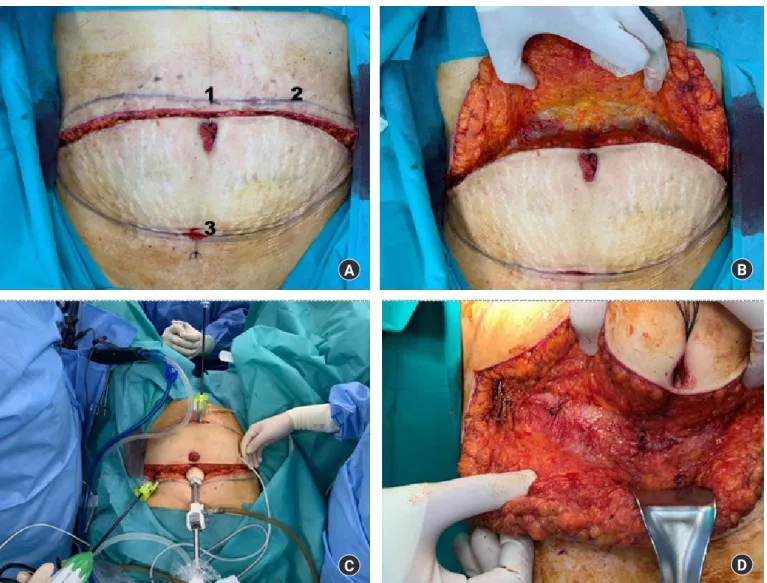
In the lithotomy position, an incision was made along the upper part of DIEP flap design and umbilicus. With adequate beveling of subcutaneous fat, dissection through the external oblique fascia was performed. A sufficient area near the umbi- licus was dissected to allow initial trocar puncture, then an in- cision along the lower border of the flap design was also made, followed by avoiding injury to the superficial inferior epigastric vein (SIEV) (Fig. 2). The gynecologic team stepped in for placement of the initial trocar in the periumbilical linea alba. A second and third port were also successfully placed on the level of the fascia.
Hysterectomy with salpingo-oophorectomy was performed without any unexpected events and with proper pneumoperi- toneum. Thirty-five minutes of dissection was needed before trocar insertion, and it took 125 minutes to finish laparoscopic surgery. All of posterior fascia was closed, and the skin was su- tured with a temporary stapler and Ioban drape (3M Corpo- rate, St. Paul, MN, USA) was applied. The patient was reposi- tioned and redraped. No perforator nor SIEV injury was ob- served during DIEP flap elevation.
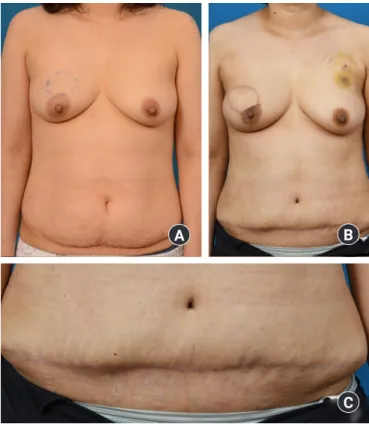
The concurrent breast reconstruction and mastectomy with laparoscopic surgery was successfully completed and the pa- tient discharged from hospital without any wounds or laparos- copy related complication. No additional postoperative care was needed and no other events or complications related to the surgery were noted after 6 months of follow-up in an outpatient clinic (Fig. 3).
DISCUSSION
Some patients encounter the choice of whether to have con- current laparoscopic surgery with DIEP flap. BRCA gene posi- tive patients receiving prophylactic oophorectomy are typical candidates. Some clinics would rather separate the procedures but there have been studies that show the possibilities of com- bined procedure despite of structural difficulties of a multidis-
ciplinary approach [1,2]. In some cases, surgery cannot be de- layed for long because of the patient’s emergent condition.
As abdomen-based flap surgery directly shares its surgical field with laparoscopic surgeries, the possibility of vascular in- jury has been outlined by several studies [2,3]. Flap perforators lie around the periumbilical area which is close to port. SIEV, which can be used in the supercharging flap, is also prone to damage. These injuries are most likely to occur during trocar insertion, but can also take place when the ports are pulled strenuously during surgery. However, most articles focus on the methods of laparoscopy after abdomen-based flap surgery.
There are few reports about concurrent surgery and abdo- men-based flap procedures. Spear et al. [1] mentioned in an ar- ticle that an oophorectomy can simultaneously done via direct incision through the external oblique fascia, as an open tech- nique without laparoscopy. Hunsinger et al. [2] described 8 cases of simultaneous laparoscopic oophorectomy with mastec- tomy and bilateral DIEP flap breast reconstruction in BRCA-positive patients. The authors place an initial port above the umbilicus to preserve perforator and lateral ports in an ab- dominoplasty scar. Therefore the method inevitably restricts
A
B Fig. 1. Computed tomographic angiography of the patient. (A) Perforator mapping for deep inferior epigastric artery perforator flap. (B) Multiple uterine myoma with secondary degeneration.
original laparoscopic port location.
The novel approach presented above has several advantages over the previous one. Because trocars are inserted after direct visualization of perforator vessel of flap above fascia level, the method definitely obviates the possibility of injury to the perfo- rators and protect them from traction injury. Main pedicle, deep inferior epigastric artery, is also preserved easily as its lo- cation becomes more apparent. Moreover, there is no addition- al scarring on the upper abdominoplasty flap or DIEP flap.
Otherwise, the injury of upper abdominal flap may lead to do- nor site dehiscence or necrosis. Also, as the safety of vascula- ture and the scar issue is guaranteed, it is possible to modify port placement to wherever surgeons feel comfortable for lapa- roscopic surgery, except a region where rectus muscle and main
A
C
B
D
Fig. 2. (A) Port placement plan after dissection through external oblique fascia (1, main port for endoscopy; 2, left upper quadrant port;
3, suprapubic port). (B) Dissection until external oblique fascia is reached. (C) Simultaneous laparoscopic surgery after port insertion. (D) Appropriate fascial closure after laparoscopic surgery.
artery lies under external oblique fascia. If laparoscopic team closes fascia before elevation of flap, there is also a possibility of tearing the site during the elevation of the DIEP flap, which can be prevented in the novel method (Fig. 1).
More cases are needed to establish the eligibility of the ap- proach and to compare operation times or complications.
Nonetheless, it could be uncomfortable for laparoscopic sur- geons performing abdominal surgery because ports on the fas- cia could be unusual for them. A temporary skin stapler could alleviate this problem. Concerns over structural limitations due to the discomfort caused by involving multiple teams may be voiced in clinical practice but standardizing protocol will help to overcome such impediments.
In conclusion, simultaneous laparoscopic surgery can be suc-
Fig. 3. Clinical photo of 45-year-old female patient received simultaneous laparoscopic surgery with deep inferior epigastric artery perforator flap: (A) preoperative, (B) postoperative 6 months, and (C) no additional scarring can be seen 6 months after operation.
duced risk of vascular damage and less surgical incision needed.
CONFLICTS OF INTEREST
The authors have nothing to disclose.
REFERENCES
1. Spear SL, Pennanen M, Barter J, Burke JB. Prophylactic mas- tectomy, oophorectomy, hysterectomy, and immediate trans- verse rectus abdominis muscle flap breast reconstruction in a BRCA-2-positive patient. Plast Reconstr Surg. 1999;103:548- 53.
2. Hunsinger V, Marchac AC, Derder M, et al. A new strategy for prophylactic surgery in BRCA women: combined mastec- tomy and laparoscopic salpingo-oophorectomy with immedi- ate reconstruction by double DIEP flap. Ann Chir Plast Es- thet. 2016;61:177-82.
3. Khansa I, Wang D, Coriddi M, Tiwari P. Timing of prophylac- tic hysterectomy-oophorectomy, mastectomy, and microsur- gical breast reconstruction in BRCA1 and BRCA2 carriers.
Microsurgery. 2014;34:271-6.
A
C B
심부하복벽천공지 피판과 복강경수술의 동시 시행에 대한 증례 보고
이재민, 이형철, 이병일, 박승하, 윤을식
고려대학교 안암병원 성형외과
유방재건에 심부하복벽천공지 피판술이 많이 사용되면서, BRCA 양성 환자처럼 동시 복강경 수술을 요하는 환자들 역시 늘고 있다. 본 증례보고에서는 새로운 방법으로 심부하복벽천공지 피판술과 복강경을 이용한 자궁절제술을 동시에 시행한 경험을 공유하고자 한다.
환자는 우측 유방암과 다발성 자궁근종으로 두 가지 수술을 동시에 시행해야 하는 상황에서 외복사근 깊이까지 피판을 거상한 이후, 천공지와 혈관을 보존한 상태에서 직접 근막을 통해서 3개의 공을 이용하여 복강경수술을 시행하였다. 수술 당시 가스누출이나 혈관손상은 발생하지 않았으며, 적은 수술 흉터와 혈관 보존 하에 수술을 진행할 수 있었고, 합병증은 관찰되지 않았다.
색인단어: 심부하복벽천공지 피판, 유방재건, 복강경
접수일 2020년 1월 31일 수정일 2020년 2월 12일 게재확정일 2020년 3월 3일 교신저자 이형철
02841, 서울시 성북구 고려대로 73, 고려대학교 안암병원 성형외과
TEL 02-920-5440 FAX 02-922-7437 E-mail [email protected] ORCID https://orcid.org/0000-0003-2482-8112