Journal of Information Science Theory and Practice http://dx.doi.org/10.1633/JISTaP.2014.2.2.5
Internet Access and Use among Students of Physical
Education: A Study of Kurukshetra University, Kurukshetra
Rajender Kumar *
Panipat Institute of Engineering & Technology Haryana, India
E-mail: [email protected]
Open Access
Accepted date: June 21, 2014 Received date: January 29, 2014 *Corresponding Author: Rajender Kumar
Librarian
Panipat Institute of Engineering & Technology Haryana, India
E-mail: [email protected]
All JISTaP content is Open Access, meaning it is accessible online to everyone, without fee and authors’ permission. All JISTaP content is published and distributed under the terms of the Creative Commons Attribution License (http:/ creativecommons. org/licenses/by/3.0/). Under this license, authors reserve the copyright for their content; however, they permit anyone to unrestrictedly use, distribute, and reproduce the content in any medium as far as the original authors and source are cited. For any reuse, redistribution, or reproduction of a work, users must clarify the license terms under which the work was produced. ABSTRACT
This paper depicts a study conducted on the behavior of physical education students towards Internet usage at Kurukshetra University, Kurukshetra. Specially, the study aims to know the purposes for use of Internet resourc-es and servicresourc-es, frequency of use, placresourc-es and means of use, student’s satisfaction level toward the Internet, and problems faced while using the Internet. A survey was carried out with a sample of 100 physical education stu-dents of Kurukshetra University and the response rate was 88%. A well-designed questionnaire was distributed to the students’ sample. Amazingly, the results of the study reveal that usage of the Internet in research and ed-ucation was not favored, whereas email, chatting, and sports websites were commonly used among students. The study also found that too much information on the Internet, slow access speeds, and finding relevant infor-mation were the main problems in using the Internet.
Keywords: Internet, Search engine, Internet Resource, Internet usage, Kurukshetra University
1. INTRODUCTION
The Internet has become the most famous inven-tion in modern technology and the informainven-tion revolution. The Internet plays a big role in the future
social, economic, and educational plans of a nation. The modern education system is also affected by the evolvement of the Internet. There is no question that the Internet has changed students’ lives. Cur-rently, the Internet has attracted great interest in all
branches of students and is supporting the growth of their educational proficiency. The Internet offers more information resources and services for every subject that is valuable to students than the largest print collection and permits access without time and physical boundary restrictions from anywhere. The 21st century student’s generation is known as the In-ternet generation. They are able to use various tools to locate and handle information to make new data, and to explore and understand the meaning. Use of the Internet by students in physical education can have numerous benefits such as the ability to create newsletters, sports diaries and posters concerning their own prosperity, and to create new programs to benefit others compared to the traditional system.
In addition, Internet technology provides an online health care platform of physical activity to the students. They can easily implement it in their daily routine and learn about diet for fitness as well as programs for weight / performance for analyzing body composition. Through available physical education and sports infor-mation on the Internet, they can easily learn more about other people’s skills and learn to accept loss, respect the rights of other means to assist each other, and to understand the duty and responsibility of suitable meth-ods under different situations (Yaman, 2008). Physical education is a process that aims to improve human per-formance through physical activities involving powers and skills, competition, strategy, and others including organized and recreational sports, as well as sports as entertainment (Yaman, 2007). Students use the Internet to communicate not only with colleagues, but also with their instructors (Kumar, 2013).
2. BACKGROUND
Kurukshetra University is the oldest university in Haryana state, founded in 1956 by the late Dr. Rajen-dra Prasad (first President of India). The university campus is spread over 400 acres close to the western bank of Brahm Sarover in the holy city of Kurukshet-ra, land of the historical battle of ‘Mahabharata’ and the great message of Bhagwad Gita. The university was started with only the Department of Sanskrit. In 1973, the Department of Physical Education was initiated by the university. At present the physical
ed-ucation department offers degree, diploma, and cer-tificate courses such as M.P. Ed. (43 students in first year and 45 in second year), B.P. Ed. (29), P.G. Dip. in Yoga (45), and Ph. D (5). 167 is the total strength of students in the physical education department. The university also provides a multi-facility playground for different sports persons as well as for students’ evening practice classes. The university has Internet connectivity (10 Mbps leased line) in almost all the teaching and non-teaching departments, hostels, and the entire campus through a WI-FI Internet connec-tion (http://www.kuk.ac.in/).
3. LITERATURE REVIEW
Internet usage is the top priority among today’s student community, and several studies have been conducted on the uses of the Internet by students pur-suing various activities, such as Moreno et al. (2013), who examined associations of college student Internet use with physical activity and fitness in a large state university and found 3.2 mean (SD = 2.0) of low In-ternet users for vigorous intensity exercise. For mod-erate Internet users the mean number of days was 2.9 (SD = 2.0). The study also found that Internet use was not significantly associated with physical activity or moderate intensity exercise; students of high levels of Internet use focused on academic tasks were almost on social networking sites. Hadagali et al. (2013) in a study of Internet use by P.G. students of six state uni-versities of Karnataka, found that students preferred the department for accessing the Internet for e-mail. The study also shows that slow speed of Internet connection was the major problem while accessing the Internet by students. Kumar (2013), in research carried out on Internet facility usage among students in Kurukshetra University Kurukshetra, found that the majority of the students use the Internet daily at the central library. All students used the Internet for e-mail, for education, and for research purposes, whereas the study revealed that slow access speed, insufficient allotted time slots, and too much informa-tion available on the Internet were problems faced by students while using the Internet.
Herguner (2011) conducted a survey to examine views of the researchers of physical education and sports
teaching on social networking sites by conducting an interview and questionnaire method. The survey found that the Internet is used by physical researchers for login SNS, to know what their friends are doing and to be informed about sports organizations. Researchers are found to be very conscious towards the Internet. Muni-andy (2010) carried out a study and found that students mostly used the Internet for finding information from web sites, downloading notes, communicating with friends, and searching books in the library. The result of study indicates that 94% of students were good users in downloading information, but not at uploading in-formation. Maharana et al. (2010) observed that about half of the respondents have been using the Internet for an average for two to four years for 2-4 hours a week. Fifty percent of students use e-mail two to three times a week. 80% of students have the opinion that the In-ternet is time saving and less expensive as compared to conventional documents. Salaam and Adegbare (2010) found that a majority of students use Internet resources and services for academic purposes only. In a conducted study by Malik and Mahood (2009), the result shows that a maximum of students searched the web at home and 31% of students used it once a day, while 13.5% of students used the Internet throughout the day. A large number of students (75%) used the Internet for academ-ic and research work. 97% of students liked to search the Google search engine. Yaman (2007) investigated phys-ical education students’ attitudes about the Internet in Sakarya University, Turkey and found that the students were strongly agreed on having Internet-fluent attitudes. The results of the study with calculation of t-test show that foreign language is not a barrier to use the Internet and strongly agree with the conclusion that the Inter-net is a universal library (88.0%); is a digital place that creates close relationship among societies (94%); and it prvides learning for people in order to search (85.0%).
4. NEED FOR THE STUDY
India has one of the leading higher education sys-tems across the globe. The Internet offers a large num-ber of e-resources and services to students and has changed the image of information retrieval and elevat-ed user expectations. Several earlier studies conductelevat-ed outside of India have also shown that there is a
signifi-cant amount of rapidly increasing Internet use among physical education students. In India, much less effort has been made by researchers to examine Internet us-age attitude of physical education students. It is neces-sary to examine Internet access and usage by students of physical education of Kurukshetra University.
5. OBJECTIVE OF THE STUDY
The main objective is to explore Internet access by students of physical education in Kurukshetra Uni-versity. It is expected that the results of the study may help to achieve the following sub-objectives.
• To know the perfect location and means to use the Internet by students;
• To know how much time is spent on the Internet by students;
• To find out the purpose for using the Internet by students;
• To know which type of Internet resources and ser-vices are used by students;
• To find out which search engine are used by stu-dents;
• To identify which websites are used by the students under study;
• To explore the problems faced by the students while using the Internet;
• To know the satisfaction level of physical education students with the Internet.
6. SCOPE AND METHODOLOGY
In this study, a descriptive survey research design was used in order to know Internet usage behavior of the physical education students of Kurukshetra Uni-versity, Kurukshetra. Considering the objectives of the study, a structured questionnaire was developed and used to collect data for this study. 100 questionnaires were distributed among those students who were in their departments and present at the playground for their evening practice class. The questionnaires were filled and returned immediately by 69 of the male (38 from P.G., 18 from U.G., and 13 from Yoga) and 19 of the female (11 from P.G., 6 from U.G., and 2 from Yoga) students, with a response rate of 88%. The
col-lected data was organized and presented in table and graph form by using a percentage method as well as calculated mean deviations and standard deviations.
7. DATA ANALYSIS
Table 1 presents Internet usage in different location by the students. The study found that a maximum numbers of students access the Internet on their own cell phones. The university central library is also the second place of the students to use the Internet. The study also found that 13.64% of students use the Inter-net in hostels on their laptop. The table shows that few numbers of students use the Internet in the Internet lab, department, and home. The study also made a
at-tempt to find the frequency of Internet usage and found that 42.04% of the students use the Internet daily, and 21.6% of the students use the Internet once a fortnight, followed by once a week (20.46%), whereas 9.1% and 6.8% of the students use the Internet rarely, and once a month, respectively.
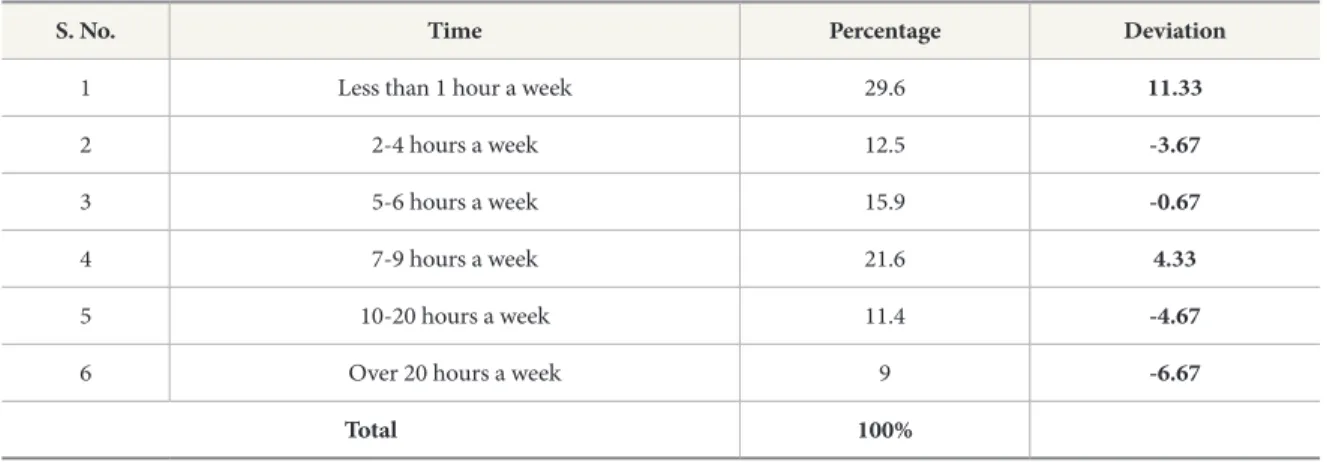
The question was asked to the students how much time is spent on the Internet per week. It is noted from Table 2 that 29.6% of the students spend less than 1 hour a week on the Internet, 21.6% spend 7-9 hours per week, 15.9% spend 5-6 hours per week, 12.5% spend 2-4 hours a week, 11.4% spend 10-20 hours, a week and 9% spend over 20 hours per week. Time spent on the Internet, i.e. 2-4 hours a week, 5-6 hours a week, 10-20 hours a week, and over 20 hours a week were less from the average value of students.
Table 1. Location/means and Frequency of Internet Use
Internet Usage Daily Once a Week FortnightOnce a Once a month Rarely Total
Me
an
s
On Cell Phone 14 (15.9%) 8 (9.09%) 9 (10.23%) 3 (3.41%) 4 (4.55%) 38 (43.18%)
Own laptops in hostel 12 (13.64%) --- --- --- --- 12 (13.64%)
Loc atio n Internet Lab --- --- 2 (2.3%) 1 (1.1%) --- 3 (3.41%) Central Library 9 (10.23%) 7 (7.96%) 6 (6.8%) 2 (2.3%) 2 (2.3%) 26 (29.55%) Department --- --- --- --- 2 (2.3%) 2 (2.27%) Home 2 (2.27%) 3 (3.41%) 2 (2.27%) --- --- 7 (7.95%) Total 37 (42.04%) 18 (20.46%) 19 (21.6%) 6 (6.8%) 8 (9.1%) 88 (100%)
Table 2. Time Spent in Weeks Using the Internet
S. No. Time Percentage Deviation
1 Less than 1 hour a week 29.6 11.33
2 2-4 hours a week 12.5 -3.67
3 5-6 hours a week 15.9 -0.67
4 7-9 hours a week 21.6 4.33
5 10-20 hours a week 11.4 -4.67
6 Over 20 hours a week 9 -6.67
Total 100%
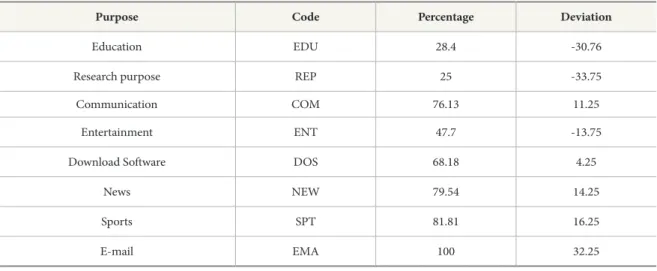
Students were asked the question what is the pur-pose of their Internet use; Table 3 points out that all the students use the Internet for e-mail followed by Sports (81.81%), News (79.54%), Communication (76.13%), Downloading Software (68.18%), and Entertainment (47.7%), whereas 28.4% of the students used the Inter-net for Education purposes followed by Research work
(25%).
It may be noted from Figure 1 that the number of people using the Internet for education, research pur-poses, and entertainment are below the average values, while most of the people used the Internet for commu-nication, news, sports, and email.
Fig. 1 Purpose of Internet use Table 3. Purpose of Internet Use
Purpose Code Percentage Deviation
Education EDU 28.4 -30.76
Research purpose REP 25 -33.75
Communication COM 76.13 11.25
Entertainment ENT 47.7 -13.75
Download Software DOS 68.18 4.25
News NEW 79.54 14.25
Sports SPT 81.81 16.25
E-mail EMA 100 32.25
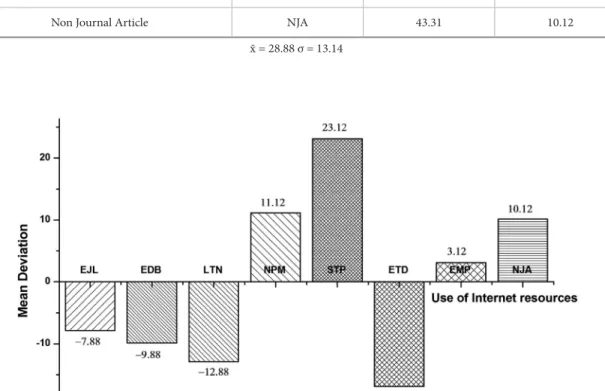
While the Internet provides lots of resource facilities to the users, the study’s purpose is to explore which type of Internet resources are used by the students, and the result of the study shows in Table 4 that 59.1% of the students use Sport Reports, 45.45% use News Papers/ Magazines, 43.31% use Non-Journal Articles, and 36.36% use E-maps. E-journals, E-Databases, Lec-ture notes, and E-Theses and Dissertations are used by
small numbers of students.
Figure 2 shows the Internet resources that are used by students from the above and below of the average value. E-Journals, E-Databases, Lecture notes, and E-Theses and Dissertations are below the average value, meaning that these resources are used by fewer numbers of students.
Fig. 2 Use of Internet resources Table 4. Use of Internet resources
Internet Resources Code Percentage Deviation
E-Journals EJL 23.86 -7.88
E-Database EDB 21.59 -9.88
Lecture notes LTN 18.18 -12.88
News Paper/ Magazines NPM 45.45 11.12
Sport Report STP 59.1 23.12
E-Thesis and Dissertations ETD 13.63 -16.88
E-maps EMP 36.36 3.12
Non Journal Article NJA 43.31 10.12
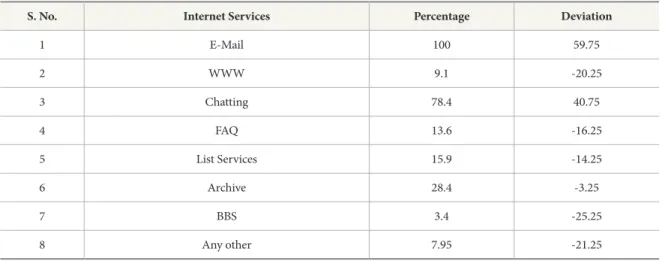
Table 5 reveals that e-mail (mean deviation = 59.75) and chatting Internet services (mean deviation = 40.75) are used by students very frequently, whereas other Internet services such as WWW (mean deviation= -20.25), FAQ (mean deviation= -16.25), List Services (mean deviation= -14.25), Archives (mean deviation= -3.25), BBS (mean deviation= -25.25), and any other (mean deviation= -21.25) are used by fewer numbers of students.
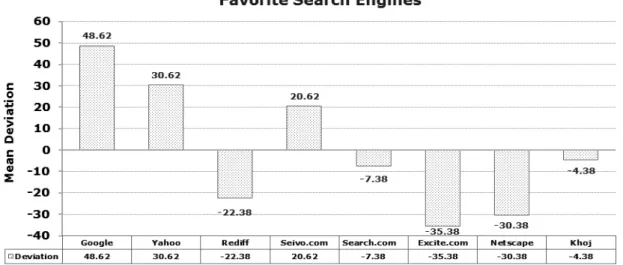
It is visible from Table 6 that the Google, Yahoo,
and Seivo.com search engines are preferred by 100%, 79.54%, and 68.18% of users, respectively, whereas some other search engine that are mentioned in the study are not highly favored among the students.
Figure 3 depicts the usage of search engines by the students with mean deviation. The search engine Redff (mean deviation = -22.38), search.com (mean devia-tion = -7.38), Excite.com (mean deviadevia-tion = -35.38), Netscape (mean deviation = -30.38), and Khoj (mean deviation = -4.38) usages are not favored.
Table 5. Use of Internet Services
S. No. Internet Services Percentage Deviation
1 E-Mail 100 59.75 2 WWW 9.1 -20.25 3 Chatting 78.4 40.75 4 FAQ 13.6 -16.25 5 List Services 15.9 -14.25 6 Archive 28.4 -3.25 7 BBS 3.4 -25.25 8 Any other 7.95 -21.25 ¯x = 28.25 σ = 30.02
Table 6. Favorite Search Engines
S. No. Search Engine Percentage Deviation
1 Google 100 48.62 2 Yahoo 79.54 30.62 3 Rediff 19.31 -22.38 4 Seivo.com 68.18 20.62 5 Search.com 36.36 -7.38 6 Excite.com 4.54 -35.38 7 Netscape 10.22 -30.38 8 Khoj 39.77 -4.38 ¯x = 39.38 σ = 28.45
The present study has also attempted to know the most used web sites by students and the responses are analyzed and presented in Table 7, indicating that 47.72% of the students use sport websites, 39.77% use general websites, and 12.5% use recreational web sites.
The study purpose was to know the problems faced by students while using the Internet. Table 8 depicts
that 61.4% of the students face so much information on the Internet, followed by slow access speed (56.8%). The study also noted that 47.7% of students faced dif-ficulty in finding relevant information, 20.5% are not satisfied with the allotted time slots, and 13.6% faced payment for online services.
Table 8. Problems Faced by Students
S. No. Types of problems Percentage Deviation
1 Slow access speed/Downloading 56.8 10.5
2 Difficulty in finding relevant information 47.7 22.5
3 Too much information on the Internet 61.4 -13.5
4 The allotted time slot is insufficient 20.5 -19.5
5 Payment for online services 13.6 -31.5
¯x = 31.5 σ = 17.17
Table 7. Most Used Web Sites
S. No. Website Type Percentage Deviation
1 General 39.8 5.67
2 Sport Website 47.7 12.67
3 Recreational 12.5 -18.33
Total 100%
¯x = 29.33 σ = 13.27
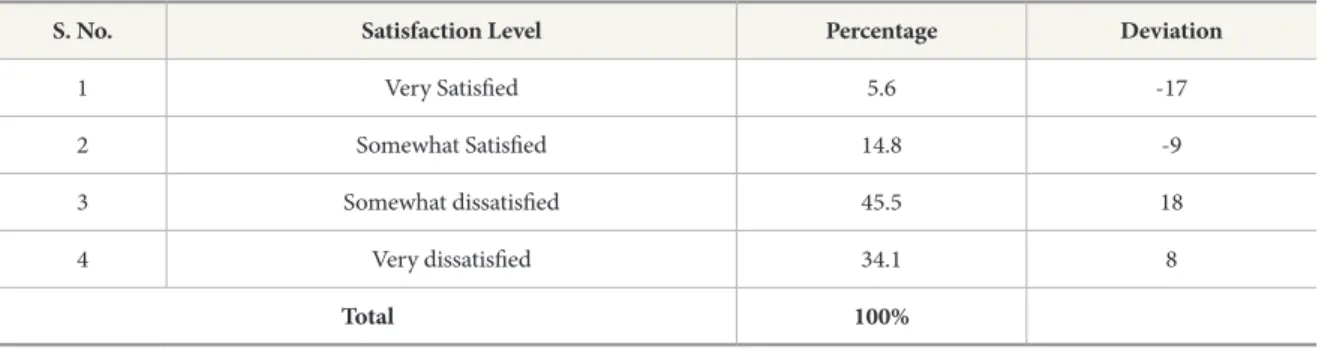
The study purpose was to know the satisfaction level of the students while using the Internet. Table 9 reveals that 45.5% (mean deviation = 18) of the students are somewhat dissatisfied with the Internet, and 34.1% (mean deviation = 8) are very dissatisfied. Small num-bers of the students are satisfied (mean deviation = -17), or somewhat satisfied (mean deviation = -9) with the Internet.
8. CONCLUSION
The Internet has become the backbone of students’ education as well as in other parts of life. It bridges between students and information. However, they face a lot of new challenges to satisfy the thirst for required information. Fluency with the Internet is mandatory to keep up with changes in the present educational environment. Based on the study result, it may be concluded that Internet literacy is increasing among students who use the Internet on their own cell phones frequently. However, the study reveals that Internet usage for education and research purpose is below the average values among physical education students. Low utilization of the Internet in education by students seems to be a challenge for the physical education de-partment of Kurukshetra University. It is suggested that the department should organization orientation pro-grams on Internet literacy for fresh students. A period should be added in the time table for Internet literacy by restricting Internet access to educational purposes. This strategy will improve Internet access by students for online resources and services as shown in the study.
However, so much information on Internet and slow access speed are the common problems while using the Internet. To wipe out such types of common problems, the university should make efforts to increase band-width capacity and develop a federated search/semantic web technology so that students can share and search the wealth of information.
REFERENCES
Kumar, R. (2013). Students and the Internet: A study of Internet use by the students of NIT Kuruk-shetra, Haryana, India. International Journal of
Library and Information Studies, 3(2), 17-25.
Retrieved from http://www.ijlis.org/img/2013_ Vol_3_Issue_2/17-25.pdf
--. (2013). Internet facility usage among students: A study in Kurukshetra University Kurukshetra (Haryana) India. International Journal of Digital
Information and Knowledge Management, 1(1),
7-16.
Hadagali, G. S. (2013). Use of Internet by the post-grad-uate students of six state universities of Karna-taka: A study. International Journal of Library
Science, 9(3), 13-22. Retrieved from http://ceser.
in/ceserp/index.php/ijls/issue/view/183 Herguner, G. (2011). Opinions of students in physical
education and sports teaching on the use of so-cial network sites. Turkish Online Journal of
Ed-ucational Technology (TOJET), 10(2), 174-183.
Retrieved from http://www.tojet.net/articles/ v10i2/10217.pdf
Table 9. Levels of Satisfaction
S. No. Satisfaction Level Percentage Deviation
1 Very Satisfied 5.6 -17 2 Somewhat Satisfied 14.8 -9 3 Somewhat dissatisfied 45.5 18 4 Very dissatisfied 34.1 8 Total 100% ¯x = 22 σ = 13.77
Kurukshetra University (2010). Retrieved from http:// www.kuk.ac.in/
Maharana, B., et al. (2010). Use of Internet and e-re-sources by students of business Management: A survey of P.G. students of business administra-tion, Sambapur University, India. International
Journal of Library and Information Science, 2(3),
45-53. Retrieved from http//www.academic-journals.org/ijlis
Malik, A. & Mahmood, K. (2009). Web search behavior of University students: A case study at Univer-sity of Panjab. Weblogy, 6(2). Retrieved from http://www.webology.ir/2009/v6n2/a70.html Moreno et al. (2013). Associations between Internet use
and fitness among college students: An experi-ence sampling approach. Journal of Interaction
Science, 1, 1-8. Retrieved from
http://www.jour-nalofinteractionscience.com/content/1/1/4 Muniandy, B. (2010). Academic use of internet among
undergraduate Students: A preliminary case study in a Malaysian university. International
Journal of Cyber Society and Education, 3(2),
171-178. Retrieved from http://ijcse.academ-ic-publication.org/articles
Salaam, M.O. & Adegbore, A.M. (2010). Internet ac-cess and use by students of private universities in Ogun state, Nigeria. Library Philosophy and
Practice. Retrieved from http://www.webpages.
uidaho.edu/~mbolin/salaam-adegbore.htm Yaman, Ç. (2008). The abilities of physical education
teachers in educational technologies and mul-timedia. Turkish Online Journal of Educational
Technology (TOJET), 7(2), 20-31. Retrieved
from http://www.tojet.net/volumes/v7i2.pdf Yaman, M. (2007). The attitudes of the physical
educa-tion students towards Internet. Turkish Online
Journal of Educational Technology (TOJET), 6(3), 79-87. Retrieved from http://www.tojet.