ISSN 2234-3806 • eISSN 2234-3814
https://doi.org/10.3343/alm.2020.40.2.187 www.annlabmed.org 187
Ann Lab Med 2020;40:187-189
https://doi.org/10.3343/alm.2020.40.2.187
Letter to the Editor
Transfusion Medicine
Red Blood Cell Alloimmunization in Pediatric Sickle Cell Disease Population of Puerto Rico: An
Observational Study
Raisa I. Balbuena-Merle , M.D.1,4, Cruz M. Nazario-Delgado , Ph.D.2, Rosa V. Rosario-Rosado , Dr.PH.2, Dalia Millán-Tapia , M.T.3, and Consuelo Climent-Peris , M.D.1,3
1Department of Pathology and Laboratory Medicine, School of Medicine, University of Puerto Rico, San Juan, Puerto Rico; 2Graduate School of Public Health, School of Medicine, University of Puerto Rico, San Juan, Puerto Rico; 3Medical Services Administration of Puerto Rico, Clinical Laboratory Transfusion Service, San Juan, Puerto Rico; 4Yale University, Department of Laboratory Medicine, New Haven, CT, USA
Dear Editor,
We read with interest the manuscript by Kim, et al. [1] regard- ing high rates of red blood cell (RBC) alloimmunization in pa- tients with myelodysplastic syndrome (MDS) and liver cirrhosis.
Another population with an increased risk of RBC alloimmuniza- tion includes patients with sickle cell disease (SCD), with preva- lence rates as high as 40–50% [2]. As in MDS, the manage- ment of SCD may require acute or chronic RBC transfusions, increasing the exposure to non-self RBC antigens that could re- sult in the formation of alloantibodies [3].
We hypothesized that the RBC alloimmunization prevalence in patients with SCD in Puerto Rico (PR) would be lower than that of other described SCD patients, owing in part to genetic homogeneity between blood donors and transfusion recipients [4, 5], as well as due to an initiative of our transfusion service to provide phenotypically matched RBCs when feasible. To our knowledge, no prior studies have been published on RBC allo- immunization rates in SCD patients living in PR. This study was approved by the Institutional Review Board of The Medical Sci- ences Campus, University of PR, San Juan, PR (approval num- ber: B0870116) which waived informed consent.
We reviewed retrospectively the medical records of all children with SCD, diagnosed using Hb electrophoresis and transfused at the PR Medical Center, Rio Piedras, PR, within a nine-year period (July 2005 to December 2014). Inclusion criteria were age <18 years, a complete RBC phenotype on file, a complete transfusion history, follow-up antibody screening, and no trans- fusions prior to 2005 (the date the electronic medical record system was implemented). Each RBC transfusion was catego- rized into three groups according to the degree of serologic anti- gen phenotype matching: ABO/D, matched for Rh (C,c, E,e) and K (“limited phenotype matched”), or more extensively matched for Rh and K in addition to Fy, Jk, and MNS (“extended pheno- type matched”). A total of 52 children with SCD (SS, SB+, SB0, and SC) met this study’s inclusion criteria. Their median age was eight yrs (interquartile range, IQR: 16 years), and 35% were fe- males. Overall, the patients received 302 RBC units (median: 3 units, IQR: 36 units). Over the nine-year study period, by neces- sity, 22 of the patients received blood with differing degrees of antigenic matching. Of these 22 patients, 13 received both lim- ited and extended phenotype matched units. Antibody screen- ing was completed in a tube and/or gel prior to each transfusion,
Received: May 31, 2019 Revision received: July 5, 2019 Accepted: October 1, 2019
Corresponding author: Raisa I. Balbuena-Merle, M.D.
Department of Laboratory Medicine, Yale University, 330 Cedar Street, Clinic Building 441, New Haven, CT 06520-8035, USA
Tel: +1-203-688-2286, Fax: +1-203-688-7340 E-mail: [email protected]
© Korean Society for Laboratory Medicine
This is an Open Access article distributed under the terms of the Creative Commons Attribution Non-Commercial License (http://creativecommons.org/licenses/by-nc/4.0) which permits unrestricted non-commercial use, distribution, and reproduction in any medium, provided the original work is properly cited.
1 / 1 CROSSMARK_logo_3_Test
2017-03-16 https://crossmark-cdn.crossref.org/widget/v2.0/logos/CROSSMARK_Color_square.svg
Balbuena-Merle RI, et al.
RBC alloimmunization in SCD in Puerto Rico
188 www.annlabmed.org https://doi.org/10.3343/alm.2020.40.2.187 and any newly detected antibody was attributed to the previous
transfusion.
Eight (15.4%) patients developed RBC alloantibodies at some points over the study period. RBC alloantibodies were more com- mon in males (17.6%) than in females (11.1%). The transfu- sion burden of the eight patients with RBC alloantibodies (“re- sponders”) was 50 units (median: 1.5 units, IQR: 6.5 units), and that of the non-responders was 252 units (median: 3 units, IQR:
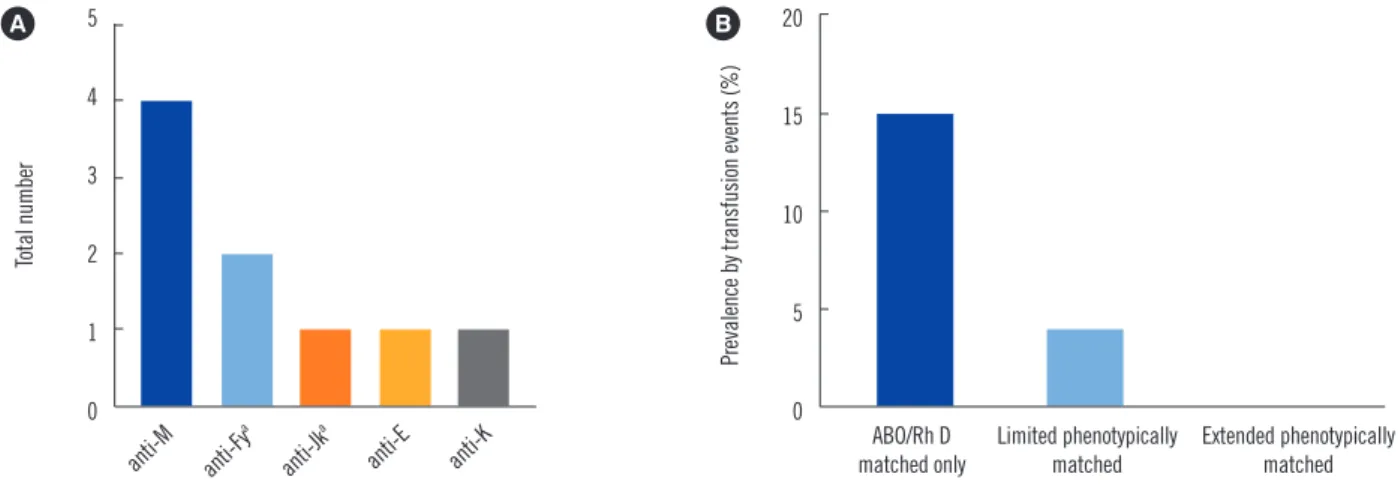
4.5 units). Nine new RBC alloantibody formation events were observed following the 302 transfusion events, for an overall al- loimmunization prevalence of 3% (9/302). These antibodies had specificities against M (N=4; all IgG class), E (N=1), K (N=1), Fya (N=2), and Jka (N=1) (Fig. 1).
One patient received a non-matched unit and developed anti- K antibodies; two years later, an anti-Jka antibody was identified following a non-matched transfusion. The patient received only extended phenotype-matched RBC transfusions between these alloimmunization events. A total of 26/302 (9%) of the transfused RBC units were matched for only ABO/RhD, 124/302 (41%) were “limited phenotype matched,” and 152/302 (50%) were
“extended phenotype matched.”
We calculated the prevalence of alloimmunization by transfu- sion events during this nine-year period. Of the nine antibodies formed, four occurred following ABO/D matched RBC transfu-
sions (4/26 transfusion events=15.4%), five occurred following
“limited phenotype matched” RBC transfusions (5/124 transfu- sion events=4%), and none occurred following “extended phe- notype matched” RBC transfusions (0/152 transfusion events=
0%; Fig. 1). In addition, the distribution of RBC antigens in the SCD population in PR did not completely correlate with either Caucasians or Blacks [6]; rather, it was generally positioned be- tween the prevalence of both groups (Table 1).
The low percentage of antibodies in the Rh family could re- flect a combination of decreased exposure to non-self-antigens as a result of our phenotypic matching, in addition to the lower Rh genetic diversity in this population compared with individu- als living in the mainland US [7, 8]. Future genotyping studies on the RBC donors and the SCD patient population in PR may be informative.
In summary, the PR pediatric SCD population demonstrated a 15.4% RBC alloimmunization prevalence, which is lower than the overall prevalence reported in other SCD populations and closer to the prevalence observed in more homogeneous popu- lations [4, 5]. The observed specificities of all antibodies formed, in combination with the fact that 0% of our patients developed new alloantibodies after receiving “extended phenotype matched”
RBCs, support the phenotypic matching strategy proposed in this journal by Kim, et al. [1].
Table 1. RBC group antigen prevalence in 52 pediatric patients with SCD in Puerto Rico, as determined by serologic phenotype
RBC antigen A B AB O D C E c E M N S s K k Fya Fyb Jka Jkb
Prevalence (%) 21 11 4 63 92 67 25 86 98 69 77 54 92 6 100 46 44 88 56
Abbreviations: SCD, sickle cell disease; RBC, red blood cell.
Fig. 1. RBC alloantibody distribution and prevalence of new antibody formation in pediatric patients with SCD in Puerto Rico. (A) Number and antigen specificity of the nine alloantibodies formed by eight alloimmunized pediatric SCD patients. (B) Alloantibody formation following RBC transfusion based on degree of serologic RBC phenotype matching.
Abbreviations: see Table 1.
5 4 3 2 1
0
anti-M anti-Fy
a
anti-Jk
a
anti-E anti-K
Total number
A 20
15
10
5
0 ABO/Rh D
matched only Limited phenotypically
matched Extended phenotypically matched
Prevalence by transfusion events (%)
B
Balbuena-Merle RI, et al.
RBC alloimmunization in SCD in Puerto Rico
https://doi.org/10.3343/alm.2020.40.2.187 www.annlabmed.org 189
Acknowledgements
RBM thanks her fellowship mentors, Jeanne Hendrickson and Christopher Tormey, for their advice on this manuscript.
Authors’ Contributions
All authors have accepted their responsibility for the entire con- tent of this manuscript and approved its submission. RBM, CCP, and DMT designed and completed the research. RBM and CCP analyzed the raw data. Along with RBM and CCP, CND and RRR critically analyzed the findings. RBM wrote the first draft of the manuscript and all authors edited and approved the final sub- mission.
Conflicts of Interest
None declared.
Funding
None declared.
ORCID
Raisa I. Balbuena-Merle https://orcid.org/0000-0002-7943- 5597
Cruz M. Nazario-Delgado https://orcid.org/0000-0002-5753- 4738
Rosa V. Rosario-Rosado https://orcid.org/0000-0002-1124- 0400
Dalia Millán-Tapia https://orcid.org/0000-0002-3960-0113 Consuelo Climent-Peris https://orcid.org/0000-0002-0301-9917
REFERENCES
1. Kim HY, Cho EJ, Chun S, Kim KH, Cho D. Red blood cell alloimmuniza- tion in Korean patients with myelodysplastic syndrome and liver cirrho- sis. Ann Lab Med 2019;39:218-22.
2. Chou ST, Jackson T, Vege S, Smith-Whitley K, Friedman DF, Westhoff CM. High prevalence of red blood cell alloimmunization in sickle cell disease despite transfusion from Rh-matched minority donors. Blood 2013;122:1062-71.
3. Yazdanbakhsh K, Ware RE, Noizat-Pirenne F. Red blood cell alloimmu- nization in sickle cell disease: pathophysiology, risk factors, and transfu- sion management. Blood 2012;120:528-37.
4. Moreira Júnior G, Bordin JO, Kuroda A, Kerbauy J. Red blood cell allo- immunization in sickle cell disease: the influence of racial and antigenic pattern differences between donors and recipients in Brazil. Am J He- matol 1996;52:197-200.
5. Samarah F, Srour MA, Yaseen D, Dumaidi K. Frequency of red blood cell alloimmunization in patients with sickle cell disease in Palestine.
Adv Hematol 2018;2018:5356245.
6. Dean L. Blood groups and red cell antigens. Bethesda: National Center for Biotechnology Information, 2005:32, 50, 57, 63, 69, 81.
7. Chou ST, Flanagan JM, Vege S, Luban NLC, Brown RC, Ware RE, et al.
Whole-exome sequencing for RH genotyping and alloimmunization risk in children with sickle cell anemia. Blood Adv 2017;1:1414-22.
8. Chou ST, Evans P, Vege S, Coleman SL, Friedman DF, Keller M, et al.
RH genotype matching for transfusion support in sickle cell disease.
Blood 2018;132:1198-207.