• 검색 결과가 없습니다.

Change of Crystalline Properties of Poly(ethylene-co-vinyl acetate) according to the Microstructures

N/A
N/A
Protected

Academic year: 2021

Share "Change of Crystalline Properties of Poly(ethylene-co-vinyl acetate) according to the Microstructures"

Copied!
8
0
0

로드 중.... (전체 텍스트 보기)

전체 글

(1)

DOI: https://doi.org/10.7473/EC.2021.56.2.92

Change of Crystalline Properties of Poly(ethylene- co-vinyl acetate) according to the Microstructures

Sung-Seen Choi and Yu Yeon Chung

Department of Chemistry, Sejong University, 209 Neungdong-ro, Gwangjin-gu, Seoul 05006, Republic of Korea (Received June 16, 2021, Revised June 28, 2021, Accepted June 30, 2021)

Abstract: Microstructure-dependent changes in the crystalline properties of poly(ethylene-co-vinyl acetate) (EVA) was investigated using various EVAs at different VA contents via X-ray diffraction (XRD). The parameters analyzed herein were percentage crystallinity (X

c

), interplanar crystal spacing (d

hkl

), crystal stack size (D

hkl

), and the number of crystal plane piles (N

hkl

). The X

c

s of [110] and [200] crystals were 21.0-4.1 and 6.7-1.4%, respectively, and they decreased by approximately 2.3 and 0.7% for every mol% of the VA content, respectively. The X

c

ratios of the [110] and [200] crystals were approx- imately 3. The d

110

s and d

200

s values were 0.41-0.42 and 0.37-0.38 nm, respectively. The D

110

s and D

200

s values were 9.56 -21.92 and 7.00-16.42 nm, respectively. The d

hkl

s increased with an increase in the VA content, whereas the D

hkl

s decreased.

The N

110

s and N

200

s were 22.7-51.3 and 18.3-43.2, respectively, and they decreased by increasing the VA content. EVA with the same VA content showed different crystalline properties as per the suppliers, and some EVAs deviated from the average trends. This could be explained by the difference in their microstructures such as the sizes and distribution uniformity of the ethylene sequences in EVA chains.

Keywords: poly(ethylene-co-vinyl acetate), crystalline properties, microstructures, X-ray diffraction

Introduction

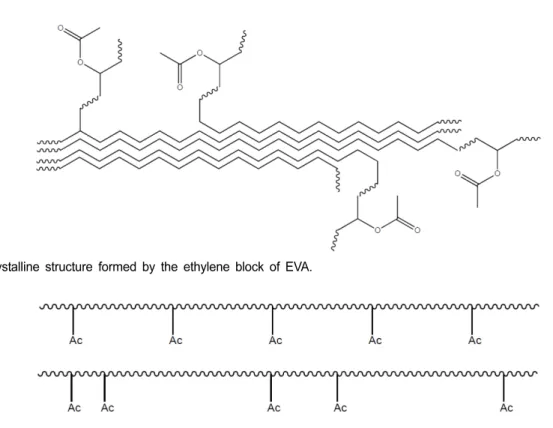
Poly(ethylene-co-vinyl acetate) (EVA) is a copolymer of ethylene and vinyl acetate (VA), and the VA units are ran- domly distributed throughout the ethylene polymer back- bone. EVA is a transparent thermoplastic copolymer, and it becomes more flexible and transparent by increasing the VA content. EVA has crystalline structures due to the ethylene sequences, and its properties and application fields are mainly depending on the VA content. 1-6 The crystalline struc- tures are influenced by the VA units (Scheme 1). Crystallinity and melting points of EVA decrease with increase in the VA content. 7 X-ray diffraction (XRD) and differential scanning calorimetry (DSC) are common analysis techniques to inves- tigate crystalline properties of polymeric materials. 8-22 It is well known that degree of crystallinity influences on prop- erties of polymers, and XRD is widely used for analysis of the crystallinity of polymeric materials.

Length of the ethylene sequence of EVA is restricted by positions of the VA units as shown in Scheme 2. Paraffin wax has stacked lamella crystals due to relatively short methylene

sequence, while polyethylene (PE) has chain-folding crys- talline structures due to long methylene sequence. 23-27 EVA should have stacked lamella crystals like paraffin wax because of relatively small ethylene block size. In general, EVAs have two crystalline structures of [110] and [200].

Crystalline structure and ethylene block size of an EVA should be influenced not only by the VA content but also by positions of the VA units in an EVA chain. Thus, crystalline structures and ethylene block sizes of EVAs with the same VA content may be different each other if the distribution pat- terns (or uniformities) of the VA units are different as described in Scheme 2.

In this study, crystalline properties of various EVAs with the VA contents of 3.3-17.8 mol% (9.5-40 wt%) were ana- lyzed using XRD and influence of microstructures of the EVAs on the crystalline properties was investigated. Per- centage crystallinity (X c ), interplanar crystal spacing (d hkl ), and crystal stack size (D hkl ) were compared as the crystalline properties. Three sets of EVAs having the same VA contents were employed to examine the influence of microstructures on the crystalline properties in detail. Relative superiority for the percentage crystallinity and the number of crystal plane

Corresponding author E-mail: [email protected]

(2)

piles (N hkl ) of [110] and [200] crystals was also investigated.

Experimental

Twelve EVAs with different VA contents of three suppliers were used: four EVAs of Aldrich Co. (USA) (marked to EVA 12, EVA 18, EVA 25, and EVA 40 with the VA contents of 12, 18, 25, and 40 wt%, respectively), four EVAs of DuPont Co. (USA) (EVA 770, EVA 450, EVA 360, and EVA 265 with the VA contents of 9.5, 18, 25, and 28 wt%, respec- tively), and four EVAs of Hanwha Co. (Republic of Korea) (EVA 1315, EVA 1316, EVA 1317, and EVA 1328 with the VA contents of 15, 18, 22, and 28 wt%, respectively). Weight percentages (wt%) of the VA contents were converted to the mole percentages (mol%) (Table 1). Three EVAs of EVA 18, EVA 450, and EVA 1316 have the same VA content of 6.7 mol%. Two sets of EVAs (EVA 25/EVA 360 and EVA 265/

EVA 13128) have the same VA contents of 9.8 and 11.2 mol%, respectively.

Crystalline properties of EVA samples were measured using XRD. XRD analysis was performed using a D-max 2500/PC diffractometer (Rigaku Co., Japan) with Cu-K  radi- ation. The accelerating voltage and electric current were 40 kV and 100 mA, respectively. The samples were scanned

from 10 o to 35 o at a scan speed of 2 o /min. The degree of crys- tallinity determined by XRD was calculated as the percent- age of the scattered intensity of the crystalline phase over the sum of the scattered intensities of the crystalline and amor- phous phases. The percentage crystallinity was acquired from the peak at 12 o to 28 o using XRD analysis software (Mdi Jade 6.0).

The percentage crystallinity (X c , %) was calculated using equation (1).

Scheme 1. Crystalline structure formed by the ethylene block of EVA.

Scheme 2. Microstructures of EVA depending on the positions of vinyl acetate units.

Table 1. EVAs Used in This Study

EVA Vinyl acetate content (mol%)

EVA 770 3.3

EVA 12 4.3

EVA 1315 5.4

EVA 18 6.7

EVA 450 6.7

EVA 1316 6.7

EVA 1317 8.4

EVA 25 9.8

EVA 360 9.8

EVA 265 11.2

EVA 1328 11.2

EVA 40 17.8

(3)

X c (%) = 100 × I c /(I c + I a ) (1) where I c and I a are the sums of the intensities of the crys- talline and amorphous regions, respectively. The interplanar crystal spacing of (hkl) planes, d hkl was calculated according to Bragg's law of equation (2).

d hkl = /2sin (2)

where  is the wavelength of the X-ray (Cu-K = 0.154 nm) and  is the Bragg angle. The stack (or particle) size of crys- tal was calculated according to Scherrer formula of equation (3).

D hkl = K/(B 1/2 cos) (3)

where D hkl is the interfacial distance (perpendicular to the plane of the crystal particle), K is the Scherrer constant (0.89 is selected),  is the wavelength of the X-ray, B 1/2 is the FWHM (radian), and  is the Bragg angle.

Results and Discussion

Raw XRD pattern was smoothed for following deconvo- lution process to separate the crystalline and amorphous regions. The smoothed curve was deconvoluted to one amor- phous and two crystalline peaks as shown in Figure 1. Two crystalline peaks at 2 = 21.4 and 23.7 o corresponding to [110] and [200] crystals, respectively, were observed. Full width at half maximum (FWHM) of the crystalline peak was also measured. The Bragg angles (2) and FWHMs of EVAs were summarized in Table 2. Ranges of the Bragg angles of

[110] and [200] peaks were 21.04-21.68 and 23.26-23.92 o , respectively. Ranges of the FWHMs of [110] and [200] peaks were 0.76-1.67 and 0.99-2.29 o , respectively. The FWHMs of [110] peaks were narrower than those of [200] ones. The FWHM of [110] peak tended to increase as the VA content increased.

The X c variation with the VA content was plotted as shown in Figure 2. The total X c of [110] and [200] crystals decreased by about 3% every 1 mol% of the VA content. The individual X c s of [110] and [200] crystals decreased by about

Figure 1. XRD pattern and deconvolted peaks of EVA 18. The XRD pattern was deconvoluted into the amorphous and crystalline peaks. FWHM denotes the full width at half maximum of the peak.

Table 2. Bragg Angles (2) and FWHMs of EVAs Obtained from the XRD Analysis Results (

o

)

EVA 2 FWHM

[110] [200] [110] [200]

EVA 12 21.45 23.68 0.765 1.191

EVA 18 21.42 23.40 0.919 0.978

EVA 25 21.62 23.92 1.028 1.112

EVA 40 21.04 23.26 1.672 2.294

EVA 770 21.68 23.88 0.761 1.032

EVA 450 21.44 23.56 0.924 1.049

EVA 360 21.66 23.78 0.924 1.249

EVA 265 21.24 23.48 0.936 1.195

EVA 1315 21.44 23.54 0.844 1.220

EVA 1316 21.54 23.86 0.878 1.195

EVA 1317 21.26 23.61 1.141 1.195

EVA 1328 21.10 23.31 1.178 1.605

Figure 2. Variation of the total, [110], and [200] crystallinities of

EVA with the vinyl acetate content. The squares, circles, and

triangles stand for the EVAs of Aldrich Co., DuPont Co., and

Hanwha Co., respectively. The solid, open, and crossed symbols

indicate the total, [110], and [200] crystallinities, respectively. The

three dash lines are the curve fitted lines less than 10 mol% of

the vinyl acetate content for the total, [110], and [200] of y = -2.98x

+ 37.68 (r = 0.975), y = -2.27x + 28.61 (r = 0.977) and y = -0.72x

+ 9.06 (r = 0.945), respectively.

(4)

2.3 and 0.7%/mol%, respectively. After 10 mol% of the VA content, the decrement was very slight. There were some cases largely deviated from the fitted curve. For EVAs with 9.8 mol% of the VA content (EVA 25 and EVA 360), the X c s of EVA 25 were lower than the fitted line but those of EVA 360 were much higher than the fitted line. If the VA units are evenly distributed, there will be few large ethylene blocks and crystalline structures may not be well developed. If the VA units of an EVA with 10.0 mol% of the VA content are absolutely evenly distributed, the ethylene block size is ‘9’

of ~VA-(CH 2 CH 2 ) 9 -VA~. Difference in the melting points of paraffin wax and its ester is about 15 o C, and the total number of ethylene units not to participate in crystal formation by the prevention of VA units in both sides is about ‘8’. 28,29 Thus, the number of ethylene sequence to participate in the crystal formation is just ‘1’ for an EVA with the VA content of 10.0 mol% when the VA units are completely evenly distributed.

Hence, it can be expected that distribution uniformity of the VA units of EVA 25 will be greater than that of EVA 360.

There are two crystalline structures of ethylene blocks of

~VA-(CH 2 CH 2 ) n -VA~ (n > 20 and 15 < n < 20) in EVA. 29 The large and small ethylene block sizes may belong to the [110] and [200] crystals, respectively. The X c ratio of [110]

and [200] crystals (X c [110]/X c [200]) was plotted as a func- tion of the VA content as shown in Figure 3. The X c ratio on the whole slightly decreased with increase in the VA con- tent. It means that crystal formation of the big ethylene block was more decreased than that of the small one by increasing the VA content. Except for three EVAs (EVA 18, EVA 265, and EVA 1328), the X c ratios were about 3. The X c ratio of EVA 18 (6.7 mol% of the VA content) was larger than those

of the other EVAs. This is because EVA 18 has higher [110]

crystallinity as well as lower [200] one compared to the other EVAs with the same VA content as shown in Figure 2. This implies that there are longer ethylene sequences in EVA 18 due to more inhomogeneous distribution of the VA units. The X c ratios of EVA 265 and EVA 1328 (their VA contents are the same of 11.2 mol%) were much lower than those of the other EVAs since they had relatively higher X c s of the [200]

crystal. Thus, EVA 265 and EVA 1328 should have more homogeneous distribution of VA units than the other EVAs.

Variations of the d hkl and D hkl were plotted as a function of the VA content as shown in Figures 4 and 5, respectively.

The d 110 s and d 200 s were 0.410-0.422 and 0.372-0.382 nm, respectively (Figure 4). The d 110 s were greater than the d 200 s and the difference was about 0.04 nm. The d 110 and d 200 on the whole increased as the VA content increased, and the increment of d 110 was slightly larger than that of d 200 . This means that distance between EVA chains becomes longer by prevention of the VA units. The D 110 s and D 200 s were 9.564- 21.918 and 6.997-16.417 nm, respectively (Figure 5). The D 110 was greater than the D 200 , and the difference became smaller by increasing the VA content. The D 110 and D 200 on the whole decreased with increase in the VA content, and the decrement of D 110 was greater than that of D 200 . The decreased D hkl s can be explained by reduction of the number of ethylene sequences participating in the crystal formation.

Some EVAs of the same supplier had similar D hkl s though

Figure 3. Variations of the crystallinity ratio of [110]/[200] of EVA with the vinyl acetate content.

Figure 4. Variations of the interplanar crystal spacings (d

hkl

s) with

the vinyl acetate content. The squares, circles, and triangles stand

for the EVAs of Aldrich Co., DuPont Co., and Hanwha Co.,

respectively. The solid and open symbols indicate the d

110

and

d

200

, respectively. The dash lines are the curve fitted lines for the

d

110

and d

200

of y = 7.010 × 10

-4

x + 0.409 (r = 0.637) and y =

4.954 × 10

-4

x + 0.373 (r = 0.485), respectively.

(5)

their VA contents are very different. For instance, EVA 450, EVA 360, and EVA 265 (6.7-11.2 mol% of the VA content) had similar D 110 of 17.32-17.09, and EVA 1315, EVA 1316, and EVA 1317 (5.4-8.4 mol% of the VA content) had similar D 200 of 13.16-13.45. The D hkl s of EVAs with the same VA content showed big difference according to the suppliers. For EVA 18, EVA 450, and EVA 1316 with the same VA content of 6.7 mol%, the order of D 110 was EVA 1316 > EVA 18 ~ EVA 450, whereas that of D 200 was EVA 18 > EVA 450 >

EVA 1316. For EVA 25 and EVA 360 with the VA content of 9.8 mol%, the D 110 of EVA 360 was greater than that of EVA 25, whereas the D 200 of EVA 360 was smaller than that of EVA 25. Thus, it can lead to a conclusion that the D hkl s are largely influenced by the VA content and the distribution uniformity of VA units.

The number of crystal plane piles (N hkl ) was calculated using equation (4). 30

N hkl = D hkl /d hkl (4)

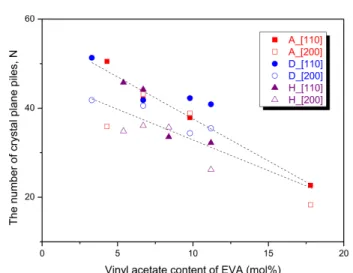
The N 110 s and N 200 s were 22.7-51.3 and 18.3-43.2, respec- tively. Figure 6 shows variations of the N 110 and N 200 with the VA content. The N 110 decreased with increase in the VA content by about twice every 1 mol% of the VA content, and it will be lower than 10 when the VA content is higher than 24.8 mol%. This implies that not only the ethylene block size but also the number of EVA chains participating in the [110]

crystal formation decreased by increasing the VA content.

The N 200 did not show notable change until about 10 mol%

of the VA content and then showed a decreased trend. The N 110 s were generally larger than the N 200 s, but EVA 18, EVA 25, and EVA 1317 showed the reverse trends. The larger N 110 s than N 200 s implies that the number of EVA chains with long ethylene sequences is greater than that of EVA chains with short ones. On the contrary to this, for EVA 18, EVA 25, and EVA 1317, the number of EVA chains with long eth- ylene sequences might be smaller than that of EVA chains with short ones.

The N 110 s and N 200 s of EVAs with the same VA content also showed different trends according to the suppliers. For EVA 18, EVA 450, and EVA 1316 with the same VA content of 6.7 mol%, the N 110 of EVA 1316 was greater than those of the others whereas the N 200 of EVA 1316 was smaller than those of the others. And total N hkl s of the N 110 and N 200 were also different each other. The total N hkl s of EVA 18, EVA 450, and EVA 1316 were 85.2, 82.3, and 80.3, respectively.

Flexibility and transparency of EVA with smaller N hkl s might be better than those of EVA with larger ones. For EVA 25 and EVA 360 with the same VA content of 9.8 mol%, the N 110 of EVA 360 was greater than that of EVA 25 but the N 200 of EVA 360 was smaller than that of EVA 25 though the total N hkl s were the same of 76.7 and 76.6 for EVA 25 and EVA 360, respectively. For EVA 265 and EVA 1328 with the same VA content of 11.2 mol%, both the N 110 and N 200

Figure 5. Variations of the interfacial distances (D

hkl

s) with the vinyl acetate content. The squares, circles, and triangles stand for the EVAs of Aldrich Co., DuPont Co., and Hanwha Co., respectively. The solid and open symbols indicate the D

110

and D

200

, respectively. The dash lines are the curve fitted lines for the D

110

and D

200

of y = -0.751x + 23.092 (r = 0.901) and y = -0.522x + 17.625 (r = 0.782), respectively.

Figure 6. Variations of the numbers of crystal plane piles (N

110

and N

200

) of the [110] and [200] crystalline peaks of EVA with the

vinyl acetate content. The squares, circles, and triangles stand for

the EVAs of Aldrich Co., DuPont Co., and Hanwha Co.,

respectively. The solid and open symbols indicate the crystalline

structures of [110] and [200], respectively. The dash lines are the

curve fitted lines for [110] and [200] crystals of y = -1.86x + 56.15

(r = 0.900) and y = -1.42x + 47.07 (r = 0.787), respectively.

(6)

of EVA 265 were greater than those of EVA 1328. The total N hkl of EVA 265 (76.3) was greater than that of EVA 1328 (58.5) by 1.3 times. This denotes that EVA 1328 would be more flexible and transparent than EVA 265.

Figure 7 shows variation of the N 110 /N 200 ratio with the VA content. Except for some EVAs, the N 110 /N 200 ratios were about 1.2. This implies that the number of EVA chains par- ticipating in [110] crystal formation is greater than that of EVA chains participating in [200] one by about 20%. EVA 12 had the greatest N 110 /N 200 ratio of 1. 41. The N 110 /N 200

ratios of EVA 450, EVA 18, and EVA 25 were nearly 1.00 (1.03, 0.97, and 0.98, respectively). The N 110 /N 200 ratio of EVA 1317 (0.94) was lower than the others. EVAs with the average low N 110 /N 200 ratio might have the long ethylene sequences less than the short ones. Especially, EVA 1317, EVA 25, and EVA 18 would have the long ethylene sequences less than the short ones as discussed previously.

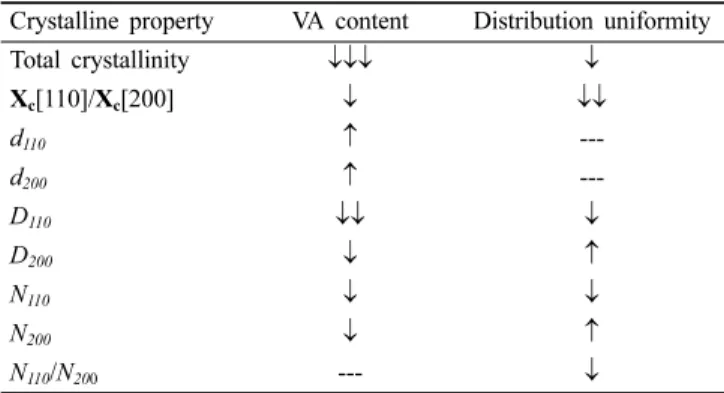
Influence of the VA content and distribution uniformity of EVA on the crystalline properties was summarized in Table 3. The total X c notably decreased by increasing the VA con- tent, while it slightly decreased by increasing the distribution uniformity. The X c [110]/X c [200] ratio was more affected by the distribution uniformity than the VA content. The d 110 and d 200 slightly increased by increasing the VA content, but the distribution uniformity did not affect the d 110 and d 200 . The D 110 and D 200 decreased by increasing the VA content, whereas the D 200 slightly increased by increasing the distri- bution uniformity. Variations of the N 110 and N 200 according to the VA content and distribution uniformity showed similar

trends to those of the D 110 and D 200 . The N 110 /N 200 ratio slightly decreased by increasing the distribution uniformity, but the VA content did not affect the N 110 /N 200 ratio.

Conclusions

Two crystalline peaks at 2 = 21.0-21.7 o and 23.2-24.0 o of the [110] and [200] crystals of EVA were corresponded to the large and small ethylene block sizes, respectively. The X c

ratios of [110] and [200] were about 3 except for some EVAs, and it on the whole slightly decreased with increase in the VA content of EVA. The total X c decreased by about 3%/

mol%, while the individual X c s of [110] and [200] decreased by about 2.3 and 0.7%/mol%, respectively. Formation of the crystalline structures of EVA became more difficult by increasing the distribution uniformity. The d 110 s and d 200 s were 0.410-0.422 and 0.372-0.382 nm, respectively, and they on the whole increased as the VA content increased. The D 110 s and D 200 s were 9.564-21.918 and 6.997-16.417 nm, respectively, and they on the whole decreased with increase in the VA content. The N 110 s and N 200 s were 22.7-51.3 and 18.3-43.2, respectively, and the N 110 decreased with increase in the VA content by about 2/mol%. The N 110 /N 200 ratios were about 1.2 except for some EVAs. For some EVAs, the crys- talline properties were largely deviated from the average trends. EVAs with the same VA content of different suppliers showed some different crystalline properties. These were explained by difference in their microstructures, especially degree of the distribution uniformity. Difference in the crys- talline properties due to the microstructures could influence on properties of EVAs such as flexibility and transparency.

Figure 7. Variation of the N

110

/N

200

ratio with the vinyl acetate content. N

110

and N

200

are the numbers of crystal plane piles of [110] and [200], respectively. The squares, circles, and triangles stand for the EVAs of Aldrich Co., DuPont Co., and Hanwha Co., respectively.

Table 3. Influence of the Microstructures on the Crystalline Properties of EVA

*

Crystalline property VA content Distribution uniformity

Total crystallinity  

X

c

[110]/X

c

[200]  

d

110

 ---

d

200

 ---

D

110

 

D

200

 

N

110

 

N

200

 

N

110

/N

200

--- 

*: slightly increased, ---: not influenced, : slightly decreased, :

decreased, : largely decreased

(7)

References

1. S. Bistac, P. Kunemann, and J. Schultz, “Crystalline modifi- cations of ethylene-vinyl acetate copolymers induced by a tensile drawing: effect of the molecular weight”, Polymer, 39, 4875 (1998).

2. S. Bistac and J. Schultz, “Influence of tensile deformation on the crystalline organization of ethylene copolymers”, J. Mac- romol. Sci. B Phys., 38, 663 (1999).

3. X. M. Shi, J. Zhang, J. Jin, and S. J. Chen, “Non-isothermal crystallization and melting of ethylene-vinyl acetate copoly- mers with different vinyl acetate contents”, Exp. Polym. Lett., 2, 623 (2008).

4. M. Alexandre, G. Beyer, C. Henrist, R. Cloots, A. Rulmont, R. Jerome, and P. Dubois, “Preparation and properties of lay- ered silicate nanocomposites based on ethylene vinyl acetate copolymers”, Macromol. Rapid Commun., 22, 643 (2001).

5. W. Zhang, D. Chen, Q. Zhao, and Y. Fang, “Effects of differ- ent kinds of clay and different vinyl acetate content on the morphology and properties of EVA/clay nanocomposites”, Polymer, 44, 7953 (2003).

6. V. Pasanovic-Zujo, R. K. Gupta, and S. N. Bhattacharya,

“Effect of vinyl acetate content and silicate loading on EVA nanocomposites under shear and extensional flow”, Rheol.

Acta, 43, 99 (2004).

7. C. Schneider, R. Langer, D. Loveday, and D. Haire, “Appli- cations of ethylene vinyl acetate copolymers (EVA) in drug delivery systems”, J. Control. Rel., 262, 284 (2017).

8. Y. Kong and J.N. Hay, “The enthalpy of fusion and degree of crystallinity of polymers as measured by DSC”, Eur. Polym.

J., 39, 1721 (2003).

9. P. Cebe, D. Thomas, J. Merfeld, B. P. Partlow, D. L. Kaplan, R. G. Alamo, A. Wurm, E. Zhuravlev, and C. Schick, “Heat of fusion of polymer crystals by fast scanning calorimetry”, Polymer, 126, 240 (2017).

10. J. E. K. Schawe, “Remarks regarding the determination of the initial crystallinity by temperature modulated DSC”, Thermo- chim. Acta, 657, 151 (2017).

11. N. S. Murthy and H. Minor, “General procedure for evaluat- ing amorphous scattering and crystallinity from X-ray diffrac- tion scans of semicrystalline polymers”, Polymer, 31, 996, (1990).

12. T. H. Lee, F. Y. C. Boey, and K. A. Khor, “X-ray diffraction analysis technique for determining the polymer crystallinity in a polyphenylene sulfide composite”, Polym. Compos., 16, 481 (1995).

13. K. A. Moly, H. J. Radusch, R. Androsh, S. S. Bhagawan, and S. Thomas, “Nonisothermal crystallisation, melting behavior and wide angle X-ray scattering investigations on linear low

density polyethylene (LLDPE)/ethylene vinyl acetate (EVA) blends: effects of compatibilisation and dynamic crosslink- ing”, Eur. Polym. J., 41, 1410 (2005).

14. Y. Chen, H. Zou, M. Liang, and Y. Cao, “Melting and crys- tallization behavior of partially miscible high densitypolyeth- ylene/ethylene vinyl acetate copolymer (HDPE/EVA) blends”, Thermochim. Acta, 586, 1 (2014).

15. X. Ju, M. Bowden, E. E. Brown, and X. Zhang, “An improved X-ray diffraction method for cellulose crystallinity measure- ment”, Carb. Polym., 123, 476 (2015).

16. C. Motta, “The effect of copolymerization on transition tem- perature of polymeric materials, J. Therm. Anal., 49, 461 (1997).

17. W. Stark and M. Jaunich, “Investigation of ethylene/vinyl acetate copolymer (EVA) by thermal analysis DSC and DMA”, Polym. Test., 30, 236 (2011).

18. X. M. Shi, J. Zhang, D. R. Li, and S. J. Chen, “Effect of damp-heat aging on the structures and properties of ethylene- vinyl acetate copolymers with different vinyl acetate con- tents”, J. Appl. Polym. Sci., 112, 2358 (2009).

19. H. A. Khonakdar, S. H. Jafari, A. Haghighi-Asl, U. Wagenk- necht, L. Haeussler, and U. Reuter, “Thermal and mechanical properties of uncrosslinked and chemically crosslinked poly- ethylene/ethylene vinyl acetate copolymer blends”, J. Appl.

Polym. Sci., 103, 3261 (2007).

20. K. Agroui, A. Maallemi, M. Boumaour, G. Collins, and M.

Salama, “Thermal stability of slow and fast cure EVA encap- sulant material for photovoltaic module manufacturing pro- cess”, Sol. Energy Mater. Sol. Cells, 90, 2509 (2006).

21. H. Varghese, T. Johnson, S. S. Bhagawan, S. Joseph, S.

Thomas, and G. Groeninckx, “Dynamic mechanical behavior of acrylonitrile butadiene rubber/poly(ethylene-co-vinyl ace- tate) blends”, J. Polym. Sci. B: Polym. Phys., 40, 1556 (2002).

22. A. Marcilla, J. A. Reyes-Labarta, and F. J. Sempere, “DSC kinetic study of the transitions involved in the thermal treat- ment of polymers. Methodological considerations”, Polymer, 42, 5343 (2001).

23. V. Chevallier, M. Bouroukba, D. Petitjean, M. Dirand, J.

Pauly, J. L. Daridon, and V. Ruffier-Meray, “Crystallization of a multiparaffinic wax in normal tetradecane”, Fuel, 79, 1743 (2000).

24. H. S. Ashbaugh, A. Radulescu, R. K. Prudhomme, D. Schwahn, D. Richter, and L. J. Fetters, “Interaction of paraffin wax gels with random crystalline/amorphous hydrocarbon copoly- mers”, Macromolecules, 35, 7044 (2002).

25. I. A. M. Al-Raheil and A. M. Okaz, “Chain‐folding in poly- ethylene lamellar structure”, Polym. Int., 28, 261 (1992).

26. J. D. Hoffman and R. L. Miller, “Kinetic of crystallization

from the melt and chain folding in polyethylene fractions

(8)

revisited: theory and experiment”, Polymer, 38, 3151 (1997).

27. D. L. Dorset and B. K. Annis, “Lamellar order and the crys- tallization of linear chain solid solutions”, Macromolecules, 29, 2969 (1996).

28. S. Patel, D. R. Nelson, and A. G. Gibbs, “Chemical and phys- ical analyses of wax ester Properties”, J. Insect Sci., 1, 4 (2001).

29. S-S Choi and Y. Y. Chung, “Simple analytical method for

determination of microstructures of poly(ethylene-co-vinyl acetate) using the melting points”, Polym. Test., 90, 106706 (2020).

30. J. Zhang, C. Wu, W. Li, Y. Wang, and Z. Han, “Study on per-

formance mechanism of pour point depressants with differen-

tial scanning calorimeter and X-ray diffraction methods”,

Fuel, 82, 1419 (2003).

수치

Table  1.  EVAs  Used  in  This  Study
Figure 2.  Variation  of  the  total,  [110],  and  [200]  crystallinities  of EVA  with  the  vinyl  acetate  content
Figure 3. Variations of the crystallinity ratio of [110]/[200] of EVA with  the  vinyl  acetate  content.
Figure  6.  Variations  of  the  numbers  of  crystal  plane  piles  (N 110
+2

참조

관련 문서

(2003) Development of functional microsphere(I) - Formation and characteristics of poly(ethylene- co-vinyl acetate) microspheres via thermally induced phase

Abstract: Influence of poly(ethylene- co-vinyl acetate) (EVA) types and cure systems on cure characteristics of foaming EVA compounds were investigated.. Three kind EVAs

Variations of expected VA contents (marked by sup- pliers) with calculated VA content determined by H-NMR

Ethylene vinyl acetate (EVA)는 Fig. 초기에는 낮은 함량의 비닐아세테이트 단량체만 사용하여 생산했는데 약 4 wt% VA 이하의 비율에 기초한 EVA

Since emulsion polymerization has a disadvantage that surfactant and ionic initiator degrade properties of the product polymer,poly(vinyl acetate-co-ethyl acrylat ε )

The result옹 show that the retention of a copolymer increases when either vinyl acetate composition or the molecular weight increase.. DT values measured by experiments vary

Low density polyethylene and ethylene-co-vinyl acetate (LDPE-EVA) resin composed of the smaller secondary particle size of Mg(OH) 2 shows a higher limited oxygen index (LOI) at