2011, Vol. 55, No. 1
Printed in the Republic of Korea DOI 10.5012/jkcs.2011.55.1.092
Pd-Au/SiO
2촉매에 의한 에틸렌과 아세트산으로부터 비닐 아세트산염의 생성반응에 대한 아세트산염의 촉진 효과
Hossein Atashi*, Kazem Motahari, Farshad Farshchi Tabrizi, Majid Sarkari, and Farhad Fazlollahi Department of chemical engineering, Faculty of engineering, University of Sistan and Baluchestan,
P.O. Box 98164-161, Zahedan, Iran
(접수 2010. 12. 1; 수정 2010. 12. 15; 게재확정 2010. 12. 24)
Effect of Acetate Promotor on the Pd-Au/SiO
2-catalyzed Synthesis of Vinyl Acetate from the Reaction of Ethylene with Acetic Acid
Hossein Atashi*, Kazem Motahari, Farshad Farshchi Tabrizi, Majid Sarkari, and Farhad Fazlollahi Department of chemical engineering, Faculty of engineering, University of Sistan and Baluchestan,
P.O. Box 98164-161, Zahedan, Iran. *E-mail: [email protected]
(Received December 1, 2010; Revised December 15, 2010; Accepted December 24, 2010)
요 약. 비닐 아세트산염 합성에 대한 1족 알칼리금속 아세트산염의 촉진 효과를 조사하였다. Pd-Au/SiO2 촉매를 사용한
경우와 사용하지 않은 경우에 대해 에틸렌과 아세트산 간의 기체상 반응에 대해 생성물 선택성과 에틸렌 전환을 비교하 였다. 촉진제가 촉매 표면을 안정화시켰으며, 생성물 선택성과 에틸렌 전환을 촉진하였다. 이 촉매 효과는 1족에서 위에 서 아래로 내려갈수록 증가하였다. 이것은 아세트산염의 공통이온효과 때문이다.
주제어: 비닐 아세트산염, Pd-Au/SiO2 촉매, 아세트산 알칼리금속염, 촉진제
ABSTRACT. The effect of Group I alkali acetate promoters on vinyl acetate (VA) synthesis was evaluated. Catalyst product selectivity and ethylene conversion are compared to the unpromoted catalyst in the fixed-bed reactor with oxidation reaction of ethylene and acetic acid in gaseous phase over Pd-Au/SiO2 catalyst. It was found that: a) the promoters were stabilized on the catalyst surface, b) common effect for the alkali promoted Pd-Au catalysts increaseed in product selectivity and eth- ylene conversion compared to unpromoted catalyst (these effects increase from top to the bottom of Group I). These pro- moting effect is due to the common-ion effect of acetate, present in the reaction, resulting in an increase in the activity of the catalyst. In addition a complementary theory for the effect of Au in the structure of the catalyst is proposed the imposition of distribution of palladium particles through decreasing the particle’s diameter.
Keywords: Vinyl acetate, Pd-Au/SiO2 Catalyst, Alkali metallic acetates, Promoters
INTRODUCTION
Acetoxylation of ethylene on Pd-Au bimetallic silica- supported catalysts promoted with alkali metal acetate is a well-founded commercial route for the synthesis of VA.1-11 Previously, the reaction of acetylene and acetic acid had a conversion of 92-98%.12,13 However, with the breakthrough of inexpensive ethylene and lower production of acety- lene, the process became obsolete leading to replacement by oxidation reaction of ethylene and acetic acid to an extent that over 80 percent of the world’s current vinyl acetate production is obtained through this process14 where the ideal reaction path away is:
(1)
and aforementioned process lies in the side reaction between ethylene and oxygen which due to combustion of CO2 production:
(2) The former proposal is less applicable due to explosive reaction of oxygen and ethylene at which halides may be used to prevent such a problem however they cause cat- alyst deactivation. Therefore the main focus of current research is on the latter method through changing the characteristics of the catalyst; and hence increase the activity and selectivity of the catalyst. Moreover, in cat- alytic processes where the catalyst activity is low or the catalyst is deactivated during the process, promoters play a significant role in increasing the catalyst activity. Lately, C2H4 CH3COOH 1
2---O2→C2H3OOCH3+H2O
+ +
C2H4+3O2→2CO2+2H2O
the use of promoters in vinyl acetate synthesis has become a great interest among research. Due to this, the catalyst used in the early processes have evolved from palladium- based to more developed alloys of palladium-gold based on silica or aluminum in recent years.15
For the mechanism and influence of promoters, differ- ent theories have been proposed on how the increase in desired properties of the catalyst is achieved. Provine et al.16,17 believed that the increase of vinyl acetate production by addition of Au-potassium acetate is due to electrons cohe- sion increases the amount of adsorbed reactants to the cat- alyst, while Nakamura et al.3,18 proclaims that the palladium acetate intermediate is oxidized faster in present of potas- sium acetate and upon termination, palladium acetate is fully reacted and conceives that the potassium acetate pro- moter is consumed for the dissociation of palladium ace- tate and de-bonding of ethylene and acetate, however proof of this claim has not been provided. They have fur- ther suggested that the implementing of other anions does not influence over the effect of promoter.
It has been distinguished unpredictably that the vinyl acetate space/time yields and more particularly the life time of supported catalyst until regeneration thereof can be significantly increased when the catalyst is impregnated with a solution prepared from a mixture of various ace- tates of the metals Na, K, Cs or Rb instead of impregna- tion with a solution of a single alkali metal acetate.19 The low melting point of the alkali metal acetate mixtures named above contributes to some extent to the catalyst activity, lower mixed melting points resulting in higher space/time yields and /or in a extended life time of the catalyst clearly.
It is especially beneficial to use a eutectic mixture (melt- ing point : 210oC) prepared from potassium acetate (melting point : 292oC) and sodium acetate (melting point : 324oC).
This salt contributes to the formation of the acetic acid layer, as described by the reaction:
KOAc + AcOH → KH(OAc)2 (3)
which further prevents the combustion of ethylene. More- over, the KOAc enhances the formation of actives centers through the solvation of palladium complexes as:
Pd(OAc)2 + KOAc → KPd(OAc)3 (4) Therefore, a probable reaction mechanism could be for- mulated as follows:
Pd + 0.5O2 + 2AcOH ↔ Pd(OAc)2 + H2O (5) Pd(OAc)2 + AcO-→ Pd(OAc)3- (6) Pd(OAc)3 +C2H4↔ VAM + AcOH + AcO- + Pd (7)
In this research, effect of alkali acetate promoters on vinyl acetate (VA) synthesis has been studied in fixed bed reac- tor with oxidation reaction of ethylene and acetic acid in gaseous phase over Pd-Au/SiO2 catalyst. Also, detailed analysis of changes in selectivity and conversion of eth- ylene with respect to different alkali metallic acetate pro- moters are investigated and it is concluded that such promoters are stabilized the surface of catalyst.
MATERIALS AND METHODS Catalyst preparation
1.0 wt%/Pd/0.5 wt%Au/SiO2 (atomic ratio of Pd/Au 4:1) catalyst, were prepared by the incipient wet-impregnation method. The appropriate quantities of AuCl3 and PdCl2 were dissolved in deionized water to prepared a Pd2+ and Au3+ solution. A high-surface-area SiO2 (600 m2/g, particle size 230-400 mesh, pore volume of 1.1 ml/g) was used as the support. The Pd2+ Au3+ solution, was then added to the SiO2 powder by stirring to wet the support and in order to uniformly distribute the metal compound on the silica dried with agitation. The impregnated catalyst was allowed to stand for 5 h in a covered beaker. Finally, the precursor was dried under vacuum at 250 ºC for 8 h before it was used. For promoted catalyst the acetates, e.g. of lithium, sodium, potassium, magnesium and calcium are used in a proportion of 1 to 20% by weight, referred to the weight of the carrier according to.12
X-ray diffraction
X-ray Diffraction (XRD) was also performed on the cata- lyst using a Philips PW 3373 with a copper anode. Dif- fractograms at degree of 32 to 50 with an increase of 2θ = 0.02 − 0.2 were obtained.
Fixed Bed Reactor and the Reaction Conditions All experiments were performed using a plug flow sys- tem. A reactor consisting of a 1.5 in inner diameter (ID) and 12 in length was filled with 200 g of Pd/SiO2 catalyst at a pressure of 8 bar. The ratio of the catalyst mass to the feed (W/F) was maintained at 70 gr.mol-1.min.
The feed mixture was composed of 44% ethylene, 18%
acetic acid, 6% oxygen and the remaining was nitrogen.
Ethylene, Oxygen and Nitrogen gases with a purity of 99.9%
were obtained from Technical Services Co. while the acetic acid (99.9%) was provided by Arak Petrochemical Complex.
The reactor temperature was controlled with a constant temperature bath with an accuracy of 0.01 ºC at which eth- ylene glycol was used as the cycling fluid. Acetic acid was
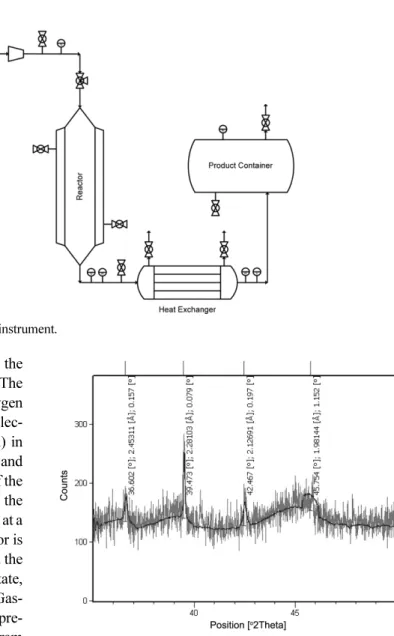
vaporized in the container and C2H4 saturated with the acetic acid vapours, leaving the container at 120 ºC. The saturated gas was then combined with O2 and N2. Oxygen gas is added on a concentration of less than %6 on molec- ular basis (by controlling the nitrogen concentration) in order to avoid an explosive reaction between ethylene and oxygen. In order to further increase the temperature of the reactants, the mixture was heated prior to entering the reactor. The reactants were then supplied to the reactor at a temperature of 160oC. The mixture leaving the reactor is condensed in two stages leaving the first at 85 ºC and the second at 35 ºC at which at this temperature vinyl acetate, acetic acid and water were obtained in liquid phase. Gas- eous compounds consisting of un reacted feed were pre- pared for chromatography analysis. A schematic diagram of the process is shown in Fig. 1.
Metallic promoters with corresponding compound per- centages were injected into the reactor by a micro pump with an injection range of 0-0.1 ml/min and at a pressure of 10 bar. The inlet and outlet of the reactor were con- nected to a gas chromatograph; continuously determining the compound percentage of the entering and exiting com- pounds of the reactor. The experiments were performed for lithium, sodium, potassium, rubidium and caesium ace- tate salts as promoters. The promoters were obtained from Merck Chemicals (Merck KGaA, Darmstadt, Germany).
RESULTS AND DISCUSSIONS X-ray diffraction
The x-ray diffraction data for the catalyst are shown in
Fig. 2. Using the Scherrer equation,20 D = Kλ/∆cosθ, λ = 15 nm, (wavelength of diffraction), K = 0.94 (diffraction constant) and θ (wavelength peak), the average Pd par- ticle size is estimated to be approximately 2.27 Ao.
Effect of Promoters on Ethylene Conversion and Selectivity
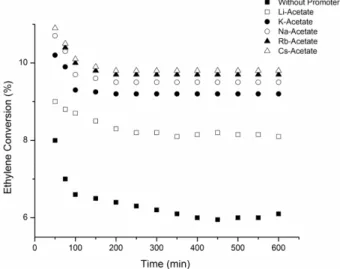
The effect of metallic acetate promoters have been mea- sured for conversion of ethylene and product selectivity of the reaction. Promoters such as cesium acetate, rubidium acetate, potassium acetate, sodium acetate, lithium acetate compared to unpromoted catalyst have been examined and the results are given in Fig. 3 and 4. The promoters are obtained through 5% solution of the salt. As shown, the Fig. 1. A schematic of the vinyl acetate fixed bed reactor instrument.
Fig. 2. X-rays diffraction data for the Pd(1.0 wt%)-Au(0.5 wt%)/
SiO2 catalyst.
conversion rate and product selectivity for those experi- ments using promoters increases with respect to the exper- iment without a promoter. In addition, a stable condition with constant conversion rate and selectivity is reached in a shorter time when using promoters.
With respect to the conversion of ethylene without the presence of promoters, the reaction rate is significantly reduced after 100 minutes and shows steady state operation.
This can be described by the catalyst active sites being free at the beginning of the reaction, while as the reaction proceeds the reactants are adsorbed on the surface and therefore it can be deduced that the adsorption of the reac- tants are not the rate limiting step in the steady condition and rather other steps such as surface reaction can be the cause of limiting the reaction rate. Furthermore, it can be observed from that the selectivity is lower at the beginning,
while after 100 minutes, there is a significant increase after which is remained constant throughout the reaction.
This also can be explained by the fact that prior to the step of surface saturation from reactants; at which the rate of adsorption and desorption of reactants are the limiting step, the rate of desorption of side products such as water is higher than that of the main product (i.e. vinyl acetate).
The conversion rate does not change significantly from potassium acetate to rubidium and cesium acetates how- ever considerable increase of selectivity can be seen from these substances with cesium acetate giving the highest at approximately 89% constant after stability is obtained.
The acetate salts of alkaline metals increase the reaction rate significantly while the effect is increased from the top to the bottom of the Group I in the periodic table.
However, the reason and mechanism of this promotion has not yet been entirely clarified. Interaction between palladium-acetate and potassium acetate has been inves- tigated by Kragten et al.21 stating that upon absence of alkali acetate salt promoters, palladium- acetate complexes appear more as a trimers while after addition of the pro- moter, the complexes appear in the form of dimers and are of main active reaction intermediates. However, the com- mon-ion effect was more evident in this work. For more about this, the common ion obtained from the dissocia- tion of acetate salts in available compounds on the cata- lyst bed; here an anion compound (acetate) performs as the effective common ion in all of the promoters used;
thus improves adhesion of the acetic acid molecules to the catalyst surface, and forms the mediator material Pd(CH3CO), the main mediator in the reaction of vinyl acetate.
The increase in suitable effects related to heavier alkali metals is due to presence of more value of acetate ions in the reaction following reasons:
• Since the first group elements are electropositive, they have a low ionization potential and are oxidized readily. The ionization potential is also very depen- dent on the nuclei charge in which from top to bot- tom, this potential is reduced, and hence an easier oxidation and cat ion is achieved.
• In the alkali group according to energy levels, from top to bottom since the element’s last electron is fur- ther away from the nuclei than its previous element, the electron can be departed easier and therefore the tendency to oxidization is increased from top to bot- tom of the alkali group.
Due to the above reasons, acetate salt is easily ionized and increases because the heavier elements in the alkali group providing a higher acetate ion to the reaction and Fig. 3. Ethylene conversion with time.
Fig. 4. Reaction selectivity with time on stream.
increasing the selectivity and conversion. In addition, as aforementioned in the mechanism section, the vinyl acetate production consists of several reactions initially between the reactants and the catalyst surface to produce the inter- mediates and forming the vinyl acetate. The major inter- mediates in these reactions can be regarded as palladium- acetate and palladium-ethylene. The increase in ethylene partial pressure will eventuate to increase the conversion rat. It can be concluded that with the increase of acetate ion, the concentration of the palladium-acetate complex and hereby the rate of formation of vinyl acetate will increase.
However, the question may arise about the reason for observing no effect on the reaction rate with the increase of acetic acid partial pressure. In response, substantial consideration must be given to the fact that acetic acid is a weak acid with fairly low dissociation constant (Ka= 1.8×10⁻⁵), which upon increasing the concentration on the surface introduces minor change in the acetate ion concentration and does not significantly affect the concentration of the palladium-acetate complex. The increase of the reaction rate with increase of cationic property of a metal attached to acetate (as in promoters) is another reason consistent with the given postulation. Moreover, if metallic acetate promoters were to form a layer on the catalyst surface as proposed by Augustine et al.,9 the effect of such promot- ers on the reaction rate must be reduced with the increase of cationic property from the top elements of the alkali group to the bottom due to higher dissociation and reduc- tion of acetic acid concentration, however this is not the case as presented from above observation in this work. In addition to theories provided in the discussion part on the effect of Au in the palladium catalyst by Chen et al.,24 our observation also complies with this theory while suggest- ing that Au imposes the distribution of palladium parti- cles by decreasing the particle’s diameter.
CONCLUSIONS
In this work, detailed study of influence of promoters on the synthesis of vinyl acetate has been presented. Descrip- tions on changes in selectivity and ethylene conversion with respect to different alkali metallic acetate promoters were also provided. Experiments showed that the reaction rate of producing vinyl acetate in presence of Pd-Au cat- alysts, without implementing promoters can be very slow, thus it is not economically efficient. In contrast, metallic promoters increase the reaction rate and eventually increase the conversion and the selectivity of the reaction by cre- ating an acid layer on the catalyst bed. Such property will
increase by the electron donation of the metal connected to the acetate ion in acetate metallic salts to an extent that is less effective for acetate salts of rare metals as tin ace- tate, zinc acetate and lead acetate and more effective of alkali metals. In addition, the stability in conversion and selectivity is obtained in a shorter time with the use of these promoters and is increased from top to the bottom of the alkali group based elements. On the effect of Au in the palladium catalyst, our observation complies with theo- ries given before while further suggesting that Au imposes the distribution of palladium particles through decreasing the particle’s diameter.
Acknowledgments. The authors acknowledge finan- cial support from University of Sistan and Baluchestan and Arak’s petrochemical complex. Mr. Yaghoobi and Mr.
Bakhshi are appreciatively acknowledged for technical support and collaboration on data gathering and Mr. Jokar for his support and help. Support from Arak’s petrochem- ical complex is gratefully acknowledged.
REFERNCES
1. Allison, E. G.; Bond, G. C. Catal. Rev. 1972, 7, 233.
2. Abel, R.; Collins, P.; Eichler, K.; Nicolau, I.; Peters, D.
Ertl, G.; Knözinger, H.; Weitkamp, J. Eds.; Handbook of Heterogeneous Catalysis; Wiley-VCH: Weinheim, 1997; vol.
5, p 2298.
3. Nakamura, S.; Yasui, T. J. Catal. 1970, 17, 366.
4. Samanos, B.; Boutry, P. J. Catal. 1971, 23, 19.
5. Provine, W. D.; Mills, P. L.; Lerou, J. J. Stud. Surf. Sci.
Catal. 1996, 101, 191.
6. Macleod, N.; Keel, J. M.; Lambert, R. M. Appl. Catal.
A. 2004, 261, 37.
7. Han, Y. F.; Kumar, D.; Goodman, D. W. J. Catal. 2005, 230, 353.
8. Stacchiola, D.; Calaza, F.; Burkholder, L.; Tysoe, W. T.
J. Am. Chem. Soc. 2004, 126, 15384.
9. Han, Y. F.; Kumar, D.; Sivadinarayana, C.; Goodman, D. W. J. Catal. 2004, 224, 60.
10. Han, Y. F.; Wang, J. H.; Kumar, D.; Yan, Z.; Goodman, D.
W. J. Catal. 2005, 232, 467.
11. Kumar, D.; Han, Y. F.; Chen, M. S.; Goodman, D. W. Catal.
Lett. 2006, 106, 1.
12. Bissot, C. T. US Patent, 4,048,096. 1976.
13. Crathorne, E. A.; MacGowan, D.; Morris, S. R.; Rawlin- son, A. P. J. Catal. 1994, 149, 54.
14. Johnson, W. K.; Toki, G. SRI Internatioanl: CEH Market- ing Report, 2001.
15. Rylander, P. N. Catalytic Hydrogenation in Organic Syn- thesis; Academic Press: London, 1979.
16. Macleod, N.; Keel, J. M.; Lambert, R. M. Appl. Catal. A.
2004, 261, 37.
17. Han, Y. F.; Kumar, D.; Goodman, D. W. J. Catal. 2005, 230, 353.
18. Nakamura, S.; Yasui, T. J. Catal. 1971, 23, 315.
19. Sennewald, K.; United States patent , 3 743 607, 1973.
20. Shekhar, R.; Barteau, M. A.; Plank, R. V.; Vohs, J. M. Surf.
Sci. Catal. 1997, 815, 384.
21. Kragten, D. D. Van Santen, R. A.; Crawford, M. K.; Pro- vine, W. D.; Lerou, J. J. Inorg. Chem. 1999, 331, 38.
22. Augustine, S. M.; Blitz, J. P. J. of Catal. 1993, 312, 142.
23. Sennewald, K. US patent, 3 743 607, 1976.
24. Chen, C.; Kumar, D.; Yi, C.W.; Goodman, D. W. Surf. Sci.
2005, 291, 310.