INTRODUCTION
In recent years, there have been considerable efforts to search for naturally ocurring substances that can inhibit, reverse, or retard the multi-stage carcinogenesis. A wide array of sub- stances present in the medicinal herbs or dietary plants have been screened for their ability to prevent carcinogenesis. A large number of medicinal or dietary plants have been shown to exhibit substantial inhibitory effects on experimentally- induced carcinogenesis, and in many cases their chemopre- ventive activities are associated with antioxidative and/or anti- inflammatory properties some of their ingredients retain (reviewed in 1 and references therein).
The roots or rhizome of many kinds of Panax plants (such as Panax ginseng, P. notoginseng, P. japonicus and P. quinque- folius) have long been used in traditional Oriental medicine.
Among those Panax species, Panax ginseng C.A. Meyer is one of the most widely used medicinal plants in Far Eastern coun-
tries including China, Korea and Japan. It has recently been reported that chronic intake of Panax ginseng C.A. Meyer has been associated with decreased incidence of cancers such as lung, gastric, liver and colorectal tumors (2, 3). Certain frac- tions or individual ingredients of ginseng have been shown to exert anticarcinogenic and antimutagenic activities (4-6).
The present review deals with the chemopreventive activity of heat-processed Panax ginseng, particularly its anti-tumor promoting potential. In an attempt to elucidate the molecular mechanisms underlying the possible anti-tumor promoting activity of the heat-processed Panx ginseng C.A. Meyer culti- vated in Korea and its constituents, we have assessed their effects on phorbol ester-induced activation and expression of ornithine decarboxylase (ODC), a biochemical marker for tumor promotion, and on expression of cyclooxygenase-2 (COX-2), an important enzyme that plays a key role in in- flammation and is implicated for pathophysiology of car- cinogenesis.
Young-Joon Surh*, Hye-Kyung Na, Ji-Yoon Lee, Young Sam Keum
College of Pharmacy, Seoul National University, Seoul, Korea
Address for correspondence Young-Joon Surh, Ph.D.
College of Pharmacy, Seoul National University, Shinlim-dong, Kwanak-ku, Seoul 151-742, Korea Tel : +82.2-880-7845, Fax : +82.2-874-9775 E-mail : [email protected]
*This work was supported in part by the grant from the Korean Society of Ginseng Research (2000) and the grant (HMP-00-B-20800-0085) from the Ministry of Health and Welfare, Korea.
S38 J Korean Med Sci 2001; 16(Suppl): S38-41
ISSN 1011-8934
Copyright � The Korean Academy of Medical Sciences
Molecular Mechanisms Underlying Anti-Tumor Promoting Activities of Heat-Processed Panax ginseng C.A. Meyer
Recently, there have been considerable efforts to search for naturally occurring substances that can inhibit, reverse, or retard the multi-stage carcinogenesis. A wide array of phenolic substances derived from edible and medicinal plants have been reported to possess anticarcinogenic and antimutagenic activities and in many cases, the chemopreventive activities of phytochemicals are associated with their anti-inflammatory and/or antioxidative properties. Panax ginseng C.A.
Meyer cultivated in Korea has been widely used in traditional herbal medicine for the treatment of various diseases. Certain fractions or purified ingredients of ginseng have been shown to exert anticarcinogenic and antimutagenic activi- ties. Our previous studies have revealed that the methanol extract of heat-pro- cessed Panax ginseng C.A. Meyer attenuates the lipid peroxidation in rat brain homogenates and is also capable of scavenging superoxide generated by xan- thine-xanthine oxidase or by 12-O-tetradecanoylphorbol-13-acetate (TPA) in dif- ferentiated human promyelocytic leukemia (HL-60) cells. Topical application of the same extract onto shaven backs of female ICR mice also suppressed TPA- induced skin tumor promotion. Likewise, topical application of ginsenoside Rg3, one of the constituents of heat-treated ginseng, significantly inhibited TPA-induced mouse epidermal ornithine decarboxylase activity and skin tumor promotion.
Expression of cyclooxygenase-2 (COX-2) in TPA-stimulated mouse skin was markedly suppressed by Rg3 pretreatment. In addition, Rg3 inhibited TPA-stim- ulated activation of NF- B and extracellular-regulated protein kinase (ERK), one of the mitogen-activated protein (MAP) kinase in mouse skin and also in cultured human breast epithelial cells (MCF-10A).
Key Words : Ginseng; Ginsenosides; Rg3; Chemoprevention; Cyclooxygenase-2; Anti-Carcinogenic Agents
ANTIOXIDANT PROPERTIES OF HEAT-PROCESSED PANAX GINSENG
The antioxidative and free radical scavenging effects of ginseng and some of its selected ingredients have been exten- sively investigated and well documented (7). The methanol extract of the heat-processed Panax ginseng significantly inhibited the lipid peroxidation induced by ferric ion or fer- ric ion plus ascorbic acid in rat brain homogenates (8). The same extract also suppressed the superoxide generation con- centration-dependently by xanthine-xanthine oxidase in vitro and also in differentiated human promyelocytic leukemia (HL-60) cells stimulated with 12-O-tetradecanoylphorbol- 13-acetate (TPA) (8).
ANTI-TUMOR PROMOTING ACTIVITIES OF THE HEAT-TREATED GINSENG AND ITS MAJOR
INGREDIENT Rg3
Reactive oxygen intermediates have been considered to play a role in multi-stage carcinogenesis. There has been accumulating evidence for the involvement of reactive oxy- gen species in promoting as well as in initiating experimen- tal carcinogenesis. Since the methanol extract of heat-pro- cessed ginseng has an antioxidant activity, it may possess the anti-tumor promotional potential. In support of this possibility, topical application of the ginseng extract prior to each topical dose of the tumor promoter TPA markedly lowered the papilloma formation in mouse skin (8). ODC is a rate-limiting enzyme in the biosynthesis of polyamines that play pivotal roles in cell proliferation. Elevation of ODC activity is closely associated with tumor promotion (9). Top- ical application of the heat-processed ginseng extract 30 min before TPA caused substantial reduction in epidermal ODC activity and also suppressed the expression of ODC
mRNA (8). TPA-induced production of tumor necrosis fac- tor-alpha (TNF- ) was similarly inhibited by heat-processed ginseng. One of the major ginsenosides present in heat-pro- cessed ginseng is Rg3. Topical application of Rg3 onto dor- sal skins of mice prior to TPA also resulted in inhibition of ODC activity (unpublished).
Considerable effort is being directed towards developing agents that can inhibit the activity of cyclooxygenase (COX).
COX is a key enzyme in prostaglandin synthesis. There are two forms of COX enzymes, COX-1 and COX-2. While COX-1, which is a constitutive form present in most tissues, is involved in the physiological production of prostaglandins for maintaining normal homeostasis, COX-2 is barely detect- ed in normal tissues, but is readily expressed in response to inflammatory cytokines, bacterial lipopolysaccharide, mito- gens and reactive oxygen intermediates (10). Substantial evidence has been accumulated to suggest that improper elevation of COX-2 is implicated in tumorigenesis. Thus, it was recognized that COX-2 was upregulated in transformed cells as well as in various forms of cancer, whereas levels of COX-1 remained unchanged (11). Overexpression of COX- 2 inhibited apoptosis and increased the invasiveness of cells.
Experimentally-induced null mutation of COX-2 reduced the number and size of colon tumors in a murine model of familial adenomatous polyposis (12).
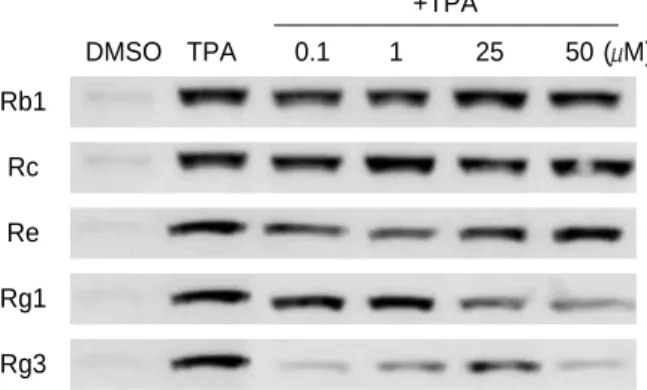
To test whether Rg3 could inhibit TPA-induced COX-2 expression, we have applied Rg3 30 min prior to TPA treat- ment and sacrificed mice after 5 hr later. Rg3 treatment caused marked suppression of TPA-induced COX-2 expression in mouse skin. TPA-induced expression of inducible nitric oxide synthase (iNOS), another important enzyme responsible for mediating inflammation, was also inhibited by Rg3 pre- treatment (unpublished). Besides Rg3, other structurally related ginsenosides including Rb1, Rc, Re and Rg1 (Fig. 1) were also tested for their effects on TPA-induced COX-2 expression in mouse skin, but their inhibitory activities
Mechanisms of Chemopreventive Activities of Panax ginseng S39
Rb1; R1=glu-2-1-glu R2=H R3=glu-6-1-glu Rc; R1=glu-2-1-glu R2=H R3=glu-6-1-ara
Re; R1=H R2=glu-2-1-rham R3=glu
Rg1; R1=H R2=glu R3=glu
Rg3; R1=glu-2-1-glu R2=H R3=H
HO
O R3
R2
R1O
Fig. 2.Effects of selected ginsenosides on TPA-induced COX-2 expression in human breast epitelial cells (MCF-10A). MCF-10A cells were treated with 10 nM of TPA in the absence or pres- ence of indicated concentrations of a given ginsenoside. The levels of COX-2 protein were determined by Western blot analy- sis 4 hr later.
Rb1 Rc Re Rg1 Rg3
DMSO TPA 0.1 1 25 50 ( M)
+TPA
Fig. 1.Structures of various ginsenosides present in heat-pro- cessed ginseng.
were found to be relatively weaker than that of Rg3 (data not shown). Likewise, Rg3 strongly inhibited TPA-induced COX-2 expression in human breast epithelial cells (MCF- 10A) in culture (Fig. 2).
EFFECTS OF GINSENOSIDES ON NF- B ACTIVATION
NF- B is a ubiquitous eukaryotic transcription factor that exists as a dimer composed of Rel family of proteins (13).
Several lines of evidence support that NF- B is implicated in cellular proliferation, inflammation, and malignant trans- formation. NF- B activation is an essential early event, which occurs prior to malignant transformation, and contributes to cell transformation by inhibiting cell death signal acti- vated by oncogenic Ras (14). Constitutive activation of NF- B has been associated with proliferation of certain cancer cells and their resistance to apoptotic death (15, 16). Thus, the role of NF- B in oncogenesis is evident. In an attempt to elucidate the moleular mechanisms underlying suppres- sion of TPA-induced expression of COX-2 by Rg3 in MCF- 10A cells, its effect on NF- B activation was compared with those of the other ginsenosides. As illustrated in Fig. 3, TPA treatment caused increased DNA binding of NF- B, and all of the ginsenosides tested exerted inhibitory effects to the different extent. In another experiment, topically applied Rg3 suppressed TPA-induced activation of NF- B in mouse
skin (unpublished).
MODULATION OF MITOGEN-ACTIVATED PROTEIN (MAP) KINASES BY GINSENOSIDES
The molecular signaling mechanisms that lead to the in- duction of COX-2 as well as activation of NF- B in response to various external stimuli have not been fully clarified (17).
One of the most extensively investigated intracellular sig- naling cascades involved in pro-inflammatory responses is the mitogen-activated protein (MAP) kinase pathway. Three distinct groups of well characterized major MAP kinases subfamily members include extracellular-regulated protein kinase (ERK), c-Jun NH2-protein kinase (JNK)/stress-acti- vated protein kinase (SAPK) and p38 MAPK that are ser- ine/threonine protein kinases. The activated form of each of the above MAP kinases then phosphorylates and activates other kinases or transcription factors, thereby altering the expression of the target genes.
The induction of COX-2 and resulting production of PGE2 were abolished by the specific inhibitors of the corre- sponding MAP kinases, suggesting that the MAP kinase cascade is responsible, at least in part, for up-regulation of COX-2. Treatment of MCF-10A cells with 10 nM TPA led to rapid activation of ERK, whereas p38 MAP kinase was
S40 Y.-J. Surh, H.-K. Na, J.-Y. Lee, et al.
NF- B
Fig. 3.Effects of ginsenosides on NF- B activation in MCF- 10A cells stimulated with TPA. Nuclear extracts were obtained 2 hr after 10 nM TPA treatment in the absence or presence of indicated concentrations of each ginsenoside, and NF- B DNA binding activity was measured by gel shift assay.
untreated DMSO TPA Rb1 (10 M) Rb1 (50 M) Rc (1 M) Rc (50 M) Re (1 M) Re (50 M) Rg1 (1 M) Rg1 (50 M) Rg3 (1 M) Rg3 (50 M) competitor probe
Fig. 4.Effects of TPA on activation of ERK and p38 MAP kinas- es in MCF-10A cells. MCF-10A cells exposed to 10 nM TPA were harvested at the indicated time intervals and subjected to immunoblot analysis using an phospho-specific antibody against each kinase.
P-ERK P-p38
DMSO
Untreated 5 15 30 45 60 (min)
TPA
Fig. 5.Effects of various ginsenosides on TPA-induced ERK activation in MCF-10A cells. The levels of phosphorylated ERK were meaured as described in the legend to Fig. 4.
Rb1 Rc Re Rg1 Rg3
TPA
DMSO 0.1 1 25 50 ( M)
+TPA +TPA
not much induced (Fig. 4). We then evaluated the possible inhibitory effects of various ginsenosides on ERK activation in TPA-stimulated MCF-10A cells. As shown in Fig. 5, Rg3 exhibited the most potent inhibitory activity.
CONCLUSIONS
The heat-processed Panax ginseng has potent antioxidative and anti-tumor promoting activities. Rg3, one of the major ginsenosides contained in heat-processed ginseng, also inhibits tumor promotion and ODC activity induced by TPA in mouse skin. Inflammatory tissue damage has been closely associated with tumor promotion. Rg3 inhibits the TPA-induced expression of the proinflammatory enzyme, COX-2 in both mouse skin and the human breast epithelial cell line (MCF-10A). Rg3 also inhibits TPA-induced acti- vation of NF- B and ERK, an upstream kinase known to play a role in regulating NF- B activation. These findings, taken together, suggest that the previously observed anti- tumor promoting effects of heat-processed ginseng and its ingredient Rg3 are mediated through suppression of intra- cellular signaling cascades responsible for activation of NF- B and and subsequent induction of COX-2.
REFERENCES
1. Surh Y-J. Molecular mechanisms of chemopreventive effects of select- ed dietary and medicinal phenolic substances. Mutat Res 1999; 428:
305-27.
2. Yun T-K. Experimental and epidemiologic evidence of cancer pre- ventive effects of Panax ginseng C.A. Meyer. Nutr Rev 1996; 54:
S71-81.
3. Yun T-K. Panax ginseng- a non-organ-specific cancer preventive?
Lancet Oncol 2001; 2: 49-54.
4. Kubo M, Tong CN, Matsuda H. Influence of 70% methanol extract from red ginseng on the lysosome of tumor cells and on the cytoci- dal effect of mitomycin C. Planta Med 1992; 58: 424-8.
5. Matsunaga H, Katano M, Saita T, Yamamoto H, Mori M. Potentia- tion of cytotoxicity of mitomycin C by a polyacetylenic alcohol, panaxytriol. Cancer Chemother Pharmacol 1994; 33: 291-7.
6. Wakabayashi C, Hasegawa H, Murata J, Saiki I. In vivo antimetastat-
ic action of ginseng protopanaxadiol saponins is based on their intestinal bacterial metabolites after oral administration. Oncol Res 1997; 9: 411-7.
7. Zhang D, Yasuda T, Yu Y, Zheng P, Kawabata T, Ma Y, Okada S.
Ginseng extract scavenges hydroxyl radical and protects unsaturat- ed fatty acids from decomposition caused by iron-mediated lipid peroxidation. Free Radic Biol Med 1996; 20: 145-50.
8. Keum Y-S, Park K-K, Lee J-M, Chun K-S, Park JH, Lee SK, Kwon H, Surh Y-J. Antioxidant and anti-tumor promoting activities of the methanol extract of heat-processed ginseng. Cancer Lett 2000; 150:
41-8.
9. O’Brien TG. The induction of ornithine decarboxylase as an early, possibly obligatory event in mouse skin carcinogenesis. Cancer Res 1976; 36: 2644-53.
10. Crofford LJ. COX-1 and COX-2 tissue expression. Lancet 1997; 24 (suppl. 49): 15-9.
11. Subbaramaiah K, Telang N, Ramonetti JT, Araki R, DeVito B, Weksler BB, Dannenberg AJ. Transcription of cyclooxygenase-2 is enhanced in transformed mammary epithelial cells. Cancer Res 1996; 56: 4424-9.
12. Oshima M, Dinchuk JE, Kargman SL, Oshima H, Hancock B, Kwong E, Trzaskos JM, Evans F, Taketo MM. Suppression of intestinal polyposis in Apc delta716 knockout mice by inhibition of cyclooxy- genase-2 (COX-2). Cell 1996; 87: 803-9.
13. Thanos D, Maniatis T. NF-kappaB: a lesson in family values. Cell 1995; 80: 529-32.
14. Mayo MW, Wang CY, Cogswell PC, Rogers-Graham KS, Lowe SW, Der CJ, Baldwin AS Jr. Requirement of NF-kappaB activation to suppress p53-independent apoptosis induced by oncogenic Ras. Sci- ence 1997; 278: 1812-5.
15. Bargou RC, Emmerich F, Krappmann D, Bommert K, Mapara MY, Arnold W, Royer HD, Grinstein E, Greiner A, Scheidereit C, Dorken B. Constitutive nuclear factor- B-RelA activation is required for proliferation and survival of Hodgkin’s disease tumor cells. J Clin Invest 1997; 100: 2961-9.
16. Sovak MA, Bellas RE, Kim DW, Zanieski GJ, Rogers AE, Traish AM, Sonnenshein GE. Aberrant NF- B/Rel expression and the pathogenesis of breast cancer. J Clin Invest 1997; 100: 2952-60.
17. Surh Y-J, Chun K-S, Cha H-H, Han SS, Keum YS, Park K-K, Lee SS. Molecular mechanisms underlying chemopreventive activities of anti-inflammatory phytochemicals: down-regulation of COX-2 and iNOS through suppression of NF-kappa B activation. Mutat Res 2001; 480-1; 243-68.
Mechanisms of Chemopreventive Activities of Panax ginseng S41