ABSTRACT
Breast tissue markers are common in current clinical practice and are susceptible to migration. Herein, we present the case of a 47-year-old woman with invasive breast carcinoma diagnosed through ultrasound-guided core biopsy, who underwent placement of a breast marker (HydroMARK
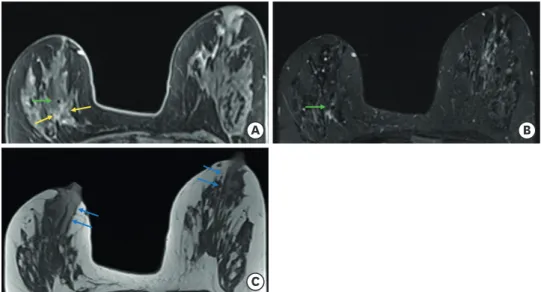
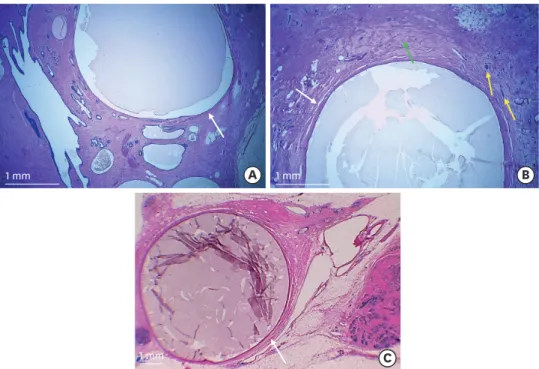
®) under ultrasound guidance 30 days after core biopsy and with subsequent marker migration to the nipple. The correct position of the marker was documented by mammography after its placement and by magnetic resonance imaging (MRI) after neoadjuvant chemotherapy. Migration of the marker to the nipple was evident only by mammography on the day of surgery. We hypothesized that an intraductal path was the route of marker migration in this patient. Marked ductal ectasia evident on MRI and histopathologic examination supported this hypothesis. To the best of our knowledge, this is the first published case of intraductal migration of a breast tissue marker.
Keywords: Breast; Breast neoplasms
INTRODUCTION
Image-guided core biopsy followed by placement of a marker has become the standard of care of suspicious breast lesions [1].
Migration of a breast lesion marker is a known complication that is most commonly associated with vacuum-assisted biopsies [2]. Significant migration may hamper the achievement of clear margins after surgical removal. This is particularly relevant in breast cancer because of the high rates of clinical response after neoadjuvant systemic therapy achieved nowadays, often making markers the only landmark of the remaining lesion.
The mechanisms of migration described in the literature include the accordion effect, displacement by a hematoma, and migration through the biopsy track or through adipose breast tissue. The accordion effect is a common complication of vacuum-assisted biopsies and occurs along the axis of needle insertion immediately after breast decompression.
Marker displacement due to a hematoma resulting from biopsy may occur, owing to its mass
Case Report
Received: May 23, 2021 Revised: Jul 18, 2021 Accepted: Aug 10, 2021 Correspondence to Gisela Andrade
Department of Radiology, Hospital Prof.
Doutor Fernando Fonseca EPE, IC 19, 2720- 276, Amadora, Portugal.
E-mail: [email protected]
© 2021 Korean Breast Cancer Society This is an Open Access article distributed under the terms of the Creative Commons Attribution Non-Commercial License (https://
creativecommons.org/licenses/by-nc/4.0/) which permits unrestricted non-commercial use, distribution, and reproduction in any medium, provided the original work is properly cited.
ORCID iDs Gisela Andrade
https://orcid.org/0000-0001-8003-4232 André Pereira
https://orcid.org/0000-0002-2578-2075 Lucília Gonçalves
https://orcid.org/0000-0002-3902-0717 Cláudia Videira
https://orcid.org/0000-0002-1532-154X Conflicts of Interest
The authors declare that they have no competing interest.
Author Contributions
Conceptualization: Andrade G; Writing - original draft: Andrade G, Pereira A; Writing - review & editing: Andrade G, Gonçalves L, Videira C.
Gisela Andrade 1 , André Pereira 2 , Lucília Gonçalves 2 , Cláudia Videira 1
1
Department of Radiology, Hospital Prof. Doutor Fernando Fonseca EPE, Amadora, Portugal
2